USING RFID IN
MANUFACTURING
OPERATIONS
BY: ANGELA CARVER
What is RFID?
• RFID is a type of automatic identification technology thattransmits
data in the form of a unique serial number wirelessly.
• The system consists of a RFID tag attached to the inventory item, an
antenna which collects the inventory activity data and the portal
which houses the antenna unit.
• As the tag passes through the designated portal, activity data is
transmitted in real time to inventory management software systems
where data can be viewed and utilized
Using RFID in Manufacturing
• Due to the increasing cost of operation, manufacturers and contract
manufacturers are searching for new ways to reduce cost and
optimize operations.
• New technology implementation has been a solution and RFID is
becoming one of the top technologies. Frost & Sullivan reported the
RFID marketplace will increase from $738 mil in 2014 to $5.4 bil in
2020.
• RFID is being implemented in manufacturing worldwide to act as an
intelligent monitoring system that can provide track and trace
functionality throughout all levels of the supply chain.
RFID Tags Designed for Manufacturing
Operations
• Radio frequency identification systems have been in use for many
years, but were not practical for manufacturing due to their inability
to withstand the harsh conditions within manufacturing
environments.
• New and improved RFID tags have been designed to handle
conditions such as:
• Extreme heat and cold
• High pressures
• Hazardous locations
• Extreme moisture levels
• These changes have made RFID a more viableinventory
management solution for manufacturing.
Inventory Traceability Using RFID
• Constant, up-to-date access to inventory data is criticalto
manufacturers as it is a basis for all operations and decision making.
• Tagging components, work in progress (WIP) and finished products
with RFID tags can provide manufacturing operators with continuous
status updates.
• As product is funneled through the facility it passes designated “read
points” where new data is collected and added to the recorded audit
trail.
• This data helps to both forecast future replenishment needs as well
as monitor manufacturing progress.
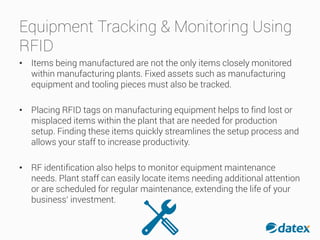
Equipment Tracking & Monitoring Using
RFID
• Items being manufactured are not the only items closely monitored
within manufacturing plants. Fixed assets such as manufacturing
equipment and tooling pieces must also be tracked.
• Placing RFID tags on manufacturing equipment helps to find lost or
misplaced items within the plant that are needed for production
setup. Finding these items quickly streamlines the setup process and
allows your staff to increase productivity.
• RF identification also helps to monitor equipment maintenance
needs. Plant staff can easily locate items needing additional attention
or are scheduled for regular maintenance, extending the life of your
business’ investment.
RFID Aids in Production Scheduling
• Manufacturing operations run on strict schedules based on pre-sold
inventory and fluctuations in demand.
• When setting production schedules RFID can assist in identifying
tools and equipment not currently in use. This helps to increaseasset
utilization and increase production capabilities.
• Using RFID to track asset usage also helps to reduce labor hours
used identifying idle equipment. Staff no longer has to walk the floor
to identify available production areas and can use this time to focus
on other business critical activities.
RFID Helps Monitor Waste/Shrinkage
• With the tagging of component, WIP and finished inventory with RFID
tags comes greater inventory traceability capabilities.
• Waste inventory from production lines can be tracked to monitor
acceptable levels while removing waste from usable inventory,
keeping available component levels accurate.
• Shrinkage, inventory that is lost or stolen, can also be more closely
monitored within the facility using RFID as it can pinpoint the
approximate location of inventory items at any given time by tracking
the last passive scan through stationary RFID portals.
• Having more accurate data can help to reduce inventory lost
internally and identify problem staff.
RFID Helps Reduce Inventory Carrying
Costs
• The focus of many manufacturing businesses is cost reductionwith
product quality consistency.
• RFID helps to reduce costs by facilitating the implementation of just-
in-time (JIT) replenishment strategies.
• With more accurate inventory data, safety stock inventory levels can
be reduced, replenishing inventory on an as-needed basis. This helps
to reduce inventory carrying costs, savings that can be passed on to
customers.
RFID Enables Shipment Routing
• As finished products come off of the assembly line they arethen
prepared for final shipment.
• With RFID implementation inventory tags carry data related to
predetermined shipping routes. Characteristics such as carrier
information, product origin, destination and container contents are all
associated to the inventory item, simplifying shipment staging.
• Having this data easily accessible expedites the shippingprocess
and requires less labor output to process outbound shipments.
RFID Aids in Labor Tracking & Security
• Inventory and tools/equipment are not the only assets many
manufacturers are tracking using RFID systems.
• Many facilities now require staff to carry ID badges equipped with
built-in RFID tags.
• These badges allow staff to easily access permitted areas
throughout the facility and tracks their location in real time.
• This helps security to track employees if needed and assistslabor
tracking efforts.
RFID-Machinery Integration
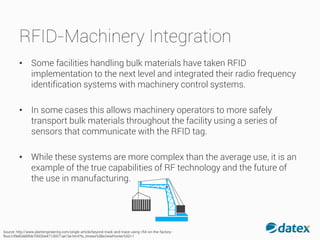
• Some facilities handling bulk materials have taken RFID
implementation to the next level and integrated their radio frequency
identification systems with machinery control systems.
• In some cases this allows machinery operators to more safely
transport bulk materials throughout the facility using a series of
sensors that communicate with the RFID tag.
• While these systems are more complex than the average use, it is an
example of the true capabilities of RF technology and the future of
the use in manufacturing.
Source: http://www.plantengineering.com/single-article/beyond-track-and-trace-using-rfid-on-the-factory-
floor/cf9e83dd0fde70fd2be47135571ae16e.html?tx_ttnews%5BsViewPointer%5D=1
Conclusion
• Manufacturing operations are extremely complex and at times all of
the moving pieces are difficult to manage.
• RFID provides significant benefits to manufacturing operations
including:
• More efficient and cost effective inventory replenishment
• Reduces labor needs and associated costs
• Provides more accurate, real time inventory data
• Tool and equipment maintenance tracking
• Streamlines overall facility operation
Contact Us
800.933.2839
Online demonstration
Email Us
Web Chat
Datex Corporation
@Datexcorp

Using RFID in Manufacturing Operations

  • 1.
  • 2.
    What is RFID? •RFID is a type of automatic identification technology thattransmits data in the form of a unique serial number wirelessly. • The system consists of a RFID tag attached to the inventory item, an antenna which collects the inventory activity data and the portal which houses the antenna unit. • As the tag passes through the designated portal, activity data is transmitted in real time to inventory management software systems where data can be viewed and utilized
  • 3.
    Using RFID inManufacturing • Due to the increasing cost of operation, manufacturers and contract manufacturers are searching for new ways to reduce cost and optimize operations. • New technology implementation has been a solution and RFID is becoming one of the top technologies. Frost & Sullivan reported the RFID marketplace will increase from $738 mil in 2014 to $5.4 bil in 2020. • RFID is being implemented in manufacturing worldwide to act as an intelligent monitoring system that can provide track and trace functionality throughout all levels of the supply chain.
  • 4.
    RFID Tags Designedfor Manufacturing Operations • Radio frequency identification systems have been in use for many years, but were not practical for manufacturing due to their inability to withstand the harsh conditions within manufacturing environments. • New and improved RFID tags have been designed to handle conditions such as: • Extreme heat and cold • High pressures • Hazardous locations • Extreme moisture levels • These changes have made RFID a more viableinventory management solution for manufacturing.
  • 5.
    Inventory Traceability UsingRFID • Constant, up-to-date access to inventory data is criticalto manufacturers as it is a basis for all operations and decision making. • Tagging components, work in progress (WIP) and finished products with RFID tags can provide manufacturing operators with continuous status updates. • As product is funneled through the facility it passes designated “read points” where new data is collected and added to the recorded audit trail. • This data helps to both forecast future replenishment needs as well as monitor manufacturing progress.
  • 6.
    Equipment Tracking &Monitoring Using RFID • Items being manufactured are not the only items closely monitored within manufacturing plants. Fixed assets such as manufacturing equipment and tooling pieces must also be tracked. • Placing RFID tags on manufacturing equipment helps to find lost or misplaced items within the plant that are needed for production setup. Finding these items quickly streamlines the setup process and allows your staff to increase productivity. • RF identification also helps to monitor equipment maintenance needs. Plant staff can easily locate items needing additional attention or are scheduled for regular maintenance, extending the life of your business’ investment.
  • 7.
    RFID Aids inProduction Scheduling • Manufacturing operations run on strict schedules based on pre-sold inventory and fluctuations in demand. • When setting production schedules RFID can assist in identifying tools and equipment not currently in use. This helps to increaseasset utilization and increase production capabilities. • Using RFID to track asset usage also helps to reduce labor hours used identifying idle equipment. Staff no longer has to walk the floor to identify available production areas and can use this time to focus on other business critical activities.
  • 8.
    RFID Helps MonitorWaste/Shrinkage • With the tagging of component, WIP and finished inventory with RFID tags comes greater inventory traceability capabilities. • Waste inventory from production lines can be tracked to monitor acceptable levels while removing waste from usable inventory, keeping available component levels accurate. • Shrinkage, inventory that is lost or stolen, can also be more closely monitored within the facility using RFID as it can pinpoint the approximate location of inventory items at any given time by tracking the last passive scan through stationary RFID portals. • Having more accurate data can help to reduce inventory lost internally and identify problem staff.
  • 9.
    RFID Helps ReduceInventory Carrying Costs • The focus of many manufacturing businesses is cost reductionwith product quality consistency. • RFID helps to reduce costs by facilitating the implementation of just- in-time (JIT) replenishment strategies. • With more accurate inventory data, safety stock inventory levels can be reduced, replenishing inventory on an as-needed basis. This helps to reduce inventory carrying costs, savings that can be passed on to customers.
  • 10.
    RFID Enables ShipmentRouting • As finished products come off of the assembly line they arethen prepared for final shipment. • With RFID implementation inventory tags carry data related to predetermined shipping routes. Characteristics such as carrier information, product origin, destination and container contents are all associated to the inventory item, simplifying shipment staging. • Having this data easily accessible expedites the shippingprocess and requires less labor output to process outbound shipments.
  • 11.
    RFID Aids inLabor Tracking & Security • Inventory and tools/equipment are not the only assets many manufacturers are tracking using RFID systems. • Many facilities now require staff to carry ID badges equipped with built-in RFID tags. • These badges allow staff to easily access permitted areas throughout the facility and tracks their location in real time. • This helps security to track employees if needed and assistslabor tracking efforts.
  • 12.
    RFID-Machinery Integration • Somefacilities handling bulk materials have taken RFID implementation to the next level and integrated their radio frequency identification systems with machinery control systems. • In some cases this allows machinery operators to more safely transport bulk materials throughout the facility using a series of sensors that communicate with the RFID tag. • While these systems are more complex than the average use, it is an example of the true capabilities of RF technology and the future of the use in manufacturing. Source: http://www.plantengineering.com/single-article/beyond-track-and-trace-using-rfid-on-the-factory- floor/cf9e83dd0fde70fd2be47135571ae16e.html?tx_ttnews%5BsViewPointer%5D=1
  • 13.
    Conclusion • Manufacturing operationsare extremely complex and at times all of the moving pieces are difficult to manage. • RFID provides significant benefits to manufacturing operations including: • More efficient and cost effective inventory replenishment • Reduces labor needs and associated costs • Provides more accurate, real time inventory data • Tool and equipment maintenance tracking • Streamlines overall facility operation
  • 14.
    Contact Us 800.933.2839 Online demonstration EmailUs Web Chat Datex Corporation @Datexcorp