Blockchain & IoT 

Supply Chain
Traceability
Shameer Thaha // CEO, Accubits (MENA)
AI & Blockchain focused development company
Shameer Thaha
CEO, Accubits (MENA) & Global CSO
6 countries so far, with 150+ team members
Next 30 minutes is about …
" Supply Chain Challenges
" How blockchain solves these
challenges
" Role of IoT & It’s Challenges
" Why Blockchain & IoT?
" How blockchain and IoT can
assist
" Impact on stakeholders in the
supply chain
" Other use cases
" Hurdles in the chain
" Where do you start?
Fraud in Supply Chain
Pharma
" 25% of vaccines reach their
destination degraded because of
incorrect shipping
" 30% of pharmaceuticals are scrapped
due to logistics issues alone
" 20% of temp-sensitive products are
damaged during transport due to
broken cold chain
Food
Agromafia
" PwC study - $40b food fraud globally
" 70% of extra virgin oil in US (that you
probably ate) was counterfeit
" In 2014 Interpol seized 11k tons of fake food
Food Consumption
" 3000 American deaths/ year
" Frequent Salmonella & E.Coli outbreaks
Operations & Logistics
“10,000 containers
lost in sea every year”
- World Economic
Forum
Delays & Inefficiencies Manual Processes
Customers demand quality, safety, transparency, ethical sourcing, & speed
Supply chain challenge - Recall
”Where did <this> come from?”
Farm/
Source
Factory Transporter
Supplier
Assembly
Line
Region
Country Batch Retailers
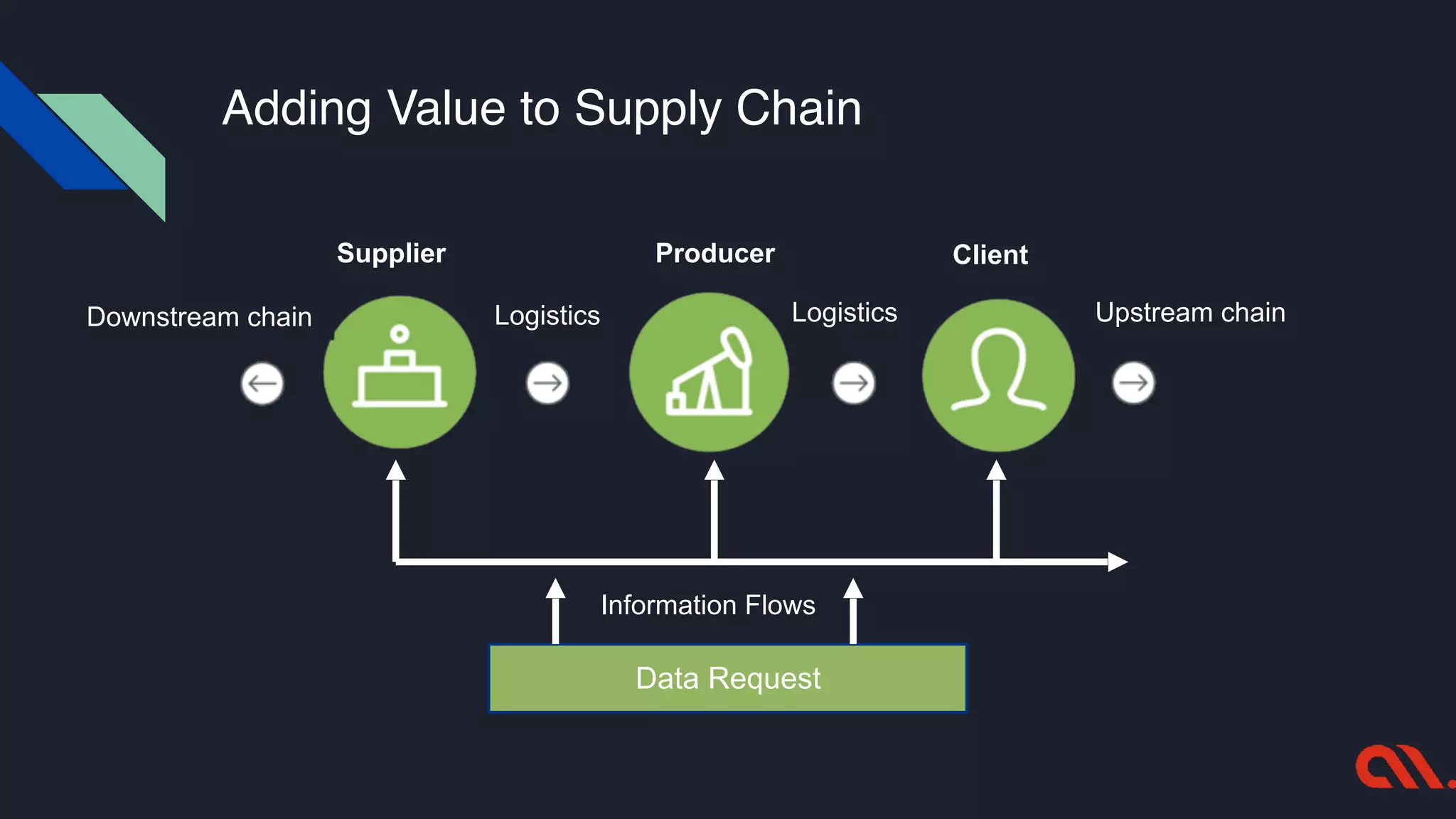
Adding Value to Supply Chain
Downstream chain Logistics Logistics Upstream chain
Data Request
Information Flows
Supplier Producer Client
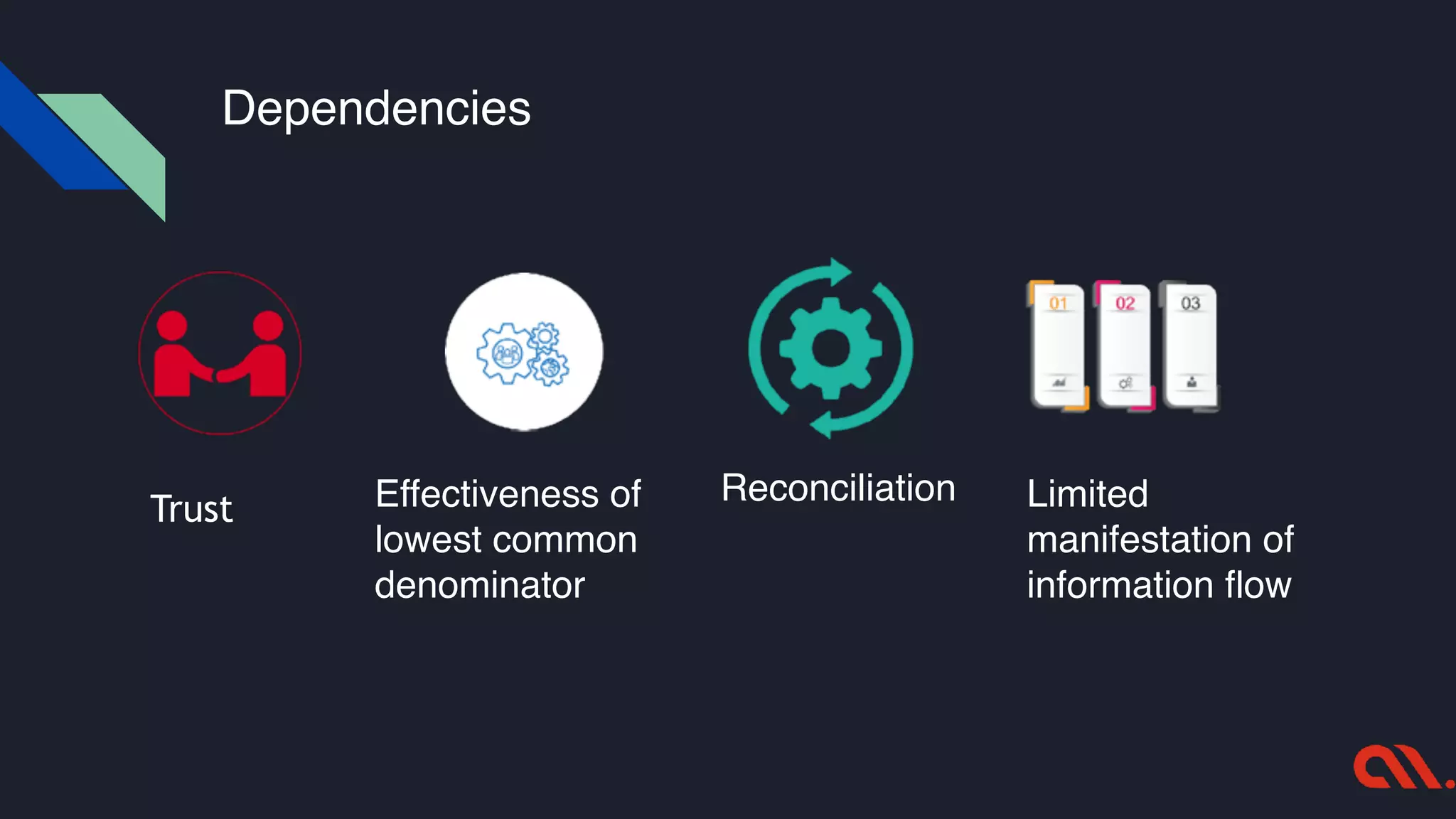
Dependencies
Trust Effectiveness of
lowest common
denominator
Reconciliation Limited
manifestation of
information flow
So what do we need for an ideal supply
chain?
End-to-end
visibility
• Increase
efficiency along
the supply chain
and ensure
traceability
Flexibility
• Ability to adapt
and respond to
issues rapidly
with no critical
impact on
operational costs
is necessary to
stay competitive
in the market
Inferred trust
• The stakeholders
should not have
to trust each
other but should
trust the security
integrated into
the system to
collect and
provide true and
accurate data
Control
• Policies,
monitoring
capabilities and
control
mechanisms are
important
Auditability
Blockchain
provides a full
audit trail of data,
creating an
everlasting means
of record keeping
along a supply
chain
Immutability
All blockchain
transactions are
timestamped and
tamper-proof,
providing a single
source of data
integrity
Smart Contracts
Continuous real-
time tracking of
data is facilitated
through the use of
smart-contracts
across the supply
chain
Disintermediation
Blockchain
enables peer-to-
peer interactions
which can be
trusted based on
the digital
signatures
Traceability Compliance Flexibility Stakeholder
Management
Capability to
monitor events and
meta data
associated with a
product
Standards and controls
to provide evidence that
regulatory conditions
are met
The ability to adapt
rapidly to events or
issues, run various
scenarios without
significantly increasing
operational costs
Effective governance
in place to enable
communication, risk
reduction and trust
among the involved
parties
Supply chain
Pain points
Block chain
capabilities
Blockchain to the rescue
Fast transaction
settlement
Low
Cost
Transparent
and Audit-
able
Reliable
IoT Architecture Layer
5 challenges to industrial IoT - Gartner
" Connecting 26 billion devices by 2020.
" Creating controls for vast number of devices
" Enable P2P communication between globally distributed
computers.
" Provide compliance and governance for all autonomous
systems
" Address the security complexities of the new landscape.
How blockchain and IoT Assist
The major challenges are about information sharing and trust. 

✓ Track & Trace product journey & lifecycle
✓ Trade Finance
✓ Automate Bill of Lading & Customs
✓ Simplify Global Trade Compliance
✓ Track Point-of-origin & ownership changes
✓ Detect & notify tampering attempts
Better Visibility
Faster Root Cause Analysis
Easier Info Sharing
Impact on
Stakeholders
Producer
Now
• Has a limited ability to
control and verify the flows
coming from its suppliers
(e.g. compliance to
standards, respect of
requirements)
Future
• Benefits from an
integrated and distributed
ledger that enables them
to control the inputs and
keep track of its
production
Freight Forwarder
Now
• Reliable but one-sided tracking
system
• Limited certification ability and
complex tracking (e.g. heat or
pressure variations)
• Difficult to certify a code of
conduct
Future
• Shared information system
• Client can benefit from a
distributed and certified system
• Client can make sure his goods
are transported in the right
conditions and timing
Broker
Now
• Difficulty to certify the
origin and path of the goods
bought and sold
Future
• Can easily check the origin
of the goods and their
transformation path on the
blockchain
• With sealed IoT devices put
on the goods, the broker can
check and prove its
authenticity and provenance
Consumer
Now
• Difficulty to verify the
compliance, origin, and
composition of the goods to be
bought
Future
• Has a full view on the goods
bought (i.e., provenance,
transformation process,
transportation) directly on
the blockchain
Other use cases
Healthcare
industry
verify authenticity,
avoiding potential
fraud and
manipulation
Food industry
packaging sensitive
products with tags,
smart
thermometers
Art & Luxury wares
industry
RFID seals and
blockchain .
Embedding into the
work to guarantee
authenticity sort of
like a DNA
identification
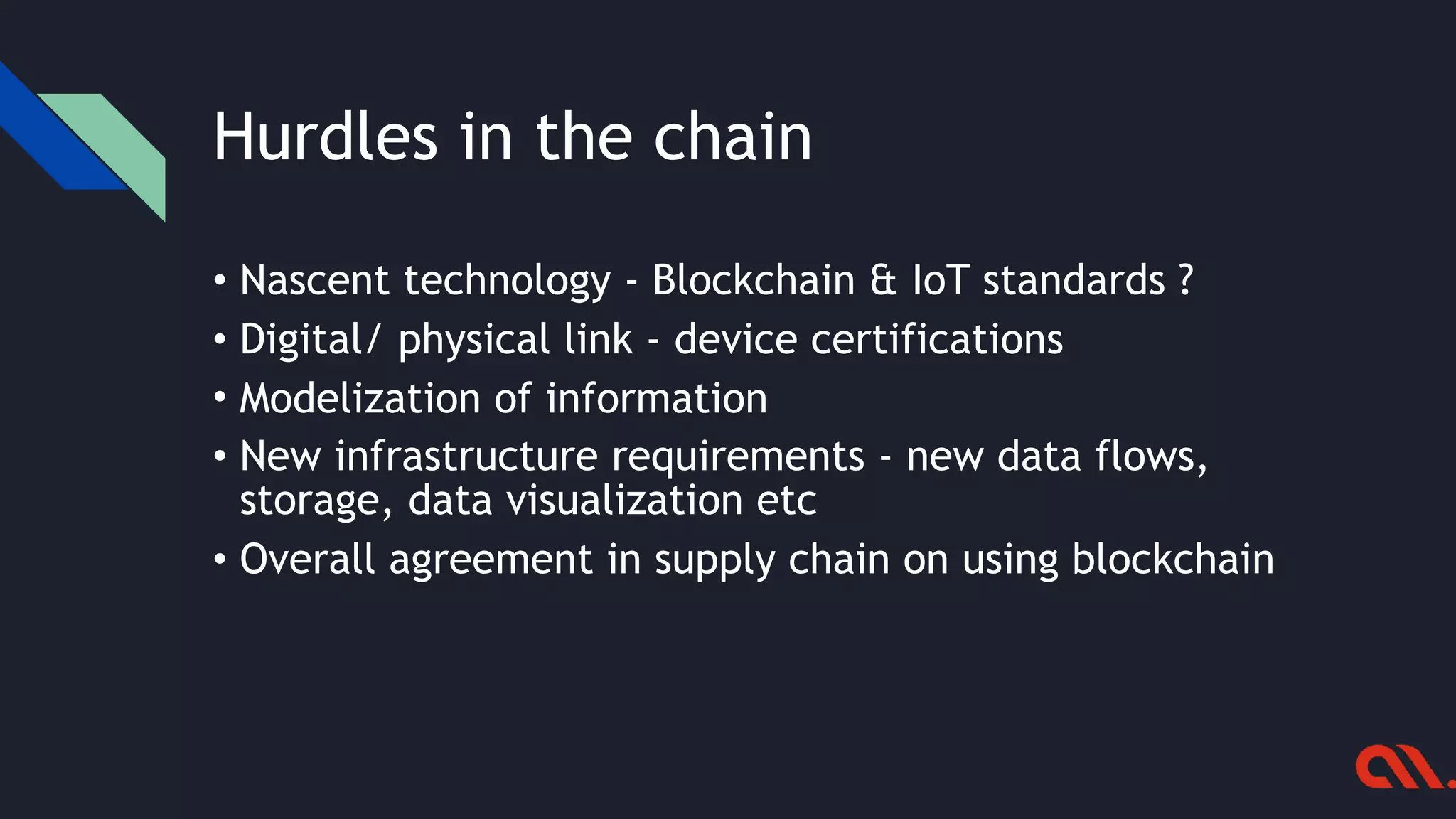
Hurdles in the chain
• Nascent technology - Blockchain & IoT standards ?
• Digital/ physical link - device certifications
• Modelization of information
• New infrastructure requirements - new data flows,
storage, data visualization etc
• Overall agreement in supply chain on using blockchain
Where do you start?
❑ Understand your supply chain weaknesses and risks
❑ Review your supply chain as upstream as possible to
identify weaknesses and risks you will face
❑ Start small
❑ Collaborate
❑ Scale progressively
Reach me on


shameer@accubits.com


@shameerthaha

Blockchain and IoT For Supply Chain Traceability

  • 1.
    Blockchain & IoT
 Supply Chain Traceability Shameer Thaha // CEO, Accubits (MENA)
  • 2.
    AI & Blockchainfocused development company Shameer Thaha CEO, Accubits (MENA) & Global CSO 6 countries so far, with 150+ team members
  • 3.
    Next 30 minutesis about … " Supply Chain Challenges " How blockchain solves these challenges " Role of IoT & It’s Challenges " Why Blockchain & IoT? " How blockchain and IoT can assist " Impact on stakeholders in the supply chain " Other use cases " Hurdles in the chain " Where do you start?
  • 4.
    Fraud in SupplyChain Pharma " 25% of vaccines reach their destination degraded because of incorrect shipping " 30% of pharmaceuticals are scrapped due to logistics issues alone " 20% of temp-sensitive products are damaged during transport due to broken cold chain Food Agromafia " PwC study - $40b food fraud globally " 70% of extra virgin oil in US (that you probably ate) was counterfeit " In 2014 Interpol seized 11k tons of fake food Food Consumption " 3000 American deaths/ year " Frequent Salmonella & E.Coli outbreaks
  • 5.
    Operations & Logistics “10,000containers lost in sea every year” - World Economic Forum Delays & Inefficiencies Manual Processes Customers demand quality, safety, transparency, ethical sourcing, & speed
  • 6.
    Supply chain challenge- Recall ”Where did <this> come from?” Farm/ Source Factory Transporter Supplier Assembly Line Region Country Batch Retailers
  • 7.
    Adding Value toSupply Chain Downstream chain Logistics Logistics Upstream chain Data Request Information Flows Supplier Producer Client
  • 8.
    Dependencies Trust Effectiveness of lowestcommon denominator Reconciliation Limited manifestation of information flow
  • 9.
    So what dowe need for an ideal supply chain? End-to-end visibility • Increase efficiency along the supply chain and ensure traceability Flexibility • Ability to adapt and respond to issues rapidly with no critical impact on operational costs is necessary to stay competitive in the market Inferred trust • The stakeholders should not have to trust each other but should trust the security integrated into the system to collect and provide true and accurate data Control • Policies, monitoring capabilities and control mechanisms are important
  • 10.
    Auditability Blockchain provides a full audittrail of data, creating an everlasting means of record keeping along a supply chain Immutability All blockchain transactions are timestamped and tamper-proof, providing a single source of data integrity Smart Contracts Continuous real- time tracking of data is facilitated through the use of smart-contracts across the supply chain Disintermediation Blockchain enables peer-to- peer interactions which can be trusted based on the digital signatures Traceability Compliance Flexibility Stakeholder Management Capability to monitor events and meta data associated with a product Standards and controls to provide evidence that regulatory conditions are met The ability to adapt rapidly to events or issues, run various scenarios without significantly increasing operational costs Effective governance in place to enable communication, risk reduction and trust among the involved parties Supply chain Pain points Block chain capabilities
  • 11.
    Blockchain to therescue Fast transaction settlement Low Cost Transparent and Audit- able Reliable
  • 12.
  • 13.
    5 challenges toindustrial IoT - Gartner " Connecting 26 billion devices by 2020. " Creating controls for vast number of devices " Enable P2P communication between globally distributed computers. " Provide compliance and governance for all autonomous systems " Address the security complexities of the new landscape.
  • 15.
    How blockchain andIoT Assist The major challenges are about information sharing and trust. 
 ✓ Track & Trace product journey & lifecycle ✓ Trade Finance ✓ Automate Bill of Lading & Customs ✓ Simplify Global Trade Compliance ✓ Track Point-of-origin & ownership changes ✓ Detect & notify tampering attempts Better Visibility Faster Root Cause Analysis Easier Info Sharing
  • 16.
  • 17.
    Producer Now • Has alimited ability to control and verify the flows coming from its suppliers (e.g. compliance to standards, respect of requirements) Future • Benefits from an integrated and distributed ledger that enables them to control the inputs and keep track of its production
  • 18.
    Freight Forwarder Now • Reliablebut one-sided tracking system • Limited certification ability and complex tracking (e.g. heat or pressure variations) • Difficult to certify a code of conduct Future • Shared information system • Client can benefit from a distributed and certified system • Client can make sure his goods are transported in the right conditions and timing
  • 19.
    Broker Now • Difficulty tocertify the origin and path of the goods bought and sold Future • Can easily check the origin of the goods and their transformation path on the blockchain • With sealed IoT devices put on the goods, the broker can check and prove its authenticity and provenance
  • 20.
    Consumer Now • Difficulty toverify the compliance, origin, and composition of the goods to be bought Future • Has a full view on the goods bought (i.e., provenance, transformation process, transportation) directly on the blockchain
  • 21.
    Other use cases Healthcare industry verifyauthenticity, avoiding potential fraud and manipulation Food industry packaging sensitive products with tags, smart thermometers Art & Luxury wares industry RFID seals and blockchain . Embedding into the work to guarantee authenticity sort of like a DNA identification
  • 22.
    Hurdles in thechain • Nascent technology - Blockchain & IoT standards ? • Digital/ physical link - device certifications • Modelization of information • New infrastructure requirements - new data flows, storage, data visualization etc • Overall agreement in supply chain on using blockchain
  • 23.
    Where do youstart? ❑ Understand your supply chain weaknesses and risks ❑ Review your supply chain as upstream as possible to identify weaknesses and risks you will face ❑ Start small ❑ Collaborate ❑ Scale progressively
  • 24.