Periodontal Treatment
of
Medically Compromised
Patients
Dr.Abhishek Gaur
BDS, MDS
Department of Periodontics
?What the periodontal
Treatment has to do with the
medically compromised
patients
Many patients seeking dental care might have
significant medical condition which may alter the
course of their oral disease and therapy provided.
The therapeutic responsibility of clinician includes
identification of medical problems and consultation
with or referral of the patient to appropriate physician
may be indicated.
Hemorrhagic disorders
Renal diseases
Liver diseases
Pulmonary diseases
Infectious diseases
Pregnancy
Prosthetic joint replacement.
HEMORRHAGIC
DISORDERS
Patients with a history of bleeding problems caused by the disease or drugs should
be managed to minimise risks of haemorrhage.
Identification of these patients can be done by the following methods :
1. Health history
2. Clinical examination
3. Laboratory tests
1) HEALTH HISTORY
The health questioning should cover
1. History of bleeding after previous surgery or trauma
2. Past and present drug history
(drugs that interfere with hemostasis are : aspirin, anticoagulants, alcohol, anticancer drug, antibiotics)
2) Clinical Examination
1. Ecchymoses
2. Petechiae
3. Hemarthrosis
4. Epistaxis
5. G.I. bleeding
6. Soft tissue
bleeding
3) Laboratory Tests
It includes :
•Bleeding time
•Prothrombin time (PT)
•Partial thromboplastin time (PTT)
•Complete blood cell count (CBC)
•Coagulation time
HEMORRHAGIC
DISORDERS
It can be classified as :
1.Coagulation disorders (inherited or acquired)
2.Disorder of vessels
3.Disorder of platelets (quantity or function)
TreatmenT
• Probing, oral prophylaxis can be done without medical
modification.
• More invasive treatment such as local block anaesthesia, root
planing or surgery require prior physician consultation.
• Complete wound closure and application of pressure will reduce
haemorrhage.
• Anti-hemostatic agents such as oxidised cellulose or purified bovine
collagen may be placed over surgical sites or extraction sockets.
Thrombocytopenic
Purpura
Thrombocytopenia is defined as a platelet
count of less than 1,00,000 /mm.
It may be seen in the cases of radiation
therapy, chemotherapy, leukaemia or
infections.
Periodontal Therapy for Patients
with
Thrombocytopenic Purpura
1. Removal of local irritants.
2. Oral hygiene instructions and frequent maintenance visits.
3. Scaling and root planning are safe (platelet count should not
be less than 60,000/mm).
4. Local hemostatic measures should be applied.
5. No surgical procedures should be done until the platelet count
of more than 80000/mm.
6. Platelet transfusion may be required before surgery.
Non-Thrombocytopenic
Purpura
It is due to either vascular wall fragility.
Causes :
Vascular wall fragility – scurvy, infections,
chemicals (phenacetin, aspirin), dysproteinemia.
Treatment
1.Direct pressure applied for at least
15 minutes.
3.Surgical therapy should be avoided.
Leukaemia
Leukaemia is a malignant progressive disease in which
the bone marrow and other blood forming organs
produce increased numbers of immature or abnormal
leucocytes.
The treatment plan is based on the effects of
chemotherapy, bleeding tendency, susceptibility to
infections.
1. ACUTE LEUKAEMIA :
• Antibiotic therapy combined with non-surgical
or surgical debridement is indicated.
2. CHRONIC LEUKAEMIA :
• Scaling and root planing can be performed.
• Periodontal surgery should be avoided.
Treatment
1.Monitor BT, CT, PT and Platelet count.
2.Administer antibiotic coverage before any periodontal
treatment.
3.Extract all hopeless, potentially infectious teeth at least
10 days before chemotherapy (if systemic conditions
allow).
4.Scaling, root planing should be performed.
5.Topical hemostatic agents can be used.
6.Twice daily rinsing with 0.12% chlorhexidine gluconate
is recommended after oral hygiene procedures.
RENAL
DISEASES
Most common causes
of
renal failure are:
1. Glomerulonephritis
2. Kidney cystic disease
3. Reno-vascular disease
4. Drug nephropathy
5. Obstructive uropathy
6. Hypertension
Oral Manifestations of
Renal Disease
1.Halitosis
2.Altered taste sensation
3.Xerostomia
4.Gingivitis
5.Enamel hypoplasia
6.Infections
TreatmenT
1.Consult the patient’s physician.
2.Monitor Blood Pressure (patients in end stage renal failure are
usually hypertensive).
3.Periodontal treatment should aim at eliminating inflammation or
infection and frequent recall appointments should be scheduled.
4.Drugs that are nephrotoxic or metabolised by the kidney should
not be given (eg: tetracycline, amino-glycoside antibiotics).
5.Acetaminophen may be used for analgesia, diazepam may be
used for sedation.
6.Local anaesthetics such as lidocaine are generally safe.
LIVER
DISEASES
Major causes of liver diseases includes :
1. Drug toxicity
2. Cirrhosis
3. Viral infections (hepatitis B and C)
4. Neoplasms
5. Biliary tract disorders
Oral Manifestations of Liver
diseases
1. Candidiasis
2. Angular cheilitis
3. Atropic glossitis
4. Petechiae
5. Lichen Planus
Treatment
Consultation with the physician concerning current stage of disease, risk for
bleeding, potential drugs to be prescribed during treatment and required
alterations to periodontal therapy…
1. Screening for hepatitis B and C.
2. Check laboratory values for PT and PTT.
3. Teeth with severe bone and attachment loss, furcation invasion,
periodontal abscesses or extensive surgical requirements should be
extracted before the transplant procedure.
4. Conservative, non-surgical periodontal therapy can be done whenever
possible.
Pulmonary
Diseases
• Pulmonary diseases range from obstructive lung
diseases (eg: asthma, emphysema, bronchitis) to
restrictive ventilatory disorders that could.
• Interfere with effective ventilation.
• Acute respiratory distress may be caused by slight
airway obstruction or depression of respiratory
function.
• Patients with acute respiratory distress might alter their
position in attempts to improve their ventilatory
efficiency.
• Increased by muscle weakness, scarring & obesity.
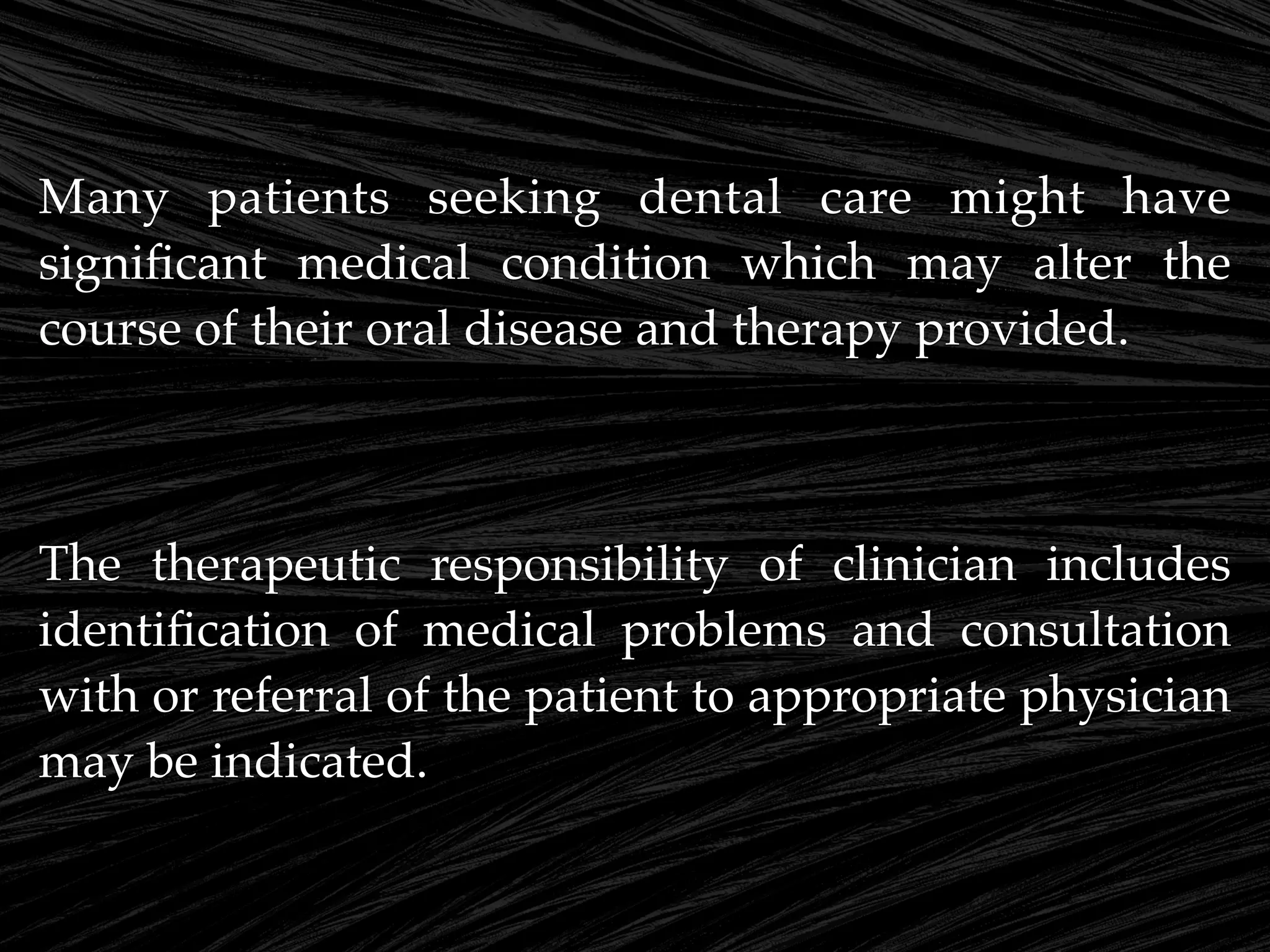
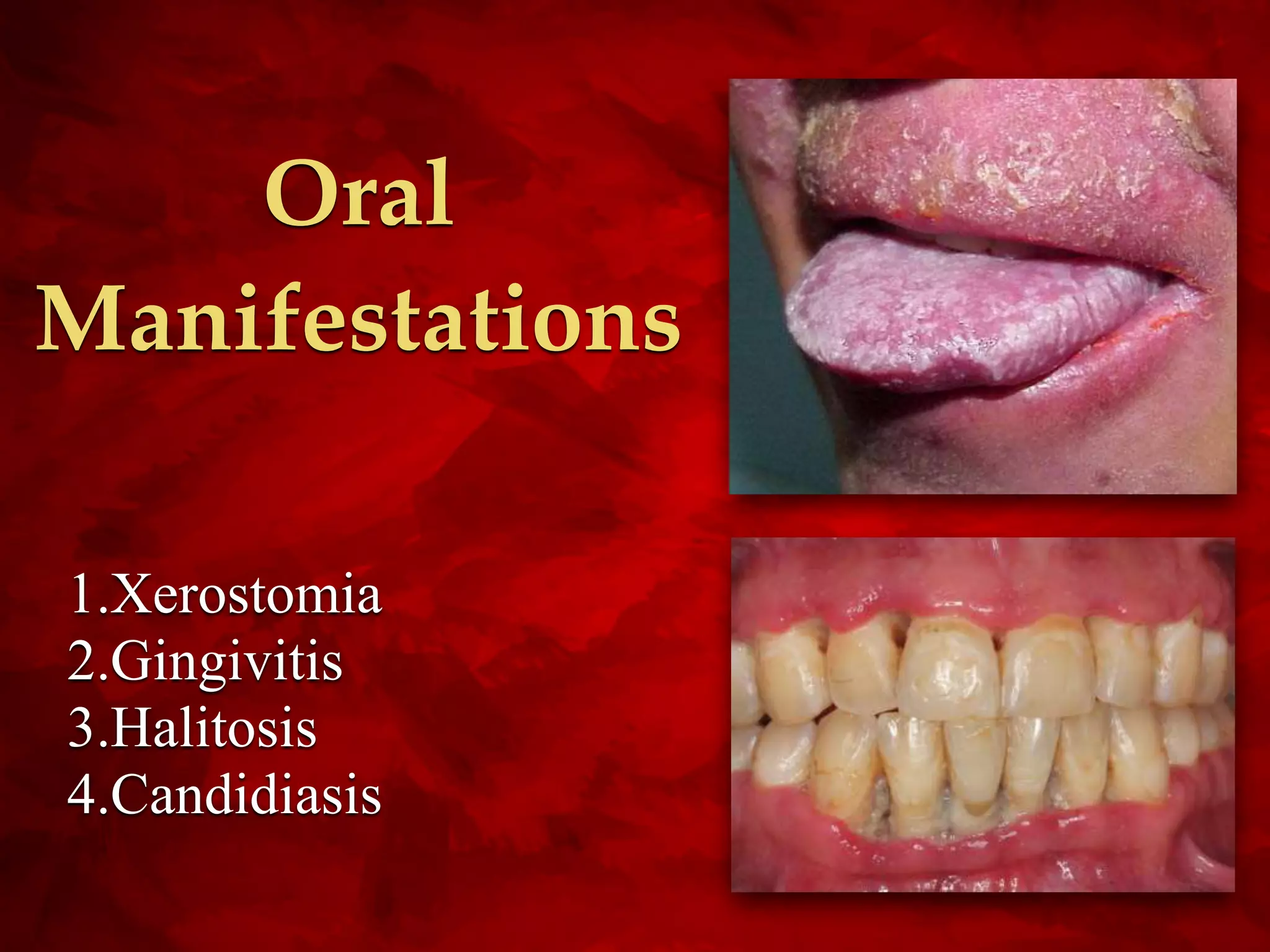
Oral
Manifestations
1.Xerostomia
2.Gingivitis
3.Halitosis
4.Candidiasis
Treatment
• Need consultation from the physician and medication
details.
• Avoid elicitation of respiratory depression or distress.
• Minimise the stress of periodontal appointment.
• Patient with emphysema should be treated in the
afternoon.
• Avoid medications that cause respiratory depression
(eg: narcotics, sedatives or general anaesthetics).
• Do not use equipments that produce aerosol. (eg:
ultrasonic scalers)
PERIODONTAL TREATMENT
FOR HIV PATIENTS
• Primary goals should be restoration and maintenance of oral
health, comfort and function.
• Treatment should be directed toward control of HIV-associated
mucosal diseases such as chronic candidiasis and recurrent oral
ulcerations.
• Effective oral hygiene maintenance.
• Conservative, nonsurgical periodontal therapy should be a
treatment option for virtually all HIV +ve patients.
TUBERCULOSISTUBERCULOSIS
Tuberculosis
Patients with the tuberculosis should receive only
emergency care following the guidelines :
1.The sputum culture for mycobacterium tuberculosis
should be done.
2.If the results are negative patients may be treated
normally.
Prosthetic
Joint
Replacement
There are many controversies in the dental
literature regarding the use of prophylactic
antibiotics in patients with joint prosthesis.
Antibiotics are prescribed in dentistry to treat
& Prevent infections.
Prosthetic Join Replacement
Periodontal treatment of medically compromised patients

Periodontal treatment of medically compromised patients

  • 1.
  • 2.
    ?What the periodontal Treatmenthas to do with the medically compromised patients
  • 3.
    Many patients seekingdental care might have significant medical condition which may alter the course of their oral disease and therapy provided. The therapeutic responsibility of clinician includes identification of medical problems and consultation with or referral of the patient to appropriate physician may be indicated.
  • 4.
    Hemorrhagic disorders Renal diseases Liverdiseases Pulmonary diseases Infectious diseases Pregnancy Prosthetic joint replacement.
  • 5.
    HEMORRHAGIC DISORDERS Patients with ahistory of bleeding problems caused by the disease or drugs should be managed to minimise risks of haemorrhage. Identification of these patients can be done by the following methods : 1. Health history 2. Clinical examination 3. Laboratory tests 1) HEALTH HISTORY The health questioning should cover 1. History of bleeding after previous surgery or trauma 2. Past and present drug history (drugs that interfere with hemostasis are : aspirin, anticoagulants, alcohol, anticancer drug, antibiotics)
  • 6.
    2) Clinical Examination 1.Ecchymoses 2. Petechiae 3. Hemarthrosis 4. Epistaxis 5. G.I. bleeding 6. Soft tissue bleeding
  • 7.
    3) Laboratory Tests Itincludes : •Bleeding time •Prothrombin time (PT) •Partial thromboplastin time (PTT) •Complete blood cell count (CBC) •Coagulation time
  • 8.
    HEMORRHAGIC DISORDERS It can beclassified as : 1.Coagulation disorders (inherited or acquired) 2.Disorder of vessels 3.Disorder of platelets (quantity or function)
  • 9.
    TreatmenT • Probing, oralprophylaxis can be done without medical modification. • More invasive treatment such as local block anaesthesia, root planing or surgery require prior physician consultation. • Complete wound closure and application of pressure will reduce haemorrhage. • Anti-hemostatic agents such as oxidised cellulose or purified bovine collagen may be placed over surgical sites or extraction sockets.
  • 10.
    Thrombocytopenic Purpura Thrombocytopenia is definedas a platelet count of less than 1,00,000 /mm. It may be seen in the cases of radiation therapy, chemotherapy, leukaemia or infections.
  • 11.
    Periodontal Therapy forPatients with Thrombocytopenic Purpura 1. Removal of local irritants. 2. Oral hygiene instructions and frequent maintenance visits. 3. Scaling and root planning are safe (platelet count should not be less than 60,000/mm). 4. Local hemostatic measures should be applied. 5. No surgical procedures should be done until the platelet count of more than 80000/mm. 6. Platelet transfusion may be required before surgery.
  • 12.
    Non-Thrombocytopenic Purpura It is dueto either vascular wall fragility. Causes : Vascular wall fragility – scurvy, infections, chemicals (phenacetin, aspirin), dysproteinemia.
  • 13.
    Treatment 1.Direct pressure appliedfor at least 15 minutes. 3.Surgical therapy should be avoided.
  • 14.
    Leukaemia Leukaemia is amalignant progressive disease in which the bone marrow and other blood forming organs produce increased numbers of immature or abnormal leucocytes. The treatment plan is based on the effects of chemotherapy, bleeding tendency, susceptibility to infections.
  • 15.
    1. ACUTE LEUKAEMIA: • Antibiotic therapy combined with non-surgical or surgical debridement is indicated. 2. CHRONIC LEUKAEMIA : • Scaling and root planing can be performed. • Periodontal surgery should be avoided.
  • 16.
    Treatment 1.Monitor BT, CT,PT and Platelet count. 2.Administer antibiotic coverage before any periodontal treatment. 3.Extract all hopeless, potentially infectious teeth at least 10 days before chemotherapy (if systemic conditions allow). 4.Scaling, root planing should be performed. 5.Topical hemostatic agents can be used. 6.Twice daily rinsing with 0.12% chlorhexidine gluconate is recommended after oral hygiene procedures.
  • 17.
  • 18.
    Most common causes of renalfailure are: 1. Glomerulonephritis 2. Kidney cystic disease 3. Reno-vascular disease 4. Drug nephropathy 5. Obstructive uropathy 6. Hypertension
  • 19.
    Oral Manifestations of RenalDisease 1.Halitosis 2.Altered taste sensation 3.Xerostomia 4.Gingivitis 5.Enamel hypoplasia 6.Infections
  • 20.
    TreatmenT 1.Consult the patient’sphysician. 2.Monitor Blood Pressure (patients in end stage renal failure are usually hypertensive). 3.Periodontal treatment should aim at eliminating inflammation or infection and frequent recall appointments should be scheduled. 4.Drugs that are nephrotoxic or metabolised by the kidney should not be given (eg: tetracycline, amino-glycoside antibiotics). 5.Acetaminophen may be used for analgesia, diazepam may be used for sedation. 6.Local anaesthetics such as lidocaine are generally safe.
  • 21.
  • 22.
    Major causes ofliver diseases includes : 1. Drug toxicity 2. Cirrhosis 3. Viral infections (hepatitis B and C) 4. Neoplasms 5. Biliary tract disorders
  • 23.
    Oral Manifestations ofLiver diseases 1. Candidiasis 2. Angular cheilitis 3. Atropic glossitis 4. Petechiae 5. Lichen Planus
  • 24.
    Treatment Consultation with thephysician concerning current stage of disease, risk for bleeding, potential drugs to be prescribed during treatment and required alterations to periodontal therapy… 1. Screening for hepatitis B and C. 2. Check laboratory values for PT and PTT. 3. Teeth with severe bone and attachment loss, furcation invasion, periodontal abscesses or extensive surgical requirements should be extracted before the transplant procedure. 4. Conservative, non-surgical periodontal therapy can be done whenever possible.
  • 25.
  • 26.
    • Pulmonary diseasesrange from obstructive lung diseases (eg: asthma, emphysema, bronchitis) to restrictive ventilatory disorders that could. • Interfere with effective ventilation. • Acute respiratory distress may be caused by slight airway obstruction or depression of respiratory function. • Patients with acute respiratory distress might alter their position in attempts to improve their ventilatory efficiency. • Increased by muscle weakness, scarring & obesity.
  • 27.
  • 28.
    Treatment • Need consultationfrom the physician and medication details. • Avoid elicitation of respiratory depression or distress. • Minimise the stress of periodontal appointment. • Patient with emphysema should be treated in the afternoon. • Avoid medications that cause respiratory depression (eg: narcotics, sedatives or general anaesthetics). • Do not use equipments that produce aerosol. (eg: ultrasonic scalers)
  • 31.
    PERIODONTAL TREATMENT FOR HIVPATIENTS • Primary goals should be restoration and maintenance of oral health, comfort and function. • Treatment should be directed toward control of HIV-associated mucosal diseases such as chronic candidiasis and recurrent oral ulcerations. • Effective oral hygiene maintenance. • Conservative, nonsurgical periodontal therapy should be a treatment option for virtually all HIV +ve patients.
  • 32.
  • 33.
    Tuberculosis Patients with thetuberculosis should receive only emergency care following the guidelines : 1.The sputum culture for mycobacterium tuberculosis should be done. 2.If the results are negative patients may be treated normally.
  • 35.
  • 36.
    There are manycontroversies in the dental literature regarding the use of prophylactic antibiotics in patients with joint prosthesis. Antibiotics are prescribed in dentistry to treat & Prevent infections. Prosthetic Join Replacement