ABSOLUTEABSOLUTE
MONARCHYMONARCHY
ABSOLUTE MONARCHYABSOLUTE MONARCHY
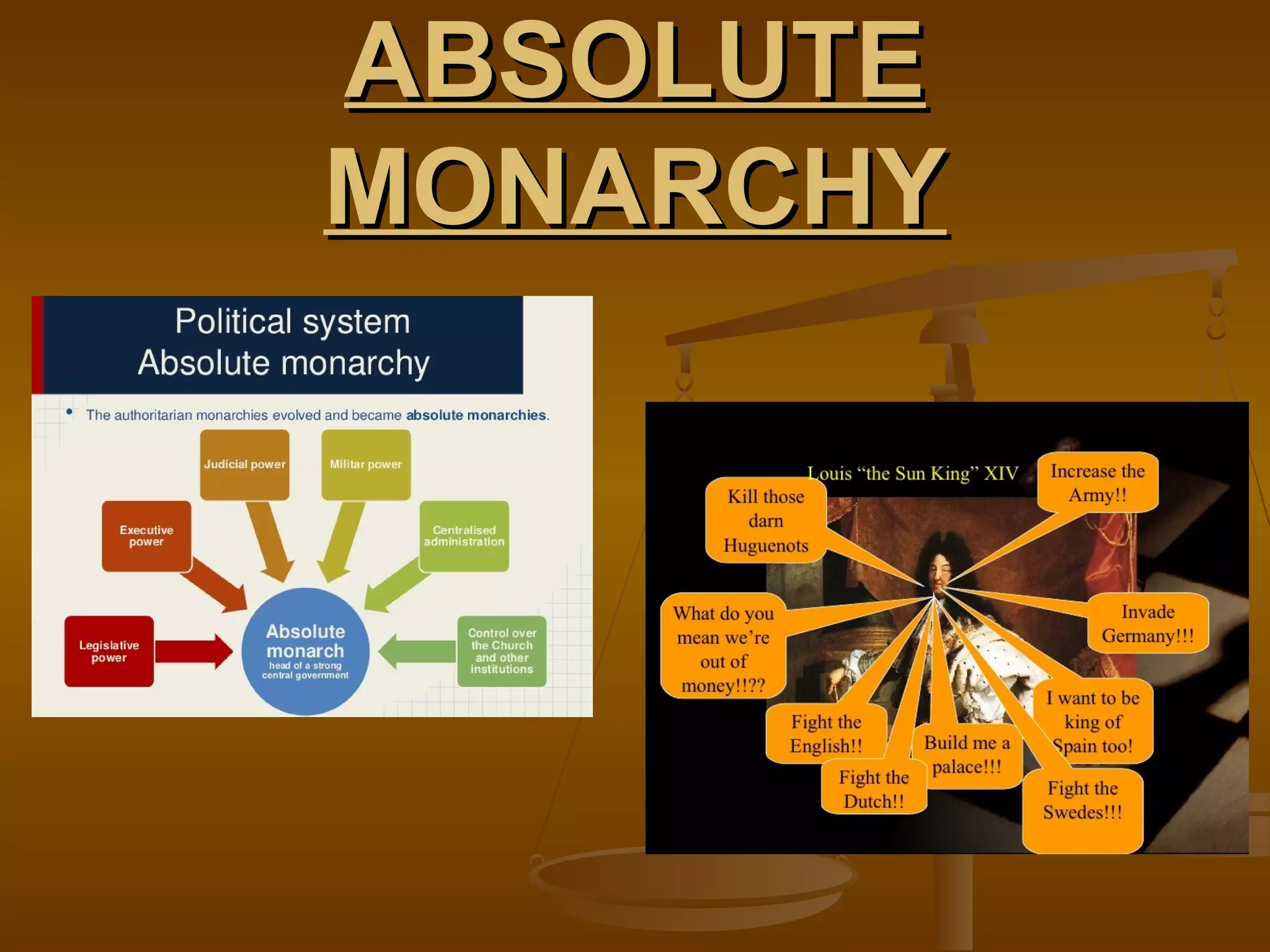
 Absolute monarchy or despotic monarchy is aAbsolute monarchy or despotic monarchy is a
monarchical from of government in which themonarchical from of government in which the
monarch has absolute power among his or hermonarch has absolute power among his or her
people.people.
 An absolute monarch wields unrestricted politicalAn absolute monarch wields unrestricted political
power over the sovereign state and its people.power over the sovereign state and its people.
 An absolute monarch exercises total power overAn absolute monarch exercises total power over
the land, yet in practise the monarchy isthe land, yet in practise the monarchy is
counterbalanced by political groups from amongcounterbalanced by political groups from among
the social groups from among the social classesthe social groups from among the social classes
and castes of the realm, such as the aristocracy,and castes of the realm, such as the aristocracy,
clergy, and middle and lower classes.clergy, and middle and lower classes.
ABSOLUTE MONARCHY INABSOLUTE MONARCHY IN
EUROPEEUROPE
 Througthout much of European history, theThrougthout much of European history, the
divine right of kings was the theologicaldivine right of kings was the theological
justification for absolute monarchy.justification for absolute monarchy.
 Many european monarchs, such as those ofMany european monarchs, such as those of
Russia, claimed supreme autocratic power byRussia, claimed supreme autocratic power by
divine right, and that their subjects had no rightsdivine right, and that their subjects had no rights
to limit their power.to limit their power.
ABSOLUTE MONARCHY INABSOLUTE MONARCHY IN
EUROPEEUROPE
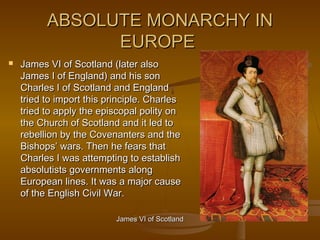
 James VI of Scotland (later alsoJames VI of Scotland (later also
James I of England) and his sonJames I of England) and his son
Charles I of Scotland and EnglandCharles I of Scotland and England
tried to import this principle. Charlestried to import this principle. Charles
tried to apply the episcopal polity ontried to apply the episcopal polity on
the Church of Scotland and it led tothe Church of Scotland and it led to
rebellion by the Covenanters and therebellion by the Covenanters and the
Bishops’ wars. Then he fears thatBishops’ wars. Then he fears that
Charles I was attempting to establishCharles I was attempting to establish
absolutists governments alongabsolutists governments along
European lines. It was a major causeEuropean lines. It was a major cause
of the English Civil War.of the English Civil War.
James VI of ScotlandJames VI of Scotland
ABSOLUTE MONARCHY INABSOLUTE MONARCHY IN
EUROPEEUROPE
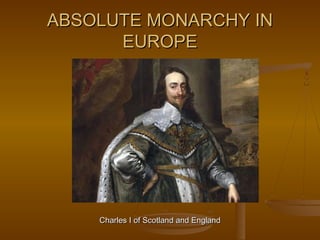
Charles I of Scotland and EnglandCharles I of Scotland and England
ABSOLUTE MONARCHY INABSOLUTE MONARCHY IN
EUROPEEUROPE
 In the 19th Century, the Divine right wasIn the 19th Century, the Divine right was
considered as an absolute theory in the majorityconsidered as an absolute theory in the majority
of the countries in the Western world, except inof the countries in the Western world, except in
Russia, were it was still given credence as theRussia, were it was still given credence as the
official justification for the Czar’s power.official justification for the Czar’s power.
 There are differents opinions by historians aboutThere are differents opinions by historians about
the extent of absolutism among europeanthe extent of absolutism among european
monarchs.monarchs.
 Perry Anderson argue that some monarchsPerry Anderson argue that some monarchs
archieved levels of absolute control over theirarchieved levels of absolute control over their
states, while other historians, such as Rogerstates, while other historians, such as Roger
Mettam dispute the same concept of absolutism.Mettam dispute the same concept of absolutism.
ABSOLUTE MONARCHY INABSOLUTE MONARCHY IN
EUROPE: FranceEUROPE: France
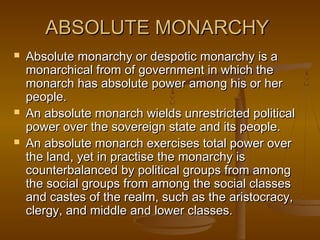
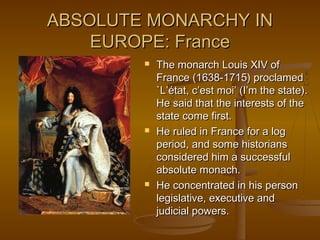
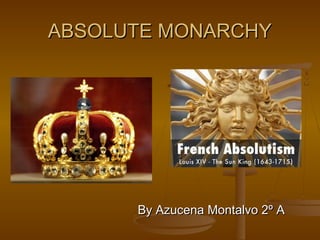
 The monarch Louis XIV ofThe monarch Louis XIV of
France (1638-1715) proclamedFrance (1638-1715) proclamed
`L’état, c’est moi’ (I’m the state).`L’état, c’est moi’ (I’m the state).
He said that the interests of theHe said that the interests of the
state come first.state come first.
 He ruled in France for a logHe ruled in France for a log
period, and some historiansperiod, and some historians
considered him a successfulconsidered him a successful
absolute monach.absolute monach.
 He concentrated in his personHe concentrated in his person
legislative, executive andlegislative, executive and
judicial powers.judicial powers.
ABSOLUTE MONARCHY INABSOLUTE MONARCHY IN
EUROPE: FranceEUROPE: France
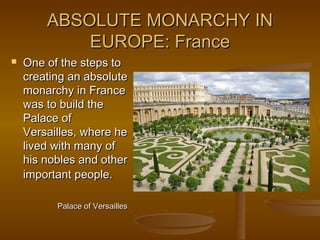
 One of the steps toOne of the steps to
creating an absolutecreating an absolute
monarchy in Francemonarchy in France
was to build thewas to build the
Palace ofPalace of
Versailles, where heVersailles, where he
lived with many oflived with many of
his nobles and otherhis nobles and other
important people.important people.
Palace of VersaillesPalace of Versailles
ABSOLUTE MONARCHY INABSOLUTE MONARCHY IN
EUROPE: Denmark-NorwayEUROPE: Denmark-Norway
 Absolutism was underpinned by a writtenAbsolutism was underpinned by a written
constitution for the first time in Europe in the 1665constitution for the first time in Europe in the 1665
Kongeloven ("King's Law") of Denmark-Norway,
who ordered that the Monarch shall from this day
forth be revered and considered the most perfect
and supreme person on the Earth by all his
subjects. This law consequently authorized the king
to abolish all other centers of power. Most important
was the abolition of the Council of the Realm.
ABSOLUTE MONARCHY INABSOLUTE MONARCHY IN
EUROPE: PrussiaEUROPE: Prussia
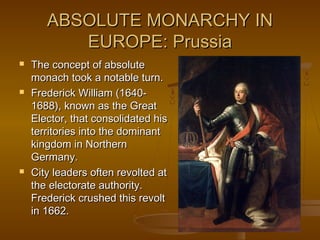
 The concept of absoluteThe concept of absolute
monach took a notable turn.monach took a notable turn.
 Frederick William (1640-Frederick William (1640-
1688), known as the Great1688), known as the Great
Elector, that consolidated hisElector, that consolidated his
territories into the dominantterritories into the dominant
kingdom in Northernkingdom in Northern
Germany.Germany.
 City leaders often revolted atCity leaders often revolted at
the electorate authority.the electorate authority.
Frederick crushed this revoltFrederick crushed this revolt
in 1662.in 1662.
ABSOLUTE MONARCHY INABSOLUTE MONARCHY IN
EUROPE: RussiaEUROPE: Russia
 Until 1905 the Tsars of RussiaUntil 1905 the Tsars of Russia
governed as absolutegoverned as absolute
monarchs.monarchs.
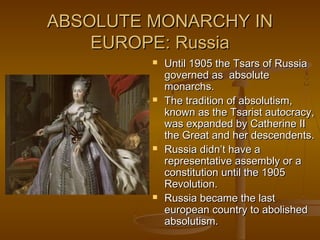
 The tradition of absolutism,The tradition of absolutism,
known as the Tsarist autocracy,known as the Tsarist autocracy,
was expanded by Catherine IIwas expanded by Catherine II
the Great and her descendents.the Great and her descendents.
 Russia didn’t have aRussia didn’t have a
representative assembly or arepresentative assembly or a
constitution until the 1905constitution until the 1905
Revolution.Revolution.
 Russia became the lastRussia became the last
european country to abolishedeuropean country to abolished
absolutism.absolutism.
ABSOLUTE MONARCHY INABSOLUTE MONARCHY IN
EUROPE: SwedenEUROPE: Sweden
 The form of government is commonlyThe form of government is commonly
referred to as absolute monarchy,referred to as absolute monarchy,
however, the monarch still ruled under thehowever, the monarch still ruled under the
law and could only legislate in agreementlaw and could only legislate in agreement
with the Riksdad of the Estates.with the Riksdad of the Estates.
ABSOLUTE MONARCHYABSOLUTE MONARCHY
By Azucena Montalvo 2º ABy Azucena Montalvo 2º A

Absolute monarchy

  • 1.
  • 2.
    ABSOLUTE MONARCHYABSOLUTE MONARCHY Absolute monarchy or despotic monarchy is aAbsolute monarchy or despotic monarchy is a monarchical from of government in which themonarchical from of government in which the monarch has absolute power among his or hermonarch has absolute power among his or her people.people.  An absolute monarch wields unrestricted politicalAn absolute monarch wields unrestricted political power over the sovereign state and its people.power over the sovereign state and its people.  An absolute monarch exercises total power overAn absolute monarch exercises total power over the land, yet in practise the monarchy isthe land, yet in practise the monarchy is counterbalanced by political groups from amongcounterbalanced by political groups from among the social groups from among the social classesthe social groups from among the social classes and castes of the realm, such as the aristocracy,and castes of the realm, such as the aristocracy, clergy, and middle and lower classes.clergy, and middle and lower classes.
  • 3.
    ABSOLUTE MONARCHY INABSOLUTEMONARCHY IN EUROPEEUROPE  Througthout much of European history, theThrougthout much of European history, the divine right of kings was the theologicaldivine right of kings was the theological justification for absolute monarchy.justification for absolute monarchy.  Many european monarchs, such as those ofMany european monarchs, such as those of Russia, claimed supreme autocratic power byRussia, claimed supreme autocratic power by divine right, and that their subjects had no rightsdivine right, and that their subjects had no rights to limit their power.to limit their power.
  • 4.
    ABSOLUTE MONARCHY INABSOLUTEMONARCHY IN EUROPEEUROPE  James VI of Scotland (later alsoJames VI of Scotland (later also James I of England) and his sonJames I of England) and his son Charles I of Scotland and EnglandCharles I of Scotland and England tried to import this principle. Charlestried to import this principle. Charles tried to apply the episcopal polity ontried to apply the episcopal polity on the Church of Scotland and it led tothe Church of Scotland and it led to rebellion by the Covenanters and therebellion by the Covenanters and the Bishops’ wars. Then he fears thatBishops’ wars. Then he fears that Charles I was attempting to establishCharles I was attempting to establish absolutists governments alongabsolutists governments along European lines. It was a major causeEuropean lines. It was a major cause of the English Civil War.of the English Civil War. James VI of ScotlandJames VI of Scotland
  • 5.
    ABSOLUTE MONARCHY INABSOLUTEMONARCHY IN EUROPEEUROPE Charles I of Scotland and EnglandCharles I of Scotland and England
  • 6.
    ABSOLUTE MONARCHY INABSOLUTEMONARCHY IN EUROPEEUROPE  In the 19th Century, the Divine right wasIn the 19th Century, the Divine right was considered as an absolute theory in the majorityconsidered as an absolute theory in the majority of the countries in the Western world, except inof the countries in the Western world, except in Russia, were it was still given credence as theRussia, were it was still given credence as the official justification for the Czar’s power.official justification for the Czar’s power.  There are differents opinions by historians aboutThere are differents opinions by historians about the extent of absolutism among europeanthe extent of absolutism among european monarchs.monarchs.  Perry Anderson argue that some monarchsPerry Anderson argue that some monarchs archieved levels of absolute control over theirarchieved levels of absolute control over their states, while other historians, such as Rogerstates, while other historians, such as Roger Mettam dispute the same concept of absolutism.Mettam dispute the same concept of absolutism.
  • 7.
    ABSOLUTE MONARCHY INABSOLUTEMONARCHY IN EUROPE: FranceEUROPE: France  The monarch Louis XIV ofThe monarch Louis XIV of France (1638-1715) proclamedFrance (1638-1715) proclamed `L’état, c’est moi’ (I’m the state).`L’état, c’est moi’ (I’m the state). He said that the interests of theHe said that the interests of the state come first.state come first.  He ruled in France for a logHe ruled in France for a log period, and some historiansperiod, and some historians considered him a successfulconsidered him a successful absolute monach.absolute monach.  He concentrated in his personHe concentrated in his person legislative, executive andlegislative, executive and judicial powers.judicial powers.
  • 8.
    ABSOLUTE MONARCHY INABSOLUTEMONARCHY IN EUROPE: FranceEUROPE: France  One of the steps toOne of the steps to creating an absolutecreating an absolute monarchy in Francemonarchy in France was to build thewas to build the Palace ofPalace of Versailles, where heVersailles, where he lived with many oflived with many of his nobles and otherhis nobles and other important people.important people. Palace of VersaillesPalace of Versailles
  • 9.
    ABSOLUTE MONARCHY INABSOLUTEMONARCHY IN EUROPE: Denmark-NorwayEUROPE: Denmark-Norway  Absolutism was underpinned by a writtenAbsolutism was underpinned by a written constitution for the first time in Europe in the 1665constitution for the first time in Europe in the 1665 Kongeloven ("King's Law") of Denmark-Norway, who ordered that the Monarch shall from this day forth be revered and considered the most perfect and supreme person on the Earth by all his subjects. This law consequently authorized the king to abolish all other centers of power. Most important was the abolition of the Council of the Realm.
  • 10.
    ABSOLUTE MONARCHY INABSOLUTEMONARCHY IN EUROPE: PrussiaEUROPE: Prussia  The concept of absoluteThe concept of absolute monach took a notable turn.monach took a notable turn.  Frederick William (1640-Frederick William (1640- 1688), known as the Great1688), known as the Great Elector, that consolidated hisElector, that consolidated his territories into the dominantterritories into the dominant kingdom in Northernkingdom in Northern Germany.Germany.  City leaders often revolted atCity leaders often revolted at the electorate authority.the electorate authority. Frederick crushed this revoltFrederick crushed this revolt in 1662.in 1662.
  • 11.
    ABSOLUTE MONARCHY INABSOLUTEMONARCHY IN EUROPE: RussiaEUROPE: Russia  Until 1905 the Tsars of RussiaUntil 1905 the Tsars of Russia governed as absolutegoverned as absolute monarchs.monarchs.  The tradition of absolutism,The tradition of absolutism, known as the Tsarist autocracy,known as the Tsarist autocracy, was expanded by Catherine IIwas expanded by Catherine II the Great and her descendents.the Great and her descendents.  Russia didn’t have aRussia didn’t have a representative assembly or arepresentative assembly or a constitution until the 1905constitution until the 1905 Revolution.Revolution.  Russia became the lastRussia became the last european country to abolishedeuropean country to abolished absolutism.absolutism.
  • 12.
    ABSOLUTE MONARCHY INABSOLUTEMONARCHY IN EUROPE: SwedenEUROPE: Sweden  The form of government is commonlyThe form of government is commonly referred to as absolute monarchy,referred to as absolute monarchy, however, the monarch still ruled under thehowever, the monarch still ruled under the law and could only legislate in agreementlaw and could only legislate in agreement with the Riksdad of the Estates.with the Riksdad of the Estates.
  • 13.
    ABSOLUTE MONARCHYABSOLUTE MONARCHY ByAzucena Montalvo 2º ABy Azucena Montalvo 2º A