Chapter 3 - Context Maps
Speaker: Eason Kuo
Date: 2019/04/10 @ Taiwan iDDD Study Group
Why Context Maps Are So Essential
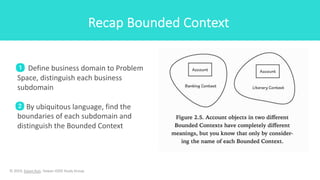
Define business domain to Problem
Space, distinguish each business
subdomain
By ubiquitous language, find the
boundaries of each subdomain and
distinguish the Bounded Context
Recap Bounded Context
© 2019, Eason Kuo, Taiwan iDDD Study Group
Define business domain to Problem
Space, distinguish each business
subdomain
By ubiquitous language, find the
boundaries of each subdomain and
distinguish the Bounded Context
Recap Bounded Context
© 2019, Eason Kuo, Taiwan iDDD Study Group
Okay Everything seems great, right?
But !
© 2019, Eason Kuo, Taiwan iDDD Study Group
Found Subdomain & Bounded Contexts
Is Enough?
© 2019, Eason Kuo, Taiwan iDDD Study Group
No.
There are some issues you should consider…
© 2019, Eason Kuo, Taiwan iDDD Study Group
Issue 1 : More Complex Scenario, More Unclearly Bounded Context
Issue 2: Organization Complexity
Sample from Internet, Not I Say..
© 2019, Eason Kuo, Taiwan iDDD Study Group
Issue 3: Large team size or multiple development teams
Issue 4: Distributed or offshore team
© 2019, Eason Kuo, Taiwan iDDD Study Group
Issue 5: External, Separate Systems
© 2019, Eason Kuo, Taiwan iDDD Study Group
Issue 6: Legacy Systems
© 2019, Eason Kuo, Taiwan iDDD Study Group
So, We need Context Maps
© 2019, Eason Kuo, Taiwan iDDD Study Group
What is Context Maps ?
© 2019, Eason Kuo, Taiwan iDDD Study Group
Context Maps Description
Context Maps could reflect the collaborative or even
organizational teams relationships between different
Bounded Contexts in your systems.
What is Context Maps?
© 2019, Eason Kuo, Taiwan iDDD Study Group
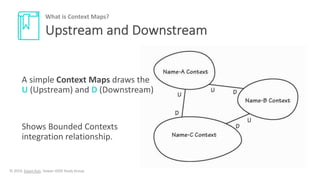
A simple Context Maps draws the
U (Upstream) and D (Downstream)
Shows Bounded Contexts
integration relationship.
Upstream and Downstream
What is Context Maps?
© 2019, Eason Kuo, Taiwan iDDD Study Group
Focusing on what’s happening
between different bounded
contexts.
Inter-communication with teams.
Discover relationship / influence
from Bounded Contexts mapping
to your teams or others partners.
The helping from Context Maps
What is Context Maps?
© 2019, Eason Kuo, Taiwan iDDD Study Group
The Benefit for Drawing
Context Maps
© 2019, Eason Kuo, Taiwan iDDD Study Group
• A Context Map captures the existing terrain
and landscape will change as your current
project progresses, you can update it.
• we could to include other items such as
Modules, Aggregates or team allocation to
assist us.
• All Information, Context Maps can put into
reference document / wiki if it has value.
The Benefit for Drawing Context Maps
© 2019, Eason Kuo, Taiwan iDDD Study Group
• If detail too much, it’s helpless and
fewer people want to use the Map, assist
team to communication is important.
• It can providing views of the enterprise
not otherwise available
• Could find the some bottleneck like
integration, management .
The Benefit for Drawing Context Maps
© 2019, Eason Kuo, Taiwan iDDD Study Group
Relationship for Context Maps
© 2019, Eason Kuo, Taiwan iDDD Study Group
Relationship
Relationship for Context Maps
Different Relationship
and communication
for everyone with you
© 2019, Eason Kuo, Taiwan iDDD Study Group
Is this important for
relationship ?
© 2019, Eason Kuo, Taiwan iDDD Study Group
Discovering potentially crisis
Helps to integrate different bounded contexts with other teams
© 2019, Eason Kuo, Taiwan iDDD Study Group
Relationship Patterns for
Context Maps
© 2019, Eason Kuo, Taiwan iDDD Study Group
• Different teams / separate bounded
context crossover in terms of
domain concepts and logic.
• With an explicit boundary subset of
the domain model that the teams
agree to share.
• shouldn’t be changed without
consultation with the other team
• At this case, recommended that
they do so as a partnership. Not distinguish U/D Relationship
1. Shared Kernel
Relationship Patterns for Context Maps
© 2019, Eason Kuo, Taiwan iDDD Study Group
• When teams in 2 Contexts will
succeed or fail together
• coordinated planning of
development and joint
management of integration.
• cooperate on the evolution of
their interfaces to accommodate
the development needs of both
systems.
Not distinguish U/D Relationship
2. Partnership
Relationship Patterns for Context Maps
© 2019, Eason Kuo, Taiwan iDDD Study Group
• teams are in an upstream-
downstream relationship.
• Upstream teams could
interdependently developing
feature.
• Downstream teams will be
influence from upstream.
3. Customer – Supplier
Relationship Patterns for Context Maps
© 2019, Eason Kuo, Taiwan iDDD Study Group
• Also upstream-downstream
relationship.
• Upstream team has no
motivation to provide for the
downstream team’s needs.
• Downstream is helpless.
4. Conformist
Relationship Patterns for Context Maps
© 2019, Eason Kuo, Taiwan iDDD Study Group
• If 2 sets of functionality have no
significant relationship
• cloud be completely cut loose from
each other.
• Declare bounded context have no
connection to others at all.
• Enable to find simple, specialized
solutions within the scope
5. Separate Way
Relationship Patterns for Context Maps
© 2019, Eason Kuo, Taiwan iDDD Study Group
6. Big Ball of Mud
Relationship Patterns for Context Maps
© 2019, Eason Kuo, Taiwan iDDD Study Group
• Happens on Shared Kernel, Partnership,
Customer-Supplier can not implement.
• Downstream build a translation layer
(Adapter) to protect inner domain
model.
• The ACL also be a interface layer to
cooperate with external system,
decrease changed.
7. Anticorruption Layer (ACL)
Relationship Patterns for Context Maps
© 2019, Eason Kuo, Taiwan iDDD Study Group
• Define a protocol that gives access to
your subsystem as a set of services
• Open the protocol so that all who need
to integrate with you can use it.
• Other systems or components that
communicate with OHS will use
transformation layer for translating
our model into terms of their own,
similar to the ACL.
8. Open Host Service (OHS)
Relationship Patterns for Context Maps
© 2019, Eason Kuo, Taiwan iDDD Study Group
• The translation between the models of
two Bounded Contexts requires a
common language
• Use a well-documented shared language
that can express the necessary domain
information, translating as necessary into
and out of that language.
• Publish Languages often combined with
Open Host Service
9. Public Language (PL)
Relationship Patterns for Context Maps
© 2019, Eason Kuo, Taiwan iDDD Study Group
Sample Link DDD "Cargo" Sample Application
Example – DDD Cargo Sample
Relationship Patterns for Context Maps
© 2019, Eason Kuo, Taiwan iDDD Study Group
So far so good.
We can do some Practice.
© 2019, Eason Kuo, Taiwan iDDD Study Group
20 mins Practice
© 2019, Eason Kuo, Taiwan iDDD Study Group
Example – Insurance Company
20 mins Practice
© 2019, Eason Kuo, Taiwan iDDD Study Group
P M s I u M A -A D D r a W r
- CDA B 5 5 D t
W t s - CDA BC Io M W S c W y
- CDA B 3 > 3 B 5 5 D t
W x M4 6 b W d k f
1A> 5 5 D t
W t I m -A DB5 DC 1A> C 2 C 5 5 D A D D n
M . 6D -A>> D A -A D D I
. 6D -A>> D A g
W I m -A DB5 DC 1A> C e g s I
( 2 C 5 5 D t
W 1A> 5 5 D -A D D vy I R -A DB5 DC 1A> C
) 1B D -A D D l t
W x S W 1 I t l I f I . 6 D 1A> C
- CDA BC I i
© 2019, Eason Kuo, Taiwan iDDD Study Group
a n B 9 2 2 9 it C Ph od
e M 9 2 2 9 pS 9 1 x m
Dl ru pP U w
s 9 1 K 0 1 9 1
. 61 9 -1 Rx / 1 2 6
2. Partnerships
3. Customer-Supplier
4. Conformist
5. Separate Way
6. Big Ball of Mud
7. ACL
8. OHS
9. PL
. 61 9 -1
Example – Insurance Company
20 mins Practice
Sample Link Insurance Company Example
Example – Insurance Company
20 mins Practice
© 2019, Eason Kuo, Taiwan iDDD Study Group
Mapping the IDDD Three Bounded
Context - SaaSOvation
© 2019, Eason Kuo, Taiwan iDDD Study Group
• CollabOviation - social collaboration suite product.
• enables register to publish content.
• Using forums, shared calendars, blogs, wikis
• IdOvation - A reusable identity & access management model.
• provides secure role-based access management for
registered users
• ProjectOvation - An agile project management product.
• create project management assets
• analysis and design artifacts, and track progress
Recap Three Bounded Context Product
Mapping the IDDD Three Bounded Context - SaaSOvation
© 2019, Eason Kuo, Taiwan iDDD Study Group
• Unclear part for user permission in Collaboration Context
• Analyze and split unclear part (user permission) from Collaboration Context
• Put user permission part to Identity & Access Context
Collaboration Context Mapping Example
Mapping the IDDD Three Bounded Context - SaaSOvation
© 2019, Eason Kuo, Taiwan iDDD Study Group
Code Implementing for
Context Maps Representation
© 2019, Eason Kuo, Taiwan iDDD Study Group
• OHS - Implementing like API using REST, RPC,
SOAP or Message exchange.
• Even old way like Files, database is OHS (not
recommend)
• PL – represent Domain concept.
• Like XML/ JSON
• if you want to use User Interface, also HTML is Ok.
• Can be used in Event-Driven Architecture by Domain
Event to deliver message for subscriber.
• ACL – Define Domain Service or Repository to
request OHS and return PL
• Build a translation interface like Adapter and translate
to Value Object
OHS/PL and ACL for Implementing.
Code Implementing for Context Maps Representation
© 2019, Eason Kuo, Taiwan iDDD Study Group
• UserRoleAdater and CollaboratorTranslator
representation and translate it, creating the
appropriate Value Object instance –
Moderator.
• CollaboratorService is Domain Service
• But why creating Value Object ?
Collaboration Context with Identity & Access Context
Code Implementing for Context Maps Representation
© 2019, Eason Kuo, Taiwan iDDD Study Group
• In order to achieve greater degree of
autonomy, make dependent state is already
in place in our local system.
• In DDD, not use Cache. DDD create local
domain objects translated from the foreign
model, maintaining only the minimal
amount of state needed by the local model
(p795 - Integrate with Minimalism)
• To get the state in the first place we may
need to make limited.
Autonomy - Value Object for minimal amount of state
Code Implementing for Context Maps Representation
© 2019, Eason Kuo, Taiwan iDDD Study Group
Agile PM Context with Identity & Access Context
Code Implementing for Context Maps Representation
© 2019, Eason Kuo, Taiwan iDDD Study Group
• In Agile PM Context, each Domain Service
map to its Translator, and use Translator to
create Value Object to achieve minimal
mount of state data.
• Actually there is not one single
CollaborationAdapter. It is just a
placeholder for the several needed, it may
changes by times.
Agile PM Context with Collaboration Context
Code Implementing for Context Maps Representation
© 2019, Eason Kuo, Taiwan iDDD Study Group
• In Agile PM Context, a feature is “when
system creates the Product with a Forum
and Discussion. ”
• Agile PM Context needs objects that don’t
exist yet and won’t exist until it requests
them, it is Potential obstacle to autonomy.
• Because we depend on the availability of
the Collaboration Context in order to
create resources remotely.
Dependent on other Context to do Action issue
Code Implementing for Context Maps Representation
© 2019, Eason Kuo, Taiwan iDDD Study Group
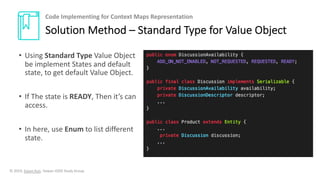
• Using Standard Type Value Object
be implement States and default
state, to get default Value Object.
• If The state is READY, Then it’s can
access.
• In here, use Enum to list different
state.
Solution Method – Standard Type for Value Object
Code Implementing for Context Maps Representation
© 2019, Eason Kuo, Taiwan iDDD Study Group
Sharing Your Reward
10 mins with your group
© 2019, Eason Kuo, Taiwan iDDD Study Group
Context Maps
Recap Chapter 3
© 2019, Eason Kuo, Taiwan iDDD Study Group
Context Maps could reflect the collaborative or even
organizational teams relationships between different Bounded
Contexts in your systems.
Drawing your Context Map using 9 Relationship Patterns and
changes as your current project progresses.
Using ACL or OHS/PL could assist you to translate outer Bounded
Context , decrease unnecessary changes and protect your Domain
Model in your Bounded Context.
Recap for Context Maps (1)
© 2019, Eason Kuo, Taiwan iDDD Study Group
Try to make your Bounded Context could achieve a greater
degree of Autonomy
Autonomy - make dependent state is already in place in
our local system, maintaining only the minimal amount of
state needed by the local model.
Using Value Object / Standard Type skill to keep minimal
amount of state (More detail : Value Object in Chapter 6 )
Recap for Context Maps (2)
© 2019, Eason Kuo, Taiwan iDDD Study Group
Thanks!
© 2019, Eason Kuo, Taiwan iDDD Study Group

Implementing Domain-Driven Design (Study Group) Chapter 3 - Context Maps

  • 1.
    Chapter 3 -Context Maps Speaker: Eason Kuo Date: 2019/04/10 @ Taiwan iDDD Study Group Why Context Maps Are So Essential
  • 2.
    Define business domainto Problem Space, distinguish each business subdomain By ubiquitous language, find the boundaries of each subdomain and distinguish the Bounded Context Recap Bounded Context © 2019, Eason Kuo, Taiwan iDDD Study Group
  • 3.
    Define business domainto Problem Space, distinguish each business subdomain By ubiquitous language, find the boundaries of each subdomain and distinguish the Bounded Context Recap Bounded Context © 2019, Eason Kuo, Taiwan iDDD Study Group Okay Everything seems great, right?
  • 4.
    But ! © 2019,Eason Kuo, Taiwan iDDD Study Group
  • 5.
    Found Subdomain &Bounded Contexts Is Enough? © 2019, Eason Kuo, Taiwan iDDD Study Group
  • 6.
    No. There are someissues you should consider… © 2019, Eason Kuo, Taiwan iDDD Study Group
  • 7.
    Issue 1 :More Complex Scenario, More Unclearly Bounded Context
  • 8.
    Issue 2: OrganizationComplexity Sample from Internet, Not I Say.. © 2019, Eason Kuo, Taiwan iDDD Study Group
  • 9.
    Issue 3: Largeteam size or multiple development teams
  • 10.
    Issue 4: Distributedor offshore team © 2019, Eason Kuo, Taiwan iDDD Study Group
  • 11.
    Issue 5: External,Separate Systems © 2019, Eason Kuo, Taiwan iDDD Study Group
  • 12.
    Issue 6: LegacySystems © 2019, Eason Kuo, Taiwan iDDD Study Group
  • 13.
    So, We needContext Maps © 2019, Eason Kuo, Taiwan iDDD Study Group
  • 14.
    What is ContextMaps ? © 2019, Eason Kuo, Taiwan iDDD Study Group
  • 15.
    Context Maps Description ContextMaps could reflect the collaborative or even organizational teams relationships between different Bounded Contexts in your systems. What is Context Maps? © 2019, Eason Kuo, Taiwan iDDD Study Group
  • 16.
    A simple ContextMaps draws the U (Upstream) and D (Downstream) Shows Bounded Contexts integration relationship. Upstream and Downstream What is Context Maps? © 2019, Eason Kuo, Taiwan iDDD Study Group
  • 17.
    Focusing on what’shappening between different bounded contexts. Inter-communication with teams. Discover relationship / influence from Bounded Contexts mapping to your teams or others partners. The helping from Context Maps What is Context Maps? © 2019, Eason Kuo, Taiwan iDDD Study Group
  • 18.
    The Benefit forDrawing Context Maps © 2019, Eason Kuo, Taiwan iDDD Study Group
  • 19.
    • A ContextMap captures the existing terrain and landscape will change as your current project progresses, you can update it. • we could to include other items such as Modules, Aggregates or team allocation to assist us. • All Information, Context Maps can put into reference document / wiki if it has value. The Benefit for Drawing Context Maps The Benefit for Drawing Context Maps © 2019, Eason Kuo, Taiwan iDDD Study Group
  • 20.
    • If detailtoo much, it’s helpless and fewer people want to use the Map, assist team to communication is important. • It can providing views of the enterprise not otherwise available • Could find the some bottleneck like integration, management . The Benefit for Drawing Context Maps The Benefit for Drawing Context Maps © 2019, Eason Kuo, Taiwan iDDD Study Group
  • 21.
    Relationship for ContextMaps © 2019, Eason Kuo, Taiwan iDDD Study Group
  • 22.
    Relationship Relationship for ContextMaps Different Relationship and communication for everyone with you © 2019, Eason Kuo, Taiwan iDDD Study Group
  • 23.
    Is this importantfor relationship ? © 2019, Eason Kuo, Taiwan iDDD Study Group
  • 24.
  • 25.
    Helps to integratedifferent bounded contexts with other teams © 2019, Eason Kuo, Taiwan iDDD Study Group
  • 26.
    Relationship Patterns for ContextMaps © 2019, Eason Kuo, Taiwan iDDD Study Group
  • 27.
    • Different teams/ separate bounded context crossover in terms of domain concepts and logic. • With an explicit boundary subset of the domain model that the teams agree to share. • shouldn’t be changed without consultation with the other team • At this case, recommended that they do so as a partnership. Not distinguish U/D Relationship 1. Shared Kernel Relationship Patterns for Context Maps © 2019, Eason Kuo, Taiwan iDDD Study Group
  • 28.
    • When teamsin 2 Contexts will succeed or fail together • coordinated planning of development and joint management of integration. • cooperate on the evolution of their interfaces to accommodate the development needs of both systems. Not distinguish U/D Relationship 2. Partnership Relationship Patterns for Context Maps © 2019, Eason Kuo, Taiwan iDDD Study Group
  • 29.
    • teams arein an upstream- downstream relationship. • Upstream teams could interdependently developing feature. • Downstream teams will be influence from upstream. 3. Customer – Supplier Relationship Patterns for Context Maps © 2019, Eason Kuo, Taiwan iDDD Study Group
  • 30.
    • Also upstream-downstream relationship. •Upstream team has no motivation to provide for the downstream team’s needs. • Downstream is helpless. 4. Conformist Relationship Patterns for Context Maps © 2019, Eason Kuo, Taiwan iDDD Study Group
  • 31.
    • If 2sets of functionality have no significant relationship • cloud be completely cut loose from each other. • Declare bounded context have no connection to others at all. • Enable to find simple, specialized solutions within the scope 5. Separate Way Relationship Patterns for Context Maps © 2019, Eason Kuo, Taiwan iDDD Study Group
  • 32.
    6. Big Ballof Mud Relationship Patterns for Context Maps © 2019, Eason Kuo, Taiwan iDDD Study Group
  • 33.
    • Happens onShared Kernel, Partnership, Customer-Supplier can not implement. • Downstream build a translation layer (Adapter) to protect inner domain model. • The ACL also be a interface layer to cooperate with external system, decrease changed. 7. Anticorruption Layer (ACL) Relationship Patterns for Context Maps © 2019, Eason Kuo, Taiwan iDDD Study Group
  • 34.
    • Define aprotocol that gives access to your subsystem as a set of services • Open the protocol so that all who need to integrate with you can use it. • Other systems or components that communicate with OHS will use transformation layer for translating our model into terms of their own, similar to the ACL. 8. Open Host Service (OHS) Relationship Patterns for Context Maps © 2019, Eason Kuo, Taiwan iDDD Study Group
  • 35.
    • The translationbetween the models of two Bounded Contexts requires a common language • Use a well-documented shared language that can express the necessary domain information, translating as necessary into and out of that language. • Publish Languages often combined with Open Host Service 9. Public Language (PL) Relationship Patterns for Context Maps © 2019, Eason Kuo, Taiwan iDDD Study Group
  • 36.
    Sample Link DDD"Cargo" Sample Application Example – DDD Cargo Sample Relationship Patterns for Context Maps © 2019, Eason Kuo, Taiwan iDDD Study Group
  • 37.
    So far sogood. We can do some Practice. © 2019, Eason Kuo, Taiwan iDDD Study Group
  • 38.
    20 mins Practice ©2019, Eason Kuo, Taiwan iDDD Study Group
  • 39.
    Example – InsuranceCompany 20 mins Practice © 2019, Eason Kuo, Taiwan iDDD Study Group P M s I u M A -A D D r a W r - CDA B 5 5 D t W t s - CDA BC Io M W S c W y - CDA B 3 > 3 B 5 5 D t W x M4 6 b W d k f 1A> 5 5 D t W t I m -A DB5 DC 1A> C 2 C 5 5 D A D D n M . 6D -A>> D A -A D D I . 6D -A>> D A g W I m -A DB5 DC 1A> C e g s I ( 2 C 5 5 D t W 1A> 5 5 D -A D D vy I R -A DB5 DC 1A> C ) 1B D -A D D l t W x S W 1 I t l I f I . 6 D 1A> C - CDA BC I i
  • 40.
    © 2019, EasonKuo, Taiwan iDDD Study Group a n B 9 2 2 9 it C Ph od e M 9 2 2 9 pS 9 1 x m Dl ru pP U w s 9 1 K 0 1 9 1 . 61 9 -1 Rx / 1 2 6 2. Partnerships 3. Customer-Supplier 4. Conformist 5. Separate Way 6. Big Ball of Mud 7. ACL 8. OHS 9. PL . 61 9 -1 Example – Insurance Company 20 mins Practice
  • 41.
    Sample Link InsuranceCompany Example Example – Insurance Company 20 mins Practice © 2019, Eason Kuo, Taiwan iDDD Study Group
  • 42.
    Mapping the IDDDThree Bounded Context - SaaSOvation © 2019, Eason Kuo, Taiwan iDDD Study Group
  • 43.
    • CollabOviation -social collaboration suite product. • enables register to publish content. • Using forums, shared calendars, blogs, wikis • IdOvation - A reusable identity & access management model. • provides secure role-based access management for registered users • ProjectOvation - An agile project management product. • create project management assets • analysis and design artifacts, and track progress Recap Three Bounded Context Product Mapping the IDDD Three Bounded Context - SaaSOvation © 2019, Eason Kuo, Taiwan iDDD Study Group
  • 44.
    • Unclear partfor user permission in Collaboration Context • Analyze and split unclear part (user permission) from Collaboration Context • Put user permission part to Identity & Access Context Collaboration Context Mapping Example Mapping the IDDD Three Bounded Context - SaaSOvation © 2019, Eason Kuo, Taiwan iDDD Study Group
  • 45.
    Code Implementing for ContextMaps Representation © 2019, Eason Kuo, Taiwan iDDD Study Group
  • 46.
    • OHS -Implementing like API using REST, RPC, SOAP or Message exchange. • Even old way like Files, database is OHS (not recommend) • PL – represent Domain concept. • Like XML/ JSON • if you want to use User Interface, also HTML is Ok. • Can be used in Event-Driven Architecture by Domain Event to deliver message for subscriber. • ACL – Define Domain Service or Repository to request OHS and return PL • Build a translation interface like Adapter and translate to Value Object OHS/PL and ACL for Implementing. Code Implementing for Context Maps Representation © 2019, Eason Kuo, Taiwan iDDD Study Group
  • 47.
    • UserRoleAdater andCollaboratorTranslator representation and translate it, creating the appropriate Value Object instance – Moderator. • CollaboratorService is Domain Service • But why creating Value Object ? Collaboration Context with Identity & Access Context Code Implementing for Context Maps Representation © 2019, Eason Kuo, Taiwan iDDD Study Group
  • 48.
    • In orderto achieve greater degree of autonomy, make dependent state is already in place in our local system. • In DDD, not use Cache. DDD create local domain objects translated from the foreign model, maintaining only the minimal amount of state needed by the local model (p795 - Integrate with Minimalism) • To get the state in the first place we may need to make limited. Autonomy - Value Object for minimal amount of state Code Implementing for Context Maps Representation © 2019, Eason Kuo, Taiwan iDDD Study Group
  • 49.
    Agile PM Contextwith Identity & Access Context Code Implementing for Context Maps Representation © 2019, Eason Kuo, Taiwan iDDD Study Group
  • 50.
    • In AgilePM Context, each Domain Service map to its Translator, and use Translator to create Value Object to achieve minimal mount of state data. • Actually there is not one single CollaborationAdapter. It is just a placeholder for the several needed, it may changes by times. Agile PM Context with Collaboration Context Code Implementing for Context Maps Representation © 2019, Eason Kuo, Taiwan iDDD Study Group
  • 51.
    • In AgilePM Context, a feature is “when system creates the Product with a Forum and Discussion. ” • Agile PM Context needs objects that don’t exist yet and won’t exist until it requests them, it is Potential obstacle to autonomy. • Because we depend on the availability of the Collaboration Context in order to create resources remotely. Dependent on other Context to do Action issue Code Implementing for Context Maps Representation © 2019, Eason Kuo, Taiwan iDDD Study Group
  • 52.
    • Using StandardType Value Object be implement States and default state, to get default Value Object. • If The state is READY, Then it’s can access. • In here, use Enum to list different state. Solution Method – Standard Type for Value Object Code Implementing for Context Maps Representation © 2019, Eason Kuo, Taiwan iDDD Study Group
  • 53.
    Sharing Your Reward 10mins with your group © 2019, Eason Kuo, Taiwan iDDD Study Group
  • 54.
    Context Maps Recap Chapter3 © 2019, Eason Kuo, Taiwan iDDD Study Group
  • 55.
    Context Maps couldreflect the collaborative or even organizational teams relationships between different Bounded Contexts in your systems. Drawing your Context Map using 9 Relationship Patterns and changes as your current project progresses. Using ACL or OHS/PL could assist you to translate outer Bounded Context , decrease unnecessary changes and protect your Domain Model in your Bounded Context. Recap for Context Maps (1) © 2019, Eason Kuo, Taiwan iDDD Study Group
  • 56.
    Try to makeyour Bounded Context could achieve a greater degree of Autonomy Autonomy - make dependent state is already in place in our local system, maintaining only the minimal amount of state needed by the local model. Using Value Object / Standard Type skill to keep minimal amount of state (More detail : Value Object in Chapter 6 ) Recap for Context Maps (2) © 2019, Eason Kuo, Taiwan iDDD Study Group
  • 57.
    Thanks! © 2019, EasonKuo, Taiwan iDDD Study Group