Flashpoints & Key Events in the Cold War1950 – 1962
Key EventsLoss of China (1949)Korean War (1950-1953) *Hungarian Uprising (1956)U2 Spy Plane Incident (1960)Construction of Berlin Wall (1961)Nuclear Arms/Space RaceCheckpoint Charlie Incident (1961)Cuban Missile Crisis (1962) ** SBQ examinable
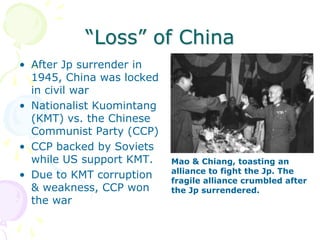
“Loss” of ChinaAfter Jp surrender in 1945, China was locked in civil war Nationalist Kuomintang (KMT) vs. the Chinese Communist Party (CCP)CCP backed by Soviets while US support KMT.Due to KMT corruption & weakness, CCP won the warMao & Chiang, toasting an alliance to fight the Jp. The fragile alliance crumbled after the Jp surrendered.
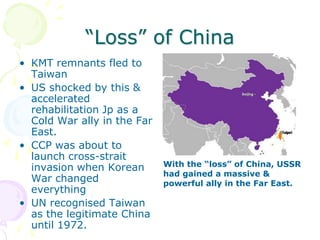
“Loss” of ChinaKMT remnants fled to TaiwanUS shocked by this & accelerated rehabilitation Jp as a Cold War ally in the Far East.CCP was about to launch cross-strait invasion when Korean War changed everythingUN recognised Taiwan as the legitimate China until 1972.With the “loss” of China, USSR had gained a massive & powerful ally in the Far East.
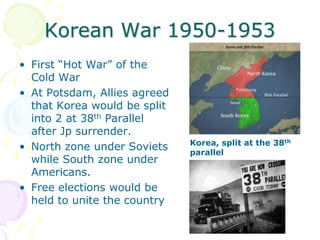
Korean War 1950-1953First “Hot War” of the Cold WarAt Potsdam, Allies agreed that Korea would be split into 2 at 38th Parallel after Jp surrender.North zone under Soviets while South zone under Americans.Free elections would be held to unite the countryKorea, split at the 38th parallel
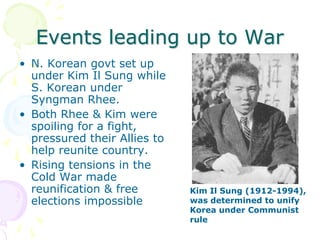
Events leading up to WarN. Korean govt set up under Kim Il Sung while S. Korean under Syngman Rhee.Both Rhee & Kim were spoiling for a fight, pressured their Allies to help reunite country.Rising tensions in the Cold War made reunification & free elections impossibleKim Il Sung (1912-1994), was determined to unify Korea under Communist rule
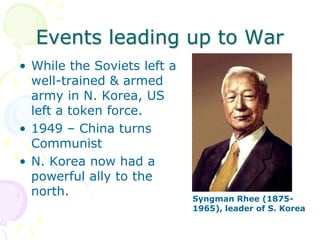
Events leading up to WarWhile the Soviets left a well-trained & armed army in N. Korea, US left a token force.1949 – China turns CommunistN. Korea now had a powerful ally to the north.Syngman Rhee (1875-1965), leader of S. Korea
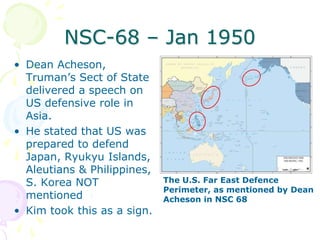
NSC-68 – Jan 1950Dean Acheson, Truman’s Sect of State delivered a speech on US defensive role in Asia.He stated that US was prepared to defend Japan, Ryukyu Islands, Aleutians & Philippines, S. Korea NOT mentionedKim took this as a sign.The U.S. Far East Defence Perimeter, as mentioned by Dean Acheson in NSC 68
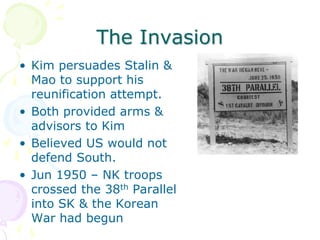
The InvasionKim persuades Stalin & Mao to support his reunification attempt.Both provided arms & advisors to KimBelieved US would not defend South.Jun 1950 – NK troops crossed the 38th Parallel into SK & the Korean War had begun
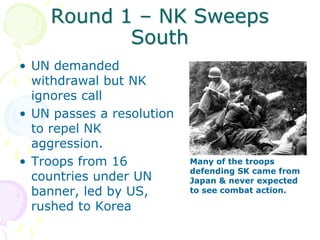
Round 1 – NK Sweeps SouthUN demanded withdrawal but NK ignores callUN passes a resolution to repel NK aggression. Troops from 16 countries under UN banner, led by US, rushed to KoreaMany of the troops defending SK came from Japan & never expected to see combat action.
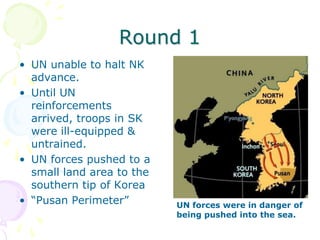
Round 1UN unable to halt NK advance.Until UN reinforcements arrived, troops in SK were ill-equipped & untrained.UN forces pushed to a small land area to the southern tip of Korea“Pusan Perimeter”UN forces were in danger of being pushed into the sea.
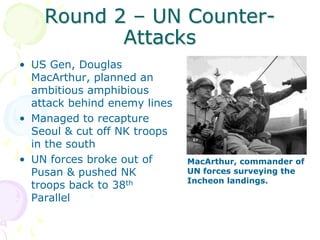
Round 2 – UN Counter-AttacksUS Gen, Douglas MacArthur, planned an ambitious amphibious attack behind enemy linesManaged to recapture Seoul & cut off NK troops in the southUN forces broke out of Pusan & pushed NK troops back to 38th ParallelMacArthur, commander of UN forces surveying the Incheon landings.
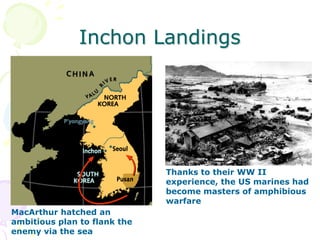
Inchon LandingsThanks to their WW II experience, the US marines had become masters of amphibious warfareMacArthur hatched an ambitious plan to flank the enemy via the sea
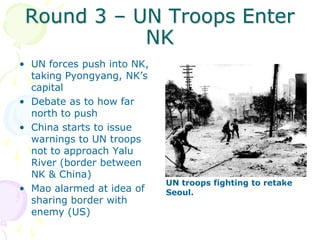
Round 3 – UN Troops Enter NKUN forces push into NK, taking Pyongyang, NK’s capitalDebate as to how far north to pushChina starts to issue warnings to UN troops not to approach Yalu River (border between NK & China)Mao alarmed at idea of sharing border with enemy (US)UN troops fighting to retake Seoul.
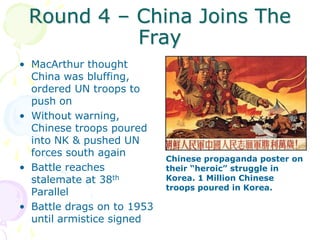
Round 4 – China Joins The FrayMacArthur thought China was bluffing, ordered UN troops to push onWithout warning, Chinese troops poured into NK & pushed UN forces south againBattle reaches stalemate at 38th ParallelBattle drags on to 1953 until armistice signedChinese propaganda poster on their “heroic” struggle in Korea. 1 Million Chinese troops poured in Korea.
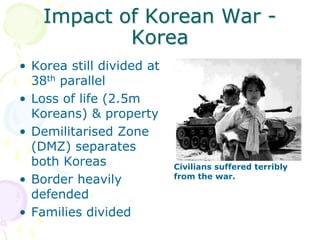
Impact of Korean War - KoreaKorea still divided at 38th parallelLoss of life (2.5m Koreans) & propertyDemilitarised Zone (DMZ) separates both KoreasBorder heavily defendedFamilies dividedCivilians suffered terribly from the war.
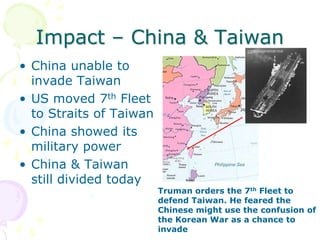
Impact – China & TaiwanChina unable to invade TaiwanUS moved 7th Fleet to Straits of TaiwanChina showed its military powerChina & Taiwan still divided todayTruman orders the 7th Fleet to defend Taiwan. He feared the Chinese might use the confusion of the Korean War as a chance to invade
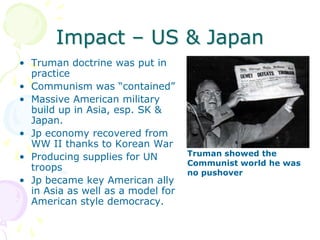
Impact – US & JapanTruman doctrine was put in practiceCommunism was “contained”Massive American military build up in Asia, esp. SK & Japan.Jp economy recovered from WW II thanks to Korean WarProducing supplies for UN troopsJp became key American ally in Asia as well as a model for American style democracy.Truman showed the Communist world he was no pushover
Impact – WorldShowed global impact of Cold War, not just in EuroShowed that smaller countries could influence conflict – e.g. Kim & RheeFirst instance of superpowers using proxy warIron Curtain in Euro, Bamboo Curtain in Asia
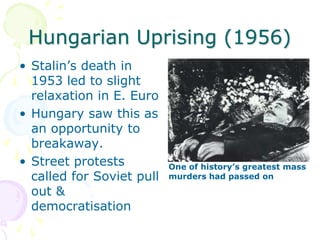
Hungarian Uprising (1956)Stalin’s death in 1953 led to slight relaxation in E. EuroHungary saw this as an opportunity to breakaway.Street protests called for Soviet pull out & democratisationOne of history’s greatest mass murders had passed on
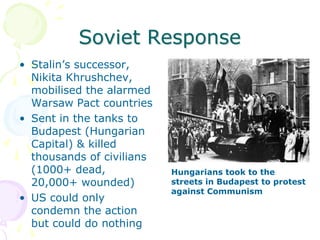
Soviet ResponseStalin’s successor, Nikita Khrushchev, mobilised the alarmed Warsaw Pact countriesSent in the tanks to Budapest (Hungarian Capital) & killed thousands of civilians (1000+ dead, 20,000+ wounded)US could only condemn the action but could do nothingHungarians took to the streets in Budapest to protest against Communism
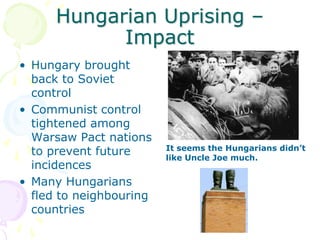
Hungarian Uprising – Impact Hungary brought back to Soviet controlCommunist control tightened among Warsaw Pact nations to prevent future incidencesMany Hungarians fled to neighbouring countriesIt seems the Hungarians didn’t like Uncle Joe much.
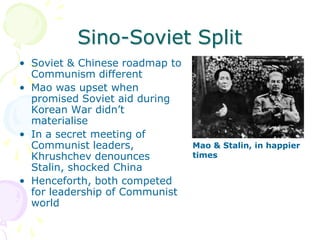
Sino-Soviet SplitSoviet & Chinese roadmap to Communism differentMao was upset when promised Soviet aid during Korean War didn’t materialiseIn a secret meeting of Communist leaders, Khrushchev denounces Stalin, shocked ChinaHenceforth, both competed for leadership of Communist worldMao & Stalin, in happier times
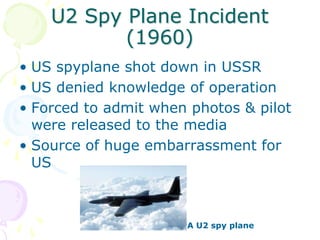
U2 Spy Plane Incident (1960)US spyplane shot down in USSRUS denied knowledge of operationForced to admit when photos & pilot were released to the mediaSource of huge embarrassment for USA U2 spy plane
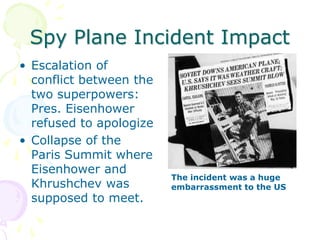
Spy Plane Incident ImpactEscalation of conflict between the two superpowers: Pres. Eisenhower refused to apologizeCollapse of the Paris Summit where Eisenhower and Khrushchev was supposed to meet.The incident was a huge embarrassment to the US
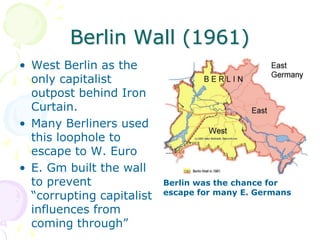
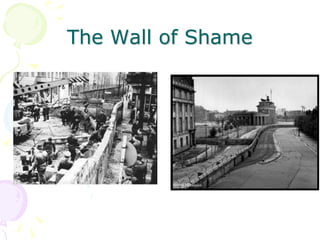
Berlin Wall (1961) West Berlin as the only capitalist outpost behind Iron Curtain.Many Berliners used this loophole to escape to W. EuroE. Gm built the wall to prevent “corrupting capitalist influences from coming through”Berlin was the chance for escape for many E. Germans
Berlin Wall – Escape AttemptsAnyone caught trying to escape would be shotGuard towers, patrol dogs, barbed wire, mines, poison gas, reinforced wallsEscape: Tunneling, climbingMore sophisticated attempts included zipline, hot air balloon, surfing, air glidersHundreds died in failed escape attempts
The Wall of Shame
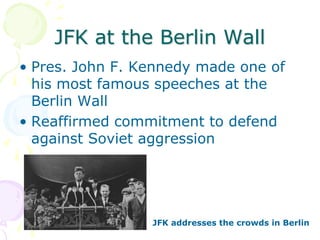
JFK at the Berlin WallPres. John F. Kennedy made one of his most famous speeches at the Berlin WallReaffirmed commitment to defend against Soviet aggressionJFK addresses the crowds in Berlin
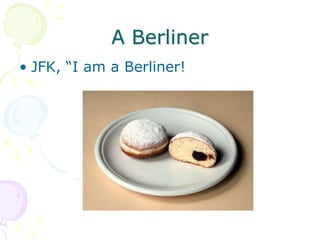
JFK at the Berlin WallTwo thousand years ago the proudest boast was Civis Romanus Sum [I am a Roman citizen]. Today, in the world of freedom, the proudest boast is 'Ich bin ein Berliner'... All free men, wherever they may live, are citizens of Berlin, and, therefore, as a free man, I take pride in the words 'Ich bin ein Berliner!'
A BerlinerJFK, “I am a Berliner!
Nuclear Arms RaceBoth sides engaged in massive buildup of nukesMutually assured destruction (MAD)Brinkmanshipthe policy or practice of pushing a dangerous situation to the brink of disaster in order to achieve the most advantageous outcome. It occurs in international politics, foreign policy and (in contemporary settings) in military strategy involving the threatened use of nuclear weapons
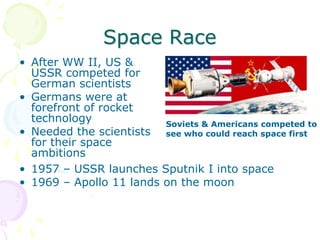
Space RaceAfter WW II, US & USSR competed for German scientistsGermans were at forefront of rocket technologyNeeded the scientists for their space ambitionsSoviets & Americans competed to see who could reach space first1957 – USSR launches Sputnik I into space
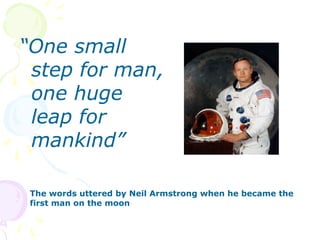
1969 – Apollo 11 lands on the moon“One small step for man, one huge leap for mankind”The words uttered by Neil Armstrong when he became the first man on the moon
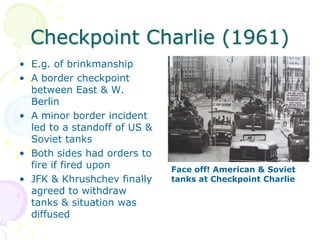
Checkpoint Charlie (1961)E.g. of brinkmanshipA border checkpoint between East & W. BerlinA minor border incident led to a standoff of US & Soviet tanksBoth sides had orders to fire if fired uponJFK & Khrushchev finally agreed to withdraw tanks & situation was diffusedFace off! American & Soviet tanks at Checkpoint Charlie
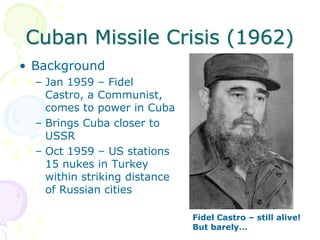
Cuban Missile Crisis (1962)BackgroundJan 1959 – Fidel Castro, a Communist, comes to power in CubaBrings Cuba closer to USSROct 1959 – US stations 15 nukes in Turkey within striking distance of Russian citiesFidel Castro – still alive! But barely…
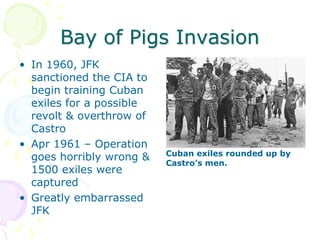
Bay of Pigs InvasionIn 1960, JFK sanctioned the CIA to begin training Cuban exiles for a possible revolt & overthrow of CastroApr 1961 – Operation goes horribly wrong & 1500 exiles were capturedGreatly embarrassed JFKCuban exiles rounded up by Castro’s men.
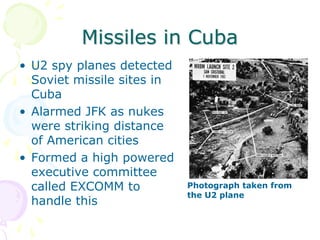
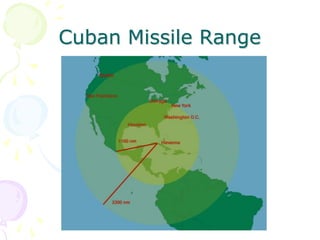
Missiles in CubaU2 spy planes detected Soviet missile sites in CubaAlarmed JFK as nukes were striking distance of American citiesFormed a high powered executive committee called EXCOMM to handle thisPhotograph taken from the U2 plane
Cuban Missile Range
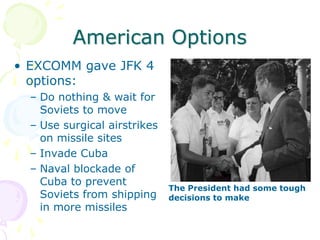
American OptionsEXCOMM gave JFK 4 options:Do nothing & wait for Soviets to moveUse surgical airstrikes on missile sitesInvade CubaNaval blockade of Cuba to prevent Soviets from shipping in more missilesThe President had some tough decisions to make
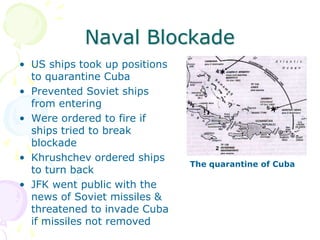
Naval BlockadeUS ships took up positions to quarantine CubaPrevented Soviet ships from enteringWere ordered to fire if ships tried to break blockadeKhrushchev ordered ships to turn backJFK went public with the news of Soviet missiles & threatened to invade Cuba if missiles not removedThe quarantine of Cuba
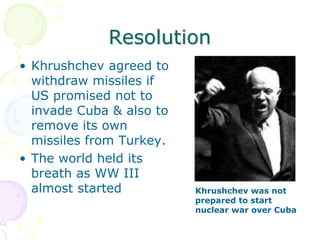
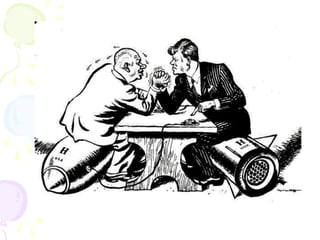
ResolutionKhrushchev agreed to withdraw missiles if US promised not to invade Cuba & also to remove its own missiles from Turkey.The world held its breath as WW III almost startedKhrushchev was not prepared to start nuclear war over Cuba
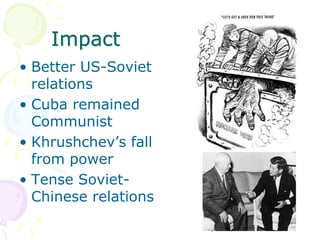
ImpactBetter US-Soviet relationsCuba remained CommunistKhrushchev’s fall from powerTense Soviet-Chinese relations
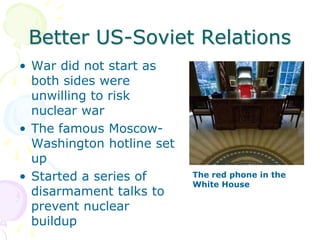
Better US-Soviet RelationsWar did not start as both sides were unwilling to risk nuclear warThe famous Moscow-Washington hotline set upStarted a series of disarmament talks to prevent nuclear buildupThe red phone in the White House
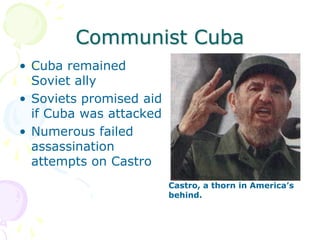
Communist CubaCuba remained Soviet allySoviets promised aid if Cuba was attackedNumerous failed assassination attempts on CastroCastro, a thorn in America’s behind.
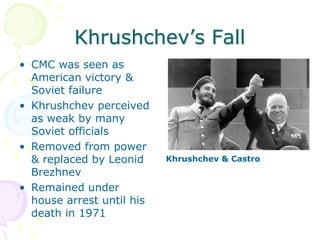
Khrushchev’s FallCMC was seen as American victory & Soviet failureKhrushchev perceived as weak by many Soviet officialsRemoved from power & replaced by Leonid Brezhnev Remained under house arrest until his death in 1971Khrushchev & Castro
Tense Soviet-Chinese RelationsChina also accused USSR of being weakExacerbated the Sino-Soviet splitBoth camps now competed for leadership of the Communist world
Flashpoints & Key Events In The Cold War

Flashpoints & Key Events In The Cold War

  • 1.
    Flashpoints & KeyEvents in the Cold War1950 – 1962
  • 2.
    Key EventsLoss ofChina (1949)Korean War (1950-1953) *Hungarian Uprising (1956)U2 Spy Plane Incident (1960)Construction of Berlin Wall (1961)Nuclear Arms/Space RaceCheckpoint Charlie Incident (1961)Cuban Missile Crisis (1962) ** SBQ examinable
  • 3.
    “Loss” of ChinaAfterJp surrender in 1945, China was locked in civil war Nationalist Kuomintang (KMT) vs. the Chinese Communist Party (CCP)CCP backed by Soviets while US support KMT.Due to KMT corruption & weakness, CCP won the warMao & Chiang, toasting an alliance to fight the Jp. The fragile alliance crumbled after the Jp surrendered.
  • 4.
    “Loss” of ChinaKMTremnants fled to TaiwanUS shocked by this & accelerated rehabilitation Jp as a Cold War ally in the Far East.CCP was about to launch cross-strait invasion when Korean War changed everythingUN recognised Taiwan as the legitimate China until 1972.With the “loss” of China, USSR had gained a massive & powerful ally in the Far East.
  • 5.
    Korean War 1950-1953First“Hot War” of the Cold WarAt Potsdam, Allies agreed that Korea would be split into 2 at 38th Parallel after Jp surrender.North zone under Soviets while South zone under Americans.Free elections would be held to unite the countryKorea, split at the 38th parallel
  • 6.
    Events leading upto WarN. Korean govt set up under Kim Il Sung while S. Korean under Syngman Rhee.Both Rhee & Kim were spoiling for a fight, pressured their Allies to help reunite country.Rising tensions in the Cold War made reunification & free elections impossibleKim Il Sung (1912-1994), was determined to unify Korea under Communist rule
  • 7.
    Events leading upto WarWhile the Soviets left a well-trained & armed army in N. Korea, US left a token force.1949 – China turns CommunistN. Korea now had a powerful ally to the north.Syngman Rhee (1875-1965), leader of S. Korea
  • 8.
    NSC-68 – Jan1950Dean Acheson, Truman’s Sect of State delivered a speech on US defensive role in Asia.He stated that US was prepared to defend Japan, Ryukyu Islands, Aleutians & Philippines, S. Korea NOT mentionedKim took this as a sign.The U.S. Far East Defence Perimeter, as mentioned by Dean Acheson in NSC 68
  • 9.
    The InvasionKim persuadesStalin & Mao to support his reunification attempt.Both provided arms & advisors to KimBelieved US would not defend South.Jun 1950 – NK troops crossed the 38th Parallel into SK & the Korean War had begun
  • 10.
    Round 1 –NK Sweeps SouthUN demanded withdrawal but NK ignores callUN passes a resolution to repel NK aggression. Troops from 16 countries under UN banner, led by US, rushed to KoreaMany of the troops defending SK came from Japan & never expected to see combat action.
  • 11.
    Round 1UN unableto halt NK advance.Until UN reinforcements arrived, troops in SK were ill-equipped & untrained.UN forces pushed to a small land area to the southern tip of Korea“Pusan Perimeter”UN forces were in danger of being pushed into the sea.
  • 12.
    Round 2 –UN Counter-AttacksUS Gen, Douglas MacArthur, planned an ambitious amphibious attack behind enemy linesManaged to recapture Seoul & cut off NK troops in the southUN forces broke out of Pusan & pushed NK troops back to 38th ParallelMacArthur, commander of UN forces surveying the Incheon landings.
  • 13.
    Inchon LandingsThanks totheir WW II experience, the US marines had become masters of amphibious warfareMacArthur hatched an ambitious plan to flank the enemy via the sea
  • 14.
    Round 3 –UN Troops Enter NKUN forces push into NK, taking Pyongyang, NK’s capitalDebate as to how far north to pushChina starts to issue warnings to UN troops not to approach Yalu River (border between NK & China)Mao alarmed at idea of sharing border with enemy (US)UN troops fighting to retake Seoul.
  • 15.
    Round 4 –China Joins The FrayMacArthur thought China was bluffing, ordered UN troops to push onWithout warning, Chinese troops poured into NK & pushed UN forces south againBattle reaches stalemate at 38th ParallelBattle drags on to 1953 until armistice signedChinese propaganda poster on their “heroic” struggle in Korea. 1 Million Chinese troops poured in Korea.
  • 16.
    Impact of KoreanWar - KoreaKorea still divided at 38th parallelLoss of life (2.5m Koreans) & propertyDemilitarised Zone (DMZ) separates both KoreasBorder heavily defendedFamilies dividedCivilians suffered terribly from the war.
  • 17.
    Impact – China& TaiwanChina unable to invade TaiwanUS moved 7th Fleet to Straits of TaiwanChina showed its military powerChina & Taiwan still divided todayTruman orders the 7th Fleet to defend Taiwan. He feared the Chinese might use the confusion of the Korean War as a chance to invade
  • 18.
    Impact – US& JapanTruman doctrine was put in practiceCommunism was “contained”Massive American military build up in Asia, esp. SK & Japan.Jp economy recovered from WW II thanks to Korean WarProducing supplies for UN troopsJp became key American ally in Asia as well as a model for American style democracy.Truman showed the Communist world he was no pushover
  • 19.
    Impact – WorldShowedglobal impact of Cold War, not just in EuroShowed that smaller countries could influence conflict – e.g. Kim & RheeFirst instance of superpowers using proxy warIron Curtain in Euro, Bamboo Curtain in Asia
  • 20.
    Hungarian Uprising (1956)Stalin’sdeath in 1953 led to slight relaxation in E. EuroHungary saw this as an opportunity to breakaway.Street protests called for Soviet pull out & democratisationOne of history’s greatest mass murders had passed on
  • 21.
    Soviet ResponseStalin’s successor,Nikita Khrushchev, mobilised the alarmed Warsaw Pact countriesSent in the tanks to Budapest (Hungarian Capital) & killed thousands of civilians (1000+ dead, 20,000+ wounded)US could only condemn the action but could do nothingHungarians took to the streets in Budapest to protest against Communism
  • 22.
    Hungarian Uprising –Impact Hungary brought back to Soviet controlCommunist control tightened among Warsaw Pact nations to prevent future incidencesMany Hungarians fled to neighbouring countriesIt seems the Hungarians didn’t like Uncle Joe much.
  • 23.
    Sino-Soviet SplitSoviet &Chinese roadmap to Communism differentMao was upset when promised Soviet aid during Korean War didn’t materialiseIn a secret meeting of Communist leaders, Khrushchev denounces Stalin, shocked ChinaHenceforth, both competed for leadership of Communist worldMao & Stalin, in happier times
  • 24.
    U2 Spy PlaneIncident (1960)US spyplane shot down in USSRUS denied knowledge of operationForced to admit when photos & pilot were released to the mediaSource of huge embarrassment for USA U2 spy plane
  • 25.
    Spy Plane IncidentImpactEscalation of conflict between the two superpowers: Pres. Eisenhower refused to apologizeCollapse of the Paris Summit where Eisenhower and Khrushchev was supposed to meet.The incident was a huge embarrassment to the US
  • 26.
    Berlin Wall (1961)West Berlin as the only capitalist outpost behind Iron Curtain.Many Berliners used this loophole to escape to W. EuroE. Gm built the wall to prevent “corrupting capitalist influences from coming through”Berlin was the chance for escape for many E. Germans
  • 27.
    Berlin Wall –Escape AttemptsAnyone caught trying to escape would be shotGuard towers, patrol dogs, barbed wire, mines, poison gas, reinforced wallsEscape: Tunneling, climbingMore sophisticated attempts included zipline, hot air balloon, surfing, air glidersHundreds died in failed escape attempts
  • 28.
  • 29.
    JFK at theBerlin WallPres. John F. Kennedy made one of his most famous speeches at the Berlin WallReaffirmed commitment to defend against Soviet aggressionJFK addresses the crowds in Berlin
  • 30.
    JFK at theBerlin WallTwo thousand years ago the proudest boast was Civis Romanus Sum [I am a Roman citizen]. Today, in the world of freedom, the proudest boast is 'Ich bin ein Berliner'... All free men, wherever they may live, are citizens of Berlin, and, therefore, as a free man, I take pride in the words 'Ich bin ein Berliner!'
  • 31.
    A BerlinerJFK, “Iam a Berliner!
  • 32.
    Nuclear Arms RaceBothsides engaged in massive buildup of nukesMutually assured destruction (MAD)Brinkmanshipthe policy or practice of pushing a dangerous situation to the brink of disaster in order to achieve the most advantageous outcome. It occurs in international politics, foreign policy and (in contemporary settings) in military strategy involving the threatened use of nuclear weapons
  • 33.
    Space RaceAfter WWII, US & USSR competed for German scientistsGermans were at forefront of rocket technologyNeeded the scientists for their space ambitionsSoviets & Americans competed to see who could reach space first1957 – USSR launches Sputnik I into space
  • 34.
    1969 – Apollo11 lands on the moon“One small step for man, one huge leap for mankind”The words uttered by Neil Armstrong when he became the first man on the moon
  • 35.
    Checkpoint Charlie (1961)E.g.of brinkmanshipA border checkpoint between East & W. BerlinA minor border incident led to a standoff of US & Soviet tanksBoth sides had orders to fire if fired uponJFK & Khrushchev finally agreed to withdraw tanks & situation was diffusedFace off! American & Soviet tanks at Checkpoint Charlie
  • 36.
    Cuban Missile Crisis(1962)BackgroundJan 1959 – Fidel Castro, a Communist, comes to power in CubaBrings Cuba closer to USSROct 1959 – US stations 15 nukes in Turkey within striking distance of Russian citiesFidel Castro – still alive! But barely…
  • 37.
    Bay of PigsInvasionIn 1960, JFK sanctioned the CIA to begin training Cuban exiles for a possible revolt & overthrow of CastroApr 1961 – Operation goes horribly wrong & 1500 exiles were capturedGreatly embarrassed JFKCuban exiles rounded up by Castro’s men.
  • 38.
    Missiles in CubaU2spy planes detected Soviet missile sites in CubaAlarmed JFK as nukes were striking distance of American citiesFormed a high powered executive committee called EXCOMM to handle thisPhotograph taken from the U2 plane
  • 39.
  • 40.
    American OptionsEXCOMM gaveJFK 4 options:Do nothing & wait for Soviets to moveUse surgical airstrikes on missile sitesInvade CubaNaval blockade of Cuba to prevent Soviets from shipping in more missilesThe President had some tough decisions to make
  • 41.
    Naval BlockadeUS shipstook up positions to quarantine CubaPrevented Soviet ships from enteringWere ordered to fire if ships tried to break blockadeKhrushchev ordered ships to turn backJFK went public with the news of Soviet missiles & threatened to invade Cuba if missiles not removedThe quarantine of Cuba
  • 42.
    ResolutionKhrushchev agreed towithdraw missiles if US promised not to invade Cuba & also to remove its own missiles from Turkey.The world held its breath as WW III almost startedKhrushchev was not prepared to start nuclear war over Cuba
  • 43.
    ImpactBetter US-Soviet relationsCubaremained CommunistKhrushchev’s fall from powerTense Soviet-Chinese relations
  • 44.
    Better US-Soviet RelationsWardid not start as both sides were unwilling to risk nuclear warThe famous Moscow-Washington hotline set upStarted a series of disarmament talks to prevent nuclear buildupThe red phone in the White House
  • 45.
    Communist CubaCuba remainedSoviet allySoviets promised aid if Cuba was attackedNumerous failed assassination attempts on CastroCastro, a thorn in America’s behind.
  • 46.
    Khrushchev’s FallCMC wasseen as American victory & Soviet failureKhrushchev perceived as weak by many Soviet officialsRemoved from power & replaced by Leonid Brezhnev Remained under house arrest until his death in 1971Khrushchev & Castro
  • 47.
    Tense Soviet-Chinese RelationsChinaalso accused USSR of being weakExacerbated the Sino-Soviet splitBoth camps now competed for leadership of the Communist world