Knowledge Era Paradigms:
Fundamental Rationale behind Agile
Agile India Conference
Bangalore, Mar 2016
Vishu Hegde
vishu@pm-powerconsulting.com
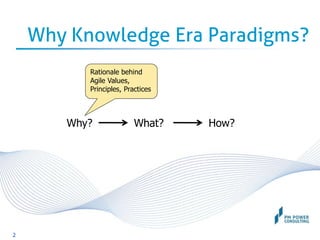
Why Knowledge Era Paradigms?
2
Why? What? How?
Rationale behind
Agile Values,
Principles, Practices
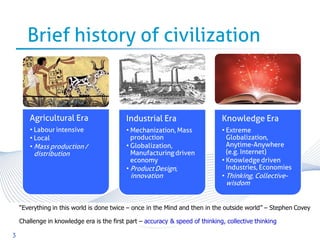
Brief history of civilization
3
Agricultural Era
• Labour intensive
• Local
• Mass production /
distribution
Industrial Era
• Mechanization, Mass
production
• Globalization,
Manufacturingdriven
economy
• Product Design,
innovation
Knowledge Era
• Extreme
Globalization,
Anytime-Anywhere
(e.g. Internet)
• Knowledge driven
Industries, Economies
• Thinking, Collective-
wisdom
“Everything in this world is done twice – once in the Mind and then in the outside world” – Stephen Covey
Challenge in knowledge era is the first part – accuracy & speed of thinking, collective thinking
Legacy of Industrial Era
 Current Management, Leadership, Quality Management philosophies in Software
industry (e.g. CMM, Six Sigma, PMI) are influenced by the Industrial Era experiences
 Improper application of mass production principles to design/creation principles
 Knowledge Era products need a different approach on Quality, Management, Engineering
– Human centric & Knowledge centric
Industrial Era Product/Business20% 80%
Knowledge Era Product/Business20%80%
Design/Creation
Intensive
Mass-production &
Distribution Intensive
Management, Leadership, Quality Management, …
CMMI, Six Sigma, PMI, …
 What is the raw material for software?
 It’s Knowledge/ Idea
 Where does the transformation from raw material to finished product
happen?
 It’s in the Minds of people
 Computer is only a tool to capture & facilitate the thoughts
 How do we know then, how the transformation is happening?
 Break the transformation into smaller steps
 Bring visibility (e.g. pictures, documents, models, prototypes…)
 What is the measuring equipment to verify whether transformation is
happening correctly or not? (the calipers?)
 Another knowledge body (e.g. peers, customers, experts…)
 Collective wisdom (Peer Reviews, Brainstorming…)
 Knowledge Era Product Engineering
 From raw material to finished product, the object is not physical in nature. There
are no Laws of Physics governing the engineering principles, like in Mechanical
or Civil engineering
The Paradigm Shift in Knowledge Era
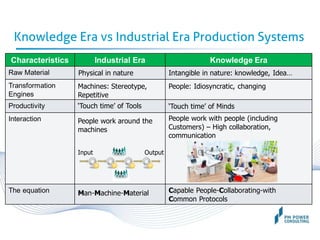
Knowledge Era vs Industrial Era Production Systems
Characteristics Industrial Era Knowledge Era
Raw Material
Transformation
Engines
Productivity
Interaction
The equation
Input Output
Intangible in nature: knowledge, Idea…Physical in nature
Machines: Stereotype,
Repetitive
‘Touch time’ of Tools
People: Idiosyncratic, changing
‘Touch time’ of Minds
People work around the
machines
People work with people (including
Customers) – High collaboration,
communication
Man-Machine-Material Capable People-Collaborating-with
Common Protocols
PARADIGM SHIFT 1
“Repeatable process to Contextual process”
7
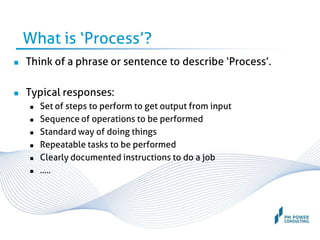
What is ‘Process’?
 Think of a phrase or sentence to describe ‘Process’.
 Typical responses:
 Set of steps to perform to get output from input
 Sequence of operations to be performed
 Standard way of doing things
 Repeatable tasks to be performed
 Clearly documented instructions to do a job
 …..
Game with Mathematics
1 1 1 = 6
2 2 2 = 6
3 3 3 = 6
4 4 4 = 6
5 5 5 = 6
6 6 6 = 6
7 7 7 = 6
8 8 8 = 6
9 9 9 = 6
Is this possible?
What Operations do you perform
to get this Consistent output?
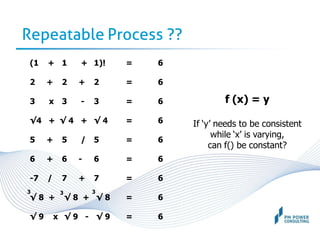
Repeatable Process ??
(1 + 1 + 1)! = 6
2 + 2 + 2 = 6
3 x 3 - 3 = 6
√4 + √ 4 + √ 4 = 6
5 + 5 / 5 = 6
6 + 6 - 6 = 6
-7 / 7 + 7 = 6
√ 8 + √ 8 + √ 8 = 6
√ 9 x √ 9 - √ 9 = 6
f (x) = y
If ‘y’ needs to be consistent
while ‘x’ is varying,
can f() be constant?
333
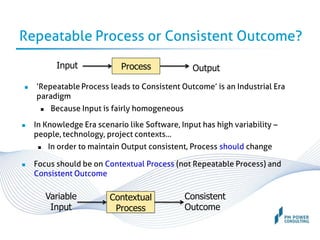
Repeatable Process or Consistent Outcome?
ProcessInput Output
 In Knowledge Era scenario like Software, Input has high variability –
people, technology, project contexts…
 In order to maintain Output consistent, Process should change
Contextual
Process
Variable
Input
Consistent
Outcome
 ‘Repeatable Process leads to Consistent Outcome’ is an Industrial Era
paradigm
 Because Input is fairly homogeneous
 Focus should be on Contextual Process (not Repeatable Process) and
Consistent Outcome
PARADIGM SHIFT 2
“Process-driven to Principles-driven”
12
How to ‘Manage’ when Variability & Diversity are
high?
 Productivity/Efficiency?
 Quality?
 Consistency/Repeatability?
 …
 Can we define ‘Rules’ and ‘Dos & Don’ts‘ for all possible cases?
 Values & Principles are the way
 Agile practices driven by principles & values
 ‘Simple Rules, Rich Relationships’
 Contextual Team-Process
 Innovation thrives in diversity
Defect Prevention context
 Most Defects relate to
Materials & Machines
 Number of Causes are
relatively less
 E.g. Poor Soldering
 Defect Fix is mostly physical in
nature
 E.g. Tune Temperature,
Voltage…
 Once fixed the machines stay
tuned
Industrial Era
 Most Defects relate to Human
Errors
 Number of Causes are relatively
large
 E.g. Poor Coding
 Defect Fix is mostly not physical
in nature
 E.g. Thinking, Communication,…
 Person’s characteristics
continuously change
Knowledge Era
One of the most important ways of Defect Prevention in Knowledge Era is taking
people through Experience/Learning:
– Learn & Adapt cycles in Agile; Short iterations; Retrospective
PARADIGM SHIFT 3
“Touch-time of tools to Touch-time of minds ”
15
Mind Switch Game
 Round 1
 Keep a timer for 30 seconds
 On number 1, keep adding number 3 successively for 30 sec
 Keep a timer for 30 seconds
 On number 1, keep adding number 4 successively for 30 sec
 Note down the total count of numbers
 Round 2
 Keep a timer for 60 seconds
 On number 1, keep adding numbers 3 & 4 alternatively in two
tables for 60 sec
 Note down the total count of numbers
 Observe count dropping by about 50% in round 2
16
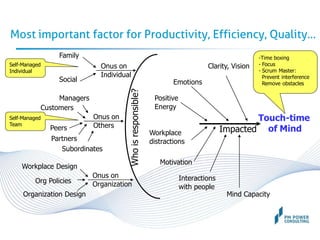
Most important factor for Productivity, Efficiency, Quality…
Touch-time
of MindImpacted
Clarity, Vision
Emotions
Motivation
Positive
Energy
Workplace
distractions
Mind Capacity
Interactions
with people
Whoisresponsible?
Onus on
Individual
Onus on
Others
Family
Social
Managers
Peers
Subordinates
Customers
Partners
Onus on
Organization
Workplace Design
Organization Design
Org Policies
Self-Managed
Individual
Self-Managed
Team
-Time boxing
- Focus
- Scrum Master:
Prevent interference
Remove obstacles
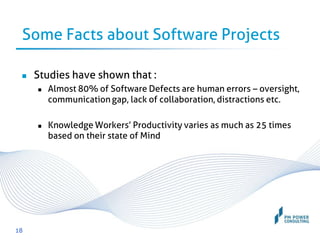
Some Facts about Software Projects
 Studies have shown that :
 Almost 80% of Software Defects are human errors – oversight,
communication gap, lack of collaboration, distractions etc.
 Knowledge Workers’ Productivity varies as much as 25 times
based on their state of Mind
18
PARADIGM SHIFT 4
“Supervised to Self-managed”
19
Management/Quality is more Intrinsic in
Knowledge Era
 A Construction industry analogy
 A prominent construction company has different supervisory ratios
 One Supervisor for every 25 civil construction laborers
 One supervisor for every 10 mechanical worker
 One supervisor for every 5 electrician
 Moral of the story: Higher the skilled labor, higher the supervision
needed !
 For Software Engineering ?
 So, by deduction, one supervisor for one engineer !!!
 In other words, PRACTICALLY, each Software Engineer needs to be
self-supervised
 Self managed individuals , Self managed teams
PARADIGM SHIFT 5
“Measuring to Sensing ”
21
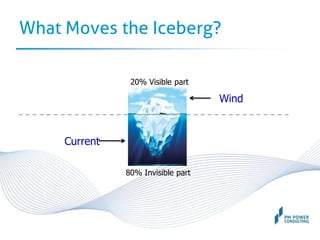
What Moves the Iceberg?
Wind
Current
20% Visible part
80% Invisible part
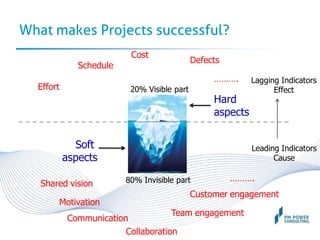
What makes Projects successful?
Hard
aspects
Soft
aspects
20% Visible part
80% Invisible part
Effort
Schedule
Cost
Defects
……….
……….
Shared vision
Motivation
Team engagement
Customer engagement
Communication
Collaboration
Lagging Indicators
Effect
Leading Indicators
Cause
Measurement Considerations
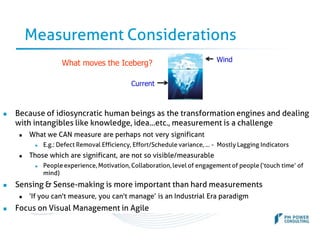
 Because of idiosyncratic human beings as the transformation engines and dealing
with intangibles like knowledge, idea…etc., measurement is a challenge
 What we CAN measure are perhaps not very significant
 E.g.: Defect Removal Efficiency, Effort/Schedule variance, … - Mostly Lagging Indicators
 Those which are significant, are not so visible/measurable
 People experience, Motivation, Collaboration, level of engagement of people (‘touch time’ of
mind)
 Sensing & Sense-making is more important than hard measurements
 ‘If you can't measure, you can't manage’ is an Industrial Era paradigm
 Focus on Visual Management in Agile
Wind
Current
What moves the Iceberg?
Fundamentals of Software Production
 In Software production we are dealing with
 Human beings as the transformation engines and
 Knowledge as the raw material
 ‘Touch time of minds’ is the key imperative for higher productivity
and quality
 Capable people Collaborating with Common protocol (process)
are the critical success factors
 Agile/Scrum practices harness these fundamentals effectively
 Agile methods are a good scaffolding to build Knowledge Era
Enterprises
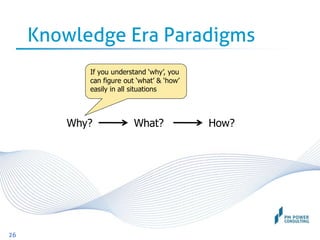
Knowledge Era Paradigms
26
Why? What? How?
If you understand ‘why’, you
can figure out ‘what’ & ‘how’
easily in all situations
Thank You
27

Knowledge Era Paradigms -agile indiaconf2016

  • 1.
    Knowledge Era Paradigms: FundamentalRationale behind Agile Agile India Conference Bangalore, Mar 2016 Vishu Hegde vishu@pm-powerconsulting.com
  • 2.
    Why Knowledge EraParadigms? 2 Why? What? How? Rationale behind Agile Values, Principles, Practices
  • 3.
    Brief history ofcivilization 3 Agricultural Era • Labour intensive • Local • Mass production / distribution Industrial Era • Mechanization, Mass production • Globalization, Manufacturingdriven economy • Product Design, innovation Knowledge Era • Extreme Globalization, Anytime-Anywhere (e.g. Internet) • Knowledge driven Industries, Economies • Thinking, Collective- wisdom “Everything in this world is done twice – once in the Mind and then in the outside world” – Stephen Covey Challenge in knowledge era is the first part – accuracy & speed of thinking, collective thinking
  • 4.
    Legacy of IndustrialEra  Current Management, Leadership, Quality Management philosophies in Software industry (e.g. CMM, Six Sigma, PMI) are influenced by the Industrial Era experiences  Improper application of mass production principles to design/creation principles  Knowledge Era products need a different approach on Quality, Management, Engineering – Human centric & Knowledge centric Industrial Era Product/Business20% 80% Knowledge Era Product/Business20%80% Design/Creation Intensive Mass-production & Distribution Intensive Management, Leadership, Quality Management, … CMMI, Six Sigma, PMI, …
  • 5.
     What isthe raw material for software?  It’s Knowledge/ Idea  Where does the transformation from raw material to finished product happen?  It’s in the Minds of people  Computer is only a tool to capture & facilitate the thoughts  How do we know then, how the transformation is happening?  Break the transformation into smaller steps  Bring visibility (e.g. pictures, documents, models, prototypes…)  What is the measuring equipment to verify whether transformation is happening correctly or not? (the calipers?)  Another knowledge body (e.g. peers, customers, experts…)  Collective wisdom (Peer Reviews, Brainstorming…)  Knowledge Era Product Engineering  From raw material to finished product, the object is not physical in nature. There are no Laws of Physics governing the engineering principles, like in Mechanical or Civil engineering The Paradigm Shift in Knowledge Era
  • 6.
    Knowledge Era vsIndustrial Era Production Systems Characteristics Industrial Era Knowledge Era Raw Material Transformation Engines Productivity Interaction The equation Input Output Intangible in nature: knowledge, Idea…Physical in nature Machines: Stereotype, Repetitive ‘Touch time’ of Tools People: Idiosyncratic, changing ‘Touch time’ of Minds People work around the machines People work with people (including Customers) – High collaboration, communication Man-Machine-Material Capable People-Collaborating-with Common Protocols
  • 7.
    PARADIGM SHIFT 1 “Repeatableprocess to Contextual process” 7
  • 8.
    What is ‘Process’? Think of a phrase or sentence to describe ‘Process’.  Typical responses:  Set of steps to perform to get output from input  Sequence of operations to be performed  Standard way of doing things  Repeatable tasks to be performed  Clearly documented instructions to do a job  …..
  • 9.
    Game with Mathematics 11 1 = 6 2 2 2 = 6 3 3 3 = 6 4 4 4 = 6 5 5 5 = 6 6 6 6 = 6 7 7 7 = 6 8 8 8 = 6 9 9 9 = 6 Is this possible? What Operations do you perform to get this Consistent output?
  • 10.
    Repeatable Process ?? (1+ 1 + 1)! = 6 2 + 2 + 2 = 6 3 x 3 - 3 = 6 √4 + √ 4 + √ 4 = 6 5 + 5 / 5 = 6 6 + 6 - 6 = 6 -7 / 7 + 7 = 6 √ 8 + √ 8 + √ 8 = 6 √ 9 x √ 9 - √ 9 = 6 f (x) = y If ‘y’ needs to be consistent while ‘x’ is varying, can f() be constant? 333
  • 11.
    Repeatable Process orConsistent Outcome? ProcessInput Output  In Knowledge Era scenario like Software, Input has high variability – people, technology, project contexts…  In order to maintain Output consistent, Process should change Contextual Process Variable Input Consistent Outcome  ‘Repeatable Process leads to Consistent Outcome’ is an Industrial Era paradigm  Because Input is fairly homogeneous  Focus should be on Contextual Process (not Repeatable Process) and Consistent Outcome
  • 12.
    PARADIGM SHIFT 2 “Process-drivento Principles-driven” 12
  • 13.
    How to ‘Manage’when Variability & Diversity are high?  Productivity/Efficiency?  Quality?  Consistency/Repeatability?  …  Can we define ‘Rules’ and ‘Dos & Don’ts‘ for all possible cases?  Values & Principles are the way  Agile practices driven by principles & values  ‘Simple Rules, Rich Relationships’  Contextual Team-Process  Innovation thrives in diversity
  • 14.
    Defect Prevention context Most Defects relate to Materials & Machines  Number of Causes are relatively less  E.g. Poor Soldering  Defect Fix is mostly physical in nature  E.g. Tune Temperature, Voltage…  Once fixed the machines stay tuned Industrial Era  Most Defects relate to Human Errors  Number of Causes are relatively large  E.g. Poor Coding  Defect Fix is mostly not physical in nature  E.g. Thinking, Communication,…  Person’s characteristics continuously change Knowledge Era One of the most important ways of Defect Prevention in Knowledge Era is taking people through Experience/Learning: – Learn & Adapt cycles in Agile; Short iterations; Retrospective
  • 15.
    PARADIGM SHIFT 3 “Touch-timeof tools to Touch-time of minds ” 15
  • 16.
    Mind Switch Game Round 1  Keep a timer for 30 seconds  On number 1, keep adding number 3 successively for 30 sec  Keep a timer for 30 seconds  On number 1, keep adding number 4 successively for 30 sec  Note down the total count of numbers  Round 2  Keep a timer for 60 seconds  On number 1, keep adding numbers 3 & 4 alternatively in two tables for 60 sec  Note down the total count of numbers  Observe count dropping by about 50% in round 2 16
  • 17.
    Most important factorfor Productivity, Efficiency, Quality… Touch-time of MindImpacted Clarity, Vision Emotions Motivation Positive Energy Workplace distractions Mind Capacity Interactions with people Whoisresponsible? Onus on Individual Onus on Others Family Social Managers Peers Subordinates Customers Partners Onus on Organization Workplace Design Organization Design Org Policies Self-Managed Individual Self-Managed Team -Time boxing - Focus - Scrum Master: Prevent interference Remove obstacles
  • 18.
    Some Facts aboutSoftware Projects  Studies have shown that :  Almost 80% of Software Defects are human errors – oversight, communication gap, lack of collaboration, distractions etc.  Knowledge Workers’ Productivity varies as much as 25 times based on their state of Mind 18
  • 19.
    PARADIGM SHIFT 4 “Supervisedto Self-managed” 19
  • 20.
    Management/Quality is moreIntrinsic in Knowledge Era  A Construction industry analogy  A prominent construction company has different supervisory ratios  One Supervisor for every 25 civil construction laborers  One supervisor for every 10 mechanical worker  One supervisor for every 5 electrician  Moral of the story: Higher the skilled labor, higher the supervision needed !  For Software Engineering ?  So, by deduction, one supervisor for one engineer !!!  In other words, PRACTICALLY, each Software Engineer needs to be self-supervised  Self managed individuals , Self managed teams
  • 21.
  • 22.
    What Moves theIceberg? Wind Current 20% Visible part 80% Invisible part
  • 23.
    What makes Projectssuccessful? Hard aspects Soft aspects 20% Visible part 80% Invisible part Effort Schedule Cost Defects ………. ………. Shared vision Motivation Team engagement Customer engagement Communication Collaboration Lagging Indicators Effect Leading Indicators Cause
  • 24.
    Measurement Considerations  Becauseof idiosyncratic human beings as the transformation engines and dealing with intangibles like knowledge, idea…etc., measurement is a challenge  What we CAN measure are perhaps not very significant  E.g.: Defect Removal Efficiency, Effort/Schedule variance, … - Mostly Lagging Indicators  Those which are significant, are not so visible/measurable  People experience, Motivation, Collaboration, level of engagement of people (‘touch time’ of mind)  Sensing & Sense-making is more important than hard measurements  ‘If you can't measure, you can't manage’ is an Industrial Era paradigm  Focus on Visual Management in Agile Wind Current What moves the Iceberg?
  • 25.
    Fundamentals of SoftwareProduction  In Software production we are dealing with  Human beings as the transformation engines and  Knowledge as the raw material  ‘Touch time of minds’ is the key imperative for higher productivity and quality  Capable people Collaborating with Common protocol (process) are the critical success factors  Agile/Scrum practices harness these fundamentals effectively  Agile methods are a good scaffolding to build Knowledge Era Enterprises
  • 26.
    Knowledge Era Paradigms 26 Why?What? How? If you understand ‘why’, you can figure out ‘what’ & ‘how’ easily in all situations
  • 27.