Converting R to PMML
Villu Ruusmann
Openscoring OÜ
"Train once, deploy anywhere"
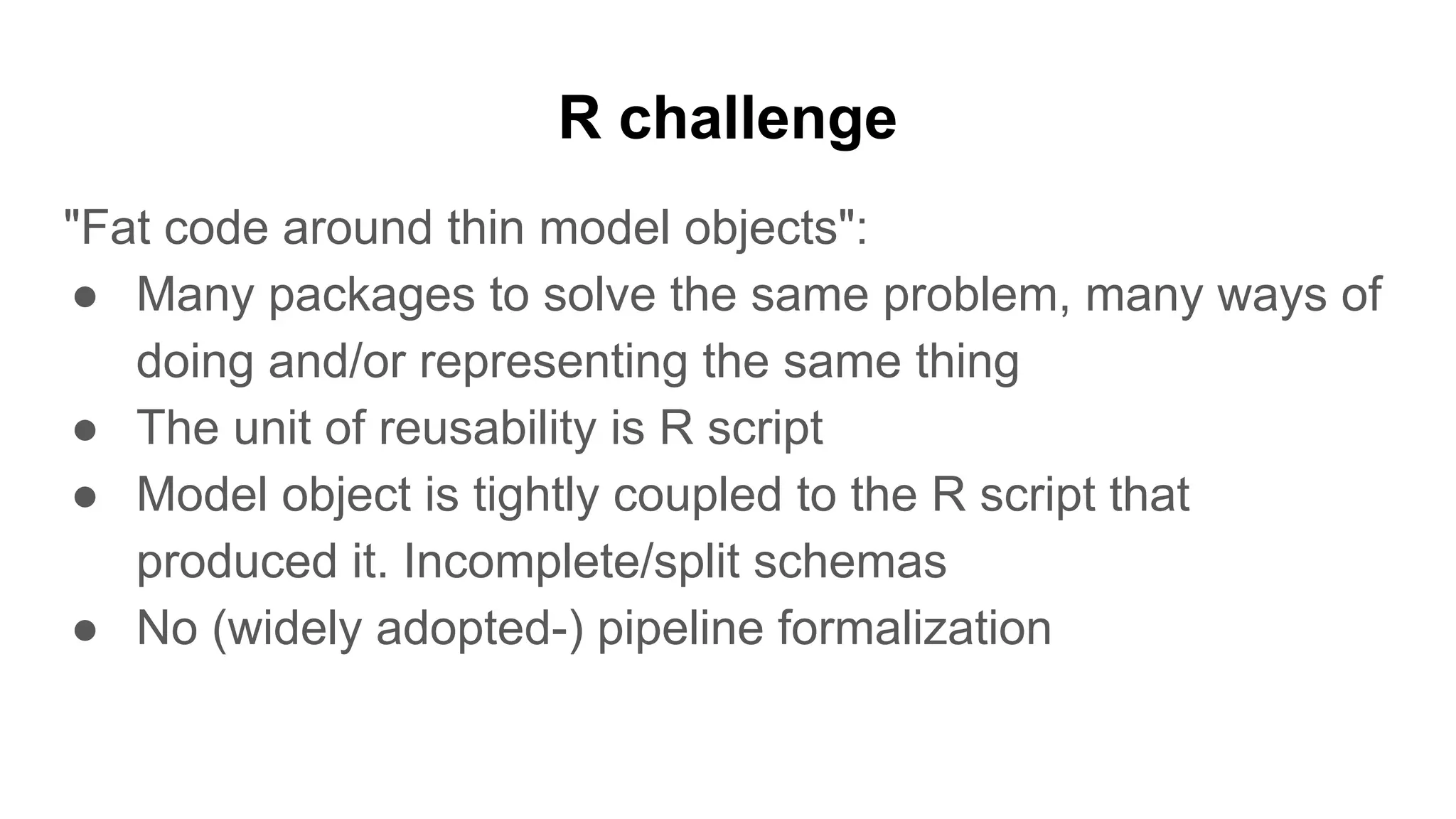
R challenge
"Fat code around thin model objects":
● Many packages to solve the same problem, many ways of
doing and/or representing the same thing
● The unit of reusability is R script
● Model object is tightly coupled to the R script that
produced it. Incomplete/split schemas
● No (widely adopted-) pipeline formalization
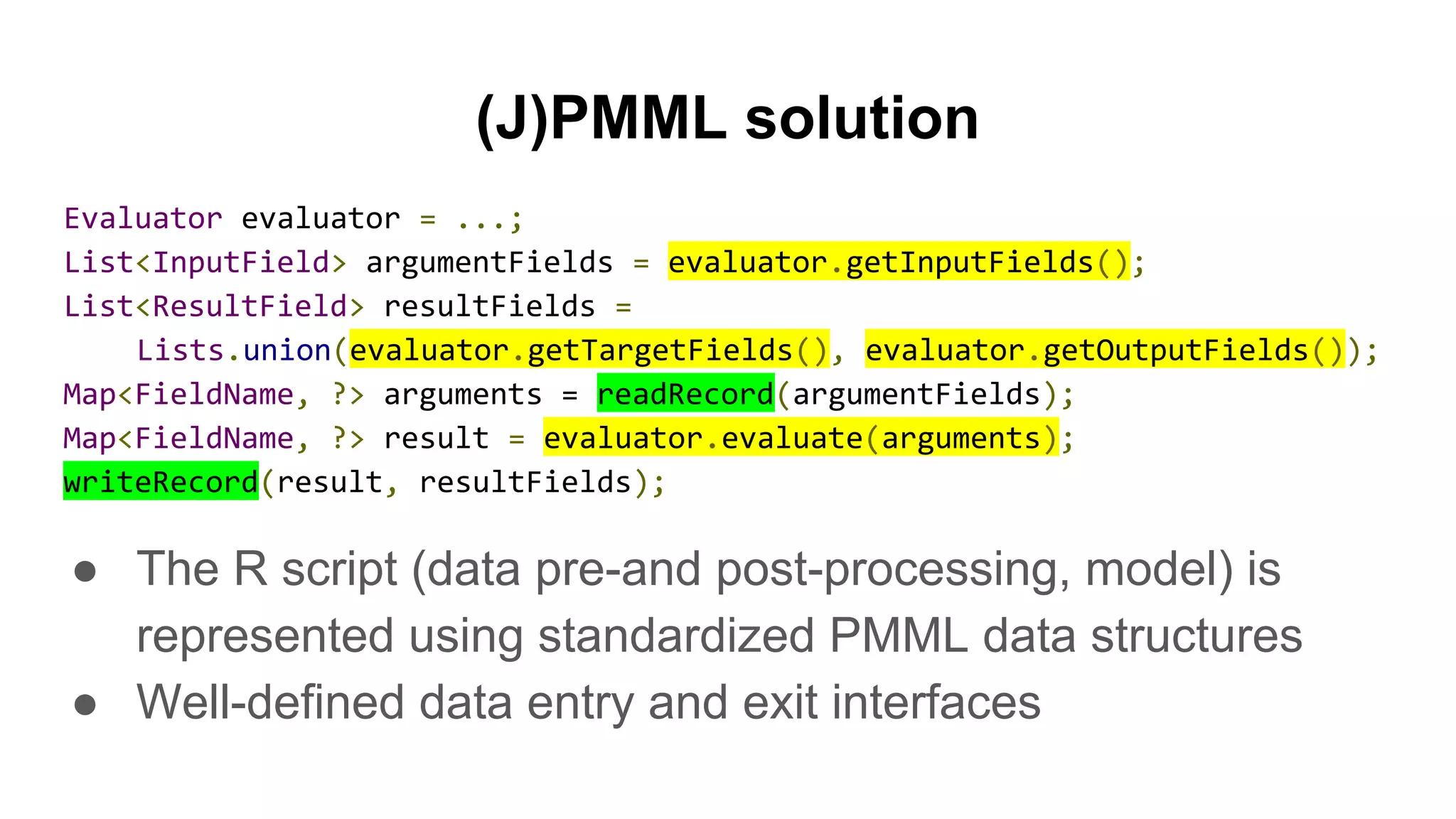
(J)PMML solution
Evaluator evaluator = ...;
List<InputField> argumentFields = evaluator.getInputFields();
List<ResultField> resultFields =
Lists.union(evaluator.getTargetFields(), evaluator.getOutputFields());
Map<FieldName, ?> arguments = readRecord(argumentFields);
Map<FieldName, ?> result = evaluator.evaluate(arguments);
writeRecord(result, resultFields);
● The R script (data pre-and post-processing, model) is
represented using standardized PMML data structures
● Well-defined data entry and exit interfaces
Workflow
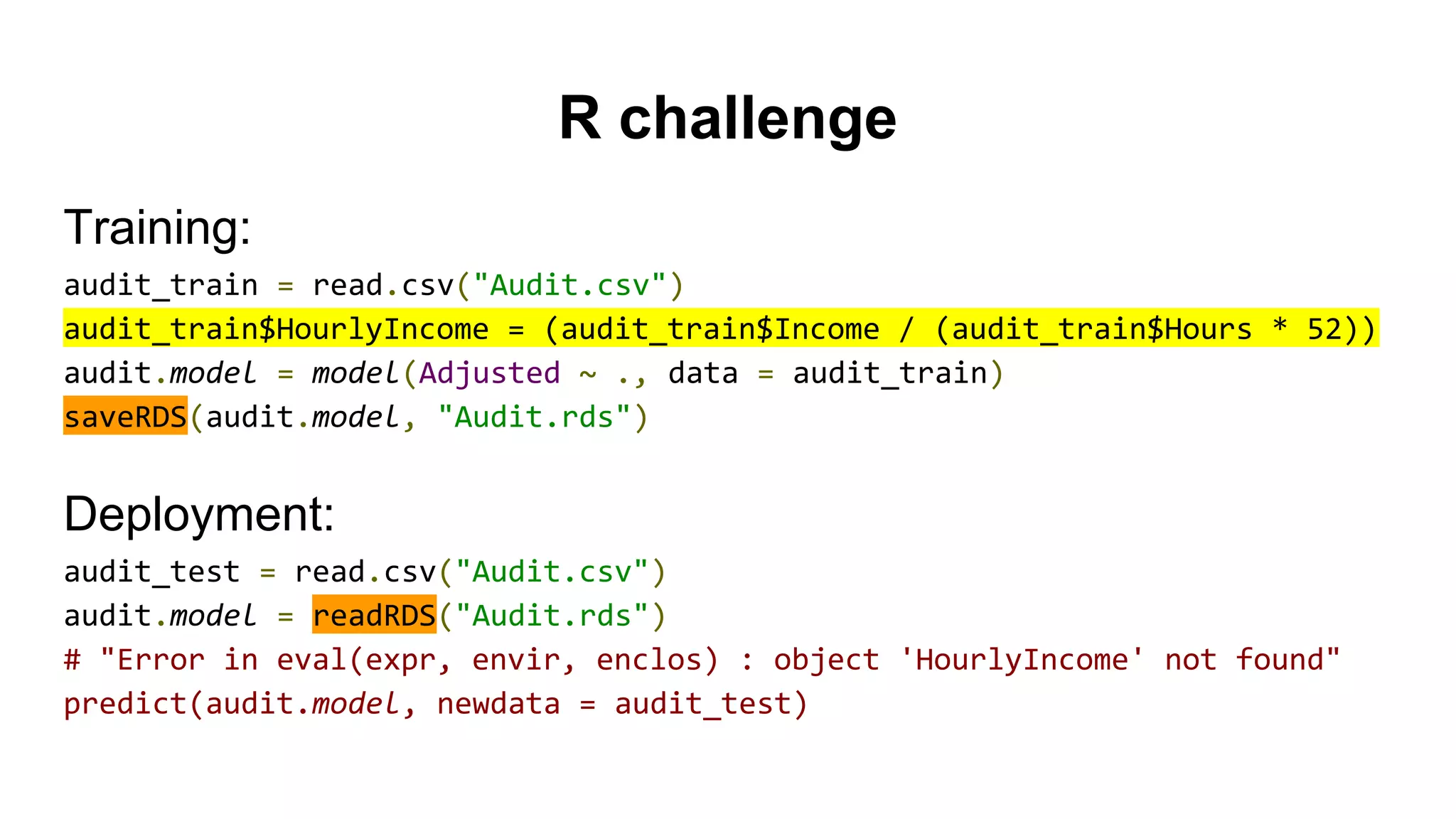
R challenge
Training:
audit_train = read.csv("Audit.csv")
audit_train$HourlyIncome = (audit_train$Income / (audit_train$Hours * 52))
audit.model = model(Adjusted ~ ., data = audit_train)
saveRDS(audit.model, "Audit.rds")
Deployment:
audit_test = read.csv("Audit.csv")
audit.model = readRDS("Audit.rds")
# "Error in eval(expr, envir, enclos) : object 'HourlyIncome' not found"
predict(audit.model, newdata = audit_test)
R solution
Matrix interface ( ):
label = audit$Adjusted
features = audit[, !(colnames(audit) %in% c("Adjusted"))]
# Returns a `model` object
audit.model = model(x = features, y = label)
Formula interface ( ):
# Returns a `model.formula` object
audit.model = model(Adjusted ~ . + I(Income / (Hours * 52)), data = audit)
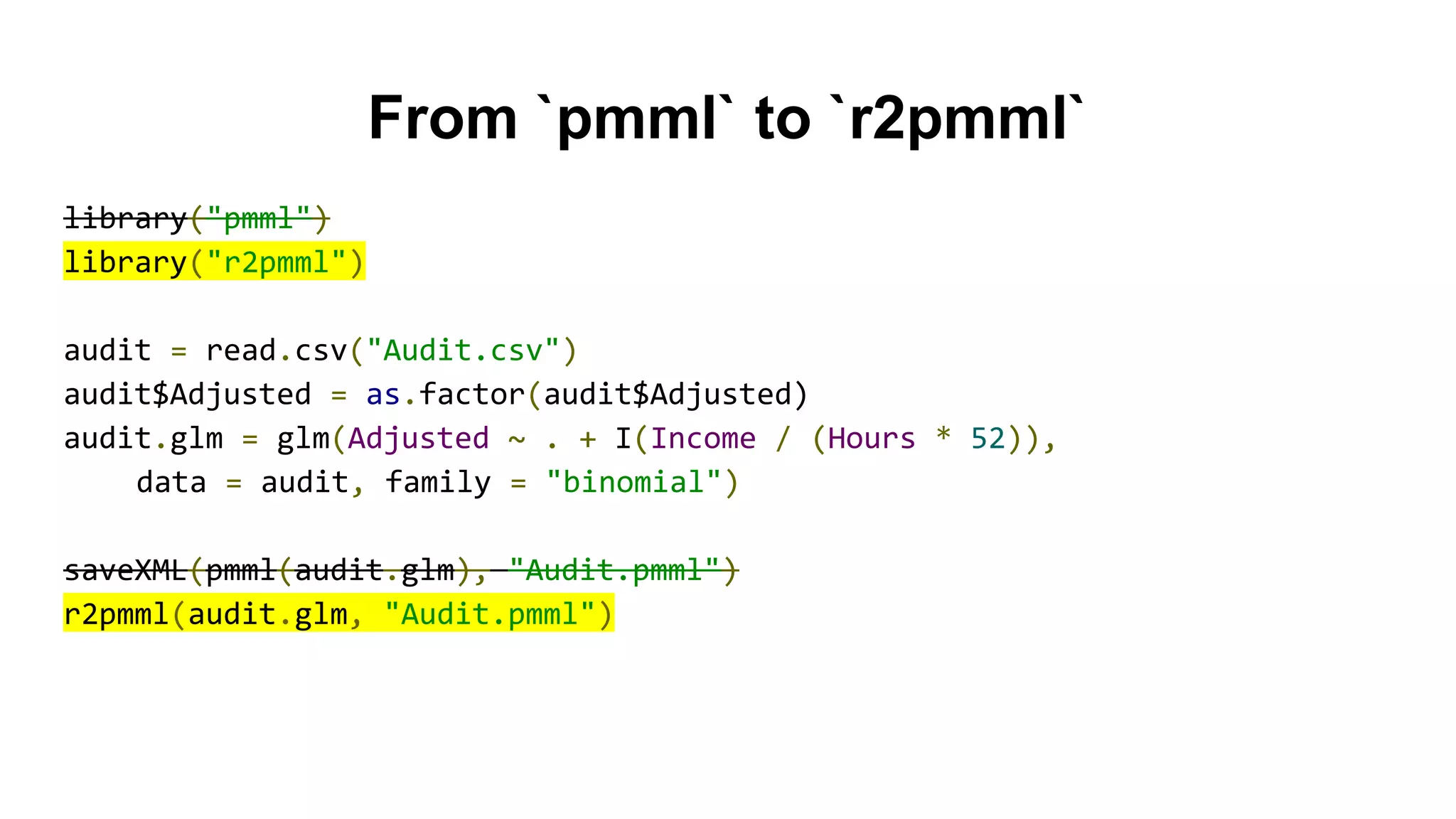
From `pmml` to `r2pmml`
library("pmml")
library("r2pmml")
audit = read.csv("Audit.csv")
audit$Adjusted = as.factor(audit$Adjusted)
audit.glm = glm(Adjusted ~ . + I(Income / (Hours * 52)),
data = audit, family = "binomial")
saveXML(pmml(audit.glm), "Audit.pmml")
r2pmml(audit.glm, "Audit.pmml")
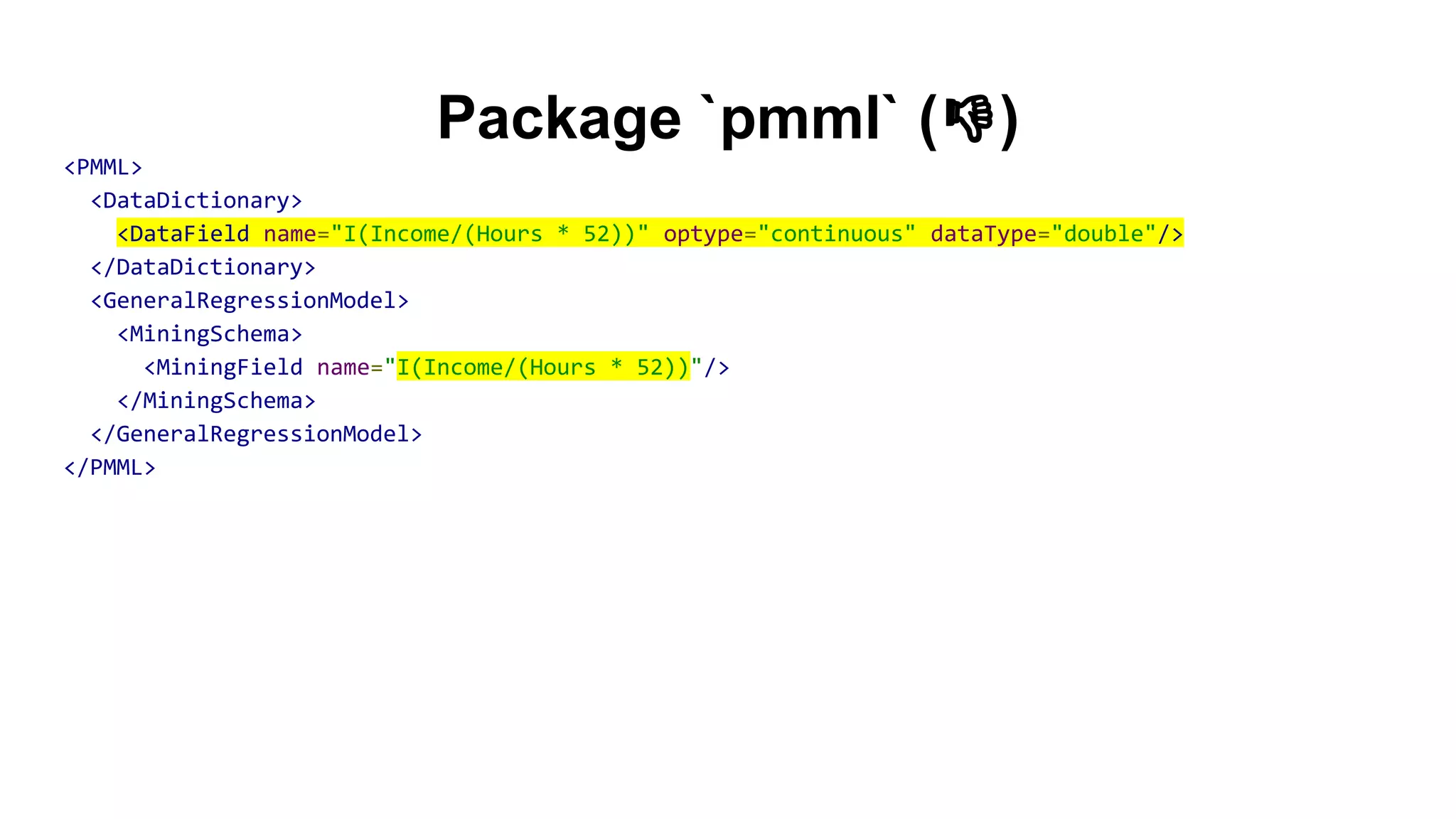
Package `pmml` ( )
<PMML>
<DataDictionary>
<DataField name="I(Income/(Hours * 52))" optype="continuous" dataType="double"/>
</DataDictionary>
<GeneralRegressionModel>
<MiningSchema>
<MiningField name="I(Income/(Hours * 52))"/>
</MiningSchema>
</GeneralRegressionModel>
</PMML>
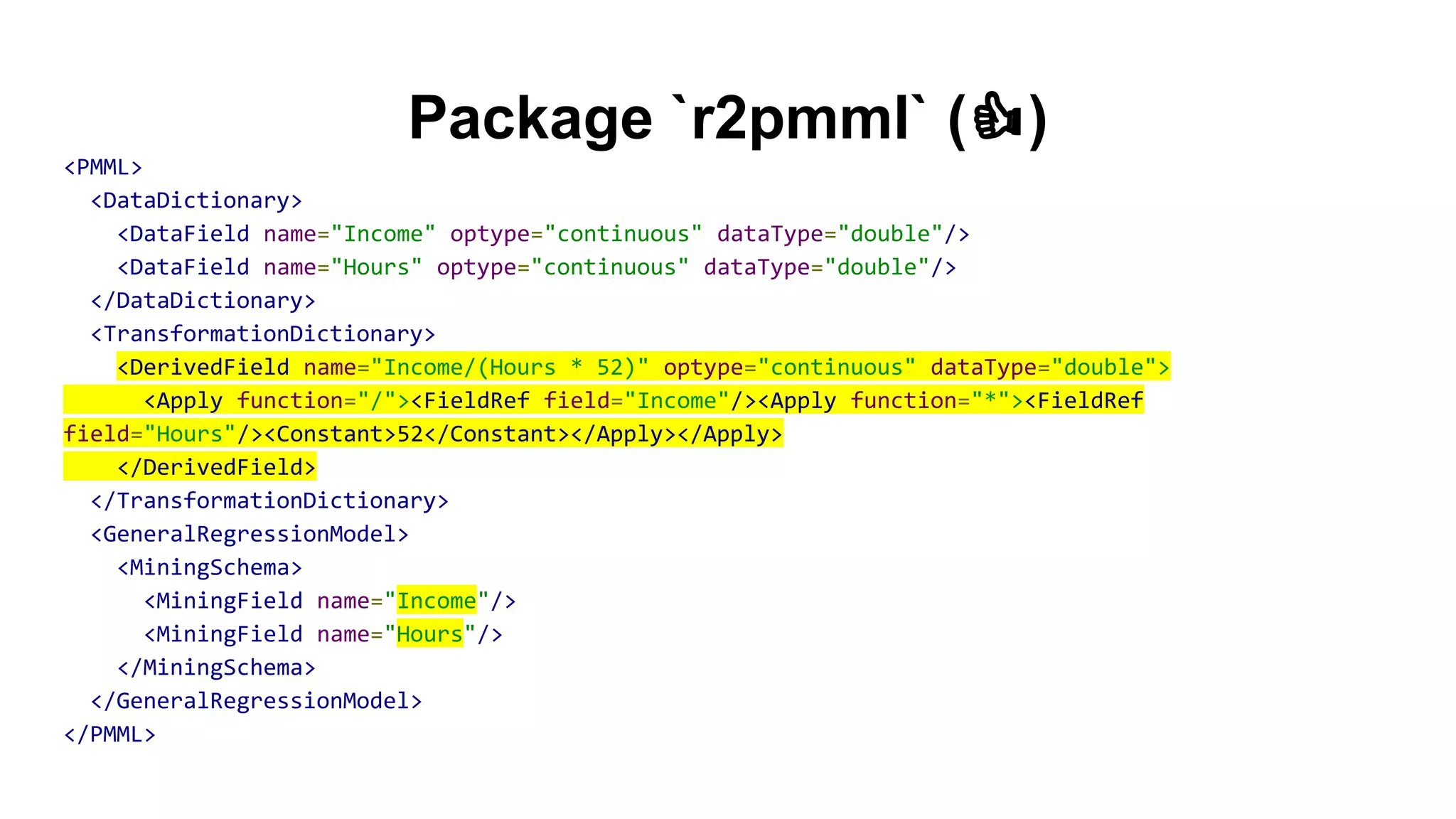
Package `r2pmml` ( )
<PMML>
<DataDictionary>
<DataField name="Income" optype="continuous" dataType="double"/>
<DataField name="Hours" optype="continuous" dataType="double"/>
</DataDictionary>
<TransformationDictionary>
<DerivedField name="Income/(Hours * 52)" optype="continuous" dataType="double">
<Apply function="/"><FieldRef field="Income"/><Apply function="*"><FieldRef
field="Hours"/><Constant>52</Constant></Apply></Apply>
</DerivedField>
</TransformationDictionary>
<GeneralRegressionModel>
<MiningSchema>
<MiningField name="Income"/>
<MiningField name="Hours"/>
</MiningSchema>
</GeneralRegressionModel>
</PMML>
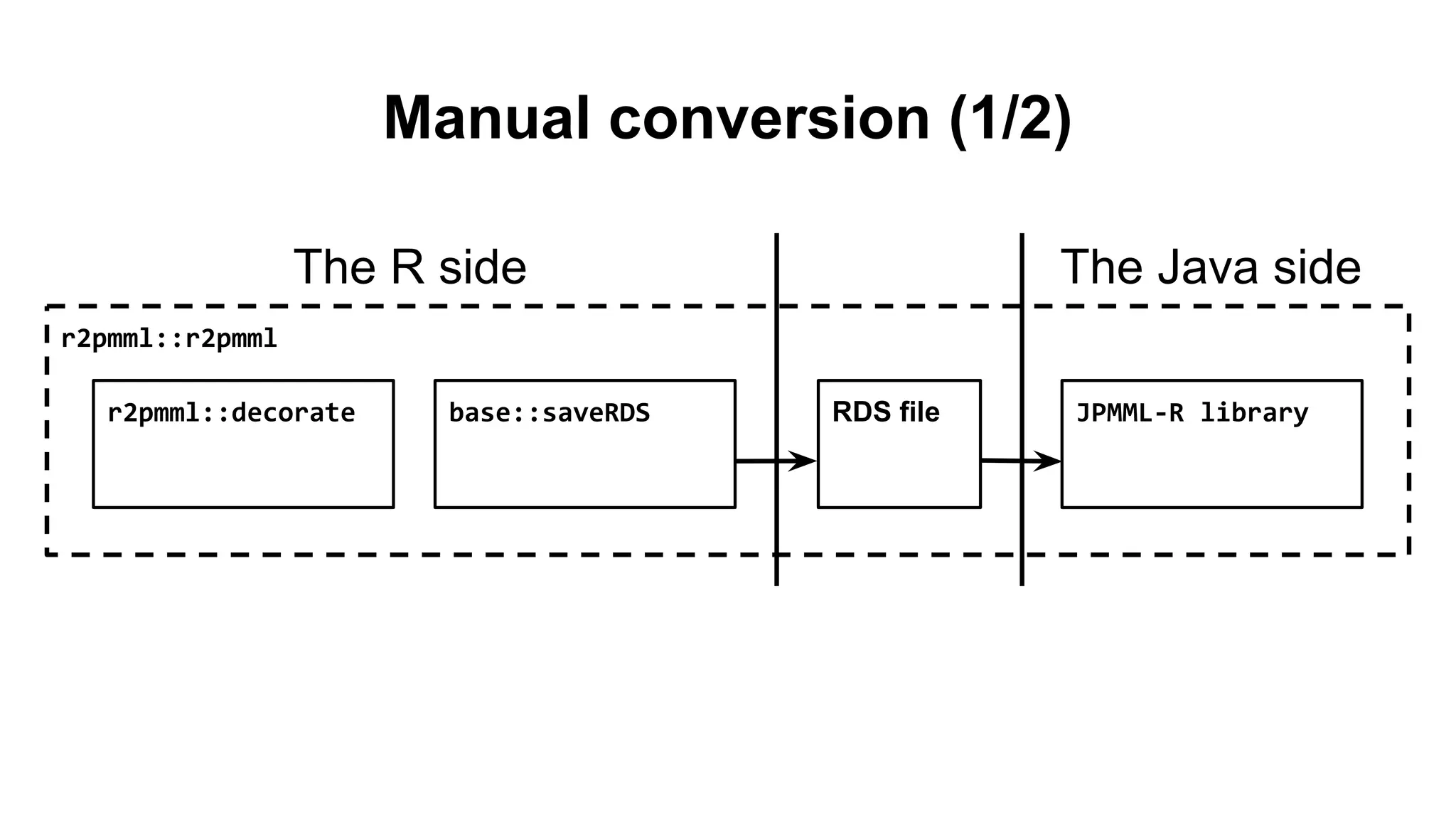
Manual conversion (1/2)
r2pmml::r2pmml
r2pmml::decorate base::saveRDS RDS file JPMML-R library
The R side The Java side
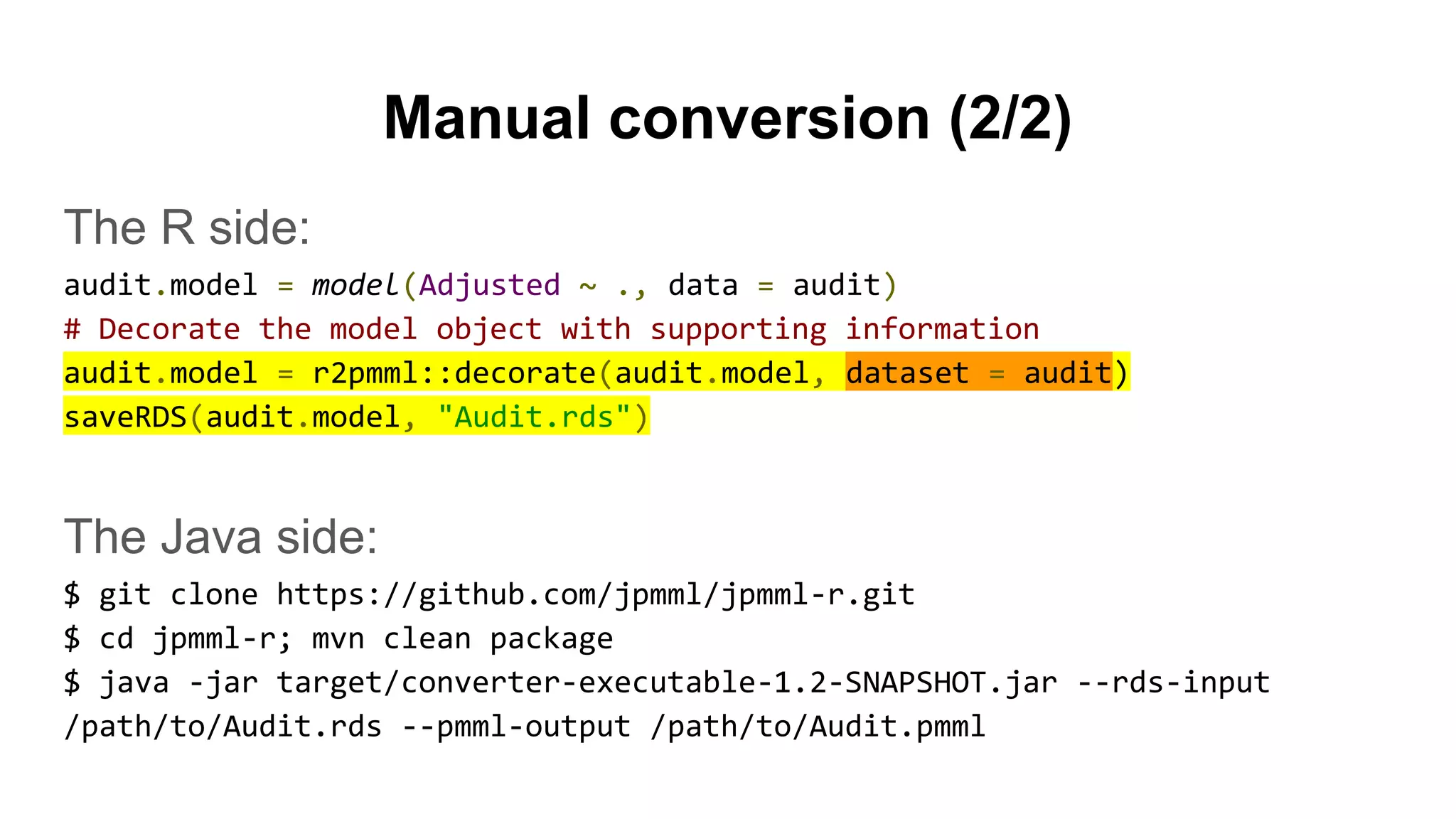
Manual conversion (2/2)
The R side:
audit.model = model(Adjusted ~ ., data = audit)
# Decorate the model object with supporting information
audit.model = r2pmml::decorate(audit.model, dataset = audit)
saveRDS(audit.model, "Audit.rds")
The Java side:
$ git clone https://github.com/jpmml/jpmml-r.git
$ cd jpmml-r; mvn clean package
$ java -jar target/converter-executable-1.2-SNAPSHOT.jar --rds-input
/path/to/Audit.rds --pmml-output /path/to/Audit.pmml
In-formula feature engineering
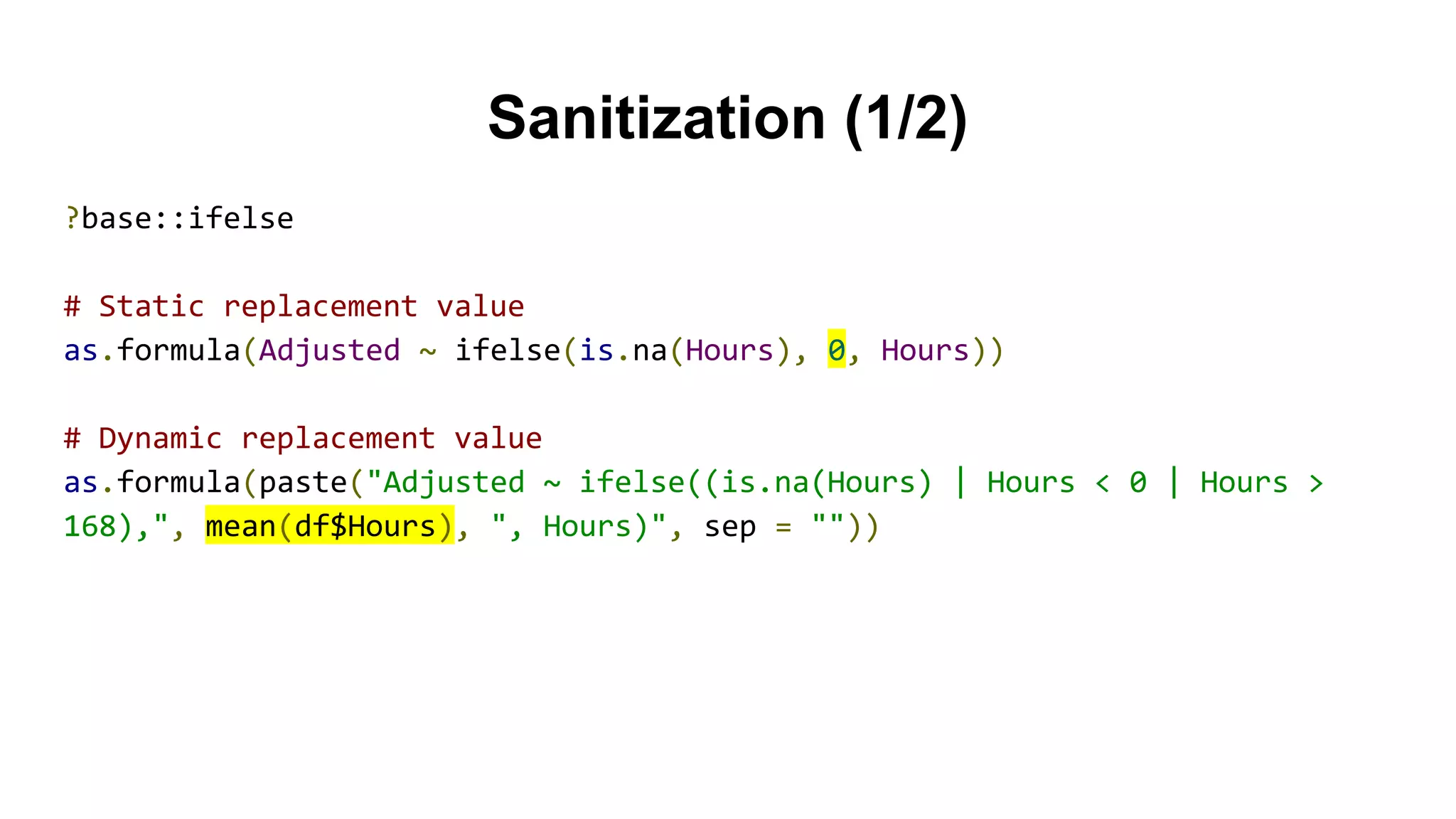
Sanitization (1/2)
?base::ifelse
# Static replacement value
as.formula(Adjusted ~ ifelse(is.na(Hours), 0, Hours))
# Dynamic replacement value
as.formula(paste("Adjusted ~ ifelse((is.na(Hours) | Hours < 0 | Hours >
168),", mean(df$Hours), ", Hours)", sep = ""))
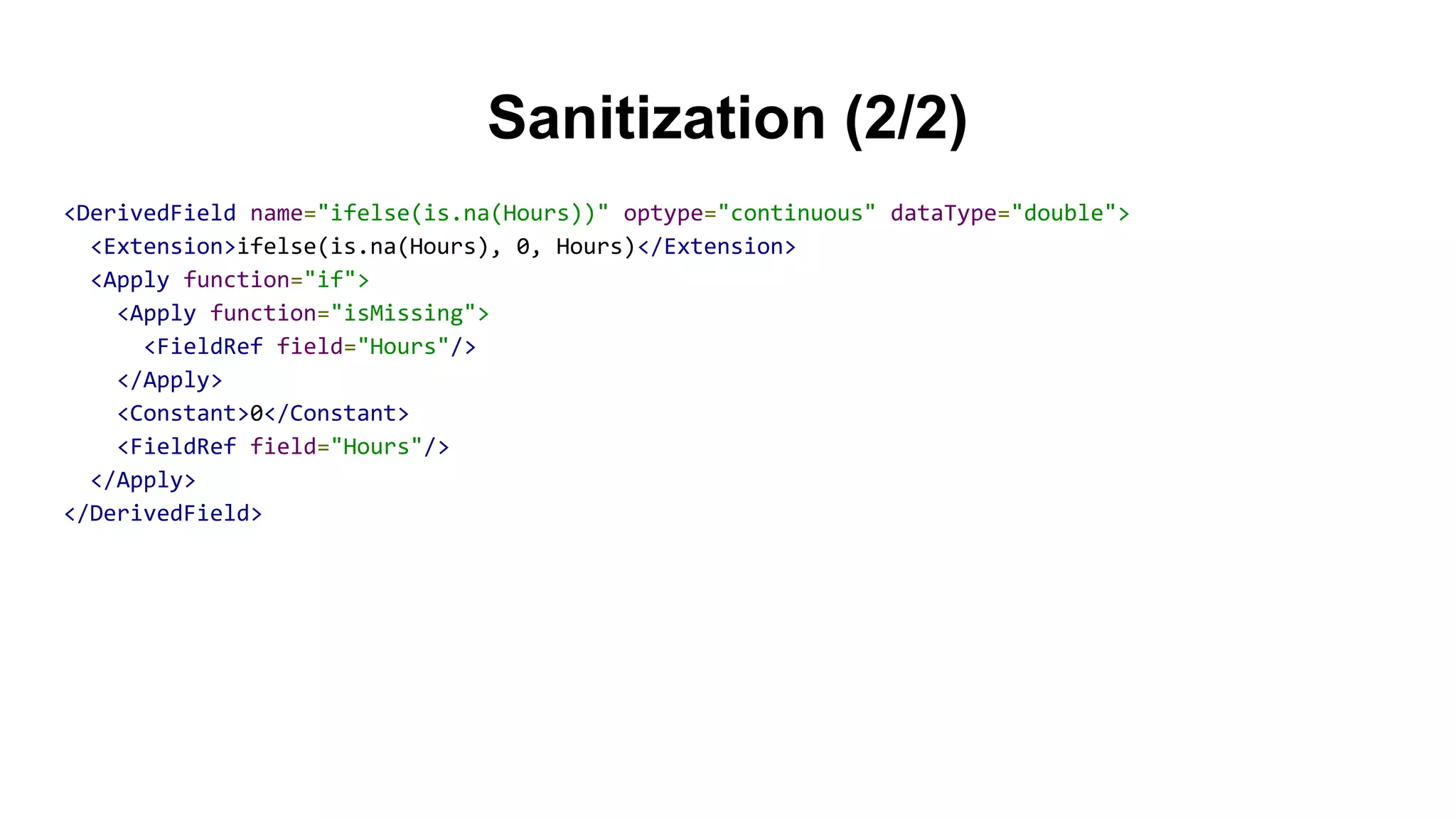
Sanitization (2/2)
<DerivedField name="ifelse(is.na(Hours))" optype="continuous" dataType="double">
<Extension>ifelse(is.na(Hours), 0, Hours)</Extension>
<Apply function="if">
<Apply function="isMissing">
<FieldRef field="Hours"/>
</Apply>
<Constant>0</Constant>
<FieldRef field="Hours"/>
</Apply>
</DerivedField>
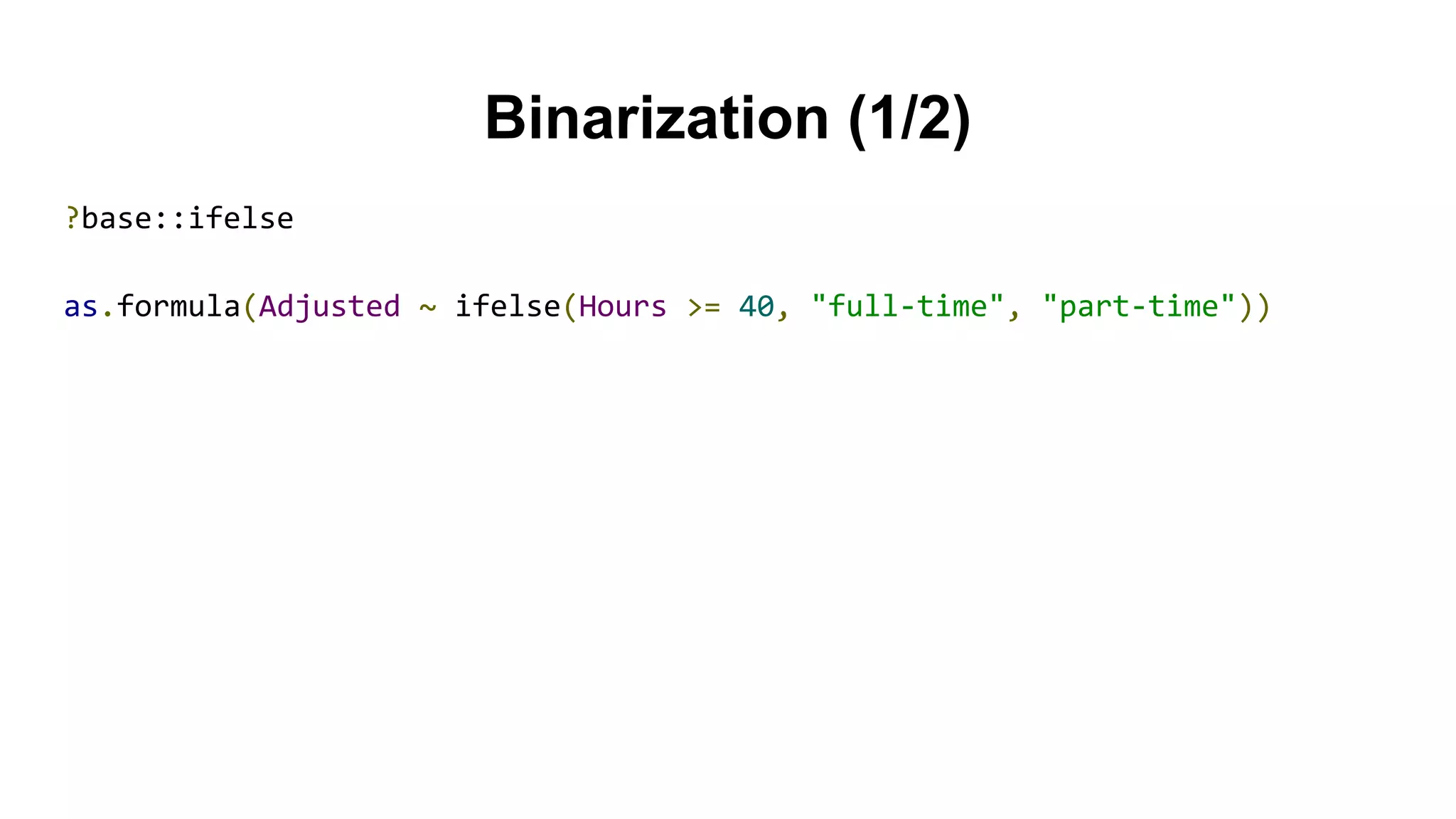
Binarization (1/2)
?base::ifelse
as.formula(Adjusted ~ ifelse(Hours >= 40, "full-time", "part-time"))
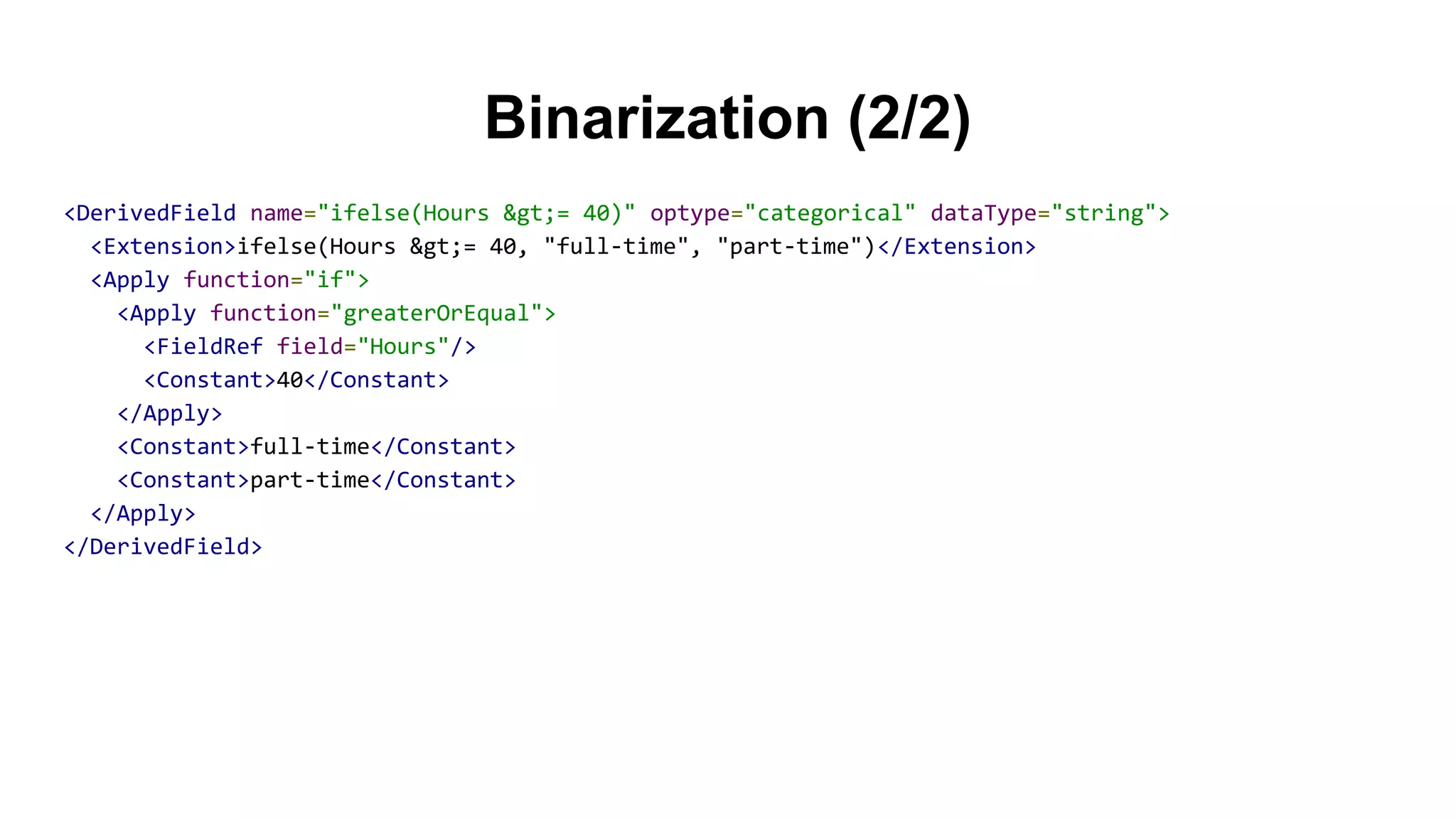
Binarization (2/2)
<DerivedField name="ifelse(Hours &gt;= 40)" optype="categorical" dataType="string">
<Extension>ifelse(Hours &gt;= 40, "full-time", "part-time")</Extension>
<Apply function="if">
<Apply function="greaterOrEqual">
<FieldRef field="Hours"/>
<Constant>40</Constant>
</Apply>
<Constant>full-time</Constant>
<Constant>part-time</Constant>
</Apply>
</DerivedField>
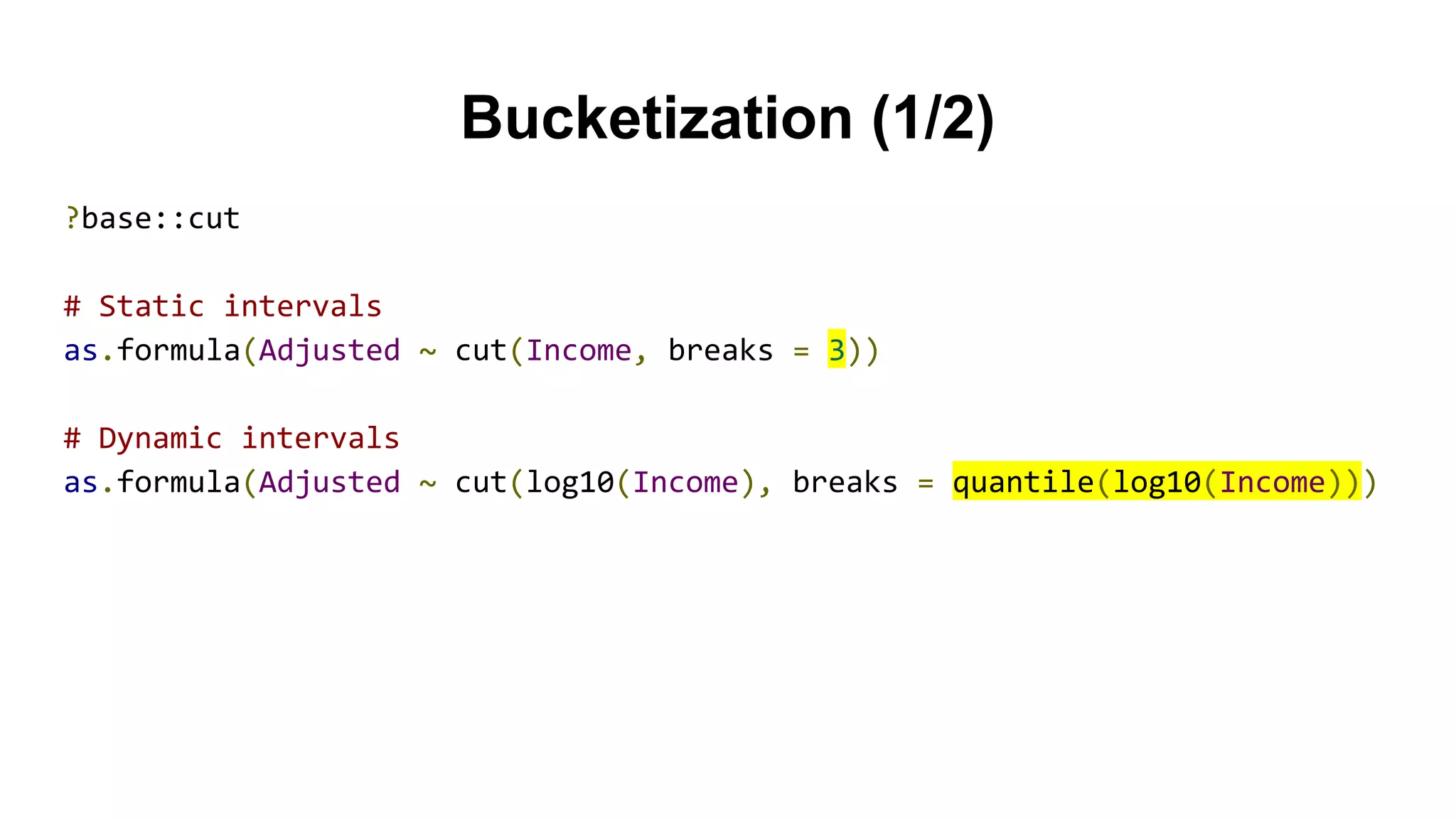
Bucketization (1/2)
?base::cut
# Static intervals
as.formula(Adjusted ~ cut(Income, breaks = 3))
# Dynamic intervals
as.formula(Adjusted ~ cut(log10(Income), breaks = quantile(log10(Income)))
Bucketization (2/2)
<DerivedField name="cut(Income)" optype="categorical" dataType="string">
<Extension>cut(Income, breaks = 3)</Extension>
<Discretize field="Income">
<DiscretizeBin binValue="(129,1.61e+05]">
<Interval closure="openClosed" leftMargin="129.0" rightMargin="161000.0"/>
</DiscretizeBin>
<DiscretizeBin binValue="(1.61e+05,3.21e+05]">
<Interval closure="openClosed" leftMargin="161000.0" rightMargin="321000.0"/>
</DiscretizeBin>
<DiscretizeBin binValue="(3.21e+05,4.82e+05]">
<Interval closure="openClosed" leftMargin="321000.0" rightMargin="482000.0"/>
</DiscretizeBin>
</Discretize>
</DerivedField>
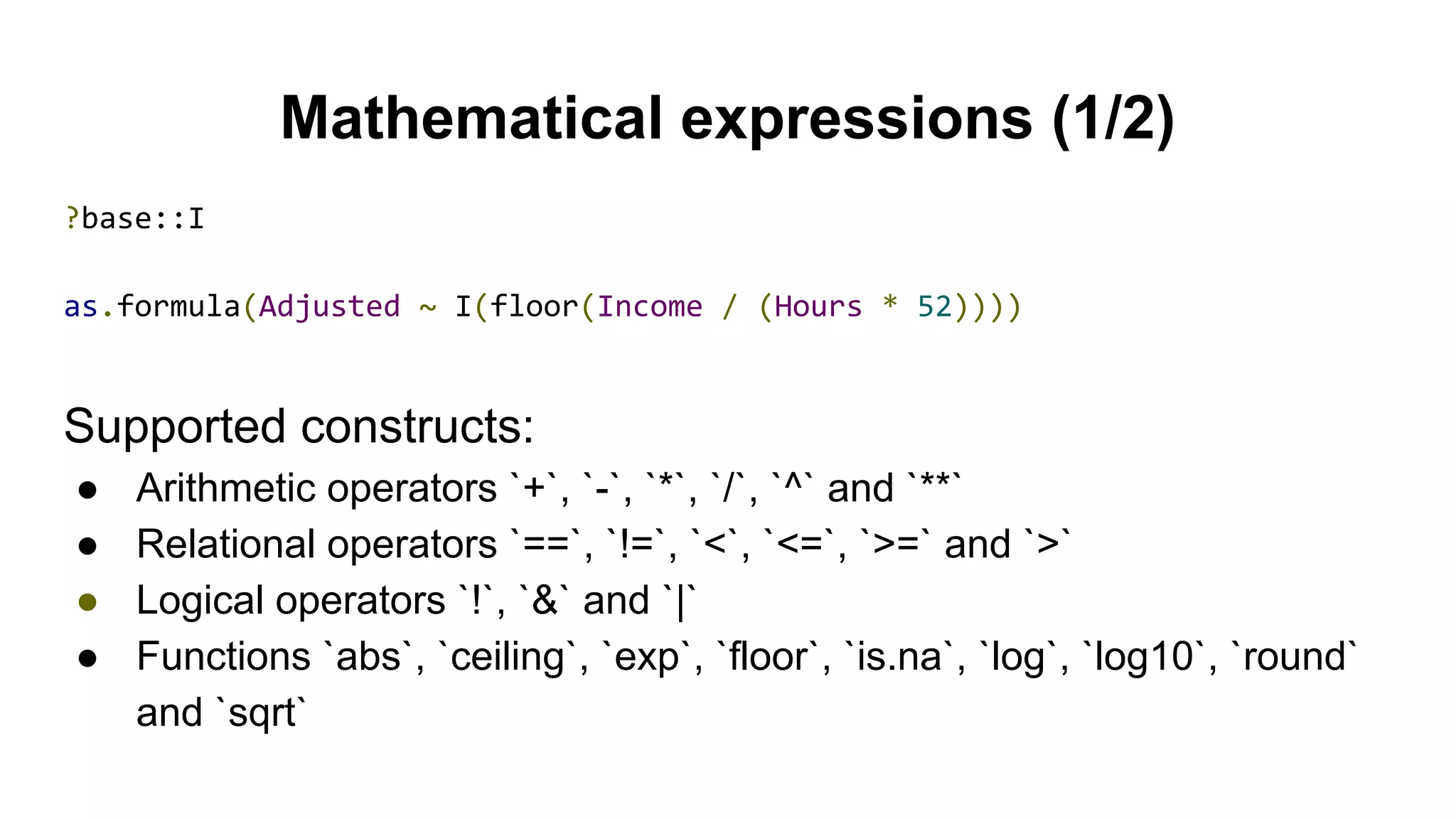
Mathematical expressions (1/2)
?base::I
as.formula(Adjusted ~ I(floor(Income / (Hours * 52))))
Supported constructs:
● Arithmetic operators `+`, `-`, `*`, `/`, `^` and `**`
● Relational operators `==`, `!=`, `<`, `<=`, `>=` and `>`
● Logical operators `!`, `&` and `|`
● Functions `abs`, `ceiling`, `exp`, `floor`, `is.na`, `log`, `log10`, `round`
and `sqrt`
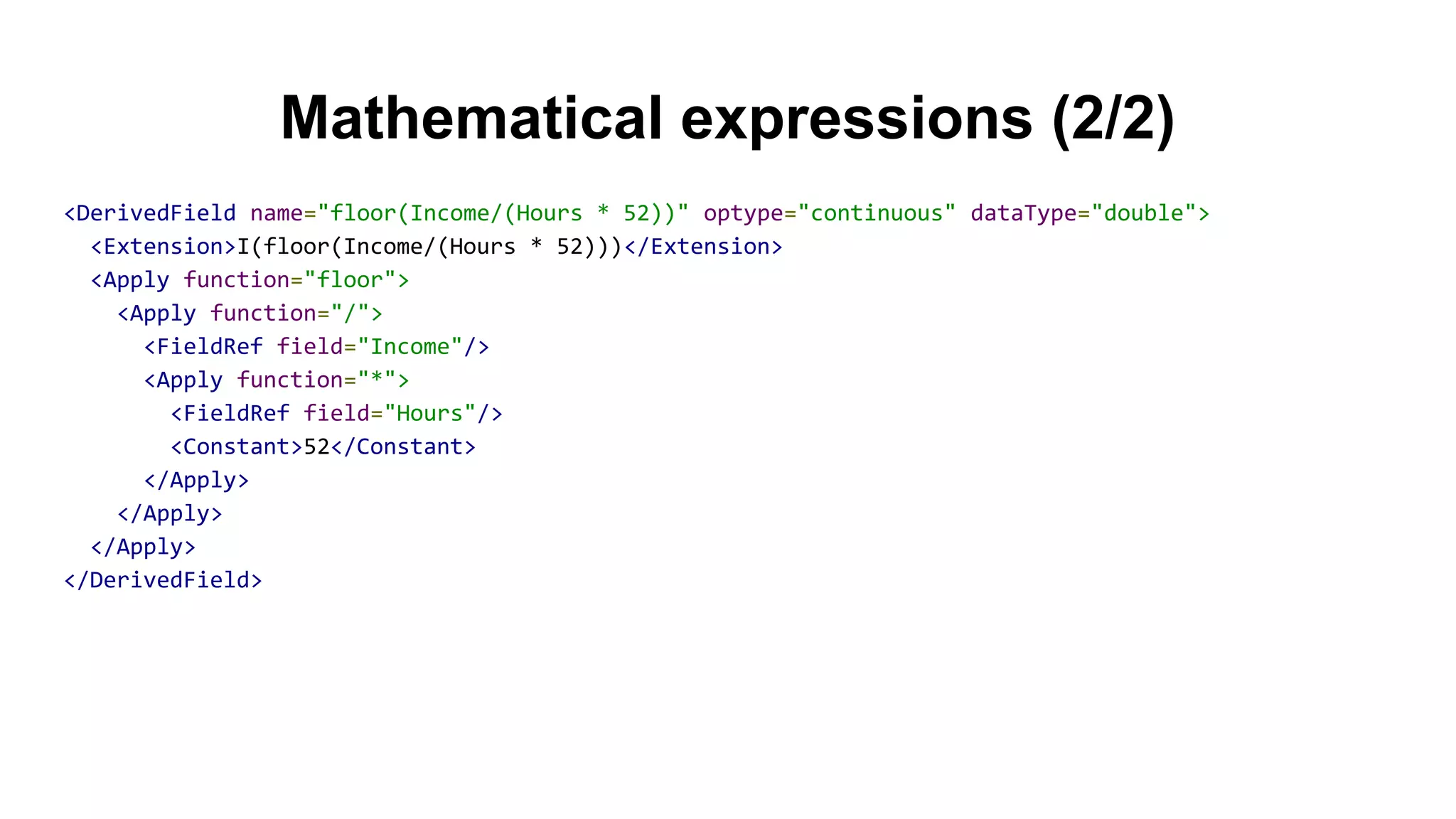
Mathematical expressions (2/2)
<DerivedField name="floor(Income/(Hours * 52))" optype="continuous" dataType="double">
<Extension>I(floor(Income/(Hours * 52)))</Extension>
<Apply function="floor">
<Apply function="/">
<FieldRef field="Income"/>
<Apply function="*">
<FieldRef field="Hours"/>
<Constant>52</Constant>
</Apply>
</Apply>
</Apply>
</DerivedField>
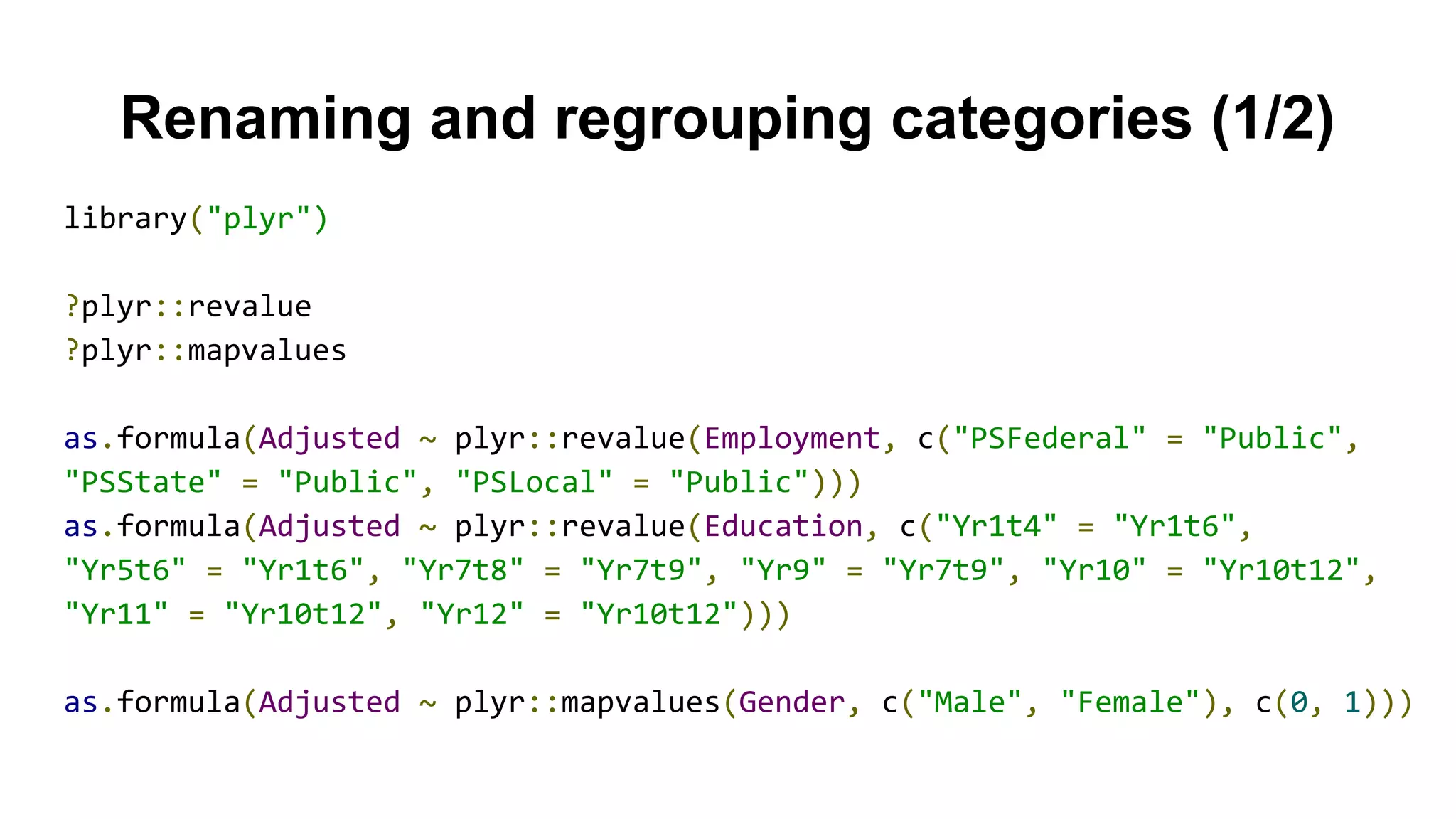
Renaming and regrouping categories (1/2)
library("plyr")
?plyr::revalue
?plyr::mapvalues
as.formula(Adjusted ~ plyr::revalue(Employment, c("PSFederal" = "Public",
"PSState" = "Public", "PSLocal" = "Public")))
as.formula(Adjusted ~ plyr::revalue(Education, c("Yr1t4" = "Yr1t6",
"Yr5t6" = "Yr1t6", "Yr7t8" = "Yr7t9", "Yr9" = "Yr7t9", "Yr10" = "Yr10t12",
"Yr11" = "Yr10t12", "Yr12" = "Yr10t12")))
as.formula(Adjusted ~ plyr::mapvalues(Gender, c("Male", "Female"), c(0, 1)))
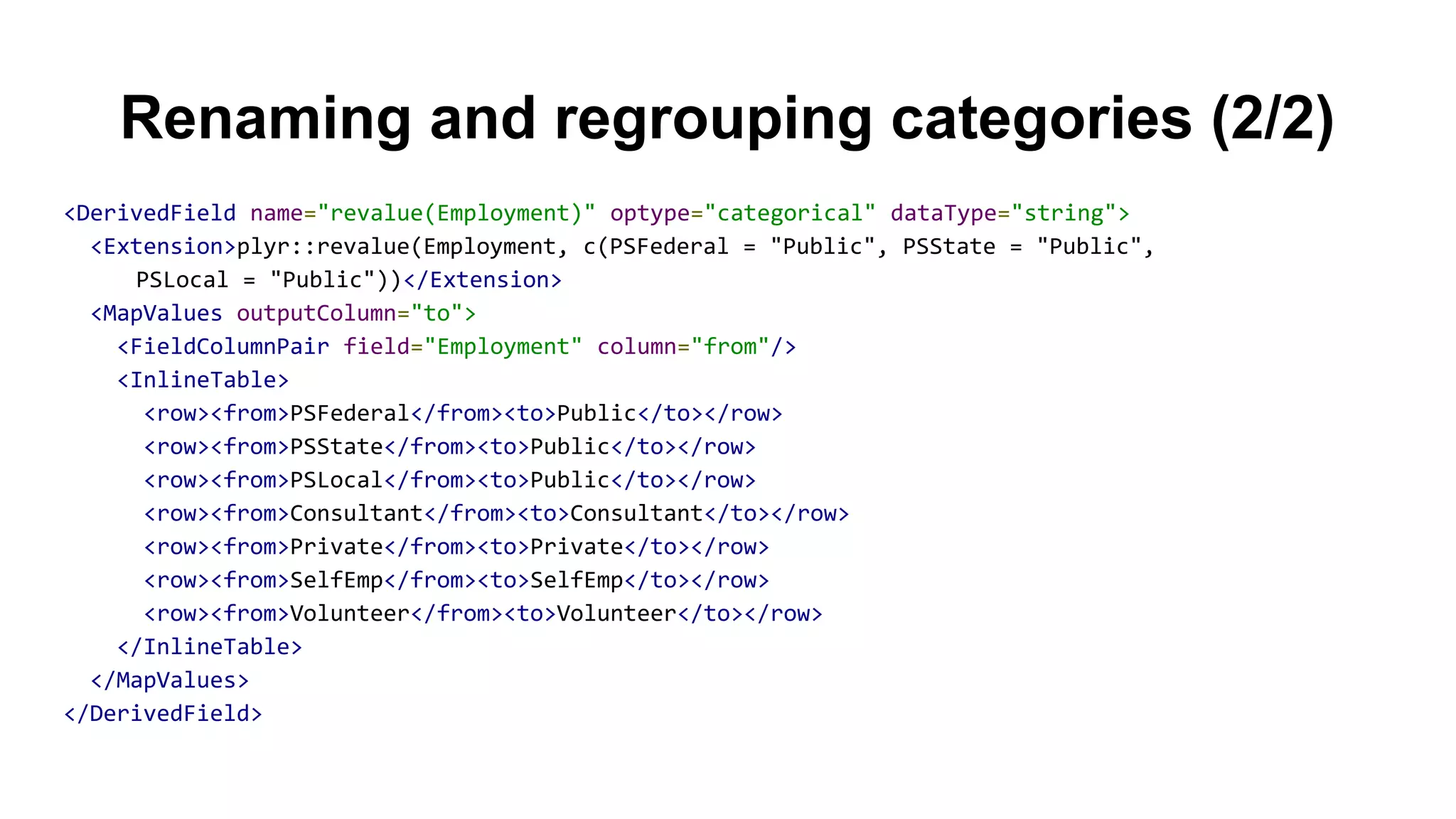
Renaming and regrouping categories (2/2)
<DerivedField name="revalue(Employment)" optype="categorical" dataType="string">
<Extension>plyr::revalue(Employment, c(PSFederal = "Public", PSState = "Public",
PSLocal = "Public"))</Extension>
<MapValues outputColumn="to">
<FieldColumnPair field="Employment" column="from"/>
<InlineTable>
<row><from>PSFederal</from><to>Public</to></row>
<row><from>PSState</from><to>Public</to></row>
<row><from>PSLocal</from><to>Public</to></row>
<row><from>Consultant</from><to>Consultant</to></row>
<row><from>Private</from><to>Private</to></row>
<row><from>SelfEmp</from><to>SelfEmp</to></row>
<row><from>Volunteer</from><to>Volunteer</to></row>
</InlineTable>
</MapValues>
</DerivedField>
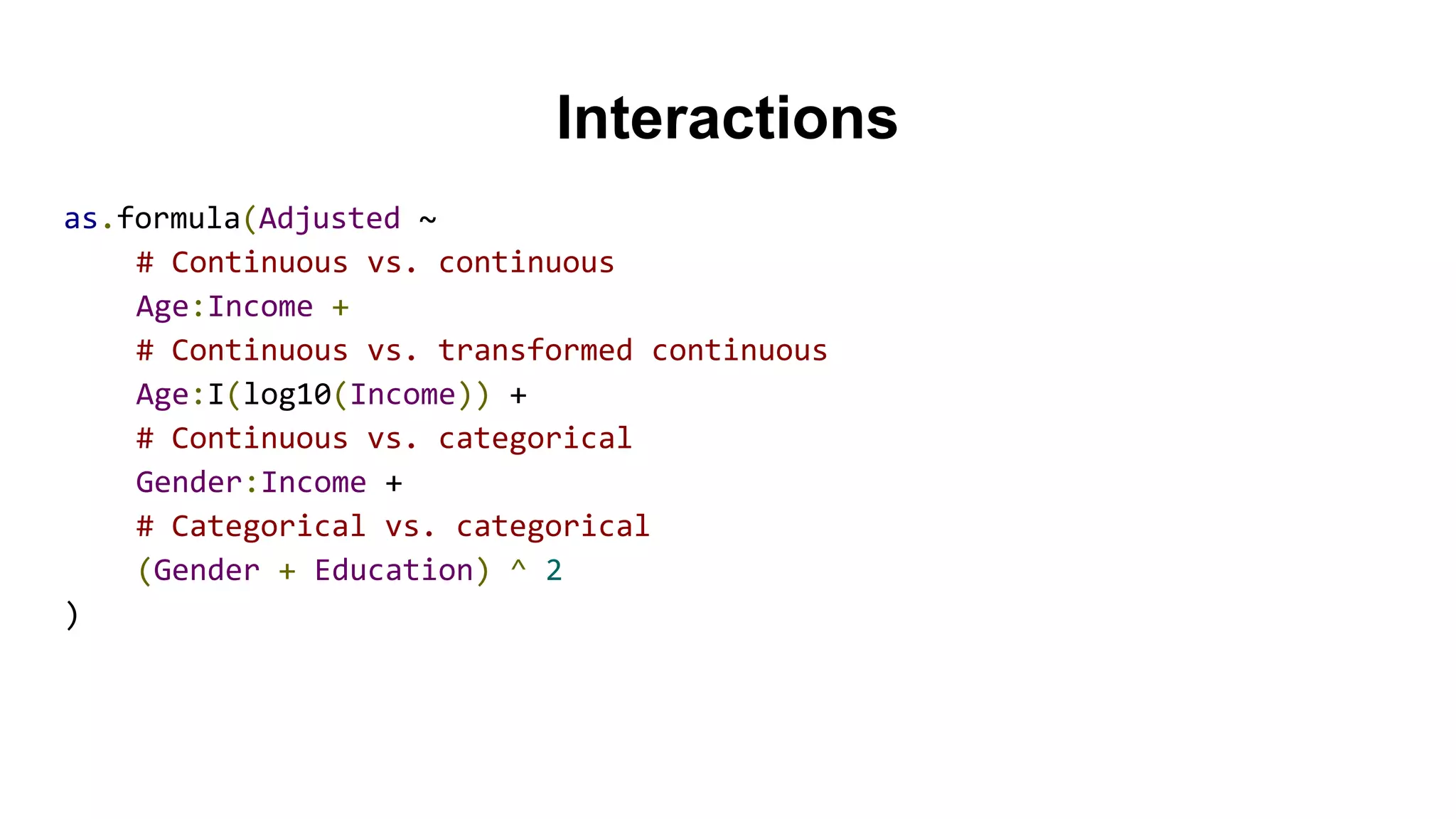
Interactions
as.formula(Adjusted ~
# Continuous vs. continuous
Age:Income +
# Continuous vs. transformed continuous
Age:I(log10(Income)) +
# Continuous vs. categorical
Gender:Income +
# Categorical vs. categorical
(Gender + Education) ^ 2
)
Estimator fitting
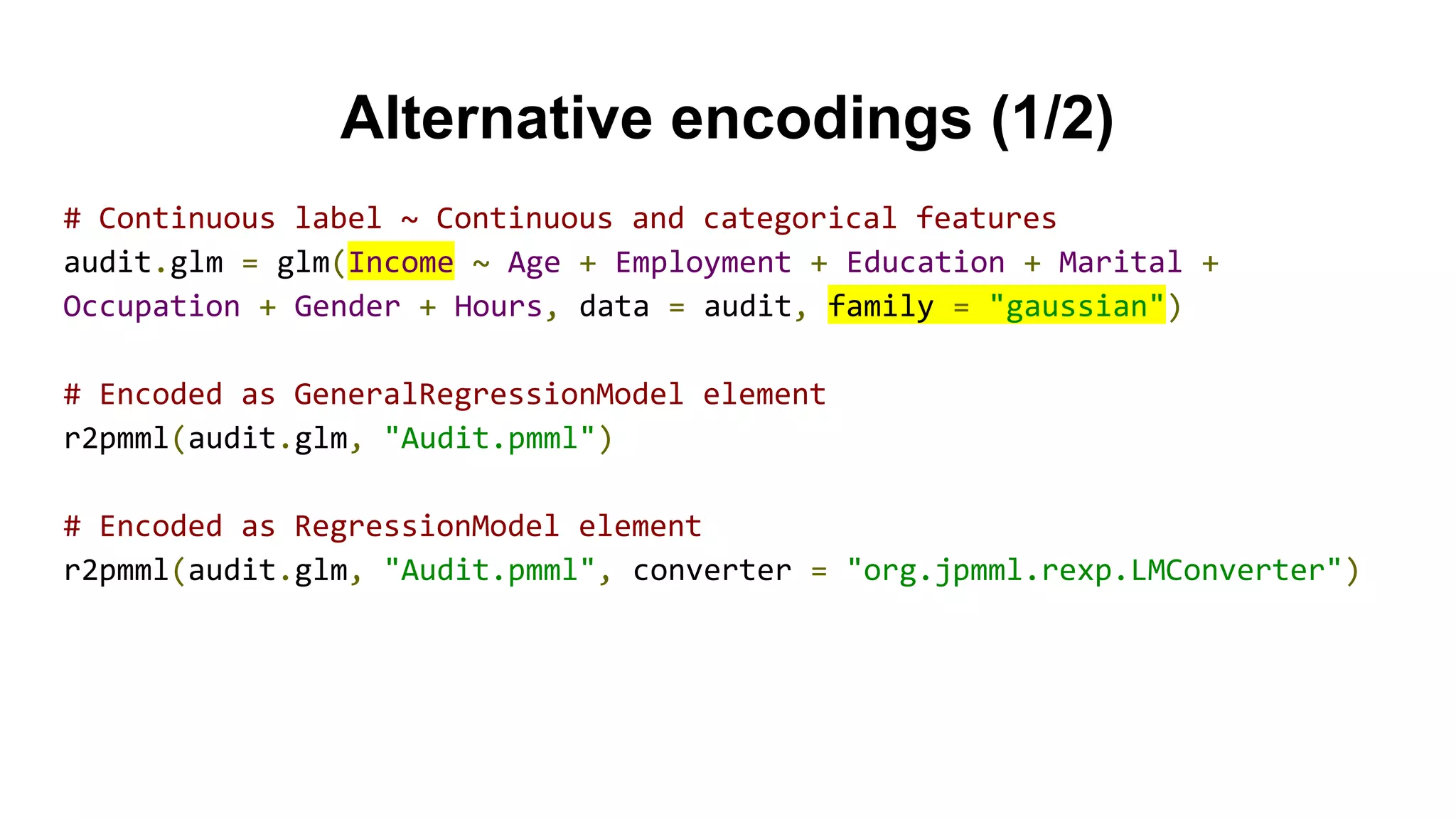
Alternative encodings (1/2)
# Continuous label ~ Continuous and categorical features
audit.glm = glm(Income ~ Age + Employment + Education + Marital +
Occupation + Gender + Hours, data = audit, family = "gaussian")
# Encoded as GeneralRegressionModel element
r2pmml(audit.glm, "Audit.pmml")
# Encoded as RegressionModel element
r2pmml(audit.glm, "Audit.pmml", converter = "org.jpmml.rexp.LMConverter")
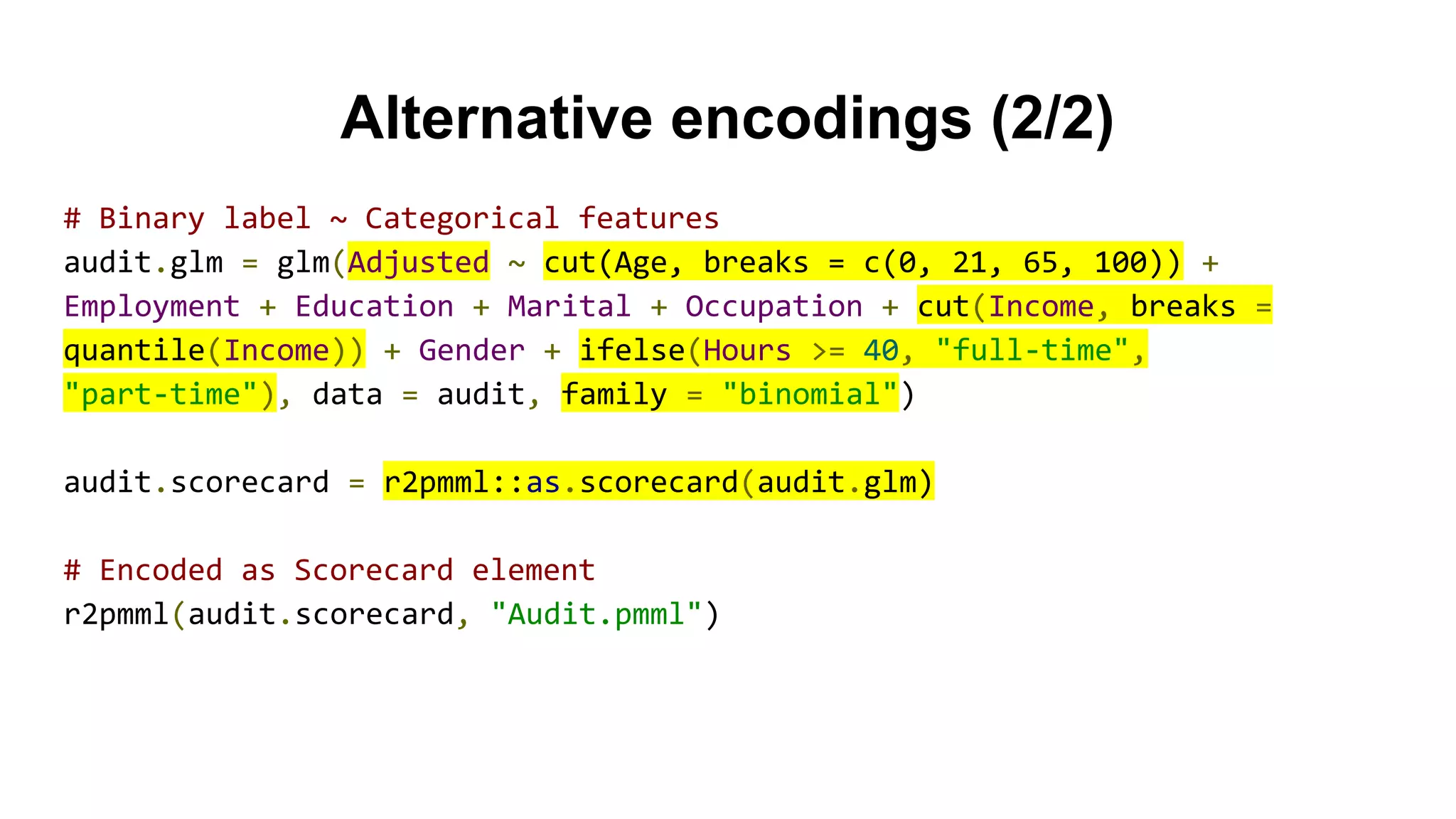
Alternative encodings (2/2)
# Binary label ~ Categorical features
audit.glm = glm(Adjusted ~ cut(Age, breaks = c(0, 21, 65, 100)) +
Employment + Education + Marital + Occupation + cut(Income, breaks =
quantile(Income)) + Gender + ifelse(Hours >= 40, "full-time",
"part-time"), data = audit, family = "binomial")
audit.scorecard = r2pmml::as.scorecard(audit.glm)
# Encoded as Scorecard element
r2pmml(audit.scorecard, "Audit.pmml")
Q&A
villu@openscoring.io
https://github.com/jpmml
https://github.com/openscoring
https://groups.google.com/forum/#!forum/jpmml
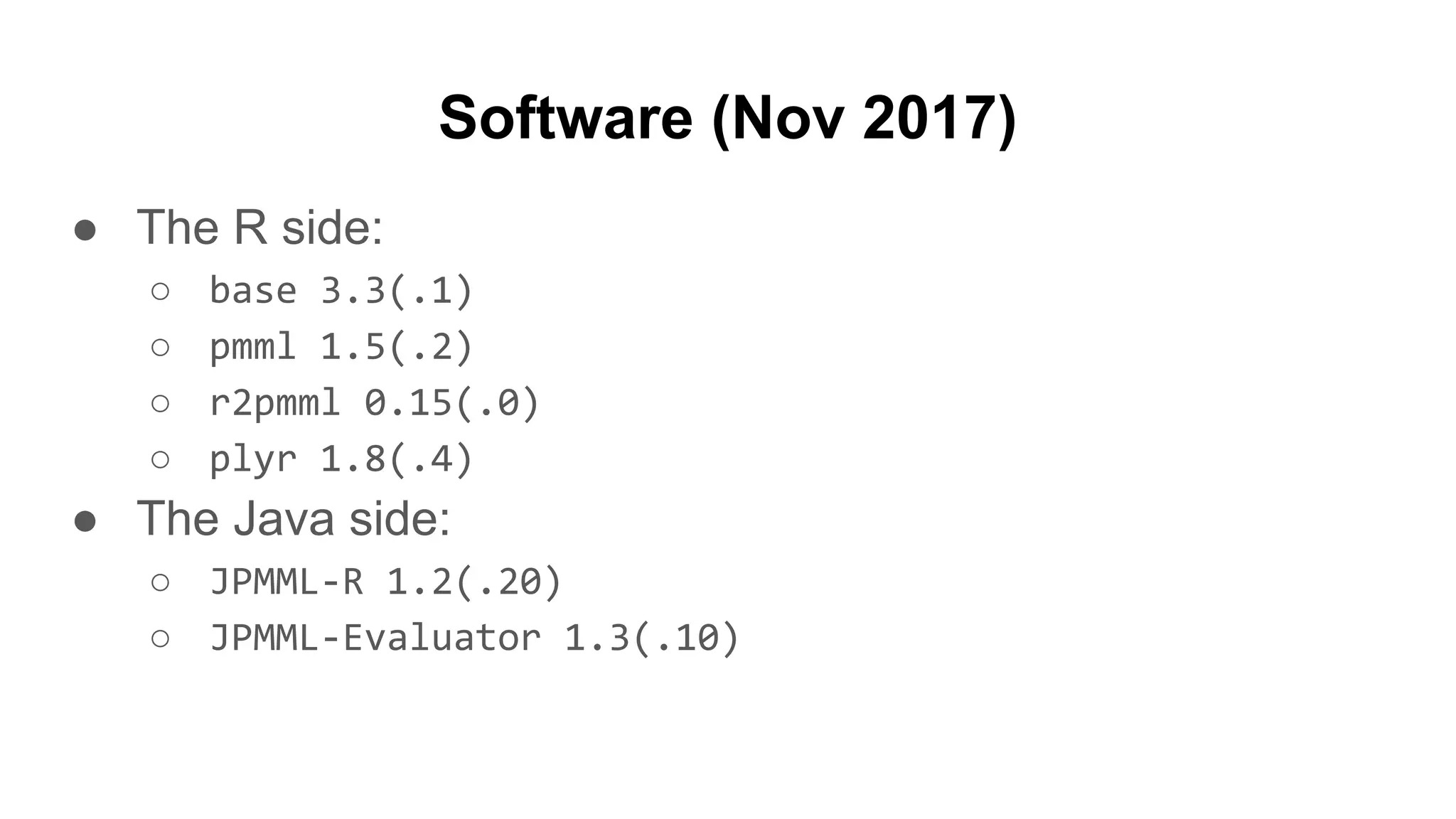
Software (Nov 2017)
● The R side:
○ base 3.3(.1)
○ pmml 1.5(.2)
○ r2pmml 0.15(.0)
○ plyr 1.8(.4)
● The Java side:
○ JPMML-R 1.2(.20)
○ JPMML-Evaluator 1.3(.10)

Converting R to PMML

  • 1.
    Converting R toPMML Villu Ruusmann Openscoring OÜ
  • 2.
  • 3.
    R challenge "Fat codearound thin model objects": ● Many packages to solve the same problem, many ways of doing and/or representing the same thing ● The unit of reusability is R script ● Model object is tightly coupled to the R script that produced it. Incomplete/split schemas ● No (widely adopted-) pipeline formalization
  • 4.
    (J)PMML solution Evaluator evaluator= ...; List<InputField> argumentFields = evaluator.getInputFields(); List<ResultField> resultFields = Lists.union(evaluator.getTargetFields(), evaluator.getOutputFields()); Map<FieldName, ?> arguments = readRecord(argumentFields); Map<FieldName, ?> result = evaluator.evaluate(arguments); writeRecord(result, resultFields); ● The R script (data pre-and post-processing, model) is represented using standardized PMML data structures ● Well-defined data entry and exit interfaces
  • 5.
  • 6.
    R challenge Training: audit_train =read.csv("Audit.csv") audit_train$HourlyIncome = (audit_train$Income / (audit_train$Hours * 52)) audit.model = model(Adjusted ~ ., data = audit_train) saveRDS(audit.model, "Audit.rds") Deployment: audit_test = read.csv("Audit.csv") audit.model = readRDS("Audit.rds") # "Error in eval(expr, envir, enclos) : object 'HourlyIncome' not found" predict(audit.model, newdata = audit_test)
  • 7.
    R solution Matrix interface( ): label = audit$Adjusted features = audit[, !(colnames(audit) %in% c("Adjusted"))] # Returns a `model` object audit.model = model(x = features, y = label) Formula interface ( ): # Returns a `model.formula` object audit.model = model(Adjusted ~ . + I(Income / (Hours * 52)), data = audit)
  • 8.
    From `pmml` to`r2pmml` library("pmml") library("r2pmml") audit = read.csv("Audit.csv") audit$Adjusted = as.factor(audit$Adjusted) audit.glm = glm(Adjusted ~ . + I(Income / (Hours * 52)), data = audit, family = "binomial") saveXML(pmml(audit.glm), "Audit.pmml") r2pmml(audit.glm, "Audit.pmml")
  • 9.
    Package `pmml` () <PMML> <DataDictionary> <DataField name="I(Income/(Hours * 52))" optype="continuous" dataType="double"/> </DataDictionary> <GeneralRegressionModel> <MiningSchema> <MiningField name="I(Income/(Hours * 52))"/> </MiningSchema> </GeneralRegressionModel> </PMML>
  • 10.
    Package `r2pmml` () <PMML> <DataDictionary> <DataField name="Income" optype="continuous" dataType="double"/> <DataField name="Hours" optype="continuous" dataType="double"/> </DataDictionary> <TransformationDictionary> <DerivedField name="Income/(Hours * 52)" optype="continuous" dataType="double"> <Apply function="/"><FieldRef field="Income"/><Apply function="*"><FieldRef field="Hours"/><Constant>52</Constant></Apply></Apply> </DerivedField> </TransformationDictionary> <GeneralRegressionModel> <MiningSchema> <MiningField name="Income"/> <MiningField name="Hours"/> </MiningSchema> </GeneralRegressionModel> </PMML>
  • 11.
    Manual conversion (1/2) r2pmml::r2pmml r2pmml::decoratebase::saveRDS RDS file JPMML-R library The R side The Java side
  • 12.
    Manual conversion (2/2) TheR side: audit.model = model(Adjusted ~ ., data = audit) # Decorate the model object with supporting information audit.model = r2pmml::decorate(audit.model, dataset = audit) saveRDS(audit.model, "Audit.rds") The Java side: $ git clone https://github.com/jpmml/jpmml-r.git $ cd jpmml-r; mvn clean package $ java -jar target/converter-executable-1.2-SNAPSHOT.jar --rds-input /path/to/Audit.rds --pmml-output /path/to/Audit.pmml
  • 13.
  • 14.
    Sanitization (1/2) ?base::ifelse # Staticreplacement value as.formula(Adjusted ~ ifelse(is.na(Hours), 0, Hours)) # Dynamic replacement value as.formula(paste("Adjusted ~ ifelse((is.na(Hours) | Hours < 0 | Hours > 168),", mean(df$Hours), ", Hours)", sep = ""))
  • 15.
    Sanitization (2/2) <DerivedField name="ifelse(is.na(Hours))"optype="continuous" dataType="double"> <Extension>ifelse(is.na(Hours), 0, Hours)</Extension> <Apply function="if"> <Apply function="isMissing"> <FieldRef field="Hours"/> </Apply> <Constant>0</Constant> <FieldRef field="Hours"/> </Apply> </DerivedField>
  • 16.
    Binarization (1/2) ?base::ifelse as.formula(Adjusted ~ifelse(Hours >= 40, "full-time", "part-time"))
  • 17.
    Binarization (2/2) <DerivedField name="ifelse(Hours&gt;= 40)" optype="categorical" dataType="string"> <Extension>ifelse(Hours &gt;= 40, "full-time", "part-time")</Extension> <Apply function="if"> <Apply function="greaterOrEqual"> <FieldRef field="Hours"/> <Constant>40</Constant> </Apply> <Constant>full-time</Constant> <Constant>part-time</Constant> </Apply> </DerivedField>
  • 18.
    Bucketization (1/2) ?base::cut # Staticintervals as.formula(Adjusted ~ cut(Income, breaks = 3)) # Dynamic intervals as.formula(Adjusted ~ cut(log10(Income), breaks = quantile(log10(Income)))
  • 19.
    Bucketization (2/2) <DerivedField name="cut(Income)"optype="categorical" dataType="string"> <Extension>cut(Income, breaks = 3)</Extension> <Discretize field="Income"> <DiscretizeBin binValue="(129,1.61e+05]"> <Interval closure="openClosed" leftMargin="129.0" rightMargin="161000.0"/> </DiscretizeBin> <DiscretizeBin binValue="(1.61e+05,3.21e+05]"> <Interval closure="openClosed" leftMargin="161000.0" rightMargin="321000.0"/> </DiscretizeBin> <DiscretizeBin binValue="(3.21e+05,4.82e+05]"> <Interval closure="openClosed" leftMargin="321000.0" rightMargin="482000.0"/> </DiscretizeBin> </Discretize> </DerivedField>
  • 20.
    Mathematical expressions (1/2) ?base::I as.formula(Adjusted~ I(floor(Income / (Hours * 52)))) Supported constructs: ● Arithmetic operators `+`, `-`, `*`, `/`, `^` and `**` ● Relational operators `==`, `!=`, `<`, `<=`, `>=` and `>` ● Logical operators `!`, `&` and `|` ● Functions `abs`, `ceiling`, `exp`, `floor`, `is.na`, `log`, `log10`, `round` and `sqrt`
  • 21.
    Mathematical expressions (2/2) <DerivedFieldname="floor(Income/(Hours * 52))" optype="continuous" dataType="double"> <Extension>I(floor(Income/(Hours * 52)))</Extension> <Apply function="floor"> <Apply function="/"> <FieldRef field="Income"/> <Apply function="*"> <FieldRef field="Hours"/> <Constant>52</Constant> </Apply> </Apply> </Apply> </DerivedField>
  • 22.
    Renaming and regroupingcategories (1/2) library("plyr") ?plyr::revalue ?plyr::mapvalues as.formula(Adjusted ~ plyr::revalue(Employment, c("PSFederal" = "Public", "PSState" = "Public", "PSLocal" = "Public"))) as.formula(Adjusted ~ plyr::revalue(Education, c("Yr1t4" = "Yr1t6", "Yr5t6" = "Yr1t6", "Yr7t8" = "Yr7t9", "Yr9" = "Yr7t9", "Yr10" = "Yr10t12", "Yr11" = "Yr10t12", "Yr12" = "Yr10t12"))) as.formula(Adjusted ~ plyr::mapvalues(Gender, c("Male", "Female"), c(0, 1)))
  • 23.
    Renaming and regroupingcategories (2/2) <DerivedField name="revalue(Employment)" optype="categorical" dataType="string"> <Extension>plyr::revalue(Employment, c(PSFederal = "Public", PSState = "Public", PSLocal = "Public"))</Extension> <MapValues outputColumn="to"> <FieldColumnPair field="Employment" column="from"/> <InlineTable> <row><from>PSFederal</from><to>Public</to></row> <row><from>PSState</from><to>Public</to></row> <row><from>PSLocal</from><to>Public</to></row> <row><from>Consultant</from><to>Consultant</to></row> <row><from>Private</from><to>Private</to></row> <row><from>SelfEmp</from><to>SelfEmp</to></row> <row><from>Volunteer</from><to>Volunteer</to></row> </InlineTable> </MapValues> </DerivedField>
  • 24.
    Interactions as.formula(Adjusted ~ # Continuousvs. continuous Age:Income + # Continuous vs. transformed continuous Age:I(log10(Income)) + # Continuous vs. categorical Gender:Income + # Categorical vs. categorical (Gender + Education) ^ 2 )
  • 25.
  • 26.
    Alternative encodings (1/2) #Continuous label ~ Continuous and categorical features audit.glm = glm(Income ~ Age + Employment + Education + Marital + Occupation + Gender + Hours, data = audit, family = "gaussian") # Encoded as GeneralRegressionModel element r2pmml(audit.glm, "Audit.pmml") # Encoded as RegressionModel element r2pmml(audit.glm, "Audit.pmml", converter = "org.jpmml.rexp.LMConverter")
  • 27.
    Alternative encodings (2/2) #Binary label ~ Categorical features audit.glm = glm(Adjusted ~ cut(Age, breaks = c(0, 21, 65, 100)) + Employment + Education + Marital + Occupation + cut(Income, breaks = quantile(Income)) + Gender + ifelse(Hours >= 40, "full-time", "part-time"), data = audit, family = "binomial") audit.scorecard = r2pmml::as.scorecard(audit.glm) # Encoded as Scorecard element r2pmml(audit.scorecard, "Audit.pmml")
  • 28.
  • 29.
    Software (Nov 2017) ●The R side: ○ base 3.3(.1) ○ pmml 1.5(.2) ○ r2pmml 0.15(.0) ○ plyr 1.8(.4) ● The Java side: ○ JPMML-R 1.2(.20) ○ JPMML-Evaluator 1.3(.10)