BANGALORE UNIVERSITY
CENTREFORAPPLIEDGENETICS
DEPARTMENTOF ZOOLOGY
JNANA BHARATHI
BENGALURU 560 056
EXTRA NUCLEAR INHERITANCE IN Chlamydomonas, Neurospora & Paramecium
VIDYASHRI S.H.
Ist Year M. Sc., Ist Semester
Centre for Applied Genetics
Department of Zoology
Bangalore University
GUIDE
Dr. VENU.G
Centre for Applied Genetics
Department of Zoology
Bangalore University
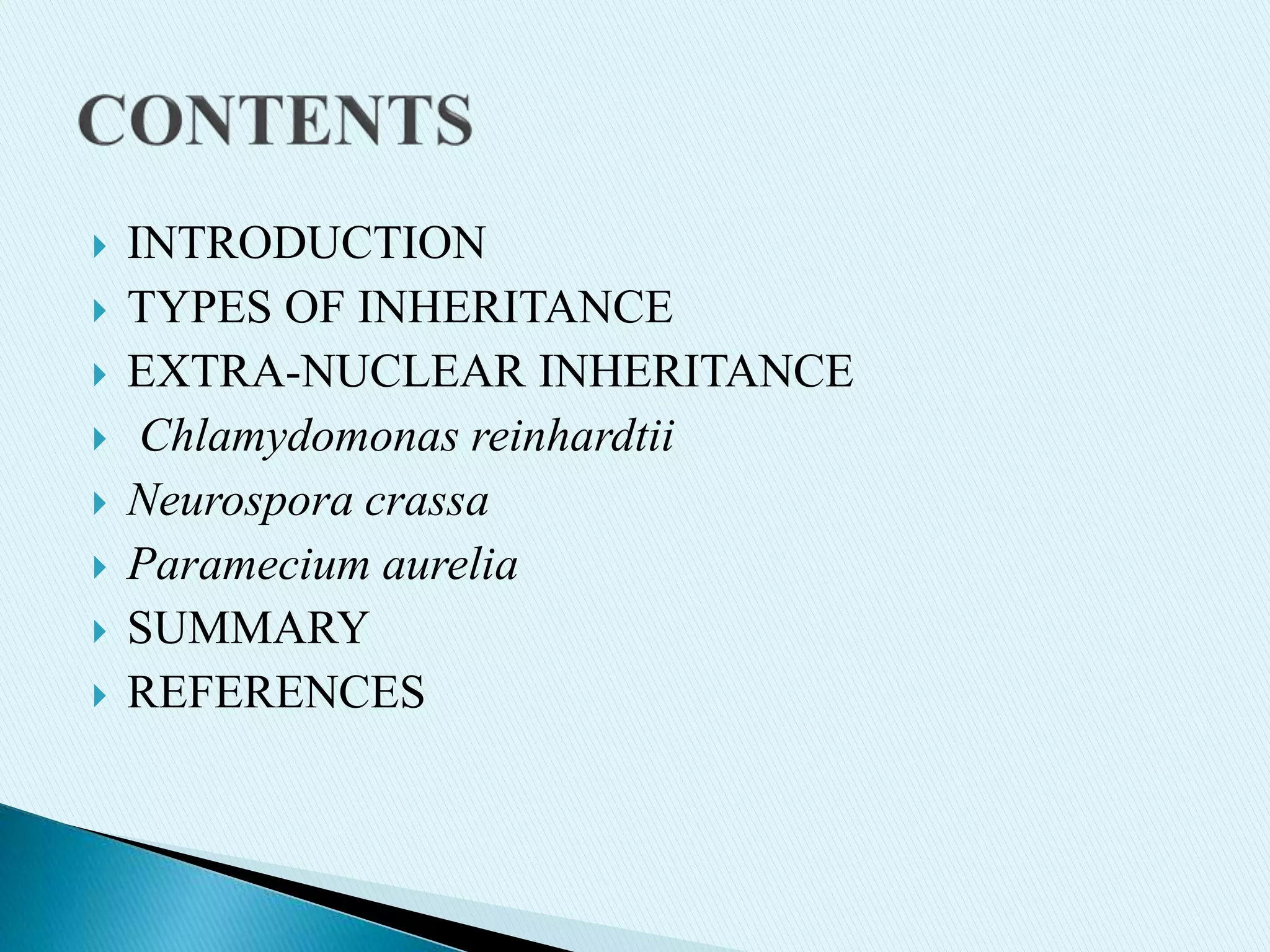
 INTRODUCTION
 TYPES OF INHERITANCE
 EXTRA-NUCLEAR INHERITANCE
 Chlamydomonas reinhardtii
 Neurospora crassa
 Paramecium aurelia
 SUMMARY
 REFERENCES
 Inheritance is the process by which genetic information
is passed on from generation to generation.
 When organisms reproduce, all the information for
growth, survival and reproduction for the next
generation is found in the DNA passed down from the
parent generation.
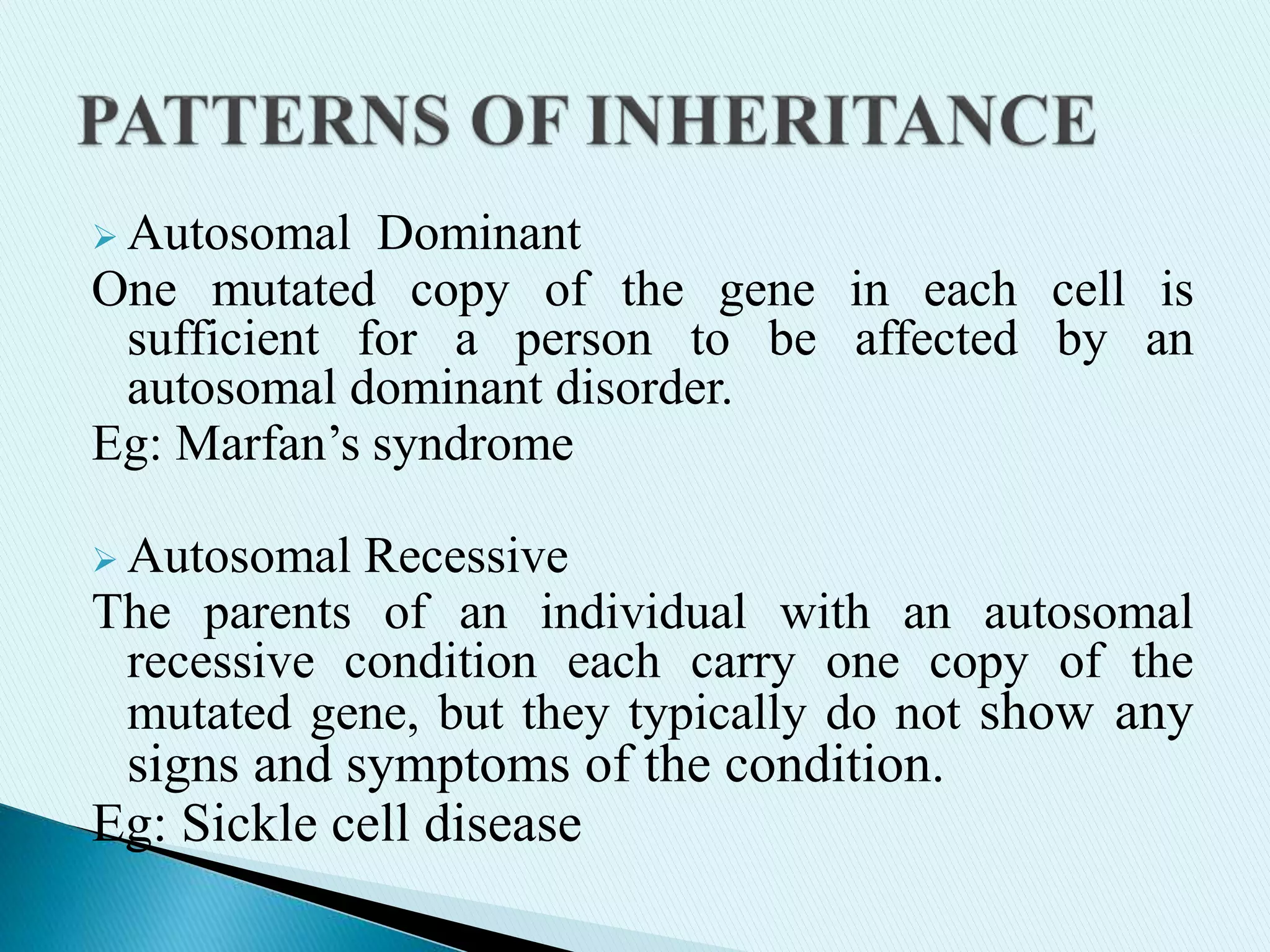
 Autosomal Dominant
One mutated copy of the gene in each cell is
sufficient for a person to be affected by an
autosomal dominant disorder.
Eg: Marfan’s syndrome
 Autosomal Recessive
The parents of an individual with an autosomal
recessive condition each carry one copy of the
mutated gene, but they typically do not show any
signs and symptoms of the condition.
Eg: Sickle cell disease
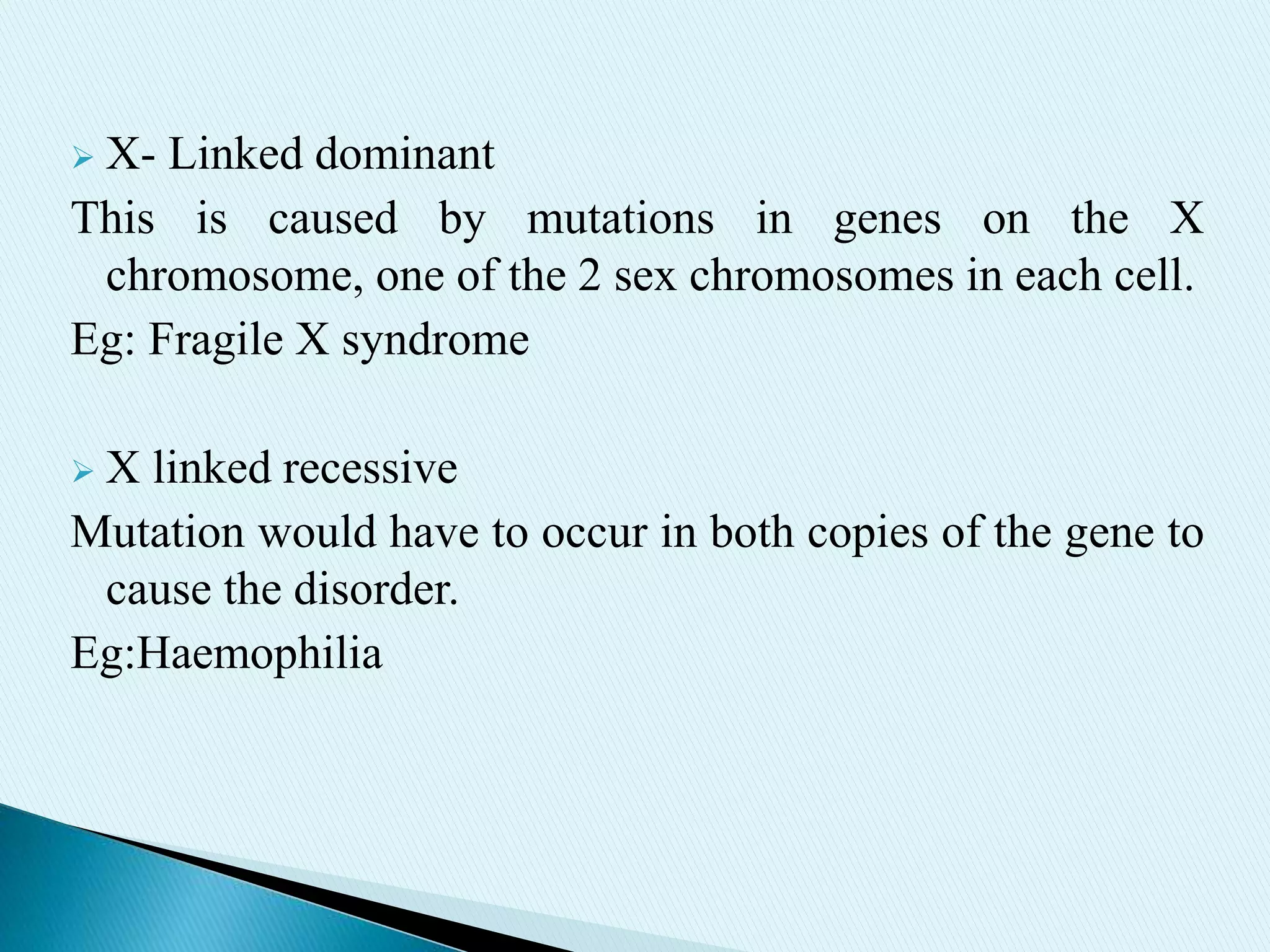
 X- Linked dominant
This is caused by mutations in genes on the X
chromosome, one of the 2 sex chromosomes in each cell.
Eg: Fragile X syndrome
 X linked recessive
Mutation would have to occur in both copies of the gene to
cause the disorder.
Eg:Haemophilia
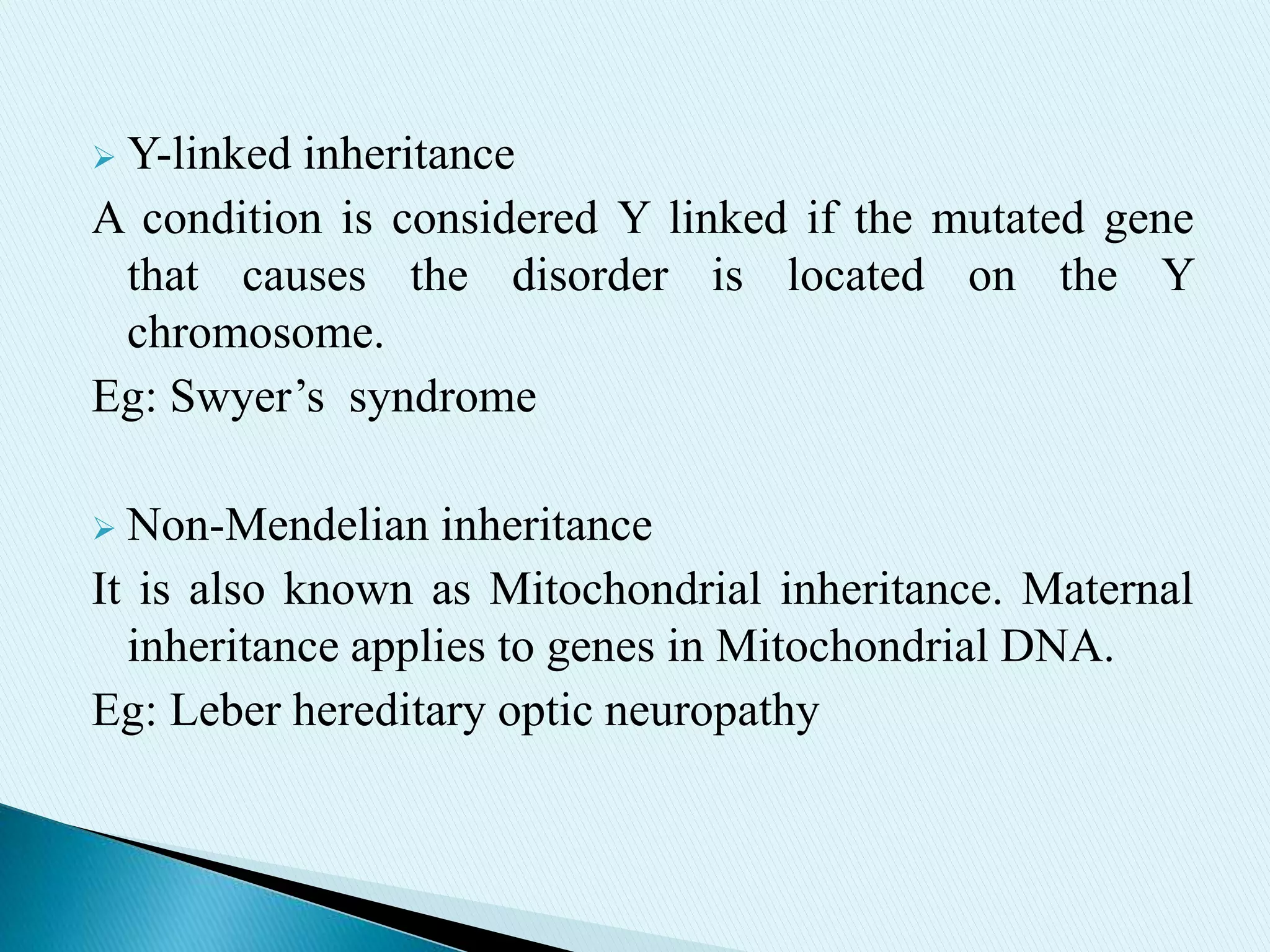
 Y-linked inheritance
A condition is considered Y linked if the mutated gene
that causes the disorder is located on the Y
chromosome.
Eg: Swyer’s syndrome
 Non-Mendelian inheritance
It is also known as Mitochondrial inheritance. Maternal
inheritance applies to genes in Mitochondrial DNA.
Eg: Leber hereditary optic neuropathy
 Extranuclear inheritance is the transmission of genes that
occur outside the nucleus.
 It is found in most eukaryotes and is commonly known
to occur in cytoplasmic organelles such as mitochondria
and chloroplasts or from cellular parasites like viruses or
bacteria.
 Most of the recorded cytoplasmically inherited characters
would follow the maternal line i.e., Uniparental mode of
transmission.
 It is also known as maternal inheritance or Trans-ovarian
transmission.
R.Sager and N.Gilham have reported some cases
of extrachromosomal inheritance in green alga
Chlamydomonas reinhardtii
The alga reproduces asexual as well as sexual
means.
The sexual reproduction takes place by fusion
between 2 morphologically similar but
physiologically dissimilar haploid gametes.
 A cross can occur only if the parents are of
different mating types.
 The mating types are physically identical but
physiologically different. Such species are called
heterothallic (literally “different bodied”).
 In Chlamydomonas, the mating type alleles are
called mt+ and mt-.
 Chlamydomonas is a haploid unicellulate green alga.
It has two mating types—’+’ and ‘-‘.The two mating
types are governed by two alleles of a nuclear single
gene. The alleles are named as mt+ and mt–.
 The + mating type is considered as female, while
the – mating type is regarded as male.
 During sexual reproduction one mt+ and one mt–
cell pair and fuse together to form a zygote where
there is mixture of cytoplasm coming from both
mt+ and mt– gametes.
 R. Sager isolated two strains of Chlamydomonas: one
strain was resistant and the other one is sensitive.
 The trait of streptomycin resistance is believed to be
located in its cp-DNA (chloroplast DNA).
 Mating between mt+ streptomycin resistant (Sr) and mt
sensitive (Ss) cells produce only resistant progeny but the
nuclear genes for mating type segregate as expected.
 But the reciprocal cross between mt+ susceptible and mt–
resistant shows again the expected segregation for
mating type but all progenies are sensitive type.
Therefore, it clearly provides an example for extra-
nuclear inheritance.
 There are many examples for mitochondrial enzyme
deficiency which are cases of extra chromosomal
inheritance—petite yeast came from the studies of
Neurospora crassa, a member of ascomycetes group of
fungi. In this fungus, there is a slow-growing mutant
strain called poky.
 Such strain exhibits poorly differentiated mitochondria
which are deficient in the membrane-bound cytochromes
b, a1 and a3, essential proteins of the respiratory electron
transport chain.
 When poky as female parent is crossed with a normal
strain as a male parent (mitochondrial parent), the
progeny are found to be poky.
 In reciprocal cross, the progeny are normal.
 This non-Mendelian uniparental inheritance suggests
that the cytoplasm of female parent is important
because the only difference between reciprocal crosses
is the contribution of cytoplasm.
 In 1943, T.M.Sonneborn reported that some strains of P.
aurelia contain kappa particles and are known as killer
strain.
 Kappa particles are the symbiont bacteria called
Caedobacter taeniospiralis.
 The strain of Paramecium in which the kappa particles
are absent are called sensitive strain. The sensitive strains
are killed by the killer strain.
 The destruction of sensitive strain occurs through
secretion of a toxic substance called Paramecin. This
toxic substance is believed to breakdown the food
vacuole membrane of the sensitive strain.
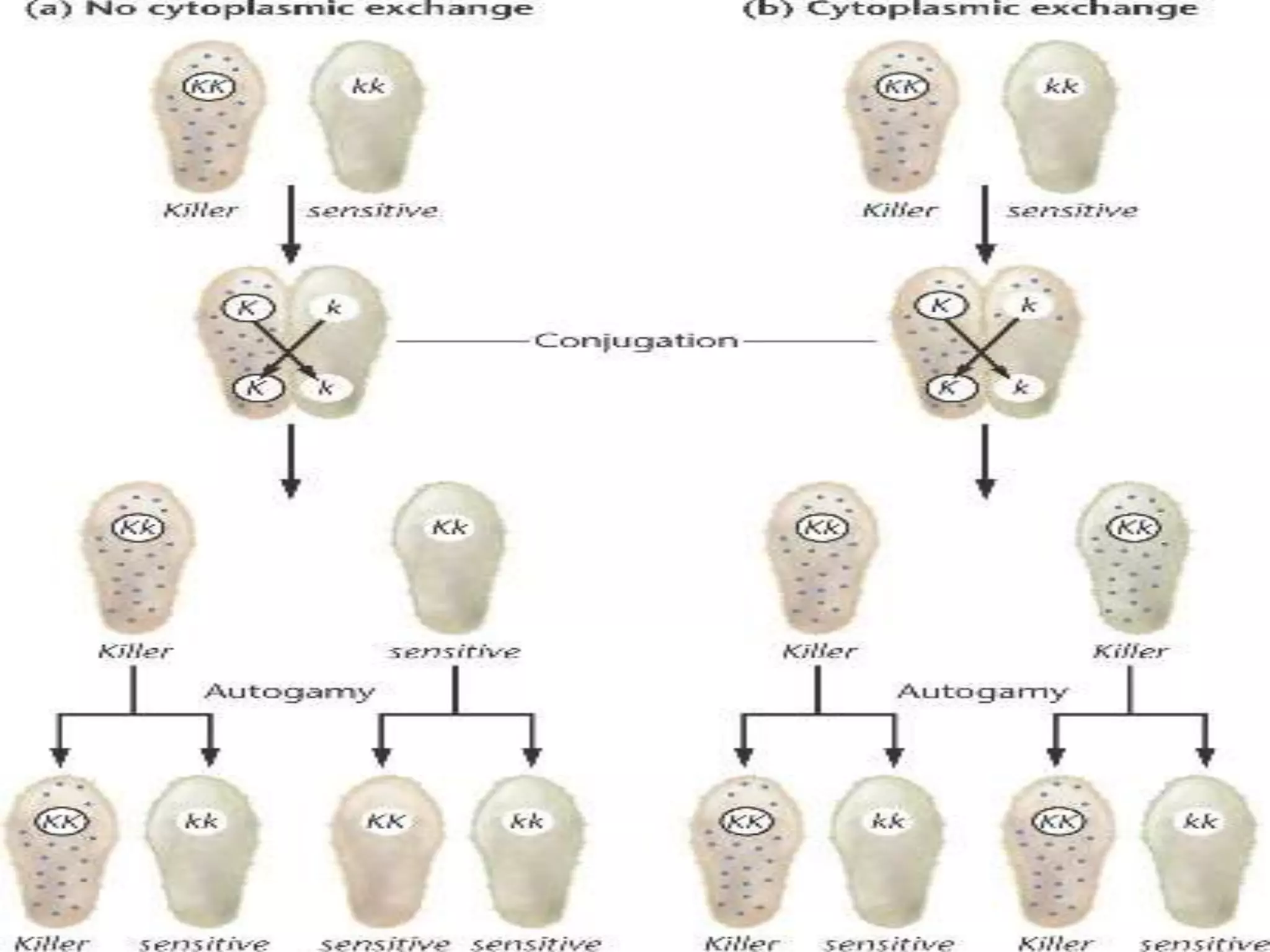
 When killer strain of Paramecium conjugates with
sensitive strain under appropriate condition for brief
period and no cytoplasm exchange occurs.
 Two kinds of clones result- one from the original
killer cell which contains allele K (Kk) and kappa
particles and the other from the original sensitive cell
which carries the allele K (Kk) and lacks kappa
particles.
 Under some conditions of conjugation persists much
longer; a long connection is established between
conjugants (killer and sensitive).
 In this conjugation, cytoplasm as well as nuclear
genes are exchanged. As a consequence both ex-
conjugants will receive the genotype Kk and the
 Extranuclear inheritance or cytoplasmic inheritance is the
transmission of genes that occur outside the nucleus.
 Extra-chromosomal inheritance, extra-nuclear inheritance, and
maternal inheritance are all synonyms.
 All these terms can be defined as the inheritance of
characteristics of only one of the two parents, usually the female
parent to the progeny.
 Evidence for cytoplasmic inheritance was first reported by
Correns in Mirabilis jalapa and by Bar in Pelargonium zonule in
1908. Rhoades described cytoplasmic male sterility in maize in
1933.
 In 1943, Sonneborn discovered kappa particles in Paramecium
and described its cytoplasmic inheritance. Presence of DNA in
chloroplasts was first demonstrated by Ris in plant cell.
 William.S.Klug&Michael.R.Cummings,1996.Essential
s of genetics, 2nd edition., Prentice Hall Internationals.
 Robert H.Tamarin,2002.Principles of Genetics,7th Ed.
mRata McGraw –Hill Ediyion , New Delhi , India
 Gardner.E.J.,Simmons.M.J.&Snustad.D.P.1991.Principl
es of Genetics , John Wiley& Sons Inc., N.Y.
Extra nuclear inheritance

Extra nuclear inheritance

  • 1.
    BANGALORE UNIVERSITY CENTREFORAPPLIEDGENETICS DEPARTMENTOF ZOOLOGY JNANABHARATHI BENGALURU 560 056 EXTRA NUCLEAR INHERITANCE IN Chlamydomonas, Neurospora & Paramecium VIDYASHRI S.H. Ist Year M. Sc., Ist Semester Centre for Applied Genetics Department of Zoology Bangalore University GUIDE Dr. VENU.G Centre for Applied Genetics Department of Zoology Bangalore University
  • 2.
     INTRODUCTION  TYPESOF INHERITANCE  EXTRA-NUCLEAR INHERITANCE  Chlamydomonas reinhardtii  Neurospora crassa  Paramecium aurelia  SUMMARY  REFERENCES
  • 3.
     Inheritance isthe process by which genetic information is passed on from generation to generation.  When organisms reproduce, all the information for growth, survival and reproduction for the next generation is found in the DNA passed down from the parent generation.
  • 4.
     Autosomal Dominant Onemutated copy of the gene in each cell is sufficient for a person to be affected by an autosomal dominant disorder. Eg: Marfan’s syndrome  Autosomal Recessive The parents of an individual with an autosomal recessive condition each carry one copy of the mutated gene, but they typically do not show any signs and symptoms of the condition. Eg: Sickle cell disease
  • 5.
     X- Linkeddominant This is caused by mutations in genes on the X chromosome, one of the 2 sex chromosomes in each cell. Eg: Fragile X syndrome  X linked recessive Mutation would have to occur in both copies of the gene to cause the disorder. Eg:Haemophilia
  • 6.
     Y-linked inheritance Acondition is considered Y linked if the mutated gene that causes the disorder is located on the Y chromosome. Eg: Swyer’s syndrome  Non-Mendelian inheritance It is also known as Mitochondrial inheritance. Maternal inheritance applies to genes in Mitochondrial DNA. Eg: Leber hereditary optic neuropathy
  • 7.
     Extranuclear inheritanceis the transmission of genes that occur outside the nucleus.  It is found in most eukaryotes and is commonly known to occur in cytoplasmic organelles such as mitochondria and chloroplasts or from cellular parasites like viruses or bacteria.  Most of the recorded cytoplasmically inherited characters would follow the maternal line i.e., Uniparental mode of transmission.  It is also known as maternal inheritance or Trans-ovarian transmission.
  • 8.
    R.Sager and N.Gilhamhave reported some cases of extrachromosomal inheritance in green alga Chlamydomonas reinhardtii The alga reproduces asexual as well as sexual means. The sexual reproduction takes place by fusion between 2 morphologically similar but physiologically dissimilar haploid gametes.
  • 9.
     A crosscan occur only if the parents are of different mating types.  The mating types are physically identical but physiologically different. Such species are called heterothallic (literally “different bodied”).  In Chlamydomonas, the mating type alleles are called mt+ and mt-.  Chlamydomonas is a haploid unicellulate green alga. It has two mating types—’+’ and ‘-‘.The two mating types are governed by two alleles of a nuclear single gene. The alleles are named as mt+ and mt–.
  • 10.
     The +mating type is considered as female, while the – mating type is regarded as male.  During sexual reproduction one mt+ and one mt– cell pair and fuse together to form a zygote where there is mixture of cytoplasm coming from both mt+ and mt– gametes.
  • 11.
     R. Sagerisolated two strains of Chlamydomonas: one strain was resistant and the other one is sensitive.  The trait of streptomycin resistance is believed to be located in its cp-DNA (chloroplast DNA).  Mating between mt+ streptomycin resistant (Sr) and mt sensitive (Ss) cells produce only resistant progeny but the nuclear genes for mating type segregate as expected.  But the reciprocal cross between mt+ susceptible and mt– resistant shows again the expected segregation for mating type but all progenies are sensitive type. Therefore, it clearly provides an example for extra- nuclear inheritance.
  • 13.
     There aremany examples for mitochondrial enzyme deficiency which are cases of extra chromosomal inheritance—petite yeast came from the studies of Neurospora crassa, a member of ascomycetes group of fungi. In this fungus, there is a slow-growing mutant strain called poky.  Such strain exhibits poorly differentiated mitochondria which are deficient in the membrane-bound cytochromes b, a1 and a3, essential proteins of the respiratory electron transport chain.
  • 15.
     When pokyas female parent is crossed with a normal strain as a male parent (mitochondrial parent), the progeny are found to be poky.  In reciprocal cross, the progeny are normal.  This non-Mendelian uniparental inheritance suggests that the cytoplasm of female parent is important because the only difference between reciprocal crosses is the contribution of cytoplasm.
  • 16.
     In 1943,T.M.Sonneborn reported that some strains of P. aurelia contain kappa particles and are known as killer strain.  Kappa particles are the symbiont bacteria called Caedobacter taeniospiralis.  The strain of Paramecium in which the kappa particles are absent are called sensitive strain. The sensitive strains are killed by the killer strain.  The destruction of sensitive strain occurs through secretion of a toxic substance called Paramecin. This toxic substance is believed to breakdown the food vacuole membrane of the sensitive strain.
  • 17.
     When killerstrain of Paramecium conjugates with sensitive strain under appropriate condition for brief period and no cytoplasm exchange occurs.  Two kinds of clones result- one from the original killer cell which contains allele K (Kk) and kappa particles and the other from the original sensitive cell which carries the allele K (Kk) and lacks kappa particles.  Under some conditions of conjugation persists much longer; a long connection is established between conjugants (killer and sensitive).  In this conjugation, cytoplasm as well as nuclear genes are exchanged. As a consequence both ex- conjugants will receive the genotype Kk and the
  • 19.
     Extranuclear inheritanceor cytoplasmic inheritance is the transmission of genes that occur outside the nucleus.  Extra-chromosomal inheritance, extra-nuclear inheritance, and maternal inheritance are all synonyms.  All these terms can be defined as the inheritance of characteristics of only one of the two parents, usually the female parent to the progeny.  Evidence for cytoplasmic inheritance was first reported by Correns in Mirabilis jalapa and by Bar in Pelargonium zonule in 1908. Rhoades described cytoplasmic male sterility in maize in 1933.  In 1943, Sonneborn discovered kappa particles in Paramecium and described its cytoplasmic inheritance. Presence of DNA in chloroplasts was first demonstrated by Ris in plant cell.
  • 20.
     William.S.Klug&Michael.R.Cummings,1996.Essential s ofgenetics, 2nd edition., Prentice Hall Internationals.  Robert H.Tamarin,2002.Principles of Genetics,7th Ed. mRata McGraw –Hill Ediyion , New Delhi , India  Gardner.E.J.,Simmons.M.J.&Snustad.D.P.1991.Principl es of Genetics , John Wiley& Sons Inc., N.Y.