Neural Tree for Estimating the
Uniaxial Compressive Strength
of Rock Materials
Varun Kumar Ojha
ETH Zurich, Switzerland
Deepak Amban Mishra
Indian Institute of Petroleum & Energy, Visakhapatnam, India
Conference: Hybrid Computational Intelligence (HIS 2017)
Paper title:
Authors:
Uniaxial Compressive Strength (UCS)
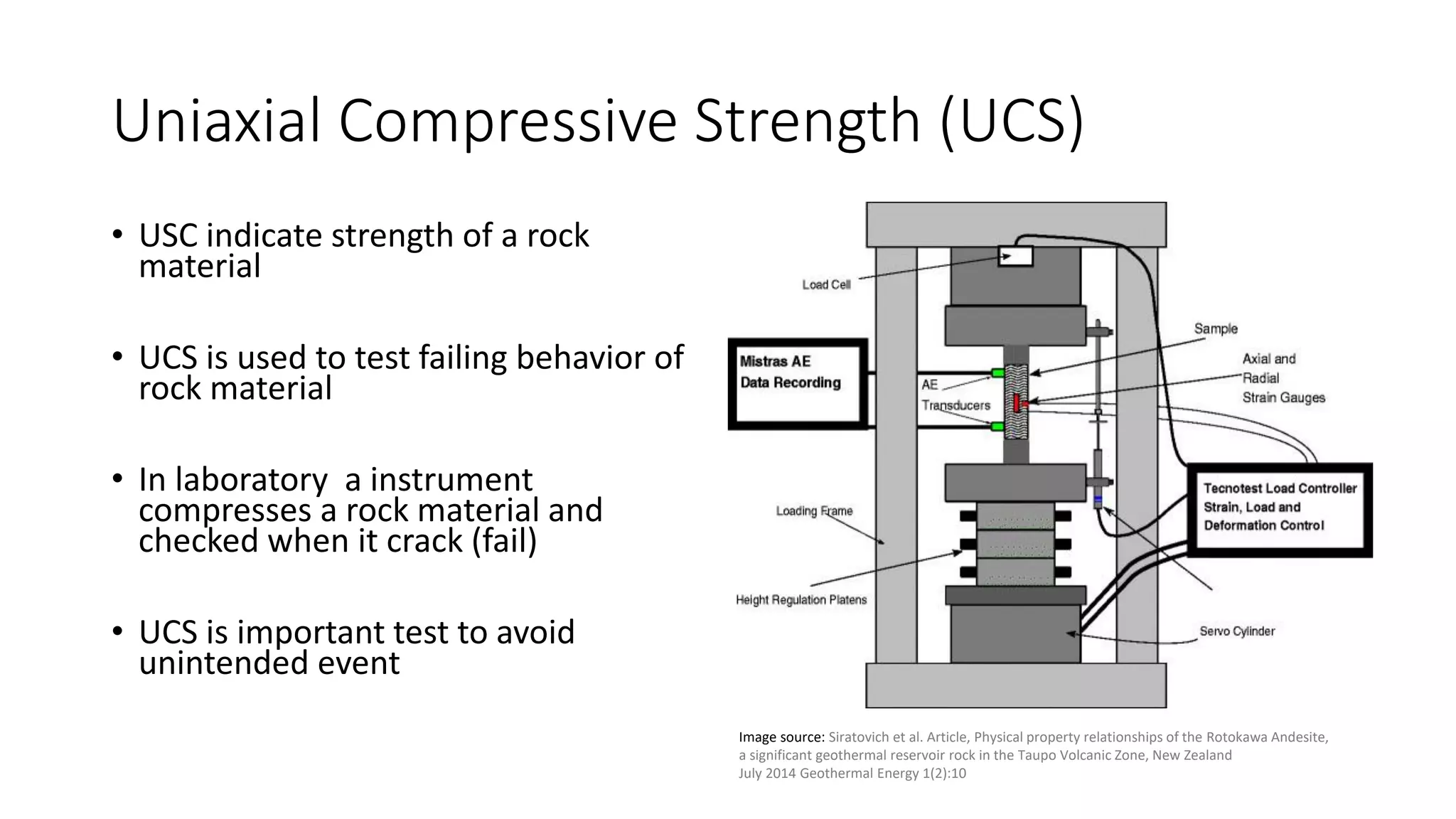
• USC indicate strength of a rock
material
• UCS is used to test failing behavior of
rock material
• In laboratory a instrument
compresses a rock material and
checked when it crack (fail)
• UCS is important test to avoid
unintended event
Image source: Siratovich et al. Article, Physical property relationships of the Rotokawa Andesite,
a significant geothermal reservoir rock in the Taupo Volcanic Zone, New Zealand
July 2014 Geothermal Energy 1(2):10
UCS Index test parameters
• Block punch index (BPI),
• Point load strength (Is-50),
• Schmidt rebound hardness (SRH),
• Ultrasonic P-wave velocity (𝑉𝑝)
• Porosity (𝜂 𝑒)
• Density (𝜌)
Rock: before failing
Rock: after failing
Image source: Mohd Ashraf Mohamad Ismail, Laboratory and in-situ rock testing,
Advanced Geotechnical Engineering
Rock samples
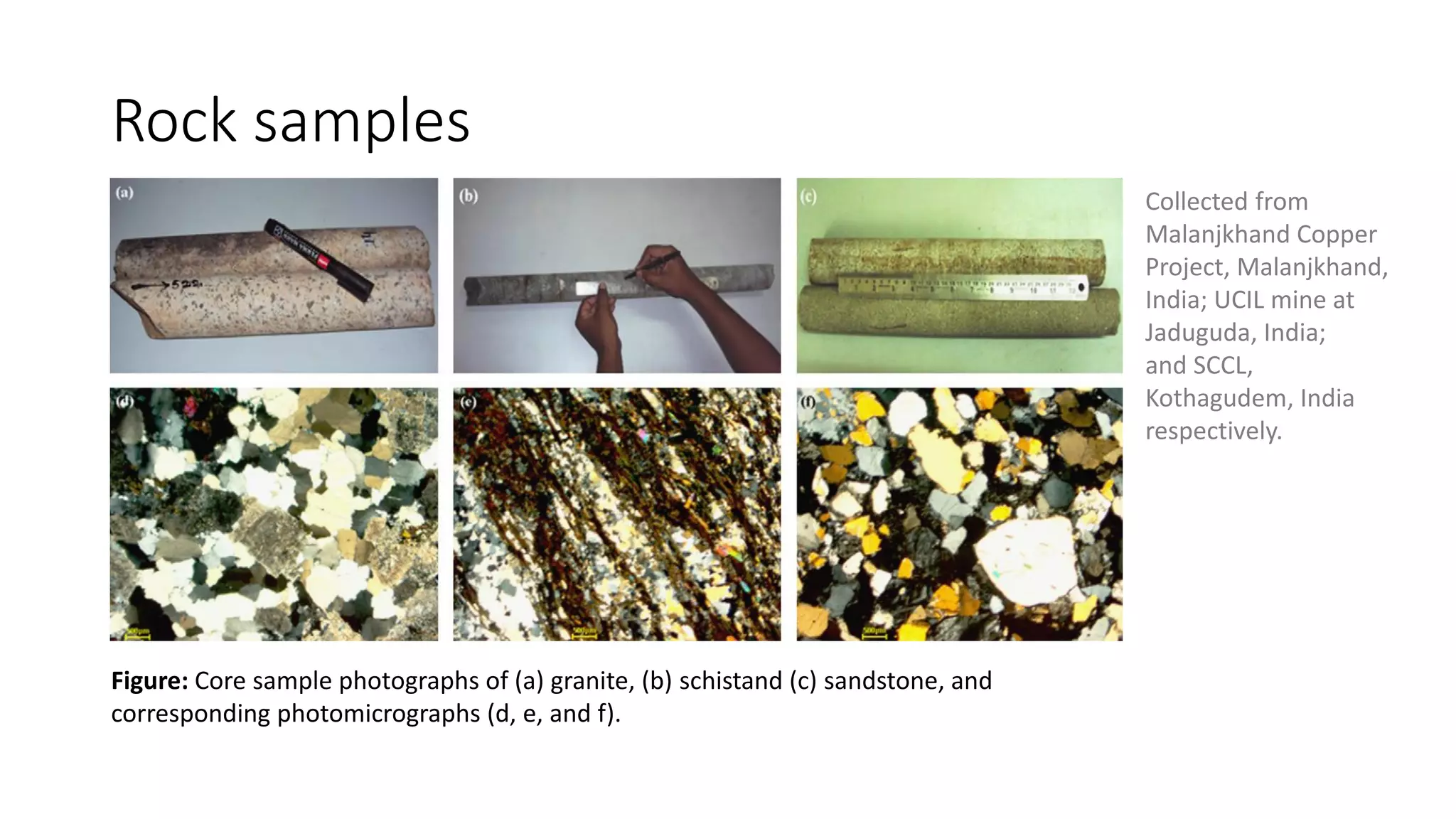
Figure: Core sample photographs of (a) granite, (b) schistand (c) sandstone, and
corresponding photomicrographs (d, e, and f).
Collected from
Malanjkhand Copper
Project, Malanjkhand,
India; UCIL mine at
Jaduguda, India;
and SCCL,
Kothagudem, India
respectively.
Dataset
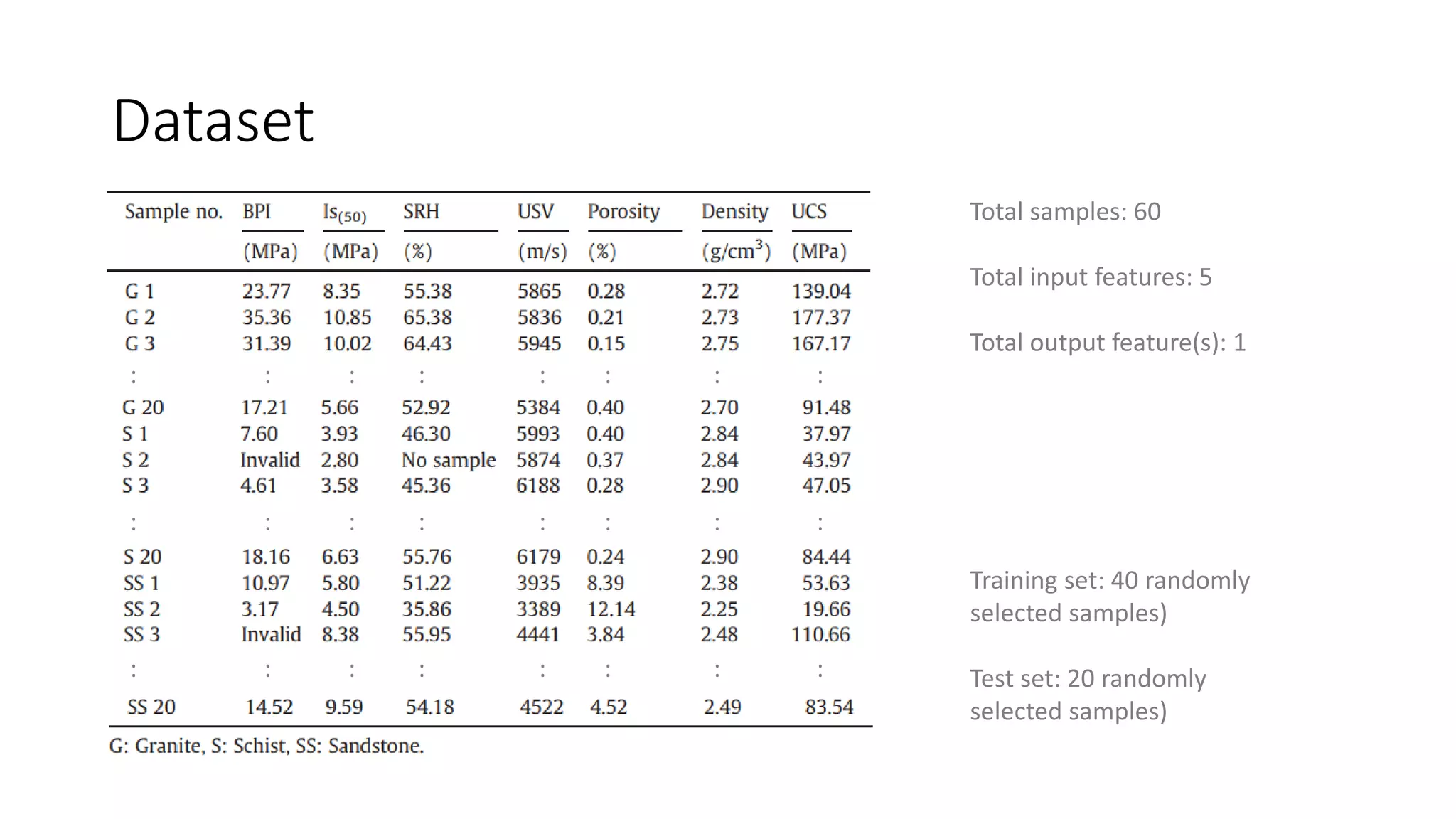
: : : : : : : :
: : : : : : : :
: : : : : : : :
Total samples: 60
Total input features: 5
Total output feature(s): 1
Training set: 40 randomly
selected samples)
Test set: 20 randomly
selected samples)
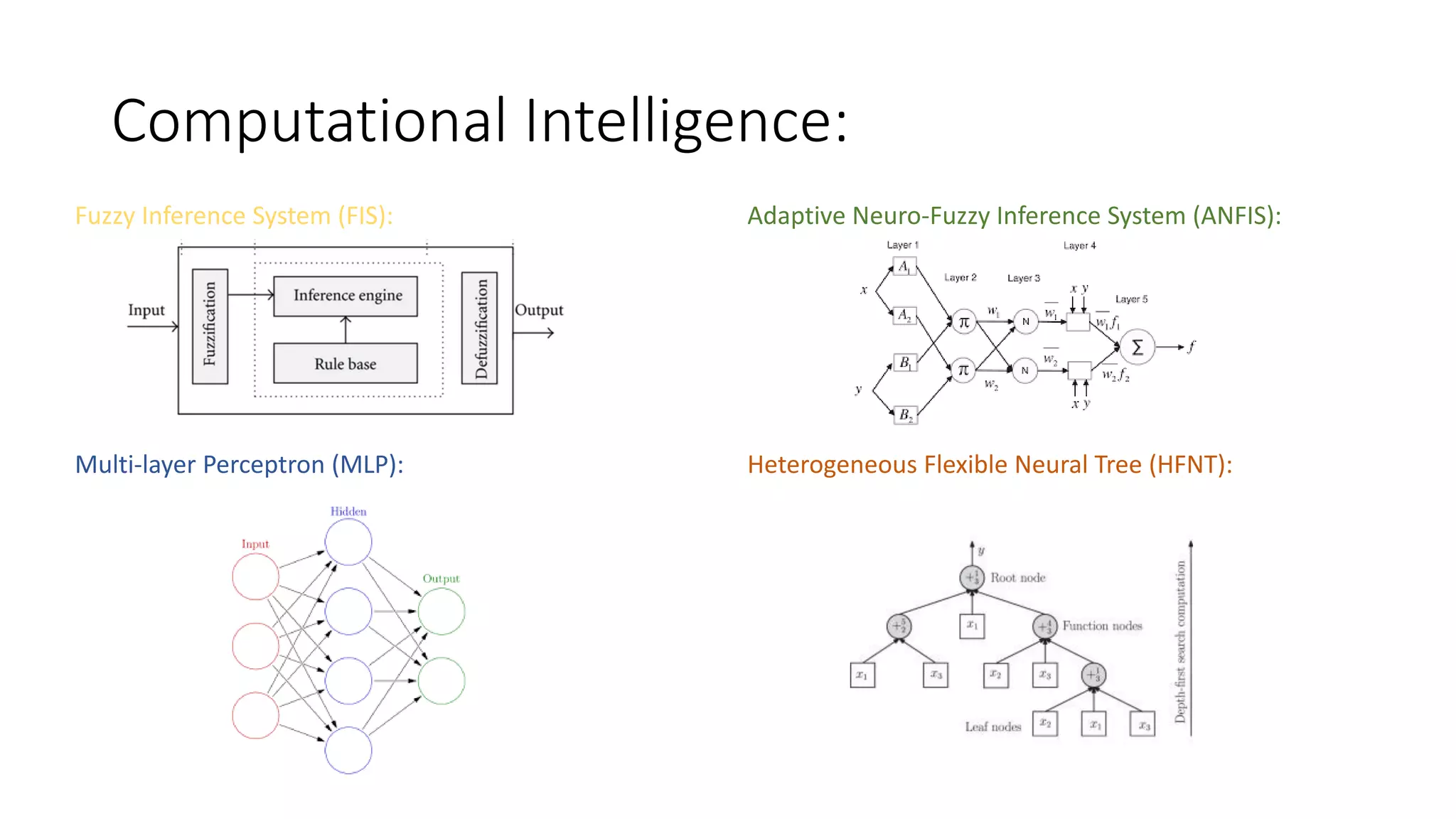
Computational Intelligence:
Fuzzy Inference System (FIS): Adaptive Neuro-Fuzzy Inference System (ANFIS):
Multi-layer Perceptron (MLP): Heterogeneous Flexible Neural Tree (HFNT):
Model Evaluation Criteria and Results
• Root mean squared error (𝑒)
• Correlation coefficient (𝑟)
• Squared of correlation coefficient (𝑟2)
• Number of parameters in the developed model (𝜒)
[1] Mishra DA, Srigyan M, Basu A, Rokade PJ (2015) Soft computing methods for estimating the uniaxial compressive strength of intact rock from index tests. Int J Rock Mech Min Sci 80:418{424
Model Evaluation Criteria and Results
• Root mean squared error (𝑒)
• Correlation coefficient (𝑟)
• Squared of correlation coefficient (𝑟2)
• Number of parameters in the developed model (𝜒)
[1] Mishra DA, Srigyan M, Basu A, Rokade PJ (2015) Soft computing methods for estimating the uniaxial compressive strength of intact rock from index tests. Int J Rock Mech Min Sci 80:418{424
The
Best
Model
Model Evaluation Criteria and Results
• Root mean squared error (𝑒)
• Correlation coefficient (𝑟)
• Squared of correlation coefficient (𝑟2)
• Number of parameters in the developed model (𝜒)
[1] Mishra DA, Srigyan M, Basu A, Rokade PJ (2015) Soft computing methods for estimating the uniaxial compressive strength of intact rock from index tests. Int J Rock Mech Min Sci 80:418{424
Best 𝑒, 𝑟,
𝑟2, and 𝜒
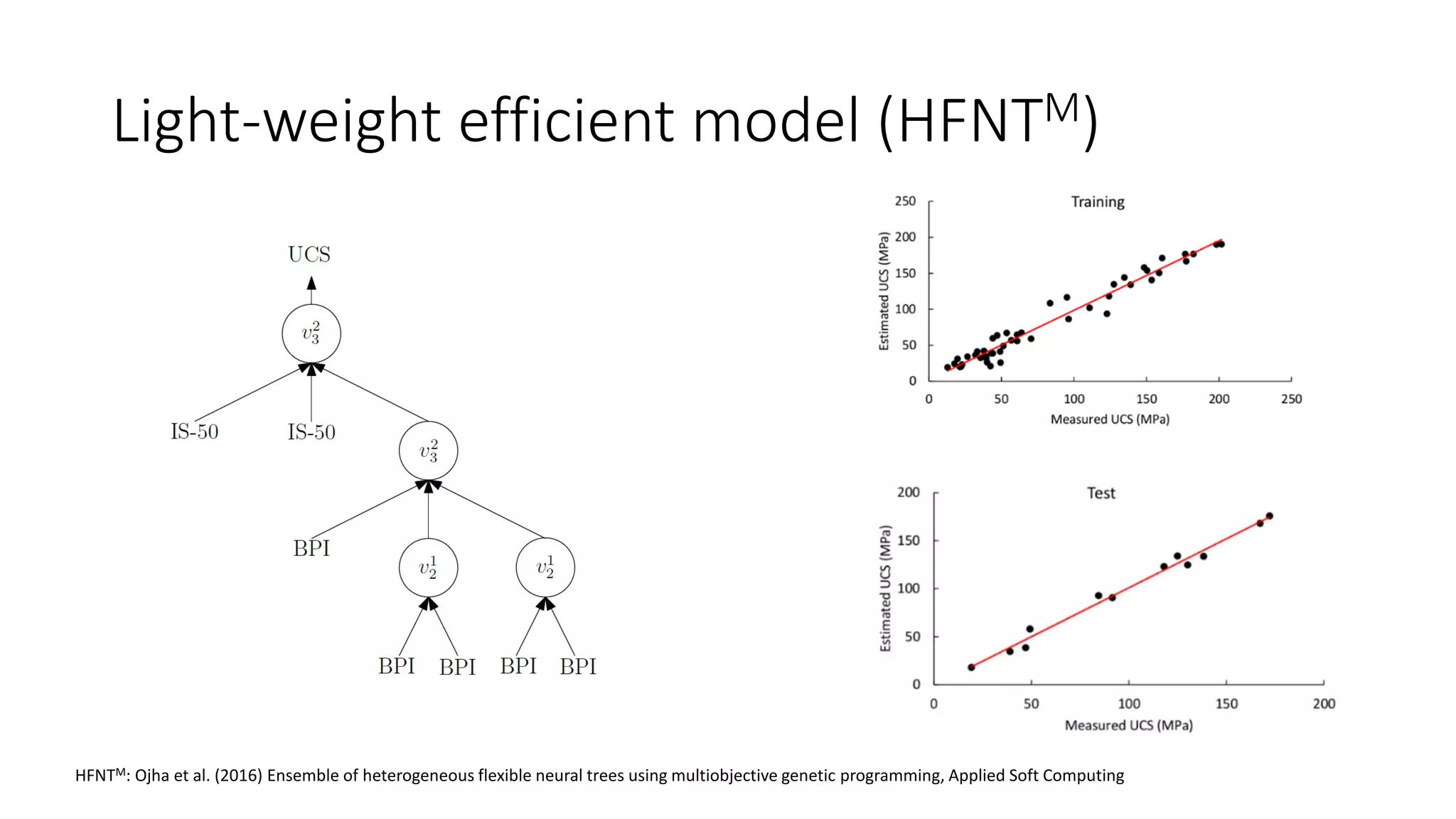
Light-weight efficient model (HFNTM)
HFNTM: Ojha et al. (2016) Ensemble of heterogeneous flexible neural trees using multiobjective genetic programming, Applied Soft Computing
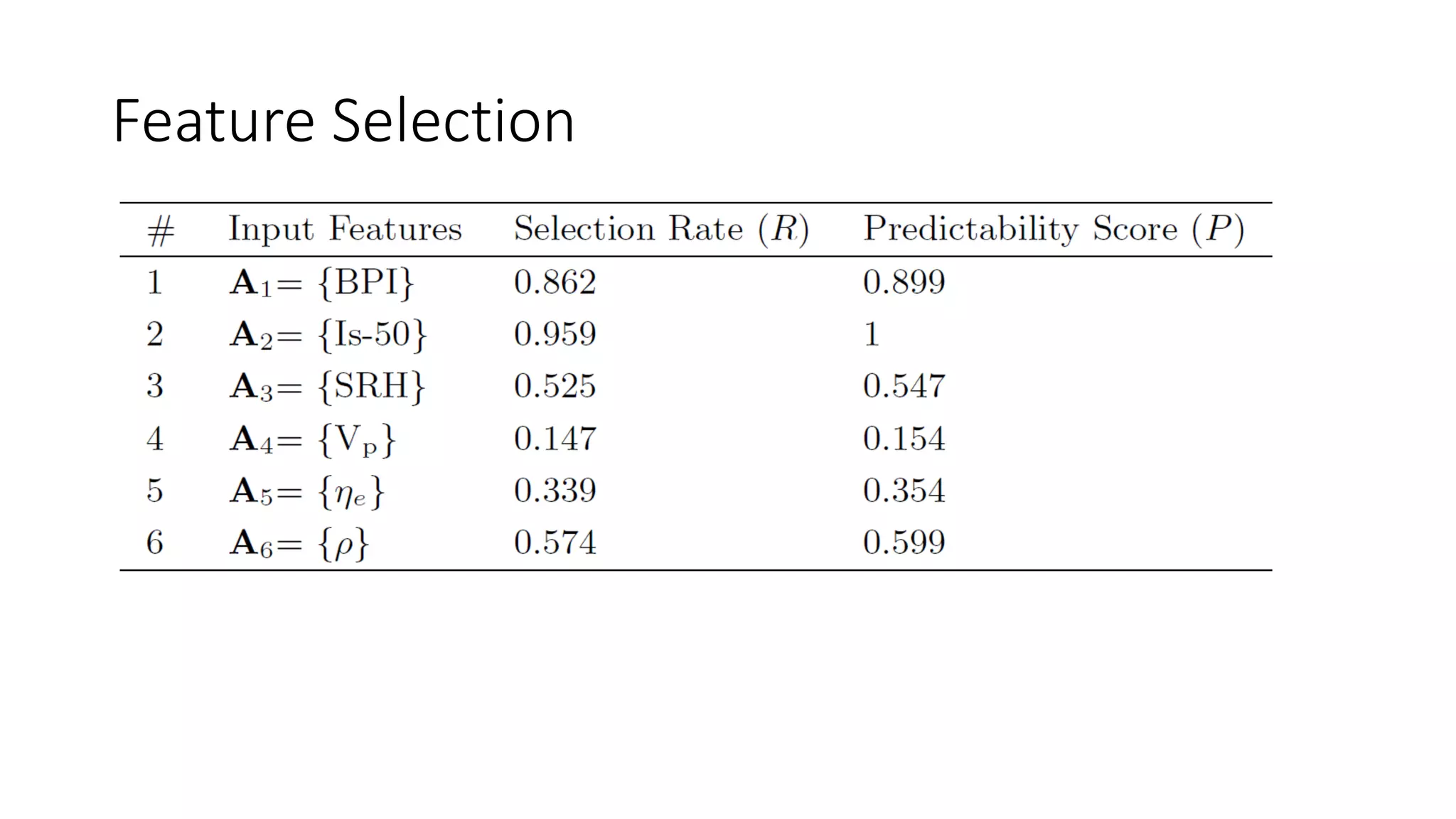
Feature Selection
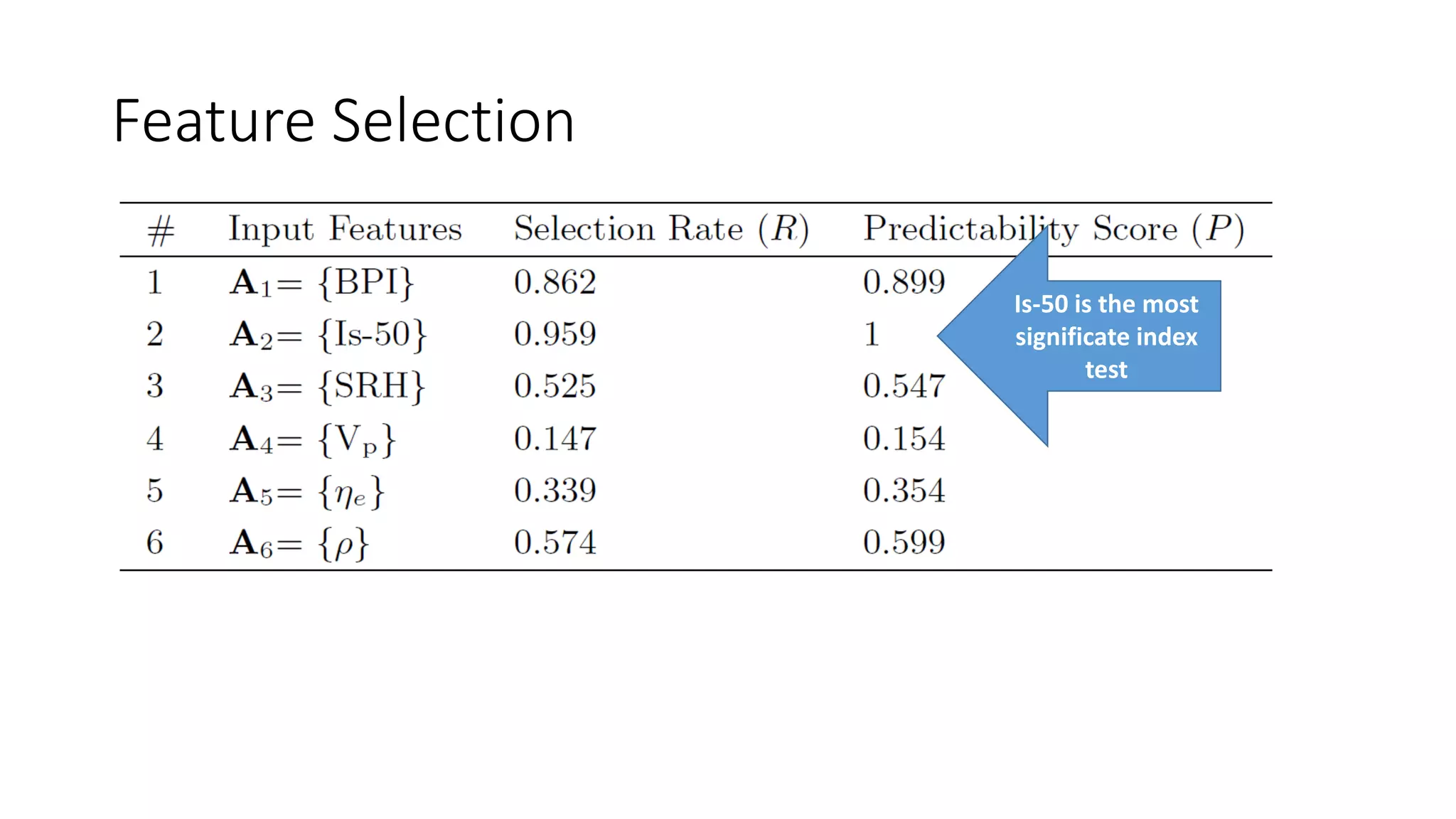
Feature Selection
Is-50 is the most
significate index
test
Conclusion
• UCS from the index tests was best estimated by a light weight a
multiobjective heterogeneous flexible neural tree (HFNTM)
• Among the different types of index tests—destructive indices, non-
destructive indices, and physical properties—the destructive
mechanical rock indices BPI and Is-50 are found to be the best index
tests to estimate the UCS.
Thankyou
Varun Ojha
vkojha@ieee.org
Deepak Mishra
deepakamban@gmail.com

Neural Tree for Estimating the Uniaxial Compressive Strength of Rock Materials

  • 1.
    Neural Tree forEstimating the Uniaxial Compressive Strength of Rock Materials Varun Kumar Ojha ETH Zurich, Switzerland Deepak Amban Mishra Indian Institute of Petroleum & Energy, Visakhapatnam, India Conference: Hybrid Computational Intelligence (HIS 2017) Paper title: Authors:
  • 2.
    Uniaxial Compressive Strength(UCS) • USC indicate strength of a rock material • UCS is used to test failing behavior of rock material • In laboratory a instrument compresses a rock material and checked when it crack (fail) • UCS is important test to avoid unintended event Image source: Siratovich et al. Article, Physical property relationships of the Rotokawa Andesite, a significant geothermal reservoir rock in the Taupo Volcanic Zone, New Zealand July 2014 Geothermal Energy 1(2):10
  • 3.
    UCS Index testparameters • Block punch index (BPI), • Point load strength (Is-50), • Schmidt rebound hardness (SRH), • Ultrasonic P-wave velocity (𝑉𝑝) • Porosity (𝜂 𝑒) • Density (𝜌) Rock: before failing Rock: after failing Image source: Mohd Ashraf Mohamad Ismail, Laboratory and in-situ rock testing, Advanced Geotechnical Engineering
  • 4.
    Rock samples Figure: Coresample photographs of (a) granite, (b) schistand (c) sandstone, and corresponding photomicrographs (d, e, and f). Collected from Malanjkhand Copper Project, Malanjkhand, India; UCIL mine at Jaduguda, India; and SCCL, Kothagudem, India respectively.
  • 5.
    Dataset : : :: : : : : : : : : : : : : : : : : : : : : Total samples: 60 Total input features: 5 Total output feature(s): 1 Training set: 40 randomly selected samples) Test set: 20 randomly selected samples)
  • 6.
    Computational Intelligence: Fuzzy InferenceSystem (FIS): Adaptive Neuro-Fuzzy Inference System (ANFIS): Multi-layer Perceptron (MLP): Heterogeneous Flexible Neural Tree (HFNT):
  • 7.
    Model Evaluation Criteriaand Results • Root mean squared error (𝑒) • Correlation coefficient (𝑟) • Squared of correlation coefficient (𝑟2) • Number of parameters in the developed model (𝜒) [1] Mishra DA, Srigyan M, Basu A, Rokade PJ (2015) Soft computing methods for estimating the uniaxial compressive strength of intact rock from index tests. Int J Rock Mech Min Sci 80:418{424
  • 8.
    Model Evaluation Criteriaand Results • Root mean squared error (𝑒) • Correlation coefficient (𝑟) • Squared of correlation coefficient (𝑟2) • Number of parameters in the developed model (𝜒) [1] Mishra DA, Srigyan M, Basu A, Rokade PJ (2015) Soft computing methods for estimating the uniaxial compressive strength of intact rock from index tests. Int J Rock Mech Min Sci 80:418{424 The Best Model
  • 9.
    Model Evaluation Criteriaand Results • Root mean squared error (𝑒) • Correlation coefficient (𝑟) • Squared of correlation coefficient (𝑟2) • Number of parameters in the developed model (𝜒) [1] Mishra DA, Srigyan M, Basu A, Rokade PJ (2015) Soft computing methods for estimating the uniaxial compressive strength of intact rock from index tests. Int J Rock Mech Min Sci 80:418{424 Best 𝑒, 𝑟, 𝑟2, and 𝜒
  • 10.
    Light-weight efficient model(HFNTM) HFNTM: Ojha et al. (2016) Ensemble of heterogeneous flexible neural trees using multiobjective genetic programming, Applied Soft Computing
  • 11.
  • 12.
    Feature Selection Is-50 isthe most significate index test
  • 13.
    Conclusion • UCS fromthe index tests was best estimated by a light weight a multiobjective heterogeneous flexible neural tree (HFNTM) • Among the different types of index tests—destructive indices, non- destructive indices, and physical properties—the destructive mechanical rock indices BPI and Is-50 are found to be the best index tests to estimate the UCS.
  • 14.