Minor Surgical
Procedures in
Orthodontics

 PRESENTED BY-
V.V.Priyanka
B.D.S final year,
RKDF Dental College & Research
Centre,Bhopal

A SEMINAR FOR DEPT. OF
ORTHODONTICS
Surgical Orthodontics:
                         Introduction
•    DEFINITION: Surgical orthodontics refers to the
     various surgical procedures carried out as a part of
     overall orthodontic treatment plan.
•    Used as an adjunct or in conjugation with orthodontic
     treatment
•    Can be carried out before, during or after completion of
     orthodontic treatment
•    Surgical procedures are usually carried out:
1.    To eliminate the existing etiologic factor
2.    As a part of treatment plan
3.    Facilitate correction of malocclusion by orthodontic
      techniques
4.    Stabilize orthodontic treatment results & prevent
      relapse
5.    To correct severe skeletal discrepancies
Surgical Procedures
 MINOR PROCEDURES      MAJOR PROCEDURES
• Extractions           • Orthognathic
• Surgical exposure       surgeries- surgical
  (uncovering) of         correction of jaws
  unerupted teeth       • Facial esthetic
• Frenectomy              surgeries like
                          rhinoplasty, blephar
• Supracrestal            oplasty
  fibrotomy/
  Pericision            • Facial
                          reconstruction like
• Corticotomy             cleft palate & lip
                          repair surgery
Minor Surgical Procedures
  The main aim is to remove the
   etiological factors & facilitate
   correction of malocclusion by
    orthodontic appliances, help
stabilize post-orthodontic results &
          to prevent relapse
Extractions
The various extraction procedures
       carried out as a part of
     orthodontic treatment are:
       a. Therapeutic extraction
          b. Serial extraction
     c. Extraction of carious teeth
d. Extraction of malformed/ankylosed
                   teeth
 e. Extraction of supernumery teeth
   f. Extraction of impacted teeth
THERAPEUTIC EXTRACTION
Extractions                              When to extract
undertaken as a part of                 (and when not to)
comprehensive                              Permanent teeth
orthodontic treatment               Central Incisors = Don’t!
mainly to gain space are            Lateral Incisors
                               • When to extract (and= Rarely to)
                                                           when not
called Therapeutic                      Canines
                               • Permanent teeth = Rarely
extractions.                      1st premolars Don’t!
                               • Central Incisors == 4+mm space
oPremolars most                                 required
                               • Lateral Incisors = Rarely
commonly extracted               2nd premolars = 2-4mm space
                               • Canines = Rarely
oExtraction should be                           required
                               • 1st premolars = 4+mm space required
atraumatic as any break in      1nd molars = Compromised = only
                                   st
                               • 2 premolars = 2-4mm space required
continuity of alveolar plate                 4-5mm space
                               • 1st molars = Compromised = only 4-5mm
may hinder the smooth                 2nd molars = To aid distal
progression of intended          space
                                   nd
                                               movement
orthodontic tooth              •   2   molars = To aid distal movement
movement.
serial
extraction

•Serial extraction is a form of
interceptive orthodontic treatment
which aims to relieve crowding at
an early stage so that the permanent
teeth can erupt into good
alignment, thus reducing or
avoiding the need for later
appliance therapy

Different procedures has been
described by different authors such
as;
Tweed’s method 1966; 8years [DC4].
Dewel’s ,,       1978; 81/2yrs[CD4]
Nance’s ,,       1940;         D4C
Extraction of Supernumery,Impacted & Ankylosed
                     Teeth
  •The presence of supernumery,impacted &
  ankylosed teeth impede the normal
  development of occlusion & are important local
  causes of malocclusion.
  •Common supernumery teeth-
  mesiodens, lower -pm
  area>incisor>molar, upper-canine area
  Extraction of impacted canine-
  i. prior to extraction, a thorough radiographic
       examination must be done.
  ii. Depending on position approach by a well-
       designed buccal or palatal flap.
  iii. Elevate flap. After reflecting flap, remove
       bone around tooth.
  iv. Remove tooth atraumatically & irrigate
       extraction socket.
  v. Reposition flap & suture.remove suture          Post surgical removal of
       after a week                                  impacted maxillary right canine
Surgical Exposure of Impacted Teeth

• Canines- freq impacted
  teeth that req surgical
  exposure.
• Favourably located
  impacted canines can be
  guided to their normal
  positions in the dental
  arch by a combined
  surgical-orthodontic
  treatment referred to as
  surgical eruption
Surgical Techniques for
exposing Impacted Canines:
1. Window approach
   (gingivectomy)
2. Apically repositioned flap
   (ARF)
3. Flap closed eruption
   technique (FCET)
4. Tunnel traction (TT)

Steps in the management of
   an Impacted Tooth:
a. Determination of the
   position
b. Evaluation of favourability
c. Surgical exposure & bone
   removal
d. Fixing orthodontic
   attachments or direct
   ligation
Frenectomy
• Frenum Problems-Midline diastema between two
  maxillary central incisors (low frenum
  attachment/thick labial frenum)
• The frenum that is inserted palatally into the
  incisive papilla & balances on eversion of lip is the
  main etiological factor of diastema. Such frenum
  has to be exised.
• A frenectomy in this case should be followed with
  orthodontic treatment.
• The RULE!!!- The presence of a maxillary diastema
  does not prompt early frenectomy-WAIT UNTIL
  THE CANINES AND LATERALS ERUPT
Corticotomy
• Corticotomy is an adjunct surgery for
  malocclusion with wide generalised
  spacings.
• The buccal palatal flaps are raised.
• The vertical cuts are placed in the
  cortical bone parallel to the roots. These
  vertical cuts on both palatal & buccal
  side are joined by horizontal bone cuts
  that extend the depth of cortical bone.
• The sutures are placed & orthodontic
  appliance is placed after 2-3weeks.
• Now the tooth move within the
  cancellous bone and the treatment time
  is appreciably reduced.
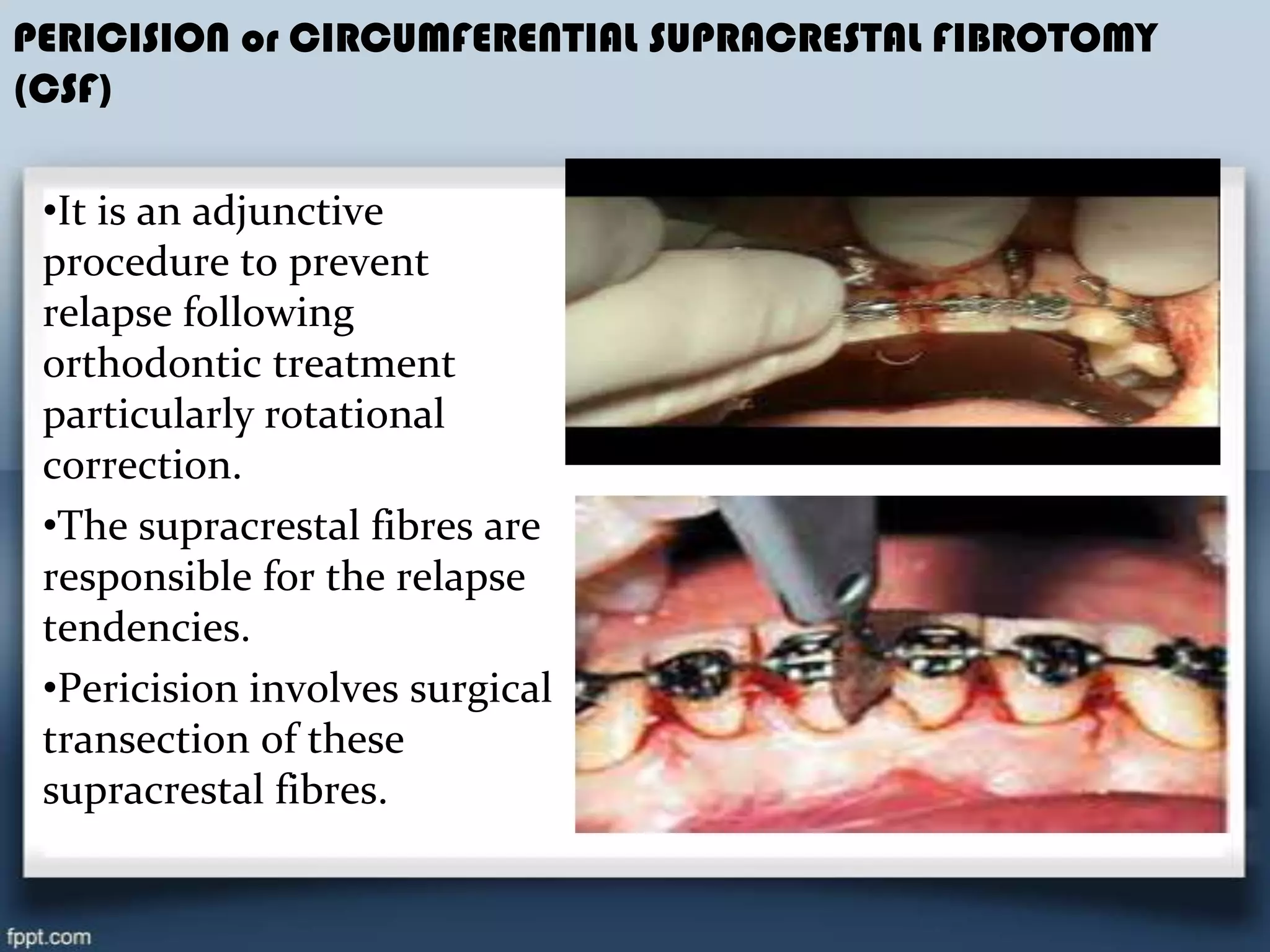
PERICISION or CIRCUMFERENTIAL SUPRACRESTAL FIBROTOMY
(CSF)

 •It is an adjunctive
 procedure to prevent
 relapse following
 orthodontic treatment
 particularly rotational
 correction.
 •The supracrestal fibres are
 responsible for the relapse
 tendencies.
 •Pericision involves surgical
 transection of these
 supracrestal fibres.
THANKS

   FOR

LISTENING!

Surgical orthodontics-minor surgical procedures

  • 1.
    Minor Surgical Procedures in Orthodontics PRESENTED BY- V.V.Priyanka B.D.S final year, RKDF Dental College & Research Centre,Bhopal A SEMINAR FOR DEPT. OF ORTHODONTICS
  • 2.
    Surgical Orthodontics: Introduction • DEFINITION: Surgical orthodontics refers to the various surgical procedures carried out as a part of overall orthodontic treatment plan. • Used as an adjunct or in conjugation with orthodontic treatment • Can be carried out before, during or after completion of orthodontic treatment • Surgical procedures are usually carried out: 1. To eliminate the existing etiologic factor 2. As a part of treatment plan 3. Facilitate correction of malocclusion by orthodontic techniques 4. Stabilize orthodontic treatment results & prevent relapse 5. To correct severe skeletal discrepancies
  • 3.
    Surgical Procedures MINORPROCEDURES MAJOR PROCEDURES • Extractions • Orthognathic • Surgical exposure surgeries- surgical (uncovering) of correction of jaws unerupted teeth • Facial esthetic • Frenectomy surgeries like rhinoplasty, blephar • Supracrestal oplasty fibrotomy/ Pericision • Facial reconstruction like • Corticotomy cleft palate & lip repair surgery
  • 4.
    Minor Surgical Procedures The main aim is to remove the etiological factors & facilitate correction of malocclusion by orthodontic appliances, help stabilize post-orthodontic results & to prevent relapse
  • 5.
    Extractions The various extractionprocedures carried out as a part of orthodontic treatment are: a. Therapeutic extraction b. Serial extraction c. Extraction of carious teeth d. Extraction of malformed/ankylosed teeth e. Extraction of supernumery teeth f. Extraction of impacted teeth
  • 6.
    THERAPEUTIC EXTRACTION Extractions When to extract undertaken as a part of (and when not to) comprehensive Permanent teeth orthodontic treatment Central Incisors = Don’t! mainly to gain space are Lateral Incisors • When to extract (and= Rarely to) when not called Therapeutic Canines • Permanent teeth = Rarely extractions. 1st premolars Don’t! • Central Incisors == 4+mm space oPremolars most required • Lateral Incisors = Rarely commonly extracted 2nd premolars = 2-4mm space • Canines = Rarely oExtraction should be required • 1st premolars = 4+mm space required atraumatic as any break in 1nd molars = Compromised = only st • 2 premolars = 2-4mm space required continuity of alveolar plate 4-5mm space • 1st molars = Compromised = only 4-5mm may hinder the smooth 2nd molars = To aid distal progression of intended space nd movement orthodontic tooth • 2 molars = To aid distal movement movement.
  • 7.
    serial extraction •Serial extraction isa form of interceptive orthodontic treatment which aims to relieve crowding at an early stage so that the permanent teeth can erupt into good alignment, thus reducing or avoiding the need for later appliance therapy Different procedures has been described by different authors such as; Tweed’s method 1966; 8years [DC4]. Dewel’s ,, 1978; 81/2yrs[CD4] Nance’s ,, 1940; D4C
  • 8.
    Extraction of Supernumery,Impacted& Ankylosed Teeth •The presence of supernumery,impacted & ankylosed teeth impede the normal development of occlusion & are important local causes of malocclusion. •Common supernumery teeth- mesiodens, lower -pm area>incisor>molar, upper-canine area Extraction of impacted canine- i. prior to extraction, a thorough radiographic examination must be done. ii. Depending on position approach by a well- designed buccal or palatal flap. iii. Elevate flap. After reflecting flap, remove bone around tooth. iv. Remove tooth atraumatically & irrigate extraction socket. v. Reposition flap & suture.remove suture Post surgical removal of after a week impacted maxillary right canine
  • 9.
    Surgical Exposure ofImpacted Teeth • Canines- freq impacted teeth that req surgical exposure. • Favourably located impacted canines can be guided to their normal positions in the dental arch by a combined surgical-orthodontic treatment referred to as surgical eruption
  • 10.
    Surgical Techniques for exposingImpacted Canines: 1. Window approach (gingivectomy) 2. Apically repositioned flap (ARF) 3. Flap closed eruption technique (FCET) 4. Tunnel traction (TT) Steps in the management of an Impacted Tooth: a. Determination of the position b. Evaluation of favourability c. Surgical exposure & bone removal d. Fixing orthodontic attachments or direct ligation
  • 11.
    Frenectomy • Frenum Problems-Midlinediastema between two maxillary central incisors (low frenum attachment/thick labial frenum) • The frenum that is inserted palatally into the incisive papilla & balances on eversion of lip is the main etiological factor of diastema. Such frenum has to be exised. • A frenectomy in this case should be followed with orthodontic treatment. • The RULE!!!- The presence of a maxillary diastema does not prompt early frenectomy-WAIT UNTIL THE CANINES AND LATERALS ERUPT
  • 16.
    Corticotomy • Corticotomy isan adjunct surgery for malocclusion with wide generalised spacings. • The buccal palatal flaps are raised. • The vertical cuts are placed in the cortical bone parallel to the roots. These vertical cuts on both palatal & buccal side are joined by horizontal bone cuts that extend the depth of cortical bone. • The sutures are placed & orthodontic appliance is placed after 2-3weeks. • Now the tooth move within the cancellous bone and the treatment time is appreciably reduced.
  • 17.
    PERICISION or CIRCUMFERENTIALSUPRACRESTAL FIBROTOMY (CSF) •It is an adjunctive procedure to prevent relapse following orthodontic treatment particularly rotational correction. •The supracrestal fibres are responsible for the relapse tendencies. •Pericision involves surgical transection of these supracrestal fibres.
  • 18.
    THANKS FOR LISTENING!