

CAREER CONVERSATION TOOLKITCAREER CONVERSATION TOOLKIT
CAREER
TERMINOLOGY
CAREER
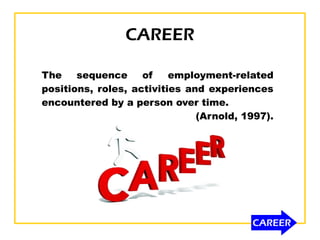
The sequence of employment-related
positions, roles, activities and experiences
encountered by a person over time.
(Arnold, 1997).
CAREER PLANNING &
DEVELOPMENT
The deliberate process
through which a person
becomes aware of personal
career-related attributes and
the lifelong series of
activities that contribute to
his or her career fulfillment.
G. Dessler, Pearson.
CAREER MANAGEMENT
The process for enabling employees to better
understand and develop their career skills and
interests, and to use these skills and interests
more effectively.
G. Dessler, Pearson.
CAREER CONVERSATION
The term “career conversation” refers to :
●
Career-related dialogue
between employees and
managers or any other
person;
●
Or “Career Coaching”.
THE CAREER PLANNING PROCESS
AND MANAGEMENT
Source : CRWG
THE OUTCOMES OF CAREER
CONVERSATION ACTIVITIES
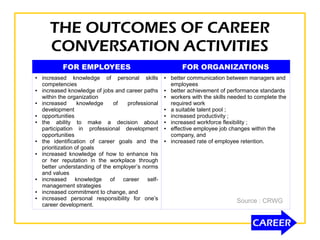
FOR EMPLOYEES FOR ORGANIZATIONS
● increased knowledge of personal skills
competencies
● increased knowledge of jobs and career paths
within the organization
● increased knowledge of professional
development
● opportunities
● the ability to make a decision about
participation in professional development
opportunities
● the identification of career goals and the
prioritization of goals
● increased knowledge of how to enhance his
or her reputation in the workplace through
better understanding of the employer’s norms
and values
● increased knowledge of career self-
management strategies
● increased commitment to change, and
● increased personal responsibility for one’s
career development.
● better communication between managers and
employees
● better achievement of performance standards
● workers with the skills needed to complete the
required work
● a suitable talent pool ;
● increased productivity ;
● increased workforce flexibility ;
● effective employee job changes within the
company, and
● increased rate of employee retention.
Source : CRWG
CAREER
CONVERSATION
TOOLKIT
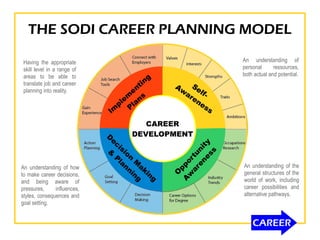
THE SODI CAREER PLANNING MODEL
CAREER
DEVELOPMENT
Self-
Aw
areness
O
pportunity
A
w
areness
An understanding of the
general structures of the
world of work, including
career possibilities and
alternative pathways.
An understanding of
personal ressources,
both actual and potential.
D
ecision
M
aking
&
Planning
Im
plem
enting
Plans
An understanding of how
to make career decisions,
and being aware of
pressures, influences,
styles, consequences and
goal setting.
Having the appropriate
skill level in a range of
areas to be able to
translate job and career
planning into reality.
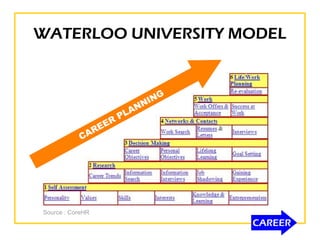
WATERLOO UNIVERSITY MODEL
CAREER
PLANNING
Source : CoreHR
CAREER DISCUSSION TOPICS
The topics of a career discussion include
the employee’s :
 Feelings about the current job and career situation ;
 Skills and performance ;
 Values and work-life issues ;
 Potential within the organization and aspirations ;
 Job and career options both within and outside of
the organization ;
 Processes and the office politics relevant to
changing jobs ;
 Identifying and evaluating career options, leading to
a decision;
 Action planning. (CIPD, 2005)
THE POWER IS IN THE QUESTION
● Where they’ve come from ?
● Where they’re heading ?
● Where they are ?
● Where are they at?
● What’s important to them in their career?
● What does success look like for them?
● What skills and qualities do they have?
● What opportunities are available?
● How do they navigate the processes and politics?
● How do they identify and evaluate different options?
● What career development strategies can they use?
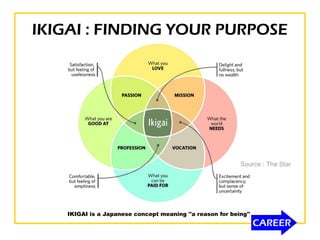
IKIGAI : FINDING YOUR PURPOSE
IKIGAI is a Japanese concept meaning ''a reason for being''
Source : The Star
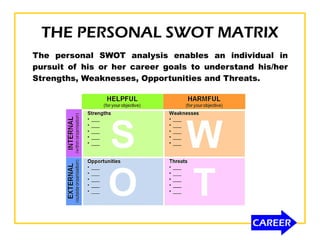
THE PERSONAL SWOT MATRIX
The personal SWOT analysis enables an individual in
pursuit of his or her career goals to understand his/her
Strengths, Weaknesses, Opportunities and Threats.
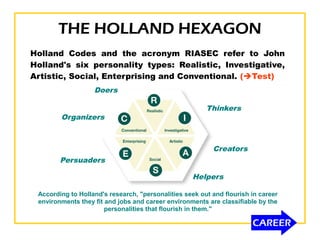
THE HOLLAND HEXAGON
Holland Codes and the acronym RIASEC refer to John
Holland's six personality types: Realistic, Investigative,
Artistic, Social, Enterprising and Conventional. (Test)
According to Holland's research, "personalities seek out and flourish in career
environments they fit and jobs and career environments are classifiable by the
personalities that flourish in them."
Organizers
Doers
Thinkers
Creators
Helpers
Persuaders
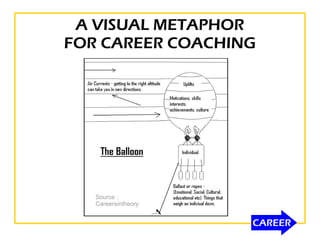
A VISUAL METAPHOR
FOR CAREER COACHING
Source :
Careersintheory
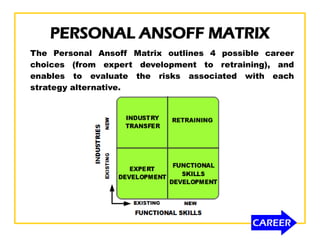
PERSONAL ANSOFF MATRIX
The Personal Ansoff Matrix outlines 4 possible career
choices (from expert development to retraining), and
enables to evaluate the risks associated with each
strategy alternative.
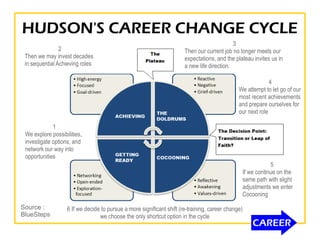
HUDSON'S CAREER CHANGE CYCLE
1
We explore possibilities,
investigate options, and
network our way into
opportunities
2
Then we may invest decades
in sequential Achieving roles
3
Then our current job no longer meets our
expectations, and the plateau invites us in
a new life direction.
4
We attempt to let go of our
most recent achievements
and prepare ourselves for
our next role
5
If we continue on the
same path with slight
adjustments we enter
Cocooning
6 If we decide to pursue a more significant shift (re-training, career change)
we choose the only shortcut option in the cycle
Source :
BlueSteps
GOAL SETTING SMART FORMAT
Career goals should be written down, and comply with the
SMART format for Specific, Measurable, Attainable,
Relevant, and Time-bound Goals.
S M A R T
Specific
Who What Where
When Why Which
Who is involved, What
do I want to
accomplish, Where will
it be done, Why am I
doing this (reason,
purpose), which
constraints /
requirements do I
have ?
Measurable
From and to
Can you track the
progress and measure
the outcome ?
How much, How many
How will I know when
my goal is
accomplished ?
Attainable
How
Is the goal reasonable
enough to be
accomplished ?
Make sure the goal is
not out of reach or
below standard
performance
Relevant
Worthwhile
Is the goal worthwhile
and will it meet your
needs ?
Is each goal consistent
with other goals you
have established and
fits with your immediate
and long term plans
Timely
When
Your objective should
include a time limit.
I will complete this step
by month/day/year
It will establish a sense
of urgency and prompt
you to have better time
management
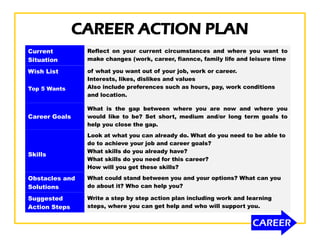
Current
Situation
Reflect on your current circumstances and where you want to
make changes (work, career, fiannce, family life and leisure time
Wish List
Top 5 Wants
of what you want out of your job, work or career.
Interests, likes, dislikes and values
Also include preferences such as hours, pay, work conditions
and location.
Career Goals
What is the gap between where you are now and where you
would like to be? Set short, medium and/or long term goals to
help you close the gap.
Skills
Look at what you can already do. What do you need to be able to
do to achieve your job and career goals?
What skills do you already have?
What skills do you need for this career?
How will you get these skills?
Obstacles and
Solutions
What could stand between you and your options? What can you
do about it? Who can help you?
Suggested
Action Steps
Write a step by step action plan including work and learning
steps, where you can get help and who will support you.
CAREER ACTION PLAN
Peter DRUCKER
THE BEST WAY TO
PREDICT THE FUTURE
IS TO CREATE IT
RESOURCES
●
UC Berkeley Human Resources : Development (UCB).
●
Canadian Research Working Group on Evidence
Based Practice in Career Development (CRWG).

Career Conversation Toolkit

  • 1.
  • 2.
  • 3.
    CAREER The sequence ofemployment-related positions, roles, activities and experiences encountered by a person over time. (Arnold, 1997).
  • 4.
    CAREER PLANNING & DEVELOPMENT Thedeliberate process through which a person becomes aware of personal career-related attributes and the lifelong series of activities that contribute to his or her career fulfillment. G. Dessler, Pearson.
  • 5.
    CAREER MANAGEMENT The processfor enabling employees to better understand and develop their career skills and interests, and to use these skills and interests more effectively. G. Dessler, Pearson.
  • 6.
    CAREER CONVERSATION The term“career conversation” refers to : ● Career-related dialogue between employees and managers or any other person; ● Or “Career Coaching”.
  • 7.
    THE CAREER PLANNINGPROCESS AND MANAGEMENT Source : CRWG
  • 8.
    THE OUTCOMES OFCAREER CONVERSATION ACTIVITIES FOR EMPLOYEES FOR ORGANIZATIONS ● increased knowledge of personal skills competencies ● increased knowledge of jobs and career paths within the organization ● increased knowledge of professional development ● opportunities ● the ability to make a decision about participation in professional development opportunities ● the identification of career goals and the prioritization of goals ● increased knowledge of how to enhance his or her reputation in the workplace through better understanding of the employer’s norms and values ● increased knowledge of career self- management strategies ● increased commitment to change, and ● increased personal responsibility for one’s career development. ● better communication between managers and employees ● better achievement of performance standards ● workers with the skills needed to complete the required work ● a suitable talent pool ; ● increased productivity ; ● increased workforce flexibility ; ● effective employee job changes within the company, and ● increased rate of employee retention. Source : CRWG
  • 9.
  • 10.
    THE SODI CAREERPLANNING MODEL CAREER DEVELOPMENT Self- Aw areness O pportunity A w areness An understanding of the general structures of the world of work, including career possibilities and alternative pathways. An understanding of personal ressources, both actual and potential. D ecision M aking & Planning Im plem enting Plans An understanding of how to make career decisions, and being aware of pressures, influences, styles, consequences and goal setting. Having the appropriate skill level in a range of areas to be able to translate job and career planning into reality.
  • 11.
  • 12.
    CAREER DISCUSSION TOPICS Thetopics of a career discussion include the employee’s :  Feelings about the current job and career situation ;  Skills and performance ;  Values and work-life issues ;  Potential within the organization and aspirations ;  Job and career options both within and outside of the organization ;  Processes and the office politics relevant to changing jobs ;  Identifying and evaluating career options, leading to a decision;  Action planning. (CIPD, 2005)
  • 13.
    THE POWER ISIN THE QUESTION ● Where they’ve come from ? ● Where they’re heading ? ● Where they are ? ● Where are they at? ● What’s important to them in their career? ● What does success look like for them? ● What skills and qualities do they have? ● What opportunities are available? ● How do they navigate the processes and politics? ● How do they identify and evaluate different options? ● What career development strategies can they use?
  • 14.
    IKIGAI : FINDINGYOUR PURPOSE IKIGAI is a Japanese concept meaning ''a reason for being'' Source : The Star
  • 15.
    THE PERSONAL SWOTMATRIX The personal SWOT analysis enables an individual in pursuit of his or her career goals to understand his/her Strengths, Weaknesses, Opportunities and Threats.
  • 16.
    THE HOLLAND HEXAGON HollandCodes and the acronym RIASEC refer to John Holland's six personality types: Realistic, Investigative, Artistic, Social, Enterprising and Conventional. (Test) According to Holland's research, "personalities seek out and flourish in career environments they fit and jobs and career environments are classifiable by the personalities that flourish in them." Organizers Doers Thinkers Creators Helpers Persuaders
  • 17.
    A VISUAL METAPHOR FORCAREER COACHING Source : Careersintheory
  • 18.
    PERSONAL ANSOFF MATRIX ThePersonal Ansoff Matrix outlines 4 possible career choices (from expert development to retraining), and enables to evaluate the risks associated with each strategy alternative.
  • 19.
    HUDSON'S CAREER CHANGECYCLE 1 We explore possibilities, investigate options, and network our way into opportunities 2 Then we may invest decades in sequential Achieving roles 3 Then our current job no longer meets our expectations, and the plateau invites us in a new life direction. 4 We attempt to let go of our most recent achievements and prepare ourselves for our next role 5 If we continue on the same path with slight adjustments we enter Cocooning 6 If we decide to pursue a more significant shift (re-training, career change) we choose the only shortcut option in the cycle Source : BlueSteps
  • 20.
    GOAL SETTING SMARTFORMAT Career goals should be written down, and comply with the SMART format for Specific, Measurable, Attainable, Relevant, and Time-bound Goals. S M A R T Specific Who What Where When Why Which Who is involved, What do I want to accomplish, Where will it be done, Why am I doing this (reason, purpose), which constraints / requirements do I have ? Measurable From and to Can you track the progress and measure the outcome ? How much, How many How will I know when my goal is accomplished ? Attainable How Is the goal reasonable enough to be accomplished ? Make sure the goal is not out of reach or below standard performance Relevant Worthwhile Is the goal worthwhile and will it meet your needs ? Is each goal consistent with other goals you have established and fits with your immediate and long term plans Timely When Your objective should include a time limit. I will complete this step by month/day/year It will establish a sense of urgency and prompt you to have better time management
  • 21.
    Current Situation Reflect on yourcurrent circumstances and where you want to make changes (work, career, fiannce, family life and leisure time Wish List Top 5 Wants of what you want out of your job, work or career. Interests, likes, dislikes and values Also include preferences such as hours, pay, work conditions and location. Career Goals What is the gap between where you are now and where you would like to be? Set short, medium and/or long term goals to help you close the gap. Skills Look at what you can already do. What do you need to be able to do to achieve your job and career goals? What skills do you already have? What skills do you need for this career? How will you get these skills? Obstacles and Solutions What could stand between you and your options? What can you do about it? Who can help you? Suggested Action Steps Write a step by step action plan including work and learning steps, where you can get help and who will support you. CAREER ACTION PLAN
  • 22.
    Peter DRUCKER THE BESTWAY TO PREDICT THE FUTURE IS TO CREATE IT
  • 23.
    RESOURCES ● UC Berkeley HumanResources : Development (UCB). ● Canadian Research Working Group on Evidence Based Practice in Career Development (CRWG).