Seccl Technology Limited is a company registered in England and Wales at 20 Manvers St, Bath, BA1 1JW (Number: 10237930). Seccl Custody Limited, a wholly owned subsidiary of Seccl Technology Limited, is registered in England
and Wales (Number: 10430958), and authorised and regulated by the Financial Conduct Authority (Firm Reference Number: 793200). Copyright © 2020 Seccl Technology Limited.
Getting to know you
A little bit all about me
Early usability testing of fruit
was somewhat unsuccessful.
Seccl Technology Limited is a company registered in England and Wales at 20 Manvers St, Bath, BA1 1JW (Number: 10237930). Seccl Custody Limited, a wholly owned subsidiary of Seccl Technology Limited, is registered in England
and Wales (Number: 10430958), and authorised and regulated by the Financial Conduct Authority (Firm Reference Number: 793200). Copyright © 2020 Seccl Technology Limited.
I work for Seccl
Official Jargon: B2B Fintech Scale Up
Some of our engineers
Behind the scenes
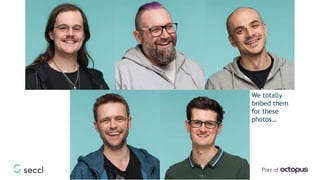
We totally
bribed them
for these
photos…
What’s the cause?
Developing for unknown users
Stealing from my experience
Experiments…
Customer Deep Dives
Aka Empathy Labs
• What’s frustrated them
• What’s made their lives easy
• What processes they’re going through at the moment
How to get the most from a deep dive
Some simple areas to discuss
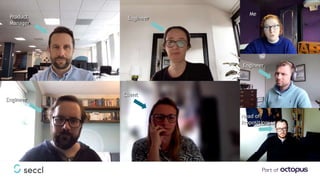
Product
Manager
Engineer
Engineer
Engineer
Head of
Propositions
Client
Me
In conclusion…
As with all good experiments
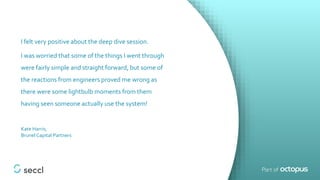
I felt very positive about the deep dive session.
I was worried that some of the things I went through
were fairly simple and straight forward, but some of
the reactions from engineers proved me wrong as
there were some lightbulb moments from them
having seen someone actually use the system!
Kate Harris,
Brunel Capital Partners
It’s crucial that we build empathy with our users –
getting to know their day-to-day tasks and context
and experiencing their pain points as if they were
our own.This will enable us to make the right
decisions about how we prioritise, shape, and build
solutions in a way that fits around our users’ needs.
James Barlett, Product
Manager
How we did it
Let’s get practical
We Mural
The charm offensive
What went wrong, what went right
They like giving feedback
Our great relationship shines through
On the day
Don’t overwhelm your customers
[Company name] Deep Dive
We’ll be using [video conference software] [Link to join] at [time] – please join just before!
Today we’ll be joined by [names of participants]. [website of company] here’s a brief bit about them.
Just to recap, it’s good to run these things a certain way.
1. I’ll need two volunteers to take notes.
2. Use this chat to funnel any questions you may have through me.
3. Keep other chat here to a minimum while the call is live.
4. Remind me to ask about recording the session.
5. We’re not here to solve their problems.
The rules of a Customer Deep Dive
Internal briefing
Thank you for listening!
I hope Deep Dives could be useful to you.

Getting To Know You: How Customer Deep Dives Work At Seccl

  • 1.
    Seccl Technology Limitedis a company registered in England and Wales at 20 Manvers St, Bath, BA1 1JW (Number: 10237930). Seccl Custody Limited, a wholly owned subsidiary of Seccl Technology Limited, is registered in England and Wales (Number: 10430958), and authorised and regulated by the Financial Conduct Authority (Firm Reference Number: 793200). Copyright © 2020 Seccl Technology Limited. Getting to know you A little bit all about me
  • 2.
    Early usability testingof fruit was somewhat unsuccessful.
  • 3.
    Seccl Technology Limitedis a company registered in England and Wales at 20 Manvers St, Bath, BA1 1JW (Number: 10237930). Seccl Custody Limited, a wholly owned subsidiary of Seccl Technology Limited, is registered in England and Wales (Number: 10430958), and authorised and regulated by the Financial Conduct Authority (Firm Reference Number: 793200). Copyright © 2020 Seccl Technology Limited. I work for Seccl Official Jargon: B2B Fintech Scale Up
  • 5.
    Some of ourengineers Behind the scenes
  • 6.
  • 7.
  • 8.
    Stealing from myexperience Experiments…
  • 10.
  • 11.
    • What’s frustratedthem • What’s made their lives easy • What processes they’re going through at the moment How to get the most from a deep dive Some simple areas to discuss
  • 12.
  • 13.
    In conclusion… As withall good experiments
  • 14.
    I felt verypositive about the deep dive session. I was worried that some of the things I went through were fairly simple and straight forward, but some of the reactions from engineers proved me wrong as there were some lightbulb moments from them having seen someone actually use the system! Kate Harris, Brunel Capital Partners
  • 15.
    It’s crucial thatwe build empathy with our users – getting to know their day-to-day tasks and context and experiencing their pain points as if they were our own.This will enable us to make the right decisions about how we prioritise, shape, and build solutions in a way that fits around our users’ needs. James Barlett, Product Manager
  • 16.
    How we didit Let’s get practical
  • 17.
  • 18.
    The charm offensive Whatwent wrong, what went right
  • 20.
    They like givingfeedback Our great relationship shines through
  • 21.
    On the day Don’toverwhelm your customers
  • 22.
    [Company name] DeepDive We’ll be using [video conference software] [Link to join] at [time] – please join just before! Today we’ll be joined by [names of participants]. [website of company] here’s a brief bit about them. Just to recap, it’s good to run these things a certain way. 1. I’ll need two volunteers to take notes. 2. Use this chat to funnel any questions you may have through me. 3. Keep other chat here to a minimum while the call is live. 4. Remind me to ask about recording the session. 5. We’re not here to solve their problems. The rules of a Customer Deep Dive Internal briefing
  • 23.
    Thank you forlistening! I hope Deep Dives could be useful to you.

Editor's Notes

  • #2 Thank you for turning up to listen to me. I’m a product designer with about 12 years experience. I’m super passionate about accessibility, user experience and sometimes even design.
  • #3 I’ve always been obsessed with the way things work. Mystified when I realized that we don’t just design things ‘the best way they can be’ and mildly mortified when I realized there isn’t even a best way.
  • #4 I work for Seccl. We’re a business to business financial technology scale up. Say that a few times.
  • #5 It’s worth noting, this is our pride picnic.
  • #7 It’s very hard to get photos of your growing team during lockdown conditions. I apologise to the other developers working at Seccl for the lack of representation in this slide! These are the backbone of the company. The ones who make us seem whizzy and shiny and fast paced. All those important things to seem when you’re a start up planning on disrupting an established giant. The problem was, they felt they could only develop based on what was written on the ticket. Our teams are all really invested in the company – they want Seccl to succeed. They didn’t know how to challenge the priority of issues as we weren’t giving them the information they needed to do so.
  • #8 They hadn’t met our clients! The ones using the systems they were developing. Pretty standard, right? But how weird is that?! To me, as someone who crafts experiences for people, to build something for people I’ve never met just felt entirely wrong. I get that we’re business to business…but our developers weren’t even aware of our clients do on a day to day basis.
  • #9 We like to experiment at Seccl. Keeps things fresh, keeps us from dwelling on anything that isn’t working. In the past when learning about a new client for an agency I worked at, we would run discovery sessions. They were broad sessions in which we intended to learn about the company as well as the problem. But this wasn’t to be a one-off, and it wasn’t just getting knowledge for myself.
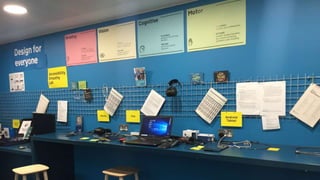
  • #10 This is a government digital service empathy lab. When you learn about accessibility, you want to get yourself in to something like this. These labs have equipment to help you experience different access needs. From hearing, to sight to movement – using headphones, goggles and sometimes even tape. Experiencing the digital tools you use on a day to day basis with an access need is seriously eye opening. You don’t even have to do something as formal – you can make an empathy lab yourself.
  • #11 Combine a discovery workshop, the purpose of an empathy lab and you have customer deep dives. A customer deep dive is presented as an opportunity for our customers to vent.
  • #12 We don’t approach them with questions. We don’t have any specific goal in mind. The approach is that we would love to hear what grinds their gears, what makes them happy, what processes they are going through at the moment. We’re looking at making this research as close to true ethnographic research as possible. When we can, we’d love to go to their offices and talk to them. We’re actually looking into workplace shadowing as well
  • #13 Here is one in action. We’ve got product managers, engineers and the head of propositions on the call Our client is telling us all about their woes during a rebalance. She’s just been sharing her screen, so we’ve seen her using the system – and she is on a much bigger screen than we anticipated! Luke – seen here as the engineer underneath me – commented on it. ‘Just seeing the system with real data and being used by someone with specific intent when she shared her screen was really informative’
  • #14 The experiment was a huge success. We now regularly (that’s every couple of weeks) run a customer deep dive. Cycling through all the different customers we have – from those who are onboarding, to our longest standing clients. We’ve found things out we never would have known with a narrower field of research.
  • #15 Quotes quotes quotes
  • #16 Quotes quotes quotes
  • #17 I’m going to get into the basics here – so you can see how easy it can be to set something like this up.
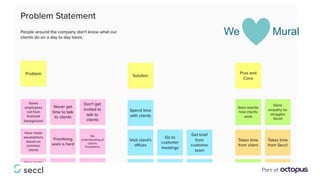
  • #18 At Seccl, whenever we have an idea, we tend to reach for Mural. It’s a collaborative whiteboard with the idea of post-it notes to jot points down on. I created a Mural board with the problem, my initial solution idea and then had a good ol’ chat with my boss (bear in mind I was still very new to the company!) about the feasibility of this. We worked out that the sessions needed to start happening soon – so we had to think remote. We could use teams, but we wouldn’t want the whole company to be seen on the call – that would be overwhelming. So we’d record them, and host watch parties. We’d need to work around our customer team’s requirements – we don’t want to frustrate our clients!
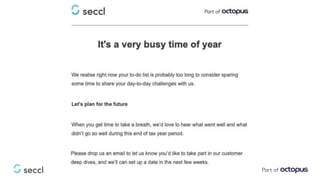
  • #19 We’re ready. We emailed our clients – and it was a slick email, I used hub spot and everything. No one responded.
  • #20 Timing is everything. Turns out…end of the tax year is not the best time to ask your clients who operate in the finance industry for something. The email was too polished, too much like my marketing past. I tried again, using real language. I’m worried. I’ve kind of made a big deal out of this. I’m still pretty new to Seccl and thought I could really boost our customer understanding by setting these things up.
  • #21 Eventually, with some gentle poking from the customer team, we get some responses. We then sign up yet more people by adding an opt in to our NPS survey.
  • #22 I brief the sessions in a similar way to the briefing at the start of any user research. No right or wrong. No stupid questions. Express that we have no tailored aim for the session. We just want to listen. I then have some rules in place…
  • #23 I very quickly learnt that some rules would be needed for these sessions. I allow 5 other people in to each session to watch ‘live’. This is agreed with the participants before hand. In my briefing I let them know that those people will be silent unless we invite them to talk. I personally prefer to host these sessions on Teams because it will automatically create searchable transcripts for me, allow me to share the videos and ‘file’ them properly. Two volunteers for notes – you don’t want to be taking notes on your own. One takes emotional notes – so when someone gets frustrated. The other takes process notes. Both should be time stamped if possible. It can be really overwhelming having to answer questions as