How Can CCU Provide a Net Benefit? 
Professor Peter Styring 
Director, UK Centre for Carbon Dioxide Utilisation 
The University of Sheffield 
UKCCSRC 
Biannual Conference 
Cardiff. 10 September 2014
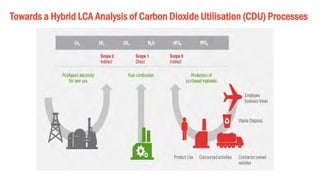
Towards a Hybrid LCA Analysis of Carbon Dioxide Utilisation (CDU) Processes
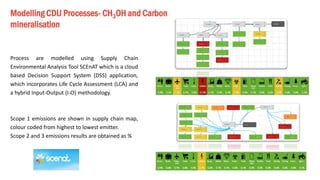
Modelling CDU Processes- CH3OH and Carbon mineralisation 
Process are modelled using Supply Chain Environmental Analysis Tool SCEnAT which is a cloud based Decision Support System (DSS) application, which incorporates Life Cycle Assessment (LCA) and a hybrid Input-Output (I-O) methodology. 
Scope 1 emissions are shown in supply chain map, colour coded from highest to lowest emitter. 
Scope 2 and 3 emissions results are obtained as %
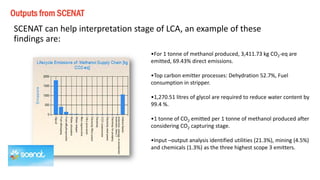
SCENAT can help interpretation stage of LCA, an example of these findings are: 
Outputs from SCENAT 
• 
For 1 tonne of methanol produced, 3,411.73 kg CO2-eq are emitted, 69.43% direct emissions. 
• 
Top carbon emitter processes: Dehydration 52.7%, Fuel consumption in stripper. 
• 
1,270.51 litres of glycol are required to reduce water content by 99.4 %. 
• 
1 tonne of CO2 emitted per 1 tonne of methanol produced after considering CO2 capturing stage. 
• 
Input –output analysis identified utilities (21.3%), mining (4.5%) and chemicals (1.3%) as the three highest scope 3 emitters.
Carbon Dioxide Utilisation- Importance of full LCA study 
‘Performing complete LCA studies on CDU processes at this stage presents an opportunity to prevent rather than react to environmental issues unlike most chemical processes currently available in the market’ 
‘There is a necessity to perform an extensive LCA with additional impact categories and statistical analysis due to the lack of available data at industrial scale for relatively new CDU processes’ 
‘Adapting existing impact assessment tools to analyse specific chemical process models will contribute to predict potential environmental impacts, present alternative supply chains to lessen these impacts and support or oppose CDU at large scale as a sustainable technology’ 
‘Highlighted is the need for further studies around how low carbon electricity can be guaranteed for CDU processes’
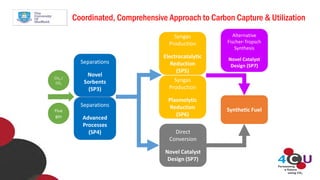
Coordinated, Comprehensive Approach to Carbon Capture & Utilization 
CH4 / 
CO2 
Flue gas 
Separations 
Novel Sorbents (SP3) 
Separations 
Advanced Processes (SP4) 
Syngas Production Electrocatalytic Reduction (SP5) 
Syngas Production Plasmolytic Reduction (SP6) 
Synthetic Fuel 
Direct Conversion 
Novel Catalyst Design (SP7) 
Alternative Fischer-Tropsch Synthesis 
Novel Catalyst Design (SP7)
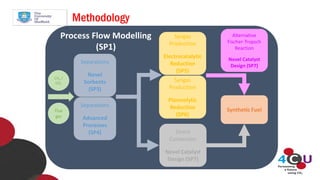
Methodology 
CH4 / 
CO2 
Flue gas 
Separations Novel Sorbents (SP3) 
Separations Advanced Processes (SP4) 
Syngas Production 
Electrocatalytic Reduction 
(SP5) 
Syngas Production 
Plasmolytic Reduction 
(SP6) 
Synthetic Fuel 
Direct Conversion 
Novel Catalyst Design (SP7) 
Alternative Fischer-Tropsch Reaction 
Novel Catalyst Design (SP7) 
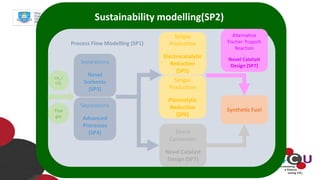
Process Flow Modelling (SP1)
Methodology 
CH4 / CO2 
Flue gas 
Separations 
Novel Sorbents (SP3) 
Separations 
Advanced Processes (SP4) 
Syngas Production 
Electrocatalytic Reduction 
(SP5) 
Syngas Production 
Plasmolytic Reduction 
(SP6) 
Synthetic Fuel 
Direct Conversion 
Novel Catalyst Design (SP7) 
Alternative Fischer-Tropsch Reaction Novel Catalyst Design (SP7) 
Process Flow Modelling (SP1) 
Sustainability modelling(SP2)
1.01 kg CO2 sequestered /1.00 kg polymer 
Poly(methyl acrylate) 
[PMA] 
Polymers
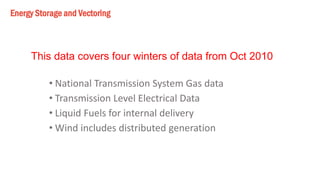
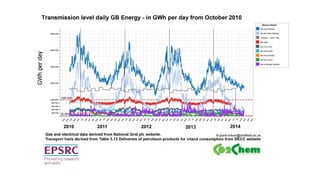
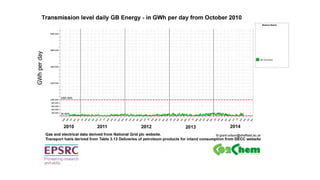
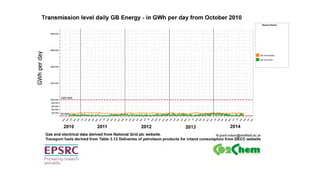
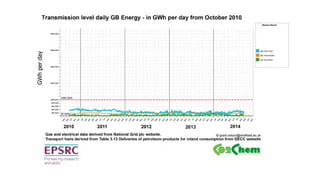
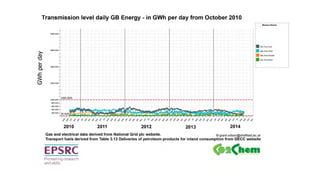
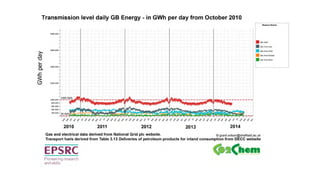
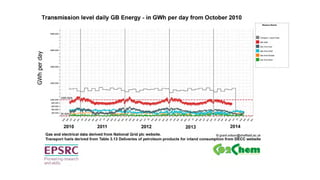
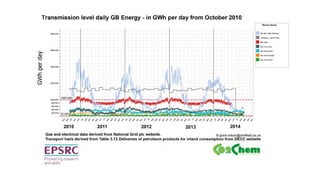
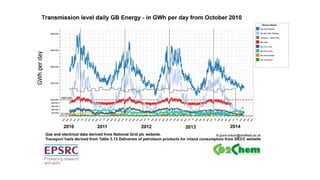
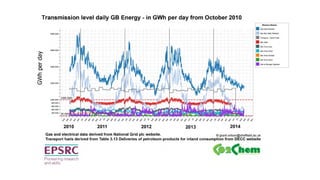
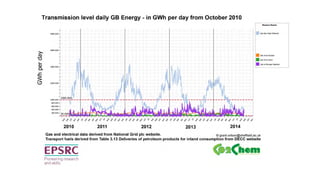
This data covers four winters of data from Oct 2010 
• 
National Transmission System Gas data 
• 
Transmission Level Electrical Data 
• 
Liquid Fuels for internal delivery 
• 
Wind includes distributed generation 
Energy Storage and Vectoring
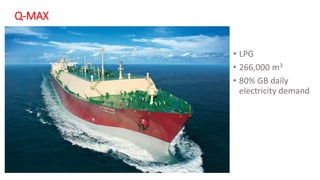
Q-MAX 
• 
LPG 
• 
266,000 m3 
• 
80% GB daily electricity demand
• 
CCU/CDU is a complementary, not replacement technology for CCS 
• 
Polymers, Minerals and Synthetic Fuels represent the most promising ways forward 
• 
Full and comparative life cycle analysis (LCA) is require up to Scope 3 with a ‘Cradle to Grave’ or ‘Cradle to Cradle’ approach 
• 
Carbon sequestrated is not necessarily the key indicator: we should also be looking at carbon avoided 
• 
Scope 3 LCA allows us to identify ‘Hot Spots’ in the supply chain so that efforts can be made to reduce their environmental and economic impact 
• 
Energy (and feedstock) supply chain security at minimum cost will become an important feature of any CCUS activity 
Conclusions
• 
Professor Peter Hall 
• 
Professor Lenny Koh 
• 
Dr Grant Wilson 
• 
Dr George Dowson 
• 
Dr Anthony Rennie 
• 
Katy Armstrong 
• 
Ana Villa Zaragoza 
• 
Liam Goucher 
Acknowledgements

How Can CCU Provide a Net Benefit? - presentation by Peter Styring at the UKCCSRC Cardiff Biannual Meeting, 10-11 September 2014

  • 1.
    How Can CCUProvide a Net Benefit? Professor Peter Styring Director, UK Centre for Carbon Dioxide Utilisation The University of Sheffield UKCCSRC Biannual Conference Cardiff. 10 September 2014
  • 4.
    Towards a HybridLCA Analysis of Carbon Dioxide Utilisation (CDU) Processes
  • 5.
    Modelling CDU Processes-CH3OH and Carbon mineralisation Process are modelled using Supply Chain Environmental Analysis Tool SCEnAT which is a cloud based Decision Support System (DSS) application, which incorporates Life Cycle Assessment (LCA) and a hybrid Input-Output (I-O) methodology. Scope 1 emissions are shown in supply chain map, colour coded from highest to lowest emitter. Scope 2 and 3 emissions results are obtained as %
  • 6.
    SCENAT can helpinterpretation stage of LCA, an example of these findings are: Outputs from SCENAT • For 1 tonne of methanol produced, 3,411.73 kg CO2-eq are emitted, 69.43% direct emissions. • Top carbon emitter processes: Dehydration 52.7%, Fuel consumption in stripper. • 1,270.51 litres of glycol are required to reduce water content by 99.4 %. • 1 tonne of CO2 emitted per 1 tonne of methanol produced after considering CO2 capturing stage. • Input –output analysis identified utilities (21.3%), mining (4.5%) and chemicals (1.3%) as the three highest scope 3 emitters.
  • 7.
    Carbon Dioxide Utilisation-Importance of full LCA study ‘Performing complete LCA studies on CDU processes at this stage presents an opportunity to prevent rather than react to environmental issues unlike most chemical processes currently available in the market’ ‘There is a necessity to perform an extensive LCA with additional impact categories and statistical analysis due to the lack of available data at industrial scale for relatively new CDU processes’ ‘Adapting existing impact assessment tools to analyse specific chemical process models will contribute to predict potential environmental impacts, present alternative supply chains to lessen these impacts and support or oppose CDU at large scale as a sustainable technology’ ‘Highlighted is the need for further studies around how low carbon electricity can be guaranteed for CDU processes’
  • 8.
    Coordinated, Comprehensive Approachto Carbon Capture & Utilization CH4 / CO2 Flue gas Separations Novel Sorbents (SP3) Separations Advanced Processes (SP4) Syngas Production Electrocatalytic Reduction (SP5) Syngas Production Plasmolytic Reduction (SP6) Synthetic Fuel Direct Conversion Novel Catalyst Design (SP7) Alternative Fischer-Tropsch Synthesis Novel Catalyst Design (SP7)
  • 9.
    Methodology CH4 / CO2 Flue gas Separations Novel Sorbents (SP3) Separations Advanced Processes (SP4) Syngas Production Electrocatalytic Reduction (SP5) Syngas Production Plasmolytic Reduction (SP6) Synthetic Fuel Direct Conversion Novel Catalyst Design (SP7) Alternative Fischer-Tropsch Reaction Novel Catalyst Design (SP7) Process Flow Modelling (SP1)
  • 10.
    Methodology CH4 /CO2 Flue gas Separations Novel Sorbents (SP3) Separations Advanced Processes (SP4) Syngas Production Electrocatalytic Reduction (SP5) Syngas Production Plasmolytic Reduction (SP6) Synthetic Fuel Direct Conversion Novel Catalyst Design (SP7) Alternative Fischer-Tropsch Reaction Novel Catalyst Design (SP7) Process Flow Modelling (SP1) Sustainability modelling(SP2)
  • 11.
    1.01 kg CO2sequestered /1.00 kg polymer Poly(methyl acrylate) [PMA] Polymers
  • 12.
    This data coversfour winters of data from Oct 2010 • National Transmission System Gas data • Transmission Level Electrical Data • Liquid Fuels for internal delivery • Wind includes distributed generation Energy Storage and Vectoring
  • 24.
    Q-MAX • LPG • 266,000 m3 • 80% GB daily electricity demand
  • 25.
    • CCU/CDU isa complementary, not replacement technology for CCS • Polymers, Minerals and Synthetic Fuels represent the most promising ways forward • Full and comparative life cycle analysis (LCA) is require up to Scope 3 with a ‘Cradle to Grave’ or ‘Cradle to Cradle’ approach • Carbon sequestrated is not necessarily the key indicator: we should also be looking at carbon avoided • Scope 3 LCA allows us to identify ‘Hot Spots’ in the supply chain so that efforts can be made to reduce their environmental and economic impact • Energy (and feedstock) supply chain security at minimum cost will become an important feature of any CCUS activity Conclusions
  • 26.
    • Professor PeterHall • Professor Lenny Koh • Dr Grant Wilson • Dr George Dowson • Dr Anthony Rennie • Katy Armstrong • Ana Villa Zaragoza • Liam Goucher Acknowledgements