RV College of
Engineering
Go, change the world
SUSTAINABLE TECHNOLOGY SELF STUDY
TOPIC- LIFE CYCLE ASSESSMENT OF CARBON
CAPTURE AND UTILISATION
Presented By:-
Prashant Verma (1RV19EI034)
EIE Department
RV College of
Engineering
Go, change the world
INTRODUCTION
What is Carbon Capture and Utilisation?
.
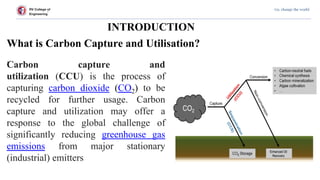
Carbon capture and
utilization (CCU) is the process of
capturing carbon dioxide (CO2) to be
recycled for further usage. Carbon
capture and utilization may offer a
response to the global challenge of
significantly reducing greenhouse gas
emissions from major stationary
(industrial) emitters
RV College of
Engineering
Go, change the world
Where does carbon comes from?
CO2 is typically captured from fixed point sources in heavy
industry such as petrochemical plants.CO2 captured from these
exhaust stream itself varies in concentration.
A typical coal power plant will have 10-12% CO2 concentration in
its flue gas exhaust stream. A biofuel refinery produces a high purity
(99%) of CO2 with small amount of impurities such as water and
ethanol.
The separation process itself can be performed through separation
processes such as absorption, adsorption, or membranes
RV College of
Engineering
Go, change the world
Environmental impacts:-
16 life cycle environmental impact analyses have been done to assess the impacts
of four main CCU technologies against conventional CCS: Chemical synthesis,
carbon mineralization, biodiesel production, as well as Enhanced Oil
Recovery (EOR).
These technologies were assessed based on 10 Life-cycle assessment (LCA)
impacts such as: acidification potential, eutrophication potential, global warming
potential, and ozone depletion potential.
The conclusion from the 16 different models was that chemical synthesis has the
highest global warming potential (216 times that of CCS) while enhanced oil
recovery has the least global warming potential (1.8 times that of CCS).
RV College of
Engineering
Go, change the world
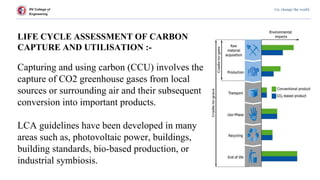
LIFE CYCLE ASSESSMENT OF CARBON
CAPTURE AND UTILISATION :-
Capturing and using carbon (CCU) involves the
capture of CO2 greenhouse gases from local
sources or surrounding air and their subsequent
conversion into important products.
LCA guidelines have been developed in many
areas such as, photovoltaic power, buildings,
building standards, bio-based production, or
industrial symbiosis.
GOAL DEFINITION
All LCA research begins with a definition of purpose by consistently stating
the intended use of the research, research reasons, target audience of the study
and whether the results will be used in comparative verification disclosed to the
public.
In most cases, CCU technology aims to produce products that are already
offered in the market. For this reason, this guide focuses on comparative tests,
or tests that should be used for comparative purposes.
LCA studies in laboratory scale procedures can measure both less or more
environmental impacts. These factors should always be considered in
comparative studies where high TRL technology is compared to low TRL
technology.
RV College of
Engineering
Go, change the world
RV College of
Engineering
Go, change the world
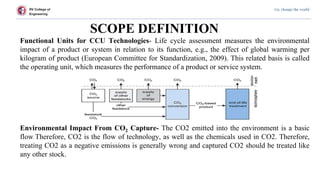
SCOPE DEFINITION
Functional Units for CCU Technologies- Life cycle assessment measures the environmental
impact of a product or system in relation to its function, e.g., the effect of global warming per
kilogram of product (European Committee for Standardization, 2009). This related basis is called
the operating unit, which measures the performance of a product or service system.
Environmental Impact From CO2 Capture- The CO2 emitted into the environment is a basic
flow. Therefore, CO2 is the flow of technology, as well as the chemicals used in CO2. Therefore,
treating CO2 as a negative emissions is generally wrong and captured CO2 should be treated like
any other stock.
RV College of
Engineering
Go, change the world
LIFE CYCLE INVENTORY (LCI)
Gate-to-Gate Inventory Estimation- In cases, where certain chemical
processes are lacking, e.g., in feedstocks, Ecoinvent uses a 95% yield based
on stoichiometric weight balance and the average demand for the product
and other additives can be considered a critical step.
A method of measuring gate-to-gate power consumption when no process
engineering is available, is provided by Bumann et al. (2010) linking the
energy demand process with the energy index provided by Sugiyama et al.
(2008). The proposed method is based on a simplified process model that
combines the reactor with the separation unit as well as chemical reaction
information, e.g., reactors, products, composite products, products, reaction
conditions and thermodynamic data.
RV College of
Engineering
Go, change the world
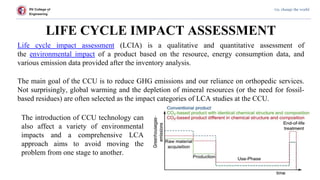
LIFE CYCLE IMPACT ASSESSMENT
Life cycle impact assessment (LCIA) is a qualitative and quantitative assessment of
the environmental impact of a product based on the resource, energy consumption data, and
various emission data provided after the inventory analysis.
The main goal of the CCU is to reduce GHG emissions and our reliance on orthopedic services.
Not surprisingly, global warming and the depletion of mineral resources (or the need for fossil-
based residues) are often selected as the impact categories of LCA studies at the CCU.
The introduction of CCU technology can
also affect a variety of environmental
impacts and a comprehensive LCA
approach aims to avoid moving the
problem from one stage to another.
RV College of
Engineering
Go, change the world
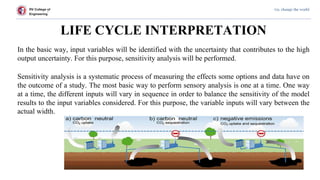
LIFE CYCLE INTERPRETATION
In the basic way, input variables will be identified with the uncertainty that contributes to the high
output uncertainty. For this purpose, sensitivity analysis will be performed.
Sensitivity analysis is a systematic process of measuring the effects some options and data have on
the outcome of a study. The most basic way to perform sensory analysis is one at a time. One way
at a time, the different inputs will vary in sequence in order to balance the sensitivity of the model
results to the input variables considered. For this purpose, the variable inputs will vary between the
actual width.
RV College of
Engineering
Go, change the world
CONCLUSION
This summarizes our guide to assessing the typical life cycle of imaging technology and
the use of carbon. This guide aims to reduce ambiguity in method selection and improve
the clarity of LCA subjects. These goals have been achieved by limiting the choice of
method of operation left open by LCA standards. In order to minimize the choice of
method, we identified the general purpose definitions of the LCA courses at the CCU and
provided appropriate scope definitions in line with these objective definitions.
THANK YOU!!

sus tech ppt.pptx

  • 1.
    RV College of Engineering Go,change the world SUSTAINABLE TECHNOLOGY SELF STUDY TOPIC- LIFE CYCLE ASSESSMENT OF CARBON CAPTURE AND UTILISATION Presented By:- Prashant Verma (1RV19EI034) EIE Department
  • 2.
    RV College of Engineering Go,change the world INTRODUCTION What is Carbon Capture and Utilisation? . Carbon capture and utilization (CCU) is the process of capturing carbon dioxide (CO2) to be recycled for further usage. Carbon capture and utilization may offer a response to the global challenge of significantly reducing greenhouse gas emissions from major stationary (industrial) emitters
  • 3.
    RV College of Engineering Go,change the world Where does carbon comes from? CO2 is typically captured from fixed point sources in heavy industry such as petrochemical plants.CO2 captured from these exhaust stream itself varies in concentration. A typical coal power plant will have 10-12% CO2 concentration in its flue gas exhaust stream. A biofuel refinery produces a high purity (99%) of CO2 with small amount of impurities such as water and ethanol. The separation process itself can be performed through separation processes such as absorption, adsorption, or membranes
  • 4.
    RV College of Engineering Go,change the world Environmental impacts:- 16 life cycle environmental impact analyses have been done to assess the impacts of four main CCU technologies against conventional CCS: Chemical synthesis, carbon mineralization, biodiesel production, as well as Enhanced Oil Recovery (EOR). These technologies were assessed based on 10 Life-cycle assessment (LCA) impacts such as: acidification potential, eutrophication potential, global warming potential, and ozone depletion potential. The conclusion from the 16 different models was that chemical synthesis has the highest global warming potential (216 times that of CCS) while enhanced oil recovery has the least global warming potential (1.8 times that of CCS).
  • 5.
    RV College of Engineering Go,change the world LIFE CYCLE ASSESSMENT OF CARBON CAPTURE AND UTILISATION :- Capturing and using carbon (CCU) involves the capture of CO2 greenhouse gases from local sources or surrounding air and their subsequent conversion into important products. LCA guidelines have been developed in many areas such as, photovoltaic power, buildings, building standards, bio-based production, or industrial symbiosis.
  • 6.
    GOAL DEFINITION All LCAresearch begins with a definition of purpose by consistently stating the intended use of the research, research reasons, target audience of the study and whether the results will be used in comparative verification disclosed to the public. In most cases, CCU technology aims to produce products that are already offered in the market. For this reason, this guide focuses on comparative tests, or tests that should be used for comparative purposes. LCA studies in laboratory scale procedures can measure both less or more environmental impacts. These factors should always be considered in comparative studies where high TRL technology is compared to low TRL technology. RV College of Engineering Go, change the world
  • 7.
    RV College of Engineering Go,change the world SCOPE DEFINITION Functional Units for CCU Technologies- Life cycle assessment measures the environmental impact of a product or system in relation to its function, e.g., the effect of global warming per kilogram of product (European Committee for Standardization, 2009). This related basis is called the operating unit, which measures the performance of a product or service system. Environmental Impact From CO2 Capture- The CO2 emitted into the environment is a basic flow. Therefore, CO2 is the flow of technology, as well as the chemicals used in CO2. Therefore, treating CO2 as a negative emissions is generally wrong and captured CO2 should be treated like any other stock.
  • 8.
    RV College of Engineering Go,change the world LIFE CYCLE INVENTORY (LCI) Gate-to-Gate Inventory Estimation- In cases, where certain chemical processes are lacking, e.g., in feedstocks, Ecoinvent uses a 95% yield based on stoichiometric weight balance and the average demand for the product and other additives can be considered a critical step. A method of measuring gate-to-gate power consumption when no process engineering is available, is provided by Bumann et al. (2010) linking the energy demand process with the energy index provided by Sugiyama et al. (2008). The proposed method is based on a simplified process model that combines the reactor with the separation unit as well as chemical reaction information, e.g., reactors, products, composite products, products, reaction conditions and thermodynamic data.
  • 9.
    RV College of Engineering Go,change the world LIFE CYCLE IMPACT ASSESSMENT Life cycle impact assessment (LCIA) is a qualitative and quantitative assessment of the environmental impact of a product based on the resource, energy consumption data, and various emission data provided after the inventory analysis. The main goal of the CCU is to reduce GHG emissions and our reliance on orthopedic services. Not surprisingly, global warming and the depletion of mineral resources (or the need for fossil- based residues) are often selected as the impact categories of LCA studies at the CCU. The introduction of CCU technology can also affect a variety of environmental impacts and a comprehensive LCA approach aims to avoid moving the problem from one stage to another.
  • 10.
    RV College of Engineering Go,change the world LIFE CYCLE INTERPRETATION In the basic way, input variables will be identified with the uncertainty that contributes to the high output uncertainty. For this purpose, sensitivity analysis will be performed. Sensitivity analysis is a systematic process of measuring the effects some options and data have on the outcome of a study. The most basic way to perform sensory analysis is one at a time. One way at a time, the different inputs will vary in sequence in order to balance the sensitivity of the model results to the input variables considered. For this purpose, the variable inputs will vary between the actual width.
  • 11.
    RV College of Engineering Go,change the world CONCLUSION This summarizes our guide to assessing the typical life cycle of imaging technology and the use of carbon. This guide aims to reduce ambiguity in method selection and improve the clarity of LCA subjects. These goals have been achieved by limiting the choice of method of operation left open by LCA standards. In order to minimize the choice of method, we identified the general purpose definitions of the LCA courses at the CCU and provided appropriate scope definitions in line with these objective definitions. THANK YOU!!