Keith Burnard
IEA Greenhouse Gas R&D Programme
Cheltenham, UK
IEAGHG activities and possible
collaboration with ETSAP
71st ETSAP Meeting
Hyattsville, MD, United States
11 July 2017
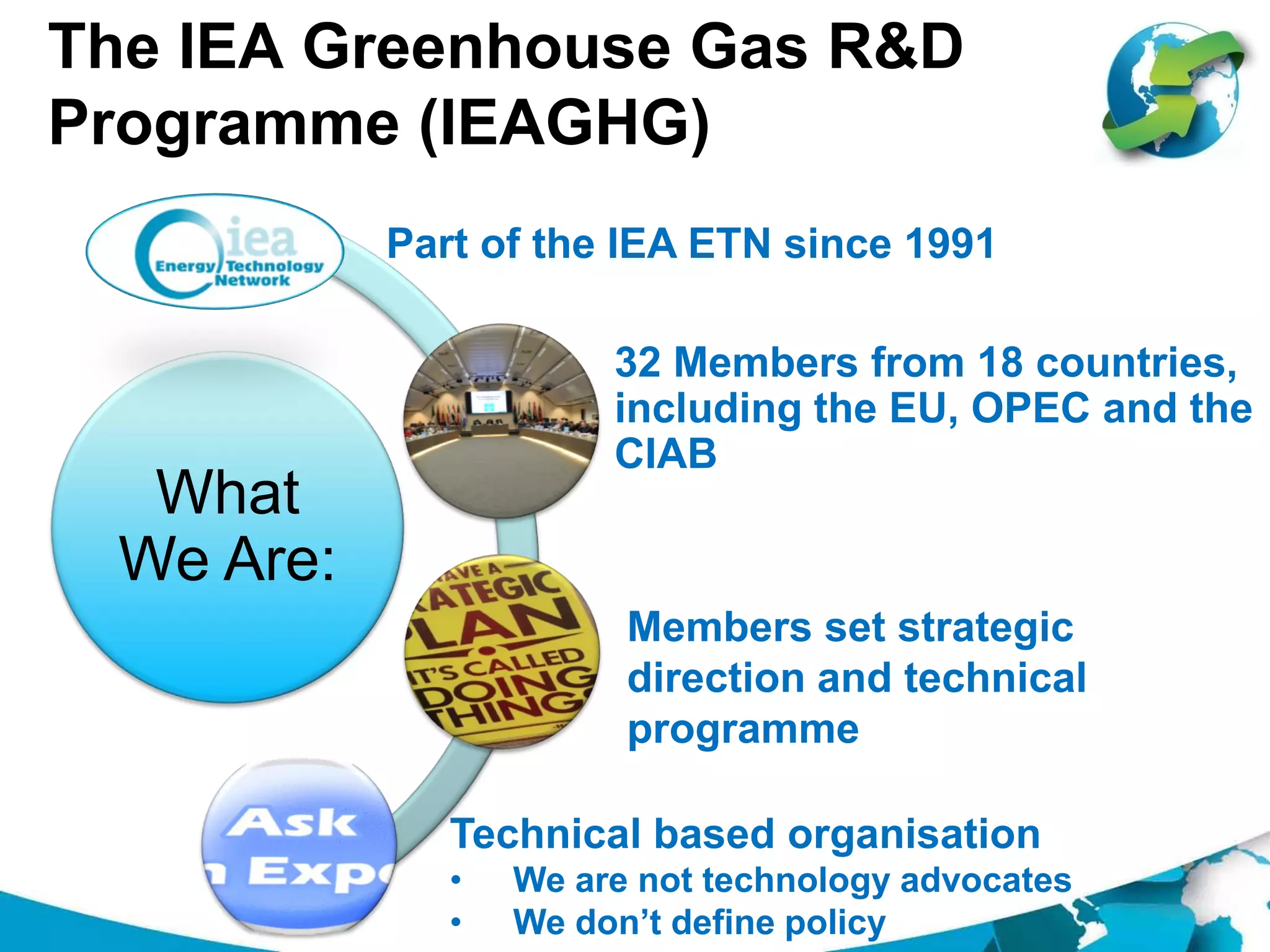
What
We Are:
Part of the IEA ETN since 1991
32 Members from 18 countries,
including the EU, OPEC and the
CIAB
The IEA Greenhouse Gas R&D
Programme (IEAGHG)
Technical based organisation
• We are not technology advocates
• We don’t define policy
Members set strategic
direction and technical
programme
Cost-shared Technology Collaboration Programme
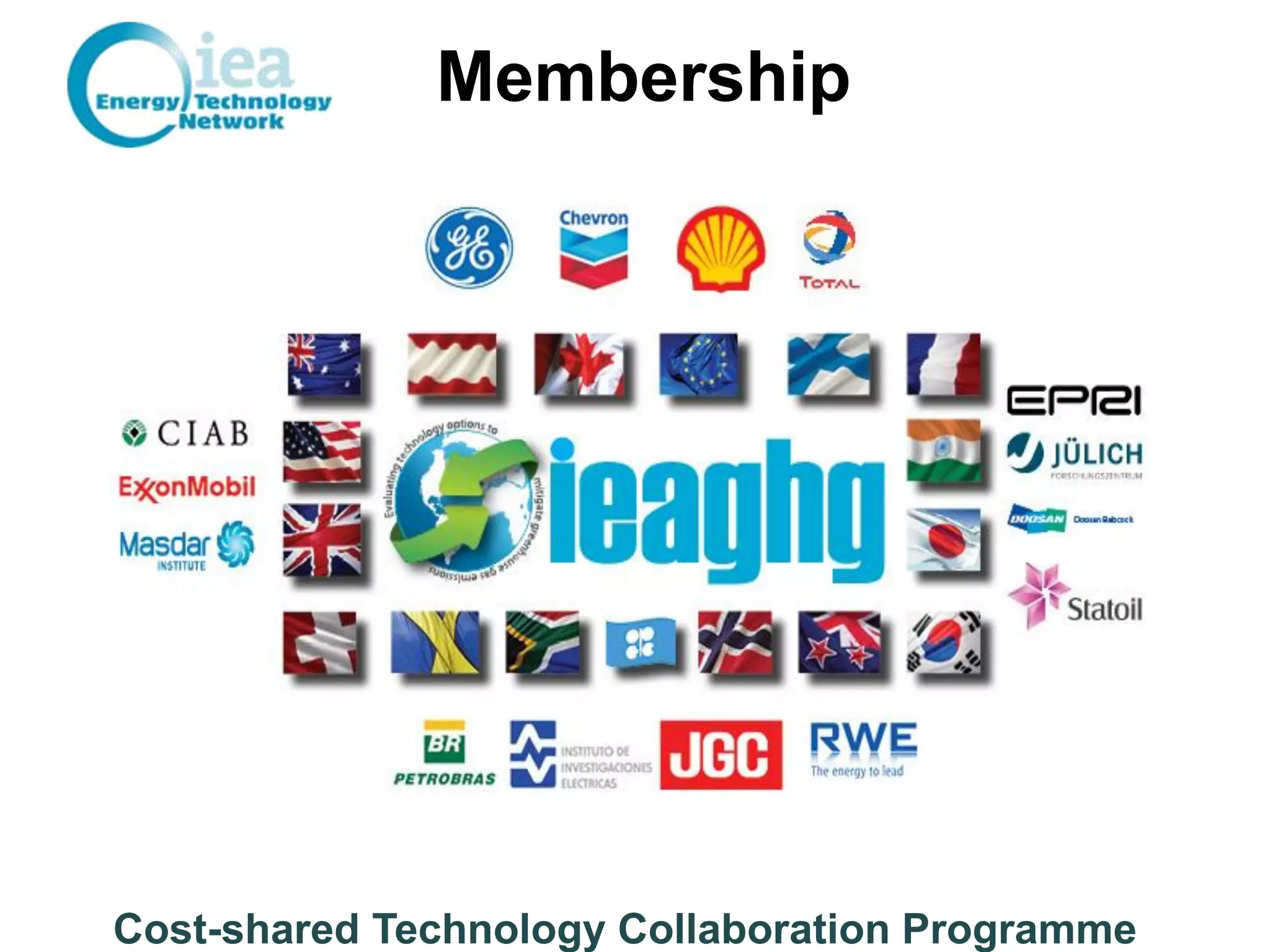
Membership
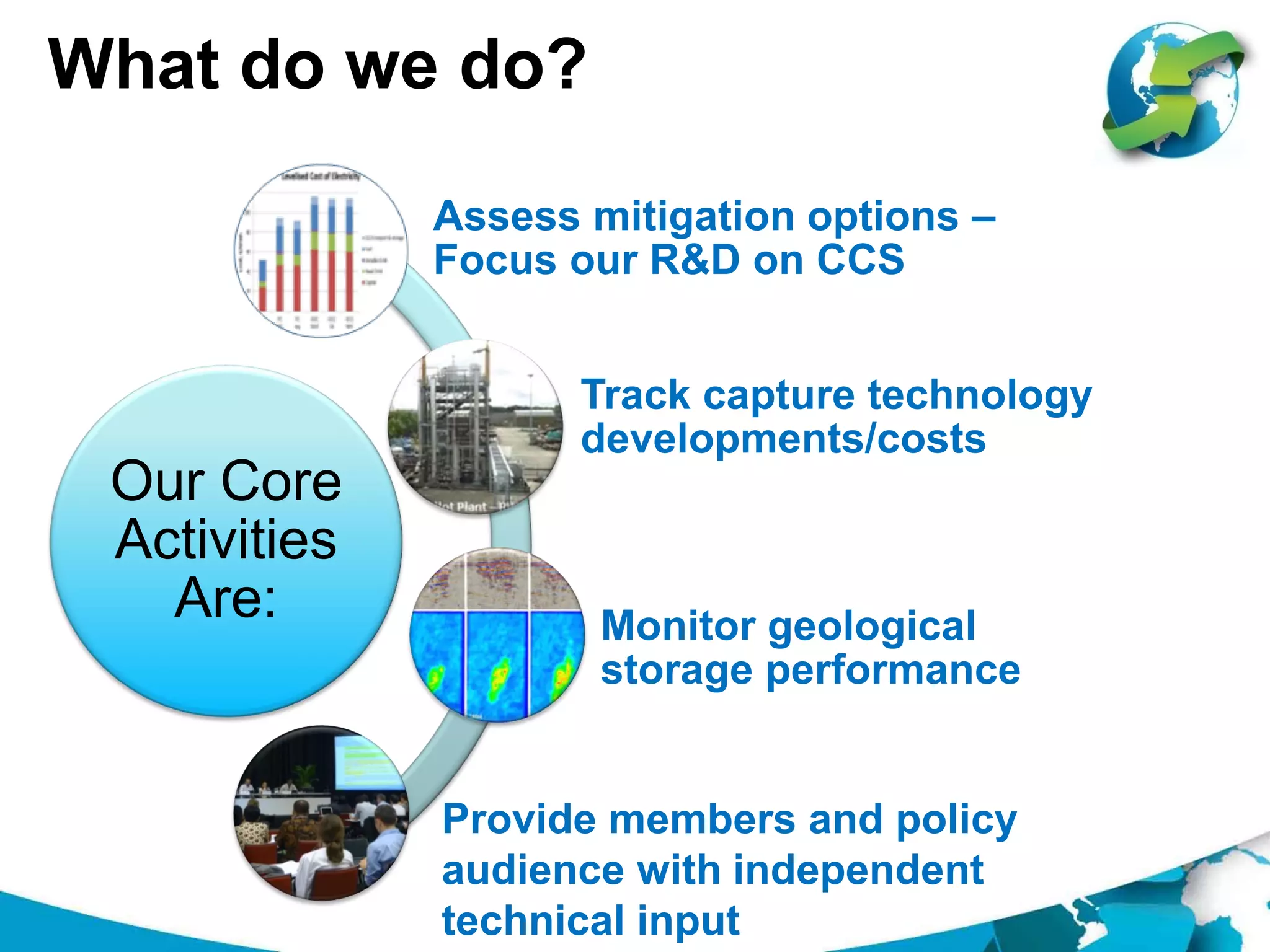
What do we do?
Our Core
Activities
Are:
Assess mitigation options –
Focus our R&D on CCS
Track capture technology
developments/costs
Monitor geological
storage performance
Provide members and policy
audience with independent
technical input
IPCC AR5 Synthesis Report
IPCC Fifth Assessment Report
Synthesis Report
2nd November 2014
Copenhagen
IPCC AR5 Synthesis Report
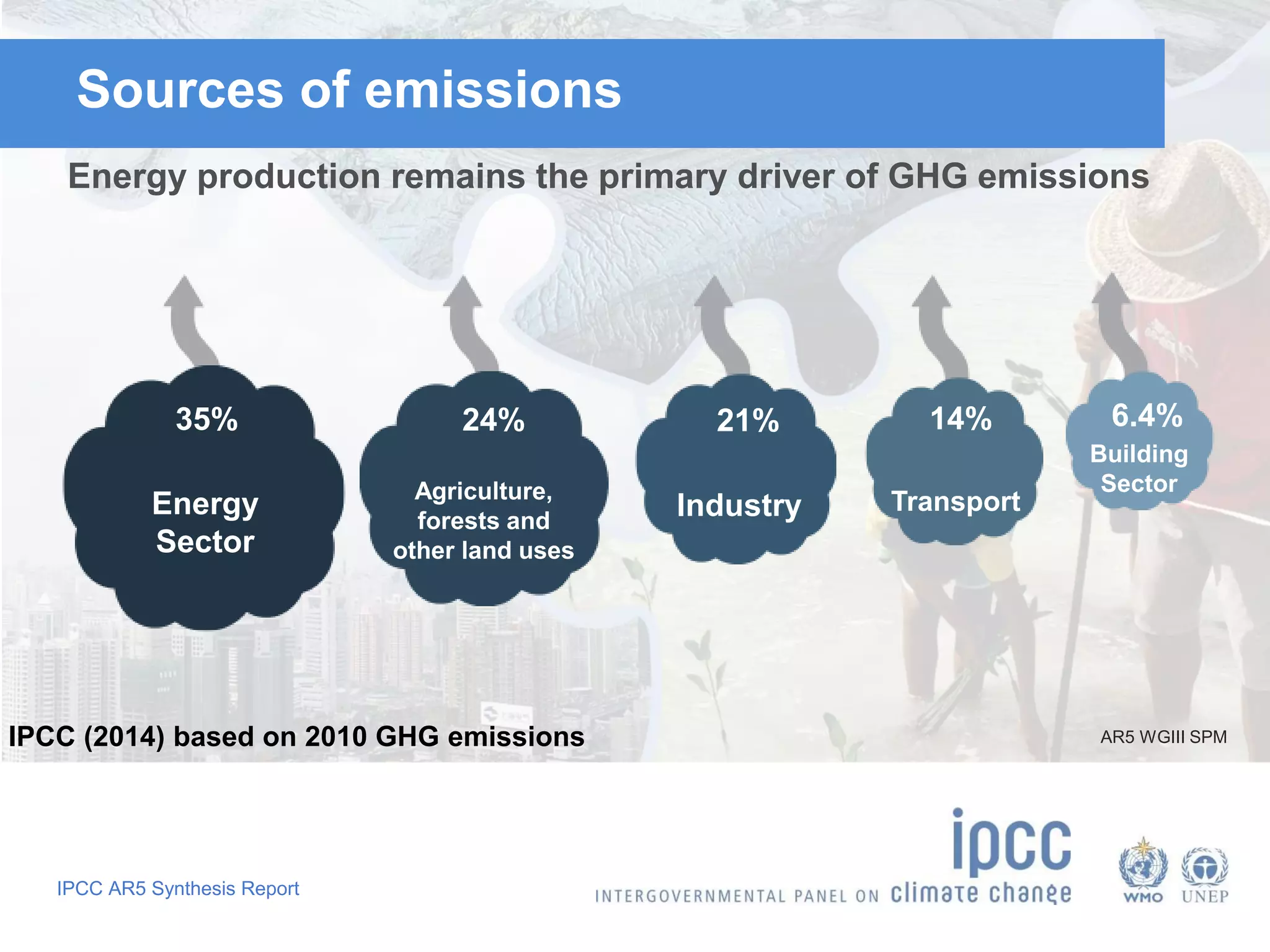
Sources of emissions
Energy production remains the primary driver of GHG emissions
35% 24% 21% 14% 6.4%
IPCC (2014) based on 2010 GHG emissions
Energy
Sector
Agriculture,
forests and
other land uses
Industry Transport
Building
Sector
AR5 WGIII SPM
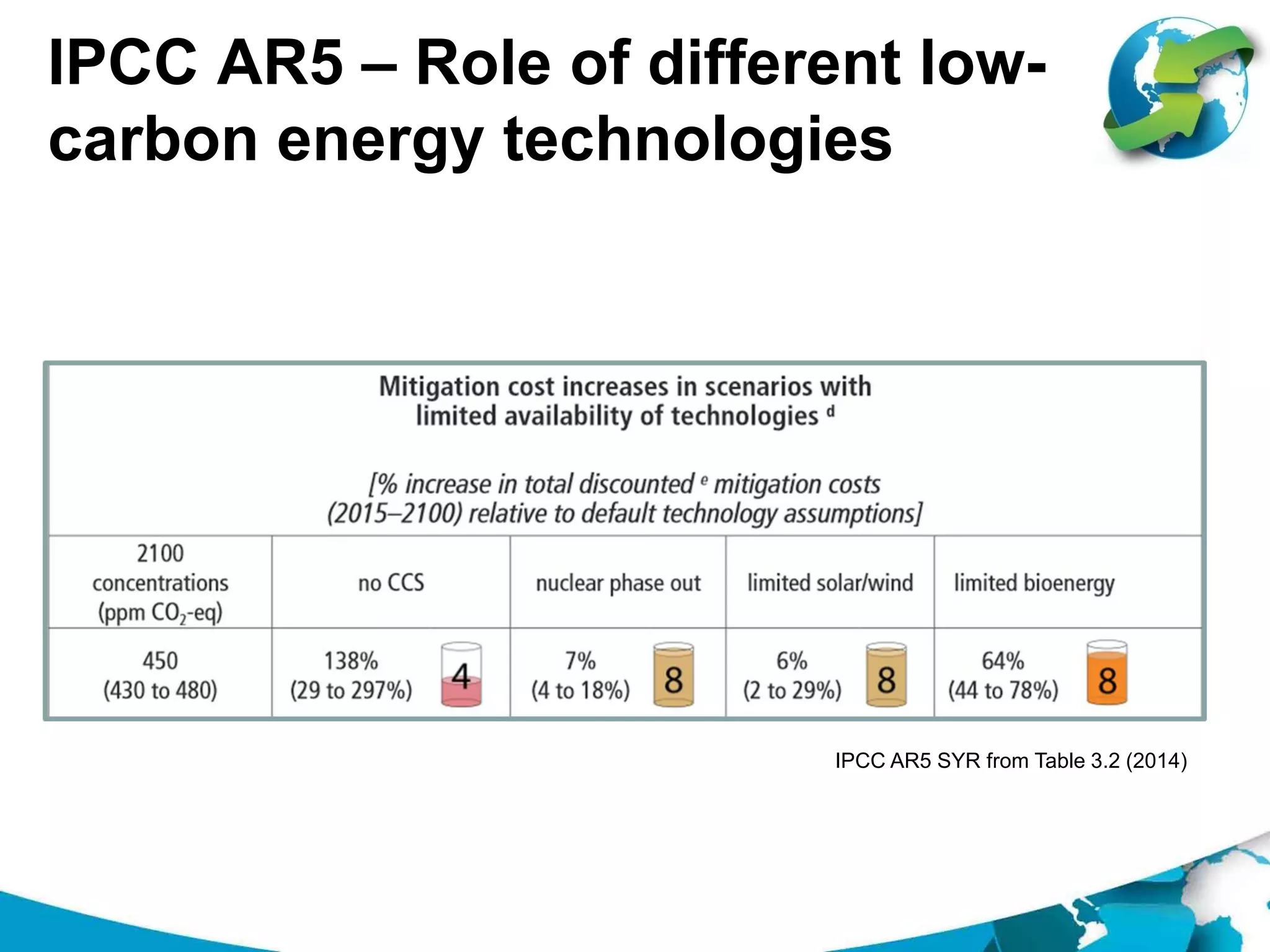
IPCC AR5 – Role of different low-
carbon energy technologies
IPCC AR5 SYR from Table 3.2 (2014)
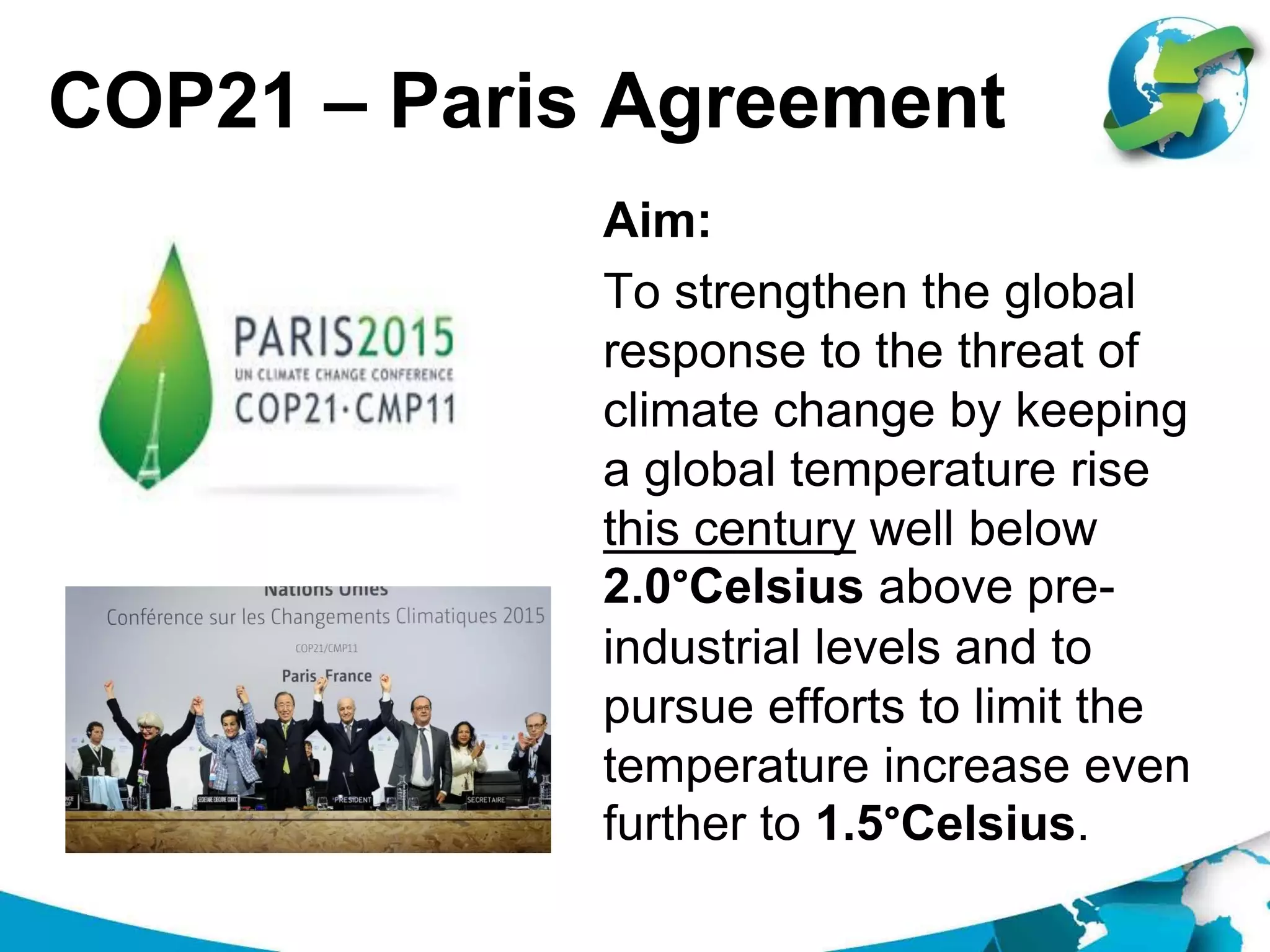
COP21 – Paris Agreement
Aim:
To strengthen the global
response to the threat of
climate change by keeping
a global temperature rise
this century well below
2.0°Celsius above pre-
industrial levels and to
pursue efforts to limit the
temperature increase even
further to 1.5°Celsius.
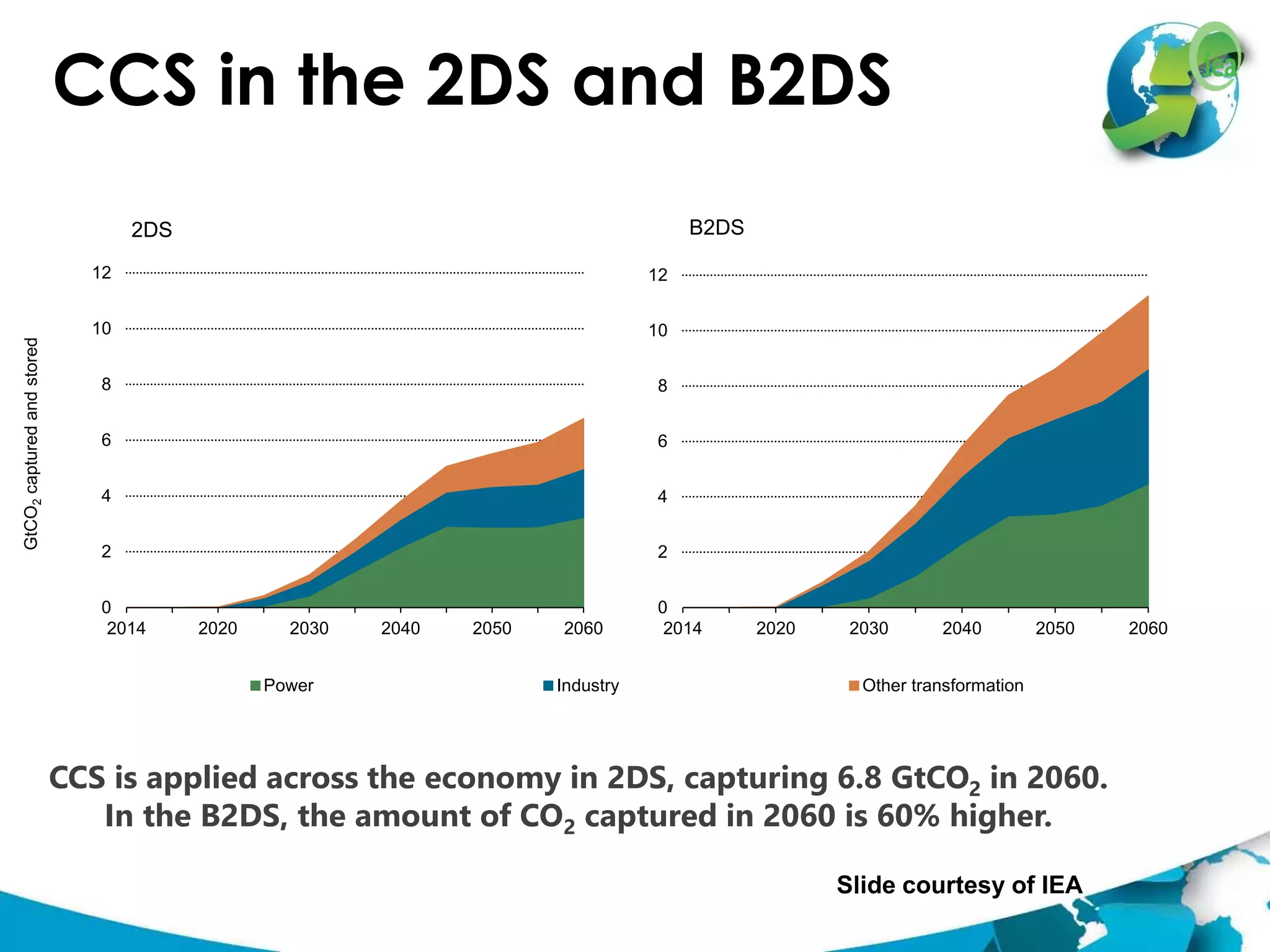
CCS in the 2DS and B2DS
CCS is applied across the economy in 2DS, capturing 6.8 GtCO2 in 2060.
In the B2DS, the amount of CO2 captured in 2060 is 60% higher.
0
2
4
6
8
10
12
2014 2020 2030 2040 2050 2060
GtCO2capturedandstored
2DS
Power Industry Other transformation
0
2
4
6
8
10
12
2014 2020 2030 2040 2050 2060
B2DS
Slide courtesy of IEA
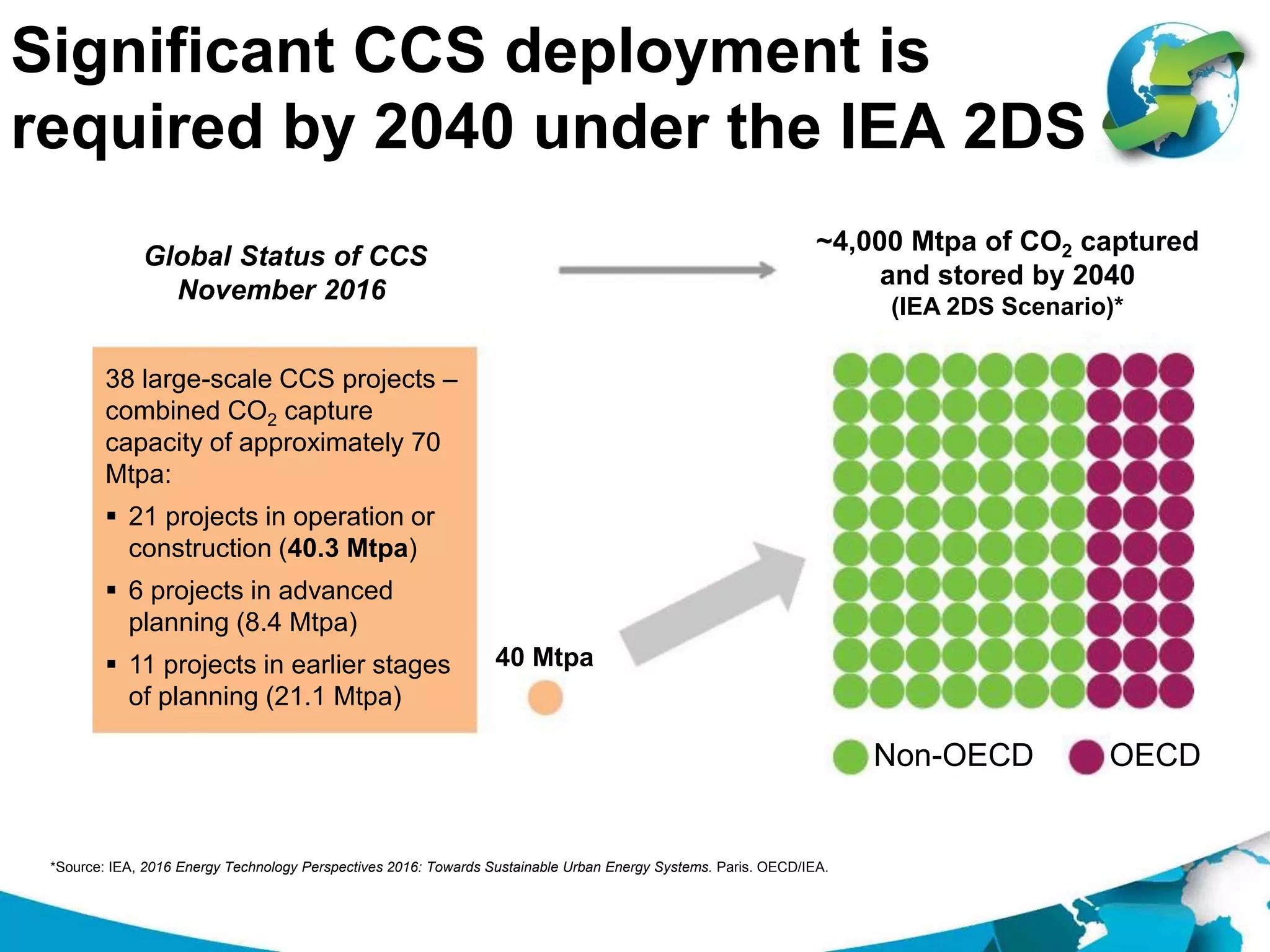
Significant CCS deployment is
required by 2040 under the IEA 2DS
*Source: IEA, 2016 Energy Technology Perspectives 2016: Towards Sustainable Urban Energy Systems. Paris. OECD/IEA.
Global Status of CCS
November 2016
38 large-scale CCS projects –
combined CO2 capture
capacity of approximately 70
Mtpa:
 21 projects in operation or
construction (40.3 Mtpa)
 6 projects in advanced
planning (8.4 Mtpa)
 11 projects in earlier stages
of planning (21.1 Mtpa)
40 Mtpa
Non-OECD OECD
~4,000 Mtpa of CO2 captured
and stored by 2040
(IEA 2DS Scenario)*
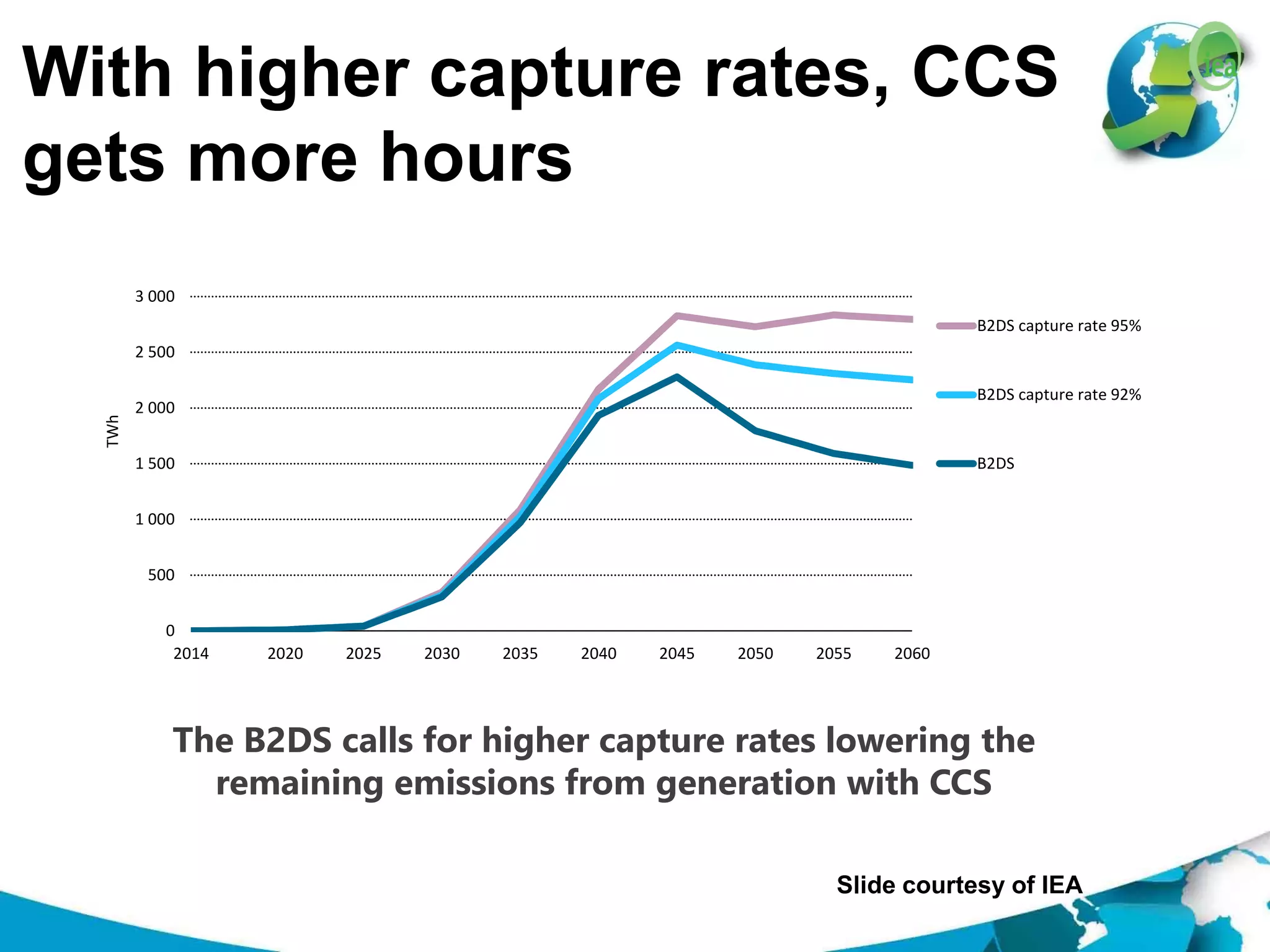
With higher capture rates, CCS
gets more hours
The B2DS calls for higher capture rates lowering the
remaining emissions from generation with CCS
0
500
1 000
1 500
2 000
2 500
3 000
2014 2020 2025 2030 2035 2040 2045 2050 2055 2060
TWh
B2DS capture rate 95%
B2DS capture rate 92%
B2DS
Slide courtesy of IEA
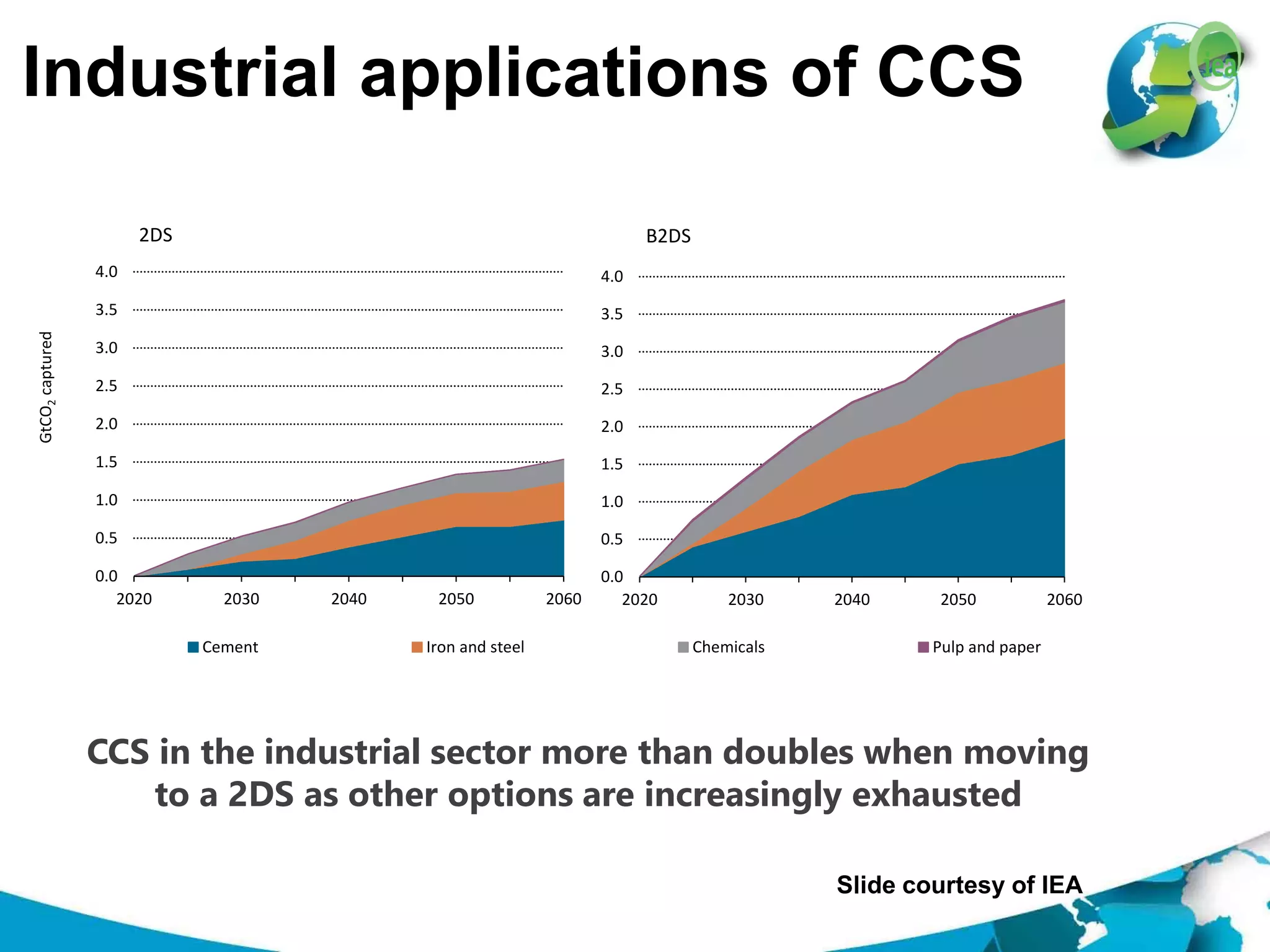
Industrial applications of CCS
CCS in the industrial sector more than doubles when moving
to a 2DS as other options are increasingly exhausted
0.0
0.5
1.0
1.5
2.0
2.5
3.0
3.5
4.0
2020 2030 2040 2050 2060
GtCO2captured
2DS
Cement Iron and steel Chemicals Pulp and paper
0.0
0.5
1.0
1.5
2.0
2.5
3.0
3.5
4.0
2020 2030 2040 2050 2060
B2DS
Slide courtesy of IEA
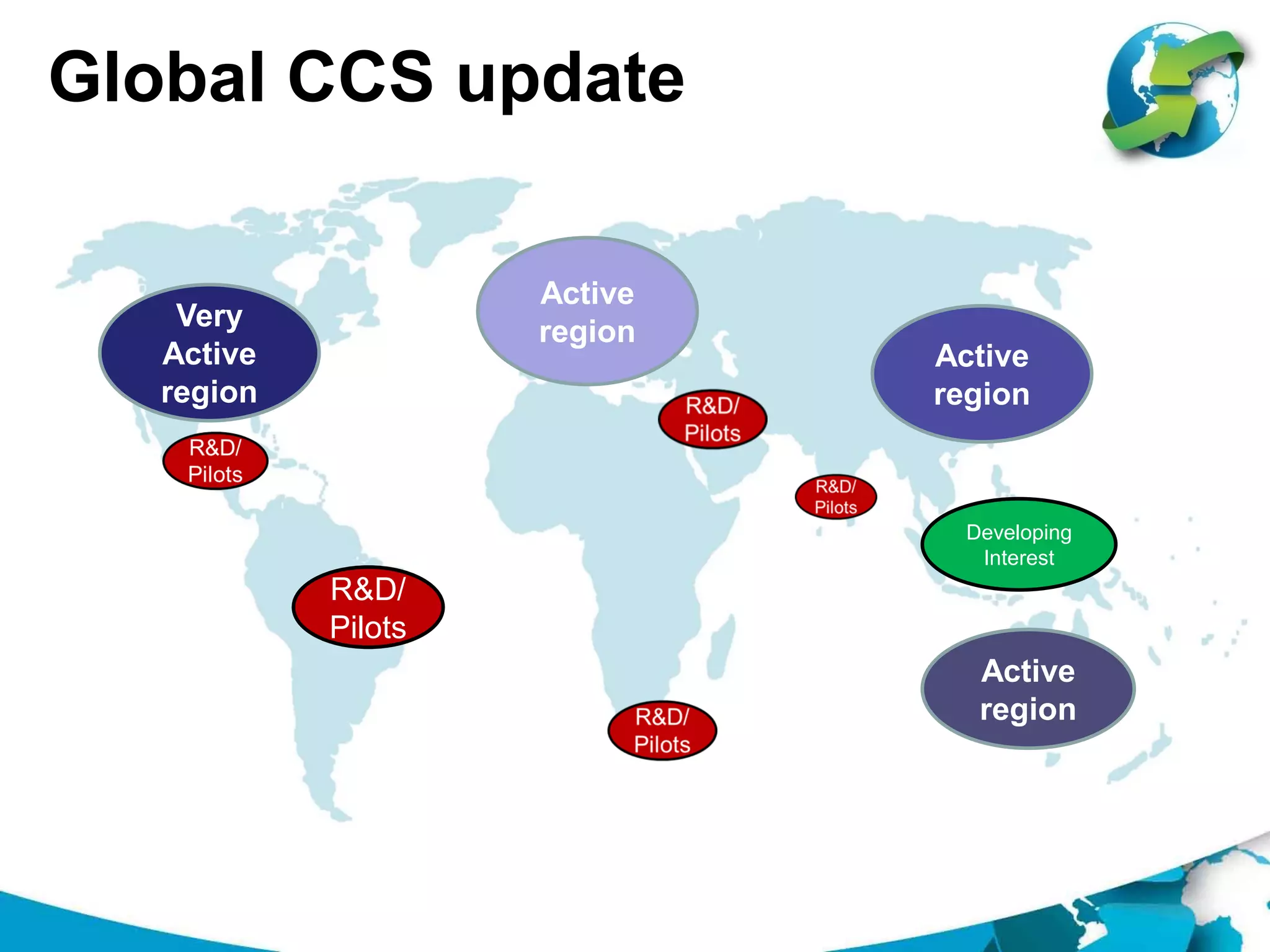
Global CCS update
Very
Active
region
Active
region
R&D/
Pilots
Active
region
Developing
Interest
Active
region
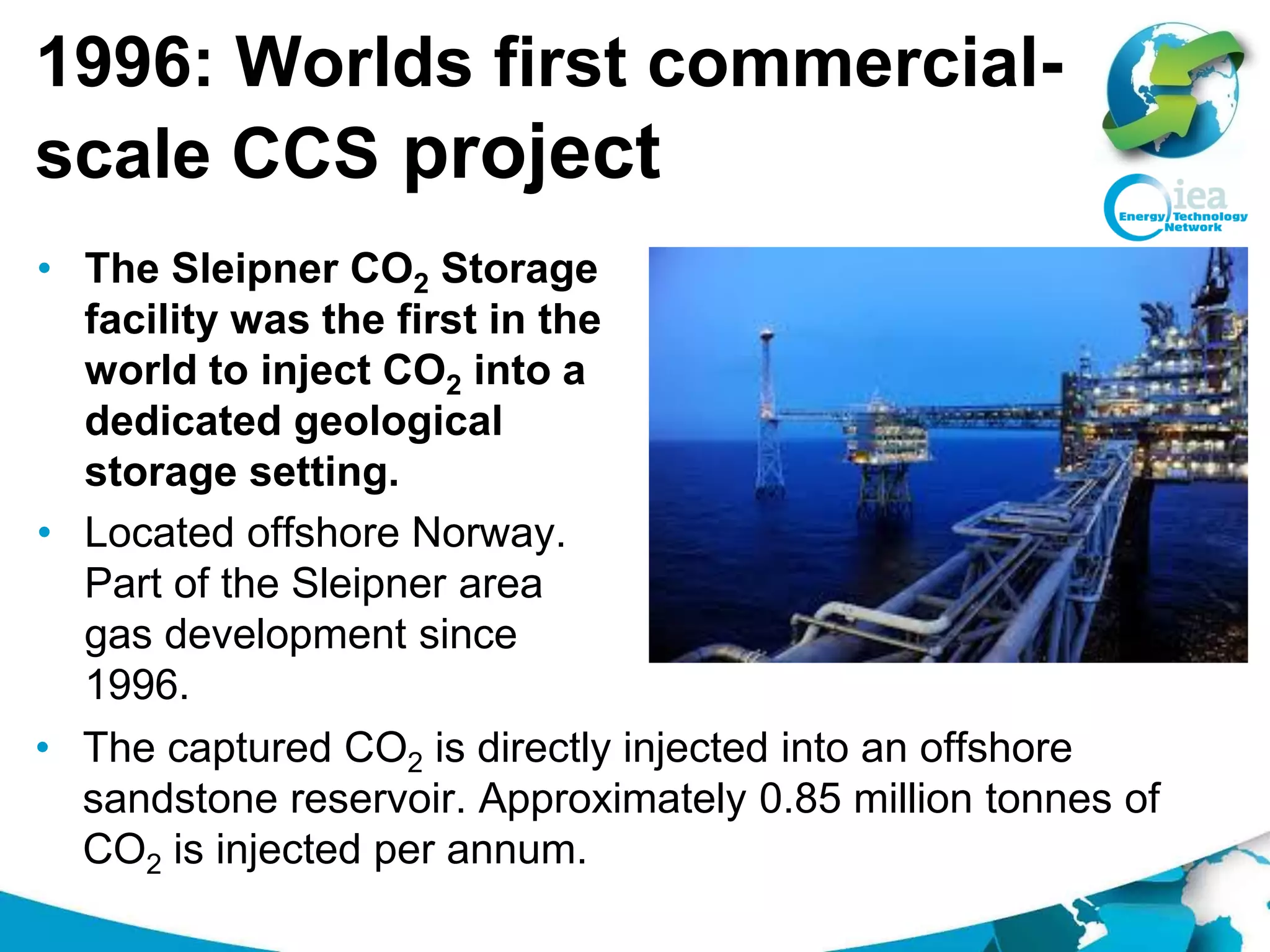
1996: Worlds first commercial-
scale CCS project
• The Sleipner CO2 Storage
facility was the first in the
world to inject CO2 into a
dedicated geological
storage setting.
• Located offshore Norway.
Part of the Sleipner area
gas development since
1996.
• The captured CO2 is directly injected into an offshore
sandstone reservoir. Approximately 0.85 million tonnes of
CO2 is injected per annum.
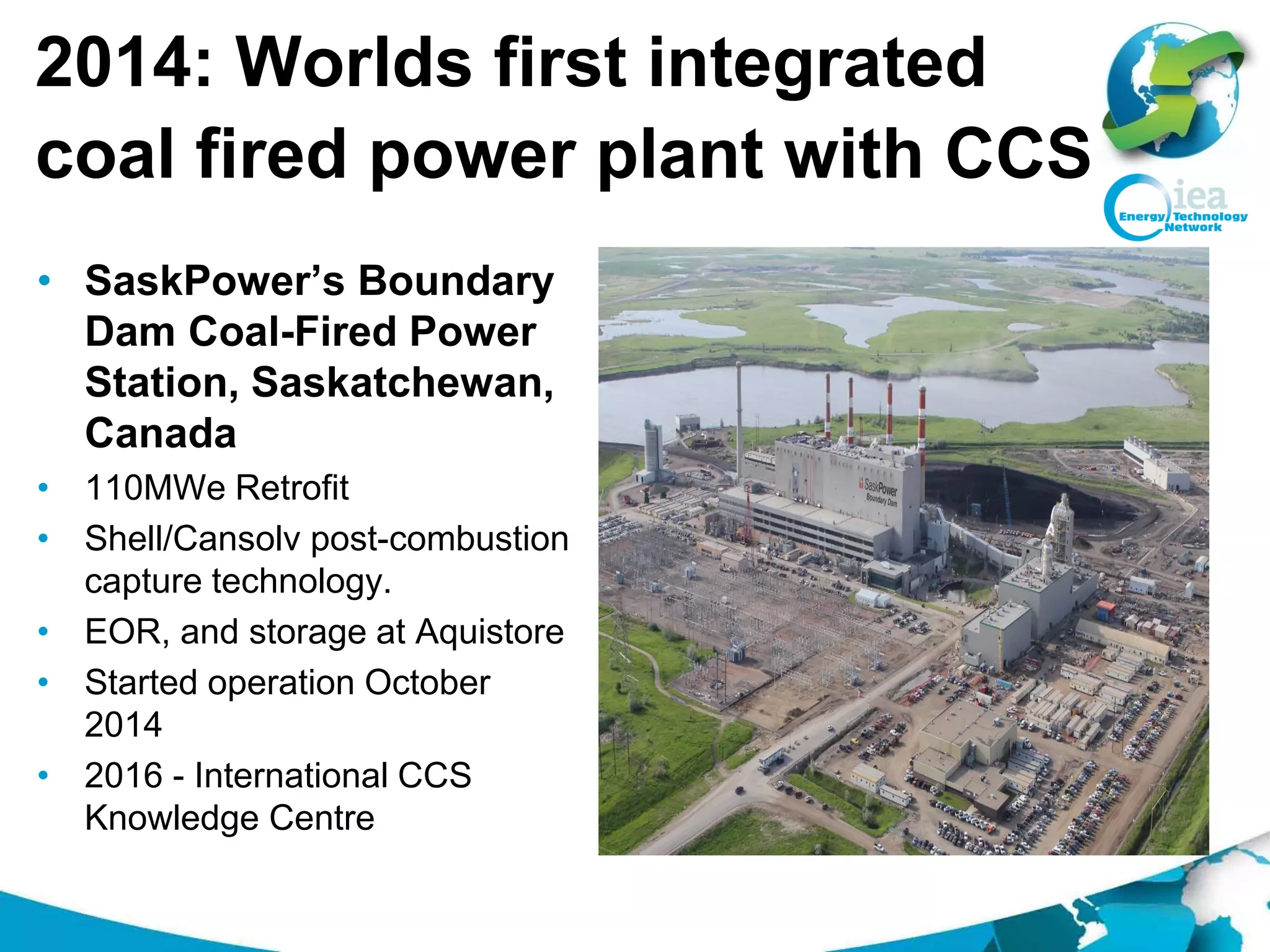
2014: Worlds first integrated
coal fired power plant with CCS
• SaskPower’s Boundary
Dam Coal-Fired Power
Station, Saskatchewan,
Canada
• 110MWe Retrofit
• Shell/Cansolv post-combustion
capture technology.
• EOR, and storage at Aquistore
• Started operation October
2014
• 2016 - International CCS
Knowledge Centre
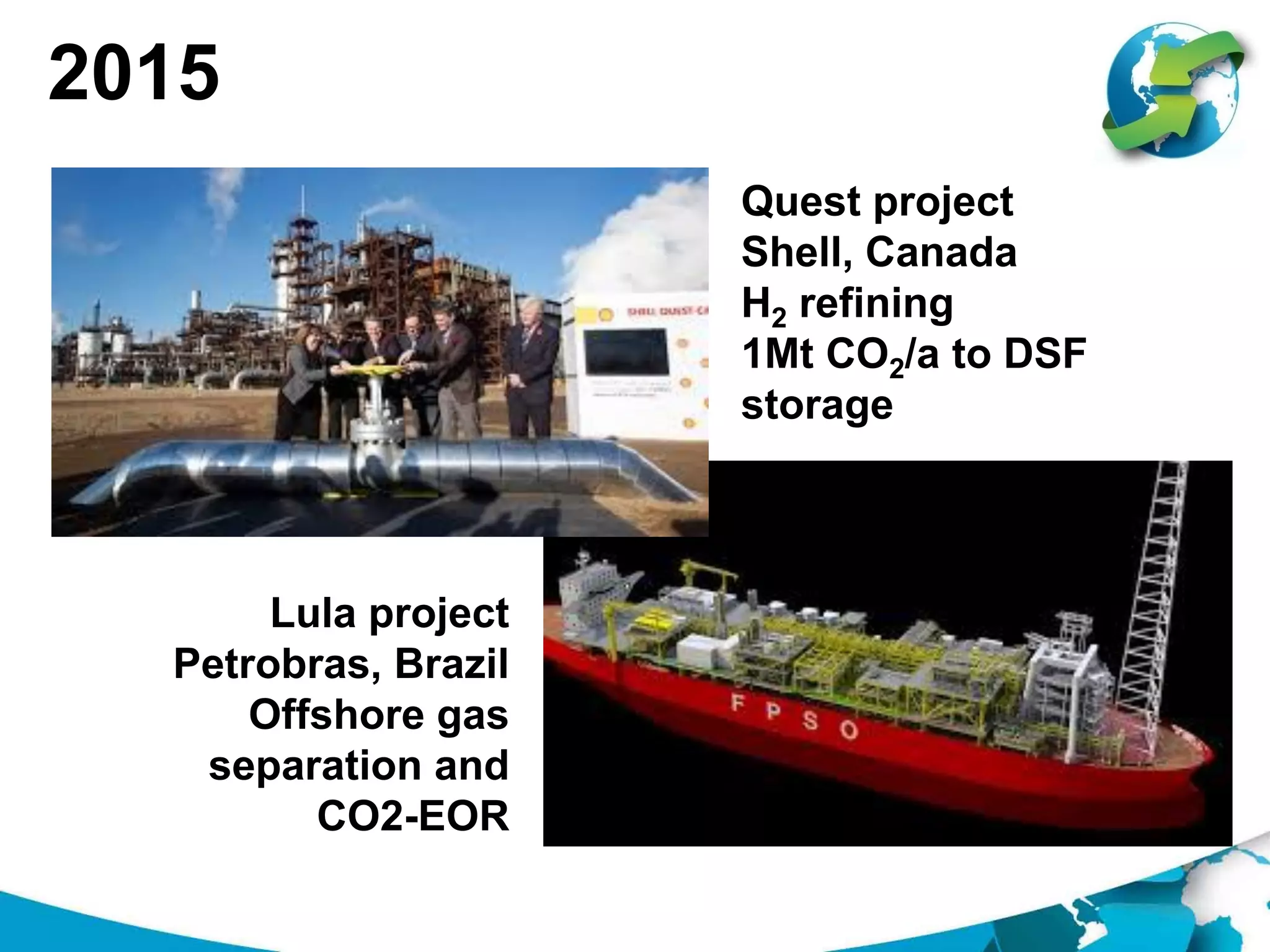
2015
Quest project
Shell, Canada
H2 refining
1Mt CO2/a to DSF
storage
Lula project
Petrobras, Brazil
Offshore gas
separation and
CO2-EOR
CCS in energy scenarios
 Results obtained from the modelling of long-term energy
outlooks are published regularly by many different parties
 Various approaches are taken and assumptions made by
each model; these are often not transparent and mean the
roles and contributions for each technology differ from model
to model
 Mixed messages can lead to confusion and
misunderstanding and, consequently, either inaction or
misdirected action
 More informed decisions could be made if policy makers,
industry, regulators and the general public were given better
guidance to the information available.
Context:
Scenarios and projections
 Many players
 International: e.g. IPCC, IEA, OPEC, WEC, MIT, …
 Industry: e.g. BP, Shell, …
 National: e.g. China (ERI), India (NITI Aayog), UK (ETI), …
 Long-term global energy outlooks
 Often to 2050, 2060 or even beyond
 May be global or national
 Can have technology or sectoral focus, or both
 Normative
 Most scenarios aim towards a specific objective such as a
particular atmospheric CO2 level or carbon budget
Project Consortium
Environmental Change Institute,
University of Oxford, UK
Prof Myles Allen
Dr Richard Millar
Environmental Research Institute,
University College Cork
Prof Brian Ó Gallachóir
Dr Paul Deane
Dr James Glynn
James.glynn@ucc.ie
Project manager
Imperial College London,
UK
Dr Niall Mac Dowell
Objectives
To help policy makers, industry, regulators and the
public to better understand and make more informed
decisions vis-à-vis CCS, the contractor will:
 Compile an overview, for example, of:
 the most influential models
 the important scenarios
 the main assumptions
 the data sources
 the key messages
 Assess and report on the reasons for the
variations in results and messaging from different
models
[Note: there is no intention within the project to advocate particular
scenarios, to undertake any modelling or to propose additional
modelling activity]
Other potential areas for
cooperation?
Engage on update of ETSAP’s technology brief on
CCS?
- current version dated October 2010
Thank you
keith.burnard@ieaghg.org
iconshut.com
To note:
4th Post Combustion Capture Conference (PCCC4)
5th-8th September 2017
Birmingham, Alabama
www.ieaghg.org/conferences/pccc/52-conferences/pccc/762-pccc4

IEA-GHG activities and possible collaboration with IEA-ETSAP

  • 1.
    Keith Burnard IEA GreenhouseGas R&D Programme Cheltenham, UK IEAGHG activities and possible collaboration with ETSAP 71st ETSAP Meeting Hyattsville, MD, United States 11 July 2017
  • 2.
    What We Are: Part ofthe IEA ETN since 1991 32 Members from 18 countries, including the EU, OPEC and the CIAB The IEA Greenhouse Gas R&D Programme (IEAGHG) Technical based organisation • We are not technology advocates • We don’t define policy Members set strategic direction and technical programme
  • 3.
  • 4.
    What do wedo? Our Core Activities Are: Assess mitigation options – Focus our R&D on CCS Track capture technology developments/costs Monitor geological storage performance Provide members and policy audience with independent technical input
  • 5.
    IPCC AR5 SynthesisReport IPCC Fifth Assessment Report Synthesis Report 2nd November 2014 Copenhagen
  • 6.
    IPCC AR5 SynthesisReport Sources of emissions Energy production remains the primary driver of GHG emissions 35% 24% 21% 14% 6.4% IPCC (2014) based on 2010 GHG emissions Energy Sector Agriculture, forests and other land uses Industry Transport Building Sector AR5 WGIII SPM
  • 7.
    IPCC AR5 –Role of different low- carbon energy technologies IPCC AR5 SYR from Table 3.2 (2014)
  • 8.
    COP21 – ParisAgreement Aim: To strengthen the global response to the threat of climate change by keeping a global temperature rise this century well below 2.0°Celsius above pre- industrial levels and to pursue efforts to limit the temperature increase even further to 1.5°Celsius.
  • 9.
    CCS in the2DS and B2DS CCS is applied across the economy in 2DS, capturing 6.8 GtCO2 in 2060. In the B2DS, the amount of CO2 captured in 2060 is 60% higher. 0 2 4 6 8 10 12 2014 2020 2030 2040 2050 2060 GtCO2capturedandstored 2DS Power Industry Other transformation 0 2 4 6 8 10 12 2014 2020 2030 2040 2050 2060 B2DS Slide courtesy of IEA
  • 10.
    Significant CCS deploymentis required by 2040 under the IEA 2DS *Source: IEA, 2016 Energy Technology Perspectives 2016: Towards Sustainable Urban Energy Systems. Paris. OECD/IEA. Global Status of CCS November 2016 38 large-scale CCS projects – combined CO2 capture capacity of approximately 70 Mtpa:  21 projects in operation or construction (40.3 Mtpa)  6 projects in advanced planning (8.4 Mtpa)  11 projects in earlier stages of planning (21.1 Mtpa) 40 Mtpa Non-OECD OECD ~4,000 Mtpa of CO2 captured and stored by 2040 (IEA 2DS Scenario)*
  • 11.
    With higher capturerates, CCS gets more hours The B2DS calls for higher capture rates lowering the remaining emissions from generation with CCS 0 500 1 000 1 500 2 000 2 500 3 000 2014 2020 2025 2030 2035 2040 2045 2050 2055 2060 TWh B2DS capture rate 95% B2DS capture rate 92% B2DS Slide courtesy of IEA
  • 12.
    Industrial applications ofCCS CCS in the industrial sector more than doubles when moving to a 2DS as other options are increasingly exhausted 0.0 0.5 1.0 1.5 2.0 2.5 3.0 3.5 4.0 2020 2030 2040 2050 2060 GtCO2captured 2DS Cement Iron and steel Chemicals Pulp and paper 0.0 0.5 1.0 1.5 2.0 2.5 3.0 3.5 4.0 2020 2030 2040 2050 2060 B2DS Slide courtesy of IEA
  • 13.
  • 14.
    1996: Worlds firstcommercial- scale CCS project • The Sleipner CO2 Storage facility was the first in the world to inject CO2 into a dedicated geological storage setting. • Located offshore Norway. Part of the Sleipner area gas development since 1996. • The captured CO2 is directly injected into an offshore sandstone reservoir. Approximately 0.85 million tonnes of CO2 is injected per annum.
  • 15.
    2014: Worlds firstintegrated coal fired power plant with CCS • SaskPower’s Boundary Dam Coal-Fired Power Station, Saskatchewan, Canada • 110MWe Retrofit • Shell/Cansolv post-combustion capture technology. • EOR, and storage at Aquistore • Started operation October 2014 • 2016 - International CCS Knowledge Centre
  • 16.
    2015 Quest project Shell, Canada H2refining 1Mt CO2/a to DSF storage Lula project Petrobras, Brazil Offshore gas separation and CO2-EOR
  • 17.
    CCS in energyscenarios  Results obtained from the modelling of long-term energy outlooks are published regularly by many different parties  Various approaches are taken and assumptions made by each model; these are often not transparent and mean the roles and contributions for each technology differ from model to model  Mixed messages can lead to confusion and misunderstanding and, consequently, either inaction or misdirected action  More informed decisions could be made if policy makers, industry, regulators and the general public were given better guidance to the information available. Context:
  • 18.
    Scenarios and projections Many players  International: e.g. IPCC, IEA, OPEC, WEC, MIT, …  Industry: e.g. BP, Shell, …  National: e.g. China (ERI), India (NITI Aayog), UK (ETI), …  Long-term global energy outlooks  Often to 2050, 2060 or even beyond  May be global or national  Can have technology or sectoral focus, or both  Normative  Most scenarios aim towards a specific objective such as a particular atmospheric CO2 level or carbon budget
  • 19.
    Project Consortium Environmental ChangeInstitute, University of Oxford, UK Prof Myles Allen Dr Richard Millar Environmental Research Institute, University College Cork Prof Brian Ó Gallachóir Dr Paul Deane Dr James Glynn James.glynn@ucc.ie Project manager Imperial College London, UK Dr Niall Mac Dowell
  • 20.
    Objectives To help policymakers, industry, regulators and the public to better understand and make more informed decisions vis-à-vis CCS, the contractor will:  Compile an overview, for example, of:  the most influential models  the important scenarios  the main assumptions  the data sources  the key messages  Assess and report on the reasons for the variations in results and messaging from different models [Note: there is no intention within the project to advocate particular scenarios, to undertake any modelling or to propose additional modelling activity]
  • 21.
    Other potential areasfor cooperation? Engage on update of ETSAP’s technology brief on CCS? - current version dated October 2010
  • 22.
    Thank you keith.burnard@ieaghg.org iconshut.com To note: 4thPost Combustion Capture Conference (PCCC4) 5th-8th September 2017 Birmingham, Alabama www.ieaghg.org/conferences/pccc/52-conferences/pccc/762-pccc4