1
Video Compression Technology
Presented by – Teerayuth M.
Technical Support Engineer
--6363
Get the Clip!
NextNext:: TheThe RasmusRasmus
- In The Shadow-
Scooter: 3%
- Wake Me Up-
--7272
--4848
Enrique: 2%
- Hero-
Status Bar X
-16 Offspring- Hit that + -48
+ Hallo Harry Hunger heute schon zu Mittag gegessen? + Isabel ist die
2
Agenda
 Digital TV Introduction
 Video Compression Standards
 Video Formats and Quality
 Video Coding Concepts
3
Digital Television
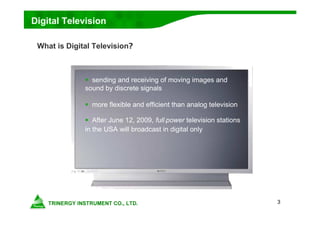
What is Digital Television?
 sending and receiving of moving images and
sound by discrete signals
 more flexible and efficient than analog television
 After June 12, 2009, full-power television stations
in the USA will broadcast in digital only
4
Digital Television Format
 Standard Definition Television (SDTV)
• Europe
- 4:3 Aspect ratio, 625 lines, 50 fields/sec
- 16:9 Aspect ratio, 625 lines, 50 fields/sec
• North America
- 4:3 Aspect ratio, 525 lines, 60 fields/sec
5
Digital Television Format
 High Definition Television (HDTV) - All 16:9 Aspect
Ratios
• 1125 (1080i) lines, 60 or 59.94 fields/sec, Interlaced
• 750 (720p) lines, 60 or 59.54 frames/sec, Progressive
• 525 (480p) lines, 60 or 59.94 frames/sec, Progressive
• Others: 24 Hz p, 25 Hz p, 30 Hz p, 50 Hz i/p, 60 50 Hz i/p
6
Digital Video Broadcast Standard
 Digital Video Broadcasting (DVB)
- DVB-S (Digital Video Broadcasting - Satellite)
- DVB-T (Digital Video Broadcasting - Terrestrial)
- DVB-C (Digital Video Broadcasting - Cable)
- DVB-H (Digital Video Broadcasting - Handheld)
 Advanced Television Systems Committee (ATSC)
 Integrated Services Digital Broadcasting (ISDB)
 Digital Multimedia Broadcasting (DMB)
7
Agenda
 Digital TV Introduction
 Video Compression Standards
 Video Formats and Quality
 Video Coding Concepts
8
Video Compression Standards
 JPEG, still images (Joint Photographic Experts Group)
• M-JPEG; motion JPEG, not a standard, generally proprietary, JPEG 2000
 ITU-T : H.261 (px64), H.262, H.263 (Video conference), H.264
 MPEG-1 (Moving Picture Experts Group), CD-ROM and
multimedia
 MPEG-2, Broadcast entertainment/contribution and DVD
 MPEG-4, very low bit rate coding of objects
 Other formats - DV, RealVideo, VC-1, WMV, XVD
9
MPEG-1
 ISO/IEC 11172 (1993)
 Lossy compression of video & audio
 Design focused on non-interlaced (progressive)
Source Input Format (SIF) = 352x240, 352x288, or 320x240
 Application was media storage e.g. CD-ROM
~1.5 Mbps data rate
 Uses most of the H.261 techniques
 Used in early DTV testing
10
MPEG-2
 ISO/IEC 13818 (1994)
 Lossy compression of video & audio
 Evolved out of the shortcomings of MPEG-1
 Applications
• RF Transmission
- ATSC, DVB-T, DVB-C, DVB-S
- Other satellite; ENG, Backhaul, Affiliate Distribution
• Broadband Network (Telco)
• Storage Media
• Intra-studio
• Internet
• Video Conferencing
• Education
• Entertainment
11
MPEG-2 ISO/IEC 13818
 Part 1 Systems
 Part 2 Video
 Part 3 Audio
 Part 4 Conformance Testing (for 1, 2 and 3)
 Part 5 Software Simulation
 Part 6 System Extensions - DSM-CC
(Digital Storage Media - Command and Control)
 Part 7 Audio Extension - NBC (Non-Backward Compatible)
 Part 9 System Extension - RTI (Real-Time Interface)
 Part 10 Conformance Extension - DSM-CC
 Part 11 Intellectual property management (IPMP)
MPEG-2 Standard Documents
12
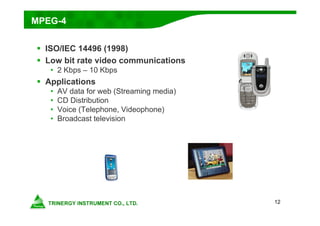
MPEG-4
 ISO/IEC 14496 (1998)
 Low bit rate video communications
• 2 Kbps – 10 Kbps
 Applications
• AV data for web (Streaming media)
• CD Distribution
• Voice (Telephone, Videophone)
• Broadcast television
13
MPEG-4 - Parts
MPEG-4 ISO/IEC 14496
 Part 1 Systems
 Part 2 Visual
 Part 3 Audio
 Part 4 Conformance
 Part 5 Reference Software
 Part 6 Delivery Multimedia Integration Framework (DMIF)
 Part 7 Optimized Reference Software
 Part 8 Carriage on IP networks
 Part 9 Reference Hardware
 Part 10 Advanced Video Coding (AVC)
14
MPEG-4 - Parts
MPEG-4 ISO/IEC 14496
 Part 11 Scene description and Application engine("BIFS")
 Part 12 ISO Base Media File Format
 Part 13 Intellectual Property Management and Protection (IPMP)
Extensions
 Part 14 MPEG-4 File Format
 Part 15 AVC File Format
 Part 16 Animation Framework eXtension (AFX)
 Part 17 Timed Text subtitle format
 Part 18 Font Compression and Streaming (for OpenType fonts)
 Part 19 Synthesized Texture Stream
 Part 20 Lightweight Application Scene Representation (LASeR)
15
MPEG-4 - Parts
MPEG-4 ISO/IEC 14496
 Part 21 MPEG-J Graphics Framework eXtensions (GFX)
 Part 22 Open Font Format
 Part 23 Symbolic Music Representation (SMR)
 Part 24 Audio and systems interaction
 Part 25 3D Graphics Compression Model
 Part 26 Audio Conformance
 Part 27 3D Graphics conformance
16
Overview of MPEG-4 Visual
 MPEG-4 Visual (Part 2, “Coding of Visual Objects”)
 Support many different application
• “Legacy” video application
• Rendered computer graphics
• Streaming video
• High-quality video editing
 Block-based video CODEC, Quantization, Entropy coding
 Introduction - Overview
 Section 1-5 Technical detail
 Section 6 Syntax & Semantics
 Section 7 Processes for decoding
 Section 8 Objects
 Section 9 Profiles & Levels
 15 Annexes
17
Overview of H.264
 Designed primarily to support efficient and robust coding and transport
of rectangular video frames
 Target applications include two-way video communication
 Introduction – Application, Concept of Profiles and Levels
 Section 1-5 Preamble to the detail, terminology and definitions,
abbreviations
 Section 6 input and output data formats
 Section 7 syntax and semantics
 Section 8 processes involved in decoding slices
 Section 9 how a coded bitstream
 4 Annexes
18
Agenda
 Digital TV Introduction
 Video Compression Standards
 Video Formats and Quality
 Video Coding Concepts
19
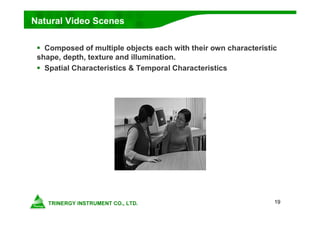
 Composed of multiple objects each with their own characteristic
shape, depth, texture and illumination.
 Spatial Characteristics & Temporal Characteristics
Natural Video Scenes
20
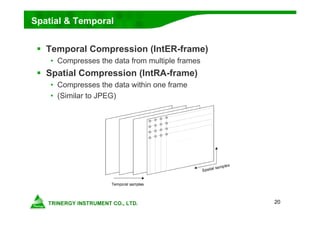
 Temporal Compression (IntER-frame)
• Compresses the data from multiple frames
 Spatial Compression (IntRA-frame)
• Compresses the data within one frame
• (Similar to JPEG)
Spatial & Temporal
21
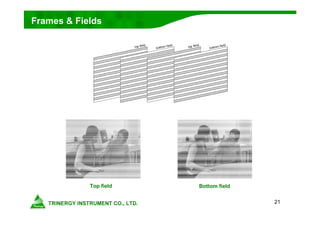
Frames & Fields
Top field Bottom field
22
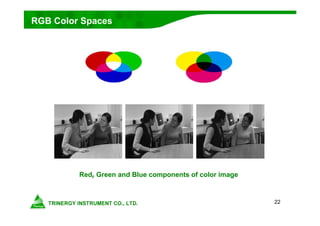
RGB Color Spaces
Red, Green and Blue components of color image
23
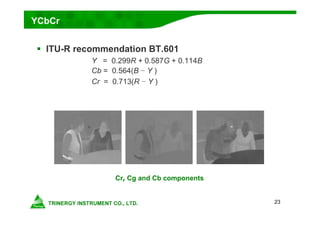
YCbCr
 ITU-R recommendation BT.601
Y = 0.299R + 0.587G + 0.114B
Cb = 0.564(B − Y )
Cr = 0.713(R − Y )
Cr, Cg and Cb components
24
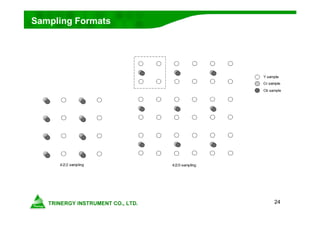
Sampling Formats
25
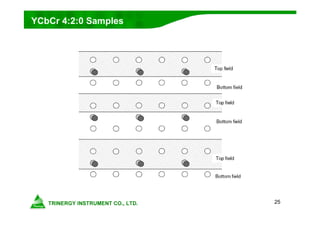
YCbCr 4:2:0 Samples
26
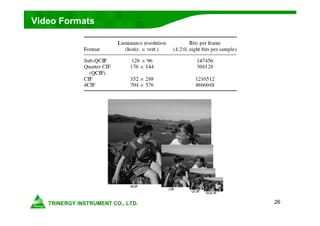
Video Formats
27
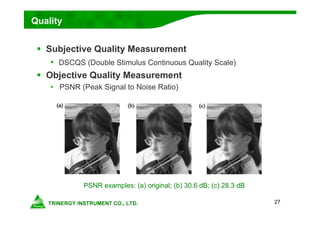
Quality
PSNR examples: (a) original; (b) 30.6 dB; (c) 28.3 dB
 Subjective Quality Measurement
• DSCQS (Double Stimulus Continuous Quality Scale)
 Objective Quality Measurement
• PSNR (Peak Signal to Noise Ratio)
28
Agenda
 Digital TV Introduction
 Video Compression Standards
 Video Formats and Quality
 Video Coding Concepts
29
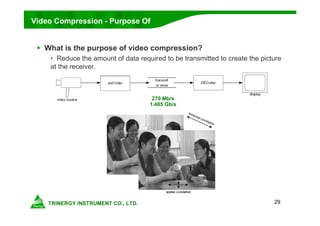
Video Compression - Purpose Of
 What is the purpose of video compression?
• Reduce the amount of data required to be transmitted to create the picture
at the receiver.
270 Mb/s
1.485 Gb/s
30
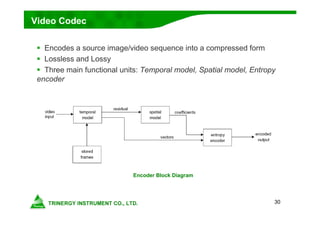
Video Codec
 Encodes a source image/video sequence into a compressed form
 Lossless and Lossy
 Three main functional units: Temporal model, Spatial model, Entropy
encoder
Encoder Block Diagram
31
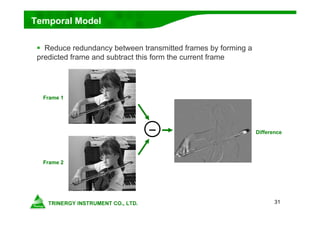
Temporal Model
 Reduce redundancy between transmitted frames by forming a
predicted frame and subtract this form the current frame
Frame 1
Frame 2
Difference
32
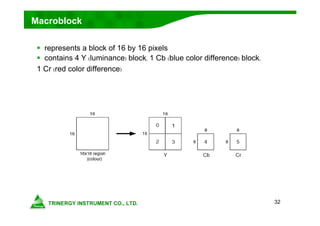
Macroblock
 represents a block of 16 by 16 pixels
 contains 4 Y (luminance) block, 1 Cb (blue color difference) block,
1 Cr (red color difference)
33
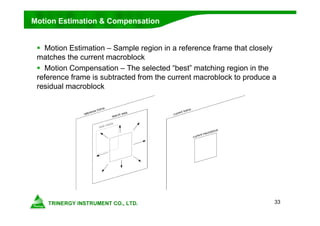
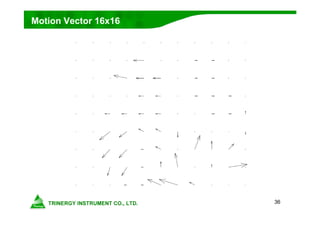
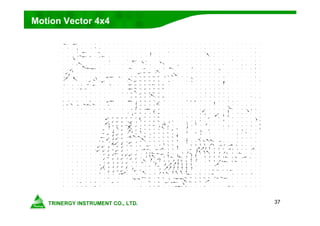
Motion Estimation & Compensation
 Motion Estimation – Sample region in a reference frame that closely
matches the current macroblock
 Motion Compensation – The selected “best” matching region in the
reference frame is subtracted from the current macroblock to produce a
residual macroblock
34
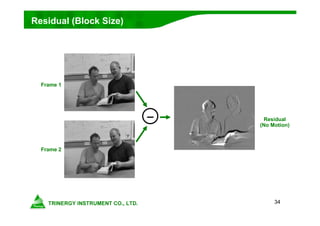
Residual (Block Size)
Frame 1
Frame 2
Residual
(No Motion)
35
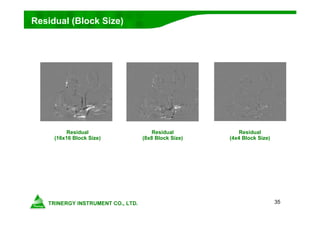
Residual (Block Size)
Residual
(16x16 Block Size)
Residual
(8x8 Block Size)
Residual
(4x4 Block Size)
36
Motion Vector 16x16
37
Motion Vector 4x4
38
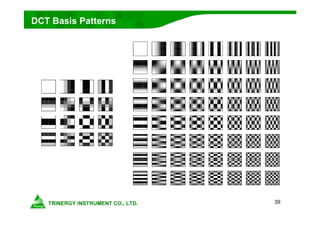
Transform Coding
 What is the purpose of “Transform” ?
 Block-Based Transform; KLT (Karhunen-Loeve Transform), SVD
(Singular Value Decomposition), DCT (Discrete Cosine Transform)
 Image-Based Transform; DWT (Discrete Wavelet Transform)
39
DCT Basis Patterns
40
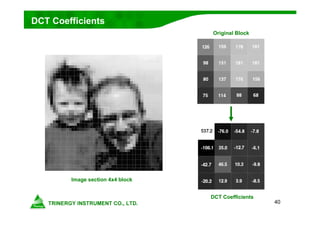
DCT Coefficients
Image section 4x4 block
Original Block
DCT Coefficients
41
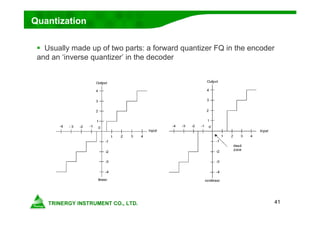
Quantization
 Usually made up of two parts: a forward quantizer FQ in the encoder
and an ‘inverse quantizer’ in the decoder
42
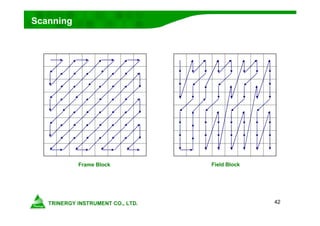
Scanning
Frame Block Field Block
43
Entropy Coder
 Converts as series of symbols representing elements
of the video sequence into a compressed bitstream
• Predictive Coding
• Variable-length Coding
- Huffman Coding
• Arithmetic Coding
44
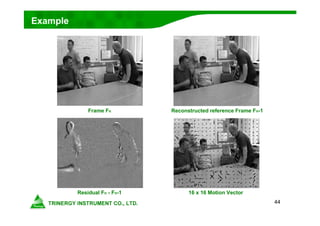
Example
Frame Fn Reconstructed reference Frame Fn-1
Residual Fn - Fn-1 16 x 16 Motion Vector
45
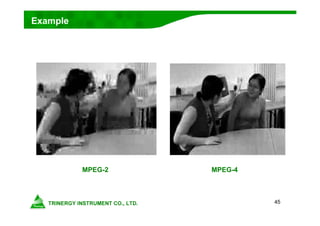
Example
MPEG-2 MPEG-4
46
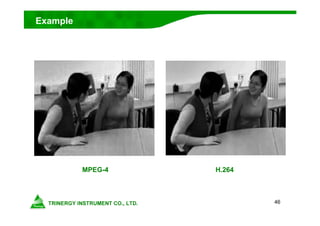
Example
MPEG-4 H.264
47
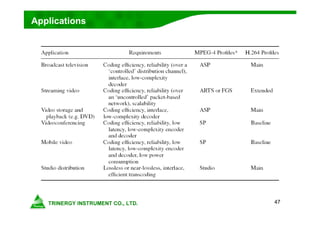
Applications
48
Thank You
For Your Attendance

Video Compression Technology

  • 1.
    1 Video Compression Technology Presentedby – Teerayuth M. Technical Support Engineer --6363 Get the Clip! NextNext:: TheThe RasmusRasmus - In The Shadow- Scooter: 3% - Wake Me Up- --7272 --4848 Enrique: 2% - Hero- Status Bar X -16 Offspring- Hit that + -48 + Hallo Harry Hunger heute schon zu Mittag gegessen? + Isabel ist die
  • 2.
    2 Agenda  Digital TVIntroduction  Video Compression Standards  Video Formats and Quality  Video Coding Concepts
  • 3.
    3 Digital Television What isDigital Television?  sending and receiving of moving images and sound by discrete signals  more flexible and efficient than analog television  After June 12, 2009, full-power television stations in the USA will broadcast in digital only
  • 4.
    4 Digital Television Format Standard Definition Television (SDTV) • Europe - 4:3 Aspect ratio, 625 lines, 50 fields/sec - 16:9 Aspect ratio, 625 lines, 50 fields/sec • North America - 4:3 Aspect ratio, 525 lines, 60 fields/sec
  • 5.
    5 Digital Television Format High Definition Television (HDTV) - All 16:9 Aspect Ratios • 1125 (1080i) lines, 60 or 59.94 fields/sec, Interlaced • 750 (720p) lines, 60 or 59.54 frames/sec, Progressive • 525 (480p) lines, 60 or 59.94 frames/sec, Progressive • Others: 24 Hz p, 25 Hz p, 30 Hz p, 50 Hz i/p, 60 50 Hz i/p
  • 6.
    6 Digital Video BroadcastStandard  Digital Video Broadcasting (DVB) - DVB-S (Digital Video Broadcasting - Satellite) - DVB-T (Digital Video Broadcasting - Terrestrial) - DVB-C (Digital Video Broadcasting - Cable) - DVB-H (Digital Video Broadcasting - Handheld)  Advanced Television Systems Committee (ATSC)  Integrated Services Digital Broadcasting (ISDB)  Digital Multimedia Broadcasting (DMB)
  • 7.
    7 Agenda  Digital TVIntroduction  Video Compression Standards  Video Formats and Quality  Video Coding Concepts
  • 8.
    8 Video Compression Standards JPEG, still images (Joint Photographic Experts Group) • M-JPEG; motion JPEG, not a standard, generally proprietary, JPEG 2000  ITU-T : H.261 (px64), H.262, H.263 (Video conference), H.264  MPEG-1 (Moving Picture Experts Group), CD-ROM and multimedia  MPEG-2, Broadcast entertainment/contribution and DVD  MPEG-4, very low bit rate coding of objects  Other formats - DV, RealVideo, VC-1, WMV, XVD
  • 9.
    9 MPEG-1  ISO/IEC 11172(1993)  Lossy compression of video & audio  Design focused on non-interlaced (progressive) Source Input Format (SIF) = 352x240, 352x288, or 320x240  Application was media storage e.g. CD-ROM ~1.5 Mbps data rate  Uses most of the H.261 techniques  Used in early DTV testing
  • 10.
    10 MPEG-2  ISO/IEC 13818(1994)  Lossy compression of video & audio  Evolved out of the shortcomings of MPEG-1  Applications • RF Transmission - ATSC, DVB-T, DVB-C, DVB-S - Other satellite; ENG, Backhaul, Affiliate Distribution • Broadband Network (Telco) • Storage Media • Intra-studio • Internet • Video Conferencing • Education • Entertainment
  • 11.
    11 MPEG-2 ISO/IEC 13818 Part 1 Systems  Part 2 Video  Part 3 Audio  Part 4 Conformance Testing (for 1, 2 and 3)  Part 5 Software Simulation  Part 6 System Extensions - DSM-CC (Digital Storage Media - Command and Control)  Part 7 Audio Extension - NBC (Non-Backward Compatible)  Part 9 System Extension - RTI (Real-Time Interface)  Part 10 Conformance Extension - DSM-CC  Part 11 Intellectual property management (IPMP) MPEG-2 Standard Documents
  • 12.
    12 MPEG-4  ISO/IEC 14496(1998)  Low bit rate video communications • 2 Kbps – 10 Kbps  Applications • AV data for web (Streaming media) • CD Distribution • Voice (Telephone, Videophone) • Broadcast television
  • 13.
    13 MPEG-4 - Parts MPEG-4ISO/IEC 14496  Part 1 Systems  Part 2 Visual  Part 3 Audio  Part 4 Conformance  Part 5 Reference Software  Part 6 Delivery Multimedia Integration Framework (DMIF)  Part 7 Optimized Reference Software  Part 8 Carriage on IP networks  Part 9 Reference Hardware  Part 10 Advanced Video Coding (AVC)
  • 14.
    14 MPEG-4 - Parts MPEG-4ISO/IEC 14496  Part 11 Scene description and Application engine("BIFS")  Part 12 ISO Base Media File Format  Part 13 Intellectual Property Management and Protection (IPMP) Extensions  Part 14 MPEG-4 File Format  Part 15 AVC File Format  Part 16 Animation Framework eXtension (AFX)  Part 17 Timed Text subtitle format  Part 18 Font Compression and Streaming (for OpenType fonts)  Part 19 Synthesized Texture Stream  Part 20 Lightweight Application Scene Representation (LASeR)
  • 15.
    15 MPEG-4 - Parts MPEG-4ISO/IEC 14496  Part 21 MPEG-J Graphics Framework eXtensions (GFX)  Part 22 Open Font Format  Part 23 Symbolic Music Representation (SMR)  Part 24 Audio and systems interaction  Part 25 3D Graphics Compression Model  Part 26 Audio Conformance  Part 27 3D Graphics conformance
  • 16.
    16 Overview of MPEG-4Visual  MPEG-4 Visual (Part 2, “Coding of Visual Objects”)  Support many different application • “Legacy” video application • Rendered computer graphics • Streaming video • High-quality video editing  Block-based video CODEC, Quantization, Entropy coding  Introduction - Overview  Section 1-5 Technical detail  Section 6 Syntax & Semantics  Section 7 Processes for decoding  Section 8 Objects  Section 9 Profiles & Levels  15 Annexes
  • 17.
    17 Overview of H.264 Designed primarily to support efficient and robust coding and transport of rectangular video frames  Target applications include two-way video communication  Introduction – Application, Concept of Profiles and Levels  Section 1-5 Preamble to the detail, terminology and definitions, abbreviations  Section 6 input and output data formats  Section 7 syntax and semantics  Section 8 processes involved in decoding slices  Section 9 how a coded bitstream  4 Annexes
  • 18.
    18 Agenda  Digital TVIntroduction  Video Compression Standards  Video Formats and Quality  Video Coding Concepts
  • 19.
    19  Composed ofmultiple objects each with their own characteristic shape, depth, texture and illumination.  Spatial Characteristics & Temporal Characteristics Natural Video Scenes
  • 20.
    20  Temporal Compression(IntER-frame) • Compresses the data from multiple frames  Spatial Compression (IntRA-frame) • Compresses the data within one frame • (Similar to JPEG) Spatial & Temporal
  • 21.
    21 Frames & Fields Topfield Bottom field
  • 22.
    22 RGB Color Spaces Red,Green and Blue components of color image
  • 23.
    23 YCbCr  ITU-R recommendationBT.601 Y = 0.299R + 0.587G + 0.114B Cb = 0.564(B − Y ) Cr = 0.713(R − Y ) Cr, Cg and Cb components
  • 24.
  • 25.
  • 26.
  • 27.
    27 Quality PSNR examples: (a)original; (b) 30.6 dB; (c) 28.3 dB  Subjective Quality Measurement • DSCQS (Double Stimulus Continuous Quality Scale)  Objective Quality Measurement • PSNR (Peak Signal to Noise Ratio)
  • 28.
    28 Agenda  Digital TVIntroduction  Video Compression Standards  Video Formats and Quality  Video Coding Concepts
  • 29.
    29 Video Compression -Purpose Of  What is the purpose of video compression? • Reduce the amount of data required to be transmitted to create the picture at the receiver. 270 Mb/s 1.485 Gb/s
  • 30.
    30 Video Codec  Encodesa source image/video sequence into a compressed form  Lossless and Lossy  Three main functional units: Temporal model, Spatial model, Entropy encoder Encoder Block Diagram
  • 31.
    31 Temporal Model  Reduceredundancy between transmitted frames by forming a predicted frame and subtract this form the current frame Frame 1 Frame 2 Difference
  • 32.
    32 Macroblock  represents ablock of 16 by 16 pixels  contains 4 Y (luminance) block, 1 Cb (blue color difference) block, 1 Cr (red color difference)
  • 33.
    33 Motion Estimation &Compensation  Motion Estimation – Sample region in a reference frame that closely matches the current macroblock  Motion Compensation – The selected “best” matching region in the reference frame is subtracted from the current macroblock to produce a residual macroblock
  • 34.
    34 Residual (Block Size) Frame1 Frame 2 Residual (No Motion)
  • 35.
    35 Residual (Block Size) Residual (16x16Block Size) Residual (8x8 Block Size) Residual (4x4 Block Size)
  • 36.
  • 37.
  • 38.
    38 Transform Coding  Whatis the purpose of “Transform” ?  Block-Based Transform; KLT (Karhunen-Loeve Transform), SVD (Singular Value Decomposition), DCT (Discrete Cosine Transform)  Image-Based Transform; DWT (Discrete Wavelet Transform)
  • 39.
  • 40.
    40 DCT Coefficients Image section4x4 block Original Block DCT Coefficients
  • 41.
    41 Quantization  Usually madeup of two parts: a forward quantizer FQ in the encoder and an ‘inverse quantizer’ in the decoder
  • 42.
  • 43.
    43 Entropy Coder  Convertsas series of symbols representing elements of the video sequence into a compressed bitstream • Predictive Coding • Variable-length Coding - Huffman Coding • Arithmetic Coding
  • 44.
    44 Example Frame Fn Reconstructedreference Frame Fn-1 Residual Fn - Fn-1 16 x 16 Motion Vector
  • 45.
  • 46.
  • 47.
  • 48.