High School Chemistry - Core Concept Cheat Sheet

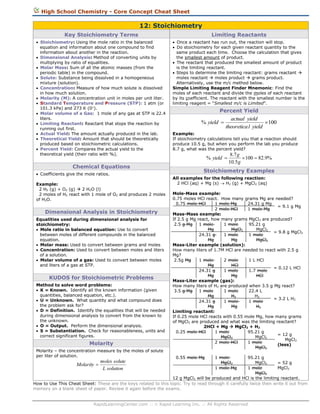
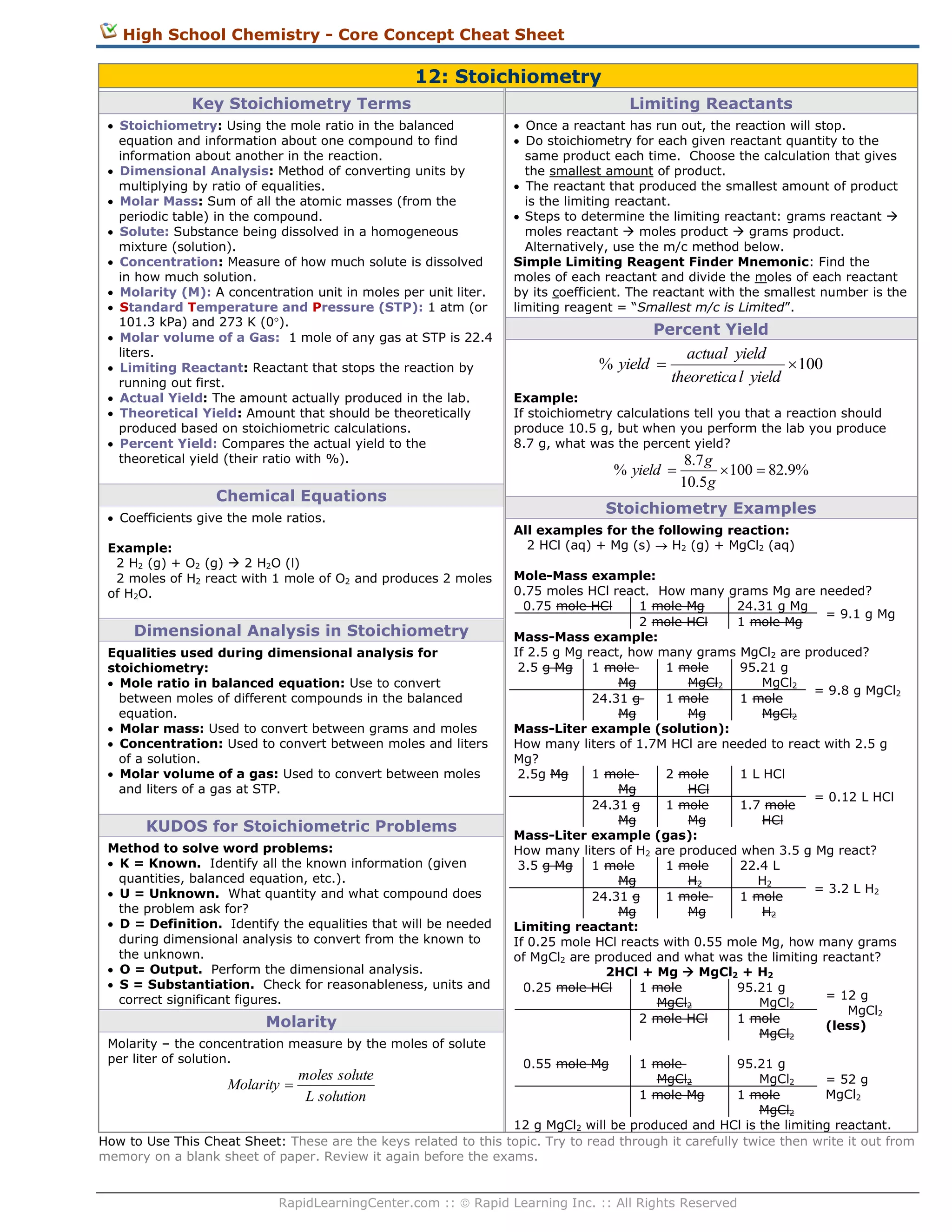
12: Stoichiometry
Key Stoichiometry Terms

Limiting Reactants

 Stoichiometry: Using the mole ratio in the balanced
equation and information about one compound to find
information about another in the reaction.
 Dimensional Analysis: Method of converting units by
multiplying by ratio of equalities.
 Molar Mass: Sum of all the atomic masses (from the
periodic table) in the compound.
 Solute: Substance being dissolved in a homogeneous
mixture (solution).
 Concentration: Measure of how much solute is dissolved
in how much solution.
 Molarity (M): A concentration unit in moles per unit liter.
 Standard Temperature and Pressure (STP): 1 atm (or
101.3 kPa) and 273 K (0).
 Molar volume of a Gas: 1 mole of any gas at STP is 22.4
liters.
 Limiting Reactant: Reactant that stops the reaction by
running out first.
 Actual Yield: The amount actually produced in the lab.
 Theoretical Yield: Amount that should be theoretically
produced based on stoichiometric calculations.
 Percent Yield: Compares the actual yield to the
theoretical yield (their ratio with %).

 Once a reactant has run out, the reaction will stop.
 Do stoichiometry for each given reactant quantity to the
same product each time. Choose the calculation that gives
the smallest amount of product.
 The reactant that produced the smallest amount of product
is the limiting reactant.
 Steps to determine the limiting reactant: grams reactant 
moles reactant  moles product  grams product.
Alternatively, use the m/c method below.
Simple Limiting Reagent Finder Mnemonic: Find the
moles of each reactant and divide the moles of each reactant
by its coefficient. The reactant with the smallest number is the
limiting reagent = “Smallest m/c is Limited”.

Chemical Equations
 Coefficients give the mole ratios.
Example:
2 H2 (g) + O2 (g)  2 H2O (l)
2 moles of H2 react with 1 mole of O2 and produces 2 moles
of H2O.

Dimensional Analysis in Stoichiometry
Equalities used during dimensional analysis for
stoichiometry:
 Mole ratio in balanced equation: Use to convert
between moles of different compounds in the balanced
equation.
 Molar mass: Used to convert between grams and moles
 Concentration: Used to convert between moles and liters
of a solution.
 Molar volume of a gas: Used to convert between moles
and liters of a gas at STP.

KUDOS for Stoichiometric Problems
Method to solve word problems:
 K = Known. Identify all the known information (given
quantities, balanced equation, etc.).
 U = Unknown. What quantity and what compound does
the problem ask for?
 D = Definition. Identify the equalities that will be needed
during dimensional analysis to convert from the known to
the unknown.
 O = Output. Perform the dimensional analysis.
 S = Substantiation. Check for reasonableness, units and
correct significant figures.

Molarity
Molarity – the concentration measure by the moles of solute
per liter of solution.

Percent Yield

% yield 

actual yield
 100
theoretica l yield

Example:
If stoichiometry calculations tell you that a reaction should
produce 10.5 g, but when you perform the lab you produce
8.7 g, what was the percent yield?

% yield 

8.7 g
 100  82.9%
10.5 g

Stoichiometry Examples
All examples for the following reaction:
2 HCl (aq) + Mg (s)  H2 (g) + MgCl2 (aq)
Mole-Mass example:
0.75 moles HCl react. How many grams Mg are needed?
0.75 mole HCl
1 mole Mg
24.31 g Mg
= 9.1 g Mg
2 mole HCl
1 mole Mg
Mass-Mass example:
If 2.5 g Mg react, how many grams MgCl2 are produced?
2.5 g Mg
1 mole
1 mole
95.21 g
Mg
MgCl2
MgCl2
= 9.8 g MgCl2
24.31 g
1 mole
1 mole
Mg
Mg
MgCl2
Mass-Liter example (solution):
How many liters of 1.7M HCl are needed to react with 2.5 g
Mg?
2.5g Mg
1 mole
2 mole
1 L HCl
Mg
HCl
= 0.12 L HCl
24.31 g
1 mole
1.7 mole
Mg
Mg
HCl
Mass-Liter example (gas):
How many liters of H2 are produced when 3.5 g Mg react?
3.5 g Mg
1 mole
1 mole
22.4 L
Mg
H2
H2
= 3.2 L H2
24.31 g
1 mole
1 mole
Mg
Mg
H2
Limiting reactant:
If 0.25 mole HCl reacts with 0.55 mole Mg, how many grams
of MgCl2 are produced and what was the limiting reactant?
2HCl + Mg  MgCl2 + H2
0.25 mole HCl
1 mole
95.21 g
= 12 g
MgCl2
MgCl2
MgCl2
2 mole HCl
1 mole
(less)
MgCl2

95.21 g
MgCl2
= 52 g
MgCl2
1 mole
MgCl2
12 g MgCl2 will be produced and HCl is the limiting reactant.
How to Use This Cheat Sheet: These are the keys related to this topic. Try to read through it carefully twice then write it out from
memory on a blank sheet of paper. Review it again before the exams.

moles solute
Molarity 
L solution

0.55 mole Mg

1 mole
MgCl2
1 mole Mg

RapidLearningCenter.com ::  Rapid Learning Inc. :: All Rights Reserved

Stoichiometry cheat sheet

  • 1.
    High School Chemistry- Core Concept Cheat Sheet 12: Stoichiometry Key Stoichiometry Terms Limiting Reactants  Stoichiometry: Using the mole ratio in the balanced equation and information about one compound to find information about another in the reaction.  Dimensional Analysis: Method of converting units by multiplying by ratio of equalities.  Molar Mass: Sum of all the atomic masses (from the periodic table) in the compound.  Solute: Substance being dissolved in a homogeneous mixture (solution).  Concentration: Measure of how much solute is dissolved in how much solution.  Molarity (M): A concentration unit in moles per unit liter.  Standard Temperature and Pressure (STP): 1 atm (or 101.3 kPa) and 273 K (0).  Molar volume of a Gas: 1 mole of any gas at STP is 22.4 liters.  Limiting Reactant: Reactant that stops the reaction by running out first.  Actual Yield: The amount actually produced in the lab.  Theoretical Yield: Amount that should be theoretically produced based on stoichiometric calculations.  Percent Yield: Compares the actual yield to the theoretical yield (their ratio with %).  Once a reactant has run out, the reaction will stop.  Do stoichiometry for each given reactant quantity to the same product each time. Choose the calculation that gives the smallest amount of product.  The reactant that produced the smallest amount of product is the limiting reactant.  Steps to determine the limiting reactant: grams reactant  moles reactant  moles product  grams product. Alternatively, use the m/c method below. Simple Limiting Reagent Finder Mnemonic: Find the moles of each reactant and divide the moles of each reactant by its coefficient. The reactant with the smallest number is the limiting reagent = “Smallest m/c is Limited”. Chemical Equations  Coefficients give the mole ratios. Example: 2 H2 (g) + O2 (g)  2 H2O (l) 2 moles of H2 react with 1 mole of O2 and produces 2 moles of H2O. Dimensional Analysis in Stoichiometry Equalities used during dimensional analysis for stoichiometry:  Mole ratio in balanced equation: Use to convert between moles of different compounds in the balanced equation.  Molar mass: Used to convert between grams and moles  Concentration: Used to convert between moles and liters of a solution.  Molar volume of a gas: Used to convert between moles and liters of a gas at STP. KUDOS for Stoichiometric Problems Method to solve word problems:  K = Known. Identify all the known information (given quantities, balanced equation, etc.).  U = Unknown. What quantity and what compound does the problem ask for?  D = Definition. Identify the equalities that will be needed during dimensional analysis to convert from the known to the unknown.  O = Output. Perform the dimensional analysis.  S = Substantiation. Check for reasonableness, units and correct significant figures. Molarity Molarity – the concentration measure by the moles of solute per liter of solution. Percent Yield % yield  actual yield  100 theoretica l yield Example: If stoichiometry calculations tell you that a reaction should produce 10.5 g, but when you perform the lab you produce 8.7 g, what was the percent yield? % yield  8.7 g  100  82.9% 10.5 g Stoichiometry Examples All examples for the following reaction: 2 HCl (aq) + Mg (s)  H2 (g) + MgCl2 (aq) Mole-Mass example: 0.75 moles HCl react. How many grams Mg are needed? 0.75 mole HCl 1 mole Mg 24.31 g Mg = 9.1 g Mg 2 mole HCl 1 mole Mg Mass-Mass example: If 2.5 g Mg react, how many grams MgCl2 are produced? 2.5 g Mg 1 mole 1 mole 95.21 g Mg MgCl2 MgCl2 = 9.8 g MgCl2 24.31 g 1 mole 1 mole Mg Mg MgCl2 Mass-Liter example (solution): How many liters of 1.7M HCl are needed to react with 2.5 g Mg? 2.5g Mg 1 mole 2 mole 1 L HCl Mg HCl = 0.12 L HCl 24.31 g 1 mole 1.7 mole Mg Mg HCl Mass-Liter example (gas): How many liters of H2 are produced when 3.5 g Mg react? 3.5 g Mg 1 mole 1 mole 22.4 L Mg H2 H2 = 3.2 L H2 24.31 g 1 mole 1 mole Mg Mg H2 Limiting reactant: If 0.25 mole HCl reacts with 0.55 mole Mg, how many grams of MgCl2 are produced and what was the limiting reactant? 2HCl + Mg  MgCl2 + H2 0.25 mole HCl 1 mole 95.21 g = 12 g MgCl2 MgCl2 MgCl2 2 mole HCl 1 mole (less) MgCl2 95.21 g MgCl2 = 52 g MgCl2 1 mole MgCl2 12 g MgCl2 will be produced and HCl is the limiting reactant. How to Use This Cheat Sheet: These are the keys related to this topic. Try to read through it carefully twice then write it out from memory on a blank sheet of paper. Review it again before the exams. moles solute Molarity  L solution 0.55 mole Mg 1 mole MgCl2 1 mole Mg RapidLearningCenter.com ::  Rapid Learning Inc. :: All Rights Reserved