Portable Energy-Aware Cluster-Based
Edge Computers
Thomas Rausch, Cosmin Avasalcai, Schahram Dustdar
TU Wien, Vienna Austria
Distributed Systems Group
http://dsg.tuwien.ac.at
ACM/IEEE Symposium on Edge Computing
2018, Bellevue, WA
2
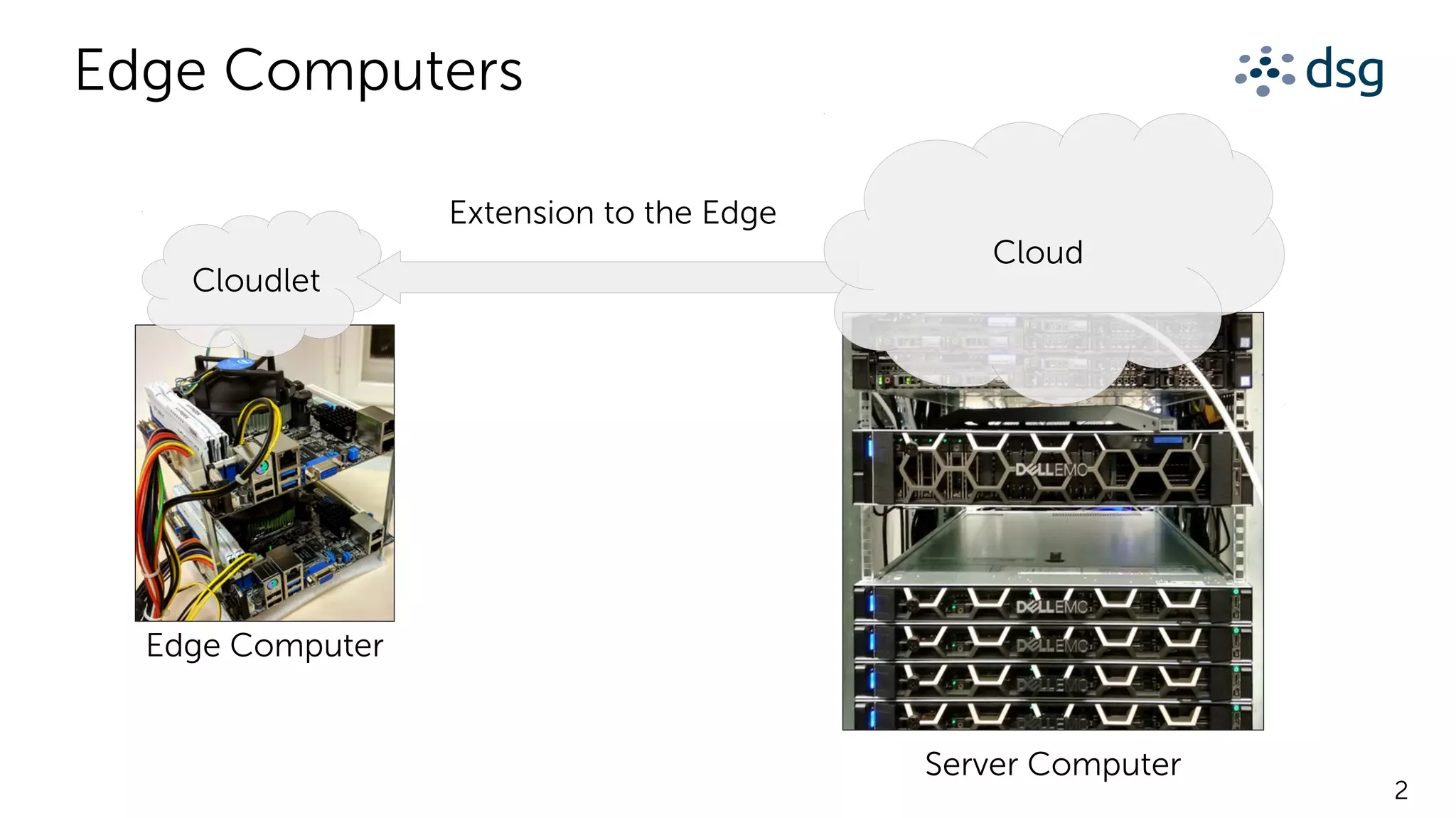
Edge Computers
Cloudlet
Cloud
Server Computer
Edge Computer
Extension to the Edge
3
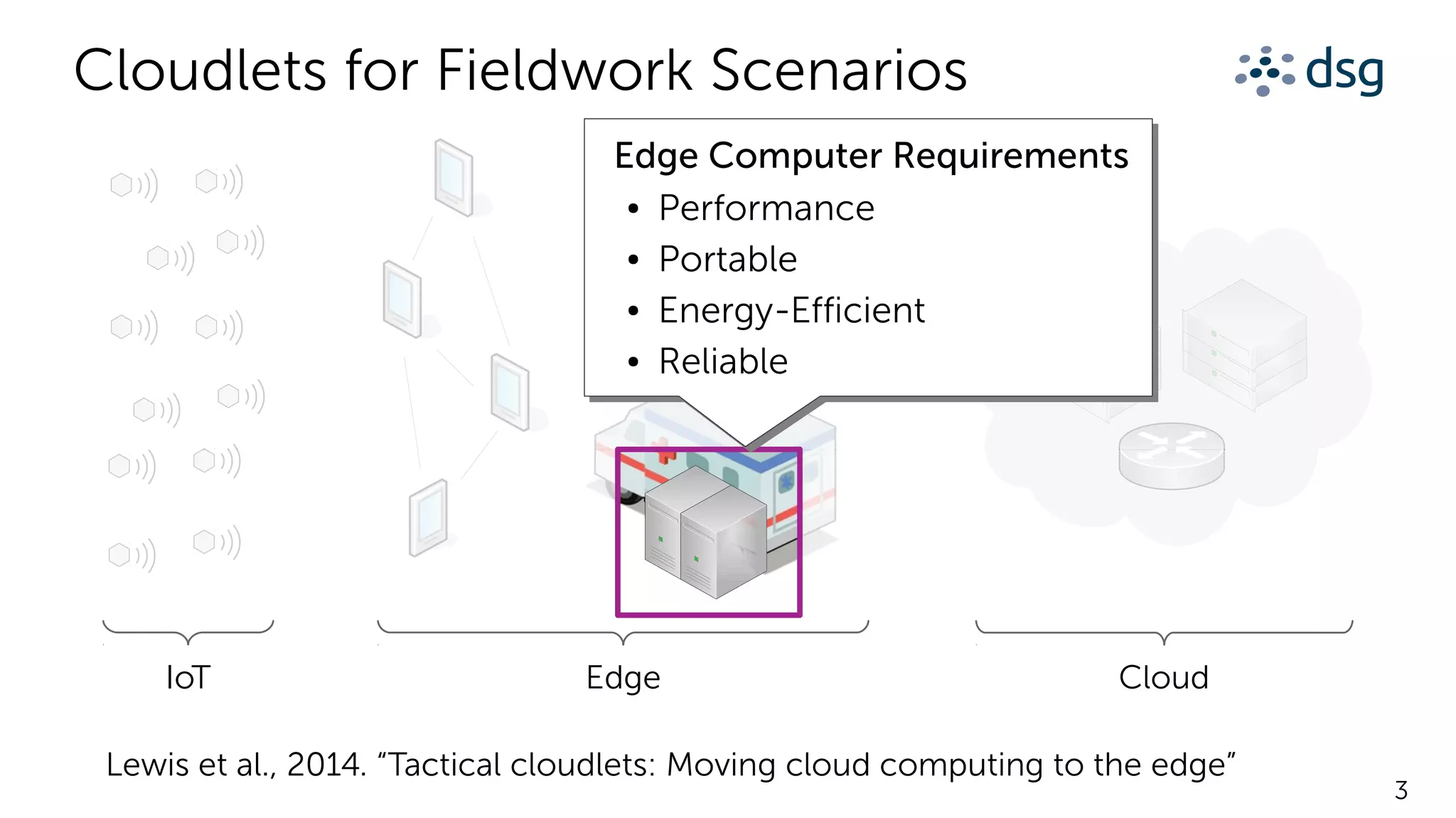
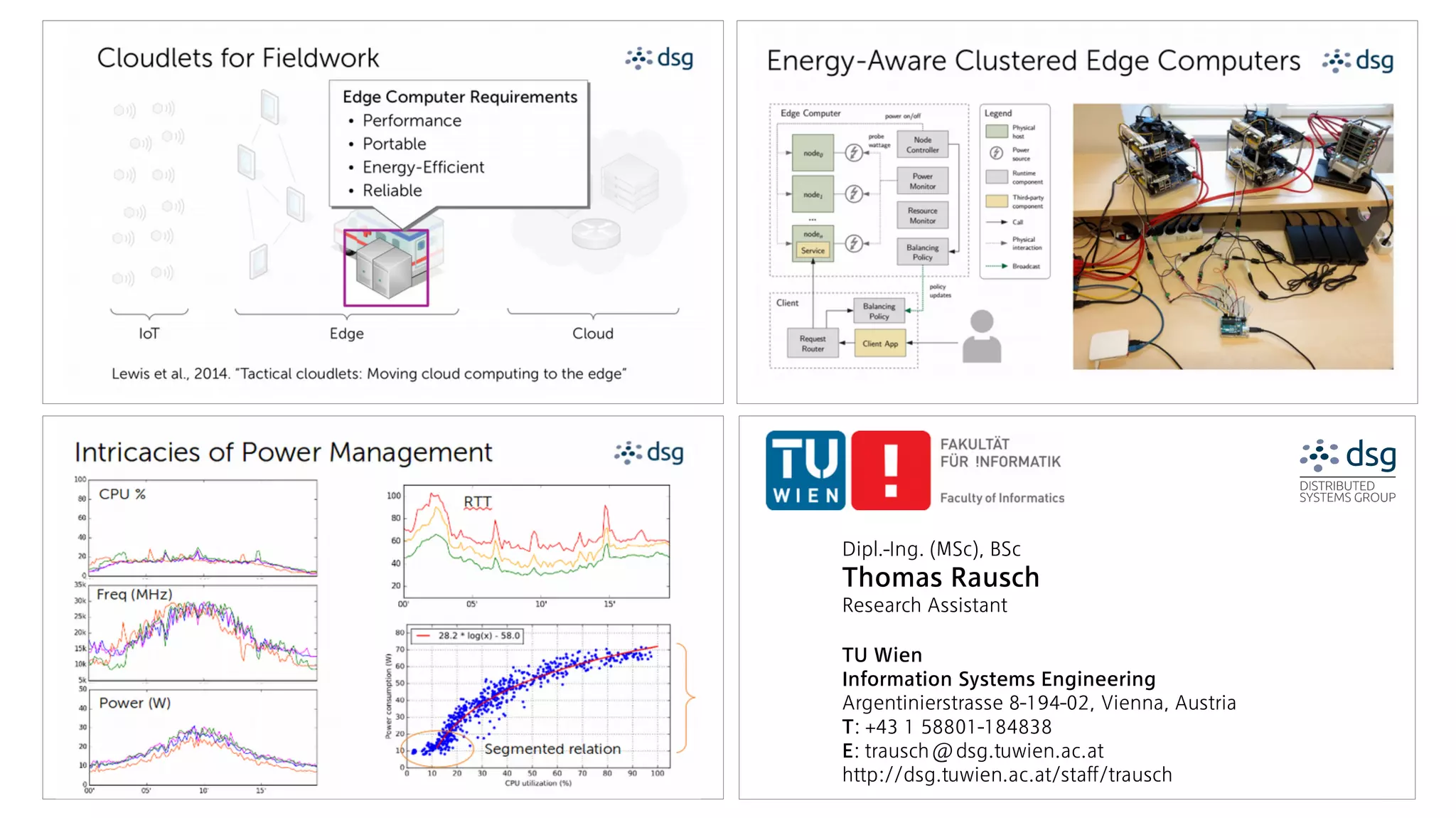
Cloudlets for Fieldwork Scenarios
Edge CloudIoT
Lewis et al., 2014. “Tactical cloudlets: Moving cloud computing to the edge”
Edge Computer Requirements
● Performance
● Portable
● Energy-Efficient
● Reliable
Edge Computer Requirements
● Performance
● Portable
● Energy-Efficient
● Reliable
4
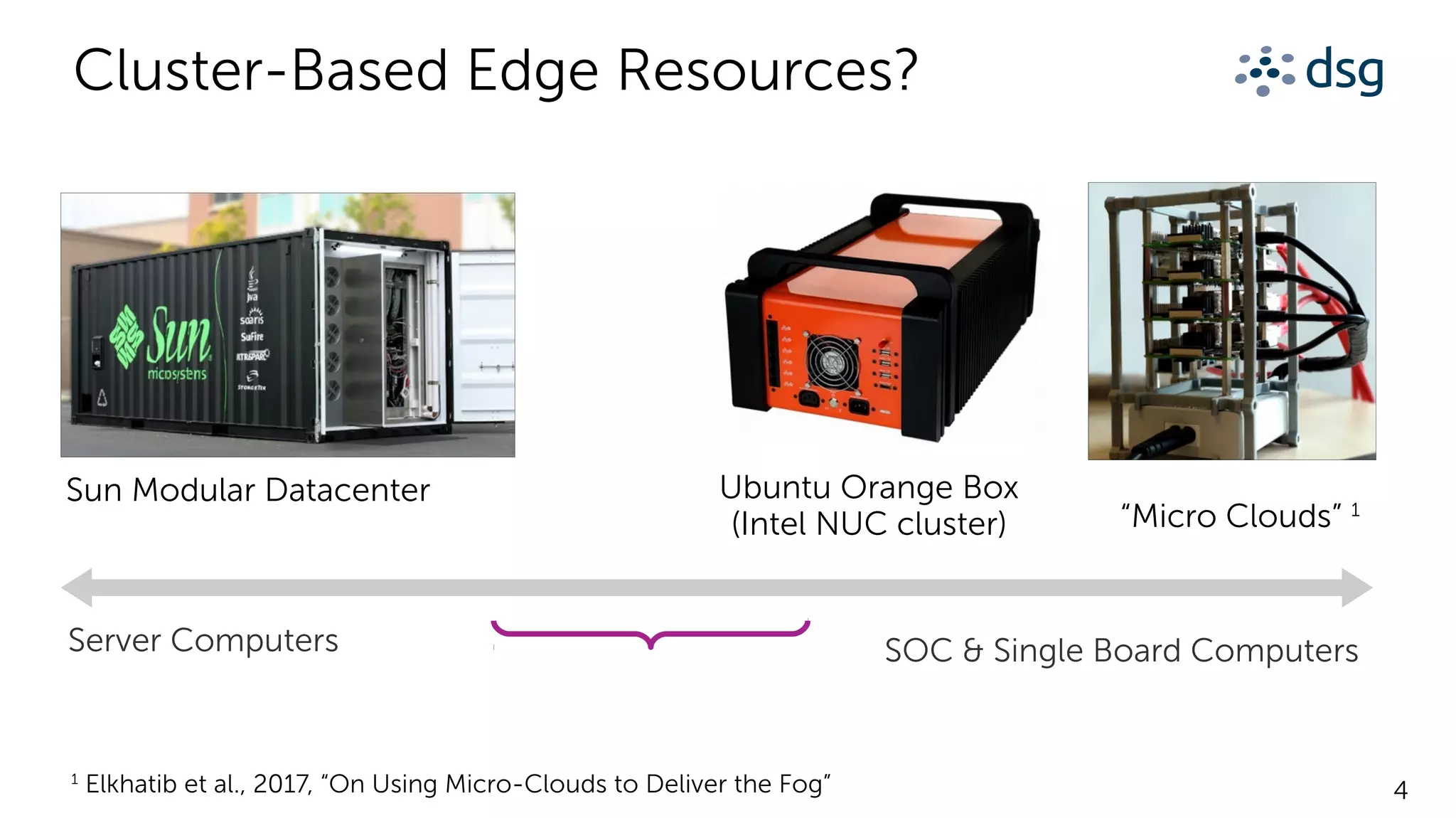
Cluster-Based Edge Resources?
Sun Modular Datacenter Ubuntu Orange Box
(Intel NUC cluster)
1
Elkhatib et al., 2017, “On Using Micro-Clouds to Deliver the Fog”
“Micro Clouds” 1
Server Computers SOC & Single Board Computers
5
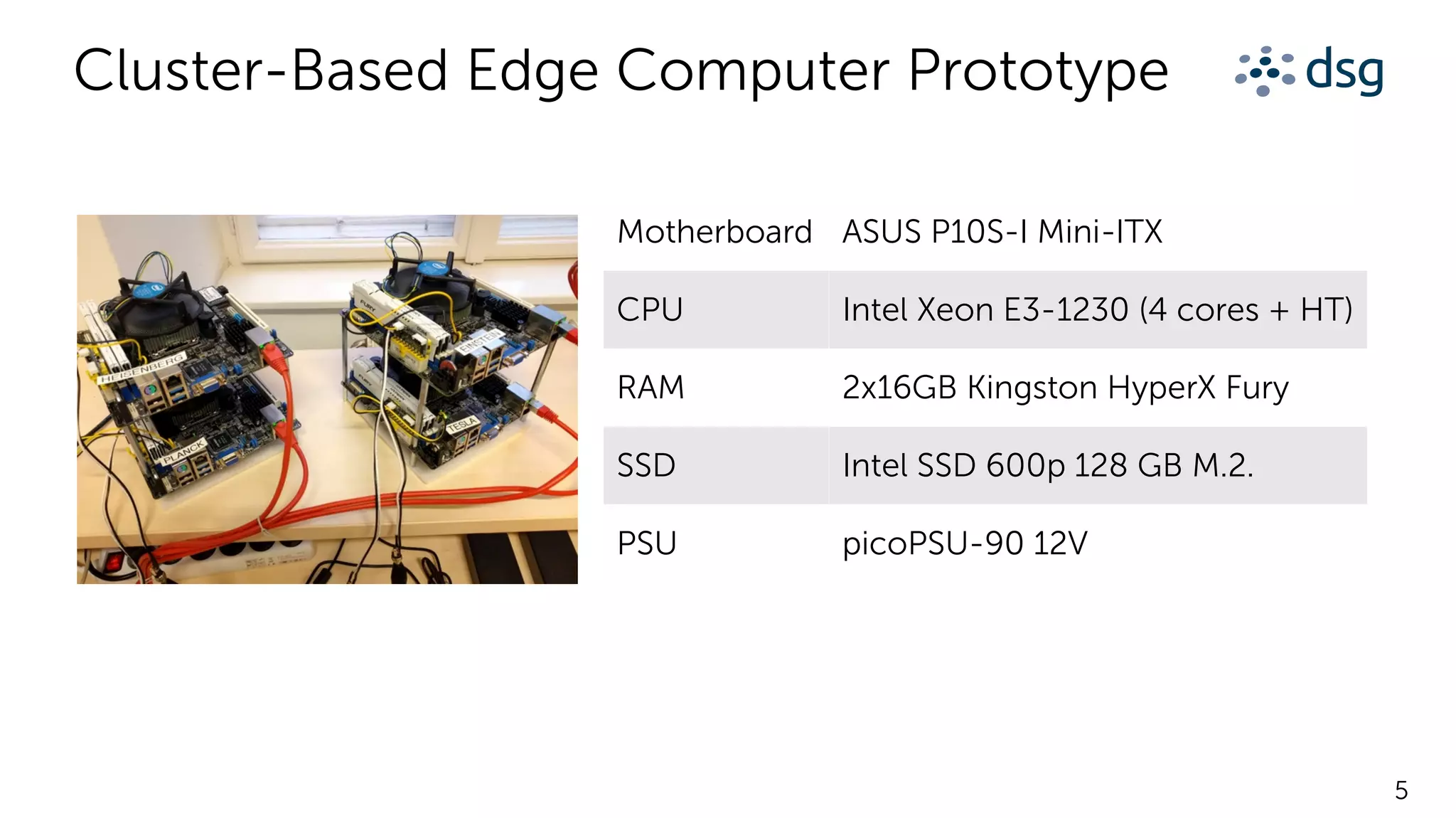
Cluster-Based Edge Computer Prototype
Motherboard ASUS P10S-I Mini-ITX
CPU Intel Xeon E3-1230 (4 cores + HT)
RAM 2x16GB Kingston HyperX Fury
SSD Intel SSD 600p 128 GB M.2.
PSU picoPSU-90 12V
6
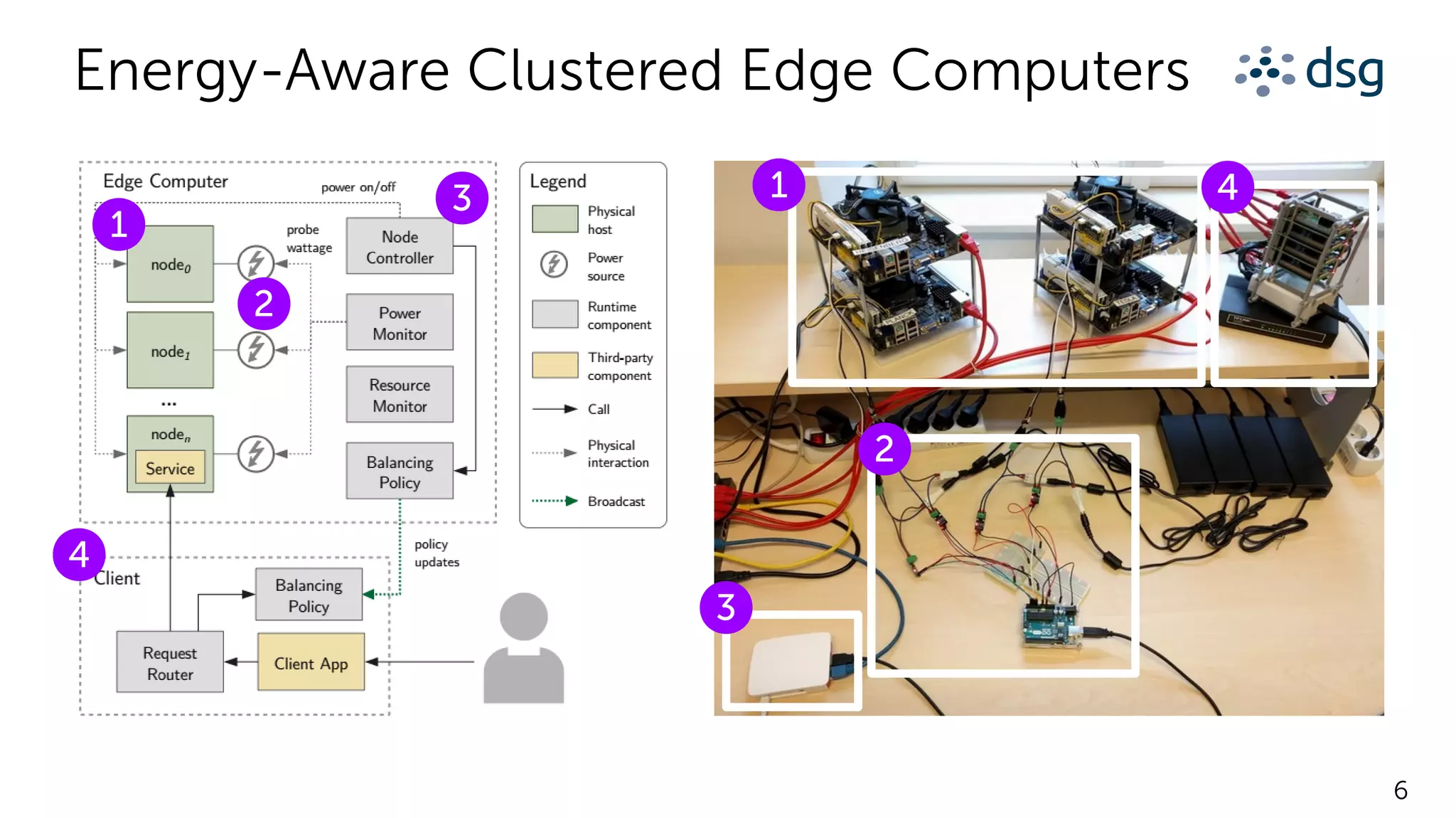
Energy-Aware Clustered Edge Computers
1
13
3
2
2
4
4
7
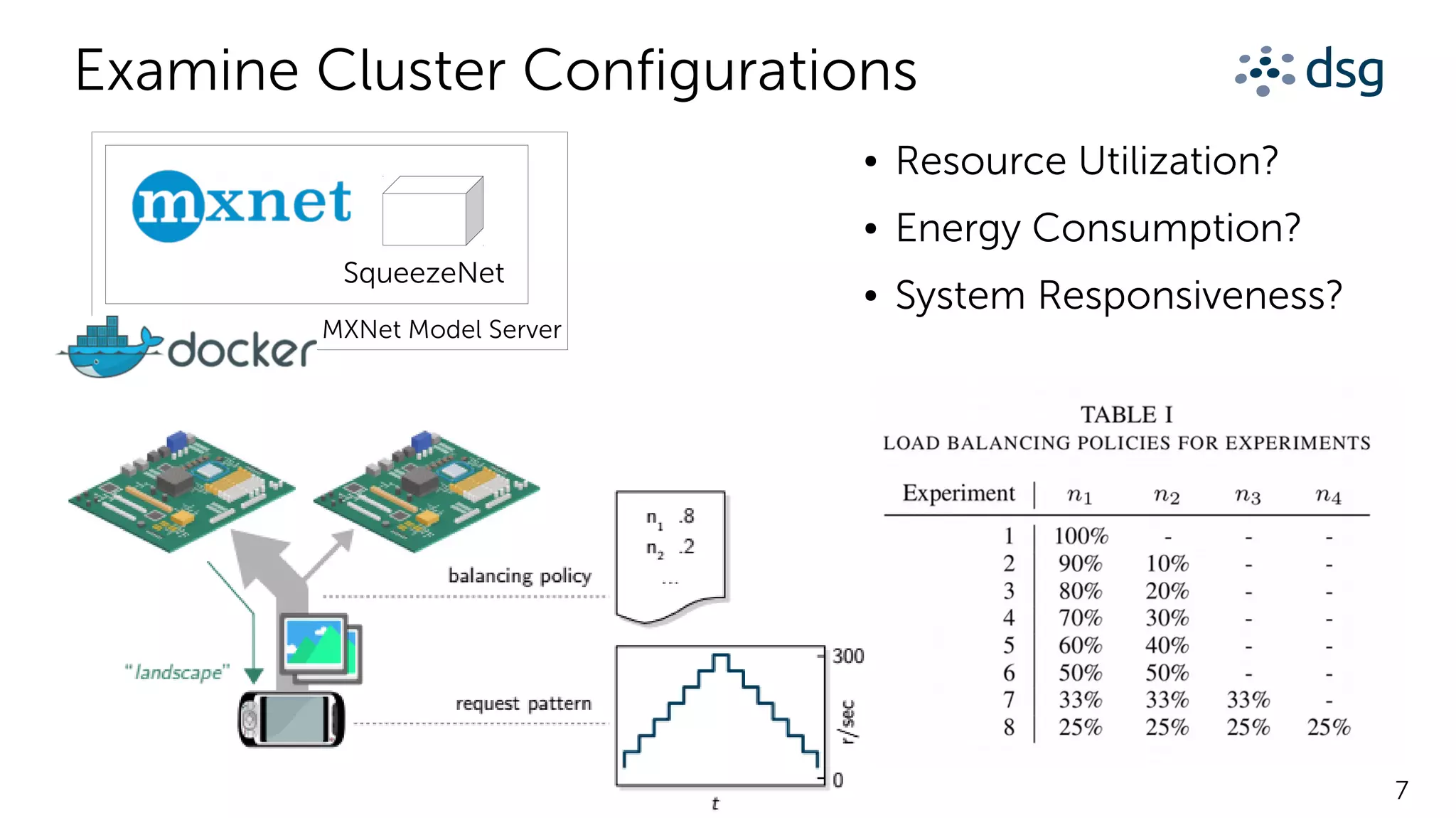
Examine Cluster Configurations
● Resource Utilization?
● Energy Consumption?
● System Responsiveness?
SqueezeNet
MXNet Model Server
8
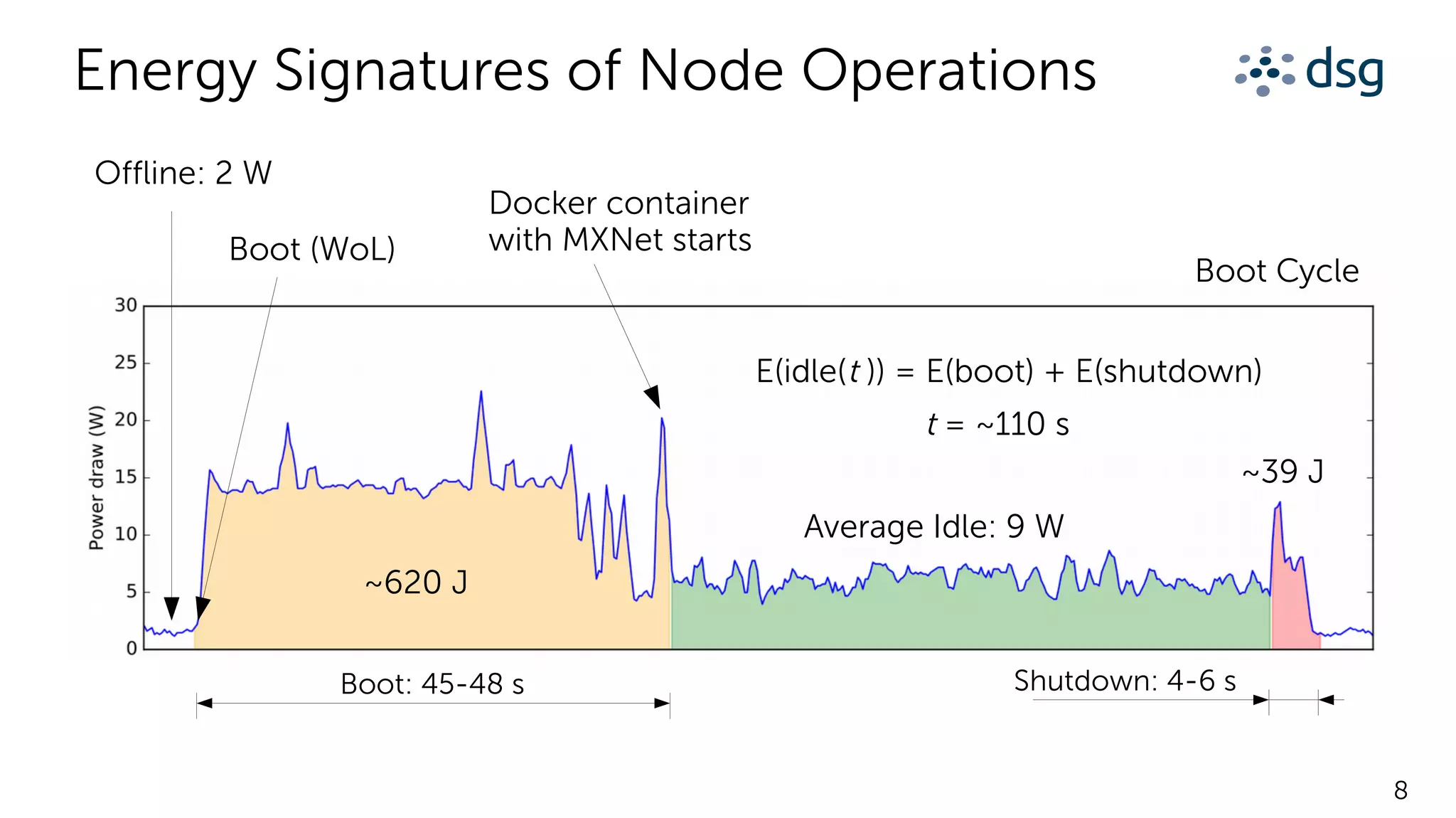
Energy Signatures of Node Operations
Offline: 2 W
Shutdown: 4-6 s
~620 J
Boot (WoL)
Docker container
with MXNet starts
Average Idle: 9 W
Boot: 45-48 s
~39 J
E(idle(t )) = E(boot) + E(shutdown)
t = ~110 s
Boot Cycle
9
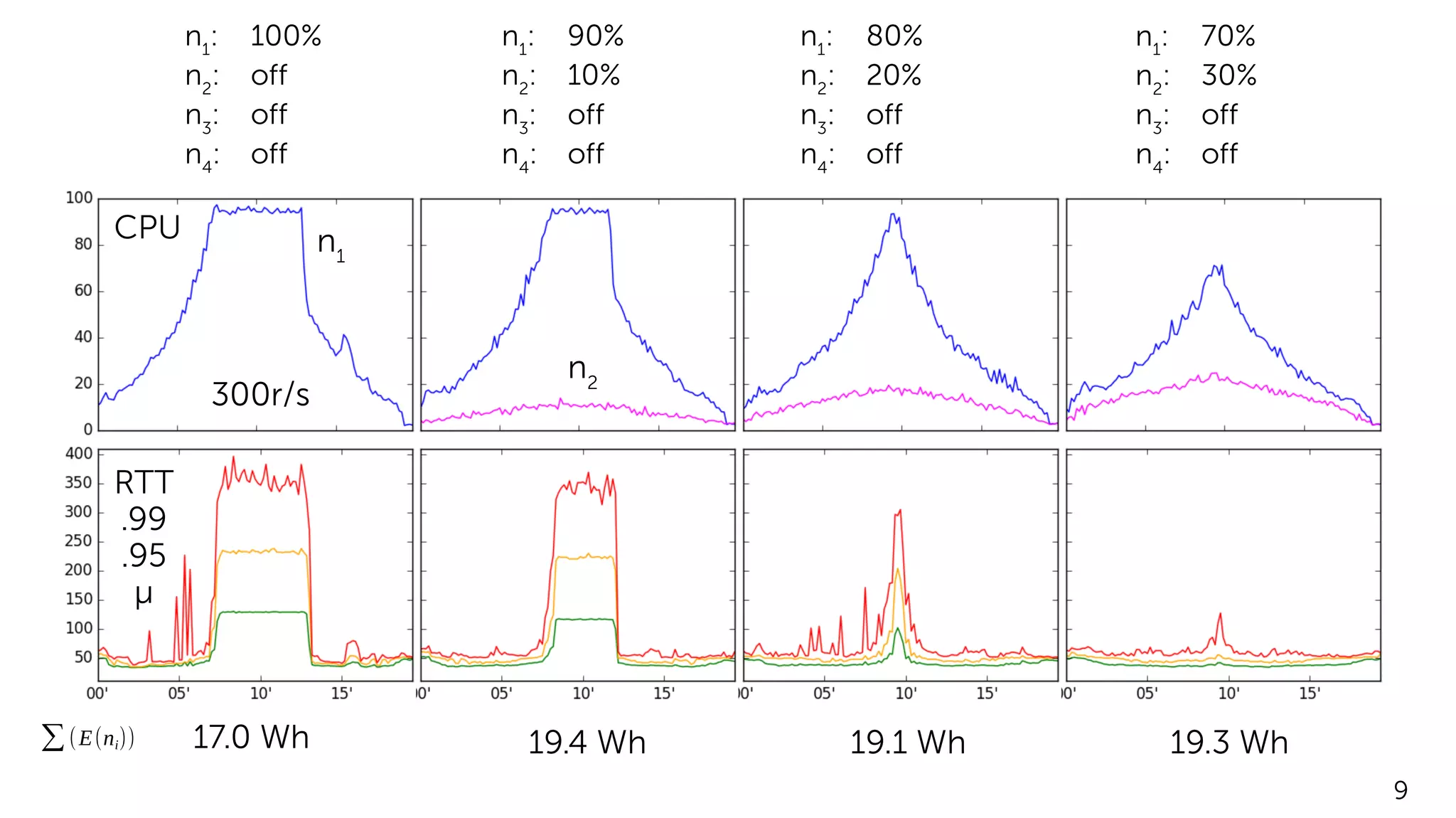
∑(E(ni)) 17.0 Wh 19.4 Wh 19.1 Wh 19.3 Wh
n1
n2
RTT
.99
.95
μ
CPU
n1
: 100%
n2
: off
n3
: off
n4
: off
n1
: 90%
n2
: 10%
n3
: off
n4
: off
n1
: 80%
n2
: 20%
n3
: off
n4
: off
n1
: 70%
n2
: 30%
n3
: off
n4
: off
300r/s
10
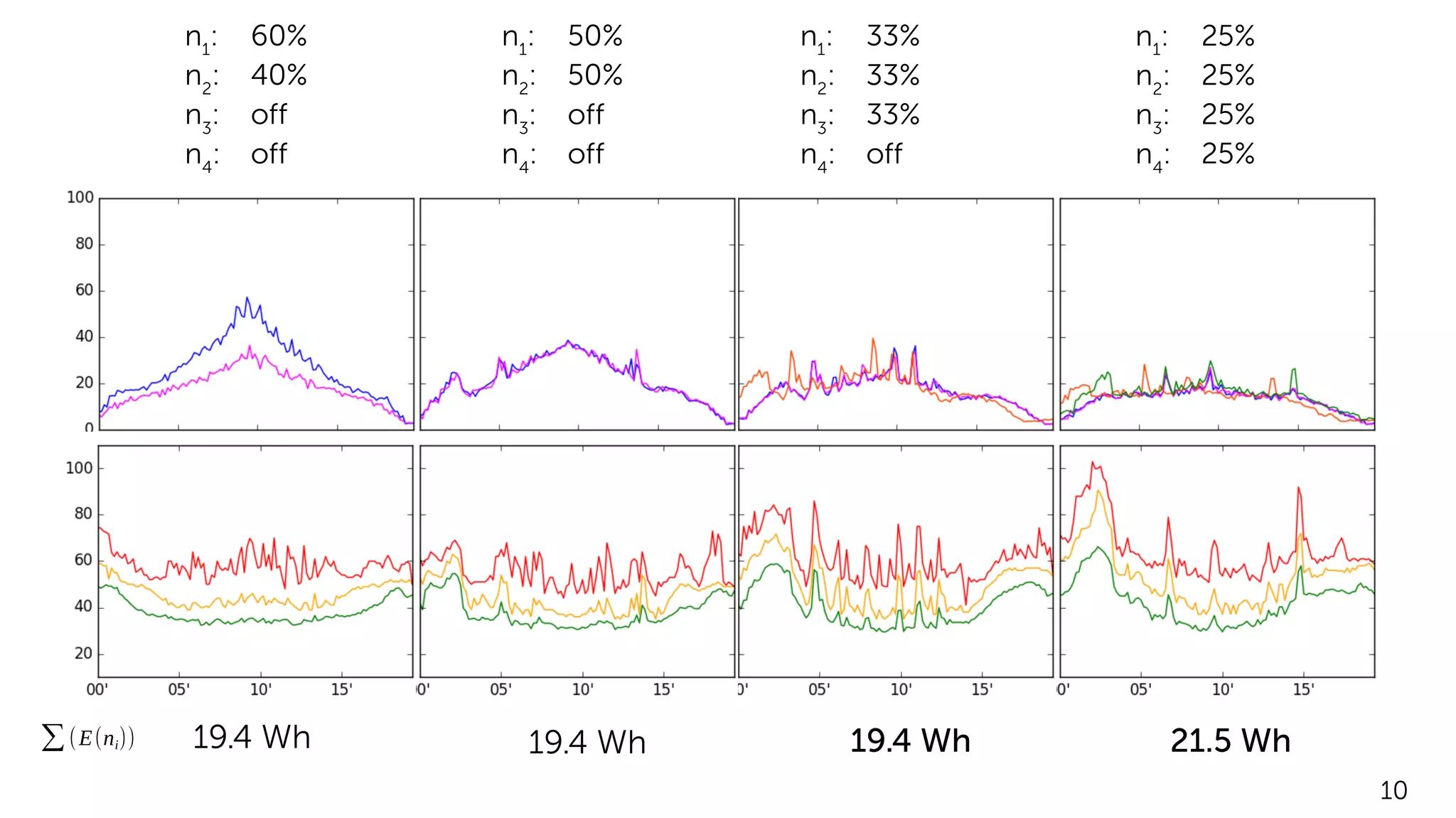
∑(E(ni)) 19.4 Wh 19.4 Wh 19.4 Wh 21.5 Wh
n1
: 60%
n2
: 40%
n3
: off
n4
: off
n1
: 50%
n2
: 50%
n3
: off
n4
: off
n1
: 33%
n2
: 33%
n3
: 33%
n4
: off
n1
: 25%
n2
: 25%
n3
: 25%
n4
: 25%
11
Conventional Wisdom
[R]ecent studies show the CPU
utilization has a linear relationship on
power consumption, when dynamic
voltage and frequency scaling is
applied.
[R]ecent studies show the CPU
utilization has a linear relationship on
power consumption, when dynamic
voltage and frequency scaling is
applied.
Farahnakian et al., 2014. Energy-Efficient Virtual Machines
Consolidation in Cloud Data Centers Using Reinforcement
Learning
Kusic et al., 2009. Power and performance management of
virtualized computing environments via lookahead control
0% 10% 20% 30% 40% 50% 60% 70% 80% 90% 100%
0
20
40
60
80
100
120
140
160
HP ProLiant G5 HP ProLiant G4
CPU (%)
W
12
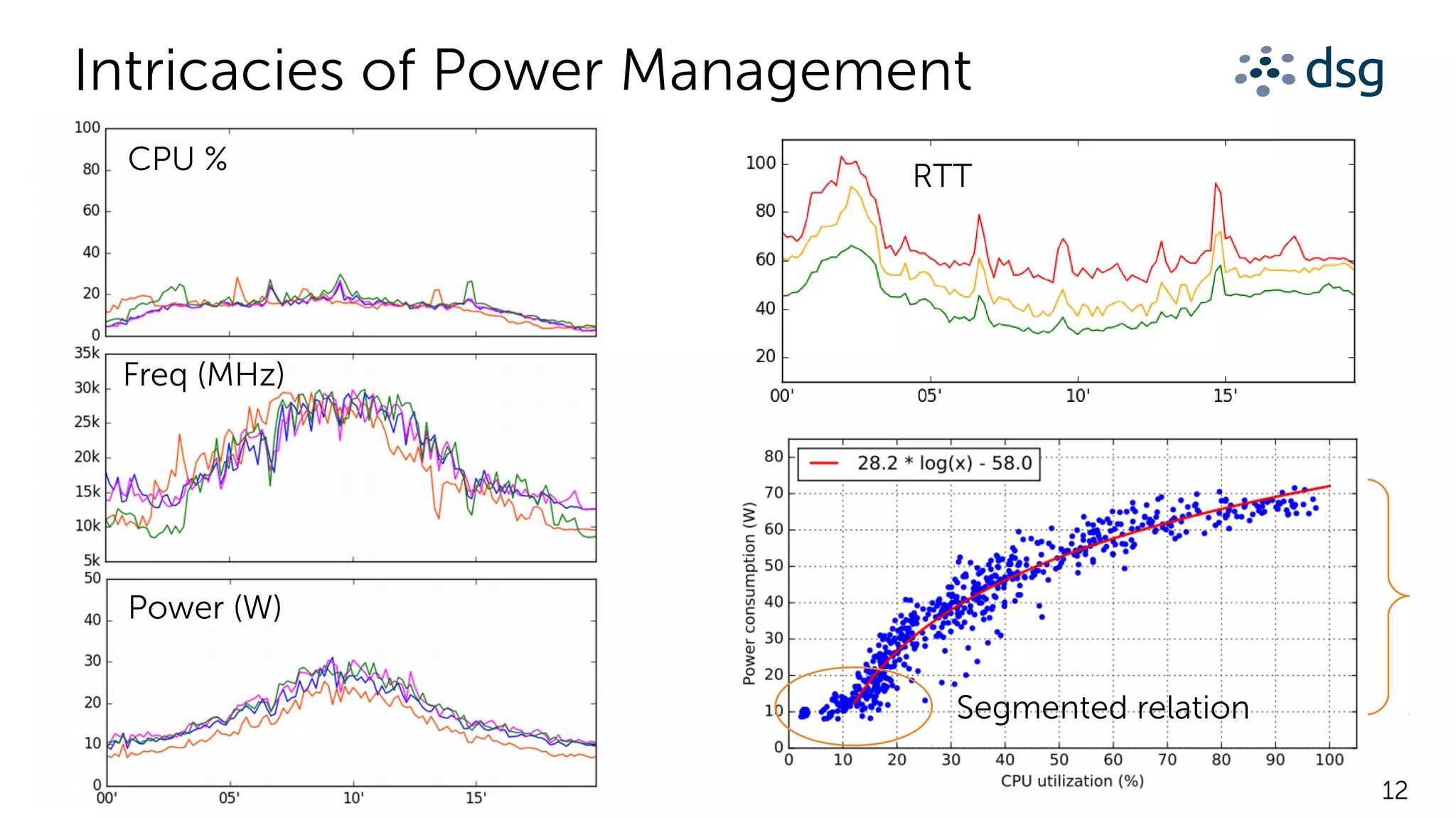
Intricacies of Power Management
CPU %
Freq (MHz)
Power (W)
RTT
Segmented relation
13
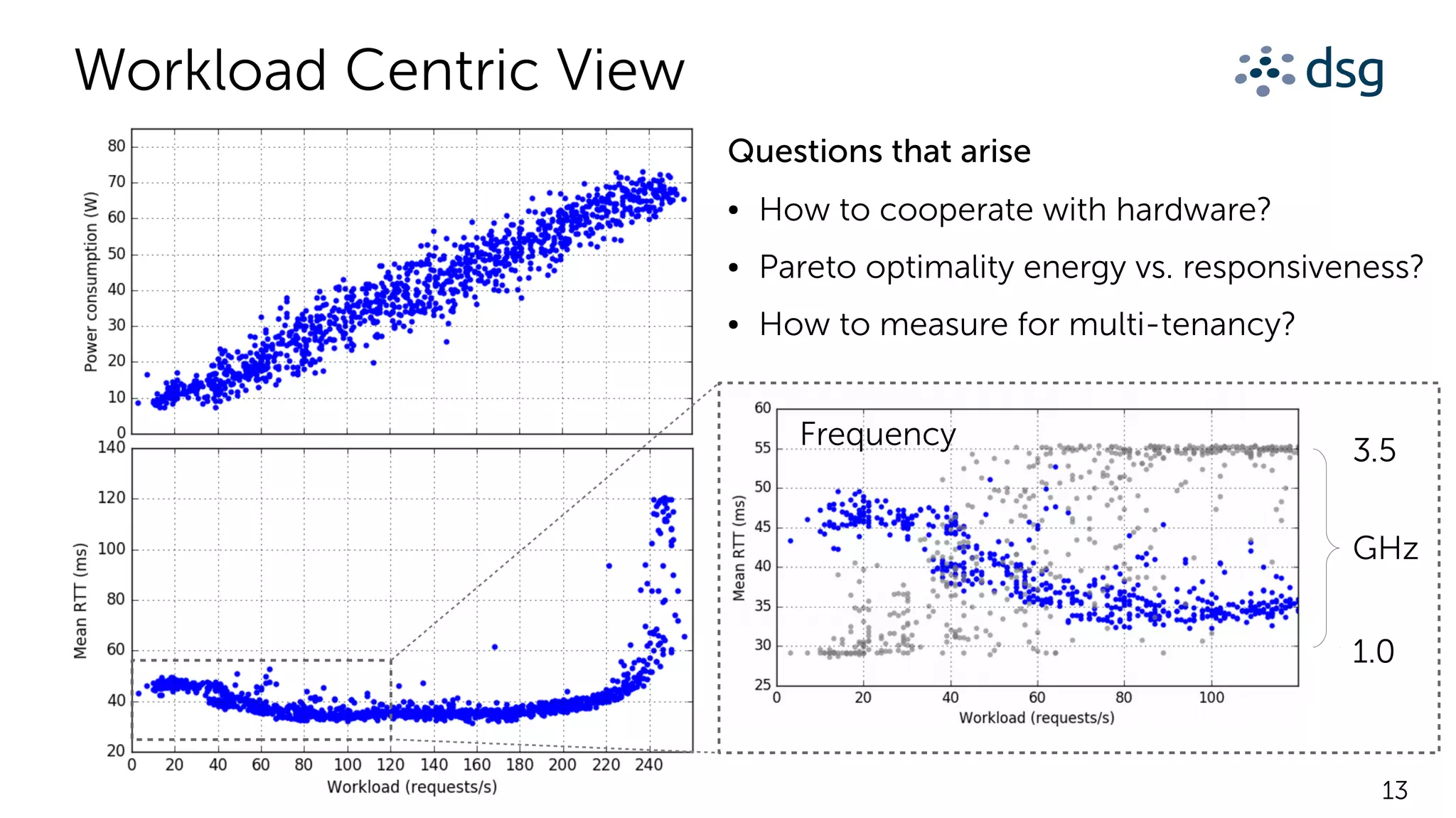
Workload Centric View
Questions that arise
● How to cooperate with hardware?
● Pareto optimality energy vs. responsiveness?
● How to measure for multi-tenancy?
Frequency
1.0
3.3.5
GHz
14
Dipl.-Ing. (MSc), BSc
Thomas Rausch
Research Assistant
TU Wien
Information Systems Engineering
Argentinierstrasse 8-194-02, Vienna, Austria
T: +43 1 58801-184838
E: trausch@dsg.tuwien.ac.at
http://dsg.tuwien.ac.at/staff/trausch

Portable Energy-Aware Cluster-Based Edge Computers

  • 1.
    Portable Energy-Aware Cluster-Based EdgeComputers Thomas Rausch, Cosmin Avasalcai, Schahram Dustdar TU Wien, Vienna Austria Distributed Systems Group http://dsg.tuwien.ac.at ACM/IEEE Symposium on Edge Computing 2018, Bellevue, WA
  • 2.
  • 3.
    3 Cloudlets for FieldworkScenarios Edge CloudIoT Lewis et al., 2014. “Tactical cloudlets: Moving cloud computing to the edge” Edge Computer Requirements ● Performance ● Portable ● Energy-Efficient ● Reliable Edge Computer Requirements ● Performance ● Portable ● Energy-Efficient ● Reliable
  • 4.
    4 Cluster-Based Edge Resources? SunModular Datacenter Ubuntu Orange Box (Intel NUC cluster) 1 Elkhatib et al., 2017, “On Using Micro-Clouds to Deliver the Fog” “Micro Clouds” 1 Server Computers SOC & Single Board Computers
  • 5.
    5 Cluster-Based Edge ComputerPrototype Motherboard ASUS P10S-I Mini-ITX CPU Intel Xeon E3-1230 (4 cores + HT) RAM 2x16GB Kingston HyperX Fury SSD Intel SSD 600p 128 GB M.2. PSU picoPSU-90 12V
  • 6.
    6 Energy-Aware Clustered EdgeComputers 1 13 3 2 2 4 4
  • 7.
    7 Examine Cluster Configurations ●Resource Utilization? ● Energy Consumption? ● System Responsiveness? SqueezeNet MXNet Model Server
  • 8.
    8 Energy Signatures ofNode Operations Offline: 2 W Shutdown: 4-6 s ~620 J Boot (WoL) Docker container with MXNet starts Average Idle: 9 W Boot: 45-48 s ~39 J E(idle(t )) = E(boot) + E(shutdown) t = ~110 s Boot Cycle
  • 9.
    9 ∑(E(ni)) 17.0 Wh19.4 Wh 19.1 Wh 19.3 Wh n1 n2 RTT .99 .95 μ CPU n1 : 100% n2 : off n3 : off n4 : off n1 : 90% n2 : 10% n3 : off n4 : off n1 : 80% n2 : 20% n3 : off n4 : off n1 : 70% n2 : 30% n3 : off n4 : off 300r/s
  • 10.
    10 ∑(E(ni)) 19.4 Wh19.4 Wh 19.4 Wh 21.5 Wh n1 : 60% n2 : 40% n3 : off n4 : off n1 : 50% n2 : 50% n3 : off n4 : off n1 : 33% n2 : 33% n3 : 33% n4 : off n1 : 25% n2 : 25% n3 : 25% n4 : 25%
  • 11.
    11 Conventional Wisdom [R]ecent studiesshow the CPU utilization has a linear relationship on power consumption, when dynamic voltage and frequency scaling is applied. [R]ecent studies show the CPU utilization has a linear relationship on power consumption, when dynamic voltage and frequency scaling is applied. Farahnakian et al., 2014. Energy-Efficient Virtual Machines Consolidation in Cloud Data Centers Using Reinforcement Learning Kusic et al., 2009. Power and performance management of virtualized computing environments via lookahead control 0% 10% 20% 30% 40% 50% 60% 70% 80% 90% 100% 0 20 40 60 80 100 120 140 160 HP ProLiant G5 HP ProLiant G4 CPU (%) W
  • 12.
    12 Intricacies of PowerManagement CPU % Freq (MHz) Power (W) RTT Segmented relation
  • 13.
    13 Workload Centric View Questionsthat arise ● How to cooperate with hardware? ● Pareto optimality energy vs. responsiveness? ● How to measure for multi-tenancy? Frequency 1.0 3.3.5 GHz
  • 14.
    14 Dipl.-Ing. (MSc), BSc ThomasRausch Research Assistant TU Wien Information Systems Engineering Argentinierstrasse 8-194-02, Vienna, Austria T: +43 1 58801-184838 E: trausch@dsg.tuwien.ac.at http://dsg.tuwien.ac.at/staff/trausch