Div : Chemical (3rd sem)
Sub : Fluid flow operation
Topic : pitot’s tube
Submitted by :
Tejas solanki– 130280105054
Submitted to : Rajula ma’m
 A pitot tube is a pressure measurement instrument
used to measure fluid flow velocity. The pitot tube was
invented by the French engineer Henri Pitot in the
early 18th century and was modified to its modern form
in the mid-19th century by French scientist Henry
Darcy. It is widely used to determine the airspeed of
an aircraft, water speed of a boat, and to measure
liquid, air and gas velocities in industrial applications.
The pitot tube is used to measure the local velocity at a
given point in the flow stream and not the average
velocity in the pipe or conduit.
 The basic pitot tube consists of a tube pointing directly
into the fluid flow. As this tube contains fluid, a pressure
can be measured; the moving fluid is brought to rest
(stagnates) as there is no outlet to allow flow to continue.
This pressure is the stagnation pressure of the fluid, also
known as the total pressure or (particularly in aviation)
the pitot pressure.
 The liquid flows up the tube and when equilibrium is
attained, the liquid reaches a height above the free
surface of the water stream.
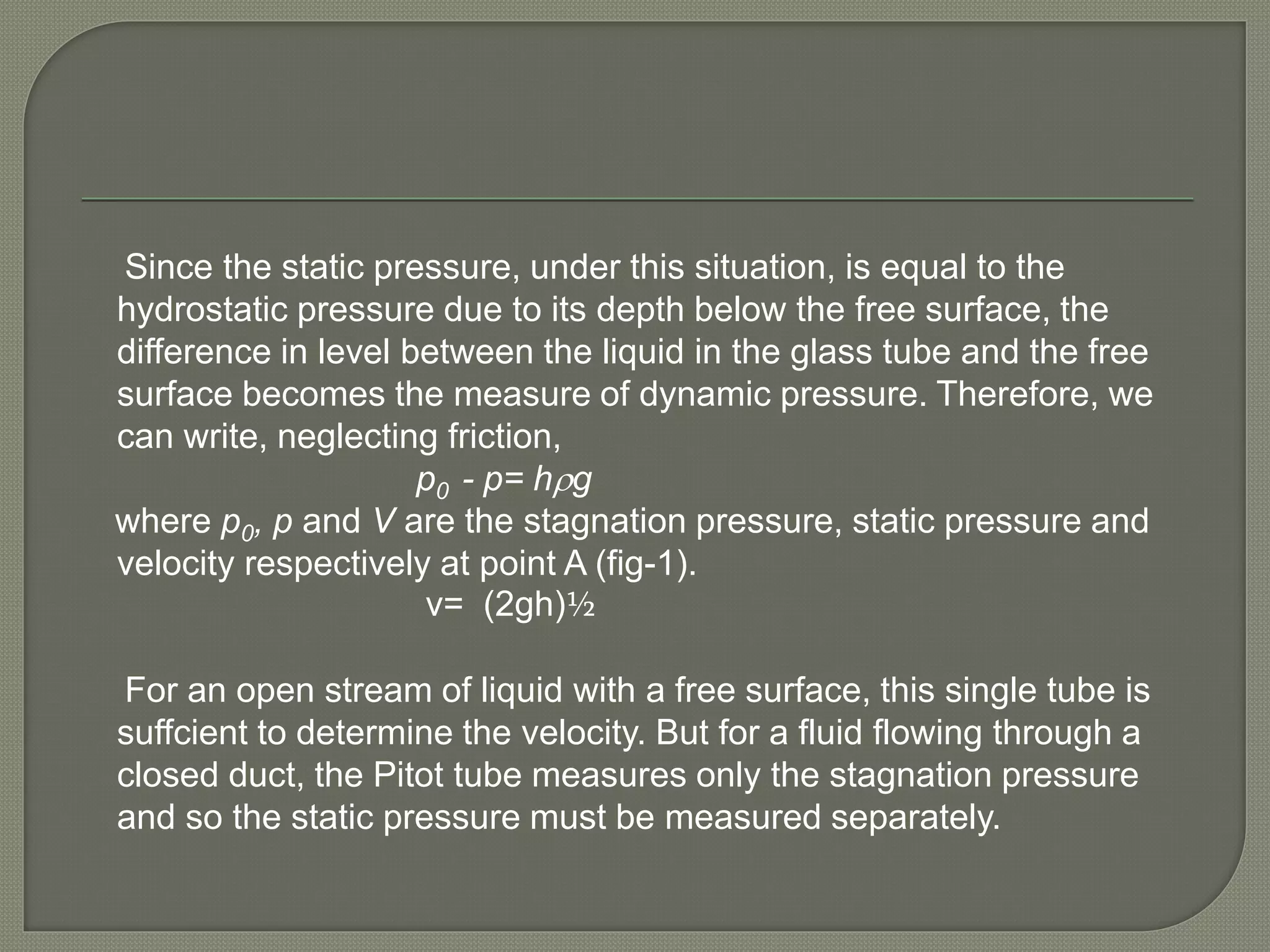
Since the static pressure, under this situation, is equal to the
hydrostatic pressure due to its depth below the free surface, the
difference in level between the liquid in the glass tube and the free
surface becomes the measure of dynamic pressure. Therefore, we
can write, neglecting friction,
p0 - p= hg
where p0, p and V are the stagnation pressure, static pressure and
velocity respectively at point A (fig-1).
v= (2gh)½
For an open stream of liquid with a free surface, this single tube is
suffcient to determine the velocity. But for a fluid flowing through a
closed duct, the Pitot tube measures only the stagnation pressure
and so the static pressure must be measured separately.
 Measurement of static pressure in this case is made at the
boundary of the wall (Fig. 16.3b). The axis of the tube
measuring the static pressure must be perpendicular to the
boundary and free from burrs, so that the boundary is smooth
and hence the streamlines adjacent to it are not curved. This is
done to sense the static pressure only without any part of the
dynamic pressure.
 A Pitot tube is also inserted as shown (Fig.-2) to sense the
stagnation pressure. The ends of the Pitot tube, measuring the
stagnation pressure, and the piezometric tube, measuring the
static pressure, may be connected to a suitable differential
manometer for the determination of flow velocity and hence
the flow rate.
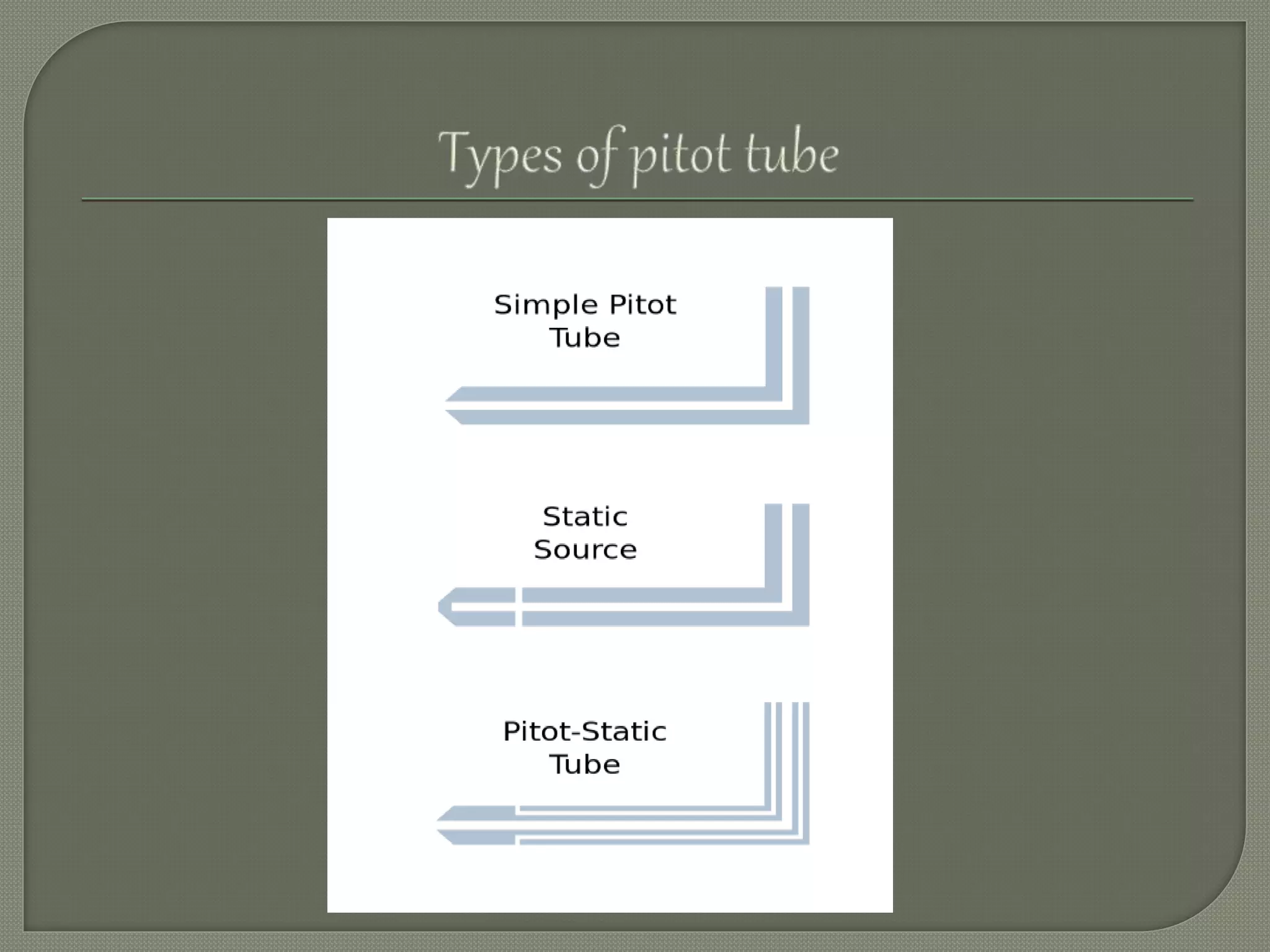
 A pitot tube is simply a small cylinder that faces a
fluid so that the fluid can enter it. Because the
cylinder is open on one side and enclosed on the
other, fluid entering it cannot flow any further and
comes to a rest inside of the device. A diaphragm
inside of the pitot tube separates the incoming
pressure (static pressure) from the stagnation
pressure (total pressure) of a system. The
difference between these two measurements
determines the fluid’s rate of flow.
 In industry, the velocities being measured are often
those flowing in ducts and tubing where
measurements by an anemometer would be
difficult to obtain. In these kinds of measurements,
the most practical instrument to use is the pitot
tube. The pitot tube can be inserted through a
small hole in the duct with the pitot connected to a
U-tube water gauge or some other
differential pressure gauge for determining the
velocity inside the ducted wind tunnel. One use of
this technique is to determine the volume of air that
is being delivered to a conditioned space.
 Advantages:
Pitot tubes measure pressure levels in a fluid. They do not
contain any moving parts and routine use does not easily
damage them. Also, pitot tubes are small and can be used in
tight spaces that other devices cannot fit into.
 Disadvantages:
Foreign material in a fluid can easily clog pitot tubes and
disrupt normal readings as a result. This is a major problem
that has already caused several aircraft to crash and many more
to make emergency landings.
Pitot tube

Pitot tube

  • 1.
    Div : Chemical(3rd sem) Sub : Fluid flow operation Topic : pitot’s tube Submitted by : Tejas solanki– 130280105054 Submitted to : Rajula ma’m
  • 3.
     A pitottube is a pressure measurement instrument used to measure fluid flow velocity. The pitot tube was invented by the French engineer Henri Pitot in the early 18th century and was modified to its modern form in the mid-19th century by French scientist Henry Darcy. It is widely used to determine the airspeed of an aircraft, water speed of a boat, and to measure liquid, air and gas velocities in industrial applications. The pitot tube is used to measure the local velocity at a given point in the flow stream and not the average velocity in the pipe or conduit.
  • 6.
     The basicpitot tube consists of a tube pointing directly into the fluid flow. As this tube contains fluid, a pressure can be measured; the moving fluid is brought to rest (stagnates) as there is no outlet to allow flow to continue. This pressure is the stagnation pressure of the fluid, also known as the total pressure or (particularly in aviation) the pitot pressure.  The liquid flows up the tube and when equilibrium is attained, the liquid reaches a height above the free surface of the water stream.
  • 7.
    Since the staticpressure, under this situation, is equal to the hydrostatic pressure due to its depth below the free surface, the difference in level between the liquid in the glass tube and the free surface becomes the measure of dynamic pressure. Therefore, we can write, neglecting friction, p0 - p= hg where p0, p and V are the stagnation pressure, static pressure and velocity respectively at point A (fig-1). v= (2gh)½ For an open stream of liquid with a free surface, this single tube is suffcient to determine the velocity. But for a fluid flowing through a closed duct, the Pitot tube measures only the stagnation pressure and so the static pressure must be measured separately.
  • 8.
     Measurement ofstatic pressure in this case is made at the boundary of the wall (Fig. 16.3b). The axis of the tube measuring the static pressure must be perpendicular to the boundary and free from burrs, so that the boundary is smooth and hence the streamlines adjacent to it are not curved. This is done to sense the static pressure only without any part of the dynamic pressure.  A Pitot tube is also inserted as shown (Fig.-2) to sense the stagnation pressure. The ends of the Pitot tube, measuring the stagnation pressure, and the piezometric tube, measuring the static pressure, may be connected to a suitable differential manometer for the determination of flow velocity and hence the flow rate.
  • 10.
     A pitottube is simply a small cylinder that faces a fluid so that the fluid can enter it. Because the cylinder is open on one side and enclosed on the other, fluid entering it cannot flow any further and comes to a rest inside of the device. A diaphragm inside of the pitot tube separates the incoming pressure (static pressure) from the stagnation pressure (total pressure) of a system. The difference between these two measurements determines the fluid’s rate of flow.
  • 11.
     In industry,the velocities being measured are often those flowing in ducts and tubing where measurements by an anemometer would be difficult to obtain. In these kinds of measurements, the most practical instrument to use is the pitot tube. The pitot tube can be inserted through a small hole in the duct with the pitot connected to a U-tube water gauge or some other differential pressure gauge for determining the velocity inside the ducted wind tunnel. One use of this technique is to determine the volume of air that is being delivered to a conditioned space.
  • 12.
     Advantages: Pitot tubesmeasure pressure levels in a fluid. They do not contain any moving parts and routine use does not easily damage them. Also, pitot tubes are small and can be used in tight spaces that other devices cannot fit into.  Disadvantages: Foreign material in a fluid can easily clog pitot tubes and disrupt normal readings as a result. This is a major problem that has already caused several aircraft to crash and many more to make emergency landings.