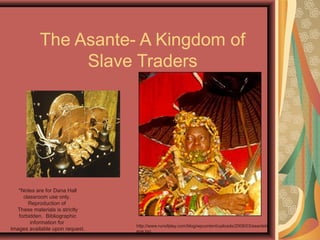
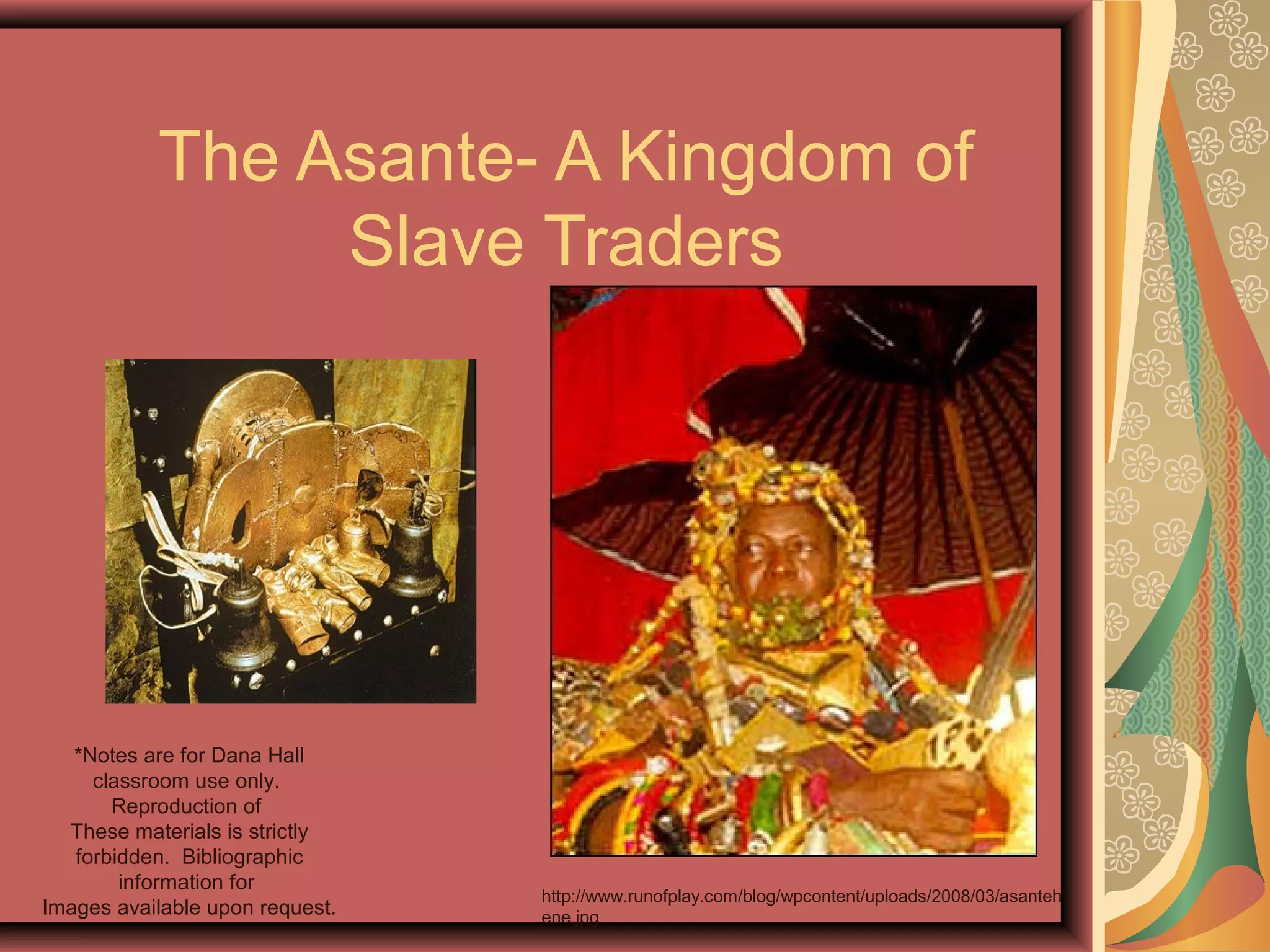
The Asante- A Kingdom of
Slave Traders
*Notes are for Dana Hall
classroom use only.
Reproduction of
These materials is strictly
forbidden. Bibliographic
information for
Images available upon request.
http://www.runofplay.com/blog/wpcontent/uploads/2008/03/asanteh
ene.jpg
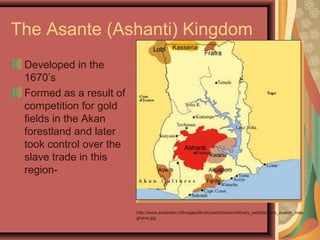
The Asante (Ashanti) Kingdom
Developed in the
1670’s
Formed as a result of
competition for gold
fields in the Akan
forestland and later
took control over the
slave trade in this
region-
http://www.ascleiden.nl/Images/library/webdossiers/library_webdossiers_asante_map
ghana.jpg
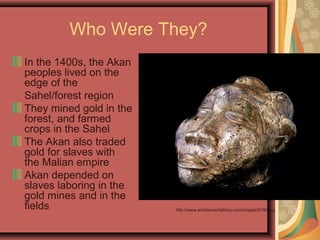
Who Were They?
In the 1400s, the Akan
peoples lived on the
edge of the
Sahel/forest region
They mined gold in the
forest, and farmed
crops in the Sahel
The Akan also traded
gold for slaves with
the Malian empire
Akan depended on
slaves laboring in the
gold mines and in the
fields http://www.artofancientafrica.com/images/0190.jpg
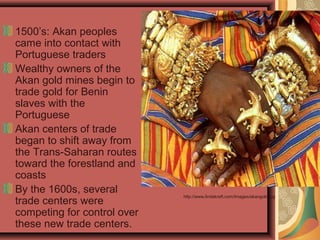
1500’s: Akan peoples
came into contact with
Portuguese traders
Wealthy owners of the
Akan gold mines begin to
trade gold for Benin
slaves with the
Portuguese
Akan centers of trade
began to shift away from
the Trans-Saharan routes
toward the forestland and
coasts
By the 1600s, several
trade centers were
competing for control over
these new trade centers.
http://www.lindakreft.com/Images/akangold.jpg
Osei Tutu: Founder of the
Asante Kingdom
1670’s: Osei Tutu was a
military leader and head of
the Oyoko clan of the Akan
peoples
Took control over a trade
center near Kumasi and
established this as his
capital city
Conquered the neighboring
chiefdoms and took control
of their trade
Took the title of
ASANTEHENE
Collected taxes from the
chiefdoms on profits from
the gold mines
Built a standing army by
demanding that chiefdoms
provide soldiers
Sought the support of
religious leaders
throughout the region
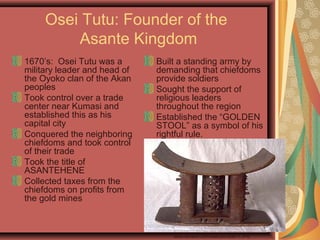
Established the “GOLDEN
STOOL” as a symbol of his
rightful rule.
www.tamarin.com/seat-pic/seat11.JPG
The Golden Stool
Osei Tutu told the Akan peoples that the Golden Stool
had been sent to him by the gods
The safety and success of these people was
dependent upon protection of the stool and the
Asantehene
Akan peoples become Asante (Ashanti)
Osei Tutu develops an Asante culture complete with
new traditions, festivals and histories (Clan histories
were outlawed)
By 1700, Osei Tutu controlled most of the gold fields
of the Akan forestland
http://newsimg.bbc.co.uk/media/images/39882000/jpg/_39882008_goldenstool203.jpg
The Continuance of the Asante
Osei Tutu was succeeded
by Opoku Ware (1717-
1750)
During his rule, he will
extend the Asante kingdom
to include most of what is
today present-day Ghana
Opoku Ware will
participate in the slave
trade with the Europeans,
selling war captives and
growing very wealthy
Asante were one of the last
great kingdoms to fall to
the Europeans in the late
19th
century.
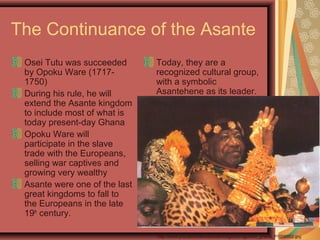
Today, they are a
recognized cultural group,
with a symbolic
Asantehene as its leader.
http://www.jmu.edu/international/images/progphoto_ghana_P7000002.jpg

The Asante Kingdom

  • 1.
    The Asante- AKingdom of Slave Traders *Notes are for Dana Hall classroom use only. Reproduction of These materials is strictly forbidden. Bibliographic information for Images available upon request. http://www.runofplay.com/blog/wpcontent/uploads/2008/03/asanteh ene.jpg
  • 2.
    The Asante (Ashanti)Kingdom Developed in the 1670’s Formed as a result of competition for gold fields in the Akan forestland and later took control over the slave trade in this region- http://www.ascleiden.nl/Images/library/webdossiers/library_webdossiers_asante_map ghana.jpg
  • 3.
    Who Were They? Inthe 1400s, the Akan peoples lived on the edge of the Sahel/forest region They mined gold in the forest, and farmed crops in the Sahel The Akan also traded gold for slaves with the Malian empire Akan depended on slaves laboring in the gold mines and in the fields http://www.artofancientafrica.com/images/0190.jpg
  • 4.
    1500’s: Akan peoples cameinto contact with Portuguese traders Wealthy owners of the Akan gold mines begin to trade gold for Benin slaves with the Portuguese Akan centers of trade began to shift away from the Trans-Saharan routes toward the forestland and coasts By the 1600s, several trade centers were competing for control over these new trade centers. http://www.lindakreft.com/Images/akangold.jpg
  • 5.
    Osei Tutu: Founderof the Asante Kingdom 1670’s: Osei Tutu was a military leader and head of the Oyoko clan of the Akan peoples Took control over a trade center near Kumasi and established this as his capital city Conquered the neighboring chiefdoms and took control of their trade Took the title of ASANTEHENE Collected taxes from the chiefdoms on profits from the gold mines Built a standing army by demanding that chiefdoms provide soldiers Sought the support of religious leaders throughout the region Established the “GOLDEN STOOL” as a symbol of his rightful rule. www.tamarin.com/seat-pic/seat11.JPG
  • 6.
    The Golden Stool OseiTutu told the Akan peoples that the Golden Stool had been sent to him by the gods The safety and success of these people was dependent upon protection of the stool and the Asantehene Akan peoples become Asante (Ashanti) Osei Tutu develops an Asante culture complete with new traditions, festivals and histories (Clan histories were outlawed) By 1700, Osei Tutu controlled most of the gold fields of the Akan forestland http://newsimg.bbc.co.uk/media/images/39882000/jpg/_39882008_goldenstool203.jpg
  • 7.
    The Continuance ofthe Asante Osei Tutu was succeeded by Opoku Ware (1717- 1750) During his rule, he will extend the Asante kingdom to include most of what is today present-day Ghana Opoku Ware will participate in the slave trade with the Europeans, selling war captives and growing very wealthy Asante were one of the last great kingdoms to fall to the Europeans in the late 19th century. Today, they are a recognized cultural group, with a symbolic Asantehene as its leader. http://www.jmu.edu/international/images/progphoto_ghana_P7000002.jpg