
The Songhai Empire
An African Empire in the 15th century
Songhai Empire
The Songhai Empire was originally situated in Africa,
northwest of Nigeria, but it later relocated to
western Sudan (Andambi, 2011).
It was the third of the great kingdom of West Africa,
established at Gao, near the bend of the Niger River.
The Songhai Empire was established in 1463 from the 15th to
16th century and it was one of the largest empires in history
(Caleb, 2011).
At that time, industry, trade, art, education, culture and trade
flourished. Much of the gold and salt trade across West Africa
was controlled by Songhai.
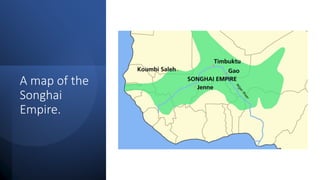
A map of the
Songhai
Empire.
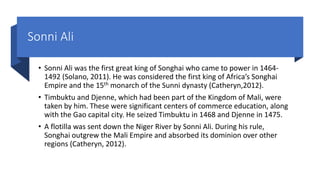
Sonni Ali
• Sonni Ali was the first great king of Songhai who came to power in 1464-
1492 (Solano, 2011). He was considered the first king of Africa’s Songhai
Empire and the 15th monarch of the Sunni dynasty (Catheryn,2012).
• Timbuktu and Djenne, which had been part of the Kingdom of Mali, were
taken by him. These were significant centers of commerce education, along
with the Gao capital city. He seized Timbuktu in 1468 and Djenne in 1475.
• A flotilla was sent down the Niger River by Sonni Ali. During his rule,
Songhai outgrew the Mali Empire and absorbed its dominion over other
regions (Catheryn, 2012).
Sonni Ali continuation
He was called a despot who was intolerant. His conquests were greater than those
of Western Europe and the largest in the history of Africa (Classtorremar, 2012).
When he took control of the city of Timbuktu, he massacred hundreds of people.
Sonni Ali is remembered as a powerful leader in the oral traditions of Songhai. He
established a centralized administration, divided the empire into provinces, each
with its own governor and also reorgarnized the army hence he was considered a
brilliant administrator.
Hewanted to reinstate the presence of African culture in all aspects of the empire,
including tradition, education, and religion.
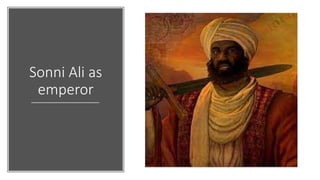
Sonni Ali as
emperor
Religion
• Sonni Ali was only nominally a Muslim. The majority of his people were still
practicing their old religion and keeping in touch with their ancestors despite not
having converted to Islam. He accepted and tolerated the African Indigenous
religion.
• This implied that women had a lot more freedom than they did in conservative
Muslim societies. They interacted with the males and were exempt from covering
their faces.
• The only place in Songhai that took Muslim serious was the royal house in Gao
because it had converted to Muslim in the 11th century and to be able to gain
access to the major trade routes it was essential for you to be a Muslim.
Askia Mohammed
• In 1492, Sonni Ali died, his son took over the empire but unfortunately lost the
throne to Askia Mohammed (Catheryn, 2012).
• In 1493, Askia Mohammed took over Songhai. He created a new system of laws
and taxation, increased the military, promoted education and encouraged
learning.
• Askia Mohammed was a very religious Muslim, he used his power to spread
Muslim within the empire (Solano, 2011).
• He constructed his power by encouraging scholars and traders who were Muslim
to come to Songhai
Askia Mohammed cont
• During his reign:
-He took control of the gold mines to the south and the salt mines to the
north.
-The trans-Saharan trade developed.
-Timbuktu developed and became a commercial and cultural centre.
-He organized the tax system and improved the government system.
-Peace, stability and growth was brought to the Songhai empire.
-He encouraged literacy and learning (Classtorremar, 2012).
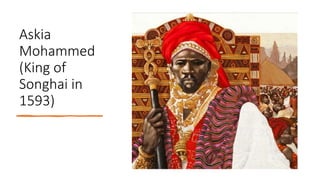
Askia
Mohammed
(King of
Songhai in
1593)
Travel and
Trade
Timbuktu, Gao and Djenne were the three main
trading centers in Songhai and the routes to
these centres were protected by the army.
Jewish, Arab and Italian merchants all came together
to buy kola nuts, salt, slaves and gold in exchange for
imported horses, textiles and luxury goods. The main
goods of trade across Sahara was gold and slaves.
Education was flourishing that time therefore
there was a great demand of books and people
paid using huge amount of gold for books.
Askia Mohammed appointed an inspector at
each trading center and instituted a uniform
system of weights and measures to regulate
trade.
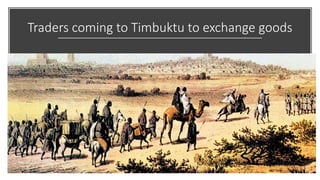
Traders coming to Timbuktu to exchange goods
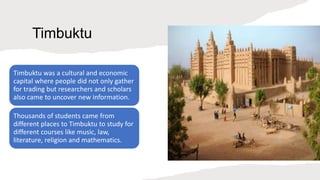
Timbuktu
Timbuktu was a cultural and economic
capital where people did not only gather
for trading but researchers and scholars
also came to uncover new information.
Thousands of students came from
different places to Timbuktu to study for
different courses like music, law,
literature, religion and mathematics.
The Fall of Songhai Empire
In 1538, Askia Mohammed died. After his death, the empire started
to decline and lost control of its huge areas of land.
A civil war broke out in the late 16th century and the empire also
became less powerful because of diseases and drought.
In 1591, the Moroccan army invaded the Songhai empire because it
wanted to take control of the gold trade in the commercial centres.
Songhai was defeated and the Moroccan army took control over
Timbuktu.
THE END
REFERENCE LIST
Andambi, K. (2011). Songhai Presentation. Available from slideshare at
https://www.slideshare.net/kevinandambi/songhai-yoooo?qid=f020c816-b491-4ccc-b03f-
047fcca9938d&v=&b=&from_search=4 (Accessed 19 August 2022).
Caleb, N. (2011). Africa’s blood diamonds. Available from slideshare at
https://www.slideshare.net/Nicolecaleb18/africas-blood-diamonds?qid=210c4fd8-6fbf-4cec-8a9e-
72b7de816d1f&v=&b=&from_search=3 (Accessed 19 August 2022).
Catheryn, L. (2012). Kingdom of Songhai. Available from slideshare at
https://www.slideshare.net/lykacatheryn/kingdom-of-songhai (Accessed 19 August 2022).
Classtorremar, SS. (2012). Songhai. Available from slideshare at
https://www.slideshare.net/ssclasstorremar/songhai-12935973?qid=8a8617b7-dee5-4981-b789-
0380b174ff34&v=&b=&from_search=8 (Accessed 19 August 2022).
Solano, J. (2011). (Social) African Civilization B. Available from slideshare at
https://www.slideshare.net/justinesolano/social-african-civilization-b?qid=f41144fc-c2aa-4bf5-
b489-5c391c1ec58c&v=&b=&from_search=5 (Accessed 19 August 2022).

The Songhai Empire.pptx

  • 1.
    The Songhai Empire AnAfrican Empire in the 15th century
  • 2.
    Songhai Empire The SonghaiEmpire was originally situated in Africa, northwest of Nigeria, but it later relocated to western Sudan (Andambi, 2011). It was the third of the great kingdom of West Africa, established at Gao, near the bend of the Niger River. The Songhai Empire was established in 1463 from the 15th to 16th century and it was one of the largest empires in history (Caleb, 2011). At that time, industry, trade, art, education, culture and trade flourished. Much of the gold and salt trade across West Africa was controlled by Songhai.
  • 3.
    A map ofthe Songhai Empire.
  • 4.
    Sonni Ali • SonniAli was the first great king of Songhai who came to power in 1464- 1492 (Solano, 2011). He was considered the first king of Africa’s Songhai Empire and the 15th monarch of the Sunni dynasty (Catheryn,2012). • Timbuktu and Djenne, which had been part of the Kingdom of Mali, were taken by him. These were significant centers of commerce education, along with the Gao capital city. He seized Timbuktu in 1468 and Djenne in 1475. • A flotilla was sent down the Niger River by Sonni Ali. During his rule, Songhai outgrew the Mali Empire and absorbed its dominion over other regions (Catheryn, 2012).
  • 5.
    Sonni Ali continuation Hewas called a despot who was intolerant. His conquests were greater than those of Western Europe and the largest in the history of Africa (Classtorremar, 2012). When he took control of the city of Timbuktu, he massacred hundreds of people. Sonni Ali is remembered as a powerful leader in the oral traditions of Songhai. He established a centralized administration, divided the empire into provinces, each with its own governor and also reorgarnized the army hence he was considered a brilliant administrator. Hewanted to reinstate the presence of African culture in all aspects of the empire, including tradition, education, and religion.
  • 6.
  • 7.
    Religion • Sonni Aliwas only nominally a Muslim. The majority of his people were still practicing their old religion and keeping in touch with their ancestors despite not having converted to Islam. He accepted and tolerated the African Indigenous religion. • This implied that women had a lot more freedom than they did in conservative Muslim societies. They interacted with the males and were exempt from covering their faces. • The only place in Songhai that took Muslim serious was the royal house in Gao because it had converted to Muslim in the 11th century and to be able to gain access to the major trade routes it was essential for you to be a Muslim.
  • 8.
    Askia Mohammed • In1492, Sonni Ali died, his son took over the empire but unfortunately lost the throne to Askia Mohammed (Catheryn, 2012). • In 1493, Askia Mohammed took over Songhai. He created a new system of laws and taxation, increased the military, promoted education and encouraged learning. • Askia Mohammed was a very religious Muslim, he used his power to spread Muslim within the empire (Solano, 2011). • He constructed his power by encouraging scholars and traders who were Muslim to come to Songhai
  • 9.
    Askia Mohammed cont •During his reign: -He took control of the gold mines to the south and the salt mines to the north. -The trans-Saharan trade developed. -Timbuktu developed and became a commercial and cultural centre. -He organized the tax system and improved the government system. -Peace, stability and growth was brought to the Songhai empire. -He encouraged literacy and learning (Classtorremar, 2012).
  • 10.
  • 11.
    Travel and Trade Timbuktu, Gaoand Djenne were the three main trading centers in Songhai and the routes to these centres were protected by the army. Jewish, Arab and Italian merchants all came together to buy kola nuts, salt, slaves and gold in exchange for imported horses, textiles and luxury goods. The main goods of trade across Sahara was gold and slaves. Education was flourishing that time therefore there was a great demand of books and people paid using huge amount of gold for books. Askia Mohammed appointed an inspector at each trading center and instituted a uniform system of weights and measures to regulate trade.
  • 12.
    Traders coming toTimbuktu to exchange goods
  • 13.
    Timbuktu Timbuktu was acultural and economic capital where people did not only gather for trading but researchers and scholars also came to uncover new information. Thousands of students came from different places to Timbuktu to study for different courses like music, law, literature, religion and mathematics.
  • 14.
    The Fall ofSonghai Empire In 1538, Askia Mohammed died. After his death, the empire started to decline and lost control of its huge areas of land. A civil war broke out in the late 16th century and the empire also became less powerful because of diseases and drought. In 1591, the Moroccan army invaded the Songhai empire because it wanted to take control of the gold trade in the commercial centres. Songhai was defeated and the Moroccan army took control over Timbuktu.
  • 15.
  • 16.
    REFERENCE LIST Andambi, K.(2011). Songhai Presentation. Available from slideshare at https://www.slideshare.net/kevinandambi/songhai-yoooo?qid=f020c816-b491-4ccc-b03f- 047fcca9938d&v=&b=&from_search=4 (Accessed 19 August 2022). Caleb, N. (2011). Africa’s blood diamonds. Available from slideshare at https://www.slideshare.net/Nicolecaleb18/africas-blood-diamonds?qid=210c4fd8-6fbf-4cec-8a9e- 72b7de816d1f&v=&b=&from_search=3 (Accessed 19 August 2022). Catheryn, L. (2012). Kingdom of Songhai. Available from slideshare at https://www.slideshare.net/lykacatheryn/kingdom-of-songhai (Accessed 19 August 2022). Classtorremar, SS. (2012). Songhai. Available from slideshare at https://www.slideshare.net/ssclasstorremar/songhai-12935973?qid=8a8617b7-dee5-4981-b789- 0380b174ff34&v=&b=&from_search=8 (Accessed 19 August 2022). Solano, J. (2011). (Social) African Civilization B. Available from slideshare at https://www.slideshare.net/justinesolano/social-african-civilization-b?qid=f41144fc-c2aa-4bf5- b489-5c391c1ec58c&v=&b=&from_search=5 (Accessed 19 August 2022).