King Faisal University   College of Clinical Pharmacy
Angina Pectoris   By  Taher Haddad
No interruption  Speaking during the presentation  (NOT ALLOWED) Note down your comments & questions There will be time for comments & questions Before Getting Started Think & act scientifically
1- Case History with Treatment 2- Definition (what is angina?) 3- Types of Angina 4- Pathophysiology 5- Clinical Presentation 6- Diagnosis (with Tests and Procedures) 7- Goals of Treatment  8- Drug Therapy and Other Measures  Outlines
Case History An 80 years old saudi female, non-smoker, D.M. HTN, dyslipidemic, with no previous chest pain, presented with severe shortness of breath & chest tightness. Condition started about 1 month ago, gradually: cough & expectoration of whitish sputum (no hemoptysis). One day before admission she's severly dyspnic & distressed. Drug history only NSAIDs. On ICCU admission: fully conscious & oriented.  From a patient file in king Saud Medical Complex, Riyadh
Result indicated that she had angina, and according to that result, she started receiving the following regimen: Carvidelol  12.5 BID Capoten  12.5 BID ASA  81 mg OD Atorva  500 mg BID  Omeprazole  20 mg OD Iron  200 mg BID Multivitamin  OD Syp lactoluse  15 ml PO Treatment for The Case From a patient file in king Saud Medical Complex, Riyadh
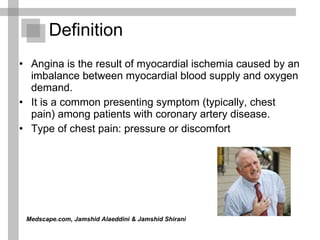
Definition Angina is the result of myocardial ischemia caused by an imbalance between myocardial blood supply and oxygen demand.  It is a common presenting symptom (typically, chest pain) among patients with coronary artery disease. Type of chest pain: pressure or discomfort  Medscape.com, Jamshid Alaeddini & Jamshid Shirani
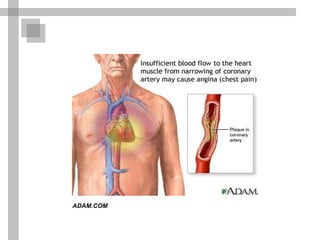
ADAM.COM
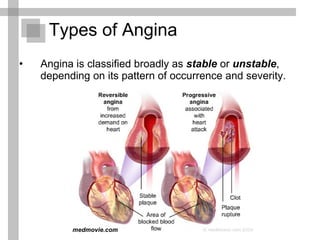
Types of Angina Angina is classified broadly as  stable  or  unstable , depending on its pattern of occurrence and severity.  medmovie.com
Stable angina  occurs when increased physical activity (e.g., hurrying across a street or climbing a long stairs) which creates a greater demand for oxygen-rich blood to reach heart tissue.  Unstable angina  occurs with lesser degrees of exertion or while at rest. Unstable angina that occurs at rest is the most serious form. This type usually is caused by the formation of a blood clot at the site of a ruptured plaque in a coronary artery.   Types of Angina (cont.) Healthcommunities.com (cardiologychannel)   2009
Pathophysiology  Myocardial ischemia develops when coronary blood flow becomes inadequate to meet myocardial oxygen demand. This causes myocardial cells to switch from   aerobic  to  anaerobic  metabolism, with a progressive impairment of metabolic, mechanical, and electrical functions.  Studies have shown that  adenosine   may be  the main chemical mediator of anginal pain. During ischemia, ATP is degraded to adenosine, which, after diffusion to the extracellular space, causes arteriolar dilation and anginal pain.  Medscape.com, Jamshid Alaeddini & Jamshid Shirani
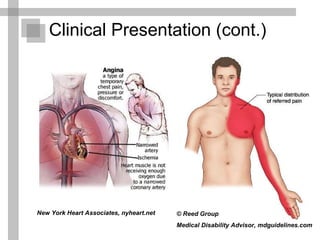
Clinical Presentation Angina is a symptom of ischemic heart disease (IHD). Episodes of stable angina typically are brought on by exertion or emotion and are relieved with rest. An attack of stable angina lasts from 1 to 5 minutes and is described as  - squeezing,  - choking, - smothering, or  - crushing pressure in the chest.  Angina pain may radiate to the shoulders, arms, back, neck, or jaw. Patients with atherosclerosis also may experience sweating, clamminess, shortness of breath (dyspnea). Healthcommunities.com (cardiologychannel)   2009
Clinical Presentation (cont.) © Reed Group  Medical Disability Advisor, mdguidelines.com   New York Heart Associates, nyheart.net
Unstable angina causes symptoms that are more severe, more frequent, and occur with modestly increased physical activity and at rest.  Blood clots may form at anytime and may partially dissolve spontaneously. Whenever this occurs, blood flow to heart tissue is blocked and angina occurs.  An attack of unstable angina may last several minutes to half an hour or longer. Unstable angina is an acute coronary syndrome, which is a medical emergency that requires immediate attention. Clinical Presentation (cont.) Healthcommunities.com (cardiologychannel)   2009
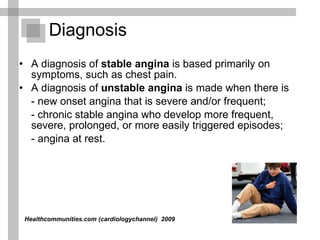
Diagnosis A diagnosis of  stable angina  is based primarily on symptoms, such as chest pain.  A diagnosis of  unstable angina  is made when there is - new onset angina that is severe and/or frequent;  - chronic stable angina who develop more frequent,  severe, prolonged, or more easily triggered episodes;  - angina at rest.  Healthcommunities.com (cardiologychannel)   2009
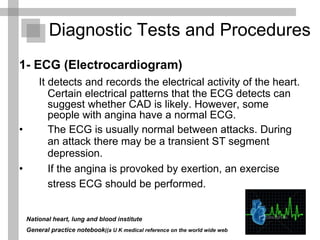
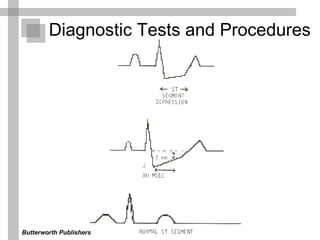
Diagnostic Tests and Procedures  1- ECG (Electrocardiogram) It detects and records the electrical activity of the heart. Certain electrical patterns that the ECG detects can suggest whether CAD is likely. However, some people with angina have a normal ECG.  The ECG is usually normal between attacks. During an attack there may be a transient ST segment depression. If the angina is provoked by exertion, an exercise stress ECG should be performed.   National heart, lung and blood institute  General practice notebook  (a U K medical reference on the world wide web)
Diagnostic Tests and Procedures  Butterworth Publishers
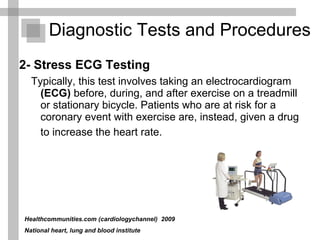
2- Stress ECG Testing   Typically, this test involves taking an electrocardiogram  (ECG)  before, during, and after exercise on a treadmill or stationary bicycle. Patients who are at risk for a coronary event with exercise are, instead, given a drug to increase the heart rate.   Diagnostic Tests and Procedures  Healthcommunities.com (cardiologychannel)   2009  National heart, lung and blood institute
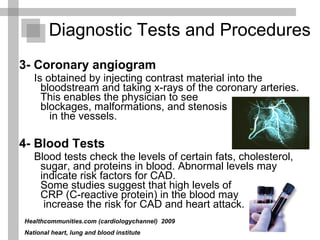
3- Coronary angiogram Is obtained by injecting contrast material into the bloodstream and taking x-rays of the coronary arteries. This enables the physician to see  blockages, malformations, and stenosis  in the vessels.  4- Blood Tests  Blood tests check the levels of certain fats, cholesterol, sugar, and proteins in blood. Abnormal levels may indicate risk factors for CAD.  Some studies suggest that high levels of  CRP (C-reactive protein) in the blood may  increase the risk for CAD and heart attack.  Diagnostic Tests and Procedures  Healthcommunities.com (cardiologychannel)   2009  National heart, lung and blood institute
Goals of Treatment All treatments for people with coronary artery disease have the same goals:  - to decrease the effects of the disease on the quality of life and alleviate symptoms.  - to reduce mortality due to CAD progression.  Patient information  —  Angina treatment ,   UpToDate.com  (Patient Preview)
Drug Therapy Currently, there are three main types of drugs used:  1) Nitrates  2) Beta blockers  3) Calcium channel blockers  Nitrates or beta blockers are usually preferred for initial treatment of angina, and calcium channel blockers may be added if needed. Patient information  —  Angina treatment ,   UpToDate.com  (Patient Preview)
Drug Therapy (cont.) 1) Nitrates   Nitrates improve blood flow by relaxing and dilating veins and arteries, including the coronary arteries. Examples:   nitroglycerin and isosorbide dinitrate. Side effects:   The most common side effects of nitrates are headache, lightheadedness, flushing, and an increase in heart rate.  Patient information  —  Angina treatment ,   UpToDate.com  (Patient Preview)
Drug Therapy (cont.) 2) Beta blockers   Beta blockers reduce the heart rate, blood pressure, and the force of contractions, thereby decreasing the amount of oxygen the heart requires to pump blood.  Examples:  atenolol, metoprolol, nadolol and propranolol. Side effects: Cardiac effects  -- worsen heart failure, bradycardia  Noncardiac effects   -- constriction of airways, circulatory problems, Impotence, hallucinations, insomnia, and fatigue  Patient information  —  Angina treatment ,   UpToDate.com  (Patient Preview)
3) Calcium channel blockers Calcium channel blockers dilate arteries and lower blood pressure, which decreases the force of contractions. They also dilate veins, reducing the amount of blood returning to the heart, which reduces the workload of the heart. Examples:  amlodipine, nifedipine, nicardipine, verapamil and diltiazem. Side effects: flushing, dizziness and lightheadedness, headache, peripheral edema and depression of cardiac function (with  non-dihydropyridines)  Drug Therapy (cont.) Patient information  —  Angina treatment ,   UpToDate.com  (Patient Preview)
Other Measures in Managing CAD  Anticoagulants Aspirin: (it helps to prevent blood clotting, keeping the narrowed arteries open and lowering the risk of a heart attack). Treat high blood pressure  Treat high cholesterol  Quit smoking  Lose excess weight  Reduce stress  Exercise regularly  Patient information  —  Angina treatment ,   UpToDate.com  (Patient Preview)
Other Treatment Options   Percutaneous Coronary Intervention (previously called Angioplasty or Balloon Angioplasty)  CABG (Coronary Artery Bypass Graft Surgery) 2009 American Heart Association website
References Patients files from King Saud Medical Complex. Medscape.com, Jamshid Alaeddini & Jamshid Shirani ADAM.COM  medmovie.com Healthcommunities.com (cardiologychannel)  2009 National heart, lung and blood institute  General practice notebook (a U K medical reference on the world wide web) Butterworth Publishers Patient information — Angina treatment , UpToDate.com (Patient Preview) Medical Disability Advisor, mdguidelines.com New York Heart Associates, nyheart.net   American Heart Association website
 
Hospital Training King Saud Medical Complex (Riyadh)
Problems from my view The program there is unfit able with our training period  (6 weeks) , it needs at least 4 months!! The program also not matching our training goals & plan, it was all clinical & I think in this training we should be in the pharmacy learning the basic concepts of WHAT WE CALL IT PHARMACIST.. It was higher than our knowledge & skills No one from the college told us about the situation there & we were surprised when Dr. Y. Alo’mi said: every student will go into two department only! (3 weeks for the 1 st  & 3 for the other one)
Comments & Questions
THE END THANK YOU

Angina pectoris presentation

  • 1.
  • 2.
    King Faisal University College of Clinical Pharmacy
  • 3.
    Angina Pectoris By Taher Haddad
  • 4.
    No interruption Speaking during the presentation (NOT ALLOWED) Note down your comments & questions There will be time for comments & questions Before Getting Started Think & act scientifically
  • 5.
    1- Case Historywith Treatment 2- Definition (what is angina?) 3- Types of Angina 4- Pathophysiology 5- Clinical Presentation 6- Diagnosis (with Tests and Procedures) 7- Goals of Treatment 8- Drug Therapy and Other Measures Outlines
  • 6.
    Case History An80 years old saudi female, non-smoker, D.M. HTN, dyslipidemic, with no previous chest pain, presented with severe shortness of breath & chest tightness. Condition started about 1 month ago, gradually: cough & expectoration of whitish sputum (no hemoptysis). One day before admission she's severly dyspnic & distressed. Drug history only NSAIDs. On ICCU admission: fully conscious & oriented. From a patient file in king Saud Medical Complex, Riyadh
  • 7.
    Result indicated thatshe had angina, and according to that result, she started receiving the following regimen: Carvidelol 12.5 BID Capoten 12.5 BID ASA 81 mg OD Atorva 500 mg BID Omeprazole 20 mg OD Iron 200 mg BID Multivitamin OD Syp lactoluse 15 ml PO Treatment for The Case From a patient file in king Saud Medical Complex, Riyadh
  • 8.
    Definition Angina isthe result of myocardial ischemia caused by an imbalance between myocardial blood supply and oxygen demand. It is a common presenting symptom (typically, chest pain) among patients with coronary artery disease. Type of chest pain: pressure or discomfort Medscape.com, Jamshid Alaeddini & Jamshid Shirani
  • 9.
  • 10.
    Types of AnginaAngina is classified broadly as stable or unstable , depending on its pattern of occurrence and severity. medmovie.com
  • 11.
    Stable angina occurs when increased physical activity (e.g., hurrying across a street or climbing a long stairs) which creates a greater demand for oxygen-rich blood to reach heart tissue. Unstable angina occurs with lesser degrees of exertion or while at rest. Unstable angina that occurs at rest is the most serious form. This type usually is caused by the formation of a blood clot at the site of a ruptured plaque in a coronary artery. Types of Angina (cont.) Healthcommunities.com (cardiologychannel) 2009
  • 12.
    Pathophysiology Myocardialischemia develops when coronary blood flow becomes inadequate to meet myocardial oxygen demand. This causes myocardial cells to switch from aerobic to anaerobic metabolism, with a progressive impairment of metabolic, mechanical, and electrical functions. Studies have shown that adenosine may be the main chemical mediator of anginal pain. During ischemia, ATP is degraded to adenosine, which, after diffusion to the extracellular space, causes arteriolar dilation and anginal pain. Medscape.com, Jamshid Alaeddini & Jamshid Shirani
  • 13.
    Clinical Presentation Anginais a symptom of ischemic heart disease (IHD). Episodes of stable angina typically are brought on by exertion or emotion and are relieved with rest. An attack of stable angina lasts from 1 to 5 minutes and is described as - squeezing, - choking, - smothering, or - crushing pressure in the chest. Angina pain may radiate to the shoulders, arms, back, neck, or jaw. Patients with atherosclerosis also may experience sweating, clamminess, shortness of breath (dyspnea). Healthcommunities.com (cardiologychannel) 2009
  • 14.
    Clinical Presentation (cont.)© Reed Group Medical Disability Advisor, mdguidelines.com New York Heart Associates, nyheart.net
  • 15.
    Unstable angina causessymptoms that are more severe, more frequent, and occur with modestly increased physical activity and at rest. Blood clots may form at anytime and may partially dissolve spontaneously. Whenever this occurs, blood flow to heart tissue is blocked and angina occurs. An attack of unstable angina may last several minutes to half an hour or longer. Unstable angina is an acute coronary syndrome, which is a medical emergency that requires immediate attention. Clinical Presentation (cont.) Healthcommunities.com (cardiologychannel) 2009
  • 16.
    Diagnosis A diagnosisof stable angina is based primarily on symptoms, such as chest pain. A diagnosis of unstable angina is made when there is - new onset angina that is severe and/or frequent; - chronic stable angina who develop more frequent, severe, prolonged, or more easily triggered episodes; - angina at rest. Healthcommunities.com (cardiologychannel) 2009
  • 17.
    Diagnostic Tests andProcedures 1- ECG (Electrocardiogram) It detects and records the electrical activity of the heart. Certain electrical patterns that the ECG detects can suggest whether CAD is likely. However, some people with angina have a normal ECG. The ECG is usually normal between attacks. During an attack there may be a transient ST segment depression. If the angina is provoked by exertion, an exercise stress ECG should be performed. National heart, lung and blood institute General practice notebook (a U K medical reference on the world wide web)
  • 18.
    Diagnostic Tests andProcedures Butterworth Publishers
  • 19.
    2- Stress ECGTesting Typically, this test involves taking an electrocardiogram (ECG) before, during, and after exercise on a treadmill or stationary bicycle. Patients who are at risk for a coronary event with exercise are, instead, given a drug to increase the heart rate. Diagnostic Tests and Procedures Healthcommunities.com (cardiologychannel) 2009 National heart, lung and blood institute
  • 20.
    3- Coronary angiogramIs obtained by injecting contrast material into the bloodstream and taking x-rays of the coronary arteries. This enables the physician to see blockages, malformations, and stenosis in the vessels. 4- Blood Tests Blood tests check the levels of certain fats, cholesterol, sugar, and proteins in blood. Abnormal levels may indicate risk factors for CAD. Some studies suggest that high levels of CRP (C-reactive protein) in the blood may increase the risk for CAD and heart attack. Diagnostic Tests and Procedures Healthcommunities.com (cardiologychannel) 2009 National heart, lung and blood institute
  • 21.
    Goals of TreatmentAll treatments for people with coronary artery disease have the same goals: - to decrease the effects of the disease on the quality of life and alleviate symptoms. - to reduce mortality due to CAD progression. Patient information — Angina treatment , UpToDate.com (Patient Preview)
  • 22.
    Drug Therapy Currently,there are three main types of drugs used: 1) Nitrates 2) Beta blockers 3) Calcium channel blockers Nitrates or beta blockers are usually preferred for initial treatment of angina, and calcium channel blockers may be added if needed. Patient information — Angina treatment , UpToDate.com (Patient Preview)
  • 23.
    Drug Therapy (cont.)1) Nitrates Nitrates improve blood flow by relaxing and dilating veins and arteries, including the coronary arteries. Examples: nitroglycerin and isosorbide dinitrate. Side effects:   The most common side effects of nitrates are headache, lightheadedness, flushing, and an increase in heart rate. Patient information — Angina treatment , UpToDate.com (Patient Preview)
  • 24.
    Drug Therapy (cont.)2) Beta blockers Beta blockers reduce the heart rate, blood pressure, and the force of contractions, thereby decreasing the amount of oxygen the heart requires to pump blood. Examples: atenolol, metoprolol, nadolol and propranolol. Side effects: Cardiac effects -- worsen heart failure, bradycardia Noncardiac effects   -- constriction of airways, circulatory problems, Impotence, hallucinations, insomnia, and fatigue Patient information — Angina treatment , UpToDate.com (Patient Preview)
  • 25.
    3) Calcium channelblockers Calcium channel blockers dilate arteries and lower blood pressure, which decreases the force of contractions. They also dilate veins, reducing the amount of blood returning to the heart, which reduces the workload of the heart. Examples: amlodipine, nifedipine, nicardipine, verapamil and diltiazem. Side effects: flushing, dizziness and lightheadedness, headache, peripheral edema and depression of cardiac function (with non-dihydropyridines) Drug Therapy (cont.) Patient information — Angina treatment , UpToDate.com (Patient Preview)
  • 26.
    Other Measures inManaging CAD Anticoagulants Aspirin: (it helps to prevent blood clotting, keeping the narrowed arteries open and lowering the risk of a heart attack). Treat high blood pressure Treat high cholesterol Quit smoking Lose excess weight Reduce stress Exercise regularly Patient information — Angina treatment , UpToDate.com (Patient Preview)
  • 27.
    Other Treatment Options Percutaneous Coronary Intervention (previously called Angioplasty or Balloon Angioplasty) CABG (Coronary Artery Bypass Graft Surgery) 2009 American Heart Association website
  • 28.
    References Patients filesfrom King Saud Medical Complex. Medscape.com, Jamshid Alaeddini & Jamshid Shirani ADAM.COM medmovie.com Healthcommunities.com (cardiologychannel) 2009 National heart, lung and blood institute General practice notebook (a U K medical reference on the world wide web) Butterworth Publishers Patient information — Angina treatment , UpToDate.com (Patient Preview) Medical Disability Advisor, mdguidelines.com New York Heart Associates, nyheart.net American Heart Association website
  • 29.
  • 30.
    Hospital Training KingSaud Medical Complex (Riyadh)
  • 31.
    Problems from myview The program there is unfit able with our training period (6 weeks) , it needs at least 4 months!! The program also not matching our training goals & plan, it was all clinical & I think in this training we should be in the pharmacy learning the basic concepts of WHAT WE CALL IT PHARMACIST.. It was higher than our knowledge & skills No one from the college told us about the situation there & we were surprised when Dr. Y. Alo’mi said: every student will go into two department only! (3 weeks for the 1 st & 3 for the other one)
  • 32.
  • 33.