What is Glaucoma?Glaucoma is a series of conditions, characterized by a particular form of optic nerve damage that is often-but not always- associated with elevated IOP. The American Academy of Ophthalmology now defines glaucoma as “a group of diseases with certain features including an intraocular pressure that is too high for the continued health of the eye.”
Risk Factors for GlaucomaIncreased IOPAge Family HistoryRace DiabetesPrevious Eye Injury
Goals of Glaucoma ManagementTreatment Lower IOP
Control of IOP fluctuation for a full 24 hours
 Preserve VisionQuality of Life Considerations Long Term Impact of Medications
 Balance of Efficacy and Side EffectsMedical TreatmentsProstaglandin Analogues- work by increasing flow of aqueous humor via the uveoscleral pathway out of the eye, thus lowering IOPUveoscleral Pathway: Aqueous humor flows through spaces of the iris and ciliary body under the sclera and drains via blood vessels. Some of the aqueous is absorbed directly through the blood vessels of the coroidDosed once a day- side effects may include hyperemia which is redness of the eye- usually mild and subsides within a few weeks of treatment
Medical TreatmentsBeta BlockersMost common is timolol- work by decreasing production of aqueous humor which lowers IOP
Side effects may include low blood pressure, slow heart rate and general fatigueMedical TreatmentsAlpha Agonists- dosed 3 times per day- cause increase in outflow as well as a decrease in production of aqueous humor to lower IOP ie. AlphaganSide effects may include ocular allergies and drowsinessCarbonic Anhydrase Inhibitors- 2 or 3 times per day dosing- lower IOP by decreasing production of aqueous humor ie. Azopt, Trusopt
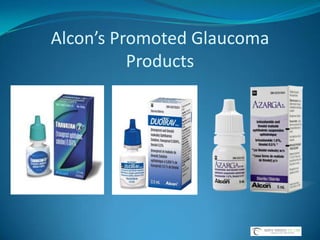
Alcon’s Promoted Glaucoma Products
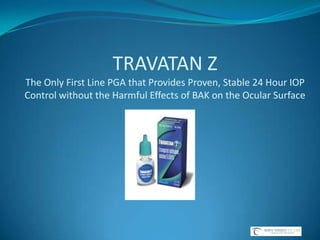
TRAVATAN ZThe Only First Line PGA that Provides Proven, Stable 24 Hour IOP Control without the Harmful Effects of BAK on the Ocular Surface
 A Look at the Past…Travatan Classic Benefits:Clinical studies show travoprost lowers IOP better than latanoprost1,2 for a full 24 hours3Travoprosthas demonstrated a flattening of the 24 hour IOP fluctuations..
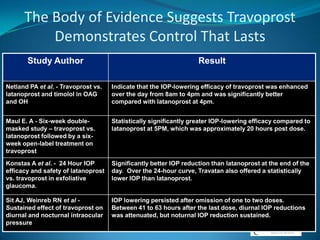
The Body of Evidence Suggests Travoprost Demonstrates Control That Lasts
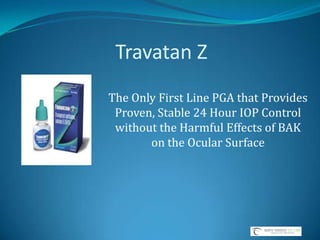
Travatan Z The Only First Line PGA that Provides Proven, Stable 24 Hour IOP Control without the Harmful Effects of BAK on the Ocular Surface
A Novel ApproachTo Ocular SurfacePreservationOcular Surface Disease (OSD) or Dry Eye  has a Significant Presence in The Glaucoma Population
Glaucoma Patients and Ocular Surface Disease are At Greater RiskElderly (Decreased Tear Secretion)
Multiple Topical Ophthalmic medications
Ocular Surface Disease Symptoms May Contribute to Poor Patient Compliance
May Need Surgery Down the RoadCommon Dry Eye SymptomsPainful or Sore Eyes
Burning / Stinging
Foreign Body Sensation
Blurred or Poor Vision
Tired EyesLeung, et al. Prevalence of Ocular Surface Disease in Glaucoma Patients. J Glaucoma 2008;17:350–355
BAK Impact on Ocular Surface HealthDecreases Epithelial Cell Integrity1
Epithelial Barrier is Compromised
Healing is Impaired
Increases Conjunctival Inflammatory Cells1
Loss of Goblet Cells1
Reduction in Tear Function2
Decreases Tear Film Break Up Time (TBUT)1Whitson ,et al. Glaucoma Drugs and The Ocular Surface, Review of Ophthalmology, November 2006Leung, et al. Prevalence of Ocular Surface Disease in Glaucoma Patients. J Glaucoma 2008;17:350–355
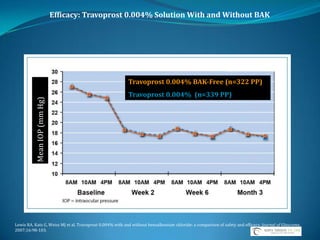
Travoprost 0.004% BAK-Free (n=322 PP)Travoprost 0.004%  (n=339 PP)Mean IOP (mm Hg)Efficacy: Travoprost 0.004% Solution With and Without BAK Lewis RA, Katz G, Weiss MJ et al. Travoprost 0.004% with and without benzalkonium chloride: a comparison of safety and efficacy. Journal of Glaucoma. 2007;16:98-103.
TMPolyolsZincBorateAn Alternative PreservativeUnique Ionic Buffer System
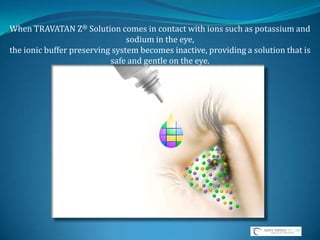
When TRAVATAN Z® Solution comes in contact with ions such as potassium and sodium in the eye, the ionic buffer preserving system becomes inactive, providing a solution that is safe and gentle on the eye.
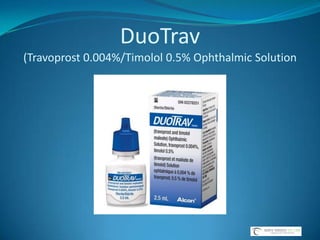
DuoTrav(Travoprost 0.004%/Timolol 0.5% Ophthalmic Solution
What Are The Benefits Of DuoTrav® Solution?DuoTravallows for continued IOP success Enhanced efficacy – two medications in a single bottle (travoprost + timolol)Enhanced convenience to improve complianceExcellent tolerability to lower IOP and preserve visual field
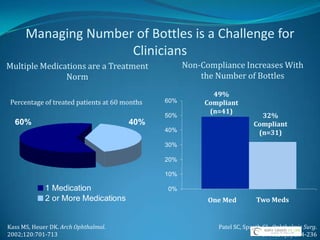
49%Compliant(n=41)32%Compliant(n=31)Two MedsOne MedManaging Number of Bottles is a Challenge for CliniciansNon-Compliance Increases With the Number of BottlesMultiple Medications are a Treatment NormPercentage of treated patients at 60 monthsKass MS, Heuer DK. Arch Ophthalmol. 2002;120:701-713Patel SC, Spaeth GL. Ophthalmic Surg. 1995;26(3):234-236
DuoTrav SummaryDuoTrav® Solution is an ideal ‘single bottle’ alternative for glaucoma Once daily dosing with the advantages of increased compliance and less preservative exposureIncreased power and endurance of the travoprost ingredient
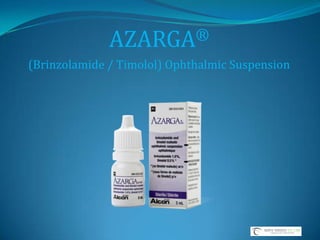
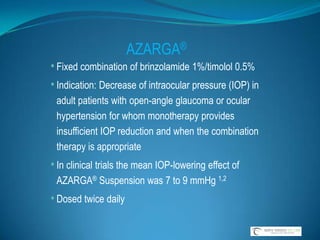
AZARGA® (Brinzolamide / Timolol) Ophthalmic Suspension
AZARGA® Fixed combination of brinzolamide 1%/timolol 0.5%
Indication: Decrease of intraocular pressure (IOP) in adult patients with open‑angle glaucoma or ocular hypertension for whom monotherapy provides insufficient IOP reduction and when the combination therapy is appropriate
In clinical trials the mean IOP-lowering effect of AZARGA® Suspension was 7 to 9 mmHg 1,2
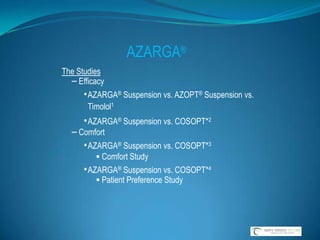
Dosed twice dailyAZARGA®The Studies Efficacy
AZARGA® Suspension vs. AZOPT® Suspension vs. Timolol1
AZARGA® Suspension vs. COSOPT*2
 Comfort
AZARGA® Suspension vs. COSOPT*3
 Comfort Study
AZARGA® Suspension vs. COSOPT*4
 Patient Preference StudyWhy is comfort important?The degree of ocular comfort can have an impact on patient adherence to IOP-lowering medication regimens.1-4Tsai JC, McClure CA, Ramos SE, et al. 2003. Compliance barriers in glaucoma: a systematic classification. J Glaucoma, 12:393-8.Day DG, Sharpe ED, Atkinson MJ, et al. 2006. The clinical validity of the treatment satisfaction survey for intraocular pressure in ocular hypertensive and glaucoma patients. Eye, 20:583-90.Konstas AG, Maskaleris G, Gratsonidis S, et al. 2000. Compliance and viewpoint of glaucoma patients in Greece. Eye, 14:752-6.Nordmann JP, Auzaneau N, Ricard S, et al. 2003. Vision related quality of life and topical glaucoma treatment side effects. Health Qual Life Outcomes, 1:75.
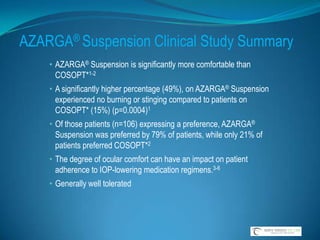
AZARGA® Suspension Clinical Study SummaryAZARGA® Suspension produces IOP-lowering efficacy that is statistically superior to both AZOPT® Suspension and timolol 0.5%1
AZARGA® Suspension lowered IOP by as much as 9.1 mmHg(35%)2
AZARGA® Suspension produced clinically meaningful IOP reductions from baseline which were similar to COSOPT*2AZARGA® Suspension Clinical Study SummaryAZARGA® Suspension is significantly more comfortable than COSOPT*1-2
A significantly higher percentage (49%), on AZARGA® Suspension experienced no burning or stinging compared to patients on COSOPT* (15%) (p=0.0004)1
Of those patients (n=106) expressing a preference, AZARGA® Suspension was preferred by 79% of patients, while only 21% of patients preferred COSOPT*2
The degree of ocular comfort can have an impact on patient adherence to IOP-lowering medication regimens.3-6
Generally well toleratedSpring Optometric Learning Series2012
Glaucoma types: stats In US Open angle glaucoma 80%	Angle Closure Glaucoma 20%50% from narrow angles40% from plateau10% from lens rise
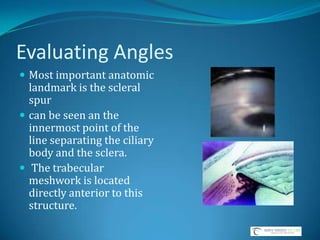
Evaluating Angles Most important anatomic landmark is the scleral spurcan be seen an the innermost point of the line separating the ciliary body and the sclera.The trabecular meshwork is located directly anterior to this structure.
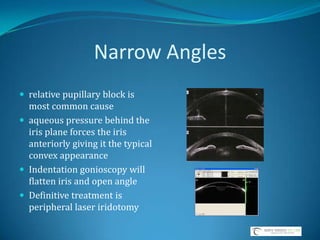
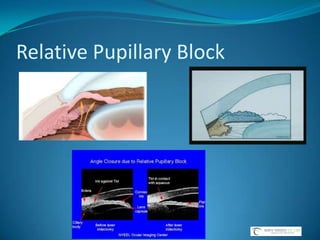
Narrow Angles relative pupillary blockis most common cause aqueous pressure behind the iris plane forces the iris anteriorlygiving it the typical convex appearanceIndentation gonioscopy will flatten iris and open angleDefinitive treatment is peripheral laser iridotomy
Relative Pupillary Block
Plateau IrisNot all angle-closure is caused by relative pupillary blockPatients with plateau iris tend to be female, in their 30-50s, hyperopic, and often have a family history of angle-closure glaucomaSlit lamp examination of patients with plateau iris usually shows normal anterior chamber depth with a flat or slightly convex iris surface. On gonioscopy, the angle is extremely narrowed or closed, with a sharp drop-off of the peripheral iris.
Plateau IrisPlateau Iris is due to anteriorly positioned ciliary processes, which hold the peripheral iris forwardThe anteriorly placed ciliary body forces the peripheral iris into the angle.In Plateau Iris, the angle remains occludable with a patent iridotomy
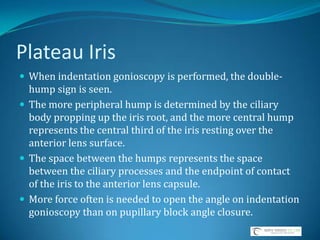
Plateau IrisWhen indentation gonioscopy is performed, the double-hump sign is seen.The more peripheral hump is determined by the ciliary body propping up the iris root, and the more central hump represents the central third of the iris resting over the anterior lens surface.The space between the humps represents the space between the ciliary processes and the endpoint of contact of the iris to the anterior lens capsule.More force often is needed to open the angle on indentation gonioscopy than on pupillary block angle closure.
Plateau IrisPlateau iris syndrome is characterized by persistent angle occludability (spontaneous, in the dark, or after dilation) in an eye with a patent iridotomyMore commonly, the diagnosis of plateau iris configuration is made on routine examination.Plateau iris syndrome usually is recognized in the postoperative period when the angle remains persistently narrow in an eye after iridotomy
ALP: Argon Laser Peripheral Iridoplastythe procedure of choice to effectively open an angle that remains occluded after successful laser iridotomyThe procedure consists of placing laser burns on the surface of the peripheral iris to contract the iris stroma between the site of the burn and the anglePeripheral location of long-duration, low-power, large spot size laser burns is essential for successThe result is iris stromal tissue contraction and compaction that physically widens the angle and prevents the apposition of the peripheral iris against the trabecular meshworkALPI is highly effective, and the effect is maintained for years
Lens Intumescence..Lens RiseA large, intumescent lens or forward lens movement due to zonular laxity or dehiscence may cause mechanical crowding of the angleDiagnosis is based on shallow AC, narrow angles, Patent PI, narrow AC and short AXL in hyperopic individualsTreatement is clear lensectomyMore and more lensectomies are taking the place of chronic glaucoma therapy for these patients
New Advances in the Treatment of Ocular Inflammatory DiseasesTheodore Rabinovitch MD FRCSCAssistant Professor of OphthalmologyUniversity of Toronto, Department of OphthalmologyHead, Humber Eye DivisionNorth Toronto Eye Care41
TREATMENT OF INFLAMMATION IN THE ANTERIOR SEGMENT OF THE EYE TOPICAL OPHTHALMIC CORTICOSTEROID THERAPY
 A Focus on Loteprednol Etabonate43
Topical Ophthalmic SteroidsEsterLoteprednolKetone SteroidsHigher-riskDexamethasone Betamethasone PrednisoloneDifluprednateLower-riskFluorometholoneMedrysoneRimexolone44McGhee CN, Dean S, Danesh-Meyer H. Locally administered ocular corticosteroids: benefits and risks. Drug Saf. 2002;25:33-55.
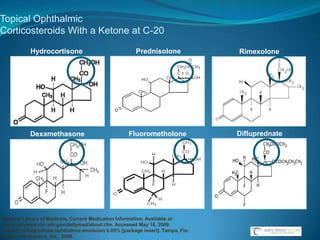
Topical Ophthalmic Corticosteroids With a Ketone at C-20Hydrocortisone PrednisoloneRimexoloneDifluprednateFluorometholoneDexamethasoneNational Library of Medicine, Current Medication Information. Available at: http://dailymed.nlm.nih.gov/dailymed/about.cfm. Accessed May 16, 2009. Durezol (difluprednate ophthalmic emulsion) 0.05% [package insert]. Tampa, Fla: Sirion Therapeutics, Inc.; 2008.
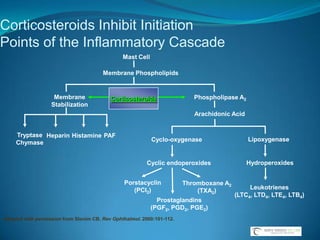
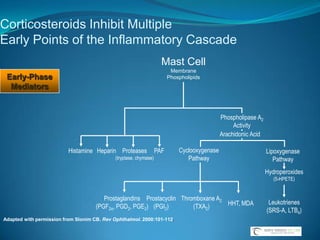
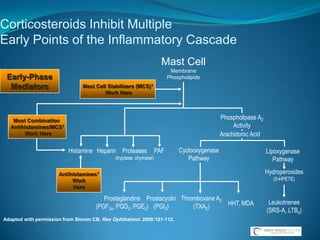
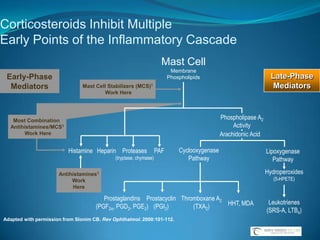
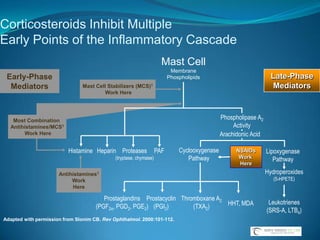
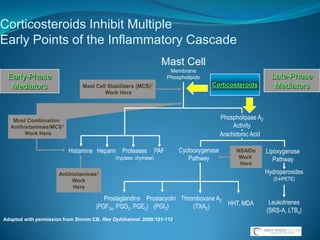
Corticosteroids Inhibit Initiation Points of the Inflammatory CascadeMast CellMembrane PhospholipidsCorticosteroidsMembraneStabilizationPhospholipase A2Arachidonic AcidTryptaseChymaseHeparinHistaminePAFLipoxygenaseCyclo-oxygenaseHydroperoxidesCyclic endoperoxidesPorstacyclin(PCI2)Thromboxane A2(TXA2)Leukotrienes(LTC4, LTD4, LTE4, LTB4)Prostaglandins(PGF2, PGD2, PGE2)Adapted with permission from Slonim CB. Rev Ophthalmol. 2000:101-112.
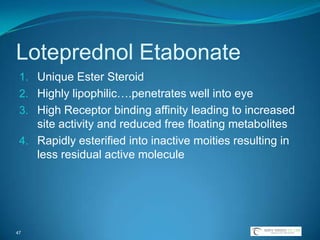
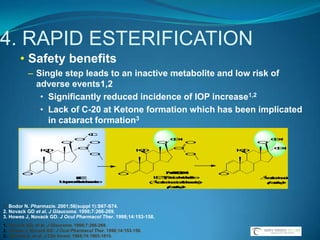
Loteprednol Etabonate Unique Ester SteroidHighly lipophilic….penetrates well into eyeHigh Receptor binding affinity leading to increased site activity and reduced free floating metabolitesRapidly esterified into inactive moities resulting in less residual active molecule47
2. Lipophilicity of LE Facilitates Optimal Ocular Tissue PenetrationHowes JF. Pharmazie. 2000;55:178-183.Alberth M, et al. J Biopharm Sci. 1991;2:115-125.

Narrow angles

  • 1.
    What is Glaucoma?Glaucomais a series of conditions, characterized by a particular form of optic nerve damage that is often-but not always- associated with elevated IOP. The American Academy of Ophthalmology now defines glaucoma as “a group of diseases with certain features including an intraocular pressure that is too high for the continued health of the eye.”
  • 2.
    Risk Factors forGlaucomaIncreased IOPAge Family HistoryRace DiabetesPrevious Eye Injury
  • 3.
    Goals of GlaucomaManagementTreatment Lower IOP
  • 4.
    Control of IOPfluctuation for a full 24 hours
  • 5.
    Preserve VisionQualityof Life Considerations Long Term Impact of Medications
  • 6.
    Balance ofEfficacy and Side EffectsMedical TreatmentsProstaglandin Analogues- work by increasing flow of aqueous humor via the uveoscleral pathway out of the eye, thus lowering IOPUveoscleral Pathway: Aqueous humor flows through spaces of the iris and ciliary body under the sclera and drains via blood vessels. Some of the aqueous is absorbed directly through the blood vessels of the coroidDosed once a day- side effects may include hyperemia which is redness of the eye- usually mild and subsides within a few weeks of treatment
  • 7.
    Medical TreatmentsBeta BlockersMostcommon is timolol- work by decreasing production of aqueous humor which lowers IOP
  • 8.
    Side effects mayinclude low blood pressure, slow heart rate and general fatigueMedical TreatmentsAlpha Agonists- dosed 3 times per day- cause increase in outflow as well as a decrease in production of aqueous humor to lower IOP ie. AlphaganSide effects may include ocular allergies and drowsinessCarbonic Anhydrase Inhibitors- 2 or 3 times per day dosing- lower IOP by decreasing production of aqueous humor ie. Azopt, Trusopt
  • 9.
  • 10.
    TRAVATAN ZThe OnlyFirst Line PGA that Provides Proven, Stable 24 Hour IOP Control without the Harmful Effects of BAK on the Ocular Surface
  • 11.
    A Lookat the Past…Travatan Classic Benefits:Clinical studies show travoprost lowers IOP better than latanoprost1,2 for a full 24 hours3Travoprosthas demonstrated a flattening of the 24 hour IOP fluctuations..
  • 12.
    The Body ofEvidence Suggests Travoprost Demonstrates Control That Lasts
  • 13.
    The Body ofEvidence Suggests Travoprost Demonstrates Control That Lasts
  • 14.
    Travatan Z TheOnly First Line PGA that Provides Proven, Stable 24 Hour IOP Control without the Harmful Effects of BAK on the Ocular Surface
  • 15.
    A Novel ApproachToOcular SurfacePreservationOcular Surface Disease (OSD) or Dry Eye has a Significant Presence in The Glaucoma Population
  • 16.
    Glaucoma Patients andOcular Surface Disease are At Greater RiskElderly (Decreased Tear Secretion)
  • 17.
  • 18.
    Ocular Surface DiseaseSymptoms May Contribute to Poor Patient Compliance
  • 19.
    May Need SurgeryDown the RoadCommon Dry Eye SymptomsPainful or Sore Eyes
  • 20.
  • 21.
  • 22.
  • 23.
    Tired EyesLeung, etal. Prevalence of Ocular Surface Disease in Glaucoma Patients. J Glaucoma 2008;17:350–355
  • 24.
    BAK Impact onOcular Surface HealthDecreases Epithelial Cell Integrity1
  • 25.
  • 26.
  • 27.
  • 28.
  • 29.
  • 30.
    Decreases Tear FilmBreak Up Time (TBUT)1Whitson ,et al. Glaucoma Drugs and The Ocular Surface, Review of Ophthalmology, November 2006Leung, et al. Prevalence of Ocular Surface Disease in Glaucoma Patients. J Glaucoma 2008;17:350–355
  • 31.
    Travoprost 0.004% BAK-Free(n=322 PP)Travoprost 0.004% (n=339 PP)Mean IOP (mm Hg)Efficacy: Travoprost 0.004% Solution With and Without BAK Lewis RA, Katz G, Weiss MJ et al. Travoprost 0.004% with and without benzalkonium chloride: a comparison of safety and efficacy. Journal of Glaucoma. 2007;16:98-103.
  • 32.
  • 33.
    When TRAVATAN Z®Solution comes in contact with ions such as potassium and sodium in the eye, the ionic buffer preserving system becomes inactive, providing a solution that is safe and gentle on the eye.
  • 34.
  • 35.
    What Are TheBenefits Of DuoTrav® Solution?DuoTravallows for continued IOP success Enhanced efficacy – two medications in a single bottle (travoprost + timolol)Enhanced convenience to improve complianceExcellent tolerability to lower IOP and preserve visual field
  • 36.
    49%Compliant(n=41)32%Compliant(n=31)Two MedsOne MedManagingNumber of Bottles is a Challenge for CliniciansNon-Compliance Increases With the Number of BottlesMultiple Medications are a Treatment NormPercentage of treated patients at 60 monthsKass MS, Heuer DK. Arch Ophthalmol. 2002;120:701-713Patel SC, Spaeth GL. Ophthalmic Surg. 1995;26(3):234-236
  • 37.
    DuoTrav SummaryDuoTrav® Solutionis an ideal ‘single bottle’ alternative for glaucoma Once daily dosing with the advantages of increased compliance and less preservative exposureIncreased power and endurance of the travoprost ingredient
  • 38.
    AZARGA® (Brinzolamide /Timolol) Ophthalmic Suspension
  • 39.
    AZARGA® Fixed combinationof brinzolamide 1%/timolol 0.5%
  • 40.
    Indication: Decrease ofintraocular pressure (IOP) in adult patients with open‑angle glaucoma or ocular hypertension for whom monotherapy provides insufficient IOP reduction and when the combination therapy is appropriate
  • 41.
    In clinical trialsthe mean IOP-lowering effect of AZARGA® Suspension was 7 to 9 mmHg 1,2
  • 42.
  • 43.
    AZARGA® Suspension vs.AZOPT® Suspension vs. Timolol1
  • 44.
  • 45.
  • 46.
  • 47.
  • 48.
  • 49.
    Patient PreferenceStudyWhy is comfort important?The degree of ocular comfort can have an impact on patient adherence to IOP-lowering medication regimens.1-4Tsai JC, McClure CA, Ramos SE, et al. 2003. Compliance barriers in glaucoma: a systematic classification. J Glaucoma, 12:393-8.Day DG, Sharpe ED, Atkinson MJ, et al. 2006. The clinical validity of the treatment satisfaction survey for intraocular pressure in ocular hypertensive and glaucoma patients. Eye, 20:583-90.Konstas AG, Maskaleris G, Gratsonidis S, et al. 2000. Compliance and viewpoint of glaucoma patients in Greece. Eye, 14:752-6.Nordmann JP, Auzaneau N, Ricard S, et al. 2003. Vision related quality of life and topical glaucoma treatment side effects. Health Qual Life Outcomes, 1:75.
  • 50.
    AZARGA® Suspension ClinicalStudy SummaryAZARGA® Suspension produces IOP-lowering efficacy that is statistically superior to both AZOPT® Suspension and timolol 0.5%1
  • 51.
    AZARGA® Suspension loweredIOP by as much as 9.1 mmHg(35%)2
  • 52.
    AZARGA® Suspension producedclinically meaningful IOP reductions from baseline which were similar to COSOPT*2AZARGA® Suspension Clinical Study SummaryAZARGA® Suspension is significantly more comfortable than COSOPT*1-2
  • 53.
    A significantly higherpercentage (49%), on AZARGA® Suspension experienced no burning or stinging compared to patients on COSOPT* (15%) (p=0.0004)1
  • 54.
    Of those patients(n=106) expressing a preference, AZARGA® Suspension was preferred by 79% of patients, while only 21% of patients preferred COSOPT*2
  • 55.
    The degree ofocular comfort can have an impact on patient adherence to IOP-lowering medication regimens.3-6
  • 56.
    Generally well toleratedSpringOptometric Learning Series2012
  • 57.
    Glaucoma types: statsIn US Open angle glaucoma 80% Angle Closure Glaucoma 20%50% from narrow angles40% from plateau10% from lens rise
  • 58.
    Evaluating Angles Mostimportant anatomic landmark is the scleral spurcan be seen an the innermost point of the line separating the ciliary body and the sclera.The trabecular meshwork is located directly anterior to this structure.
  • 59.
    Narrow Angles relativepupillary blockis most common cause aqueous pressure behind the iris plane forces the iris anteriorlygiving it the typical convex appearanceIndentation gonioscopy will flatten iris and open angleDefinitive treatment is peripheral laser iridotomy
  • 60.
  • 61.
    Plateau IrisNot allangle-closure is caused by relative pupillary blockPatients with plateau iris tend to be female, in their 30-50s, hyperopic, and often have a family history of angle-closure glaucomaSlit lamp examination of patients with plateau iris usually shows normal anterior chamber depth with a flat or slightly convex iris surface. On gonioscopy, the angle is extremely narrowed or closed, with a sharp drop-off of the peripheral iris.
  • 62.
    Plateau IrisPlateau Irisis due to anteriorly positioned ciliary processes, which hold the peripheral iris forwardThe anteriorly placed ciliary body forces the peripheral iris into the angle.In Plateau Iris, the angle remains occludable with a patent iridotomy
  • 63.
    Plateau IrisWhen indentationgonioscopy is performed, the double-hump sign is seen.The more peripheral hump is determined by the ciliary body propping up the iris root, and the more central hump represents the central third of the iris resting over the anterior lens surface.The space between the humps represents the space between the ciliary processes and the endpoint of contact of the iris to the anterior lens capsule.More force often is needed to open the angle on indentation gonioscopy than on pupillary block angle closure.
  • 64.
    Plateau IrisPlateau irissyndrome is characterized by persistent angle occludability (spontaneous, in the dark, or after dilation) in an eye with a patent iridotomyMore commonly, the diagnosis of plateau iris configuration is made on routine examination.Plateau iris syndrome usually is recognized in the postoperative period when the angle remains persistently narrow in an eye after iridotomy
  • 65.
    ALP: Argon LaserPeripheral Iridoplastythe procedure of choice to effectively open an angle that remains occluded after successful laser iridotomyThe procedure consists of placing laser burns on the surface of the peripheral iris to contract the iris stroma between the site of the burn and the anglePeripheral location of long-duration, low-power, large spot size laser burns is essential for successThe result is iris stromal tissue contraction and compaction that physically widens the angle and prevents the apposition of the peripheral iris against the trabecular meshworkALPI is highly effective, and the effect is maintained for years
  • 66.
    Lens Intumescence..Lens RiseAlarge, intumescent lens or forward lens movement due to zonular laxity or dehiscence may cause mechanical crowding of the angleDiagnosis is based on shallow AC, narrow angles, Patent PI, narrow AC and short AXL in hyperopic individualsTreatement is clear lensectomyMore and more lensectomies are taking the place of chronic glaucoma therapy for these patients
  • 67.
    New Advances inthe Treatment of Ocular Inflammatory DiseasesTheodore Rabinovitch MD FRCSCAssistant Professor of OphthalmologyUniversity of Toronto, Department of OphthalmologyHead, Humber Eye DivisionNorth Toronto Eye Care41
  • 68.
    TREATMENT OF INFLAMMATIONIN THE ANTERIOR SEGMENT OF THE EYE TOPICAL OPHTHALMIC CORTICOSTEROID THERAPY
  • 69.
    A Focuson Loteprednol Etabonate43
  • 70.
    Topical Ophthalmic SteroidsEsterLoteprednolKetoneSteroidsHigher-riskDexamethasone Betamethasone PrednisoloneDifluprednateLower-riskFluorometholoneMedrysoneRimexolone44McGhee CN, Dean S, Danesh-Meyer H. Locally administered ocular corticosteroids: benefits and risks. Drug Saf. 2002;25:33-55.
  • 71.
    Topical Ophthalmic CorticosteroidsWith a Ketone at C-20Hydrocortisone PrednisoloneRimexoloneDifluprednateFluorometholoneDexamethasoneNational Library of Medicine, Current Medication Information. Available at: http://dailymed.nlm.nih.gov/dailymed/about.cfm. Accessed May 16, 2009. Durezol (difluprednate ophthalmic emulsion) 0.05% [package insert]. Tampa, Fla: Sirion Therapeutics, Inc.; 2008.
  • 72.
    Corticosteroids Inhibit InitiationPoints of the Inflammatory CascadeMast CellMembrane PhospholipidsCorticosteroidsMembraneStabilizationPhospholipase A2Arachidonic AcidTryptaseChymaseHeparinHistaminePAFLipoxygenaseCyclo-oxygenaseHydroperoxidesCyclic endoperoxidesPorstacyclin(PCI2)Thromboxane A2(TXA2)Leukotrienes(LTC4, LTD4, LTE4, LTB4)Prostaglandins(PGF2, PGD2, PGE2)Adapted with permission from Slonim CB. Rev Ophthalmol. 2000:101-112.
  • 73.
    Loteprednol Etabonate UniqueEster SteroidHighly lipophilic….penetrates well into eyeHigh Receptor binding affinity leading to increased site activity and reduced free floating metabolitesRapidly esterified into inactive moities resulting in less residual active molecule47
  • 74.
    2. Lipophilicity ofLE Facilitates Optimal Ocular Tissue PenetrationHowes JF. Pharmazie. 2000;55:178-183.Alberth M, et al. J Biopharm Sci. 1991;2:115-125.

Editor's Notes

  • #46 Key Discussion PointsThe corticosteroids available for topical ophthalmic use are based on the hydrocortisone molecule Most of the available agents have a ketone group at location C-20, as does the original hydrocortisone molecule The newer agent difluprednate also has a ketone group at C-20 ReferencesNational Library of Medicine, Current Medication Information. Available at: http://dailymed.nlm.nih.gov/dailymed/about.cfm. Accessed May 16, 2009. Durezol (difluprednate ophthalmic emulsion) 0.05% [package insert]. Tampa, Fla: Sirion Therapeutics, Inc.; 2008.
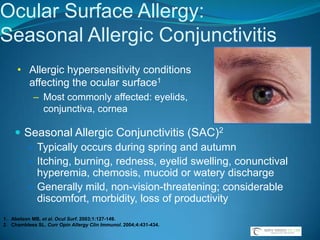
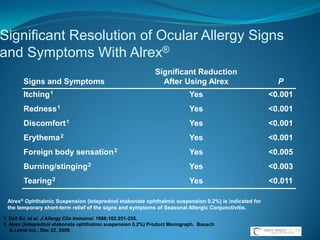
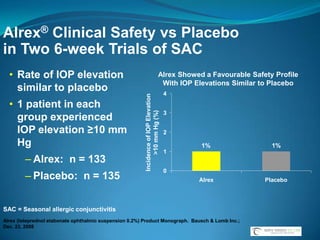
  • #58 Key Discussion PointsOcular allergy—specifically, seasonal allergic conjunctivitis—shares many features of underlying inflammation with other forms of ocular surface inflammatory disease1While it is typically not vision-threatening, SAC can cause considerable discomfort and, in some patients, morbidity and lost productivity2References Abelson MB, Smith L, Chapin M. Ocular allergic disease: mechanisms, disease sub-types, treatment. Ocul Surf. 2003;1(3):127-149. Chambless SL, Trocme S. Developments in ocular allergy. Curr Opin Allergy Clin Immunol. 2004;4(5):431-434.