Combination therapy for
Glaucoma Management
Stay with us, Grow with us!
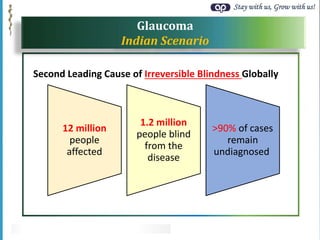
Glaucoma
Indian Scenario
12 million
people
affected
1.2 million
people blind
from the
disease
>90% of cases
remain
undiagnosed
Second Leading Cause of Irreversible Blindness Globally
3
Stay with us, Grow with us!
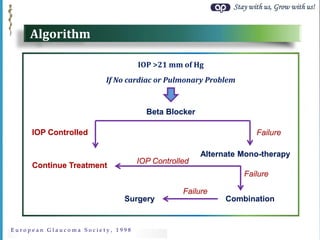
E u r o p e a n G l a u c o m a S o c i e t y , 1 9 9 8
Algorithm
IOP >21 mm of Hg
If No cardiac or Pulmonary Problem
Beta Blocker
IOP Controlled Failure
Alternate Mono-therapy
Failure
Combination
Failure
Surgery
Continue Treatment
IOP Controlled
Stay with us, Grow with us!
S u r v e y o f O p h t h a l m o l o g y ; 2 0 0 3 V o l . 4 8 ( 1 ) : S 1 - S 3
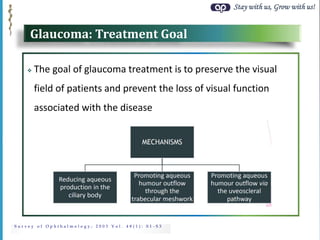
Glaucoma: Treatment Goal
 The goal of glaucoma treatment is to preserve the visual
field of patients and prevent the loss of visual function
associated with the disease
Stay with us, Grow with us!
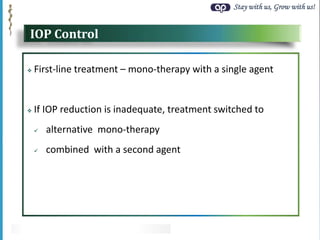
IOP Control
 First-line treatment – mono-therapy with a single agent
 If IOP reduction is inadequate, treatment switched to
 alternative mono-therapy
 combined with a second agent
Stay with us, Grow with us!
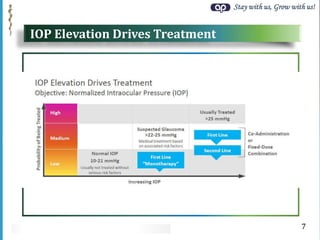
IOP Elevation Drives Treatment
7
Stay with us, Grow with us!
J A M A O p h t h a l m o l . 2 0 1 5 ; 1 3 3 ( 7 ) : 7 5 5 - 7 6 1
Rationale
 Prostaglandin analogues and β-blockers lower IOP by increasing
aqueous humor uveoscleral outflow and decreasing aqueous
humor production, respectively.
 However, even with their use, the IOP of many patients is not
adequately controlled because of adverse effects and/or
nonresponse
 Indeed, as indicated in the Ocular Hypertension Treatment
Study, a number of patients required 2 or more medications to
reach their target IOPs
Stay with us, Grow with us!
Evidences
 Need to add medications under circumstances
such as diminished IOP control with time or
disease progression in spite of pressure control
9
Stay with us, Grow with us!
Multiple medications may be problem
 Persistence with a fixed-dose glaucoma medication was
better than with two or more separate bottles, and
supports the idea that adding medication bottles reduces
persistence with glaucoma medication
 Thus, the use of fixed-combination formulations can
simplify regimens and positively contribute to patient
persistence.
10
Stay with us, Grow with us!
K l i n M o n b l A u g e n h e i l k d . 2 0 1 3 F e b ; 2 3 0 ( 2 ) : 1 3 3 -
4 0
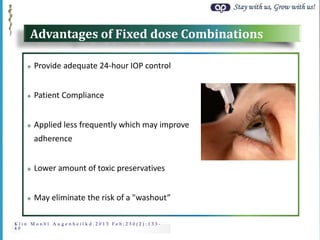
Advantages of Fixed dose Combinations
 Provide adequate 24-hour IOP control
 Patient Compliance
 Applied less frequently which may improve
adherence
 Lower amount of toxic preservatives
 May eliminate the risk of a "washout”
Stay with us, Grow with us!
E x p e r t O p i n i o n o n D r u g S a f e t y ; V o l u m e 1 9 , 2 0 2 0 - I s s u e
1 1
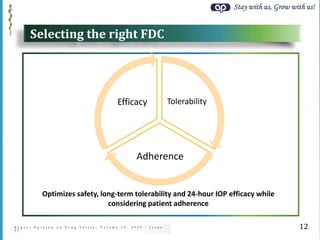
Selecting the right FDC
12
Tolerability
Adherence
Efficacy
Optimizes safety, long-term tolerability and 24-hour IOP efficacy while
considering patient adherence
Rho Kinase Inhibitors
&
Beta blockers
An Emerging therapy in Glaucoma Management
Presenting…….
Stay with us, Grow with us!
Ripasudil
 Ripasudil, a derivative of fasudil, a rho-associated protein
kinase inhibitor or ROCK inhibitor (ROCK) used for the
treatment of glaucoma and ocular hypertension
Stay with us, Grow with us!
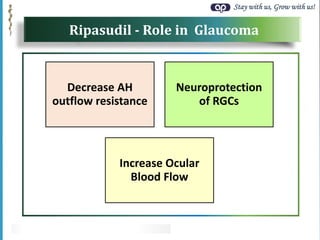
Ripasudil - Role in Glaucoma
Decrease AH
outflow resistance
Neuroprotection
of RGCs
Increase Ocular
Blood Flow
Stay with us, Grow with us!
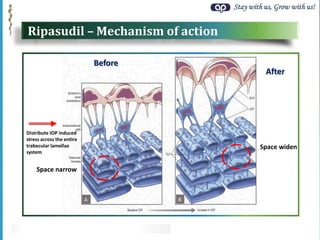
Space narrow
Space widen
Distribute IOP induced
stress across the entire
trabecular lamellae
system
Before
After
Ripasudil – Mechanism of action
Stay with us, Grow with us!
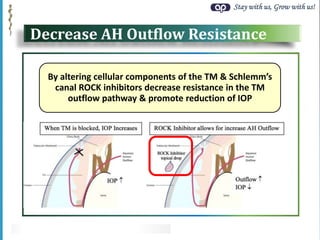
Decrease AH Outflow Resistance
By altering cellular components of the TM & Schlemm’s
canal ROCK inhibitors decrease resistance in the TM
outflow pathway & promote reduction of IOP
Stay with us, Grow with us!
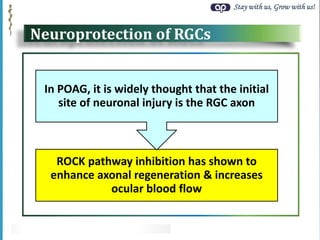
Neuroprotection of RGCs
ROCK pathway inhibition has shown to
enhance axonal regeneration & increases
ocular blood flow
In POAG, it is widely thought that the initial
site of neuronal injury is the RGC axon
Primary OAG: POAG
Stay with us, Grow with us!
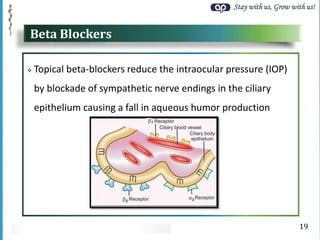
Beta Blockers
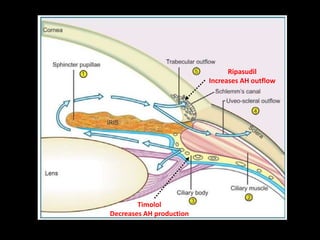
 Topical beta-blockers reduce the intraocular pressure (IOP)
by blockade of sympathetic nerve endings in the ciliary
epithelium causing a fall in aqueous humor production
19
Stay with us, Grow with us!
Timolol
 Used to treat increased pressure inside the eye such as in
ocular hypertension and glaucoma
 First beta blocker approved for topical use in treatment of
glaucoma in the United States (1978)
 Reduces intraocular pressure (IOP) 18–34% below baseline
within first few treatments
20
Stay with us, Grow with us!
Timolol
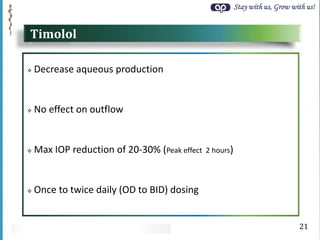
 Decrease aqueous production
 No effect on outflow
 Max IOP reduction of 20-30% (Peak effect 2 hours)
 Once to twice daily (OD to BID) dosing
21
22
Ripasudil
Increases AH outflow
Timolol
Decreases AH production
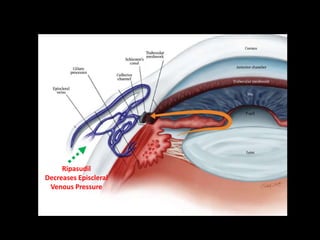
Ripasudil
Decreases Episcleral
Venous Pressure
24
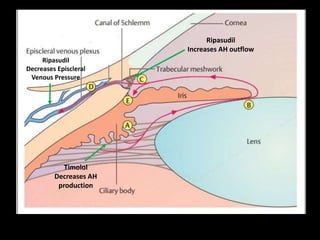
Ripasudil
Increases AH outflow
Ripasudil
Decreases Episcleral
Venous Pressure
Timolol
Decreases AH
production
Stay with us, Grow with us!
Clinical Studies
Stay with us, Grow with us!
J O p h t h a l m o l . 2 0 1 7 ; 2 0 1 7 : 7 0 7 9 6 4 5 .
Additive Efficacy
 Additive IOP-lowering effect by was seen with ripasudil through
increment of conventional outflow and with timolol through
suppressing the aqueous humor production
 Combination of ripasudil with timolol prolonged the duration of IOP-
lowering effects compared with single instillation of each agent
 Thus, ripasudil showed additional maximum IOP-lowering effect or
prolongation of IOP-lowering effect in combination with timolol
26
Stay with us, Grow with us!
C l i n O p h t h a l m o l . 2 0 2 0 ; 1 4 : 1 2 2 9 – 1 2 3 6 .
Additive Efficacy
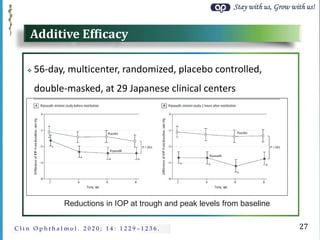
 56-day, multicenter, randomized, placebo controlled,
double-masked, at 29 Japanese clinical centers
27
Reductions in IOP at trough and peak levels from baseline
Stay with us, Grow with us!
Additive Efficacy
 Reductions in IOP at trough and peak levels from baseline in each week are
shown ripasudil – timolol study, the mean IOP reductions from baseline in
the ripasudil and placebo groups were −2.4 and −1.5 mm Hg before
instillation (9 AM) for a difference of 0.9mmHg and −2.9 and −1.3 mm Hg at
2 hours after instillation (11 AM) for a difference of 1.6mmHg
Conclusion
 The mean IOP reductions from baseline at trough and peak (2
hours after instillation) levels were −2.4 and −2.9mmHg (additive
effect – 0.9 -1.6mmHg)
28
Stay with us, Grow with us!
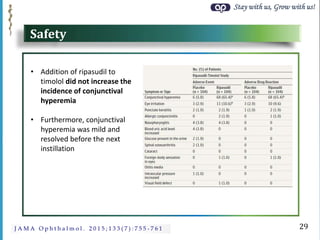
J A M A O p h t h a l m o l . 2 0 1 5 ; 1 3 3 ( 7 ) : 7 5 5 - 7 6 1
Safety
29
• Addition of ripasudil to
timolol did not increase the
incidence of conjunctival
hyperemia
• Furthermore, conjunctival
hyperemia was mild and
resolved before the next
instillation
Stay with us, Grow with us!
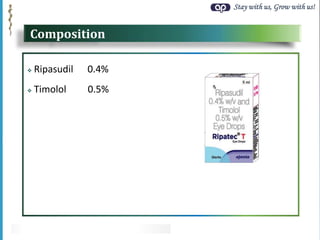
Composition
 Ripasudil 0.4%
 Timolol 0.5%
Stay with us, Grow with us!
Indications
 Primary Open Angle
 Ocular Hypertension
 Secondary Glaucoma
Stay with us, Grow with us!
Dosage
 One drop twice a day
33
Stay with us, Grow with us!
Benefits
 Lowers IOP by cytoskeletal restructuring of the TM &
decreases AH production
 Reduces Episcleral venous pressure
 Higher & prolong IOP control
 Prevents the death of RGCs & enhancing blood flow to
optic nerve
35

Combination Therapy for Glaucoma Management (1).pptx

  • 1.
  • 2.
    Stay with us,Grow with us! Glaucoma Indian Scenario 12 million people affected 1.2 million people blind from the disease >90% of cases remain undiagnosed Second Leading Cause of Irreversible Blindness Globally
  • 3.
  • 4.
    Stay with us,Grow with us! E u r o p e a n G l a u c o m a S o c i e t y , 1 9 9 8 Algorithm IOP >21 mm of Hg If No cardiac or Pulmonary Problem Beta Blocker IOP Controlled Failure Alternate Mono-therapy Failure Combination Failure Surgery Continue Treatment IOP Controlled
  • 5.
    Stay with us,Grow with us! S u r v e y o f O p h t h a l m o l o g y ; 2 0 0 3 V o l . 4 8 ( 1 ) : S 1 - S 3 Glaucoma: Treatment Goal  The goal of glaucoma treatment is to preserve the visual field of patients and prevent the loss of visual function associated with the disease
  • 6.
    Stay with us,Grow with us! IOP Control  First-line treatment – mono-therapy with a single agent  If IOP reduction is inadequate, treatment switched to  alternative mono-therapy  combined with a second agent
  • 7.
    Stay with us,Grow with us! IOP Elevation Drives Treatment 7
  • 8.
    Stay with us,Grow with us! J A M A O p h t h a l m o l . 2 0 1 5 ; 1 3 3 ( 7 ) : 7 5 5 - 7 6 1 Rationale  Prostaglandin analogues and β-blockers lower IOP by increasing aqueous humor uveoscleral outflow and decreasing aqueous humor production, respectively.  However, even with their use, the IOP of many patients is not adequately controlled because of adverse effects and/or nonresponse  Indeed, as indicated in the Ocular Hypertension Treatment Study, a number of patients required 2 or more medications to reach their target IOPs
  • 9.
    Stay with us,Grow with us! Evidences  Need to add medications under circumstances such as diminished IOP control with time or disease progression in spite of pressure control 9
  • 10.
    Stay with us,Grow with us! Multiple medications may be problem  Persistence with a fixed-dose glaucoma medication was better than with two or more separate bottles, and supports the idea that adding medication bottles reduces persistence with glaucoma medication  Thus, the use of fixed-combination formulations can simplify regimens and positively contribute to patient persistence. 10
  • 11.
    Stay with us,Grow with us! K l i n M o n b l A u g e n h e i l k d . 2 0 1 3 F e b ; 2 3 0 ( 2 ) : 1 3 3 - 4 0 Advantages of Fixed dose Combinations  Provide adequate 24-hour IOP control  Patient Compliance  Applied less frequently which may improve adherence  Lower amount of toxic preservatives  May eliminate the risk of a "washout”
  • 12.
    Stay with us,Grow with us! E x p e r t O p i n i o n o n D r u g S a f e t y ; V o l u m e 1 9 , 2 0 2 0 - I s s u e 1 1 Selecting the right FDC 12 Tolerability Adherence Efficacy Optimizes safety, long-term tolerability and 24-hour IOP efficacy while considering patient adherence
  • 13.
    Rho Kinase Inhibitors & Betablockers An Emerging therapy in Glaucoma Management Presenting…….
  • 14.
    Stay with us,Grow with us! Ripasudil  Ripasudil, a derivative of fasudil, a rho-associated protein kinase inhibitor or ROCK inhibitor (ROCK) used for the treatment of glaucoma and ocular hypertension
  • 15.
    Stay with us,Grow with us! Ripasudil - Role in Glaucoma Decrease AH outflow resistance Neuroprotection of RGCs Increase Ocular Blood Flow
  • 16.
    Stay with us,Grow with us! Space narrow Space widen Distribute IOP induced stress across the entire trabecular lamellae system Before After Ripasudil – Mechanism of action
  • 17.
    Stay with us,Grow with us! Decrease AH Outflow Resistance By altering cellular components of the TM & Schlemm’s canal ROCK inhibitors decrease resistance in the TM outflow pathway & promote reduction of IOP
  • 18.
    Stay with us,Grow with us! Neuroprotection of RGCs ROCK pathway inhibition has shown to enhance axonal regeneration & increases ocular blood flow In POAG, it is widely thought that the initial site of neuronal injury is the RGC axon Primary OAG: POAG
  • 19.
    Stay with us,Grow with us! Beta Blockers  Topical beta-blockers reduce the intraocular pressure (IOP) by blockade of sympathetic nerve endings in the ciliary epithelium causing a fall in aqueous humor production 19
  • 20.
    Stay with us,Grow with us! Timolol  Used to treat increased pressure inside the eye such as in ocular hypertension and glaucoma  First beta blocker approved for topical use in treatment of glaucoma in the United States (1978)  Reduces intraocular pressure (IOP) 18–34% below baseline within first few treatments 20
  • 21.
    Stay with us,Grow with us! Timolol  Decrease aqueous production  No effect on outflow  Max IOP reduction of 20-30% (Peak effect 2 hours)  Once to twice daily (OD to BID) dosing 21
  • 22.
  • 23.
  • 24.
    24 Ripasudil Increases AH outflow Ripasudil DecreasesEpiscleral Venous Pressure Timolol Decreases AH production
  • 25.
    Stay with us,Grow with us! Clinical Studies
  • 26.
    Stay with us,Grow with us! J O p h t h a l m o l . 2 0 1 7 ; 2 0 1 7 : 7 0 7 9 6 4 5 . Additive Efficacy  Additive IOP-lowering effect by was seen with ripasudil through increment of conventional outflow and with timolol through suppressing the aqueous humor production  Combination of ripasudil with timolol prolonged the duration of IOP- lowering effects compared with single instillation of each agent  Thus, ripasudil showed additional maximum IOP-lowering effect or prolongation of IOP-lowering effect in combination with timolol 26
  • 27.
    Stay with us,Grow with us! C l i n O p h t h a l m o l . 2 0 2 0 ; 1 4 : 1 2 2 9 – 1 2 3 6 . Additive Efficacy  56-day, multicenter, randomized, placebo controlled, double-masked, at 29 Japanese clinical centers 27 Reductions in IOP at trough and peak levels from baseline
  • 28.
    Stay with us,Grow with us! Additive Efficacy  Reductions in IOP at trough and peak levels from baseline in each week are shown ripasudil – timolol study, the mean IOP reductions from baseline in the ripasudil and placebo groups were −2.4 and −1.5 mm Hg before instillation (9 AM) for a difference of 0.9mmHg and −2.9 and −1.3 mm Hg at 2 hours after instillation (11 AM) for a difference of 1.6mmHg Conclusion  The mean IOP reductions from baseline at trough and peak (2 hours after instillation) levels were −2.4 and −2.9mmHg (additive effect – 0.9 -1.6mmHg) 28
  • 29.
    Stay with us,Grow with us! J A M A O p h t h a l m o l . 2 0 1 5 ; 1 3 3 ( 7 ) : 7 5 5 - 7 6 1 Safety 29 • Addition of ripasudil to timolol did not increase the incidence of conjunctival hyperemia • Furthermore, conjunctival hyperemia was mild and resolved before the next instillation
  • 31.
    Stay with us,Grow with us! Composition  Ripasudil 0.4%  Timolol 0.5%
  • 32.
    Stay with us,Grow with us! Indications  Primary Open Angle  Ocular Hypertension  Secondary Glaucoma
  • 33.
    Stay with us,Grow with us! Dosage  One drop twice a day 33
  • 34.
    Stay with us,Grow with us! Benefits  Lowers IOP by cytoskeletal restructuring of the TM & decreases AH production  Reduces Episcleral venous pressure  Higher & prolong IOP control  Prevents the death of RGCs & enhancing blood flow to optic nerve
  • 35.

Editor's Notes

  • #3 https://www.nhp.gov.in/world-glaucoma-week_pg
  • #15 Ref: https://en.wikipedia.org/wiki/Ripasudil
  • #17 JXT: distribute IOP induced stress across the entire trabecular lamellae system
  • #18 Clin Ophthalmol. 2014 May 9;8:883-90.; Yale J Biol Med. 2017 Mar; 90(1): 111–118. Med Hypothesis Discov Innov Ophthalmol. 2018 Fall; 7(3): 101–111;
  • #19 Ophthalmology. 2018 Nov; 125(11): 1741–1756. Pharmacol Ther. 2018 Sep;189:1-21.