NAME : Swathi.S.Rompicherla
BATCH NO : 06
CENTER NAME : Thane
SUBJECT : hospitality
YEAR : 2015 - 2016
Acknowledgement
I am using this opportunity to express my gratitude to everyone who
aspiring guidance, invaluably constructive criticism and friendly advise.
I express my warm thanks to Mr. Amitava Biswas for his guidance and
Hostess Training for the facility and opportunity.
Flow chart of flight catering
activities
The main things to keep in mind when
ordering are portion size and measurement,
packaging style and availability, and
cultural food terminology. When placing the
order, it is best to be specific with portion
sizes and have an understanding of metric
and imperial equivalences. For example, in
most of the world, a typical protein portion
is 4-6 ounces, while a U.S.-sized portion
is 8 ounces. You should be prepared to
translate your specific requests into the
local units of measurement, such as grams
or liters. Also, food presentation in other
countries may vary from what you’re
accustomed to. You will be most
successful if you are very specific in your
Menu planning
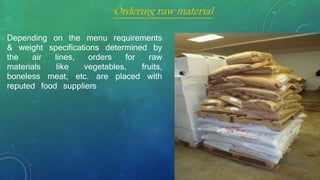
Ordering raw material
Depending on the menu requirements
& weight specifications determined by
the air lines, orders for raw
materials like vegetables, fruits,
boneless meat, etc. are placed with
reputed food suppliers
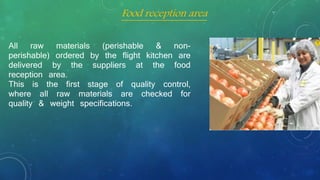
All raw materials (perishable & non-
perishable) ordered by the flight kitchen are
delivered by the suppliers at the food
reception area.
This is the first stage of quality control,
where all raw materials are checked for
quality & weight specifications.
Food reception area
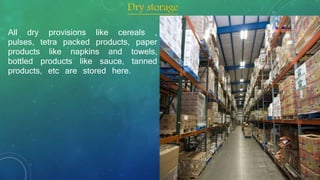
All dry provisions like cereals ,
pulses, tetra packed products, paper
products like napkins and towels,
bottled products like sauce, tanned
products, etc are stored here.
Dry storage
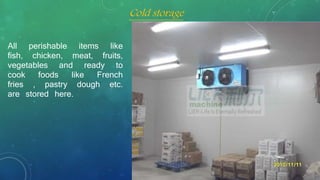
All perishable items like
fish, chicken, meat, fruits,
vegetables and ready to
cook foods like French
fries , pastry dough etc.
are stored here.
Cold storage
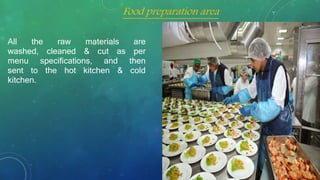
All the raw materials are
washed, cleaned & cut as per
menu specifications, and then
sent to the hot kitchen & cold
kitchen.
Food preparation area
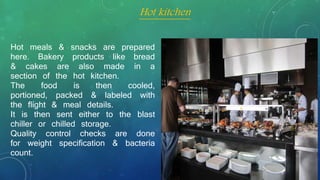
Hot meals & snacks are prepared
here. Bakery products like bread
& cakes are also made in a
section of the hot kitchen.
The food is then cooled,
portioned, packed & labeled with
the flight & meal details.
It is then sent either to the blast
chiller or chilled storage.
Quality control checks are done
for weight specification & bacteria
count.
Hot kitchen
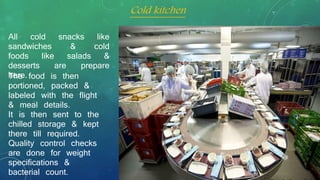
All cold snacks like
sandwiches & cold
foods like salads &
desserts are prepare
here.The food is then
portioned, packed &
labeled with the flight
& meal details.
It is then sent to the
chilled storage & kept
there till required.
Quality control checks
are done for weight
specifications &
bacterial count.
Cold kitchen
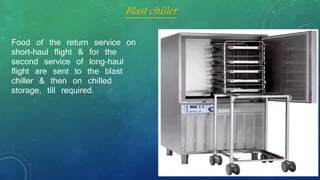
Food of the return service on
short-haul flight & for the
second service of long-haul
flight are sent to the blast
chiller & then on chilled
storage, till required.
Blast chiller
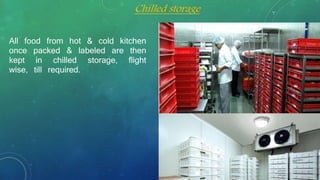
All food from hot & cold kitchen
once packed & labeled are then
kept in chilled storage, flight
wise, till required.
Chilled storage
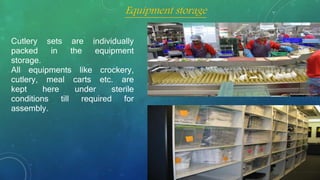
Cutlery sets are individually
packed in the equipment
storage.
All equipments like crockery,
cutlery, meal carts etc. are
kept here under sterile
conditions till required for
assembly.
Equipment storage
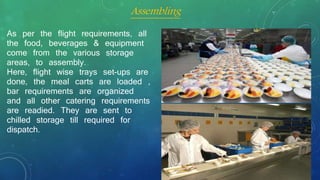
As per the flight requirements, all
the food, beverages & equipment
come from the various storage
areas, to assembly.
Here, flight wise trays set-ups are
done, the meal carts are loaded ,
bar requirements are organized
and all other catering requirements
are readied. They are sent to
chilled storage till required for
dispatch.
Assembling
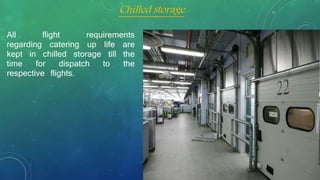
All flight requirements
regarding catering up life are
kept in chilled storage till the
time for dispatch to the
respective flights.
Chilled storage
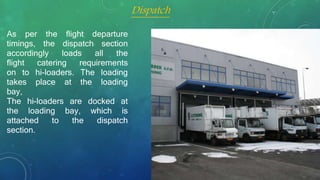
As per the flight departure
timings, the dispatch section
accordingly loads all the
flight catering requirements
on to hi-loaders. The loading
takes place at the loading
bay,
The hi-loaders are docked at
the loading bay, which is
attached to the dispatch
section.
Dispatch
Flight loading
The hi-loaders lock onto the
aircraft doors & the aircraft
galleys are then loaded. The
number of hi-loaders are sent
by one per galley. Loading of
all the galleys place at
simultaneously
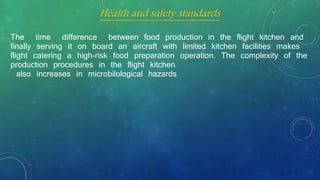
The time difference between food production in the flight kitchen and
finally serving it on board an aircraft with limited kitchen facilities makes
flight catering a high-risk food preparation operation. The complexity of the
production procedures in the flight kitchen
also increases in microbilological hazards
Health and safety standards
Reasons why health and safety procedures are important for
flight catering
 Dairy products containing raw milk, undercooked poultry and raw or
undercooked eggs, raw meat, raw shellfish and raw fish, raw
sprouts are never used as components of cold meals due to
known salmonella outbreaks.
 Food handlers must wear gloves and protective head gear in all
sections of the flight kitchen, to prevent hair and bacteria from
transferring to the food.
 Watches, bracelets and rings are not worn in the flight kitchen
because if these accidentally fall into the food it will cause metal
poisoning in the food.
 All non-vegetarian food like chicken, mutton and fish must be
boneless, so that a passenger does not choke on a piece of bone
 As per standard regulations different meals must be uplifted for the
pilot, co-pilot and cabin crew, in order to minimize sabotage caused
through food.
 All prepared food must be laboratory tested for the presence of
salmonella bacteria.
 All food once prepared must be according to the weight
specifications given by the airline, because for safety reasons
everything which is loaded on an aircraft is weight determined.
 Cutting boards in the pre-preparation area must be color coded
according to what they are used for, to prevent cross contamination
from one raw food to another.
Convenience food
 Convenience food, or tertiary processed food, is food that is
commercially prepared to optimize ease of consumption. Such food is
usually ready to eat without further preparation. It may also be
easily portable, have a long shelf life, or offer a combination of
such convenient traits.
 Convenience food is commercially prepared for ease of consumption.
Products designated as convenience food are often sold as hot,
ready-to-eat dishes; as room-temperature, shelf-stable products; or as
refrigerated or frozen food products that require minimal preparation
(typically just heating).
 Convenience foods and restaurants are similar in that they save
time. They differ in that restaurant food is ready to eat, whilst
convenience food usually requires rudimentary preparation. Both
typically cost more money and less time compared to home cooking
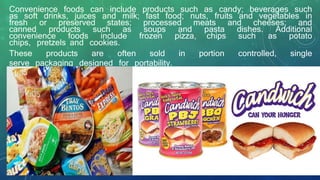
Convenience foods can include products such as candy; beverages such
as soft drinks, juices and milk; fast food; nuts, fruits and vegetables in
fresh or preserved states; processed meats and cheeses; and
canned products such as soups and pasta dishes. Additional
convenience foods include frozen pizza, chips such as potato
chips, pretzels and cookies.
These products are often sold in portion controlled, single
serve packaging designed for portability.
Bibliography
 Class notes.
 www.google.com.
 Wikipedia.
flight catering-hospitality

flight catering-hospitality

  • 2.
    NAME : Swathi.S.Rompicherla BATCHNO : 06 CENTER NAME : Thane SUBJECT : hospitality YEAR : 2015 - 2016
  • 3.
    Acknowledgement I am usingthis opportunity to express my gratitude to everyone who aspiring guidance, invaluably constructive criticism and friendly advise. I express my warm thanks to Mr. Amitava Biswas for his guidance and Hostess Training for the facility and opportunity.
  • 4.
    Flow chart offlight catering activities
  • 5.
    The main thingsto keep in mind when ordering are portion size and measurement, packaging style and availability, and cultural food terminology. When placing the order, it is best to be specific with portion sizes and have an understanding of metric and imperial equivalences. For example, in most of the world, a typical protein portion is 4-6 ounces, while a U.S.-sized portion is 8 ounces. You should be prepared to translate your specific requests into the local units of measurement, such as grams or liters. Also, food presentation in other countries may vary from what you’re accustomed to. You will be most successful if you are very specific in your Menu planning
  • 6.
    Ordering raw material Dependingon the menu requirements & weight specifications determined by the air lines, orders for raw materials like vegetables, fruits, boneless meat, etc. are placed with reputed food suppliers
  • 7.
    All raw materials(perishable & non- perishable) ordered by the flight kitchen are delivered by the suppliers at the food reception area. This is the first stage of quality control, where all raw materials are checked for quality & weight specifications. Food reception area
  • 8.
    All dry provisionslike cereals , pulses, tetra packed products, paper products like napkins and towels, bottled products like sauce, tanned products, etc are stored here. Dry storage
  • 9.
    All perishable itemslike fish, chicken, meat, fruits, vegetables and ready to cook foods like French fries , pastry dough etc. are stored here. Cold storage
  • 10.
    All the rawmaterials are washed, cleaned & cut as per menu specifications, and then sent to the hot kitchen & cold kitchen. Food preparation area
  • 11.
    Hot meals &snacks are prepared here. Bakery products like bread & cakes are also made in a section of the hot kitchen. The food is then cooled, portioned, packed & labeled with the flight & meal details. It is then sent either to the blast chiller or chilled storage. Quality control checks are done for weight specification & bacteria count. Hot kitchen
  • 12.
    All cold snackslike sandwiches & cold foods like salads & desserts are prepare here.The food is then portioned, packed & labeled with the flight & meal details. It is then sent to the chilled storage & kept there till required. Quality control checks are done for weight specifications & bacterial count. Cold kitchen
  • 13.
    Food of thereturn service on short-haul flight & for the second service of long-haul flight are sent to the blast chiller & then on chilled storage, till required. Blast chiller
  • 14.
    All food fromhot & cold kitchen once packed & labeled are then kept in chilled storage, flight wise, till required. Chilled storage
  • 15.
    Cutlery sets areindividually packed in the equipment storage. All equipments like crockery, cutlery, meal carts etc. are kept here under sterile conditions till required for assembly. Equipment storage
  • 16.
    As per theflight requirements, all the food, beverages & equipment come from the various storage areas, to assembly. Here, flight wise trays set-ups are done, the meal carts are loaded , bar requirements are organized and all other catering requirements are readied. They are sent to chilled storage till required for dispatch. Assembling
  • 17.
    All flight requirements regardingcatering up life are kept in chilled storage till the time for dispatch to the respective flights. Chilled storage
  • 18.
    As per theflight departure timings, the dispatch section accordingly loads all the flight catering requirements on to hi-loaders. The loading takes place at the loading bay, The hi-loaders are docked at the loading bay, which is attached to the dispatch section. Dispatch
  • 19.
    Flight loading The hi-loaderslock onto the aircraft doors & the aircraft galleys are then loaded. The number of hi-loaders are sent by one per galley. Loading of all the galleys place at simultaneously
  • 20.
    The time differencebetween food production in the flight kitchen and finally serving it on board an aircraft with limited kitchen facilities makes flight catering a high-risk food preparation operation. The complexity of the production procedures in the flight kitchen also increases in microbilological hazards Health and safety standards
  • 21.
    Reasons why healthand safety procedures are important for flight catering  Dairy products containing raw milk, undercooked poultry and raw or undercooked eggs, raw meat, raw shellfish and raw fish, raw sprouts are never used as components of cold meals due to known salmonella outbreaks.  Food handlers must wear gloves and protective head gear in all sections of the flight kitchen, to prevent hair and bacteria from transferring to the food.  Watches, bracelets and rings are not worn in the flight kitchen because if these accidentally fall into the food it will cause metal poisoning in the food.  All non-vegetarian food like chicken, mutton and fish must be boneless, so that a passenger does not choke on a piece of bone
  • 22.
     As perstandard regulations different meals must be uplifted for the pilot, co-pilot and cabin crew, in order to minimize sabotage caused through food.  All prepared food must be laboratory tested for the presence of salmonella bacteria.  All food once prepared must be according to the weight specifications given by the airline, because for safety reasons everything which is loaded on an aircraft is weight determined.  Cutting boards in the pre-preparation area must be color coded according to what they are used for, to prevent cross contamination from one raw food to another.
  • 23.
    Convenience food  Conveniencefood, or tertiary processed food, is food that is commercially prepared to optimize ease of consumption. Such food is usually ready to eat without further preparation. It may also be easily portable, have a long shelf life, or offer a combination of such convenient traits.  Convenience food is commercially prepared for ease of consumption. Products designated as convenience food are often sold as hot, ready-to-eat dishes; as room-temperature, shelf-stable products; or as refrigerated or frozen food products that require minimal preparation (typically just heating).  Convenience foods and restaurants are similar in that they save time. They differ in that restaurant food is ready to eat, whilst convenience food usually requires rudimentary preparation. Both typically cost more money and less time compared to home cooking
  • 24.
    Convenience foods caninclude products such as candy; beverages such as soft drinks, juices and milk; fast food; nuts, fruits and vegetables in fresh or preserved states; processed meats and cheeses; and canned products such as soups and pasta dishes. Additional convenience foods include frozen pizza, chips such as potato chips, pretzels and cookies. These products are often sold in portion controlled, single serve packaging designed for portability.
  • 25.
    Bibliography  Class notes. www.google.com.  Wikipedia.