Principles of
Marketing
Chapter 09
PRODUCT MIX STRATEGIES
Product Mix and Product Line
Product Mix
 The product mix is the set of all products offered
for sale by a company.
 A product mix has two dimensions:
 Breadth – different types of products on the bases of uses
and characteristics offered OR the number of product lines
carried.
 Depth - the variety of sizes, colors, and models offered
within each product line.
Product Line
 A product line is a group of products within the product mix
(made by the same company) that are closely related, either
because they function in a similar manner, are sold to the same
customer groups, are marketed through the same types of
outlets, or fall within given price ranges.
Product Mix Depth and Breadth
(Unilever Pakistan)
Breadth: Different Lines
Depth:Assortmentwithinaline
Ice Cream Beverages Food Dental Shampoo Skin Care Home Care
Deserts
Product Mix Strategies
vs
Product Mix Strategies
1. Positioning the Products
Marketers can choose from a variety of positioning strategies.
a. Positioning in relation to competitors
Pakistan Cables
Product Mix Strategies
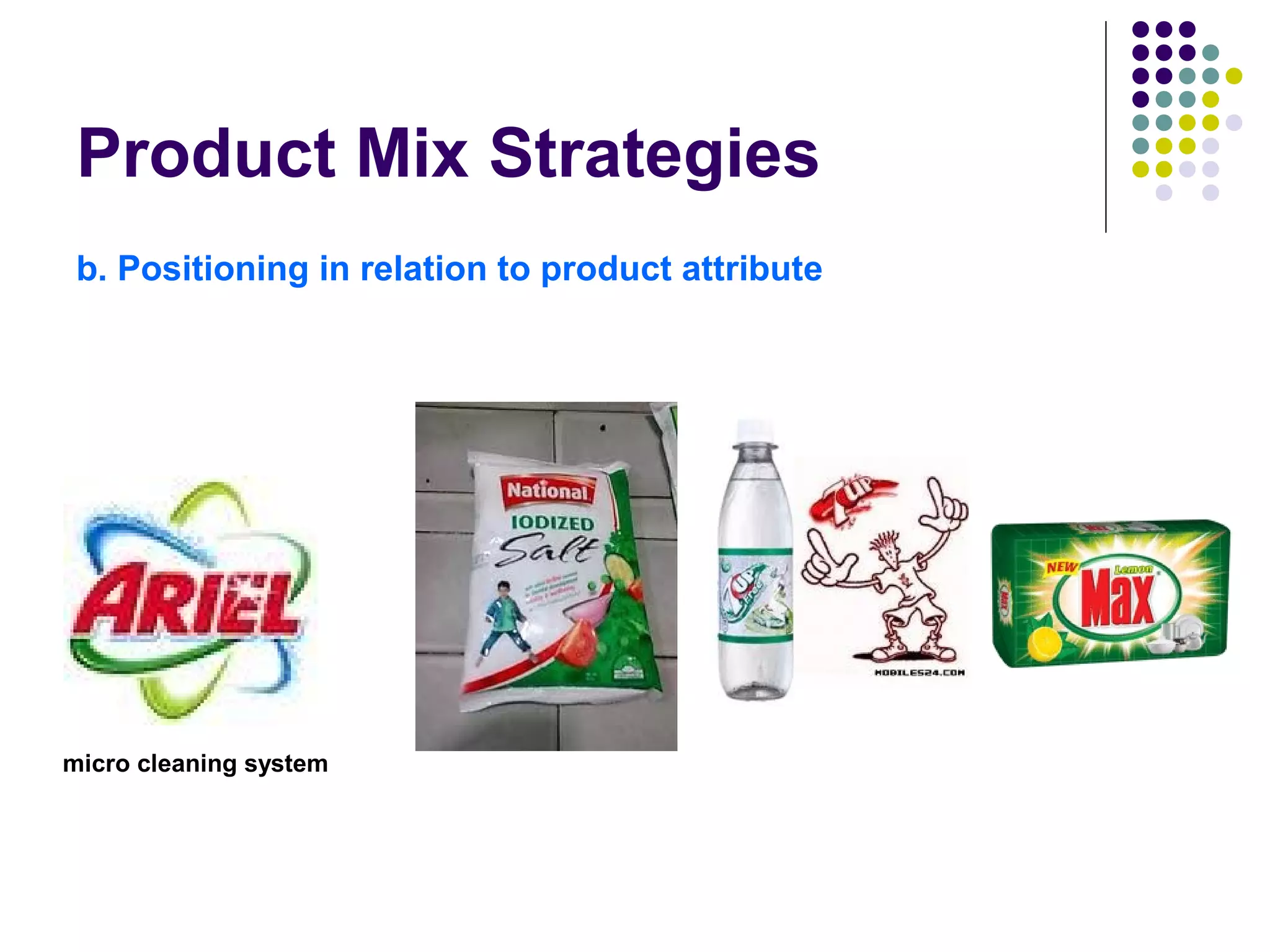
b. Positioning in relation to product attribute
micro cleaning system
Product Mix Strategies
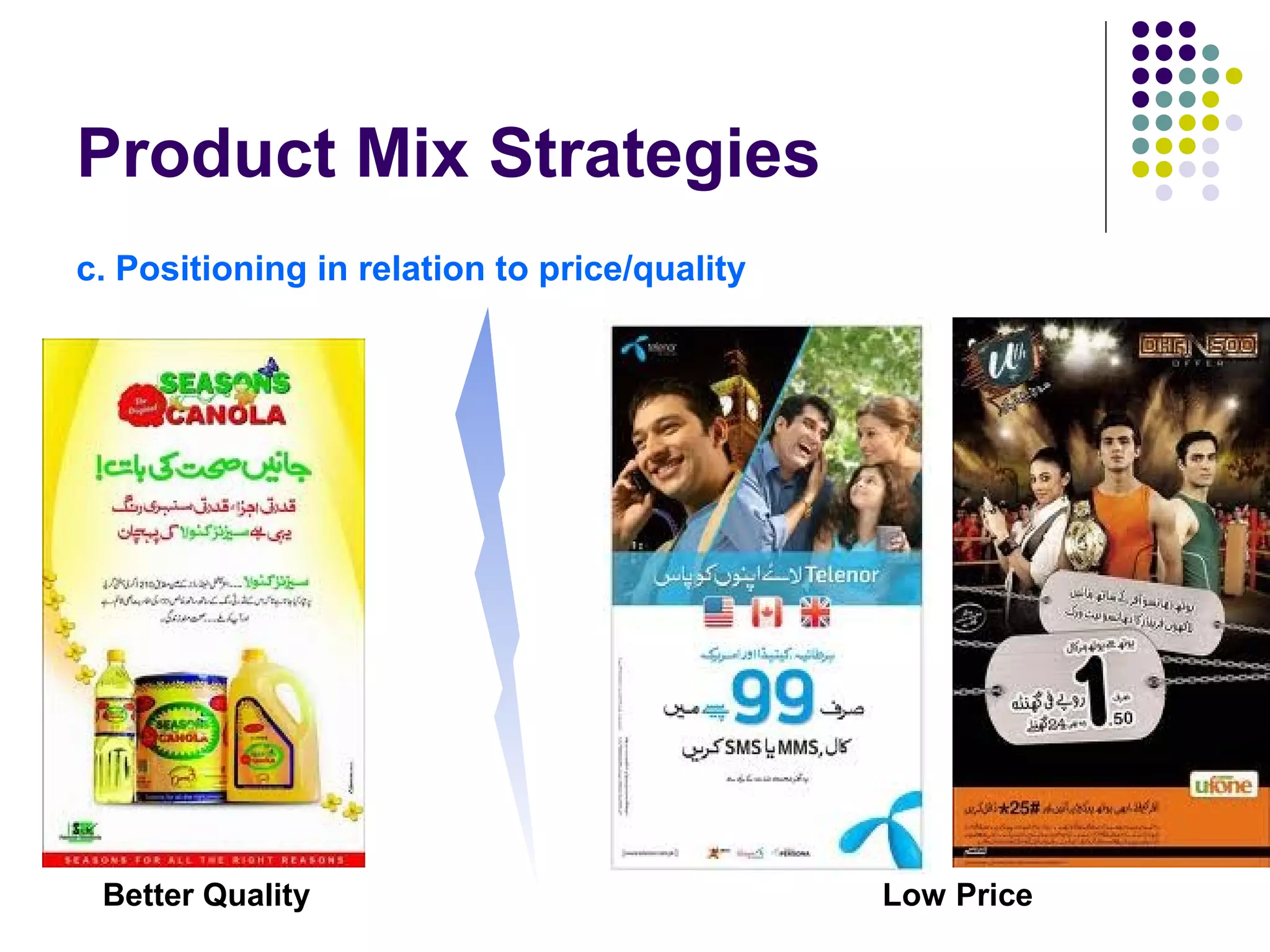
c. Positioning in relation to price/quality
Better Quality Low Price
Product Mix Strategies
2. Product Mix Expansion
There are two types:
a. Line Extension – When a company adds a similar
item into an existing line of products. For example
LU adding three new flavors to its Prince biscuit
brand.
b. Mix Extension – When a company adds a new
product line to its existing assortment of products.
For example Unilever adding a line of deodorants
to its existing products. The new line may be
related or unrelated to the current products. Also
the company can use an existing brand name or a
new brand name as in the case of Dove Soap and
Dove shampoo.
Product Mix Strategies
3. Alteration of Existing Products
Improving an existing product is more profitable and less risky than
developing a completely new product. Alteration may sustain its
appeal or may initiate its rebirth.
Product Mix Strategies
4. Product Mix Contraction
This strategy is carried out by either eliminating an entire line or by simplifying
the assortment within a line. The idea is to maintain higher profits through
fewer products.
Product Mix Strategies
5. Trading Up and Trading Down
Trading up means adding a higher
price product to a line in order to
attract a broader market. The new
products prestige may positively
impact existing product’s sales.
Trading Down means adding a low
price product to a company’s
product line. Company expects that
people who can’t afford the
expensive version will buy the low-
price version. The lower price
version carries some of the status
and some of the other more
substantive benefits of the higher-
price version.
Traded-down
Traded-up
Further
Traded-up
1
3
2
Product Life Cycle (PLC)
PLC
Product Life Cycle shows the path a typical
new product takes from its inception to its
discontinuation. In other words, it describes
the stages a product goes through from its
introduction, through its growth until it is
mature and then finally its decline.
PLC
Stages of PLC
Stage I: Introduction (pioneering stage)
 The introduction phase is when the public first sees or hears about a
product. The product appears in stores for the first time, and people
start seeing print and television ads.
 During this phase, a company may either choose to set prices high in
order to cover initial expenses that went into producing the product or to
cash in the hype and anticipation of the new technology or the company
may introduce the product with basic features at reduced prices in
hopes of gaining lots of new customers.
 The pioneering firm has to take the burden of promoting the product
category instead of just a brand.
 This stage is most risky and expensive. Many products fail at this stage.
 Adopted by innovators
Stages of PLC
SalesSales
CostsCosts
ProfitsProfits
Marketing ObjectivesMarketing Objectives
ProductProduct
PricePrice
LowLow
High cost per customerHigh cost per customer
NegativeNegative
Create product awareness and trialCreate product awareness and trial
Offer a basic productOffer a basic product
Use cost-plus formulaUse cost-plus formula
DistributionDistribution Build selective distributionBuild selective distribution
PromotionPromotion Heavy to entice product trialHeavy to entice product trial
Stages of PLC
Stage II: Growth (market acceptance stage)
 Sales and profits rise at an increasing rate
 Competitors enter the market
 Too many competitors may reduce the prices & shrink the margins
 For increased sales, distribution is expanded.
 Adopted by early adopters
Stages of PLC
SalesSales
CostsCosts
ProfitsProfits
Marketing ObjectivesMarketing Objectives
ProductProduct
PricePrice
Rapidly risingRapidly rising
Relatively Reduced cost per customerRelatively Reduced cost per customer
RisingRising
Maximize market shareMaximize market share
Offer extension, service, warrantyOffer extension, service, warranty
Reduce PricesReduce Prices
DistributionDistribution Build intensive distributionBuild intensive distribution
PromotionPromotion Reduce to take advantage of demandReduce to take advantage of demand
Stages of PLC
Stage III: Maturity
 During first part of the maturity, sales increase at a decreasing rate.
 Later at maturity, the sales level off (stagnation).
 Profits starts o decline in the beginning of this stage and diminish
later due to excessive price competition and large number of
competitors.
 Eventually the market reaches point of saturation.
 Most of early majority customers and late majority customers adopt
the product in this stage.
 To prevent the product, firms offer extensions and try to differentiate
their products. They also design new promotions and new uses of
the same product.
Stages of PLC
SalesSales
CostsCosts
ProfitsProfits
Marketing ObjectivesMarketing Objectives
ProductProduct
PricePrice
PeakPeak
Low cost per customerLow cost per customer
High but begin to declineHigh but begin to decline
Maximize profits while defending market shareMaximize profits while defending market share
Diversify brand and models (Differentiation)Diversify brand and models (Differentiation)
Match or best competitorsMatch or best competitors
DistributionDistribution Build more intensive distributionBuild more intensive distribution
PromotionPromotion Increase to encourage brand switchingIncrease to encourage brand switching
Stages of PLC
Stage IV: Decline
 For some products, decline is inevitable…
 type writer vs word processor
 board games vs video games
 tube lights vs energy saver (vs LEDs)
Stages of PLC
SalesSales
CostsCosts
ProfitsProfits
Marketing ObjectivesMarketing Objectives
ProductProduct
PricePrice
DecliningDeclining
Low cost per customerLow cost per customer
DecliningDeclining
Reduce expenditures and milk the brandReduce expenditures and milk the brand
Phase out weak itemsPhase out weak items
Cut priceCut price
DistributionDistribution Selective: phase out unprofitable outletsSelective: phase out unprofitable outlets
PromotionPromotion Reduce to minimum levelReduce to minimum level

09 product mix strategies

  • 1.
  • 2.
    Product Mix andProduct Line
  • 3.
    Product Mix  Theproduct mix is the set of all products offered for sale by a company.  A product mix has two dimensions:  Breadth – different types of products on the bases of uses and characteristics offered OR the number of product lines carried.  Depth - the variety of sizes, colors, and models offered within each product line.
  • 4.
    Product Line  Aproduct line is a group of products within the product mix (made by the same company) that are closely related, either because they function in a similar manner, are sold to the same customer groups, are marketed through the same types of outlets, or fall within given price ranges.
  • 5.
    Product Mix Depthand Breadth (Unilever Pakistan) Breadth: Different Lines Depth:Assortmentwithinaline Ice Cream Beverages Food Dental Shampoo Skin Care Home Care Deserts
  • 6.
  • 7.
    vs Product Mix Strategies 1.Positioning the Products Marketers can choose from a variety of positioning strategies. a. Positioning in relation to competitors Pakistan Cables
  • 8.
    Product Mix Strategies b.Positioning in relation to product attribute micro cleaning system
  • 9.
    Product Mix Strategies c.Positioning in relation to price/quality Better Quality Low Price
  • 10.
    Product Mix Strategies 2.Product Mix Expansion There are two types: a. Line Extension – When a company adds a similar item into an existing line of products. For example LU adding three new flavors to its Prince biscuit brand. b. Mix Extension – When a company adds a new product line to its existing assortment of products. For example Unilever adding a line of deodorants to its existing products. The new line may be related or unrelated to the current products. Also the company can use an existing brand name or a new brand name as in the case of Dove Soap and Dove shampoo.
  • 11.
    Product Mix Strategies 3.Alteration of Existing Products Improving an existing product is more profitable and less risky than developing a completely new product. Alteration may sustain its appeal or may initiate its rebirth.
  • 12.
    Product Mix Strategies 4.Product Mix Contraction This strategy is carried out by either eliminating an entire line or by simplifying the assortment within a line. The idea is to maintain higher profits through fewer products.
  • 13.
    Product Mix Strategies 5.Trading Up and Trading Down Trading up means adding a higher price product to a line in order to attract a broader market. The new products prestige may positively impact existing product’s sales. Trading Down means adding a low price product to a company’s product line. Company expects that people who can’t afford the expensive version will buy the low- price version. The lower price version carries some of the status and some of the other more substantive benefits of the higher- price version. Traded-down Traded-up Further Traded-up 1 3 2
  • 14.
  • 15.
    PLC Product Life Cycleshows the path a typical new product takes from its inception to its discontinuation. In other words, it describes the stages a product goes through from its introduction, through its growth until it is mature and then finally its decline.
  • 16.
  • 17.
    Stages of PLC StageI: Introduction (pioneering stage)  The introduction phase is when the public first sees or hears about a product. The product appears in stores for the first time, and people start seeing print and television ads.  During this phase, a company may either choose to set prices high in order to cover initial expenses that went into producing the product or to cash in the hype and anticipation of the new technology or the company may introduce the product with basic features at reduced prices in hopes of gaining lots of new customers.  The pioneering firm has to take the burden of promoting the product category instead of just a brand.  This stage is most risky and expensive. Many products fail at this stage.  Adopted by innovators
  • 18.
    Stages of PLC SalesSales CostsCosts ProfitsProfits MarketingObjectivesMarketing Objectives ProductProduct PricePrice LowLow High cost per customerHigh cost per customer NegativeNegative Create product awareness and trialCreate product awareness and trial Offer a basic productOffer a basic product Use cost-plus formulaUse cost-plus formula DistributionDistribution Build selective distributionBuild selective distribution PromotionPromotion Heavy to entice product trialHeavy to entice product trial
  • 19.
    Stages of PLC StageII: Growth (market acceptance stage)  Sales and profits rise at an increasing rate  Competitors enter the market  Too many competitors may reduce the prices & shrink the margins  For increased sales, distribution is expanded.  Adopted by early adopters
  • 20.
    Stages of PLC SalesSales CostsCosts ProfitsProfits MarketingObjectivesMarketing Objectives ProductProduct PricePrice Rapidly risingRapidly rising Relatively Reduced cost per customerRelatively Reduced cost per customer RisingRising Maximize market shareMaximize market share Offer extension, service, warrantyOffer extension, service, warranty Reduce PricesReduce Prices DistributionDistribution Build intensive distributionBuild intensive distribution PromotionPromotion Reduce to take advantage of demandReduce to take advantage of demand
  • 21.
    Stages of PLC StageIII: Maturity  During first part of the maturity, sales increase at a decreasing rate.  Later at maturity, the sales level off (stagnation).  Profits starts o decline in the beginning of this stage and diminish later due to excessive price competition and large number of competitors.  Eventually the market reaches point of saturation.  Most of early majority customers and late majority customers adopt the product in this stage.  To prevent the product, firms offer extensions and try to differentiate their products. They also design new promotions and new uses of the same product.
  • 22.
    Stages of PLC SalesSales CostsCosts ProfitsProfits MarketingObjectivesMarketing Objectives ProductProduct PricePrice PeakPeak Low cost per customerLow cost per customer High but begin to declineHigh but begin to decline Maximize profits while defending market shareMaximize profits while defending market share Diversify brand and models (Differentiation)Diversify brand and models (Differentiation) Match or best competitorsMatch or best competitors DistributionDistribution Build more intensive distributionBuild more intensive distribution PromotionPromotion Increase to encourage brand switchingIncrease to encourage brand switching
  • 23.
    Stages of PLC StageIV: Decline  For some products, decline is inevitable…  type writer vs word processor  board games vs video games  tube lights vs energy saver (vs LEDs)
  • 24.
    Stages of PLC SalesSales CostsCosts ProfitsProfits MarketingObjectivesMarketing Objectives ProductProduct PricePrice DecliningDeclining Low cost per customerLow cost per customer DecliningDeclining Reduce expenditures and milk the brandReduce expenditures and milk the brand Phase out weak itemsPhase out weak items Cut priceCut price DistributionDistribution Selective: phase out unprofitable outletsSelective: phase out unprofitable outlets PromotionPromotion Reduce to minimum levelReduce to minimum level