Sonia McDonald © 2019 Page | 1
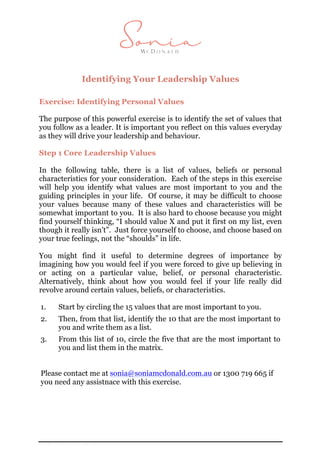
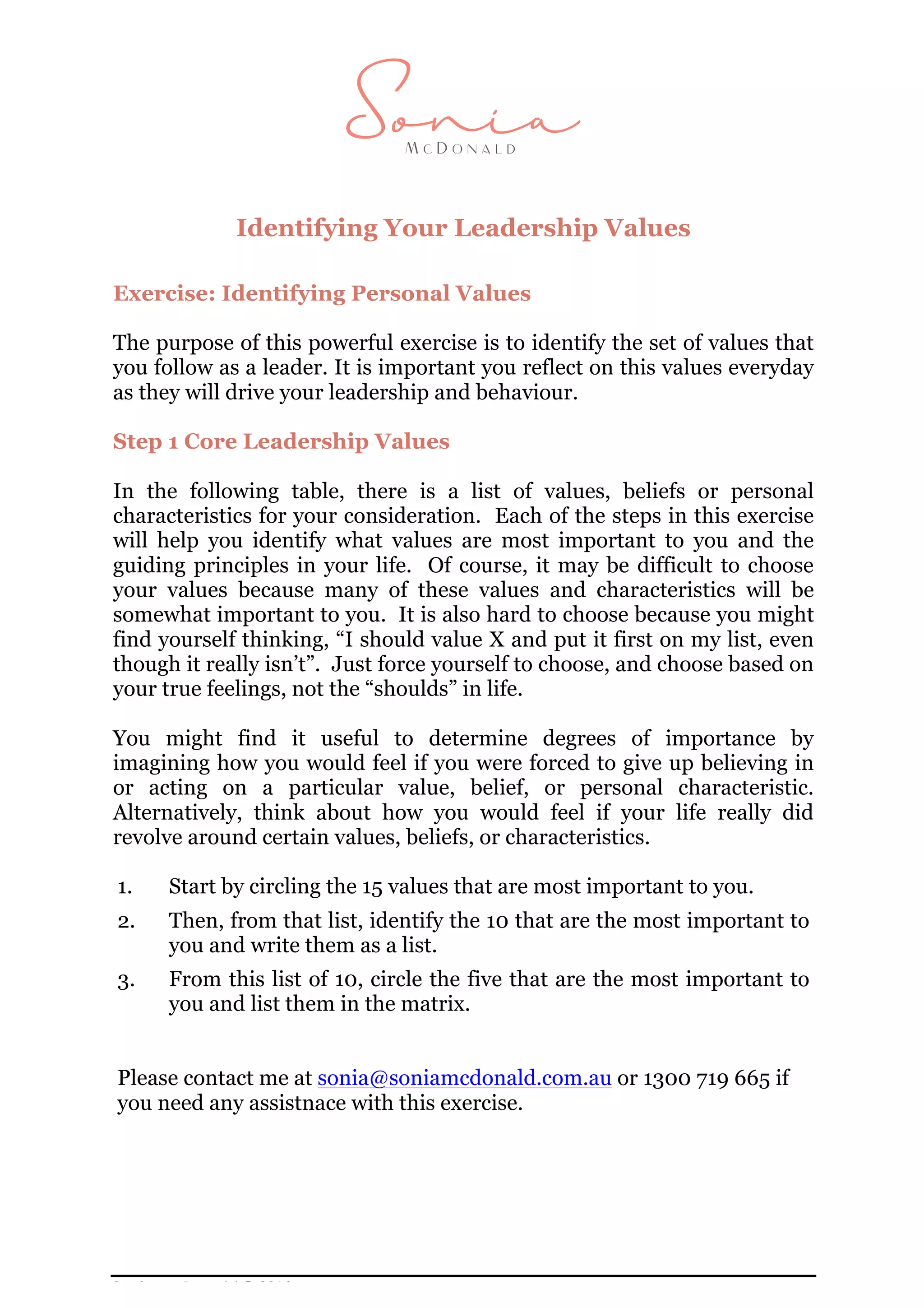
Identifying Your Leadership Values
Exercise: Identifying Personal Values
The purpose of this powerful exercise is to identify the set of values that
you follow as a leader. It is important you reflect on this values everyday
as they will drive your leadership and behaviour.
Step 1 Core Leadership Values
In the following table, there is a list of values, beliefs or personal
characteristics for your consideration. Each of the steps in this exercise
will help you identify what values are most important to you and the
guiding principles in your life. Of course, it may be difficult to choose
your values because many of these values and characteristics will be
somewhat important to you. It is also hard to choose because you might
find yourself thinking, “I should value X and put it first on my list, even
though it really isn’t”. Just force yourself to choose, and choose based on
your true feelings, not the “shoulds” in life.
You might find it useful to determine degrees of importance by
imagining how you would feel if you were forced to give up believing in
or acting on a particular value, belief, or personal characteristic.
Alternatively, think about how you would feel if your life really did
revolve around certain values, beliefs, or characteristics.
1. Start by circling the 15 values that are most important to you.
2. Then, from that list, identify the 10 that are the most important to
you and write them as a list.
3. From this list of 10, circle the five that are the most important to
you and list them in the matrix.
Please contact me at sonia@soniamcdonald.com.au or 1300 719 665 if
you need any assistnace with this exercise.
Sonia McDonald © 2019 Page | 2
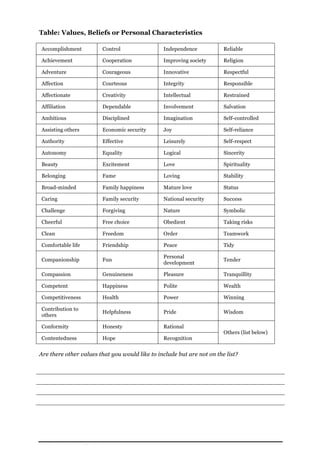
Table: Values, Beliefs or Personal Characteristics
Accomplishment Control Independence Reliable
Achievement Cooperation Improving society Religion
Adventure Courageous Innovative Respectful
Affection Courteous Integrity Responsible
Affectionate Creativity Intellectual Restrained
Affiliation Dependable Involvement Salvation
Ambitious Disciplined Imagination Self-controlled
Assisting others Economic security Joy Self-reliance
Authority Effective Leisurely Self-respect
Autonomy Equality Logical Sincerity
Beauty Excitement Love Spirituality
Belonging Fame Loving Stability
Broad-minded Family happiness Mature love Status
Caring Family security National security Success
Challenge Forgiving Nature Symbolic
Cheerful Free choice Obedient Taking risks
Clean Freedom Order Teamwork
Comfortable life Friendship Peace Tidy
Companionship Fun
Personal
development
Tender
Compassion Genuineness Pleasure Tranquillity
Competent Happiness Polite Wealth
Competitiveness Health Power Winning
Contribution to
others
Helpfulness Pride Wisdom
Conformity Honesty Rational
Others (list below)
Contentedness Hope Recognition
Are there other values that you would like to include but are not on the list?
Sonia McDonald © 2019 Page | 3
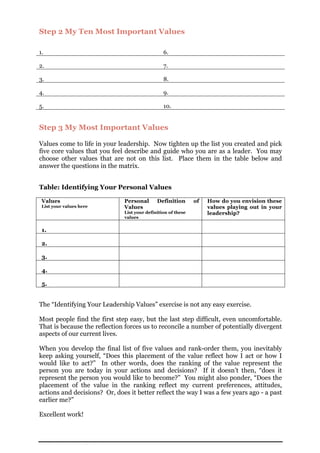
Step 2 My Ten Most Important Values
1. 6.
2. 7.
3. 8.
4. 9.
5. 10.
Step 3 My Most Important Values
Values come to life in your leadership. Now tighten up the list you created and pick
five core values that you feel describe and guide who you are as a leader. You may
choose other values that are not on this list. Place them in the table below and
answer the questions in the matrix.
Table: Identifying Your Personal Values
Values
List your values here
Personal Definition of
Values
List your definition of these
values
How do you envision these
values playing out in your
leadership?
1.
2.
3.
4.
5.
The “Identifying Your Leadership Values” exercise is not any easy exercise.
Most people find the first step easy, but the last step difficult, even uncomfortable.
That is because the reflection forces us to reconcile a number of potentially divergent
aspects of our current lives.
When you develop the final list of five values and rank-order them, you inevitably
keep asking yourself, “Does this placement of the value reflect how I act or how I
would like to act?” In other words, does the ranking of the value represent the
person you are today in your actions and decisions? If it doesn’t then, “does it
represent the person you would like to become?” You might also ponder, “Does the
placement of the value in the ranking reflect my current preferences, attitudes,
actions and decisions? Or, does it better reflect the way I was a few years ago - a past
earlier me?”
Excellent work!

Personal Values Exercise 2019

  • 1.
    Sonia McDonald ©2019 Page | 1 Identifying Your Leadership Values Exercise: Identifying Personal Values The purpose of this powerful exercise is to identify the set of values that you follow as a leader. It is important you reflect on this values everyday as they will drive your leadership and behaviour. Step 1 Core Leadership Values In the following table, there is a list of values, beliefs or personal characteristics for your consideration. Each of the steps in this exercise will help you identify what values are most important to you and the guiding principles in your life. Of course, it may be difficult to choose your values because many of these values and characteristics will be somewhat important to you. It is also hard to choose because you might find yourself thinking, “I should value X and put it first on my list, even though it really isn’t”. Just force yourself to choose, and choose based on your true feelings, not the “shoulds” in life. You might find it useful to determine degrees of importance by imagining how you would feel if you were forced to give up believing in or acting on a particular value, belief, or personal characteristic. Alternatively, think about how you would feel if your life really did revolve around certain values, beliefs, or characteristics. 1. Start by circling the 15 values that are most important to you. 2. Then, from that list, identify the 10 that are the most important to you and write them as a list. 3. From this list of 10, circle the five that are the most important to you and list them in the matrix. Please contact me at sonia@soniamcdonald.com.au or 1300 719 665 if you need any assistnace with this exercise.
  • 2.
    Sonia McDonald ©2019 Page | 2 Table: Values, Beliefs or Personal Characteristics Accomplishment Control Independence Reliable Achievement Cooperation Improving society Religion Adventure Courageous Innovative Respectful Affection Courteous Integrity Responsible Affectionate Creativity Intellectual Restrained Affiliation Dependable Involvement Salvation Ambitious Disciplined Imagination Self-controlled Assisting others Economic security Joy Self-reliance Authority Effective Leisurely Self-respect Autonomy Equality Logical Sincerity Beauty Excitement Love Spirituality Belonging Fame Loving Stability Broad-minded Family happiness Mature love Status Caring Family security National security Success Challenge Forgiving Nature Symbolic Cheerful Free choice Obedient Taking risks Clean Freedom Order Teamwork Comfortable life Friendship Peace Tidy Companionship Fun Personal development Tender Compassion Genuineness Pleasure Tranquillity Competent Happiness Polite Wealth Competitiveness Health Power Winning Contribution to others Helpfulness Pride Wisdom Conformity Honesty Rational Others (list below) Contentedness Hope Recognition Are there other values that you would like to include but are not on the list?
  • 3.
    Sonia McDonald ©2019 Page | 3 Step 2 My Ten Most Important Values 1. 6. 2. 7. 3. 8. 4. 9. 5. 10. Step 3 My Most Important Values Values come to life in your leadership. Now tighten up the list you created and pick five core values that you feel describe and guide who you are as a leader. You may choose other values that are not on this list. Place them in the table below and answer the questions in the matrix. Table: Identifying Your Personal Values Values List your values here Personal Definition of Values List your definition of these values How do you envision these values playing out in your leadership? 1. 2. 3. 4. 5. The “Identifying Your Leadership Values” exercise is not any easy exercise. Most people find the first step easy, but the last step difficult, even uncomfortable. That is because the reflection forces us to reconcile a number of potentially divergent aspects of our current lives. When you develop the final list of five values and rank-order them, you inevitably keep asking yourself, “Does this placement of the value reflect how I act or how I would like to act?” In other words, does the ranking of the value represent the person you are today in your actions and decisions? If it doesn’t then, “does it represent the person you would like to become?” You might also ponder, “Does the placement of the value in the ranking reflect my current preferences, attitudes, actions and decisions? Or, does it better reflect the way I was a few years ago - a past earlier me?” Excellent work!