Current Trends In Educational Programs
Dr. Sharon L. Burton, DBA, MBA, LSSBB, SWP, HCS
Current Trends In Educational Programs
Agenda
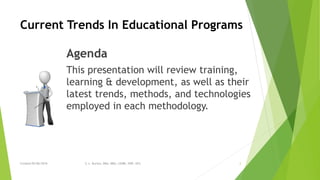
This presentation will review training,
learning & development, as well as their
latest trends, methods, and technologies
employed in each methodology.
Created 05/06/2016 S. L. Burton, DBA, MBA, LSSBB, SWP, HCS 2
Current Trends In Educational Programs
Objectives
 Define training methodology
 Define learning & development methodology
 Walk through the latest trends, methods, and
technologies employed
Created 05/06/2016 S. L. Burton, DBA, MBA, LSSBB, SWP, HCS 3
Current Trends In Educational Programs
Student Learning Objectives
After this presentation participants should be
able to:
 Define training methodology
 Explain learning & development methodology
 Expound on the latest trends, methods, and
technologies employed
Created 05/06/2016 S. L. Burton, DBA, MBA, LSSBB, SWP, HCS 4
Current Trends In Educational Programs
Training vs. Learning & Development
Training is:
 A limited aspect of learning and
development (Baker, 2014)
 One-dimensional offering of data and
information from the knowledge provider to
the learner (Baker, 2014; Boller, 2012)
 The ability to expand progressive skill,
agility, and discipline; consequently, the
more one learns, the better trained the
individual became
Created 05/06/2016 S. L. Burton, DBA, MBA, LSSBB, SWP, HCS
5
Current Trends In Educational Programs
Training vs. Learning & Development
Learning & Development incorporates:
 Learning environments which support the learning and
application of knowledge, skills, and capabilities
 The engagement of processes
 Process beginning with self-determination
 Learning environments as multi-dimensional (Eisend,
Evanschitzky, & Calanton, 2016)
Created 05/06/2016 S. L. Burton, DBA, MBA, LSSBB, SWP, HCS 6
Current Trends In Educational Programs
Trends in
Training,
Learning &
Development
Gamification
Bite-sized Education
M-Learning; Mobile Learning
Tutoring
Mentoring
Language Development
Coaching
Social Understanding
MOOCs
Adaptive Learning
Created 05/06/2016 S. L. Burton, DBA, MBA, LSSBB, SWP, HCS 7
Current Trends In Educational Programs
 Social Understanding: Web 2.0 technologies have
enabled companies to embrace learning through
social means; therefore, fostering a learning
culture through allowing enhanced engagement
Types of Social Understanding
Video Discussion Forums MOOCs
Micro-blogs Blogs Adaptive Learning
Sharing Communities of Practice Face Book
Created 05/06/2016 S. L. Burton, DBA, MBA, LSSBB, SWP, HCS 8
Current Trends In Educational Programs
 MOOCs: Whether open or closed license, this technology-
dependent enhanced way of learning offers flexibility,
and is a way to build ones’ career, widen the knowledge
base, and per (Kop & Fournier, 2010), is a part of daily
life
 Adaptive Learning: This method, allowing flexibility and
interaction, offers learners the ability to learn at their
individual paces
 Effectivity of these modalities lie in improving
efficiencies, as well as employee engagement and
retention since these modalities allow learners to build
their confidences and proficiency, and capability
Created 05/06/2016 S. L. Burton, DBA, MBA, LSSBB, SWP, HCS
9
Current Trends In Educational Programs
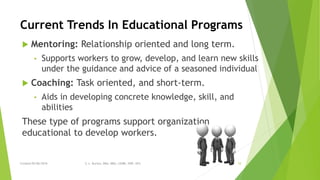
 Mentoring: Relationship oriented and long term.
• Supports workers to grow, develop, and learn new skills
under the guidance and advice of a seasoned individual
 Coaching: Task oriented, and short-term.
• Aids in developing concrete knowledge, skill, and
abilities
These type of programs support organization
educational to develop workers.
Created 05/06/2016 S. L. Burton, DBA, MBA, LSSBB, SWP, HCS 10
Current Trends In Educational Programs
 Bite-sized education: Supports education through
smaller portions of information designed to stick
due to the lessened attention spans caused by the
digital age of the quick ingestion of information
 Tutoring: Individualized or group tutoring
gatherings can be conducted online due to learners
now being able to access to the best tutoring and
education no matter the location
Created 05/06/2016 S. L. Burton, DBA, MBA, LSSBB, SWP, HCS 11
Current Trends In Educational Programs
 Gamification: Learning developed with gaming
techniques that uses tools and techniques
entrenched in the comprehension of human
behavior, inspiration, motivation, and
engagement
 M-learning (mobile learning): Learning through
digital means which supports (a) learning for
multiple locations, (b) learning through an
anytime and any location means, and ( C)
flexibility in learning
Created 05/06/2016 S. L. Burton, DBA, MBA, LSSBB, SWP, HCS 12
Current Trends In Educational Programs
TECHNOLOGY’S EFFECTS ON EDUCATION
 Ubiquitous technology is driving learning and
training in the workplace and academically
 Vigorous changes in learning environments are
pushed by the development of technology-driven
programs that boost employees’ and learners’
mutating capabilities
Created 05/06/2016 S. L. Burton, DBA, MBA, LSSBB, SWP, HCS 13
Current Trends In Educational Programs
TECHNOLOGY’S EFFECTS ON EDUCATION
 Mutating capabilities via competency-based
education pushed through developing technology
into the education environment
Created 05/06/2016 S. L. Burton, DBA, MBA, LSSBB, SWP, HCS
14
Current Trends In Educational Programs
Technological
Tools
Mobile
Phones
iPods
Learning
Management
Systems
Tablets
Strorage:
Dropbox Collaboration:
Google Drive
Screenshots:
Jing
Current Trends
In Educational
Programs
Interactive
Voice
Technology
Imaging
Technology
Groupware:
Go-to-
Meeting;
Adobe
Acrobat, etc.
Phablets
Gamification
Created 05/06/2016 S. L. Burton, DBA, MBA, LSSBB, SWP, HCS
15
Current Trends In Educational Programs
Advantages of Technologically
Enhanced and Advanced Learning
Access to a wide range of Expertise
Cost Reduction
Saves Travel Costs and Time
Saves Costs on Materials
Disadvantages of Technologically
Enhanced and Advanced Learning
Technology Issues
Voids in Technology Understanding by
All Participants
Visual Disabilities
Reduced Personal Interaction Between
Participants
Created 05/06/2016 S. L. Burton, DBA, MBA, LSSBB, SWP, HCS 16
Current Trends In Educational Programs
Educational Trend Impacts into 2017
 Education will continue to evolve through mobile technology
 Knowledge will be driven through evidence-based learning
supported by technology
 Organizations are being required to deliver transparency
 Technology will allow for more globalization
 Workers will push for basic skills to complete work
 Learner-driven personalized learning
 Alternative Credentialing (e.g., badging, MOOCs, etc.)
 Wearable technologies
Learning analytics
Created 05/06/2016 S. L. Burton, DBA, MBA, LSSBB, SWP, HCS 17
Current Trends In Educational Programs
References
Baker, T. (2014). What’s the difference between training and learning and
development? Training Journal. Retrieved from
https://www.trainingjournal.com
Boller, S. (2012, June 12). Training vs. learning: What’s the difference? [Web log
post]. Retrieved from http://www.bottomlineperformance.com/training-vs-
learning-whats-the-difference/
Eisend, M., Evanschitzky, H., & Calantone, R. J. (2016). The relative advantage of
marketing over technological capabilities in influencing new product
performance: The moderating role of country institutions. Journal of
International Marketing, 24(1), 41-56. doi:10.1509/jim.15.0068
Kop, R., & Fournier, H. (2010). New dimensions to self-directed learning in an open
networked learning environment, The International Journal of Self- Directed
Learning 7(2). Retrieved from http://www.sdlglobal.com/IJSDL/IJSDL7.2-
2010.pdf
Created 05/06/2016 S. L. Burton, DBA, MBA, LSSBB, SWP, HCS 18
Current Trends In Educational Programs
Question & answer Period
Created 05/06/2016 S. L. Burton, DBA, MBA, LSSBB, SWP, HCS 19
Current Trends In Educational Programs
Thank-you for Your Participation
Dr. Sharon L. Burton, DBA, MBA, LSSBB, SWP, HCS
P O Box 7274
Wilmington, DE 19803
Sharon.burton@slburton.com
Created 05/06/2016 S. L. Burton, DBA, MBA, LSSBB, SWP, HCS
20

Current Trends in Education Programs

  • 1.
    Current Trends InEducational Programs Dr. Sharon L. Burton, DBA, MBA, LSSBB, SWP, HCS
  • 2.
    Current Trends InEducational Programs Agenda This presentation will review training, learning & development, as well as their latest trends, methods, and technologies employed in each methodology. Created 05/06/2016 S. L. Burton, DBA, MBA, LSSBB, SWP, HCS 2
  • 3.
    Current Trends InEducational Programs Objectives  Define training methodology  Define learning & development methodology  Walk through the latest trends, methods, and technologies employed Created 05/06/2016 S. L. Burton, DBA, MBA, LSSBB, SWP, HCS 3
  • 4.
    Current Trends InEducational Programs Student Learning Objectives After this presentation participants should be able to:  Define training methodology  Explain learning & development methodology  Expound on the latest trends, methods, and technologies employed Created 05/06/2016 S. L. Burton, DBA, MBA, LSSBB, SWP, HCS 4
  • 5.
    Current Trends InEducational Programs Training vs. Learning & Development Training is:  A limited aspect of learning and development (Baker, 2014)  One-dimensional offering of data and information from the knowledge provider to the learner (Baker, 2014; Boller, 2012)  The ability to expand progressive skill, agility, and discipline; consequently, the more one learns, the better trained the individual became Created 05/06/2016 S. L. Burton, DBA, MBA, LSSBB, SWP, HCS 5
  • 6.
    Current Trends InEducational Programs Training vs. Learning & Development Learning & Development incorporates:  Learning environments which support the learning and application of knowledge, skills, and capabilities  The engagement of processes  Process beginning with self-determination  Learning environments as multi-dimensional (Eisend, Evanschitzky, & Calanton, 2016) Created 05/06/2016 S. L. Burton, DBA, MBA, LSSBB, SWP, HCS 6
  • 7.
    Current Trends InEducational Programs Trends in Training, Learning & Development Gamification Bite-sized Education M-Learning; Mobile Learning Tutoring Mentoring Language Development Coaching Social Understanding MOOCs Adaptive Learning Created 05/06/2016 S. L. Burton, DBA, MBA, LSSBB, SWP, HCS 7
  • 8.
    Current Trends InEducational Programs  Social Understanding: Web 2.0 technologies have enabled companies to embrace learning through social means; therefore, fostering a learning culture through allowing enhanced engagement Types of Social Understanding Video Discussion Forums MOOCs Micro-blogs Blogs Adaptive Learning Sharing Communities of Practice Face Book Created 05/06/2016 S. L. Burton, DBA, MBA, LSSBB, SWP, HCS 8
  • 9.
    Current Trends InEducational Programs  MOOCs: Whether open or closed license, this technology- dependent enhanced way of learning offers flexibility, and is a way to build ones’ career, widen the knowledge base, and per (Kop & Fournier, 2010), is a part of daily life  Adaptive Learning: This method, allowing flexibility and interaction, offers learners the ability to learn at their individual paces  Effectivity of these modalities lie in improving efficiencies, as well as employee engagement and retention since these modalities allow learners to build their confidences and proficiency, and capability Created 05/06/2016 S. L. Burton, DBA, MBA, LSSBB, SWP, HCS 9
  • 10.
    Current Trends InEducational Programs  Mentoring: Relationship oriented and long term. • Supports workers to grow, develop, and learn new skills under the guidance and advice of a seasoned individual  Coaching: Task oriented, and short-term. • Aids in developing concrete knowledge, skill, and abilities These type of programs support organization educational to develop workers. Created 05/06/2016 S. L. Burton, DBA, MBA, LSSBB, SWP, HCS 10
  • 11.
    Current Trends InEducational Programs  Bite-sized education: Supports education through smaller portions of information designed to stick due to the lessened attention spans caused by the digital age of the quick ingestion of information  Tutoring: Individualized or group tutoring gatherings can be conducted online due to learners now being able to access to the best tutoring and education no matter the location Created 05/06/2016 S. L. Burton, DBA, MBA, LSSBB, SWP, HCS 11
  • 12.
    Current Trends InEducational Programs  Gamification: Learning developed with gaming techniques that uses tools and techniques entrenched in the comprehension of human behavior, inspiration, motivation, and engagement  M-learning (mobile learning): Learning through digital means which supports (a) learning for multiple locations, (b) learning through an anytime and any location means, and ( C) flexibility in learning Created 05/06/2016 S. L. Burton, DBA, MBA, LSSBB, SWP, HCS 12
  • 13.
    Current Trends InEducational Programs TECHNOLOGY’S EFFECTS ON EDUCATION  Ubiquitous technology is driving learning and training in the workplace and academically  Vigorous changes in learning environments are pushed by the development of technology-driven programs that boost employees’ and learners’ mutating capabilities Created 05/06/2016 S. L. Burton, DBA, MBA, LSSBB, SWP, HCS 13
  • 14.
    Current Trends InEducational Programs TECHNOLOGY’S EFFECTS ON EDUCATION  Mutating capabilities via competency-based education pushed through developing technology into the education environment Created 05/06/2016 S. L. Burton, DBA, MBA, LSSBB, SWP, HCS 14
  • 15.
    Current Trends InEducational Programs Technological Tools Mobile Phones iPods Learning Management Systems Tablets Strorage: Dropbox Collaboration: Google Drive Screenshots: Jing Current Trends In Educational Programs Interactive Voice Technology Imaging Technology Groupware: Go-to- Meeting; Adobe Acrobat, etc. Phablets Gamification Created 05/06/2016 S. L. Burton, DBA, MBA, LSSBB, SWP, HCS 15
  • 16.
    Current Trends InEducational Programs Advantages of Technologically Enhanced and Advanced Learning Access to a wide range of Expertise Cost Reduction Saves Travel Costs and Time Saves Costs on Materials Disadvantages of Technologically Enhanced and Advanced Learning Technology Issues Voids in Technology Understanding by All Participants Visual Disabilities Reduced Personal Interaction Between Participants Created 05/06/2016 S. L. Burton, DBA, MBA, LSSBB, SWP, HCS 16
  • 17.
    Current Trends InEducational Programs Educational Trend Impacts into 2017  Education will continue to evolve through mobile technology  Knowledge will be driven through evidence-based learning supported by technology  Organizations are being required to deliver transparency  Technology will allow for more globalization  Workers will push for basic skills to complete work  Learner-driven personalized learning  Alternative Credentialing (e.g., badging, MOOCs, etc.)  Wearable technologies Learning analytics Created 05/06/2016 S. L. Burton, DBA, MBA, LSSBB, SWP, HCS 17
  • 18.
    Current Trends InEducational Programs References Baker, T. (2014). What’s the difference between training and learning and development? Training Journal. Retrieved from https://www.trainingjournal.com Boller, S. (2012, June 12). Training vs. learning: What’s the difference? [Web log post]. Retrieved from http://www.bottomlineperformance.com/training-vs- learning-whats-the-difference/ Eisend, M., Evanschitzky, H., & Calantone, R. J. (2016). The relative advantage of marketing over technological capabilities in influencing new product performance: The moderating role of country institutions. Journal of International Marketing, 24(1), 41-56. doi:10.1509/jim.15.0068 Kop, R., & Fournier, H. (2010). New dimensions to self-directed learning in an open networked learning environment, The International Journal of Self- Directed Learning 7(2). Retrieved from http://www.sdlglobal.com/IJSDL/IJSDL7.2- 2010.pdf Created 05/06/2016 S. L. Burton, DBA, MBA, LSSBB, SWP, HCS 18
  • 19.
    Current Trends InEducational Programs Question & answer Period Created 05/06/2016 S. L. Burton, DBA, MBA, LSSBB, SWP, HCS 19
  • 20.
    Current Trends InEducational Programs Thank-you for Your Participation Dr. Sharon L. Burton, DBA, MBA, LSSBB, SWP, HCS P O Box 7274 Wilmington, DE 19803 Sharon.burton@slburton.com Created 05/06/2016 S. L. Burton, DBA, MBA, LSSBB, SWP, HCS 20