



NURSING
ASSESSMENT
INTRODUCTION

 Assessment is the first step to determine health
status . It is the gathering of information to
have all the “necessary puzzle pieces ” to make
a clear picture of the person’s health status.

The entire plan of care is based on the data you
collect during this phase and make every effort
to ensure that your information is correct,
complete and organized in a way that you will
begin to get a sense of patterns of health or
illness.
DEFINITION OF ASSESSMENT

 According  to Carpenito :-Assessment is the
 deliberate and systematic collection of data to
 determine a client’s current and past health status
 functional status and to determine the client’s
 present and coping patterns.

 Atkinson  and murray(1991) :- Assessment is a
 part of each activity the nurse does for and with
 the patient.
PURPOSES OF ASSESSMENT
 To gather information regarding client’s health.
 To determine client’s normal function.

 To organize the collected information.

 To confirm hypothesis growing out of the nurse’s
  interview.
 To enhance investigation of nursing problems.

 To frame nursing diagonsis.

 It increases greater managing skill of handling
  patient’s problem.
 To identify the health problems.

 To identify client’s strengths.

 To identify need for health teaching.
TYPES OF ASSESSMENT

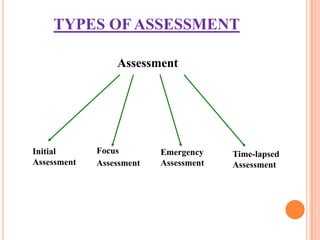
                 Assessment


Initial      Focus        Emergency    Time-lapsed
Assessment   Assessment   Assessment   Assessment
INITIAL ASSESSMENT


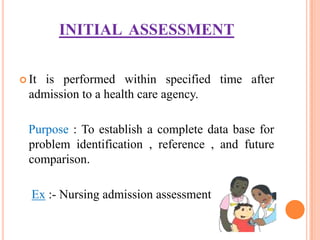
 It is performed within specified time after
  admission to a health care agency.

  Purpose : To establish a complete data base for
  problem identification , reference , and future
  comparison.

  Ex :- Nursing admission assessment
FOCUS OR ONGOING
         ASSESSMENT

 Ongoing   process integrated with nursing care.

 Purpose : To determine the status of a specific
 problem identified in an earlier assessment and
 to identify new or overlooked problem.

 Ex : Hourly assessment of client’s fluid intake
 and output chart.
EMERGENCY ASSESSMENT
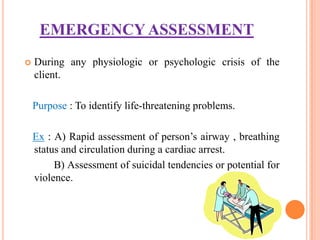
   During any physiologic or psychologic crisis of the
    client.

    Purpose : To identify life-threatening problems.

    Ex : A) Rapid assessment of person’s airway , breathing
    status and circulation during a cardiac arrest.
         B) Assessment of suicidal tendencies or potential for
    violence.
TIME-LAPSED ASSESSMENT
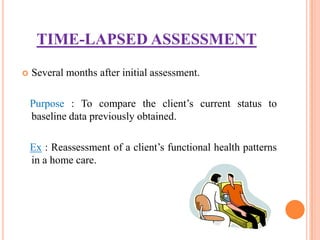
   Several months after initial assessment.

    Purpose : To compare the client’s current status to
    baseline data previously obtained.

    Ex : Reassessment of a client’s functional health patterns
    in a home care.
METHODS OF ASSESSMENT

 The   primary methods used to assess client’s are :

 1. Observing

 2. Interviewing

 3. Examining
OBSERVING

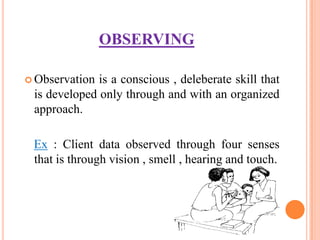
 Observation is a conscious , deleberate skill that
 is developed only through and with an organized
 approach.

 Ex : Client data observed through four senses
 that is through vision , smell , hearing and touch.
INTERVIEWING

   An interview is a planned communication or a
    conversation with a purpose.

    Ex : History taking

   There are two approaches for interviewing :
    -Directive approach
    -Non directive approach
EXAMINING

 The physical examination is a systematic data
 collection method that uses observational skills
 to detect health problems.

 To conduct the examination, the nurse uses
 techniques of inspection, auscultation, palpation
 and percussion.
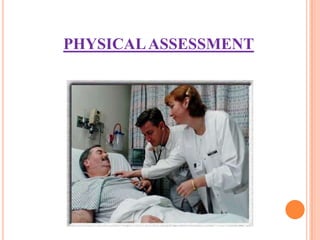
PHYSICAL ASSESSMENT
ASSESSMENT SEQUENCING


 • Head – to - Toe Assessment


 • Body Systems Assessment
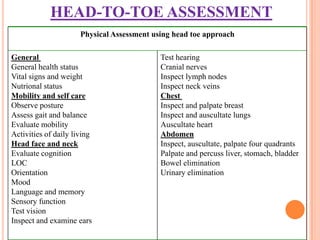
HEAD-TO-TOE ASSESSMENT
                      Physical Assessment using head toe approach

General                                     Test hearing
General health status                       Cranial nerves
Vital signs and weight                      Inspect lymph nodes
Nutrional status                            Inspect neck veins
Mobility and self care                      Chest
Observe posture                             Inspect and palpate breast
Assess gait and balance                     Inspect and auscultate lungs
Evaluate mobility                           Auscultate heart
Activities of daily living                  Abdomen
Head face and neck                          Inspect, auscultate, palpate four quadrants
Evaluate cognition                          Palpate and percuss liver, stomach, bladder
LOC                                         Bowel elimination
Orientation                                 Urinary elimination
Mood
Language and memory
Sensory function
Test vision
Inspect and examine ears
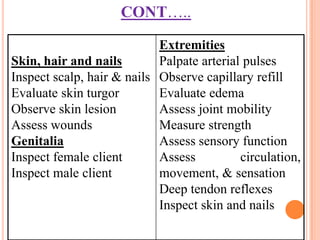
CONT…..

                            Extremities
Skin, hair and nails        Palpate arterial pulses
Inspect scalp, hair & nails Observe capillary refill
Evaluate skin turgor        Evaluate edema
Observe skin lesion         Assess joint mobility
Assess wounds               Measure strength
Genitalia                   Assess sensory function
Inspect female client       Assess          circulation,
Inspect male client         movement, & sensation
                            Deep tendon reflexes
                            Inspect skin and nails
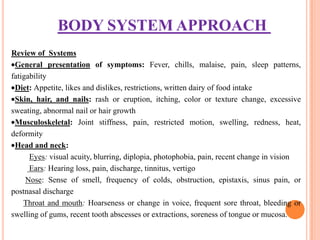
BODY SYSTEM APPROACH
Review of Systems
 General presentation of symptoms: Fever, chills, malaise, pain, sleep patterns,
fatigability
 Diet: Appetite, likes and dislikes, restrictions, written dairy of food intake
 Skin, hair, and nails: rash or eruption, itching, color or texture change, excessive
sweating, abnormal nail or hair growth
 Musculoskeletal: Joint stiffness, pain, restricted motion, swelling, redness, heat,
deformity
 Head and neck:
      Eyes: visual acuity, blurring, diplopia, photophobia, pain, recent change in vision
      Ears: Hearing loss, pain, discharge, tinnitus, vertigo
     Nose: Sense of smell, frequency of colds, obstruction, epistaxis, sinus pain, or
postnasal discharge
    Throat and mouth: Hoarseness or change in voice, frequent sore throat, bleeding or
swelling of gums, recent tooth abscesses or extractions, soreness of tongue or mucosa.
Endocrine and genital reproductive: Thyroid enlargement or tenderness, heat
or cold intolerance, unexplained weight change, polyuria, polydipsia, changes in
distribution of facial hair; Males: Puberty onset, difficulty with erections,
testicular pain, libido, infertility. Females: Menses {onset, regularity, duration
and amount}, Dysmenorrhea, last menstrual period, frequency of intercourse, age
at menopause, pregnancies {number, miscarriage, abortions} type of delivery,
complications, use of contraceptives; breasts {pain, tenderness, discharge,
lumps}

 Chest and lungs: Pain related to respiration, dyspnea, cyanosis, wheezing,
cough, sputum {character, and quantity}, exposure to tuberculosis (TB), last
chest X-ray
 Heart and blood vessels: Chest pain or distress, precipitating causes, timing
and duration, relieving factors, dyspnea, orthopnea, edema, hypertension,
exercise tolerance
Gastrointestinal: Appetite, digestion, food intolerance,
dysphagia, heartburn, nausea or vomiting, bowel regularity,
change in stool color, or contents, constipation or diarrhea,
flatulence or hemorrhoids
 Genitourinary: Dysuria, flank or suprapubic pain, urgency,
frequency, nocturia, hematuria, polyuria, hesitancy, loss in force
of stream, edema, sexually transmitted disease
 Neurological: Syncope, seizures, weakness or paralysis,
abnormalities of sensation or coordination, tremors, loss of
memory
 Psychiatric: Depression, mood changes, difficulty concentrating
nervousness, tension, suicidal thoughts, irritability.
 Pediatrics: along with systemic approach in case of pediatrics,
measure anthropometric measurement and neuromuscular
assessment.
ASSESSMENT TECHNIQUES


• Inspection
• Palpation
• Percussion
• Auscultation
ASSESSMENT TECHNIQUES -
             CONT.
          INSPECTION
• Close and careful visualization of the
person as a whole and of each body
system
• Ensure good lighting Perform at
every encounter with your client
ASSESSMENT TECHNIQUES - CONT.
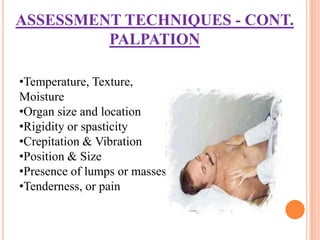
         PALPATION

•Temperature, Texture,
Moisture
•Organ size and location
•Rigidity or spasticity
•Crepitation & Vibration
•Position & Size
•Presence of lumps or masses
•Tenderness, or pain
ASSESSMENT TECHNIQUES - CONT.
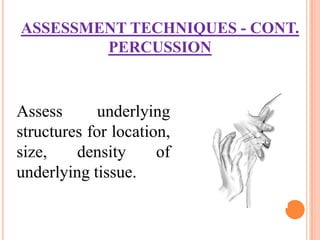
        PERCUSSION


Assess       underlying
structures for location,
size,    density      of
underlying tissue.
ASSESSMENT TECHNIQUES - CONT.
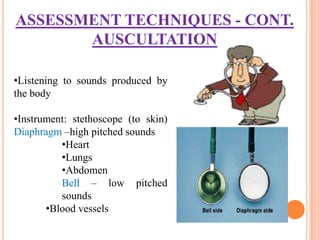
       AUSCULTATION

•Listening to sounds produced by
the body

•Instrument: stethoscope (to skin)
Diaphragm –high pitched sounds
          •Heart
          •Lungs
          •Abdomen
          Bell – low pitched
          sounds
       •Blood vessels
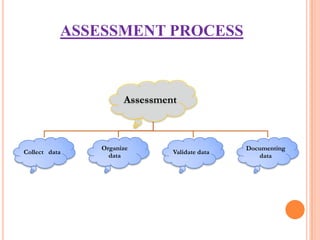
ASSESSMENT PROCESS


                     Assessment


               Organize                       Documenting
Collect data                  Validate data
                 data                            data
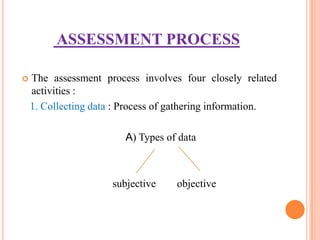
ASSESSMENT PROCESS

   The assessment process involves four closely related
    activities :
    1. Collecting data : Process of gathering information.

                         A) Types of data


                      subjective    objective
TYPES OF DATA

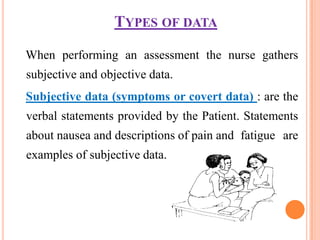
When performing an assessment the nurse gathers
subjective and objective data.
Subjective data (symptoms or covert data) : are the
verbal statements provided by the Patient. Statements
about nausea and descriptions of pain and fatigue are
examples of subjective data.
Objective data (signs or overt data): are
 detectable by an observer or can be measured or
 tested against an accepted standard. They can be
 seen, heard, felt, or smelt, and they are obtained by
 observation or physical examination. For example:
 discoloration of the skin.
SOURCES OF DATA
Data can be obtained from primary or secondary sources.
      The primary source of data is the patient. In most
instances the patient is considered to be the most accurate
reporter. The alert and oriented patient can provide
information about past illness and surgeries and present
signs, symptoms, and lifestyle.
      When the patient is unable to supply information
because of deterioration of mental status, age, or
seriousness of illness, secondary sources are used.
The Secondary sources of data include family
members, significant others, medical records,
diagnostic procedures,
Members of the patient's support system may be
able to furnish information about the patient's past
health status, current illness, allergies, and current
medications.
     Other health team professionals are also
helpful secondary      sources (Physicians, other
nurses.)
ORGANIZING DATA

Cluster the data into groups of information that
help you identify patterns of health or illnesses.

The nurse uses a written or computerized format
that organizes the assessment data systematically.
The format may be modified according to the
client's physical status.
VALIDATING DATA

The information gathered during the assessment
phase must be complete, factual, and accurate
because the nursing diagnosis and interventions
are based on this information.
                Validation is the act of "double-
checking" or verifying data to confirm that it is
accurate and factual.
DOCUMENTING DATA

To complete the assessment phase, the nurse records
client's data.
                 Accurate documentation is essential and
should include all data collected about the client's health
status.Data are recorded in a factual manner and not
interpreted by the nurse.
                 E.g.: the nurse record the client's breakfast
intake as" coffee 240 mL. Juice 120 mL, 1 egg". Rather
than as "appetite good".
nursing assessment

nursing assessment

  • 1.
  • 2.
    INTRODUCTION Assessment isthe first step to determine health status . It is the gathering of information to have all the “necessary puzzle pieces ” to make a clear picture of the person’s health status. The entire plan of care is based on the data you collect during this phase and make every effort to ensure that your information is correct, complete and organized in a way that you will begin to get a sense of patterns of health or illness.
  • 3.
    DEFINITION OF ASSESSMENT According to Carpenito :-Assessment is the deliberate and systematic collection of data to determine a client’s current and past health status functional status and to determine the client’s present and coping patterns.  Atkinson and murray(1991) :- Assessment is a part of each activity the nurse does for and with the patient.
  • 4.
    PURPOSES OF ASSESSMENT To gather information regarding client’s health.  To determine client’s normal function.  To organize the collected information.  To confirm hypothesis growing out of the nurse’s interview.  To enhance investigation of nursing problems.  To frame nursing diagonsis.  It increases greater managing skill of handling patient’s problem.  To identify the health problems.  To identify client’s strengths.  To identify need for health teaching.
  • 5.
    TYPES OF ASSESSMENT Assessment Initial Focus Emergency Time-lapsed Assessment Assessment Assessment Assessment
  • 6.
    INITIAL ASSESSMENT  Itis performed within specified time after admission to a health care agency. Purpose : To establish a complete data base for problem identification , reference , and future comparison. Ex :- Nursing admission assessment
  • 7.
    FOCUS OR ONGOING ASSESSMENT  Ongoing process integrated with nursing care. Purpose : To determine the status of a specific problem identified in an earlier assessment and to identify new or overlooked problem. Ex : Hourly assessment of client’s fluid intake and output chart.
  • 8.
    EMERGENCY ASSESSMENT  During any physiologic or psychologic crisis of the client. Purpose : To identify life-threatening problems. Ex : A) Rapid assessment of person’s airway , breathing status and circulation during a cardiac arrest. B) Assessment of suicidal tendencies or potential for violence.
  • 9.
    TIME-LAPSED ASSESSMENT  Several months after initial assessment. Purpose : To compare the client’s current status to baseline data previously obtained. Ex : Reassessment of a client’s functional health patterns in a home care.
  • 10.
    METHODS OF ASSESSMENT The primary methods used to assess client’s are : 1. Observing 2. Interviewing 3. Examining
  • 11.
    OBSERVING  Observation isa conscious , deleberate skill that is developed only through and with an organized approach. Ex : Client data observed through four senses that is through vision , smell , hearing and touch.
  • 12.
    INTERVIEWING  An interview is a planned communication or a conversation with a purpose. Ex : History taking  There are two approaches for interviewing : -Directive approach -Non directive approach
  • 13.
    EXAMINING  The physicalexamination is a systematic data collection method that uses observational skills to detect health problems.  To conduct the examination, the nurse uses techniques of inspection, auscultation, palpation and percussion.
  • 14.
  • 15.
    ASSESSMENT SEQUENCING •Head – to - Toe Assessment • Body Systems Assessment
  • 16.
    HEAD-TO-TOE ASSESSMENT Physical Assessment using head toe approach General Test hearing General health status Cranial nerves Vital signs and weight Inspect lymph nodes Nutrional status Inspect neck veins Mobility and self care Chest Observe posture Inspect and palpate breast Assess gait and balance Inspect and auscultate lungs Evaluate mobility Auscultate heart Activities of daily living Abdomen Head face and neck Inspect, auscultate, palpate four quadrants Evaluate cognition Palpate and percuss liver, stomach, bladder LOC Bowel elimination Orientation Urinary elimination Mood Language and memory Sensory function Test vision Inspect and examine ears
  • 17.
    CONT….. Extremities Skin, hair and nails Palpate arterial pulses Inspect scalp, hair & nails Observe capillary refill Evaluate skin turgor Evaluate edema Observe skin lesion Assess joint mobility Assess wounds Measure strength Genitalia Assess sensory function Inspect female client Assess circulation, Inspect male client movement, & sensation Deep tendon reflexes Inspect skin and nails
  • 18.
    BODY SYSTEM APPROACH Reviewof Systems General presentation of symptoms: Fever, chills, malaise, pain, sleep patterns, fatigability Diet: Appetite, likes and dislikes, restrictions, written dairy of food intake Skin, hair, and nails: rash or eruption, itching, color or texture change, excessive sweating, abnormal nail or hair growth Musculoskeletal: Joint stiffness, pain, restricted motion, swelling, redness, heat, deformity Head and neck: Eyes: visual acuity, blurring, diplopia, photophobia, pain, recent change in vision Ears: Hearing loss, pain, discharge, tinnitus, vertigo Nose: Sense of smell, frequency of colds, obstruction, epistaxis, sinus pain, or postnasal discharge Throat and mouth: Hoarseness or change in voice, frequent sore throat, bleeding or swelling of gums, recent tooth abscesses or extractions, soreness of tongue or mucosa.
  • 19.
    Endocrine and genitalreproductive: Thyroid enlargement or tenderness, heat or cold intolerance, unexplained weight change, polyuria, polydipsia, changes in distribution of facial hair; Males: Puberty onset, difficulty with erections, testicular pain, libido, infertility. Females: Menses {onset, regularity, duration and amount}, Dysmenorrhea, last menstrual period, frequency of intercourse, age at menopause, pregnancies {number, miscarriage, abortions} type of delivery, complications, use of contraceptives; breasts {pain, tenderness, discharge, lumps} Chest and lungs: Pain related to respiration, dyspnea, cyanosis, wheezing, cough, sputum {character, and quantity}, exposure to tuberculosis (TB), last chest X-ray Heart and blood vessels: Chest pain or distress, precipitating causes, timing and duration, relieving factors, dyspnea, orthopnea, edema, hypertension, exercise tolerance
  • 20.
    Gastrointestinal: Appetite, digestion,food intolerance, dysphagia, heartburn, nausea or vomiting, bowel regularity, change in stool color, or contents, constipation or diarrhea, flatulence or hemorrhoids Genitourinary: Dysuria, flank or suprapubic pain, urgency, frequency, nocturia, hematuria, polyuria, hesitancy, loss in force of stream, edema, sexually transmitted disease Neurological: Syncope, seizures, weakness or paralysis, abnormalities of sensation or coordination, tremors, loss of memory Psychiatric: Depression, mood changes, difficulty concentrating nervousness, tension, suicidal thoughts, irritability. Pediatrics: along with systemic approach in case of pediatrics, measure anthropometric measurement and neuromuscular assessment.
  • 21.
    ASSESSMENT TECHNIQUES • Inspection •Palpation • Percussion • Auscultation
  • 22.
    ASSESSMENT TECHNIQUES - CONT. INSPECTION • Close and careful visualization of the person as a whole and of each body system • Ensure good lighting Perform at every encounter with your client
  • 23.
    ASSESSMENT TECHNIQUES -CONT. PALPATION •Temperature, Texture, Moisture •Organ size and location •Rigidity or spasticity •Crepitation & Vibration •Position & Size •Presence of lumps or masses •Tenderness, or pain
  • 24.
    ASSESSMENT TECHNIQUES -CONT. PERCUSSION Assess underlying structures for location, size, density of underlying tissue.
  • 25.
    ASSESSMENT TECHNIQUES -CONT. AUSCULTATION •Listening to sounds produced by the body •Instrument: stethoscope (to skin) Diaphragm –high pitched sounds •Heart •Lungs •Abdomen Bell – low pitched sounds •Blood vessels
  • 26.
    ASSESSMENT PROCESS Assessment Organize Documenting Collect data Validate data data data
  • 27.
    ASSESSMENT PROCESS  The assessment process involves four closely related activities : 1. Collecting data : Process of gathering information. A) Types of data subjective objective
  • 28.
    TYPES OF DATA Whenperforming an assessment the nurse gathers subjective and objective data. Subjective data (symptoms or covert data) : are the verbal statements provided by the Patient. Statements about nausea and descriptions of pain and fatigue are examples of subjective data.
  • 29.
    Objective data (signsor overt data): are detectable by an observer or can be measured or tested against an accepted standard. They can be seen, heard, felt, or smelt, and they are obtained by observation or physical examination. For example: discoloration of the skin.
  • 30.
    SOURCES OF DATA Datacan be obtained from primary or secondary sources. The primary source of data is the patient. In most instances the patient is considered to be the most accurate reporter. The alert and oriented patient can provide information about past illness and surgeries and present signs, symptoms, and lifestyle. When the patient is unable to supply information because of deterioration of mental status, age, or seriousness of illness, secondary sources are used.
  • 31.
    The Secondary sourcesof data include family members, significant others, medical records, diagnostic procedures, Members of the patient's support system may be able to furnish information about the patient's past health status, current illness, allergies, and current medications. Other health team professionals are also helpful secondary sources (Physicians, other nurses.)
  • 32.
    ORGANIZING DATA Cluster thedata into groups of information that help you identify patterns of health or illnesses. The nurse uses a written or computerized format that organizes the assessment data systematically. The format may be modified according to the client's physical status.
  • 33.
    VALIDATING DATA The informationgathered during the assessment phase must be complete, factual, and accurate because the nursing diagnosis and interventions are based on this information. Validation is the act of "double- checking" or verifying data to confirm that it is accurate and factual.
  • 34.
    DOCUMENTING DATA To completethe assessment phase, the nurse records client's data. Accurate documentation is essential and should include all data collected about the client's health status.Data are recorded in a factual manner and not interpreted by the nurse. E.g.: the nurse record the client's breakfast intake as" coffee 240 mL. Juice 120 mL, 1 egg". Rather than as "appetite good".