Servicise:
Thinking
beyond
products
N EXT 2 0 1 3 / A P R I L 2 3 , 2 0 1 2
Katrin Dribbisch &
Martin Jordan,
Service Design Berlin
What to expect from today
• Why service design matters
• Designing products vs. designing services
• Service design mindset
• Useful service design tools
What?
Who?
How?
• Hands-on session
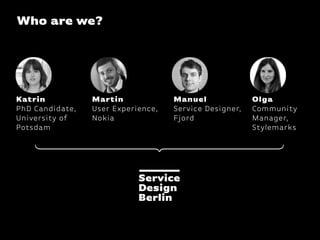
Katrin
PhD Candidate,
University of
Potsdam
Who are we?
Manuel
Service Designer,
Fjord
Olga
Community
Manager,
Stylemarks
Martin
User Experience,
Nokia
Why service design
matters
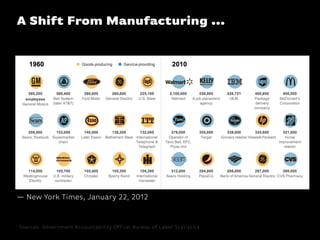
A Shift From Manufacturing ...
Sources: Government Accountability Office; Bureau of Labor Statistics
— New York Times, January 22, 2012
Almost certainly you are building a service, not a
product.
Services could be considered the new products.
Products do not vanish but are embedded in an
ecosystem. This service ecosystem encompasses
all touchpoints with the user.
In other words ...
From products
to services
“[Everything] that you can’t drop on your foot,
ranging from hairdressing to websites.”
What is a service?
— M AT T H E W B I S H O P
The Economist
* – in ‘Essential Economics: An A to Z Guide’, 2004
*
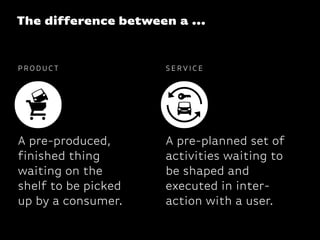
The difference between a ...
P R O D U C T S E R V I C E
A pre-produced,
finished thing
waiting on the
shelf to be picked
up by a consumer.
A pre-planned set of
activities waiting to
be shaped and
executed in inter-
action with a user.
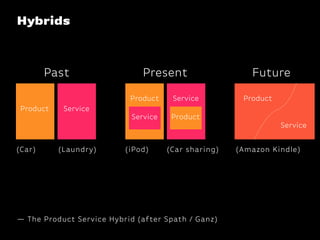
Hybrids
Past
Product Service
Present
Product Service
Service Product
— The Product Service Hybrid (after Spath / Ganz)
Future
Service
Product
(Amazon Kindle)(Car) (Car sharing)(Laundry) (iPod)
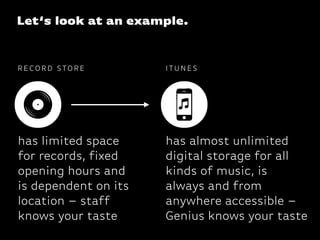
Let‘s look at an example.
R E CO R D STO R E I T U N E S
has limited space
for records, fixed
opening hours and
is dependent on its
location – staff
knows your taste
has almost unlimited
digital storage for all
kinds of music, is
always and from
anywhere accessible –
Genius knows your taste
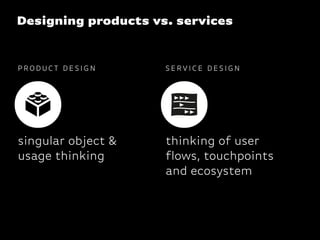
P R O D U C T D E S I G N
singular object &
usage thinking
S E R V I C E D E S I G N
thinking of user
flows, touchpoints
and ecosystem
Designing products vs. services
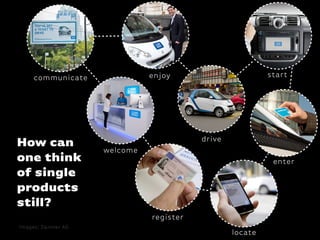
How can
one think
of single
products
still?
Images: Daimler AG
communicate
drive
welcome
register
locate
enter
startenjoy
A service design
mindset
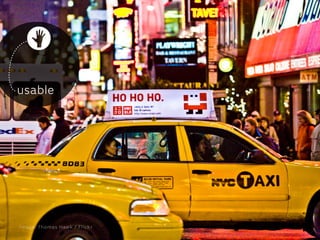
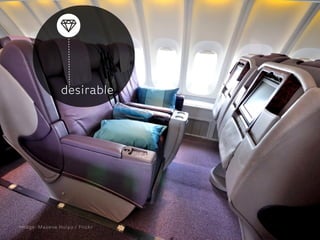
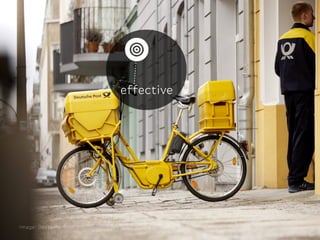
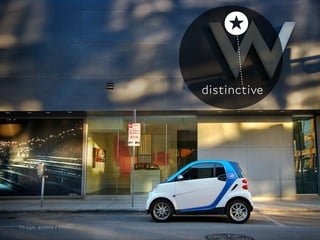
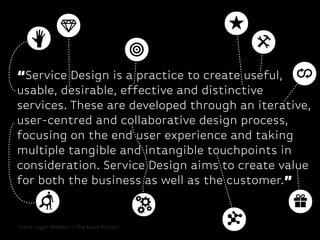
“Service Design is a practice to create useful,
usable, desirable, effective and distinctive
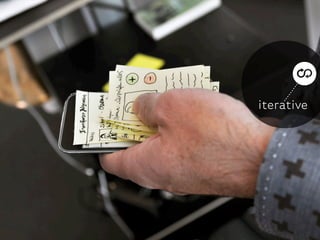
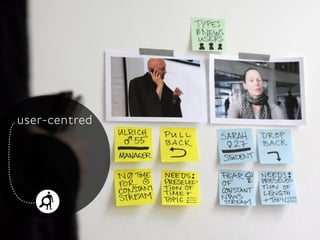
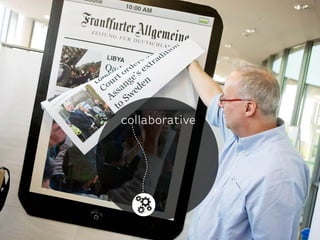
services. These are developed through an iterative,
user-centred and collaborative design process,
focusing on the end user experience and taking
multiple tangible and intangible touchpoints in
consideration. Service Design aims to create value
for both the business as well as the customer.”
Icons: Ugur Akdemir / The Noun Project
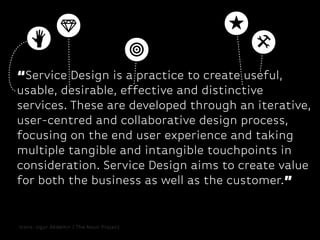
“Service Design is a practice to create useful,
usable, desirable, effective and distinctive
services. These are developed through an iterative,
user-centred and collaborative design process,
focusing on the end user experience and taking
multiple tangible and intangible touchpoints in
consideration. Service Design aims to create value
for both the business as well as the customer.”
Icons: Ugur Akdemir / The Noun Project
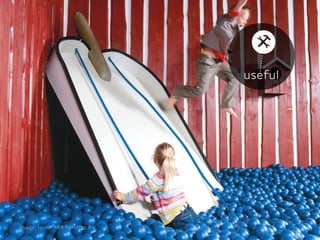
Image: Inter IKEA Systems B.V.
useful
Image: Thomas Hawk / Flickr
usable
desirable
Image: Maxene Huiyu / Flickr
Image: Deutsche Post DHL
effective
distinctive
Image: atmtx / Flickr
“Service Design is a practice to create useful,
usable, desirable, effective and distinctive
services. These are developed through an iterative,
user-centred and collaborative design process,
focusing on the end user experience and taking
multiple tangible and intangible touchpoints in
consideration. Service Design aims to create value
for both the business as well as the customer.”
Icons: Ugur Akdemir / The Noun Project
iterative
user-centred
collaborative
“Service Design is a practice to create useful,
usable, desirable, effective and distinctive
services. These are developed through an iterative,
user-centred and collaborative design process,
focusing on the end user experience and taking
multiple tangible and intangible touchpoints in
consideration. Service Design aims to create value
for both the business as well as the customer.”
Icons: Ugur Akdemir / The Noun Project
Useful service
design tools
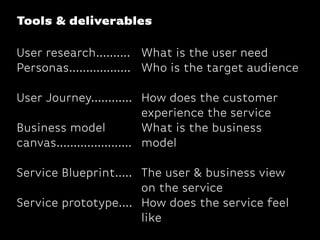
Tools & deliverables
User research..........
Personas..................
User Journey............
Business model
canvas......................
Service Blueprint.....
Service prototype....
What is the user need
Who is the target audience
How does the customer
experience the service
What is the business
model
The user & business view
on the service
How does the service feel
like
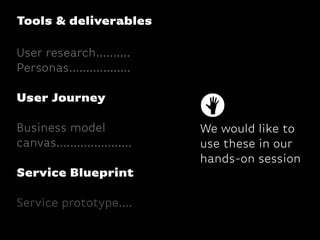
Tools & deliverables
User research..........
Personas..................
User Journey
Business model
canvas......................
Service Blueprint
Service prototype....
We would like to
use these in our
hands-on session
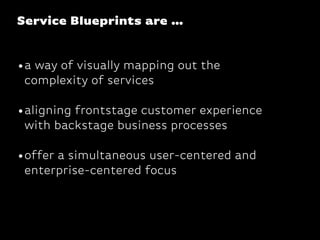
Service Blueprints are …
•a way of visually mapping out the
complexity of services
•aligning frontstage customer experience
with backstage business processes
•offer a simultaneous user-centered and
enterprise-centered focus
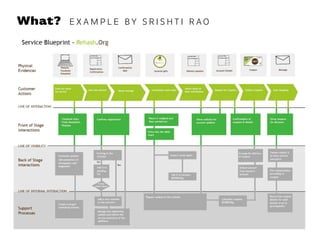
What? EX A M P L E BY S R I S H T I R AO
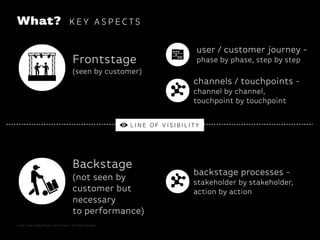
What? K E Y A S P E C TS
Icons: Juan Pablo Bravo, Jon Trillana / The Noun Project
Frontstage
(seen by customer)
Backstage
(not seen by
customer but
necessary
to performance)
L I N E O F V I S I B I L I T Y
user / customer journey -
phase by phase, step by step
channels / touchpoints -
channel by channel,
touchpoint by touchpoint
backstage processes -
stakeholder by stakeholder,
action by action
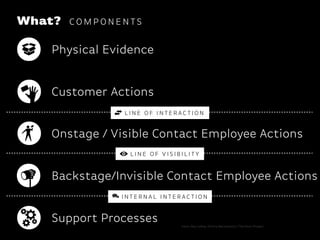
What? CO M P O N E N TS
Icons: Olyn LeRoy, Dmitry Baranovskiy / The Noun Project
Customer Actions
Onstage / Visible Contact Employee Actions
Backstage/Invisible Contact Employee Actions
Support Processes
Physical Evidence
L I N E O F V I S I B I L I T Y
L I N E O F I N T E R AC T I O N
I N T E R N A L I N T E R AC T I O N
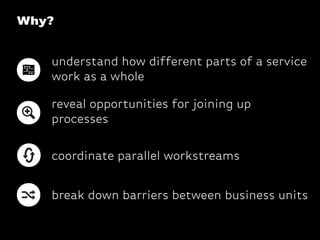
Why?
understand how different parts of a service
work as a whole
break down barriers between business units
coordinate parallel workstreams
reveal opportunities for joining up
processes
When?
analysing an existing service
creating a new service
Exercise
From user
journey to
service blueprint
Task 1
Describe the
user journey
for your persona
(15 min)
Servicise - Thinking beyond products
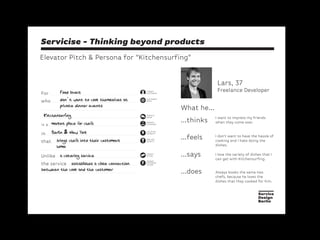
Elevator Pitch & Persona for “Kitchensurfing”
Lars, 37
Freelance Developer
...thinks
...feels
...says
...does
I love the variety of dishes that I
can get with Kitchensurfing.
I don’t want to have the hassle of
cooking and I hate doing the
dishes.
Always books the same two
chefs, because he loves the
dishes that they cooked for him.
I want to impress my friends
when they come over.
For
TARGET
CUSTOMER
CUSTOMER
NEED
SERVICE
NAME
MARKET
CATEGORY
who
in
that
Unlike
the service
is a
ONE KEY
BENEFIT
COMPE-
TITION
LOCATION
(STREET)
UNIQUE
DIFFEREN-
TIATOR
What he...
Food lovers
don’t want to cook themselves at
private dinner events
Kitchensurfing
market place for chefs
Berlin & New York
brings chefs into their customers
home
a catering service
establishes a close connection
between the cook and the customer
Task 2
Identify the most
important
touchpoints
(15 min)
Servicise - Thinking beyond products
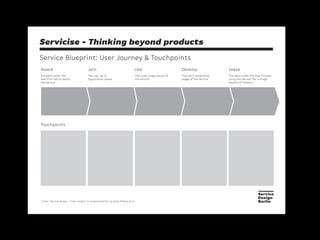
Service Blueprint: User Journey & Touchpoints
Aware
The point when the
user first learns about
the service
From: “Service Design - From insights to implementation” by Andy Polaine et al.
The sign-up or
registration phase
The usual usage period of
the service
The user’s expanding
usage of the service
The point when the user finishes
using the service (for a single
session of forever)
Join Use Develop Leave
Touchpoints
Task 3
Visualise the
backend
processes for
this service
(15 min)
Servicise - Thinking beyond products
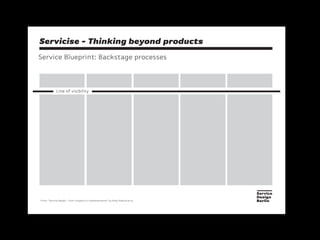
Service Blueprint: Backstage processes
From: “Service Design - From insights to implementation” by Andy Polaine et al.
Line of visibility
Take-away
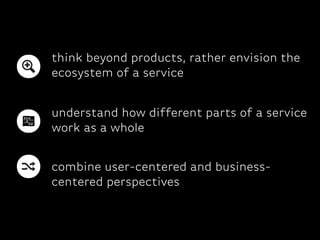
combine user-centered and business-
centered perspectives
think beyond products, rather envision the
ecosystem of a service
understand how different parts of a service
work as a whole
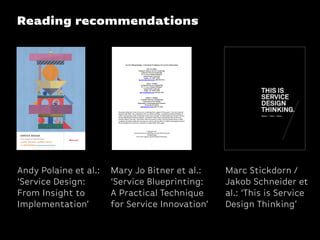
Reading recommendations
Andy Polaine et al.:
‘Service Design:
From Insight to
Implementation’
Marc Stickdorn /
Jakob Schneider et
al.: ‘This is Service
Design Thinking’
Mary Jo Bitner et al.:
‘Service Blueprinting:
A Practical Technique
for Service Innovation’
Questions
please!
servicedesignberlin.de
@SD_Berlin
fb.com/servicedesignberlin

‘Servicise – thinking beyond products’ workshop @ NEXT 2013

  • 1.
    Servicise: Thinking beyond products N EXT 20 1 3 / A P R I L 2 3 , 2 0 1 2 Katrin Dribbisch & Martin Jordan, Service Design Berlin
  • 2.
    What to expectfrom today • Why service design matters • Designing products vs. designing services • Service design mindset • Useful service design tools What? Who? How? • Hands-on session
  • 3.
    Katrin PhD Candidate, University of Potsdam Whoare we? Manuel Service Designer, Fjord Olga Community Manager, Stylemarks Martin User Experience, Nokia
  • 4.
  • 5.
    A Shift FromManufacturing ... Sources: Government Accountability Office; Bureau of Labor Statistics — New York Times, January 22, 2012
  • 6.
    Almost certainly youare building a service, not a product. Services could be considered the new products. Products do not vanish but are embedded in an ecosystem. This service ecosystem encompasses all touchpoints with the user. In other words ...
  • 7.
  • 8.
    “[Everything] that youcan’t drop on your foot, ranging from hairdressing to websites.” What is a service? — M AT T H E W B I S H O P The Economist * – in ‘Essential Economics: An A to Z Guide’, 2004 *
  • 9.
    The difference betweena ... P R O D U C T S E R V I C E A pre-produced, finished thing waiting on the shelf to be picked up by a consumer. A pre-planned set of activities waiting to be shaped and executed in inter- action with a user.
  • 10.
    Hybrids Past Product Service Present Product Service ServiceProduct — The Product Service Hybrid (after Spath / Ganz) Future Service Product (Amazon Kindle)(Car) (Car sharing)(Laundry) (iPod)
  • 11.
    Let‘s look atan example. R E CO R D STO R E I T U N E S has limited space for records, fixed opening hours and is dependent on its location – staff knows your taste has almost unlimited digital storage for all kinds of music, is always and from anywhere accessible – Genius knows your taste
  • 12.
    P R OD U C T D E S I G N singular object & usage thinking S E R V I C E D E S I G N thinking of user flows, touchpoints and ecosystem Designing products vs. services
  • 13.
    How can one think ofsingle products still? Images: Daimler AG communicate drive welcome register locate enter startenjoy
  • 14.
  • 15.
    “Service Design isa practice to create useful, usable, desirable, effective and distinctive services. These are developed through an iterative, user-centred and collaborative design process, focusing on the end user experience and taking multiple tangible and intangible touchpoints in consideration. Service Design aims to create value for both the business as well as the customer.” Icons: Ugur Akdemir / The Noun Project
  • 16.
    “Service Design isa practice to create useful, usable, desirable, effective and distinctive services. These are developed through an iterative, user-centred and collaborative design process, focusing on the end user experience and taking multiple tangible and intangible touchpoints in consideration. Service Design aims to create value for both the business as well as the customer.” Icons: Ugur Akdemir / The Noun Project
  • 17.
    Image: Inter IKEASystems B.V. useful
  • 18.
    Image: Thomas Hawk/ Flickr usable
  • 19.
  • 20.
    Image: Deutsche PostDHL effective
  • 21.
  • 22.
    “Service Design isa practice to create useful, usable, desirable, effective and distinctive services. These are developed through an iterative, user-centred and collaborative design process, focusing on the end user experience and taking multiple tangible and intangible touchpoints in consideration. Service Design aims to create value for both the business as well as the customer.” Icons: Ugur Akdemir / The Noun Project
  • 23.
  • 24.
  • 25.
  • 26.
    “Service Design isa practice to create useful, usable, desirable, effective and distinctive services. These are developed through an iterative, user-centred and collaborative design process, focusing on the end user experience and taking multiple tangible and intangible touchpoints in consideration. Service Design aims to create value for both the business as well as the customer.” Icons: Ugur Akdemir / The Noun Project
  • 27.
  • 28.
    Tools & deliverables Userresearch.......... Personas.................. User Journey............ Business model canvas...................... Service Blueprint..... Service prototype.... What is the user need Who is the target audience How does the customer experience the service What is the business model The user & business view on the service How does the service feel like
  • 29.
    Tools & deliverables Userresearch.......... Personas.................. User Journey Business model canvas...................... Service Blueprint Service prototype.... We would like to use these in our hands-on session
  • 30.
    Service Blueprints are… •a way of visually mapping out the complexity of services •aligning frontstage customer experience with backstage business processes •offer a simultaneous user-centered and enterprise-centered focus
  • 31.
    What? EX AM P L E BY S R I S H T I R AO
  • 32.
    What? K EY A S P E C TS Icons: Juan Pablo Bravo, Jon Trillana / The Noun Project Frontstage (seen by customer) Backstage (not seen by customer but necessary to performance) L I N E O F V I S I B I L I T Y user / customer journey - phase by phase, step by step channels / touchpoints - channel by channel, touchpoint by touchpoint backstage processes - stakeholder by stakeholder, action by action
  • 33.
    What? CO MP O N E N TS Icons: Olyn LeRoy, Dmitry Baranovskiy / The Noun Project Customer Actions Onstage / Visible Contact Employee Actions Backstage/Invisible Contact Employee Actions Support Processes Physical Evidence L I N E O F V I S I B I L I T Y L I N E O F I N T E R AC T I O N I N T E R N A L I N T E R AC T I O N
  • 34.
    Why? understand how differentparts of a service work as a whole break down barriers between business units coordinate parallel workstreams reveal opportunities for joining up processes
  • 35.
    When? analysing an existingservice creating a new service
  • 36.
  • 37.
    Task 1 Describe the userjourney for your persona (15 min)
  • 38.
    Servicise - Thinkingbeyond products Elevator Pitch & Persona for “Kitchensurfing” Lars, 37 Freelance Developer ...thinks ...feels ...says ...does I love the variety of dishes that I can get with Kitchensurfing. I don’t want to have the hassle of cooking and I hate doing the dishes. Always books the same two chefs, because he loves the dishes that they cooked for him. I want to impress my friends when they come over. For TARGET CUSTOMER CUSTOMER NEED SERVICE NAME MARKET CATEGORY who in that Unlike the service is a ONE KEY BENEFIT COMPE- TITION LOCATION (STREET) UNIQUE DIFFEREN- TIATOR What he... Food lovers don’t want to cook themselves at private dinner events Kitchensurfing market place for chefs Berlin & New York brings chefs into their customers home a catering service establishes a close connection between the cook and the customer
  • 39.
    Task 2 Identify themost important touchpoints (15 min)
  • 40.
    Servicise - Thinkingbeyond products Service Blueprint: User Journey & Touchpoints Aware The point when the user first learns about the service From: “Service Design - From insights to implementation” by Andy Polaine et al. The sign-up or registration phase The usual usage period of the service The user’s expanding usage of the service The point when the user finishes using the service (for a single session of forever) Join Use Develop Leave Touchpoints
  • 41.
    Task 3 Visualise the backend processesfor this service (15 min)
  • 42.
    Servicise - Thinkingbeyond products Service Blueprint: Backstage processes From: “Service Design - From insights to implementation” by Andy Polaine et al. Line of visibility
  • 43.
  • 44.
    combine user-centered andbusiness- centered perspectives think beyond products, rather envision the ecosystem of a service understand how different parts of a service work as a whole
  • 45.
    Reading recommendations Andy Polaineet al.: ‘Service Design: From Insight to Implementation’ Marc Stickdorn / Jakob Schneider et al.: ‘This is Service Design Thinking’ Mary Jo Bitner et al.: ‘Service Blueprinting: A Practical Technique for Service Innovation’
  • 46.