INTRODUCTION TO SERVICE DESIGN
francesco mazzarella, PhD researcher
master class in service design, kyiv, 03/11/15
frameworks, basics, processes & frontiers
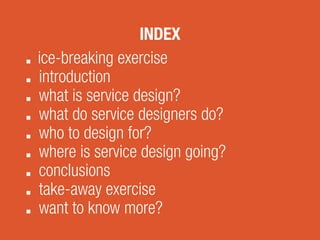
INDEX
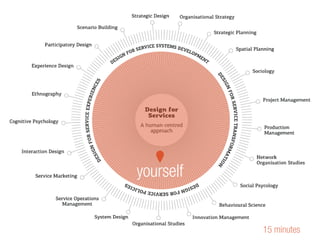
ice-breaking exercise
introduction
what is service design?
what do service designers do?
who to design for?
where is service design going?
conclusions
take-away exercise
want to know more?
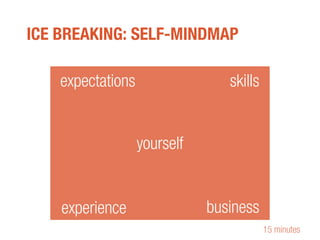
ICE-BREAKING
EXERCISE
15 minutes
ICE BREAKING: SELF-MINDMAP
yourself
skills
business
expectations
experience
INTRODUCTION
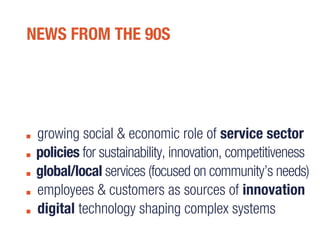
growing social & economic role of service sector
policies for sustainability, innovation, competitiveness
global/local services (focused on community’s needs)
employees & customers as sources of innovation
digital technology shaping complex systems
NEWS FROM THE 90S
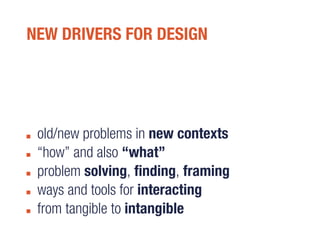
NEW DRIVERS FOR DESIGN
old/new problems in new contexts
“how” and also “what”
problem solving, finding, framing
ways and tools for interacting
from tangible to intangible
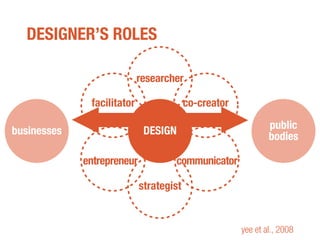
businesses DESIGN
public
bodies
facilitator
researcher
co-creator
entrepreneur
strategist
communicator
yee et al., 2008
DESIGNER’S ROLES
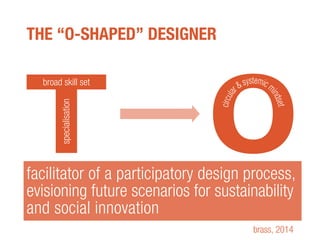
THE “O-SHAPED” DESIGNER
broad skill set
specialisation
circular
& systemicm
indset
facilitator of a participatory design process,
evisioning future scenarios for sustainability
and social innovation
brass, 2014
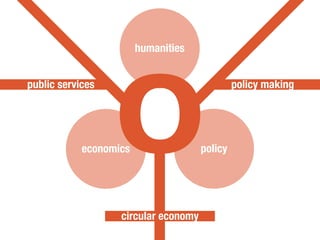
economics policy
humanities
public services
circular economy
policy making
WHAT IS SERVICE DESIGN?
https://goo.gl/FfjUpi
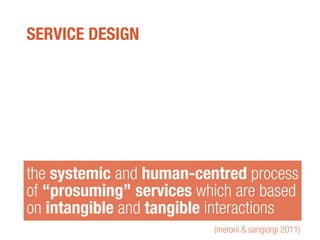
SERVICE DESIGN
the systemic and human-centred process
of “prosuming” services which are based
on intangible and tangible interactions
(meroni & sangiorgi 2011)
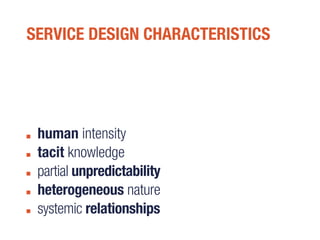
SERVICE DESIGN CHARACTERISTICS
human intensity
tacit knowledge
partial unpredictability
heterogeneous nature
systemic relationships
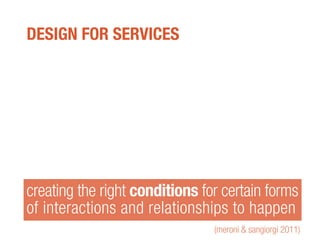
DESIGN FOR SERVICES
creating the right conditions for certain forms
of interactions and relationships to happen
(meroni & sangiorgi 2011)
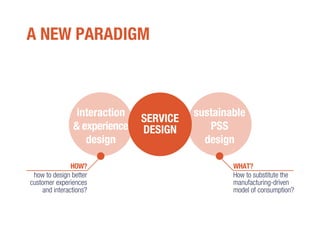
A NEW PARADIGM
sustainable
PSS
design
how to design better
customer experiences
and interactions?
How to substitute the
manufacturing-driven
model of consumption?
SERVICE
DESIGN
interaction
& experience
design
HOW? WHAT?
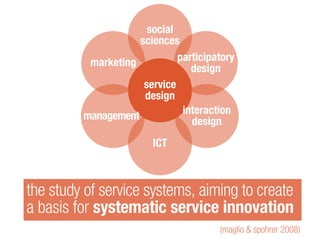
the study of service systems, aiming to create
a basis for systematic service innovation
(maglio & spohrer 2008)
service
design
marketing
social
sciences
interaction
design
participatory
design
ICT
management
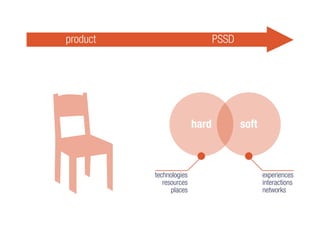
hard soft
technologies
resources
places
experiences
interactions
networks
product PSSD
product PSSD
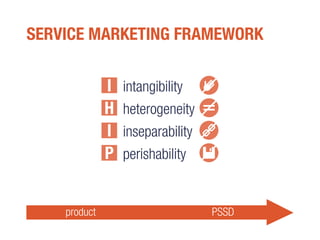
SERVICE MARKETING FRAMEWORK
intangibility
heterogeneity
inseparability
perishability
I
H
I
P
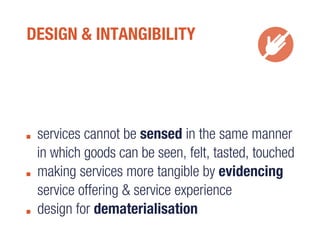
DESIGN & INTANGIBILITY
services cannot be sensed in the same manner
in which goods can be seen, felt, tasted, touched
making services more tangible by evidencing
service offering & service experience
design for dematerialisation
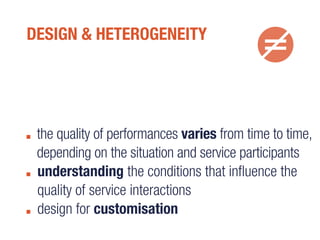
DESIGN & HETEROGENEITY
the quality of performances varies from time to time,
depending on the situation and service participants
understanding the conditions that influence the
quality of service interactions
design for customisation
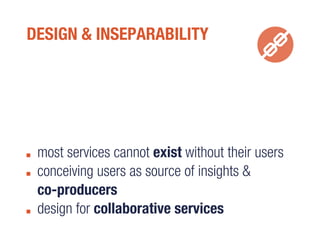
DESIGN & INSEPARABILITY
most services cannot exist without their users
conceiving users as source of insights &
co-producers
design for collaborative services
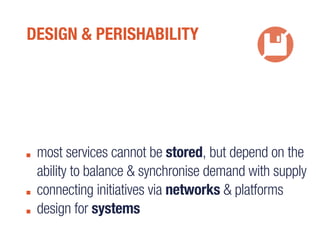
DESIGN & PERISHABILITY
most services cannot be stored, but depend on the
ability to balance & synchronise demand with supply
connecting initiatives via networks & platforms
design for systems
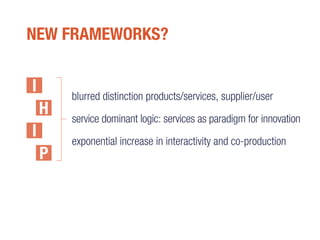
NEW FRAMEWORKS?
I
I
H
P
blurred distinction products/services, supplier/user
service dominant logic: services as paradigm for innovation
exponential increase in interactivity and co-production
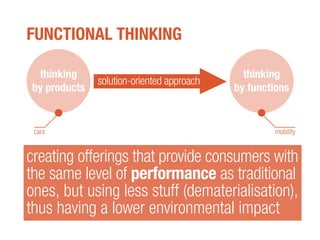
FUNCTIONAL THINKING
creating offerings that provide consumers with
the same level of performance as traditional
ones, but using less stuff (dematerialisation),
thus having a lower environmental impact
solution-oriented approach
thinking
by functions
thinking
by products
cars mobility
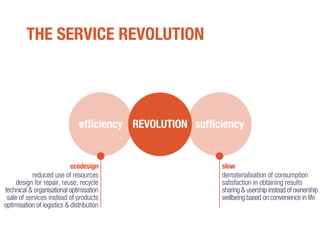
THE SERVICE REVOLUTION
sufficiency
reduced use of resources
design for repair, reuse, recycle
technical & organisational optimisation
sale of services instead of products
optimisation of logistics & distribution
dematerialisation of consumption
satisfaction in obtaining results
sharing & usership instead of ownership
wellbeing based on convenience in life
REVOLUTIONefficiency
ecodesign slow
WHAT DO
SERVICE DESIGNERS DO?
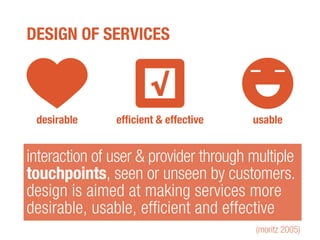
interaction of user & provider through multiple
touchpoints, seen or unseen by customers.
design is aimed at making services more
desirable, usable, efficient and effective
(moritz 2005)
DESIGN OF SERVICES
desirable usableefficient & effective
(stickdorn & schneider 2011)
user-centred
SERVICES CHARACTERISTICS
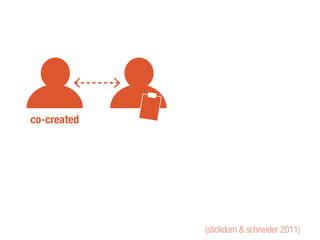
(stickdorn & schneider 2011)
co-created
(stickdorn & schneider 2011)
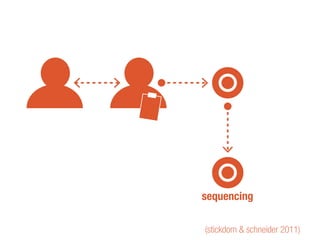
sequencing
(stickdorn & schneider 2011)
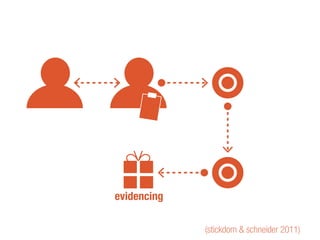
evidencing
(stickdorn & schneider 2011)
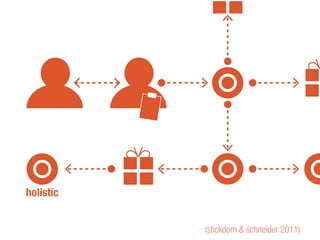
holistic
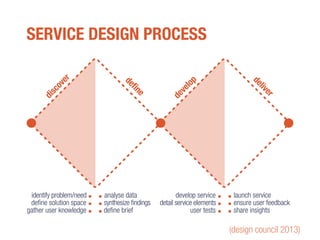
SERVICE DESIGN PROCESS
(design council 2013)
discover
define
develop
deliver
identify problem/need
define solution space
gather user knowledge
analyse data
synthesize findings
define brief
develop service
detail service elements
user tests
launch service
ensure user feedback
share insights
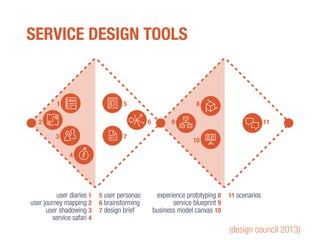
SERVICE DESIGN TOOLS
user diaries 1
user journey mapping 2
user shadowing 3
service safari 4
5 user personas
6 brainstorming
7 design brief
experience prototyping 8
service blueprint 9
business model canvas 10
11 scenarios
(design council 2013)
WHO TO DESIGN FOR?
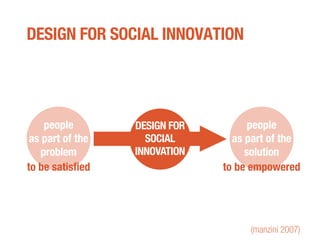
people
as part of the
problem
to be satisfied
people
as part of the
solution
to be empowered
DESIGN FOR SOCIAL INNOVATION
(manzini 2007)
DESIGN FOR
SOCIAL
INNOVATION
community
empowering
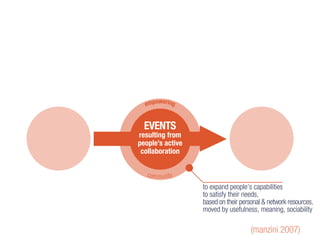
EVENTS
resulting from
people’s active
collaboration
(manzini 2007)
to expand people’s capabilities
to satisfy their needs,
based on their personal & network resources,
moved by usefulness, meaning, sociability
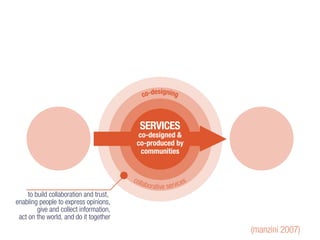
co-designing
collaborative services
SERVICES
co-designed &
co-produced by
communities
(manzini 2007)
to build collaboration and trust,
enabling people to express opinions,
give and collect information,
act on the world, and do it together
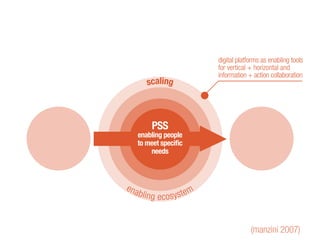
scaling
enabling ecosystem
PSS
enabling people
to meet specific
needs
(manzini 2007)
digital platforms as enabling tools
for vertical + horizontal and
information + action collaboration
WHERE IS SERVICE DESIGN
GOING?
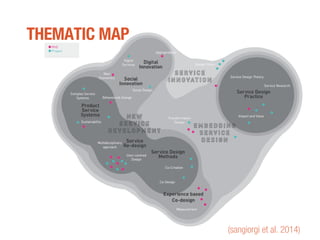
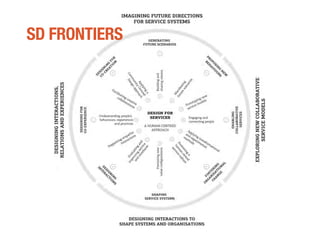
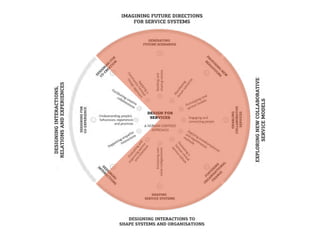
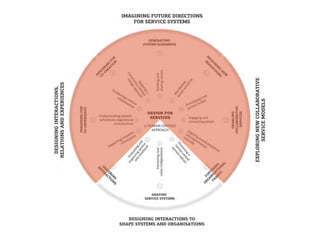
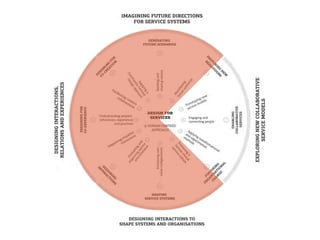
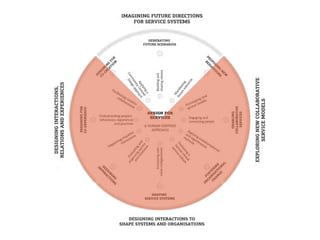
THEMATIC MAP
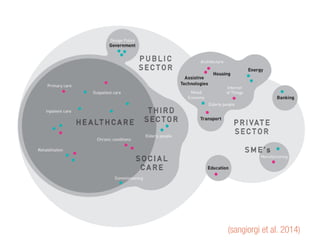
(sangiorgi et al. 2014)
SD FRONTIERS
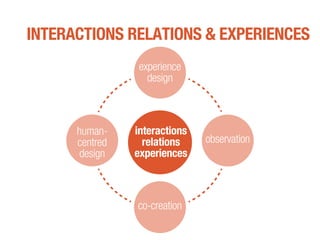
INTERACTIONS RELATIONS & EXPERIENCES
experience
design
co-creation
human-
centred
design
observation
interactions
relations
experiences
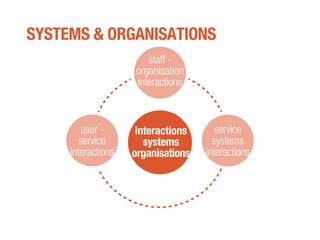
SYSTEMS & ORGANISATIONS
staff -
organisation
interactions
user -
service
interactions
service
systems
interactions
interactions
systems
organisations
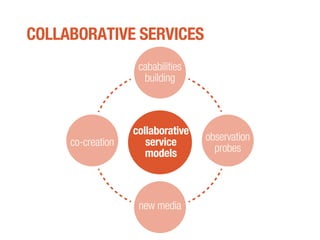
COLLABORATIVE SERVICES
cababilities
building
new media
co-creation observation
probes
collaborative
service
models
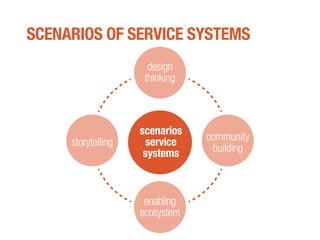
SCENARIOS OF SERVICE SYSTEMS
design
thinking
enabling
ecosystem
storytelling community
building
scenarios
service
systems
CONCLUSIONS
https://goo.gl/OVEoCt
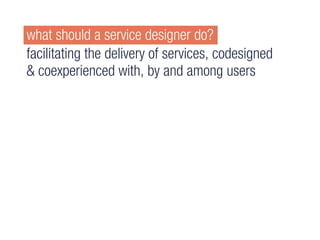
what should a service designer do?
facilitating the delivery of services, codesigned
& coexperienced with, by and among users
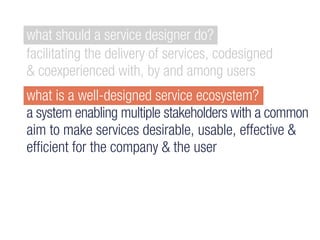
what is a well-designed service ecosystem?
a system enabling multiple stakeholders with a common
aim to make services desirable, usable, effective &
efficient for the company & the user
what should a service designer do?
facilitating the delivery of services, codesigned
& coexperienced with, by and among users
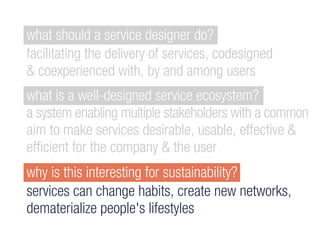
why is this interesting for sustainability?
services can change habits, create new networks,
dematerialize people's lifestyles
what is a well-designed service ecosystem?
a system enabling multiple stakeholders with a common
aim to make services desirable, usable, effective &
efficient for the company & the user
what should a service designer do?
facilitating the delivery of services, codesigned
& coexperienced with, by and among users
TAKE-AWAY EXERCISE
15 minutes
yourself
WANT TO KNOW MORE?
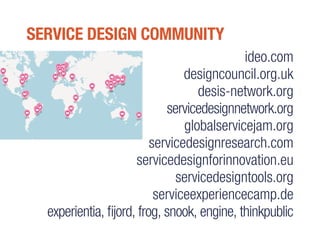
SERVICE DESIGN COMMUNITY
ideo.com
designcouncil.org.uk
desis-network.org
servicedesignnetwork.org
globalservicejam.org
servicedesignresearch.com
servicedesignforinnovation.eu
servicedesigntools.org
serviceexperiencecamp.de
experientia, fijord, frog, snook, engine, thinkpublic
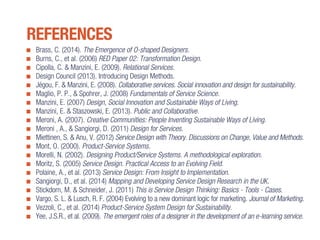
Brass, C. (2014). The Emergence of O-shaped Designers.
Burns, C., et al. (2006) RED Paper 02: Transformation Design.
Cipolla, C. & Manzini, E. (2009). Relational Services.
Design Council (2013). Introducing Design Methods.
Jégou, F. & Manzini, E. (2008). Collaborative services. Social innovation and design for sustainability.
Maglio, P. P., & Spohrer, J. (2008) Fundamentals of Service Science.
Manzini, E. (2007) Design, Social Innovation and Sustainable Ways of Living.
Manzini, E. & Staszowski, E. (2013). Public and Collaborative.
Meroni, A. (2007). Creative Communities: People Inventing Sustainable Ways of Living.
Meroni , A., & Sangiorgi, D. (2011) Design for Services.
Miettinen, S. & Anu, V. (2012) Service Design with Theory. Discussions on Change, Value and Methods.
Mont, O. (2000). Product-Service Systems.
Morelli, N. (2002). Designing Product/Service Systems. A methodological exploration.
Moritz, S. (2005) Service Design. Practical Access to an Evolving Field.
Polaine, A., et al. (2013) Service Design: From Insight to Implementation.
Sangiorgi, D., et al. (2014) Mapping and Developing Service Design Research in the UK.
Stickdorn, M. & Schneider, J. (2011) This is Service Design Thinking: Basics - Tools - Cases.
Vargo, S. L. & Lusch, R. F. (2004) Evolving to a new dominant logic for marketing. Journal of Marketing.
Vezzoli, C., et al. (2014) Product-Service System Design for Sustainability.
Yee, J.S.R., et al. (2009). The emergent roles of a designer in the development of an e-learning service.
REFERENCES
QUESTIONS ?
francesco mazzarella
f.mazzarella@lboro.ac.uk

Introduction to Service Design. Frameworks, Basics, Processes & Frontiers