Share Contact Us 
Presented by 
Sponsored by
1. Basic overview of Lamp Technologies 
2. Lamp characteristics (CCT, CRI, Lm & Fc) 
3. Common Emergency Light & Combo lamps 
4. Understanding fluorescent lamp codes 
5. Understanding CFL codes 
6. Metal Halide & HPS ANSI Codes 
AREAS THAT WILL BE COVERED 
Share Contact Us
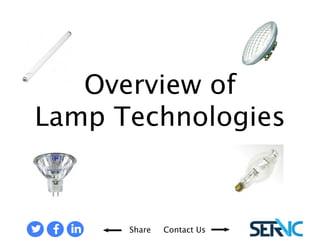
OVERVIEW OF LAMP TECHNOLOGIES 
Share Contact Us
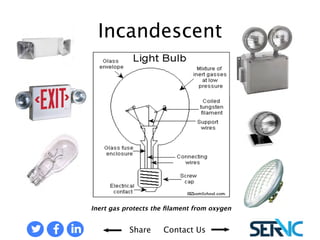
INCANDESCENT 
Inert gas protects the filament from oxygen 
Share Contact Us
Advantages 
• Color rendering (CRI) 98-100. Makes objects appear “normal,” yet softens 
Share Contact Us 
skin tones. 
• No flickering 
• Inherently dimmable 
• No ballast required :) 
• Cheap as hell and available anywhere 
• Won’t affect people with epilepsy or Aspbergers 
• Warm Color Temp. we have all grown up with 
• Not harmful to the environment 
Advantages of Incandescent Lamps
Disadvantages 
• Creates light by heating solid material (tungsten filament) 
• Most of the energy lost as heat 
• Inefficient: 60W Edison bulb = 6W LED 
• Operating cost of 1 bulb/year: $35.48 
• Cost to run them in a house: $328.59 
• Only last 6-months - year of continuous use 
• 40 and 60-watt bulbs are banned in the USA 
Disadvantages of Incandescent Lamps 
Share Contact Us
• Uses a filament like Incandescent 
• Contains halogen gas instead of inert gas 
• Much brighter, whiter light that lasts longer 
• Allows for pinpoint focusing. Ideal for task light, displays and 
Share Contact Us 
artwork. 
• 10-20% more efficient than Incandescent 
CONS 
• Burn very hot. Fingerprint residue can cause the bulb to explode. 
• Some systems require ballasts. 
HALOGEN LAMPS
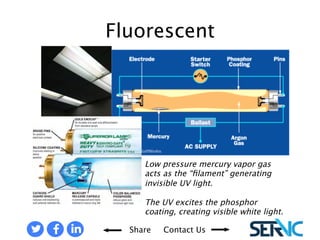
Low pressure mercury vapor gas acts as the “filament” generating invisible UV light. 
The UV excites the phosphor coating, creating visible white light. 
FLUORESECENT LAMPS 
Share Contact Us
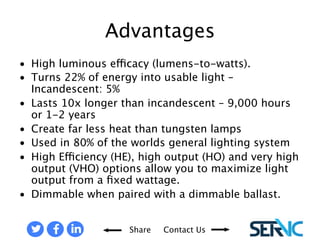
• High luminous efficacy (lumens-to-watts). 
• Turns 22% of energy into usable light – 
Share Contact Us 
Incandescent: 5% 
• Lasts 10x longer than incandescent – 
9,000 hours or 1-2 years 
• Create far less heat than tungsten 
lamps 
• Used in 80% of the worlds general 
lighting system 
• High Efficiency (HE), high output (HO) 
and very high output (VHO) options 
allow you to maximize light output 
from a fixed wattage. 
• Dimmable when paired with a 
dimmable ballast. 
ADVANTAGES OF FLUORESCENT LAMPS
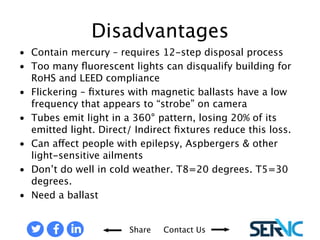
• Contain mercury – requires 12-step disposal process 
• Too many fluorescent lights can disqualify building for RoHS and LEED 
Share Contact Us 
compliance 
• Flickering – fixtures with magnetic ballasts have a low frequency that 
appears to “strobe” on camera 
• Tubes emit light in a 360° pattern, losing 20% of its emitted light. Direct/ 
Indirect fixtures reduce this loss. 
• Can affect people with epilepsy, Aspbergers & other light-sensitive 
ailments 
• Don’t do well in cold weather. T8=20 degrees. T5=30 degrees. 
• Need a ballast 
DISADVANTAGES OF FLUORESCENT LAMPS
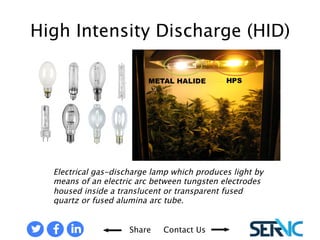
Electrical gas-discharge lamp which produces light by means of an electric arc 
between tungsten electrodes housed inside a translucent or transparent fused 
quartz or fused alumina arc tube. 
HIGH INTENSITY DISCHARGE LAMPS (HID) 
Share Contact Us
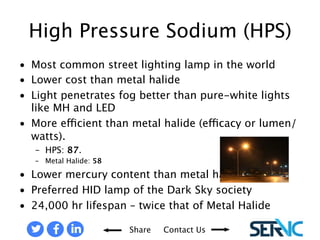
• Most common street lighting lamp in the 
Share Contact Us 
world 
• Lower cost than metal halide 
• Light penetrates fog better than pure-white 
lights like MH and LED 
• More efficient than metal halide 
(efficacy or lumen/watts). 
– HPS: 87. 
– Metal Halide: 58 
• Lower mercury content than metal 
halide 
• Preferred HID lamp of the Dark Sky 
society 
• 24,000 hour lifespan – twice that of 
Metal Halide 
HIGH PRESSURE SODIUM (HPS)
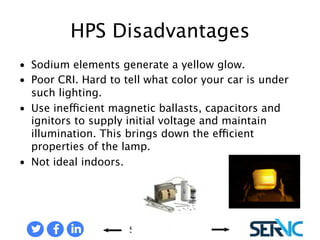
• Sodium elements generate a 
Share Contact Us 
yellow glow. 
• Poor CRI. Hard to tell what 
color your car is under such 
lighting. 
• Use inefficient magnetic 
ballasts, capacitors and ignitor 
to supply initial voltage and 
maintain illumination. This 
brings down the efficient 
properties of the lamp. 
• Not ideal indoors. 
HPS LAMP DISADVANTAGES
Share Contact Us 
• Mixture of several gases 
creates a 4500K Color 
temperature. 
• Appears bright white 
• CRI of 85. Excellent for retail 
interiors and high bays. 
• Easy to find your car in a 
parking lot. 
• More energy efficient than 
halogen and mercury vapor 
lamps 
METAL HALIDE (MH) BULBS
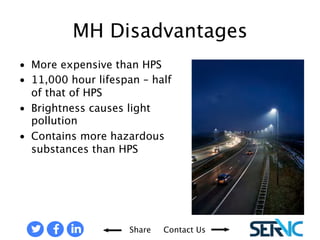
• More expensive than HPS 
• 11,000 hour lifespan – half of 
Share Contact Us 
that of HPS 
• Brightness causes light 
pollution 
• Contains more hazardous 
substances than HPS 
DISADVANTAGES OF METAL HALIDE BULBS
1. Your client wants high bay fixtures for a 
large shoe store but can’t afford LED. Do 
you offer them HID, Metal Halide or HPS 
lamps? 
2. A cold storage warehouse wants to 
retrofit their T12s with a more efficient 
fluorescent lamps. Should you offer T8 
or T5s? Bonus point if you can answer 
“Why” 
3. A customer wants either a Metal Halide 
or HPS wall pack with battery backup. 
Our site reflects that they have the 
option for that model. Which lamp 
source should they choose? 
QUIZ #1 
Share Contact Us 
Contact Us 
Now! 
Interested in how you did? 
If you’d like the answers…
4 TYPES OF LAMP CHARACTERISTICS 
Share Contact Us
• Listed on most spec sheets 
Share Contact Us 
as ‘Correlated Color 
Temperature’ (CCT) 
• Measured in Kelvins (K) 
• For dummies: The color of 
the light and how it makes 
you feel (warm or cold). 
• Anything over 5,000K = cool 
colors 
• 2700-3000K = warm colors 
COLOR TEMPERATURES
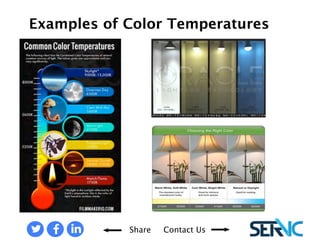
EXAMPLES OF COLOR TEMPERATURES 
Share Contact Us
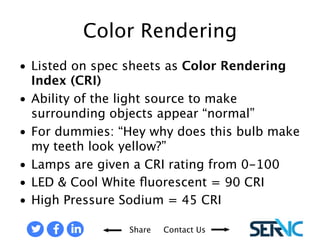
• Listed on spec sheets as Color Rendering 
Share Contact Us 
Index (CRI) 
• Ability of the light source to make 
surrounding objects appear “normal” 
• For dummies: “Hey why does this bulb make 
my teeth look yellow?” 
• Lamps are given a CRI rating from 0-100 
• LED & Cool White fluorescent = 90 CRI 
• High Pressure Sodium = 45 CRI 
COLOR RENDERING (CRI)
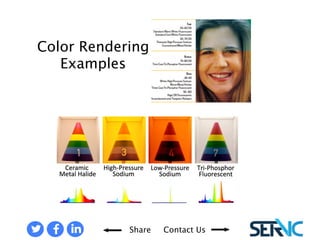
COLOR RENDERING EXAMPLE 
Share Contact Us
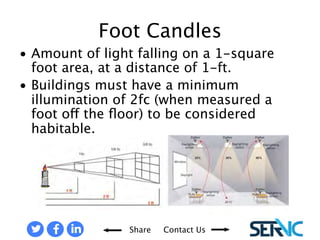
• Amount of light falling on a 1- 
square foot area, at a distance 
of 1-ft. 
• Buildings must have a minimum 
illumination of 2fc (when 
measured a foot off the floor) 
to be considered habitable. 
FOOT CANDLES 
Share Contact Us
Share Contact Us 
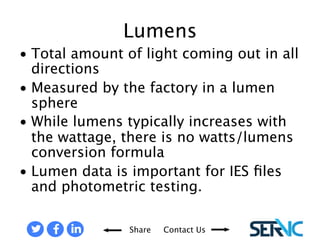
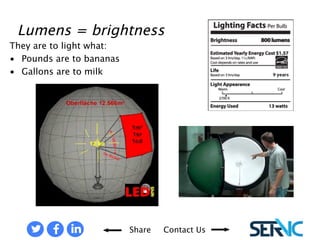
• Total amount of light 
coming out in all directions 
• Measured by the factory in 
a lumen sphere 
• While lumens typically 
increases with the wattage, 
there is no watts/lumens 
conversion formula 
• Lumen data is important 
for IES files and 
photometric testing. 
LUMENS
Share Contact Us 
They are to light what: 
• Pounds are to bananas 
• Gallons are to milk 
LUMENS MEANS = “BRIGHTNESS”
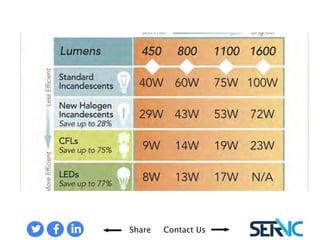
LUMENS CHART 
Share Contact Us
1. A lamp with a CCT of 5600 has a Warm 
Share Contact Us 
or Cool temperature? 
1. When an auditor inspects a buildings 
emergency lighting system, are they 
measuring ‘fc’ or ‘lm’? BONUS: How 
are these testing procedures different 
in New York City. 
1. What light factors might make a 
customer prefer an incandescent bulb 
over CFL or LED? 
1. You’re in a parking lot at night and 
can’t distinguish the color of your 
vehicle from the others. What lamp 
type is probably being used in this 
parking lot? 
QUIZ #2 
Contact Us 
Now! 
Interested in how you did? 
If you’d like the answers…
EMERGENCY LIGHTS AND COMBOS 
Share Contact Us 
Come visit with 
us!
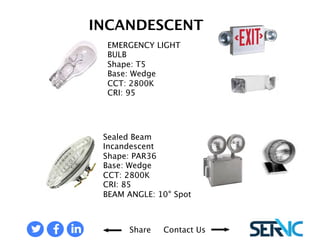
EMERGENCY LIGHT 
BULB 
Shape: T5 
Base: Wedge 
CCT: 2800K 
CRI: 95 
Sealed Beam 
Incandescent 
Shape: PAR36 
Base: Wedge 
CCT: 2800K 
CRI: 85 
BEAM ANGLE: 10° 
Spot 
EMERGENCY LIGHTS: INCANDESCENT BULBS 
Share Contact Us
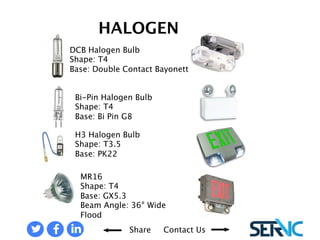
DCB Halogen Bulb 
Shape: T4 
Base: Double Contact Bayonet 
Bi-Pin Halogen Bulb 
Shape: T4 
Base: Bi Pin G8 
H3 Halogen Bulb 
Shape: T3.5 
Base: PK22 
MR16 
Shape: T4 
Base: GX5.3 
Beam Angle: 36° Wide Flood 
EMERGENCY LIGHTS: HALOGEN BULBS 
Share Contact Us
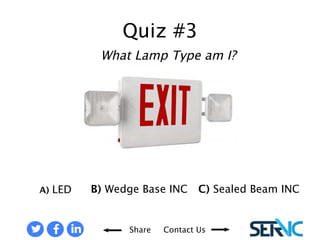
A) LED B) Wedge Base INC C) Sealed Beam INC 
QUIZ #3: WHAT LAMP TYPE AM I? 
Share Contact Us
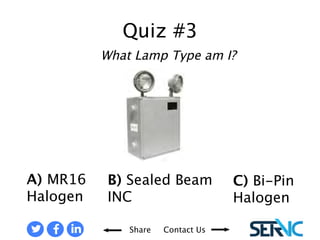
A) MR16 
Halogen 
B) Sealed Beam 
INC 
C) Bi-Pin 
Halogen 
WHAT LAMP TYPE AM I? 
Share Contact Us
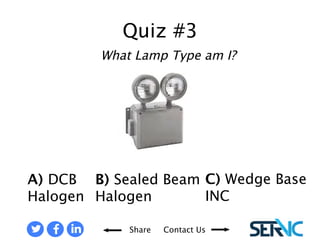
A) DCB 
Halogen 
B) Sealed Beam 
Halogen 
C) Wedge Base 
INC 
WHAT LAMP TYPE AM I? 
Share Contact Us 
Contact Us 
Now! 
Interested in how you did? 
If you’d like the answers…
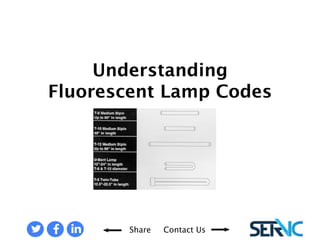
UNDERSTANDING FLUORESCENT LAMP CODES 
Share Contact Us
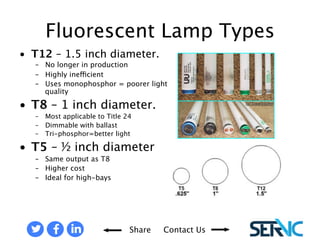
• T12 – 1.5 inch diameter. 
– No longer in production 
– Highly inefficient 
– Uses monophosphor = poorer light quality 
• T8 – 1 inch diameter. 
Share Contact Us 
– Most applicable to Title 24 
– Dimmable with ballast 
– Tri-phosphor=better light 
• T5 – ½ inch diameter 
– Same output as T8 
– Higher cost 
– Ideal for high-bays 
WHAT ARE FLUORESECENT LAMP TYPES?
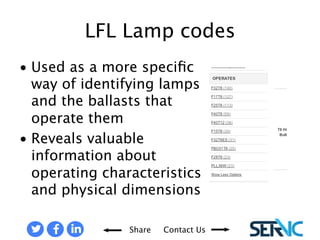
• Used as a more specific way 
of identifying lamps and the 
ballasts that operate them 
• Reveals valuable 
information about 
operating characteristics 
and physical dimensions 
LINEAR FLUORESCENT LAMP CODES 
Share Contact Us
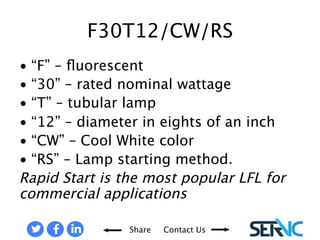
• “F” – fluorescent 
• “30” – rated nominal wattage 
• “T” – tubular lamp 
• “12” – diameter in eights of an inch 
• “CW” – Cool White color 
• “RS” – Lamp starting method. 
Rapid Start is the most popular LFL for commercial applications 
BREAKING DOWN THE FLUORESCENT LAMP CODES 
Share Contact Us
• Lamp actually draws 34-watts instead of 40 
• Due to the “ES” modifier, the generic designation for Energy 
Share Contact Us 
Saver 
• GE, Philips & Sylvania have different modifiers like: 
– SS = Super Saver 
– EW = EconoWatt 
– WM = Watt Miser 
LAMP CODES CONTINUED
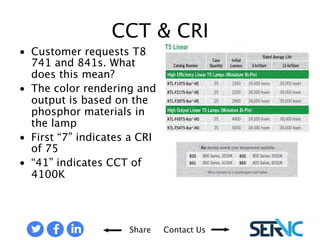
• Customer requests T8 741 
and 841s. What does this 
mean? 
• The color rendering and 
output is based on the 
phosphor materials in the 
lamp 
• First “7” indicates a CRI of 75 
• “41” indicates CCT of 4100K 
CCT & CRI 
Share Contact Us
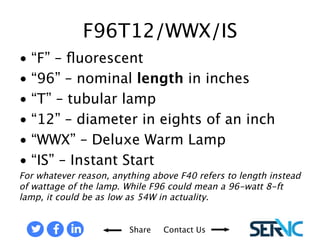
• “F” – fluorescent 
• “96” – nominal length in inches 
• “T” – tubular lamp 
• “12” – diameter in eights of an inch 
• “WWX” – Deluxe Warm Lamp 
• “IS” – Instant Start 
For whatever reason, anything above F40 refers to length instead of wattage 
of the lamp. While F96 could mean a 96-watt 8-ft lamp, it could be as low as 
54W in actuality. 
F96T12/WWX/IS 
Share Contact Us
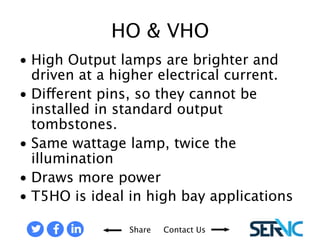
• High Output lamps are brighter and driven at a higher 
Share Contact Us 
electrical current. 
• Different pins, so they cannot be installed in standard output 
tombstones. 
• Same wattage lamp, twice the illumination 
• Draws more power 
• T5HO is ideal in high bay applications 
HO & VHO
Quiz #4 
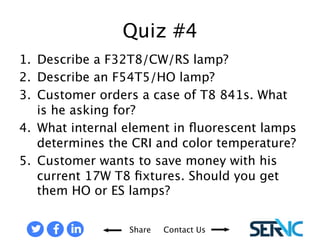
1. Describe a F32T8/CW/RS lamp? 
2. Describe an F54T5/HO lamp? 
3. Customer orders a case of T8 841s. What is he asking for? 
4. What internal element in fluorescent lamps determines the CRI and 
Share Contact Us 
color temperature? 
5. Customer wants to save money with his current 17W T8 fixtures. Should 
you get them HO or ES lamps? 
QUIZ #4
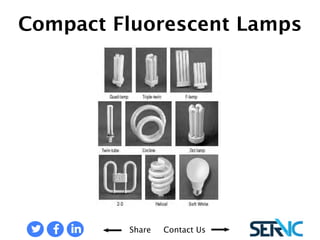
COMPACT FLUORESCENT LAMPS 
Share Contact Us
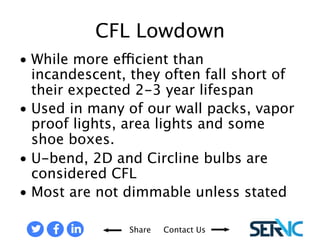
• While more efficient than incandescent, they often 
fall short of their expected 2-3 year lifespan 
• Used in many of our wall packs, vapor proof lights, 
area lights and some shoe boxes. 
• U-bend, 2D and Circline bulbs are considered CFL 
• Most are not dimmable unless stated 
CFL LOWDOWN 
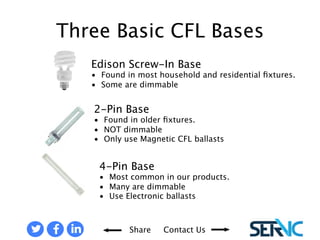
Share Contact Us
Edison Screw-In Base 
• Found in most household and residential fixtures. 
• Some are dimmable 
Share Contact Us 
2-Pin Base 
• Found in older fixtures. 
• NOT dimmable 
• Only use Magnetic CFL ballasts 
4-Pin Base 
• Most common in our products. 
• Many are dimmable 
• Use Electronic ballasts 
THE THREE BASIC CFL BASES
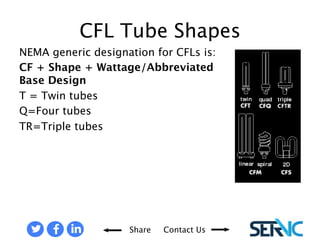
NEMA generic designation for CFLs is: 
CF + Shape + Wattage/Abbreviated Base 
Design 
Share Contact Us 
• T = Twin tubes 
• Q=Four tubes 
• TR=Triple tubes 
CFL TUBE SHAPES
Share Contact Us 
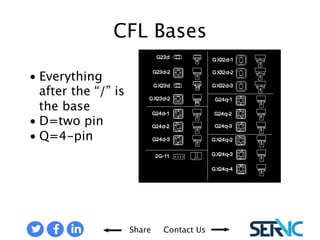
• Everything after 
the “/” is the 
base 
• D=two pin 
• Q=4-pin 
CFL BASES
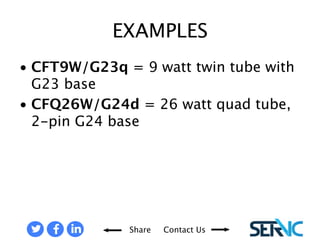
EXAMPLES 
• CFT9W/G23q = 9 watt twin tube with G23 
base 
• CFQ26W/G24d = 26 watt quad tube, 2-pin 
G24 base 
EXAMPLES OF COMPACT FLUORESCENT CODES 
Share Contact Us
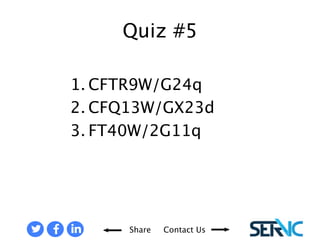
1. CFTR9W/G24q 
2. CFQ13W/GX23d 
3. FT40W/2G11q 
QUIZ #5: INDENTIFY THESE PART CODES 
Share Contact Us 
Contact Us 
Now! 
Interested in how you did? 
If you’d like the answers…
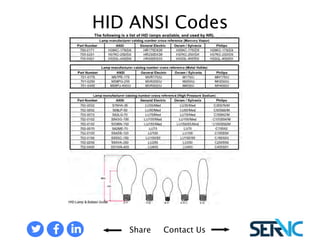
HID ANSI Codes 
Share Contact Us
Thank You for Viewing Our Presentation! 
Share Contact Us
Share Contact Us 
Have any questions? 
We’re your resource 
for all things lighting! 
We’re just a click 
away! 
REQUEST INFO! 
(800-928-2848) 
submit@servc.com

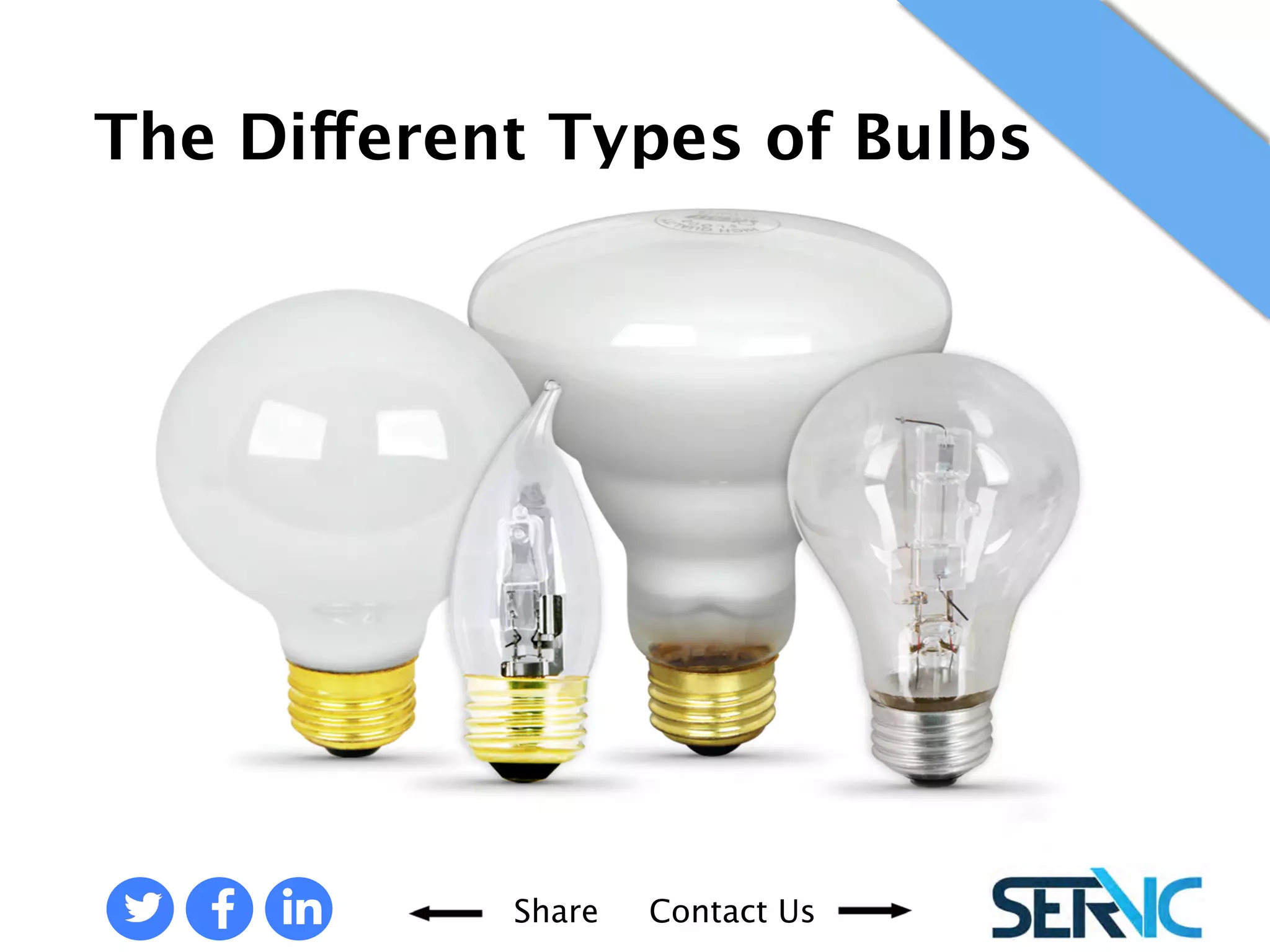
What's the Difference Between a Incandescent and LED Light Bulb (and others)?

  • 1.
    Share Contact Us Presented by Sponsored by
  • 2.
    1. Basic overviewof Lamp Technologies 2. Lamp characteristics (CCT, CRI, Lm & Fc) 3. Common Emergency Light & Combo lamps 4. Understanding fluorescent lamp codes 5. Understanding CFL codes 6. Metal Halide & HPS ANSI Codes AREAS THAT WILL BE COVERED Share Contact Us
  • 3.
    OVERVIEW OF LAMPTECHNOLOGIES Share Contact Us
  • 4.
    INCANDESCENT Inert gasprotects the filament from oxygen Share Contact Us
  • 5.
    Advantages • Colorrendering (CRI) 98-100. Makes objects appear “normal,” yet softens Share Contact Us skin tones. • No flickering • Inherently dimmable • No ballast required :) • Cheap as hell and available anywhere • Won’t affect people with epilepsy or Aspbergers • Warm Color Temp. we have all grown up with • Not harmful to the environment Advantages of Incandescent Lamps
  • 6.
    Disadvantages • Createslight by heating solid material (tungsten filament) • Most of the energy lost as heat • Inefficient: 60W Edison bulb = 6W LED • Operating cost of 1 bulb/year: $35.48 • Cost to run them in a house: $328.59 • Only last 6-months - year of continuous use • 40 and 60-watt bulbs are banned in the USA Disadvantages of Incandescent Lamps Share Contact Us
  • 7.
    • Uses afilament like Incandescent • Contains halogen gas instead of inert gas • Much brighter, whiter light that lasts longer • Allows for pinpoint focusing. Ideal for task light, displays and Share Contact Us artwork. • 10-20% more efficient than Incandescent CONS • Burn very hot. Fingerprint residue can cause the bulb to explode. • Some systems require ballasts. HALOGEN LAMPS
  • 8.
    Low pressure mercuryvapor gas acts as the “filament” generating invisible UV light. The UV excites the phosphor coating, creating visible white light. FLUORESECENT LAMPS Share Contact Us
  • 9.
    • High luminousefficacy (lumens-to-watts). • Turns 22% of energy into usable light – Share Contact Us Incandescent: 5% • Lasts 10x longer than incandescent – 9,000 hours or 1-2 years • Create far less heat than tungsten lamps • Used in 80% of the worlds general lighting system • High Efficiency (HE), high output (HO) and very high output (VHO) options allow you to maximize light output from a fixed wattage. • Dimmable when paired with a dimmable ballast. ADVANTAGES OF FLUORESCENT LAMPS
  • 10.
    • Contain mercury– requires 12-step disposal process • Too many fluorescent lights can disqualify building for RoHS and LEED Share Contact Us compliance • Flickering – fixtures with magnetic ballasts have a low frequency that appears to “strobe” on camera • Tubes emit light in a 360° pattern, losing 20% of its emitted light. Direct/ Indirect fixtures reduce this loss. • Can affect people with epilepsy, Aspbergers & other light-sensitive ailments • Don’t do well in cold weather. T8=20 degrees. T5=30 degrees. • Need a ballast DISADVANTAGES OF FLUORESCENT LAMPS
  • 11.
    Electrical gas-discharge lampwhich produces light by means of an electric arc between tungsten electrodes housed inside a translucent or transparent fused quartz or fused alumina arc tube. HIGH INTENSITY DISCHARGE LAMPS (HID) Share Contact Us
  • 12.
    • Most commonstreet lighting lamp in the Share Contact Us world • Lower cost than metal halide • Light penetrates fog better than pure-white lights like MH and LED • More efficient than metal halide (efficacy or lumen/watts). – HPS: 87. – Metal Halide: 58 • Lower mercury content than metal halide • Preferred HID lamp of the Dark Sky society • 24,000 hour lifespan – twice that of Metal Halide HIGH PRESSURE SODIUM (HPS)
  • 13.
    • Sodium elementsgenerate a Share Contact Us yellow glow. • Poor CRI. Hard to tell what color your car is under such lighting. • Use inefficient magnetic ballasts, capacitors and ignitor to supply initial voltage and maintain illumination. This brings down the efficient properties of the lamp. • Not ideal indoors. HPS LAMP DISADVANTAGES
  • 14.
    Share Contact Us • Mixture of several gases creates a 4500K Color temperature. • Appears bright white • CRI of 85. Excellent for retail interiors and high bays. • Easy to find your car in a parking lot. • More energy efficient than halogen and mercury vapor lamps METAL HALIDE (MH) BULBS
  • 15.
    • More expensivethan HPS • 11,000 hour lifespan – half of Share Contact Us that of HPS • Brightness causes light pollution • Contains more hazardous substances than HPS DISADVANTAGES OF METAL HALIDE BULBS
  • 16.
    1. Your clientwants high bay fixtures for a large shoe store but can’t afford LED. Do you offer them HID, Metal Halide or HPS lamps? 2. A cold storage warehouse wants to retrofit their T12s with a more efficient fluorescent lamps. Should you offer T8 or T5s? Bonus point if you can answer “Why” 3. A customer wants either a Metal Halide or HPS wall pack with battery backup. Our site reflects that they have the option for that model. Which lamp source should they choose? QUIZ #1 Share Contact Us Contact Us Now! Interested in how you did? If you’d like the answers…
  • 17.
    4 TYPES OFLAMP CHARACTERISTICS Share Contact Us
  • 18.
    • Listed onmost spec sheets Share Contact Us as ‘Correlated Color Temperature’ (CCT) • Measured in Kelvins (K) • For dummies: The color of the light and how it makes you feel (warm or cold). • Anything over 5,000K = cool colors • 2700-3000K = warm colors COLOR TEMPERATURES
  • 19.
    EXAMPLES OF COLORTEMPERATURES Share Contact Us
  • 20.
    • Listed onspec sheets as Color Rendering Share Contact Us Index (CRI) • Ability of the light source to make surrounding objects appear “normal” • For dummies: “Hey why does this bulb make my teeth look yellow?” • Lamps are given a CRI rating from 0-100 • LED & Cool White fluorescent = 90 CRI • High Pressure Sodium = 45 CRI COLOR RENDERING (CRI)
  • 21.
    COLOR RENDERING EXAMPLE Share Contact Us
  • 22.
    • Amount oflight falling on a 1- square foot area, at a distance of 1-ft. • Buildings must have a minimum illumination of 2fc (when measured a foot off the floor) to be considered habitable. FOOT CANDLES Share Contact Us
  • 23.
    Share Contact Us • Total amount of light coming out in all directions • Measured by the factory in a lumen sphere • While lumens typically increases with the wattage, there is no watts/lumens conversion formula • Lumen data is important for IES files and photometric testing. LUMENS
  • 24.
    Share Contact Us They are to light what: • Pounds are to bananas • Gallons are to milk LUMENS MEANS = “BRIGHTNESS”
  • 25.
  • 26.
    1. A lampwith a CCT of 5600 has a Warm Share Contact Us or Cool temperature? 1. When an auditor inspects a buildings emergency lighting system, are they measuring ‘fc’ or ‘lm’? BONUS: How are these testing procedures different in New York City. 1. What light factors might make a customer prefer an incandescent bulb over CFL or LED? 1. You’re in a parking lot at night and can’t distinguish the color of your vehicle from the others. What lamp type is probably being used in this parking lot? QUIZ #2 Contact Us Now! Interested in how you did? If you’d like the answers…
  • 27.
    EMERGENCY LIGHTS ANDCOMBOS Share Contact Us Come visit with us!
  • 28.
    EMERGENCY LIGHT BULB Shape: T5 Base: Wedge CCT: 2800K CRI: 95 Sealed Beam Incandescent Shape: PAR36 Base: Wedge CCT: 2800K CRI: 85 BEAM ANGLE: 10° Spot EMERGENCY LIGHTS: INCANDESCENT BULBS Share Contact Us
  • 29.
    DCB Halogen Bulb Shape: T4 Base: Double Contact Bayonet Bi-Pin Halogen Bulb Shape: T4 Base: Bi Pin G8 H3 Halogen Bulb Shape: T3.5 Base: PK22 MR16 Shape: T4 Base: GX5.3 Beam Angle: 36° Wide Flood EMERGENCY LIGHTS: HALOGEN BULBS Share Contact Us
  • 30.
    A) LED B)Wedge Base INC C) Sealed Beam INC QUIZ #3: WHAT LAMP TYPE AM I? Share Contact Us
  • 31.
    A) MR16 Halogen B) Sealed Beam INC C) Bi-Pin Halogen WHAT LAMP TYPE AM I? Share Contact Us
  • 32.
    A) DCB Halogen B) Sealed Beam Halogen C) Wedge Base INC WHAT LAMP TYPE AM I? Share Contact Us Contact Us Now! Interested in how you did? If you’d like the answers…
  • 33.
    UNDERSTANDING FLUORESCENT LAMPCODES Share Contact Us
  • 34.
    • T12 –1.5 inch diameter. – No longer in production – Highly inefficient – Uses monophosphor = poorer light quality • T8 – 1 inch diameter. Share Contact Us – Most applicable to Title 24 – Dimmable with ballast – Tri-phosphor=better light • T5 – ½ inch diameter – Same output as T8 – Higher cost – Ideal for high-bays WHAT ARE FLUORESECENT LAMP TYPES?
  • 35.
    • Used asa more specific way of identifying lamps and the ballasts that operate them • Reveals valuable information about operating characteristics and physical dimensions LINEAR FLUORESCENT LAMP CODES Share Contact Us
  • 36.
    • “F” –fluorescent • “30” – rated nominal wattage • “T” – tubular lamp • “12” – diameter in eights of an inch • “CW” – Cool White color • “RS” – Lamp starting method. Rapid Start is the most popular LFL for commercial applications BREAKING DOWN THE FLUORESCENT LAMP CODES Share Contact Us
  • 37.
    • Lamp actuallydraws 34-watts instead of 40 • Due to the “ES” modifier, the generic designation for Energy Share Contact Us Saver • GE, Philips & Sylvania have different modifiers like: – SS = Super Saver – EW = EconoWatt – WM = Watt Miser LAMP CODES CONTINUED
  • 38.
    • Customer requestsT8 741 and 841s. What does this mean? • The color rendering and output is based on the phosphor materials in the lamp • First “7” indicates a CRI of 75 • “41” indicates CCT of 4100K CCT & CRI Share Contact Us
  • 39.
    • “F” –fluorescent • “96” – nominal length in inches • “T” – tubular lamp • “12” – diameter in eights of an inch • “WWX” – Deluxe Warm Lamp • “IS” – Instant Start For whatever reason, anything above F40 refers to length instead of wattage of the lamp. While F96 could mean a 96-watt 8-ft lamp, it could be as low as 54W in actuality. F96T12/WWX/IS Share Contact Us
  • 40.
    • High Outputlamps are brighter and driven at a higher Share Contact Us electrical current. • Different pins, so they cannot be installed in standard output tombstones. • Same wattage lamp, twice the illumination • Draws more power • T5HO is ideal in high bay applications HO & VHO
  • 41.
    Quiz #4 1.Describe a F32T8/CW/RS lamp? 2. Describe an F54T5/HO lamp? 3. Customer orders a case of T8 841s. What is he asking for? 4. What internal element in fluorescent lamps determines the CRI and Share Contact Us color temperature? 5. Customer wants to save money with his current 17W T8 fixtures. Should you get them HO or ES lamps? QUIZ #4
  • 42.
    COMPACT FLUORESCENT LAMPS Share Contact Us
  • 43.
    • While moreefficient than incandescent, they often fall short of their expected 2-3 year lifespan • Used in many of our wall packs, vapor proof lights, area lights and some shoe boxes. • U-bend, 2D and Circline bulbs are considered CFL • Most are not dimmable unless stated CFL LOWDOWN Share Contact Us
  • 44.
    Edison Screw-In Base • Found in most household and residential fixtures. • Some are dimmable Share Contact Us 2-Pin Base • Found in older fixtures. • NOT dimmable • Only use Magnetic CFL ballasts 4-Pin Base • Most common in our products. • Many are dimmable • Use Electronic ballasts THE THREE BASIC CFL BASES
  • 45.
    NEMA generic designationfor CFLs is: CF + Shape + Wattage/Abbreviated Base Design Share Contact Us • T = Twin tubes • Q=Four tubes • TR=Triple tubes CFL TUBE SHAPES
  • 46.
    Share Contact Us • Everything after the “/” is the base • D=two pin • Q=4-pin CFL BASES
  • 47.
    EXAMPLES • CFT9W/G23q= 9 watt twin tube with G23 base • CFQ26W/G24d = 26 watt quad tube, 2-pin G24 base EXAMPLES OF COMPACT FLUORESCENT CODES Share Contact Us
  • 48.
    1. CFTR9W/G24q 2.CFQ13W/GX23d 3. FT40W/2G11q QUIZ #5: INDENTIFY THESE PART CODES Share Contact Us Contact Us Now! Interested in how you did? If you’d like the answers…
  • 49.
    HID ANSI Codes Share Contact Us
  • 50.
    Thank You forViewing Our Presentation! Share Contact Us
  • 51.
    Share Contact Us Have any questions? We’re your resource for all things lighting! We’re just a click away! REQUEST INFO! (800-928-2848) submit@servc.com