Download as PDF, PPTX





![• [sci-fi] Sentient system that learn by itself
“Machine Learning stands for that, doesn’t it?” Unknown
• [Integration] Easy to set up and tune it -> it takes patience, time and multiple
experiments
• [Explainability] Easy to give a human understandable explanation of why the model
operates in certain ways
What is not](https://image.slidesharecdn.com/onlinetestinglearningtorankwithsolrinterleaving-220407150725/85/Online-Testing-Learning-to-Rank-with-Solr-Interleaving-7-320.jpg)

![An incorrect or imperfect test set brings us model evaluation results that
aren’t reflecting the real model improvement/regressions
e.g.
We may get an extremely high evaluation metric offline, but only because
we improperly designed the test, even if the model is unfortunately not a
good fit.
There are several problems that are hard to be detected
with an offline evaluation:
[Online] A Business Perspective](https://image.slidesharecdn.com/onlinetestinglearningtorankwithsolrinterleaving-220407150725/85/Online-Testing-Learning-to-Rank-with-Solr-Interleaving-11-320.jpg)
![An incorrect test set allow us to obtain model evaluation
results that aren’t reflecting the real model improvement.
One sample per query group
One relevance label for all the samples of a query
group
Interactions considered for the data set creation
There are several problems that are hard to be detected
with an offline evaluation:
[Online] A Business Perspective](https://image.slidesharecdn.com/onlinetestinglearningtorankwithsolrinterleaving-220407150725/85/Online-Testing-Learning-to-Rank-with-Solr-Interleaving-12-320.jpg)
![A incorrect test set allow us to obtain model evaluation
results that aren’t reflecting the real model improvement.
Finding a direct correlation between the offline
evaluation metrics and the parameters used for the online
model performance evaluation (e.g. revenues, click
through rate…).
There are several problems that are hard to be detected
with an offline evaluation:
[Online] A Business Perspective](https://image.slidesharecdn.com/onlinetestinglearningtorankwithsolrinterleaving-220407150725/85/Online-Testing-Learning-to-Rank-with-Solr-Interleaving-13-320.jpg)
![A incorrect test set allow us to obtain model evaluation
results that aren’t reflecting the real model improvement.
Finding a direct correlation between the offline
evaluation metrics and the parameters used for the online
model performance evaluation (e.g. revenues).
Is based on generated relevance labels that not always
reflect the real user need.
There are several problems that are hard to be detected
with an offline evaluation:
[Online] A Business Perspective](https://image.slidesharecdn.com/onlinetestinglearningtorankwithsolrinterleaving-220407150725/85/Online-Testing-Learning-to-Rank-with-Solr-Interleaving-14-320.jpg)
![The reliability of the results: we directly observe the user
behaviour.
The interpretability of the results: we directly observe the
impact of the model in terms of online metrics the business
cares.
The possibility to observe the model behavior: we can see
how the user interact with the model and figure out how to
improve it.
Using online testing can lead to many advantages:
[Online] Business Advantages](https://image.slidesharecdn.com/onlinetestinglearningtorankwithsolrinterleaving-220407150725/85/Online-Testing-Learning-to-Rank-with-Solr-Interleaving-15-320.jpg)
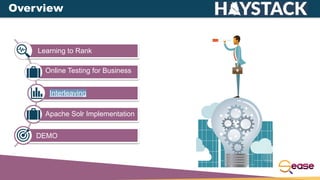
![50%
50%
A B
20% 40%
Control Variation
[Online] A/B testing](https://image.slidesharecdn.com/onlinetestinglearningtorankwithsolrinterleaving-220407150725/85/Online-Testing-Learning-to-Rank-with-Solr-Interleaving-17-320.jpg)
![[Online] Interleaving results estimator
>0 winner A
<0 winner B
=0 tie](https://image.slidesharecdn.com/onlinetestinglearningtorankwithsolrinterleaving-220407150725/85/Online-Testing-Learning-to-Rank-with-Solr-Interleaving-19-320.jpg)
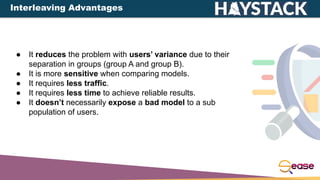
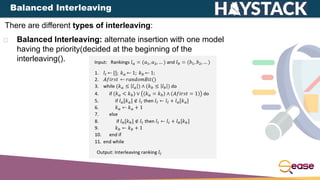
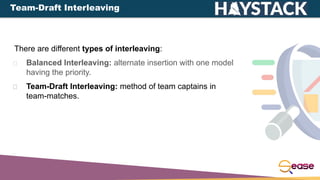
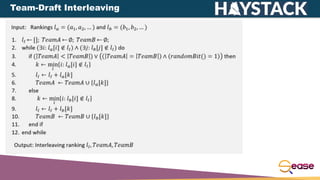
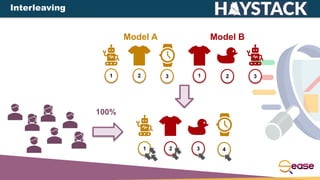
![There are different types of interleaving:
Balanced Interleaving: alternate insertion with one model
having the priority.
Team-Draft Interleaving: method of team capitains in
team-matches.
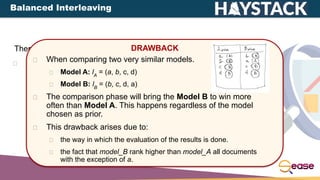
DRAWBACK
When comparing two very similar models.
Model A: lA
= (a, b, c, d)
Model B: lB
= (b, c, d, a)
Suppose c to be the only relevant document.
With this approach we can obtain four different interleaved lists:
lI1
= (aA
, bB
, cA
, dB
)
lI2
= (bB
, aA
, cB
, dA
)
lI3
= (bB
, aA
, cA
, dB
)
lI4
= (aA
, bB
, cB
, dA
)
All of them putting c at the same rank.
Tie!
But Model B should be chosen
as the best model!
[Online] Team-Draft Interleaving](https://image.slidesharecdn.com/onlinetestinglearningtorankwithsolrinterleaving-220407150725/85/Online-Testing-Learning-to-Rank-with-Solr-Interleaving-25-320.jpg)
![There are different types of interleaving:
Balanced Interleaving: alternate insertion with one model
having the priority.
Team-Draft Interleaving: method of team captains in
team-matches.
Probabilistic Interleaving: rely on probability distributions.
Every documents have a non-zero probability to be added in
the interleaved result list.
[Online] Probabilistic Interleaving](https://image.slidesharecdn.com/onlinetestinglearningtorankwithsolrinterleaving-220407150725/85/Online-Testing-Learning-to-Rank-with-Solr-Interleaving-26-320.jpg)
![There are different types of interleaving:
Balanced Interleaving: alternate insertion with one model
having the priority.
Team-Draft Interleaving: method of team captains in
team-matches.
Probabilistic Interleaving: rely on probability distributions.
Every documents have a non-zero probability to be added in
the interleaved result list.
DRAWBACK
The use of probability distribution could lead to a worse user
experience. Less relevant document could be put higher.
[Online] Probabilistic Interleaving
https://sease.io/2020/05/online-testing-for-learning-to-rank-interleaving.html](https://image.slidesharecdn.com/onlinetestinglearningtorankwithsolrinterleaving-220407150725/85/Online-Testing-Learning-to-Rank-with-Solr-Interleaving-27-320.jpg)

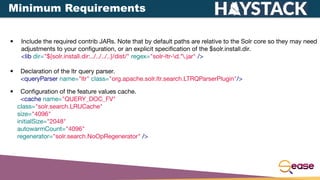
![• Declaration of the [features] transformer.
<transformer name="features"
class="org.apache.solr.ltr.response.transform.LTRFeatureLoggerTransformerFactory">
<str name="fvCacheName">QUERY_DOC_FV</str>
</transformer>
• Declaration of the [interleaving] transformer.
<transformer name="interleaving"
class="org.apache.solr.ltr.response.transform.LTRInterleavingTransformerFactory"/>
Minimum Requirements](https://image.slidesharecdn.com/onlinetestinglearningtorankwithsolrinterleaving-220407150725/85/Online-Testing-Learning-to-Rank-with-Solr-Interleaving-30-320.jpg)
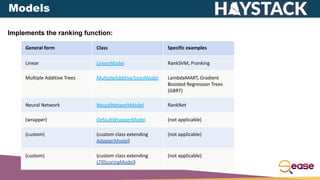
![‣ Computes the scores using a dot product
https://lucene.apache.org/solr/8_8_0//solr-ltr/org/apache/solr/ltr/model/LinearModel.html
Example configuration:
{
"class" : "org.apache.solr.ltr.model.LinearModel",
"name" : "myModelName",
"features" : [
{ "name" : "userTextTitleMatch" },
{ "name" : "originalScore" },
{ "name" : "isBook" }
],
"params" : {
"weights" : {
"userTextTitleMatch" : 1.0,
"originalScore" : 0.5,
"isBook" : 0.1
}
}
}
Linear](https://image.slidesharecdn.com/onlinetestinglearningtorankwithsolrinterleaving-220407150725/85/Online-Testing-Learning-to-Rank-with-Solr-Interleaving-32-320.jpg)
![‣ computes scores based on the summation of multiple weighted trees
https://lucene.apache.org/solr/8_8_0//solr-ltr/org/apache/solr/ltr/model/MultipleAdditiveTreesModel.html
{
"class" : "org.apache.solr.ltr.model.MultipleAdditiveTreesModel",
"name" : "multipleadditivetreesmodel",
"features":[
{ "name" : "userTextTitleMatch"},
{ "name" : "originalScore"}
],
}
"params" : {
"trees" : [
{
"weight" : "1",
"root": {
"feature" : "userTextTitleMatch",
"threshold" : "0.5",
"left" : {
"value" : "-100"
},
"right" : {
"feature" : "originalScore",
"threshold" : "10.0",
"left" : {
"value" : "50"
},
"right" : {
"value" : "75"
}
}
}
},
{
"weight" : "2",
"root" : {
"value" : "-10"
}
}
]
}
Multiple Additive Trees Model](https://image.slidesharecdn.com/onlinetestinglearningtorankwithsolrinterleaving-220407150725/85/Online-Testing-Learning-to-Rank-with-Solr-Interleaving-33-320.jpg)
![‣ computes scores using a neural network.
https://lucene.apache.org/solr/8_8_0//solr-ltr/org/apache/solr/ltr/model/MultipleAdditiveTreesModel.html
{
"class" : "org.apache.solr.ltr.model.NeuralNetworkModel",
"name" : "rankNetModel",
"features" : [
{ "name" : "documentRecency" },
{ "name" : "isBook" },
{ "name" : "originalScore" }
],
"params" : {
"layers" : [
{
"matrix" : [ [ 1.0, 2.0, 3.0 ],
[ 4.0, 5.0, 6.0 ],
[ 7.0, 8.0, 9.0 ],
[ 10.0, 11.0, 12.0 ] ],
"bias" : [ 13.0, 14.0, 15.0, 16.0 ],
"activation" : "sigmoid"
},
{
"matrix" : [ [ 17.0, 18.0, 19.0, 20.0 ],
[ 21.0, 22.0, 23.0, 24.0 ] ],
"bias" : [ 25.0, 26.0 ],
"activation" : "relu"
},
{
"matrix" : [ [ 27.0, 28.0 ],
[ 29.0, 30.0 ] ],
"bias" : [ 31.0, 32.0 ],
"activation" : "leakyrelu"
},
{
"matrix" : [ [ 33.0, 34.0 ],
[ 35.0, 36.0 ] ],
"bias" : [ 37.0, 38.0 ],
"activation" : "tanh"
},
{
"matrix" : [ [ 39.0, 40.0 ] ],
"bias" : [ 41.0 ],
"activation" : "identity"
}
]
}
Neural Network](https://image.slidesharecdn.com/onlinetestinglearningtorankwithsolrinterleaving-220407150725/85/Online-Testing-Learning-to-Rank-with-Solr-Interleaving-34-320.jpg)
![http://localhost:8983/solr/techproducts/query?q=test&rq={!ltr
model=myModel reRankDocs=100}&fl=id,score
To obtain the feature values computed during reranking, add [features] to the fl parameter, for
example:
http://localhost:8983/solr/techproducts/query?q=test&rq={!ltr
model=myModel reRankDocs=100}&fl=id,score,[features]
To rerank using external feature information:
http://localhost:8983/solr/techproducts/query?q=test&rq={!ltr
model=myEfiModel efi.text=test efi.preferredManufacturer=Apache
efi.fromMobile=0 efi.answer=13}&fl=id,cat,manu,score,
[features]
Reranking](https://image.slidesharecdn.com/onlinetestinglearningtorankwithsolrinterleaving-220407150725/85/Online-Testing-Learning-to-Rank-with-Solr-Interleaving-35-320.jpg)
![http://localhost:8983/solr/books/query?q=subjects%3A(%22England%20--%20Fiction%22%20OR%20%22Mystery%20fiction%22)&rq=%7B!ltr%20model=linear
Model1%20reRankDocs=100%20efi.favouriteSubject=%22Mystery%20fiction%22%20efi.fromMobile=1%20efi.age=25%20efi.userLanguage=%22en%22%7D&f
l=id,title,subjects,downloads,score,[features]&debug=results
Hands On: Run a reranking query](https://image.slidesharecdn.com/onlinetestinglearningtorankwithsolrinterleaving-220407150725/85/Online-Testing-Learning-to-Rank-with-Solr-Interleaving-36-320.jpg)
![http://localhost:8983/solr/techproducts/query?q=test&rq={!ltr
model=myModelA model=myModelB reRankDocs=100}&fl=id,score
To obtain the model that interleaving picked for a search result, computed during reranking,
add [interleaving] to the fl parameter, for example:
http://localhost:8983/solr/techproducts/query?q=test&rq={!ltr
model=myModelA model=myModelB reRankDocs=100}&fl=id,score,
[interleaving]
Reranking with Interleaving](https://image.slidesharecdn.com/onlinetestinglearningtorankwithsolrinterleaving-220407150725/85/Online-Testing-Learning-to-Rank-with-Solr-Interleaving-37-320.jpg)
![{
"responseHeader":{
"status":0,
"QTime":0,
"params":{
"q":"test",
"fl":"id,score,[interleaving]",
"rq":"{!ltr model=myModelA model=myModelB
reRankDocs=100}"}},
"response":{"numFound":2,"start":0,"maxScore":1.0005897,"docs":[
{
"id":"GB18030TEST",
"score":1.0005897,
"[interleaving]":"myModelB"},
{
"id":"UTF8TEST",
"score":0.79656565,
"[interleaving]":"myModelA"}]
}}
Reranking with Interleaving](https://image.slidesharecdn.com/onlinetestinglearningtorankwithsolrinterleaving-220407150725/85/Online-Testing-Learning-to-Rank-with-Solr-Interleaving-38-320.jpg)
![http://localhost:8983/solr/books/query?q=subjects%3A(%22England%20--%20Fiction%22%20
OR%20%22Mystery%20fiction%22)&rq={!ltr%20model=linearModel1%20model=_OriginalRanking
_%20reRankDocs=100%20efi.favouriteSubject=%22Mystery%20fiction%22%20efi.fromMobile=1
%20efi.age=25%20efi.userLanguage=%22en%22}&fl=id,title,subjects,downloads,score,[fea
tures],[interleaving]&debug=results
"response":{"numFound":2,"start":0,"maxScore":1.0005897,"docs
":[
{
"id":"GB18030TEST",
"score":1.0005897,
"[interleaving]":"_OriginalRanking_"},
{
"id":"UTF8TEST",
"score":0.79656565,
"[interleaving]":"myModel"}]
}}
Interleaving with Original Score](https://image.slidesharecdn.com/onlinetestinglearningtorankwithsolrinterleaving-220407150725/85/Online-Testing-Learning-to-Rank-with-Solr-Interleaving-39-320.jpg)

![Future Works
http://localhost:8983/solr/techproducts/query?q=test&rq={!ltr model=myModelA model=myModelB
reRankDocs=100 interleavingAlgorithm=TeamDraft}&fl=id,score
Currently the only (and default) algorithm supported is 'TeamDraft'.
How to contribute
Do you want to contribute a new Interleaving Algorithm?
You just need to :
● implement the solr/contrib/ltr/src/java/org/apache/solr/ltr/interleaving/Interleaving.java interface in a new class
● add the new algorithm in the package: org.apache.solr.ltr.interleaving.algorithms
● add the new algorithm reference in the org.apache.solr.ltr.interleaving.Interleaving#getImplementation
Limitations
● [Distributed Search] Sharding is not supported](https://image.slidesharecdn.com/onlinetestinglearningtorankwithsolrinterleaving-220407150725/85/Online-Testing-Learning-to-Rank-with-Solr-Interleaving-41-320.jpg)


The document discusses online testing for learning to rank using Apache Solr, emphasizing the importance of user feedback for document ranking and the challenges of offline evaluation. It outlines various interleaving methods for comparing ranking models, their advantages, and associated drawbacks, detailing how to implement these methods in Solr. Additionally, it includes technical specifications and guidelines for configuring learning to rank models and interleaving within Solr environments.


![[Final]collaborative filtering and recommender systems](https://cdn.slidesharecdn.com/ss_thumbnails/finalcollaborativefilteringandrecommendersystems-141103044224-conversion-gate01-thumbnail.jpg?width=640&height=640&fit=bounds)


