Butyl Rubber
Presented By:
Kishan Jamatia (16BPE048)
Tarun Parikh (16BPE075)
Savan Sardhara (16BPE110)
Vishal Rathod (16BPE169)
Preparation/ Synthesis
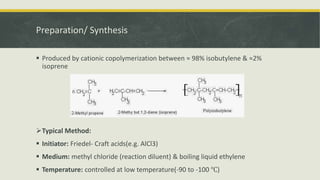
 Produced by cationic copolymerization between ≈ 98% isobutylene & ≈2%
isoprene
Typical Method:
 Initiator: Friedel- Craft acids(e.g. AlCl3)
 Medium: methyl chloride (reaction diluent) & boiling liquid ethylene
 Temperature: controlled at low temperature(-90 to -100 ℃)
Preparation/ Synthesis
Alternative Method:
 Initiator: Mixture of a major amount of diethylaluminium chloride & a minor
amount of ethylaluminium dichloride (activated by minute amounts of water/
methylalumino {MAO})
 Modified initiators: higher molecular weights, higher degrees of conversion &
higher isoprene contents in butyl rubber
 Medium: hexane
 Temperature: -60℃
 Activation by MAO allow higher polymerization temperature which does not require
much heat removal from reaction mixture
Properties of Butyl Rubber
 Low permeability to air, gases and moisture
 Vibration damping
 Low glass transition temperature
 Low modulus elastomer
 Low compression set
 Resistance to aging and to weathering from
atmospheric exposure
 Processing safety
 High Extensibility
 Blood Compatible
 Wide vulcanization versatility
 Fast cure rates
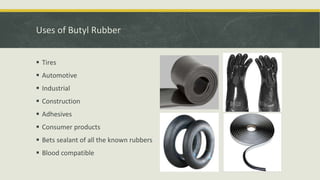
Uses of Butyl Rubber
 Tires
 Automotive
 Industrial
 Construction
 Adhesives
 Consumer products
 Bets sealant of all the known rubbers
 Blood compatible
Thank you

Butyl rubber

  • 1.
    Butyl Rubber Presented By: KishanJamatia (16BPE048) Tarun Parikh (16BPE075) Savan Sardhara (16BPE110) Vishal Rathod (16BPE169)
  • 2.
    Preparation/ Synthesis  Producedby cationic copolymerization between ≈ 98% isobutylene & ≈2% isoprene Typical Method:  Initiator: Friedel- Craft acids(e.g. AlCl3)  Medium: methyl chloride (reaction diluent) & boiling liquid ethylene  Temperature: controlled at low temperature(-90 to -100 ℃)
  • 3.
    Preparation/ Synthesis Alternative Method: Initiator: Mixture of a major amount of diethylaluminium chloride & a minor amount of ethylaluminium dichloride (activated by minute amounts of water/ methylalumino {MAO})  Modified initiators: higher molecular weights, higher degrees of conversion & higher isoprene contents in butyl rubber  Medium: hexane  Temperature: -60℃  Activation by MAO allow higher polymerization temperature which does not require much heat removal from reaction mixture
  • 4.
    Properties of ButylRubber  Low permeability to air, gases and moisture  Vibration damping  Low glass transition temperature  Low modulus elastomer  Low compression set  Resistance to aging and to weathering from atmospheric exposure  Processing safety  High Extensibility  Blood Compatible  Wide vulcanization versatility  Fast cure rates
  • 5.
    Uses of ButylRubber  Tires  Automotive  Industrial  Construction  Adhesives  Consumer products  Bets sealant of all the known rubbers  Blood compatible
  • 6.