Overhead Squat
By: Noah Erb, Parris Scott, and
Zachary Herbert.
(Fall 2017)
Overview
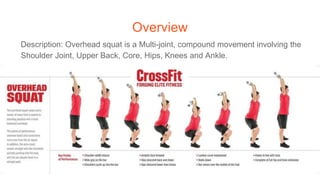
Description: Overhead squat is a Multi-joint, compound movement involving the
Shoulder Joint, Upper Back, Core, Hips, Knees and Ankle.
Major Involved Joints
Shoulder
Joints
Hip
Joint
Ankle
Joint
Knee
Joint
Muscles
Activated
● Forearm
● Biceps
● Triceps
● Shoulder
muscles
● Upper back
muscles
● Low back
muscles/core
● Butt Muscles
● Quads, thigh,
and hamstring
muscles
● Calf muscles
Standing
Phase
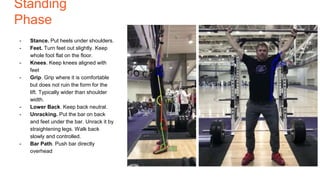
- Stance. Put heels under shoulders.
- Feet. Turn feet out slightly. Keep
whole foot flat on the floor.
- Knees. Keep knees aligned with
feet
- Grip. Grip where it is comfortable
but does not ruin the form for the
lift. Typically wider than shoulder
width.
- Lower Back. Keep back neutral.
- Unracking. Put the bar on back
and feet under the bar. Unrack it by
straightening legs. Walk back
slowly and controlled.
- Bar Path. Push bar directly
overhead
Lowering
Phase
- Stance. Squat with heels shoulder-
width apart.
- Feet. Don’t raise toes or heels.
- Knees. Keep knees in line with feet.
- Hips. Bend hips and knees at the
same time. Move hips back and down
while keeping knees stabilized
- Lower Back and Neck. Squat with a
natural arch like when you stand.
- Depth. Squat down until hips are
lower than knees. Thighs parallel isn’t
enough, go lower than parallel with the
ground WITH GOOD FORM!
- Bar Path. Move the bar in a vertical
line over mid-foot.
- Breathing. Breathe in while lowering.
Holding Phase
- Feet. Don’t raise toes or heels.
- Knees. Keep knees in line with
toes.
- Lower Back. No rounding or
excess arching.
- Neck. Keep looking straight
ahead
- Depth. Squat down until hips
are lower than knees.
- Bar Path. No horizontal
movement, Keep directly above
shoulders.
- Breathing. Hold it at the
bottom.
Upward Phase
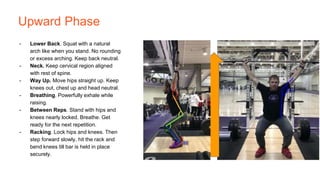
- Lower Back. Squat with a natural
arch like when you stand. No rounding
or excess arching. Keep back neutral.
- Neck. Keep cervical region aligned
with rest of spine.
- Way Up. Move hips straight up. Keep
knees out, chest up and head neutral.
- Breathing. Powerfully exhale while
raising.
- Between Reps. Stand with hips and
knees nearly locked. Breathe. Get
ready for the next repetition.
- Racking. Lock hips and knees. Then
step forward slowly, hit the rack and
bend knees till bar is held in place
securely.
Standing/Holding Phase Muscle Activation
● Main Shoulder Muscles Involved: Constant tension, No change in length
● Hip Muscles/Butt Muscles: Constant tension, No change in length
● Hamstrings/Quadriceps: Constant tension, No change in length
● Lower Leg Muscles: Constant tension, No change in length
● Core/Arms: Actively involved in stability and control
Lowering/Upward Phases Muscle Activations
● Shoulder Joint Abductors: Length of muscles stay the same.
● Hip Extensors/Butt Muscles: Muscle length lengthens when lowering and shortens
when going up.
● Quadriceps: Muscle length lengthens when lowering and shortens when going up.
● Calf Muscles: Muscle length lengthens when lowering and shortens when going up.
● Core/Arms: Actively involved in stability and control
Improper
Technique:
Things to watch for
Common Technique Errors
Problem: Toes pointed too far out
Solution: Bring toes closer to the midline
and direct weight evenly over foot
Problem: Toes pointed in
Solution: Turn the ankle outward so that
the toes are facing forward
Problem: Bar is too far behind head
Solution: Bring the bar to a position
directly above the torso
Problem: Bar too far in front of shoulders
Solution: Draw shoulders back so that
the bar is above the torso. Sometimes a
wider grip will allow the movement to
happen easier.
Problem: Knees are not aligned with feet
Solution: Balance the weight more evenly
and push the knees slightly outward
Other Common Technique Errors
Problem: Knees pointed out to far
Solution: Pull knees more toward the
center of the body, center weight evenly
Problem: Narrow Feet/Wide Feet
Solution: Push feet wider if they are too
narrow, bring feet more toward the center
of the body if they are too wide. Slightly
more than shoulder width
Problem: Too much arching of the lower
back
Solution: Straighten the back
Problem: Rounding of back
Solution: Arch back towards a more
neutral position, more natural, like when
standing
*If you feel like you are losing control of the weight, push bar forward with arms and torso
and jump back.
Find What is Wrong on the Right!
Bibliography
Comfort, Paul. "Optimizing squat technique ." Strength and Conditioning Journal (2007): 10-13.
Floyd, R.T. Manual of Structural of Kinesiology. New York: McGraw Hill Education, 2015. Print.
Glassman, Greg. "The overhead squat." The Crossfit Journal (2005): 1-7.
Baechle, T., Earle, R., & Association, &. N. (2016). Essentials of Strength Training and Conditioning (4th ed.). Champaign, IL: Human
Kinetics.

Overhead Squat

  • 1.
    Overhead Squat By: NoahErb, Parris Scott, and Zachary Herbert. (Fall 2017)
  • 2.
    Overview Description: Overhead squatis a Multi-joint, compound movement involving the Shoulder Joint, Upper Back, Core, Hips, Knees and Ankle.
  • 3.
  • 4.
    Muscles Activated ● Forearm ● Biceps ●Triceps ● Shoulder muscles ● Upper back muscles ● Low back muscles/core ● Butt Muscles ● Quads, thigh, and hamstring muscles ● Calf muscles
  • 5.
    Standing Phase - Stance. Putheels under shoulders. - Feet. Turn feet out slightly. Keep whole foot flat on the floor. - Knees. Keep knees aligned with feet - Grip. Grip where it is comfortable but does not ruin the form for the lift. Typically wider than shoulder width. - Lower Back. Keep back neutral. - Unracking. Put the bar on back and feet under the bar. Unrack it by straightening legs. Walk back slowly and controlled. - Bar Path. Push bar directly overhead
  • 6.
    Lowering Phase - Stance. Squatwith heels shoulder- width apart. - Feet. Don’t raise toes or heels. - Knees. Keep knees in line with feet. - Hips. Bend hips and knees at the same time. Move hips back and down while keeping knees stabilized - Lower Back and Neck. Squat with a natural arch like when you stand. - Depth. Squat down until hips are lower than knees. Thighs parallel isn’t enough, go lower than parallel with the ground WITH GOOD FORM! - Bar Path. Move the bar in a vertical line over mid-foot. - Breathing. Breathe in while lowering.
  • 7.
    Holding Phase - Feet.Don’t raise toes or heels. - Knees. Keep knees in line with toes. - Lower Back. No rounding or excess arching. - Neck. Keep looking straight ahead - Depth. Squat down until hips are lower than knees. - Bar Path. No horizontal movement, Keep directly above shoulders. - Breathing. Hold it at the bottom.
  • 8.
    Upward Phase - LowerBack. Squat with a natural arch like when you stand. No rounding or excess arching. Keep back neutral. - Neck. Keep cervical region aligned with rest of spine. - Way Up. Move hips straight up. Keep knees out, chest up and head neutral. - Breathing. Powerfully exhale while raising. - Between Reps. Stand with hips and knees nearly locked. Breathe. Get ready for the next repetition. - Racking. Lock hips and knees. Then step forward slowly, hit the rack and bend knees till bar is held in place securely.
  • 9.
    Standing/Holding Phase MuscleActivation ● Main Shoulder Muscles Involved: Constant tension, No change in length ● Hip Muscles/Butt Muscles: Constant tension, No change in length ● Hamstrings/Quadriceps: Constant tension, No change in length ● Lower Leg Muscles: Constant tension, No change in length ● Core/Arms: Actively involved in stability and control
  • 10.
    Lowering/Upward Phases MuscleActivations ● Shoulder Joint Abductors: Length of muscles stay the same. ● Hip Extensors/Butt Muscles: Muscle length lengthens when lowering and shortens when going up. ● Quadriceps: Muscle length lengthens when lowering and shortens when going up. ● Calf Muscles: Muscle length lengthens when lowering and shortens when going up. ● Core/Arms: Actively involved in stability and control
  • 11.
  • 12.
    Common Technique Errors Problem:Toes pointed too far out Solution: Bring toes closer to the midline and direct weight evenly over foot Problem: Toes pointed in Solution: Turn the ankle outward so that the toes are facing forward Problem: Bar is too far behind head Solution: Bring the bar to a position directly above the torso Problem: Bar too far in front of shoulders Solution: Draw shoulders back so that the bar is above the torso. Sometimes a wider grip will allow the movement to happen easier. Problem: Knees are not aligned with feet Solution: Balance the weight more evenly and push the knees slightly outward
  • 13.
    Other Common TechniqueErrors Problem: Knees pointed out to far Solution: Pull knees more toward the center of the body, center weight evenly Problem: Narrow Feet/Wide Feet Solution: Push feet wider if they are too narrow, bring feet more toward the center of the body if they are too wide. Slightly more than shoulder width Problem: Too much arching of the lower back Solution: Straighten the back Problem: Rounding of back Solution: Arch back towards a more neutral position, more natural, like when standing *If you feel like you are losing control of the weight, push bar forward with arms and torso and jump back.
  • 14.
    Find What isWrong on the Right!
  • 15.
    Find What isWrong on the Right!
  • 16.
    Find What isWrong on the Right!
  • 17.
    Bibliography Comfort, Paul. "Optimizingsquat technique ." Strength and Conditioning Journal (2007): 10-13. Floyd, R.T. Manual of Structural of Kinesiology. New York: McGraw Hill Education, 2015. Print. Glassman, Greg. "The overhead squat." The Crossfit Journal (2005): 1-7. Baechle, T., Earle, R., & Association, &. N. (2016). Essentials of Strength Training and Conditioning (4th ed.). Champaign, IL: Human Kinetics.

Editor's Notes

  • #3 https://cdn.shopify.com/s/files/1/1102/4268/products/CF_Poster2-OverheadSquat-2000px_207f3ef8-a1ce-4040-8455-cdb264fa9b7b.jpg?v=1472837471
  • #4 https://www.google.com/search?q=glenohumeral+joint&rlz=1C1GGRV_enUS772US772&source=lnms&tbm=isch&sa=X&ved=0ahUKEwj0yoarkdDXAhXMy1QKHX5bC1sQ_AUICigB&biw=1920&bih=974#imgrc=JIVNJ2shPRo-mM: http://bodymind.typepad.com/.a/6a0105360b487d970c0168ebf1ebec970c-pi http://www.jouefct.com/wp-content/uploads/2015/12/Anatomy-Of-Knee-If-ya-Want-to-Working-From-The-Ground-Upwards-With-Your-Feet-Placed-Together-Understand-The-Relational-Stuff.png https://www.google.com/search?rlz=1C1GGRV_enUS772US772&biw=1920&bih=974&tbm=isch&sa=1&ei=MVwUWpulEKSc0gLtsbHoAQ&q=hip+joint&oq=hip+joint&gs_l=psy-ab.3..0i67k1j0l9.1891.1891.0.2106.1.1.0.0.0.0.103.103.0j1.1.0....0...1c.1.64.psy-ab..0.1.101....0.9Dl-A7eng2s#imgdii=OWkAlNufbUeOJM:&imgrc=UwlJ26EWNxyN2M:
  • #5 http://humananatomylibrary.com/wp-content/uploads/2017/09/anatomy-of-the-lower-leg-muscles-anatomy-of-the-lower-leg-anatomy-lower-leg-muscles-human-anatomy.jpg https://www.google.com/search?rlz=1C1GGRV_enUS772US772&biw=1920&bih=974&tbm=isch&sa=1&ei=NFwUWqeMC-yO0wLWgqOoBA&q=glenohumeral+muscles&oq=glenohumeral+muscles&gs_l=psy-ab.3..0j0i8i30k1l2.151702.157232.0.157388.22.15.1.6.6.0.117.1239.13j2.15.0....0...1c.1.64.psy-ab..0.22.1309...0i67k1j0i10i30k1j0i30k1j0i5i30k1j0i24k1.0.Q9f1S5G7HgU#imgrc=wAzQ_jv5KfYD_M: https://static1.squarespace.com/static/52994853e4b0a6ba0e3606bc/t/53b5e95be4b0d8a133e4dd3f/1404430691645/?format=750w http://images.slideplayer.com/41/11176784/slides/slide_9.jpg
  • #12 https://www.google.com/search?rlz=1C1GGRV_enUS772US772&biw=1920&bih=974&tbm=isch&sa=1&ei=Xl8UWomRMeOP0wK9_p6gCw&q=improper+overhead+squat&oq=improper+overhead+squat&gs_l=psy-ab.3...213456.218586.0.218741.29.23.3.3.4.0.144.1903.21j2.23.0....0...1c.1.64.psy-ab..0.15.935...0j0i67k1j0i8i30k1j0i24k1.0.GzmLZnuZVnM#imgrc=VUvzzcUhCgtorM: https://www.google.com/search?rlz=1C1GGRV_enUS772US772&biw=1920&bih=974&tbm=isch&sa=1&ei=Xl8UWomRMeOP0wK9_p6gCw&q=improper+overhead+squat&oq=improper+overhead+squat&gs_l=psy-ab.3...213456.218586.0.218741.29.23.3.3.4.0.144.1903.21j2.23.0....0...1c.1.64.psy-ab..0.15.935...0j0i67k1j0i8i30k1j0i24k1.0.GzmLZnuZVnM#imgrc=utsPvxX2X1L-wM: https://www.google.com/search?rlz=1C1GGRV_enUS772US772&biw=1920&bih=974&tbm=isch&sa=1&ei=Xl8UWomRMeOP0wK9_p6gCw&q=improper+overhead+squat&oq=improper+overhead+squat&gs_l=psy-ab.3...213456.218586.0.218741.29.23.3.3.4.0.144.1903.21j2.23.0....0...1c.1.64.psy-ab..0.15.935...0j0i67k1j0i8i30k1j0i24k1.0.GzmLZnuZVnM#imgrc=PrqVliHwFjSd6M: