5th Symposium Vulnerable Plaque Org5th Symposium Vulnerable Plaque Org
March 29th, 2003March 29th, 2003
ChicagoChicago
Vulnerable (Thrombogenic) BloodVulnerable (Thrombogenic) Blood
Juan Jose BadimonJuan Jose Badimon
Cardiovascular Biology Research LaboratoryCardiovascular Biology Research Laboratory
Cardiovascular InstituteCardiovascular Institute
Mount Sinai School of MedicineMount Sinai School of Medicine
New York, NYNew York, NY
3rd Symposium Vulnerable Plaque Org3rd Symposium Vulnerable Plaque Org
March 16th, 2002March 16th, 2002
AtlantaAtlanta
VulnerableVulnerable VulnerableVulnerable VulnerableVulnerable
PlaquePlaque BloodBlood PatientPatient
++ ==
Juan Jose BadimonJuan Jose Badimon
Cardiovascular Biology Research LaboratoryCardiovascular Biology Research Laboratory
Cardiovascular InstituteCardiovascular Institute
Mount Sinai School of MedicineMount Sinai School of Medicine
New York, NYNew York, NY
ATHEROTHROMBOTICATHEROTHROMBOTIC DISEASEDISEASE
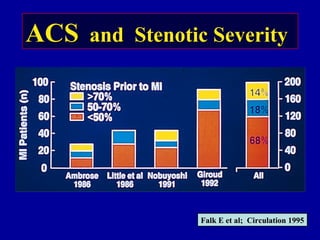
ACSACS and Stenotic Severityand Stenotic Severity
Falk E et al; Circulation 1995Falk E et al; Circulation 1995
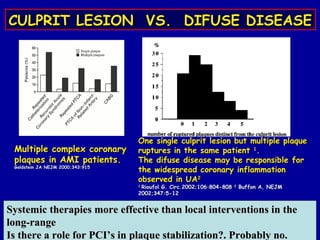
CULPRIT LESION VS. DIFUSE DISEASECULPRIT LESION VS. DIFUSE DISEASE
One single culprit lesion but multiple plaqueOne single culprit lesion but multiple plaque
ruptures in the same patientruptures in the same patient 11
..
The difuse disease may be responsible forThe difuse disease may be responsible for
the widespread coronary inflammationthe widespread coronary inflammation
observed in UAobserved in UA22
11
Rioufol G. Circ.2002;106:804-808Rioufol G. Circ.2002;106:804-808 22
Buffon A, NEJMBuffon A, NEJM
2002;347:5-122002;347:5-12
Multiple complex coronaryMultiple complex coronary
plaques in AMI patients.plaques in AMI patients.
Goldstein JA NEJM 2000;343:915Goldstein JA NEJM 2000;343:915
Systemic therapies more effective than local interventions in theSystemic therapies more effective than local interventions in the
long-rangelong-range
Is there a role for PCI’s in plaque stabilization?. Probably no.Is there a role for PCI’s in plaque stabilization?. Probably no.
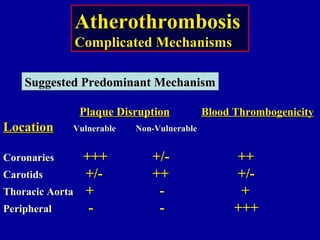
AtherothrombosisAtherothrombosis
Complicated MechanismsComplicated Mechanisms
Plaque DisruptionPlaque Disruption BloodBlood ThrombogenicityThrombogenicity
LocationLocation VulnerableVulnerable Non-VulnerableNon-Vulnerable
CoronariesCoronaries ++++++ +/-+/- ++++
CarotidsCarotids +/-+/- ++++ +/-+/-
Thoracic AortaThoracic Aorta ++ -- ++
PeripheralPeripheral -- -- ++++++
Suggested Predominant MechanismSuggested Predominant Mechanism
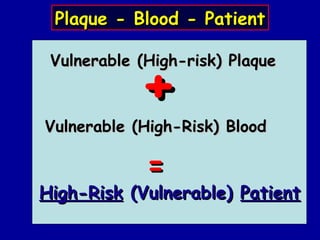
Vulnerable (High-risk) PlaqueVulnerable (High-risk) Plaque
++Vulnerable (High-Risk) BloodVulnerable (High-Risk) Blood
==
High-RiskHigh-Risk (Vulnerable)(Vulnerable) PatientPatient
Plaque - Blood - PatientPlaque - Blood - Patient
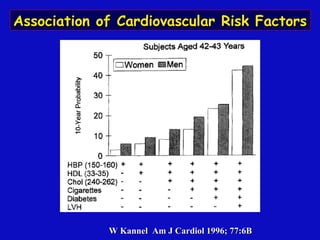
W Kannel Am J Cardiol 1996; 77:6BW Kannel Am J Cardiol 1996; 77:6B
Association of Cardiovascular Risk FactorsAssociation of Cardiovascular Risk Factors
Family/GenesFamily/Genes
GenderGender
Age (menopause)Age (menopause)
DietDiet
InflammationInflammation
HypertensionHypertension
ObesityObesity
SedentarismSedentarism
othersothers
SmokingSmoking
CathecholaminesCathecholamines
FibrinogenFibrinogen
Lp(a)/HomocysteinLp(a)/Homocystein
Factor V LeidenFactor V Leiden
Platelet polymorph.Platelet polymorph.
HypercoagulabilityHypercoagulability
HypofibrinolysisHypofibrinolysis
Genetic ProteinGenetic Protein
deficienciesdeficiencies
Diabetes
Hyperlipidemia
Apoptosis?
Shear rate
Stress
Depression ?
cRP?
ATHEROGENESISATHEROGENESIS THROMBOSISTHROMBOSIS
Risk Factor and AtherothrombosisRisk Factor and Atherothrombosis
00
40004000
80008000
1200012000
1600016000
SIMVASTATINSIMVASTATIN PRAVASTATINPRAVASTATIN
p<0.05p<0.05
p<0.05p<0.05
ThrombusFormationThrombusFormation
((µµmm22
/mm/mm))
Pre treatmentPre treatment Post treatmentPost treatment
LIPID LOWERING and BLOOD THROMBOGENICITYLIPID LOWERING and BLOOD THROMBOGENICITY
251±51251±51 176±44176±44 Total CHOTotal CHO 246+39246+39 202+41202+41
165±99165±99 151±83151±83 LDL-CHOLDL-CHO 141+56141+56 123±65123±65
Rauch U et al. Atherosclerosis 2000; 153: 181-89Rauch U et al. Atherosclerosis 2000; 153: 181-89
Effect of 2-year statin on Vessel WallEffect of 2-year statin on Vessel Wall
Corti R, Badimon JJ et al. Circulation 2002 106:2884-87Corti R, Badimon JJ et al. Circulation 2002 106:2884-87
BLOODBLOOD ARTERIAL WALLARTERIAL WALL
ACUTE CORONARY EVENTS
PLASMA LIPIDSPLASMA LIPIDS
plaque
vulnerability
plaque
progression
endothelial
dysfunction
platelet
reactivity
macrophages
hyper-
coagulability
thrombus
formation
STATINSSTATINS
plaque
disruption
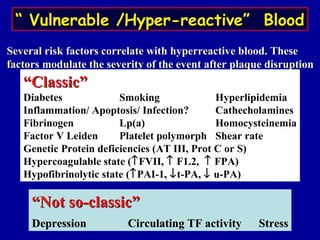
““ Vulnerable /Hyper-reactive” BloodVulnerable /Hyper-reactive” Blood
Several risk factors correlate with hyperreactive blood. TheseSeveral risk factors correlate with hyperreactive blood. These
factors modulate the severity of the event after plaque disruptionfactors modulate the severity of the event after plaque disruption
““Classic”Classic”
Diabetes Smoking Hyperlipidemia
Inflammation/ Apoptosis/ Infection? Cathecholamines
Fibrinogen Lp(a) Homocysteinemia
Factor V Leiden Platelet polymorph Shear rate
Genetic Protein deficiencies (AT III, Prot C or S)
Hypercoagulable state (↑FVII, ↑ F1.2, ↑ FPA)
Hypofibrinolytic state (↑PAI-1, ↓t-PA, ↓ u-PA)
““Not so-classic”Not so-classic”
DepressionDepression Circulating TF activityCirculating TF activity StressStress
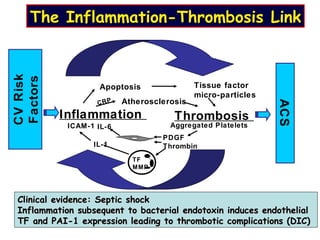
Inflammation Thrombosis
Atherosclerosis
Apoptosis Tissue factor
micro-particles
Aggregated Platelets
PDGF
Thrombin
IL-6
TF
MMP
ICAM-1
IL-1
CRP
CVRisk
Factors
ACS
The Inflammation-ThrombosisThe Inflammation-Thrombosis LinkLink
Clinical evidence: Septic shockClinical evidence: Septic shock
Inflammation subsequent to bacterial endotoxin induces endothelialInflammation subsequent to bacterial endotoxin induces endothelial
TF and PAI-1 expression leading to thrombotic complications (DIC)TF and PAI-1 expression leading to thrombotic complications (DIC)
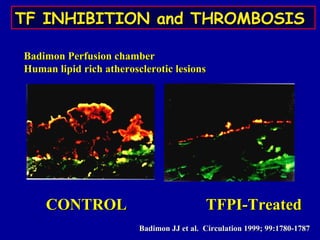
CONTROLCONTROL TFPI-TreatedTFPI-Treated
TF INHIBITION and THROMBOSISTF INHIBITION and THROMBOSIS
Badimon Perfusion chamberBadimon Perfusion chamber
Human lipid rich atherosclerotic lesionsHuman lipid rich atherosclerotic lesions
Badimon JJ et al. Circulation 1999; 99:1780-1787Badimon JJ et al. Circulation 1999; 99:1780-1787
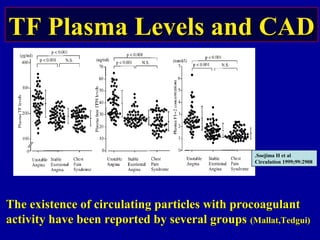
TF Plasma Levels and CADTF Plasma Levels and CAD
Soejima H et al.
Circulation 1999;99:2908
The existence of circulating particles with procoagulantThe existence of circulating particles with procoagulant
activity have been reported by several groupsactivity have been reported by several groups (Mallat,Tedgui)(Mallat,Tedgui)
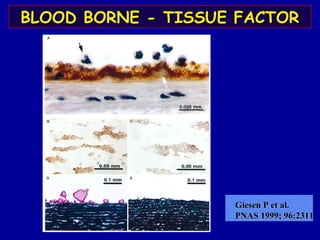
BLOOD BORNE - TISSUE FACTORBLOOD BORNE - TISSUE FACTOR
Giesen P et al.Giesen P et al.
PNAS 1999; 96:2311PNAS 1999; 96:2311
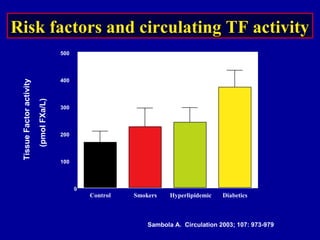
Risk factors and circulating TF activityRisk factors and circulating TF activity
Control Smokers Hyperlipidemic Diabetics
0
100
200
300
400
500
TissueFactoractivity
(pmolFXa/L)
Sambola A. Circulation 2003; 107: 973-979
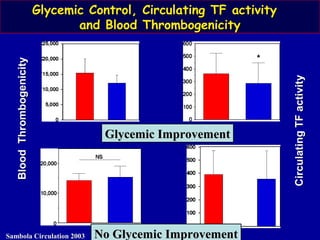
BloodThrombogenicityBloodThrombogenicity
CirculatingTFactivityCirculatingTFactivity
Glycemic ImprovementGlycemic Improvement
No Glycemic ImprovementNo Glycemic ImprovementSambola Circulation 2003Sambola Circulation 2003
Glycemic Control, Circulating TF activityGlycemic Control, Circulating TF activity
and Blood Thrombogenicityand Blood Thrombogenicity
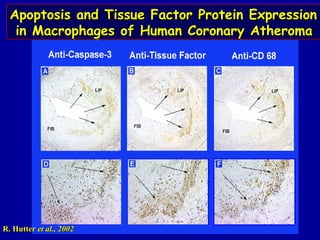
Apoptosis and Tissue Factor Protein ExpressionApoptosis and Tissue Factor Protein Expression
in Macrophages of Human Coronary Atheromain Macrophages of Human Coronary Atheroma
Apoptosis and Tissue Factor Protein ExpressionApoptosis and Tissue Factor Protein Expression
in Macrophages of Human Coronary Atheromain Macrophages of Human Coronary Atheroma
R. HutterR. Hutter et al., 2002et al., 2002
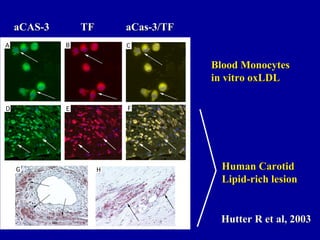
Blood MonocytesBlood Monocytes
in vitro oxLDLin vitro oxLDL
Human CarotidHuman Carotid
Lipid-rich lesionLipid-rich lesion
aCAS-3aCAS-3 TFTF aCas-3/TFaCas-3/TF
Hutter R et al, 2003Hutter R et al, 2003
monocyte
TF PMN
BLOOD
VESSEL WALL
AT plaque
SMC
lipid core
macrophage
fibroblast
myocyte
HEART
myocardial
ischemia
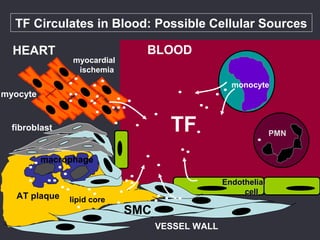
TF Circulates in Blood: Possible Cellular Sources
EndothelialEndothelial
cellcell
Inhibitors of the intrinsic pathwayInhibitors of the intrinsic pathway
HEPARINHEPARIN
WARFARINWARFARIN
LOW MOLECULAR WEIGHT HEPARINSLOW MOLECULAR WEIGHT HEPARINS
DIRECT THROMBIN INHIBITORSDIRECT THROMBIN INHIBITORS
Antiplatelet agentsAntiplatelet agents
ASPIRINASPIRIN
TICLOPIDIN, CLOPIDOGRELTICLOPIDIN, CLOPIDOGREL (±ASA)(±ASA)
GP IIb/IIIa RECEPTOR ANTAGONISTSGP IIb/IIIa RECEPTOR ANTAGONISTS
DIRECT THROMBIN INHIBITORSDIRECT THROMBIN INHIBITORS
Other ApproachesOther Approaches::
THROMBOLYTICS,THROMBOLYTICS,
ANTI IX,ANTI IX,
P2T ANTAGONISTS,P2T ANTAGONISTS,
TX-ANTAGONISTSTX-ANTAGONISTS
Antithrombotic TherapyAntithrombotic Therapy
Inhibitors of the intrinsic pathwayInhibitors of the intrinsic pathway
HEPARINHEPARIN
WARFARINWARFARIN
LOW MOLECULAR WEIGHT HEPARINSLOW MOLECULAR WEIGHT HEPARINS
DIRECT THROMBIN INHIBITORSDIRECT THROMBIN INHIBITORS
Antiplatelet agentsAntiplatelet agents
ASPIRINASPIRIN
TICLOPIDIN, CLOPIDOGREL (±ASA)TICLOPIDIN, CLOPIDOGREL (±ASA)
GP IIb/IIIa RECEPTOR ANTAGONISTSGP IIb/IIIa RECEPTOR ANTAGONISTS
DIRECT THROMBIN INHIBITORSDIRECT THROMBIN INHIBITORS
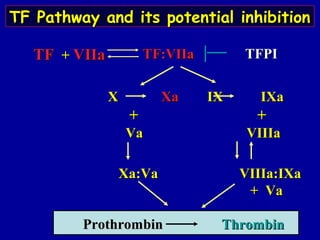
Inhibitors of Tissue Factor PathwayInhibitors of Tissue Factor Pathway
TFPITFPI TAPTAP
INHIBITORS OF FACTORS VIIa and/or XaINHIBITORS OF FACTORS VIIa and/or Xa
Other ApproachesOther Approaches::
THROMBOLYTICS, ANTI IX, P2T ANTAGONISTS, TX-ANTAGONISTSTHROMBOLYTICS, ANTI IX, P2T ANTAGONISTS, TX-ANTAGONISTS
Antithrombotic TherapyAntithrombotic Therapy
XX XaXa IXIX IXaIXa
++ ++
VaVa VIIIaVIIIa
Xa:VaXa:Va VIIIa:IXaVIIIa:IXa
+ Va+ Va
ProthrombinProthrombin ThrombinThrombin
TFTF ++ VIIaVIIa TF:VIIaTF:VIIa
TF Pathway and its potential inhibitionTF Pathway and its potential inhibition
TFPITFPI
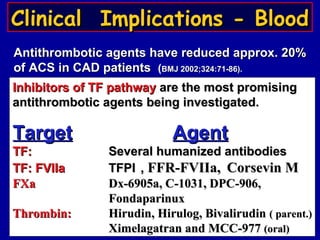
Clinical Implications - BloodClinical Implications - Blood
Inhibitors of TF pathwayInhibitors of TF pathway are the most promisingare the most promising
antithrombotic agents being investigated.antithrombotic agents being investigated.
TargetTarget AgentAgent
TF:TF: Several humanized antibodiesSeveral humanized antibodies
TF: FVIIaTF: FVIIa TFPITFPI ,, FFR-FVIIa,FFR-FVIIa, Corsevin MCorsevin M
FXaFXa Dx-6905a, C-1031, DPC-906,Dx-6905a, C-1031, DPC-906,
FondaparinuxFondaparinux
Thrombin:Thrombin: Hirudin, Hirulog, BivalirudinHirudin, Hirulog, Bivalirudin ( parent.)( parent.)
Ximelagatran and MCC-977Ximelagatran and MCC-977 (oral)(oral)
Antithrombotic agents have reduced approx. 20%Antithrombotic agents have reduced approx. 20%
of ACS in CAD patientsof ACS in CAD patients (BMJ 2002;324:71-86).BMJ 2002;324:71-86).

Vulnerable (thrombogenic blood

  • 1.
    5th Symposium VulnerablePlaque Org5th Symposium Vulnerable Plaque Org March 29th, 2003March 29th, 2003 ChicagoChicago Vulnerable (Thrombogenic) BloodVulnerable (Thrombogenic) Blood Juan Jose BadimonJuan Jose Badimon Cardiovascular Biology Research LaboratoryCardiovascular Biology Research Laboratory Cardiovascular InstituteCardiovascular Institute Mount Sinai School of MedicineMount Sinai School of Medicine New York, NYNew York, NY
  • 2.
    3rd Symposium VulnerablePlaque Org3rd Symposium Vulnerable Plaque Org March 16th, 2002March 16th, 2002 AtlantaAtlanta VulnerableVulnerable VulnerableVulnerable VulnerableVulnerable PlaquePlaque BloodBlood PatientPatient ++ == Juan Jose BadimonJuan Jose Badimon Cardiovascular Biology Research LaboratoryCardiovascular Biology Research Laboratory Cardiovascular InstituteCardiovascular Institute Mount Sinai School of MedicineMount Sinai School of Medicine New York, NYNew York, NY
  • 3.
  • 4.
    ACSACS and StenoticSeverityand Stenotic Severity Falk E et al; Circulation 1995Falk E et al; Circulation 1995
  • 5.
    CULPRIT LESION VS.DIFUSE DISEASECULPRIT LESION VS. DIFUSE DISEASE One single culprit lesion but multiple plaqueOne single culprit lesion but multiple plaque ruptures in the same patientruptures in the same patient 11 .. The difuse disease may be responsible forThe difuse disease may be responsible for the widespread coronary inflammationthe widespread coronary inflammation observed in UAobserved in UA22 11 Rioufol G. Circ.2002;106:804-808Rioufol G. Circ.2002;106:804-808 22 Buffon A, NEJMBuffon A, NEJM 2002;347:5-122002;347:5-12 Multiple complex coronaryMultiple complex coronary plaques in AMI patients.plaques in AMI patients. Goldstein JA NEJM 2000;343:915Goldstein JA NEJM 2000;343:915 Systemic therapies more effective than local interventions in theSystemic therapies more effective than local interventions in the long-rangelong-range Is there a role for PCI’s in plaque stabilization?. Probably no.Is there a role for PCI’s in plaque stabilization?. Probably no.
  • 6.
    AtherothrombosisAtherothrombosis Complicated MechanismsComplicated Mechanisms PlaqueDisruptionPlaque Disruption BloodBlood ThrombogenicityThrombogenicity LocationLocation VulnerableVulnerable Non-VulnerableNon-Vulnerable CoronariesCoronaries ++++++ +/-+/- ++++ CarotidsCarotids +/-+/- ++++ +/-+/- Thoracic AortaThoracic Aorta ++ -- ++ PeripheralPeripheral -- -- ++++++ Suggested Predominant MechanismSuggested Predominant Mechanism
  • 7.
    Vulnerable (High-risk) PlaqueVulnerable(High-risk) Plaque ++Vulnerable (High-Risk) BloodVulnerable (High-Risk) Blood == High-RiskHigh-Risk (Vulnerable)(Vulnerable) PatientPatient Plaque - Blood - PatientPlaque - Blood - Patient
  • 8.
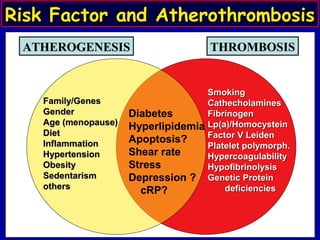
    W Kannel AmJ Cardiol 1996; 77:6BW Kannel Am J Cardiol 1996; 77:6B Association of Cardiovascular Risk FactorsAssociation of Cardiovascular Risk Factors
  • 9.
    Family/GenesFamily/Genes GenderGender Age (menopause)Age (menopause) DietDiet InflammationInflammation HypertensionHypertension ObesityObesity SedentarismSedentarism othersothers SmokingSmoking CathecholaminesCathecholamines FibrinogenFibrinogen Lp(a)/HomocysteinLp(a)/Homocystein FactorV LeidenFactor V Leiden Platelet polymorph.Platelet polymorph. HypercoagulabilityHypercoagulability HypofibrinolysisHypofibrinolysis Genetic ProteinGenetic Protein deficienciesdeficiencies Diabetes Hyperlipidemia Apoptosis? Shear rate Stress Depression ? cRP? ATHEROGENESISATHEROGENESIS THROMBOSISTHROMBOSIS Risk Factor and AtherothrombosisRisk Factor and Atherothrombosis
  • 10.
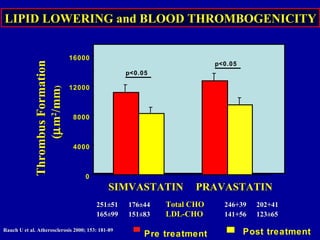
    00 40004000 80008000 1200012000 1600016000 SIMVASTATINSIMVASTATIN PRAVASTATINPRAVASTATIN p<0.05p<0.05 p<0.05p<0.05 ThrombusFormationThrombusFormation ((µµmm22 /mm/mm)) Pre treatmentPretreatment Post treatmentPost treatment LIPID LOWERING and BLOOD THROMBOGENICITYLIPID LOWERING and BLOOD THROMBOGENICITY 251±51251±51 176±44176±44 Total CHOTotal CHO 246+39246+39 202+41202+41 165±99165±99 151±83151±83 LDL-CHOLDL-CHO 141+56141+56 123±65123±65 Rauch U et al. Atherosclerosis 2000; 153: 181-89Rauch U et al. Atherosclerosis 2000; 153: 181-89
  • 11.
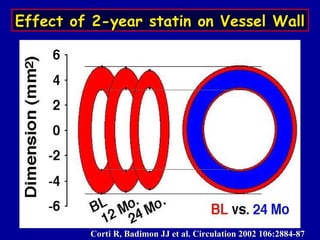
    Effect of 2-yearstatin on Vessel WallEffect of 2-year statin on Vessel Wall Corti R, Badimon JJ et al. Circulation 2002 106:2884-87Corti R, Badimon JJ et al. Circulation 2002 106:2884-87
  • 12.
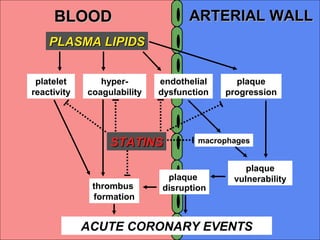
    BLOODBLOOD ARTERIAL WALLARTERIALWALL ACUTE CORONARY EVENTS PLASMA LIPIDSPLASMA LIPIDS plaque vulnerability plaque progression endothelial dysfunction platelet reactivity macrophages hyper- coagulability thrombus formation STATINSSTATINS plaque disruption
  • 13.
    ““ Vulnerable /Hyper-reactive”BloodVulnerable /Hyper-reactive” Blood Several risk factors correlate with hyperreactive blood. TheseSeveral risk factors correlate with hyperreactive blood. These factors modulate the severity of the event after plaque disruptionfactors modulate the severity of the event after plaque disruption ““Classic”Classic” Diabetes Smoking Hyperlipidemia Inflammation/ Apoptosis/ Infection? Cathecholamines Fibrinogen Lp(a) Homocysteinemia Factor V Leiden Platelet polymorph Shear rate Genetic Protein deficiencies (AT III, Prot C or S) Hypercoagulable state (↑FVII, ↑ F1.2, ↑ FPA) Hypofibrinolytic state (↑PAI-1, ↓t-PA, ↓ u-PA) ““Not so-classic”Not so-classic” DepressionDepression Circulating TF activityCirculating TF activity StressStress
  • 14.
    Inflammation Thrombosis Atherosclerosis Apoptosis Tissuefactor micro-particles Aggregated Platelets PDGF Thrombin IL-6 TF MMP ICAM-1 IL-1 CRP CVRisk Factors ACS The Inflammation-ThrombosisThe Inflammation-Thrombosis LinkLink Clinical evidence: Septic shockClinical evidence: Septic shock Inflammation subsequent to bacterial endotoxin induces endothelialInflammation subsequent to bacterial endotoxin induces endothelial TF and PAI-1 expression leading to thrombotic complications (DIC)TF and PAI-1 expression leading to thrombotic complications (DIC)
  • 15.
    CONTROLCONTROL TFPI-TreatedTFPI-Treated TF INHIBITIONand THROMBOSISTF INHIBITION and THROMBOSIS Badimon Perfusion chamberBadimon Perfusion chamber Human lipid rich atherosclerotic lesionsHuman lipid rich atherosclerotic lesions Badimon JJ et al. Circulation 1999; 99:1780-1787Badimon JJ et al. Circulation 1999; 99:1780-1787
  • 16.
    TF Plasma Levelsand CADTF Plasma Levels and CAD Soejima H et al. Circulation 1999;99:2908 The existence of circulating particles with procoagulantThe existence of circulating particles with procoagulant activity have been reported by several groupsactivity have been reported by several groups (Mallat,Tedgui)(Mallat,Tedgui)
  • 17.
    BLOOD BORNE -TISSUE FACTORBLOOD BORNE - TISSUE FACTOR Giesen P et al.Giesen P et al. PNAS 1999; 96:2311PNAS 1999; 96:2311
  • 18.
    Risk factors andcirculating TF activityRisk factors and circulating TF activity Control Smokers Hyperlipidemic Diabetics 0 100 200 300 400 500 TissueFactoractivity (pmolFXa/L) Sambola A. Circulation 2003; 107: 973-979
  • 19.
    BloodThrombogenicityBloodThrombogenicity CirculatingTFactivityCirculatingTFactivity Glycemic ImprovementGlycemic Improvement NoGlycemic ImprovementNo Glycemic ImprovementSambola Circulation 2003Sambola Circulation 2003 Glycemic Control, Circulating TF activityGlycemic Control, Circulating TF activity and Blood Thrombogenicityand Blood Thrombogenicity
  • 20.
    Apoptosis and TissueFactor Protein ExpressionApoptosis and Tissue Factor Protein Expression in Macrophages of Human Coronary Atheromain Macrophages of Human Coronary Atheroma Apoptosis and Tissue Factor Protein ExpressionApoptosis and Tissue Factor Protein Expression in Macrophages of Human Coronary Atheromain Macrophages of Human Coronary Atheroma R. HutterR. Hutter et al., 2002et al., 2002
  • 21.
    Blood MonocytesBlood Monocytes invitro oxLDLin vitro oxLDL Human CarotidHuman Carotid Lipid-rich lesionLipid-rich lesion aCAS-3aCAS-3 TFTF aCas-3/TFaCas-3/TF Hutter R et al, 2003Hutter R et al, 2003
  • 22.
    monocyte TF PMN BLOOD VESSEL WALL ATplaque SMC lipid core macrophage fibroblast myocyte HEART myocardial ischemia TF Circulates in Blood: Possible Cellular Sources EndothelialEndothelial cellcell
  • 23.
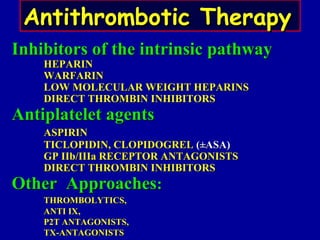
    Inhibitors of theintrinsic pathwayInhibitors of the intrinsic pathway HEPARINHEPARIN WARFARINWARFARIN LOW MOLECULAR WEIGHT HEPARINSLOW MOLECULAR WEIGHT HEPARINS DIRECT THROMBIN INHIBITORSDIRECT THROMBIN INHIBITORS Antiplatelet agentsAntiplatelet agents ASPIRINASPIRIN TICLOPIDIN, CLOPIDOGRELTICLOPIDIN, CLOPIDOGREL (±ASA)(±ASA) GP IIb/IIIa RECEPTOR ANTAGONISTSGP IIb/IIIa RECEPTOR ANTAGONISTS DIRECT THROMBIN INHIBITORSDIRECT THROMBIN INHIBITORS Other ApproachesOther Approaches:: THROMBOLYTICS,THROMBOLYTICS, ANTI IX,ANTI IX, P2T ANTAGONISTS,P2T ANTAGONISTS, TX-ANTAGONISTSTX-ANTAGONISTS Antithrombotic TherapyAntithrombotic Therapy
  • 24.
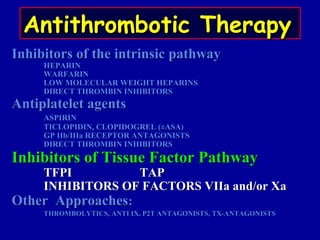
    Inhibitors of theintrinsic pathwayInhibitors of the intrinsic pathway HEPARINHEPARIN WARFARINWARFARIN LOW MOLECULAR WEIGHT HEPARINSLOW MOLECULAR WEIGHT HEPARINS DIRECT THROMBIN INHIBITORSDIRECT THROMBIN INHIBITORS Antiplatelet agentsAntiplatelet agents ASPIRINASPIRIN TICLOPIDIN, CLOPIDOGREL (±ASA)TICLOPIDIN, CLOPIDOGREL (±ASA) GP IIb/IIIa RECEPTOR ANTAGONISTSGP IIb/IIIa RECEPTOR ANTAGONISTS DIRECT THROMBIN INHIBITORSDIRECT THROMBIN INHIBITORS Inhibitors of Tissue Factor PathwayInhibitors of Tissue Factor Pathway TFPITFPI TAPTAP INHIBITORS OF FACTORS VIIa and/or XaINHIBITORS OF FACTORS VIIa and/or Xa Other ApproachesOther Approaches:: THROMBOLYTICS, ANTI IX, P2T ANTAGONISTS, TX-ANTAGONISTSTHROMBOLYTICS, ANTI IX, P2T ANTAGONISTS, TX-ANTAGONISTS Antithrombotic TherapyAntithrombotic Therapy
  • 25.
    XX XaXa IXIXIXaIXa ++ ++ VaVa VIIIaVIIIa Xa:VaXa:Va VIIIa:IXaVIIIa:IXa + Va+ Va ProthrombinProthrombin ThrombinThrombin TFTF ++ VIIaVIIa TF:VIIaTF:VIIa TF Pathway and its potential inhibitionTF Pathway and its potential inhibition TFPITFPI
  • 26.
    Clinical Implications -BloodClinical Implications - Blood Inhibitors of TF pathwayInhibitors of TF pathway are the most promisingare the most promising antithrombotic agents being investigated.antithrombotic agents being investigated. TargetTarget AgentAgent TF:TF: Several humanized antibodiesSeveral humanized antibodies TF: FVIIaTF: FVIIa TFPITFPI ,, FFR-FVIIa,FFR-FVIIa, Corsevin MCorsevin M FXaFXa Dx-6905a, C-1031, DPC-906,Dx-6905a, C-1031, DPC-906, FondaparinuxFondaparinux Thrombin:Thrombin: Hirudin, Hirulog, BivalirudinHirudin, Hirulog, Bivalirudin ( parent.)( parent.) Ximelagatran and MCC-977Ximelagatran and MCC-977 (oral)(oral) Antithrombotic agents have reduced approx. 20%Antithrombotic agents have reduced approx. 20% of ACS in CAD patientsof ACS in CAD patients (BMJ 2002;324:71-86).BMJ 2002;324:71-86).

Editor's Notes

  • #5 Several investigators have shown that the risk of coronary occlusion is not proportional to the prior severity of coronary stenoses. In fact, coronary occlusion and myocardial infarction most frequently evolve from plaques that are only mildly to moderately obstructive