



ROTARY’S COMPLIANCE WITH GDPR
27 June 2018
INTRODUCTION
Mikael Ahlberg
Treasurer 2017-18
• WHAT IS GDPR?
• WHAT HAS ROTARY DONE TO COMPLY?
• WHAT DO ROTARIANS NEED TO KNOW?
• Q&A
PROGRAM
WHAT IS GDPR?
Maureen Ninneman
Deputy General Counsel
What is GDPR?
GDPR is the most
significant global
privacy regulation
passed in the last
20 years
For more than four
years, EU
authorities have
been working on a
complete overhaul
of EU data
protection rules.
The GDPR replaces
EU Directive
95/46/EC, which was
passed in 1995
when the internet
was still in its
infancy.
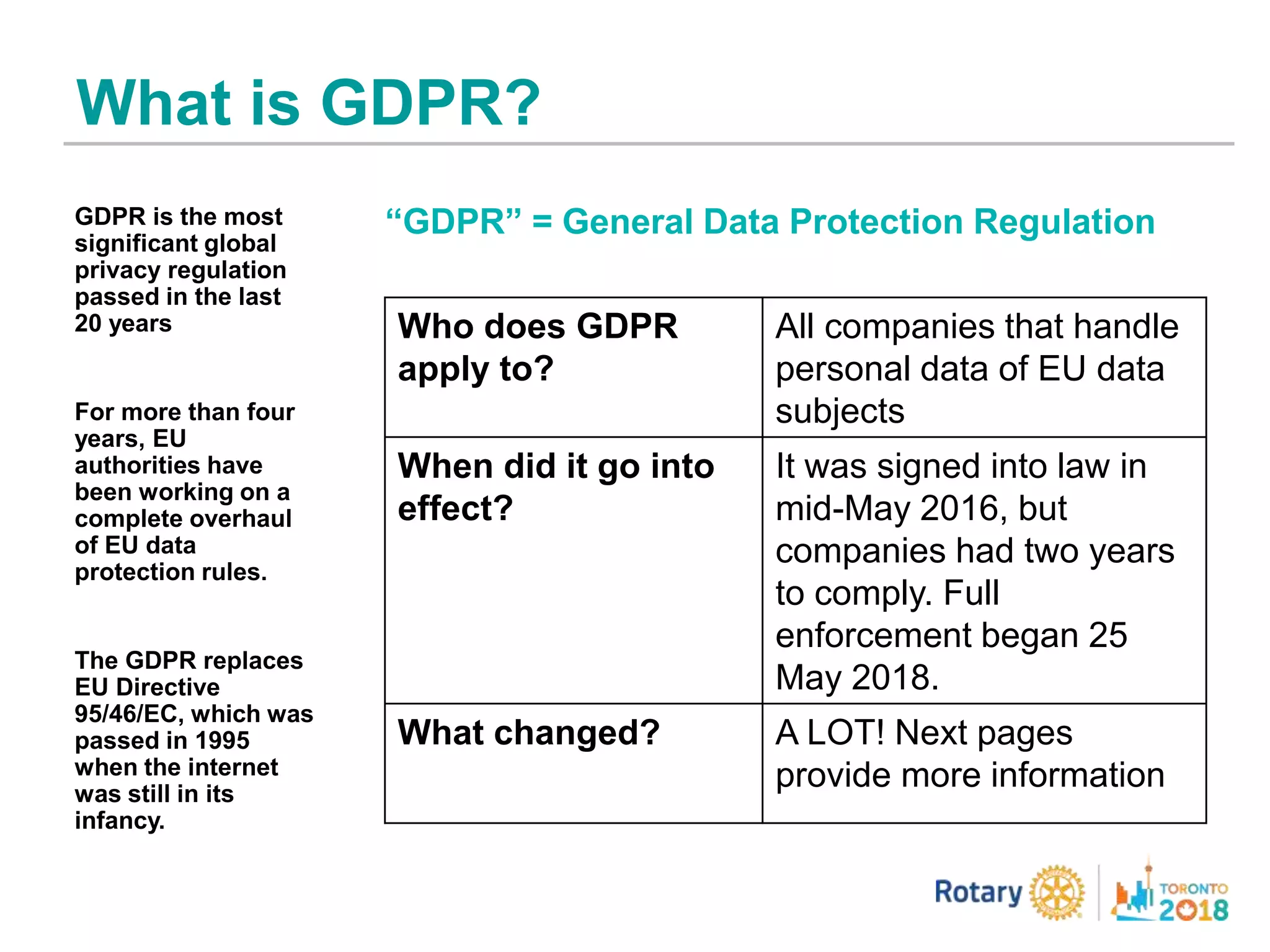
“GDPR” = General Data Protection Regulation
Who does GDPR
apply to?
All companies that handle
personal data of EU data
subjects
When did it go into
effect?
It was signed into law in
mid-May 2016, but
companies had two years
to comply. Full
enforcement began 25
May 2018.
What changed? A LOT! Next pages
provide more information
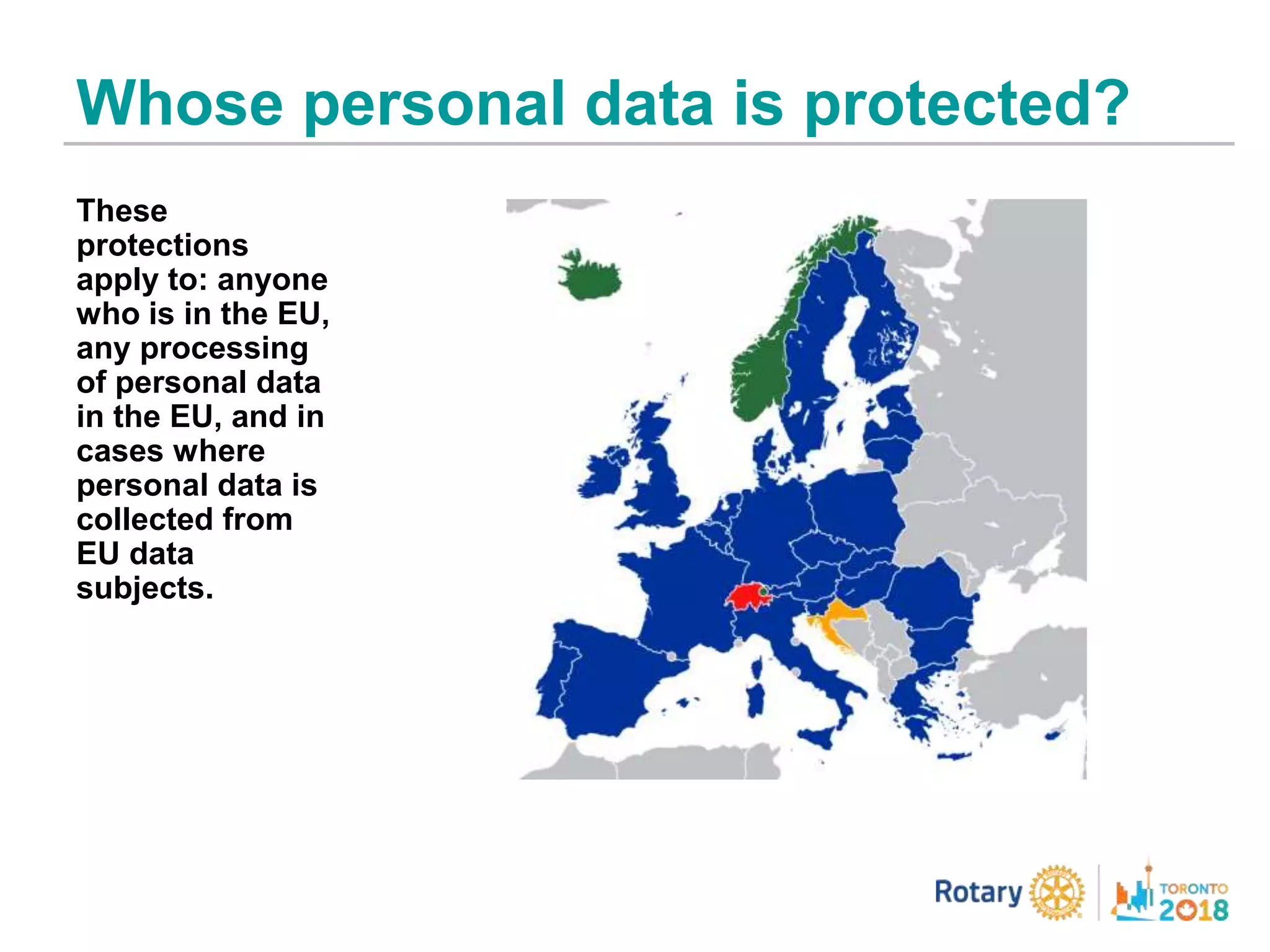
Whose personal data is protected?
These
protections
apply to: anyone
who is in the EU,
any processing
of personal data
in the EU, and in
cases where
personal data is
collected from
EU data
subjects.
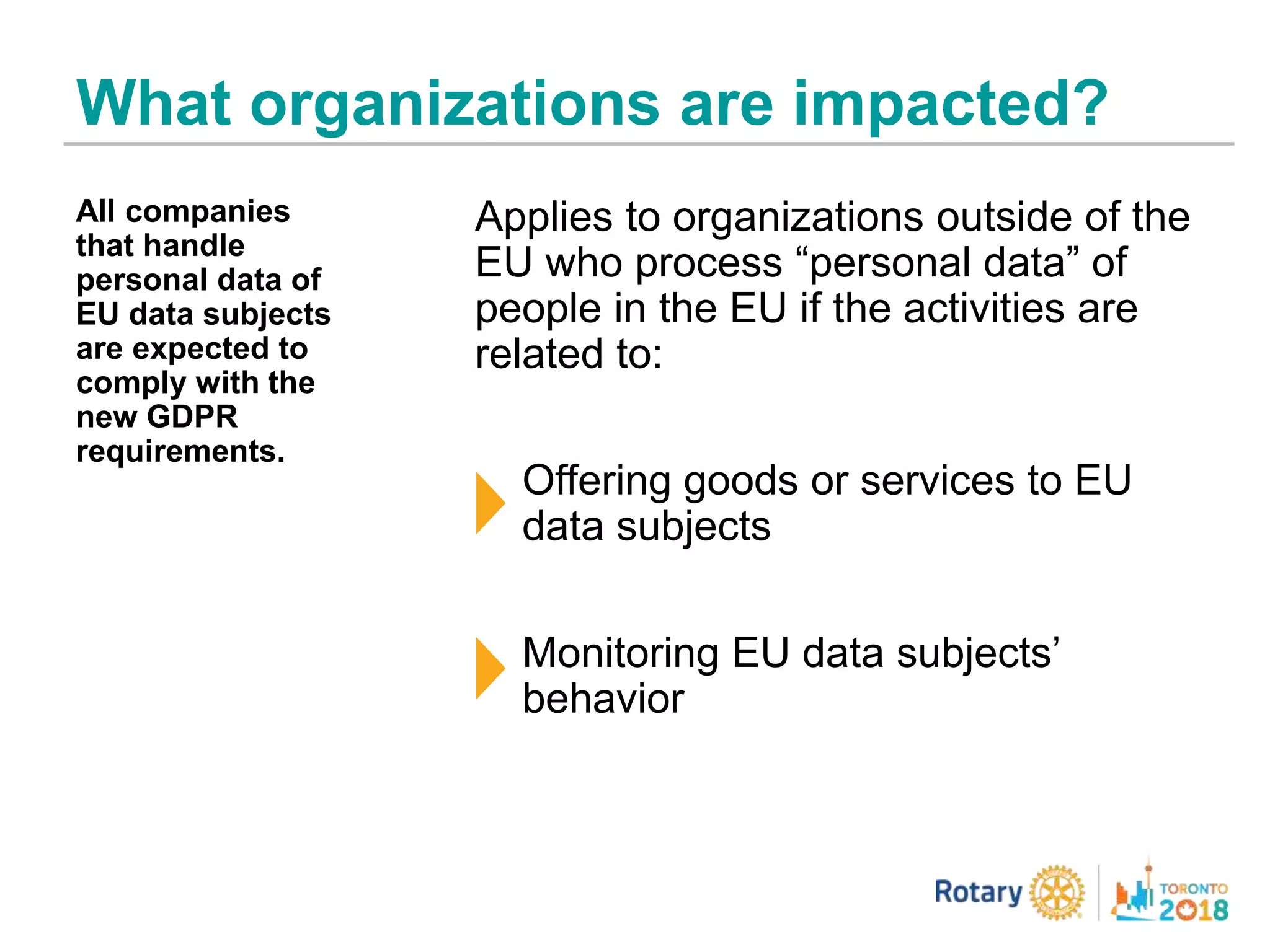
What organizations are impacted?
Applies to organizations outside of the
EU who process “personal data” of
people in the EU if the activities are
related to:
Offering goods or services to EU
data subjects
Monitoring EU data subjects’
behavior
All companies
that handle
personal data of
EU data subjects
are expected to
comply with the
new GDPR
requirements.
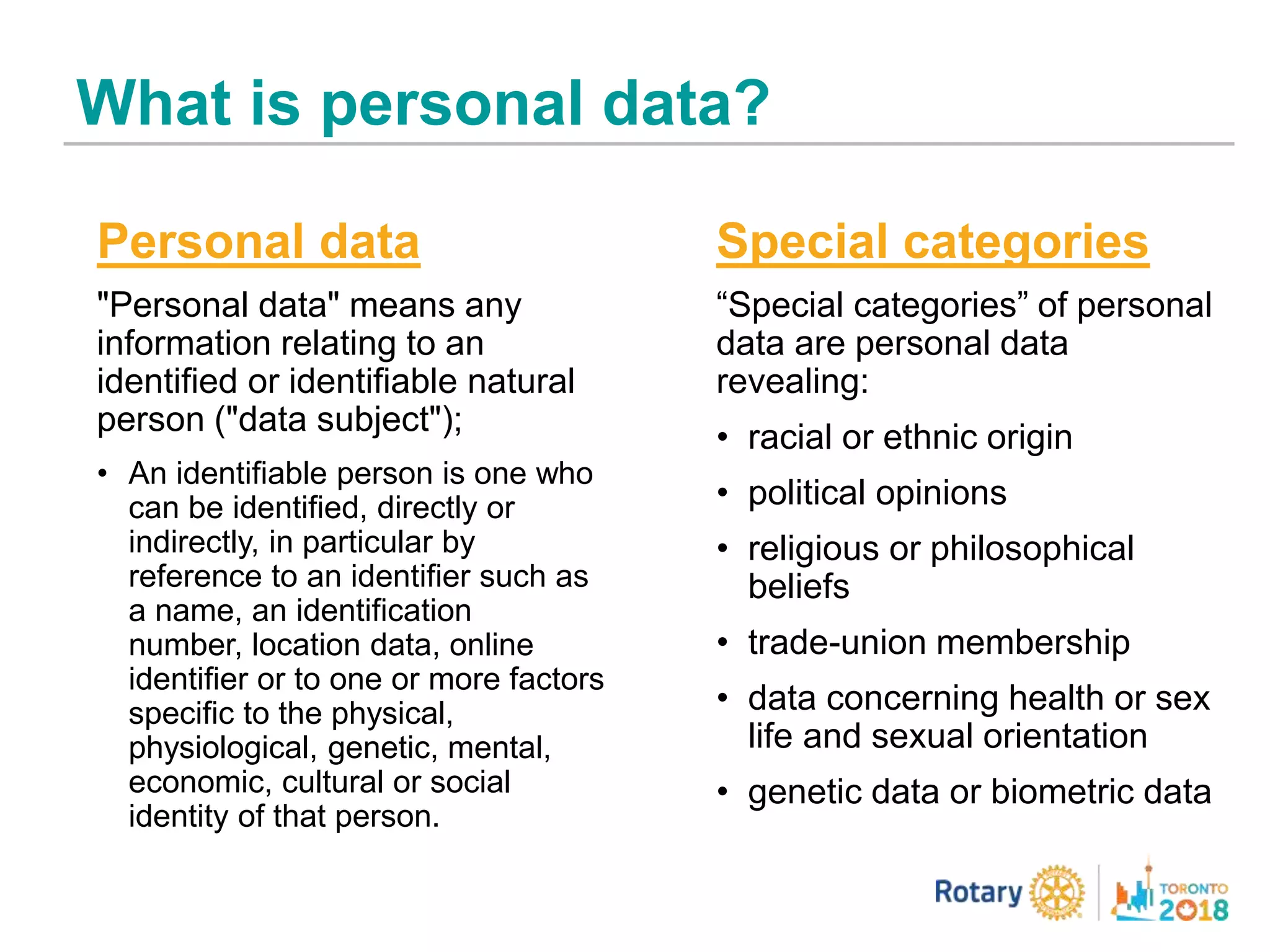
What is personal data?
Personal data
"Personal data" means any
information relating to an
identified or identifiable natural
person ("data subject");
• An identifiable person is one who
can be identified, directly or
indirectly, in particular by
reference to an identifier such as
a name, an identification
number, location data, online
identifier or to one or more factors
specific to the physical,
physiological, genetic, mental,
economic, cultural or social
identity of that person.
Special categories
“Special categories” of personal
data are personal data
revealing:
• racial or ethnic origin
• political opinions
• religious or philosophical
beliefs
• trade-union membership
• data concerning health or sex
life and sexual orientation
• genetic data or biometric data
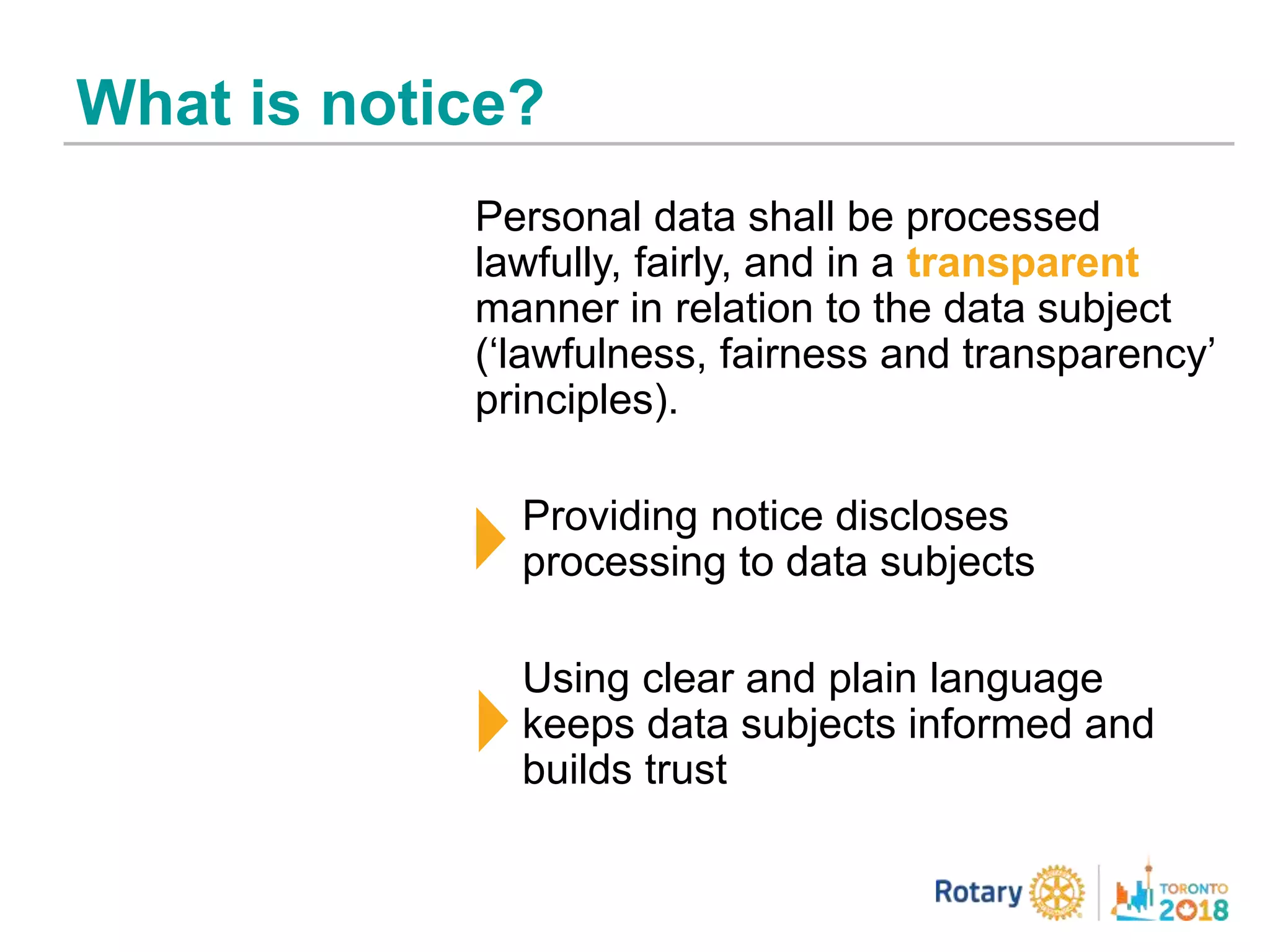
What is notice?
Personal data shall be processed
lawfully, fairly, and in a transparent
manner in relation to the data subject
(‘lawfulness, fairness and transparency’
principles).
Providing notice discloses
processing to data subjects
Using clear and plain language
keeps data subjects informed and
builds trust
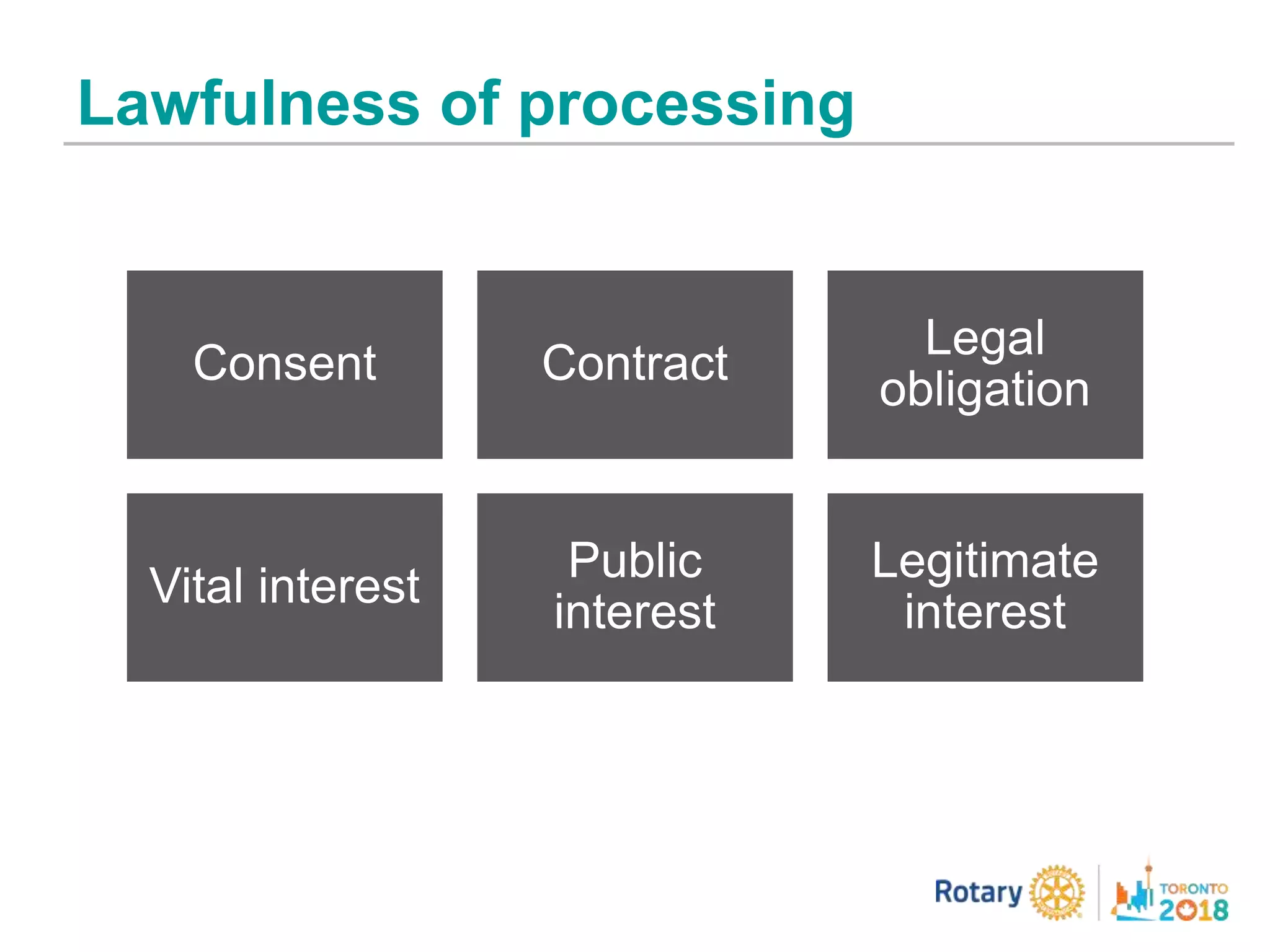
Lawfulness of processing
Consent Contract
Legal
obligation
Vital interest
Public
interest
Legitimate
interest
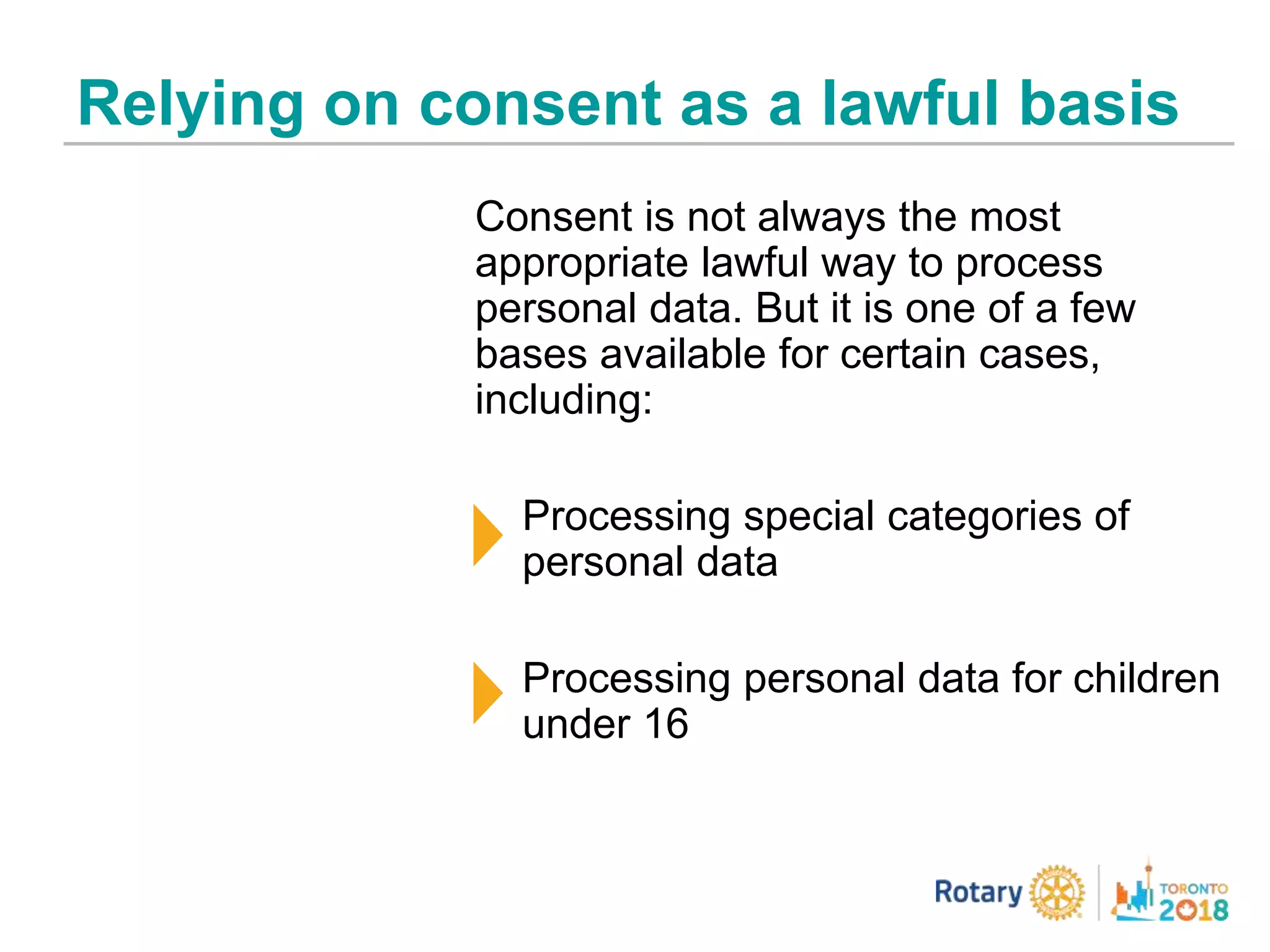
Relying on consent as a lawful basis
Consent is not always the most
appropriate lawful way to process
personal data. But it is one of a few
bases available for certain cases,
including:
Processing special categories of
personal data
Processing personal data for children
under 16
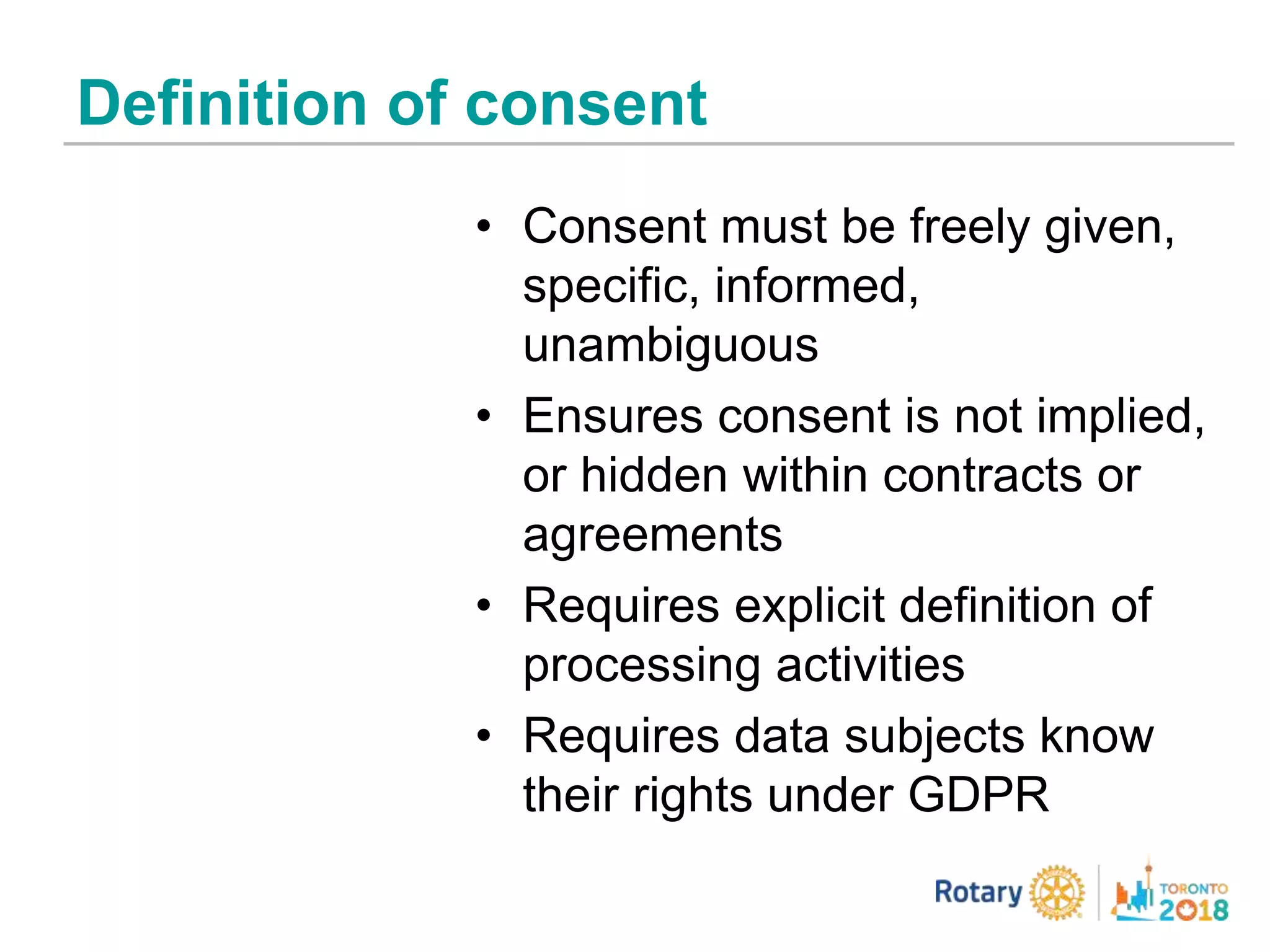
Definition of consent
• Consent must be freely given,
specific, informed,
unambiguous
• Ensures consent is not implied,
or hidden within contracts or
agreements
• Requires explicit definition of
processing activities
• Requires data subjects know
their rights under GDPR
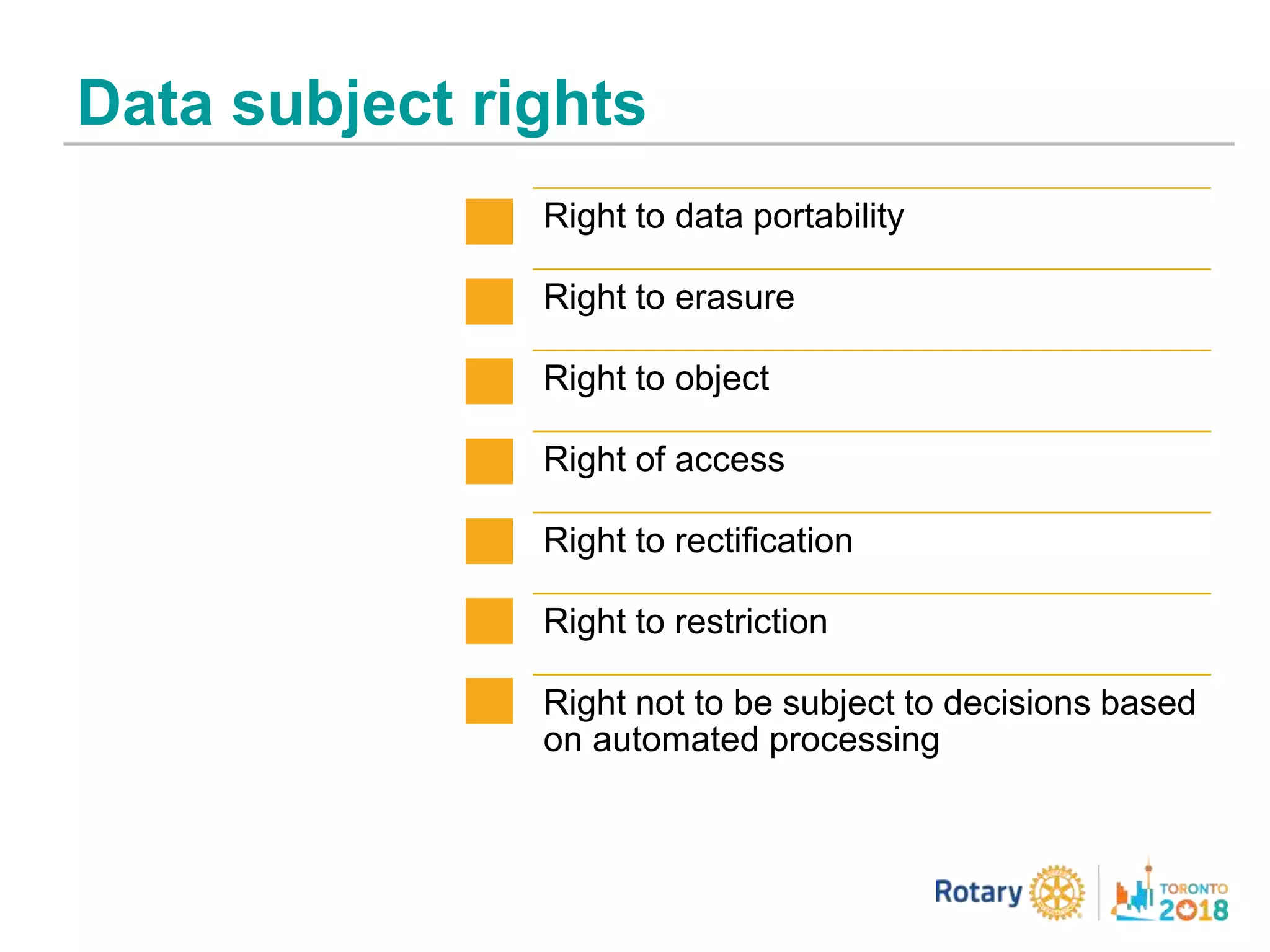
Data subject rights
Right to data portability
Right to erasure
Right to object
Right of access
Right to rectification
Right to restriction
Right not to be subject to decisions based
on automated processing
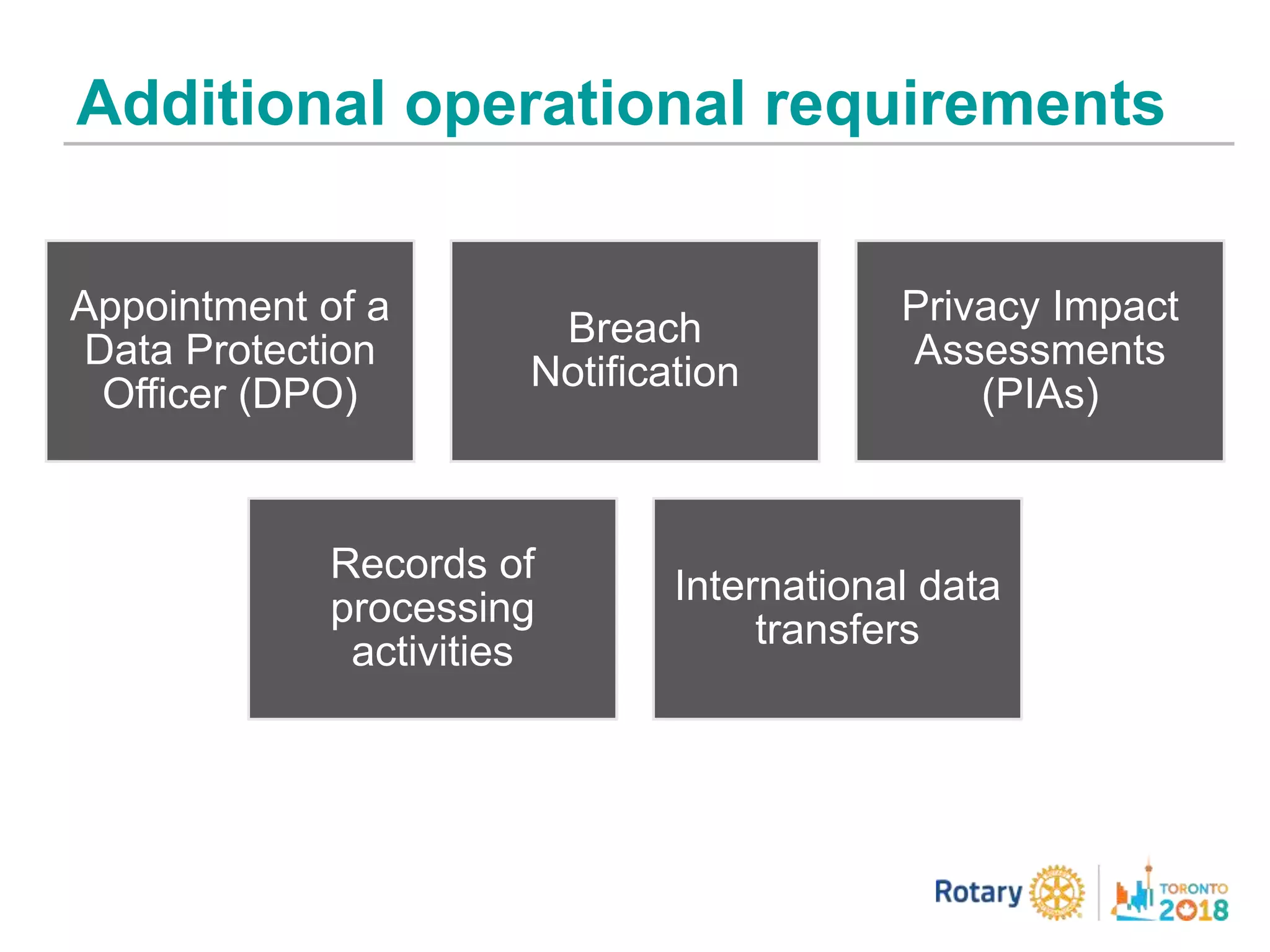
Additional operational requirements
Appointment of a
Data Protection
Officer (DPO)
Breach
Notification
Privacy Impact
Assessments
(PIAs)
Records of
processing
activities
International data
transfers
WHAT HAS
ROTARY DONE
TO COMPLY?
Kate Pichon
Manager IT Business Operations
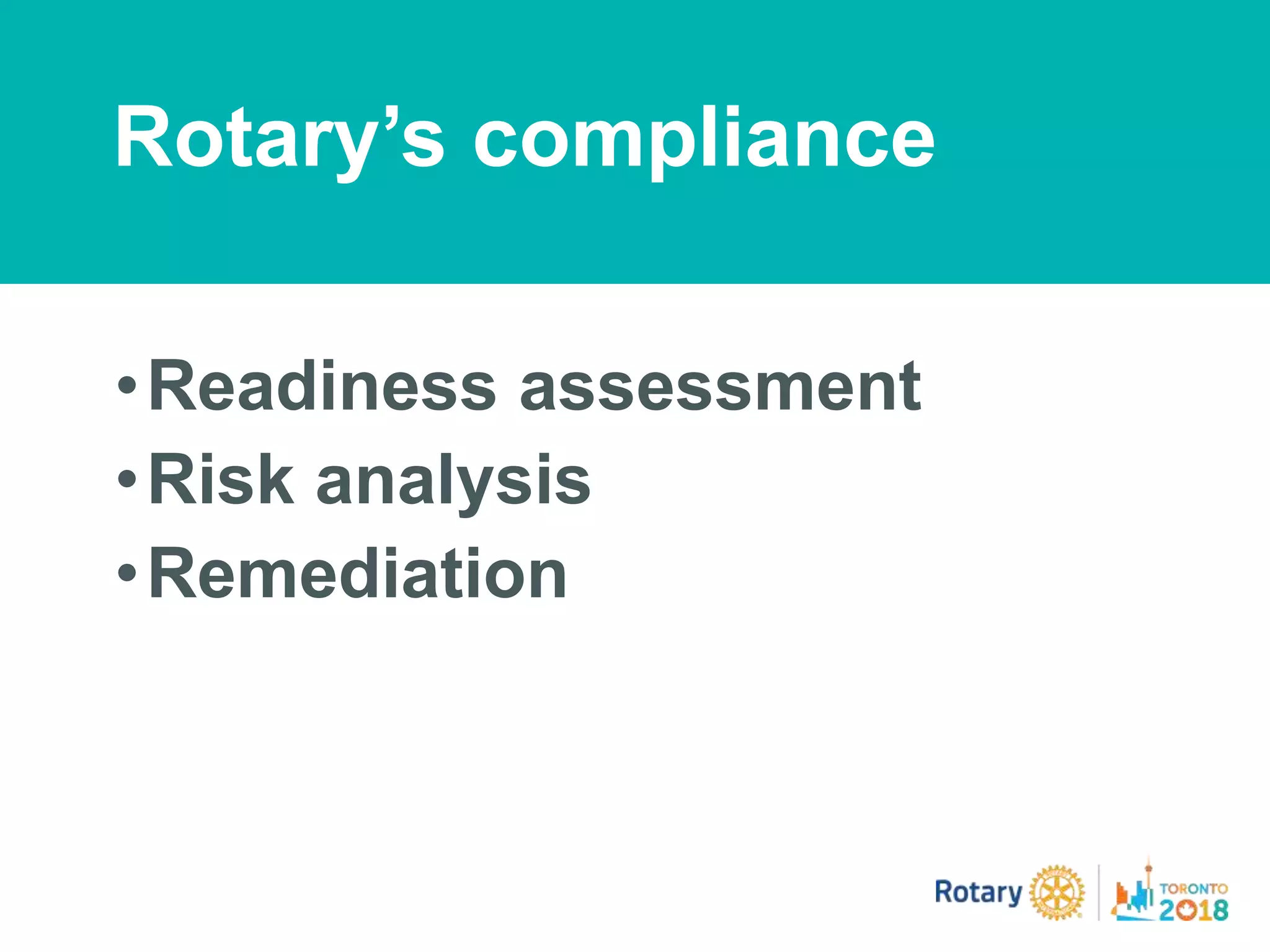
•Readiness assessment
•Risk analysis
•Remediation
Rotary’s compliance
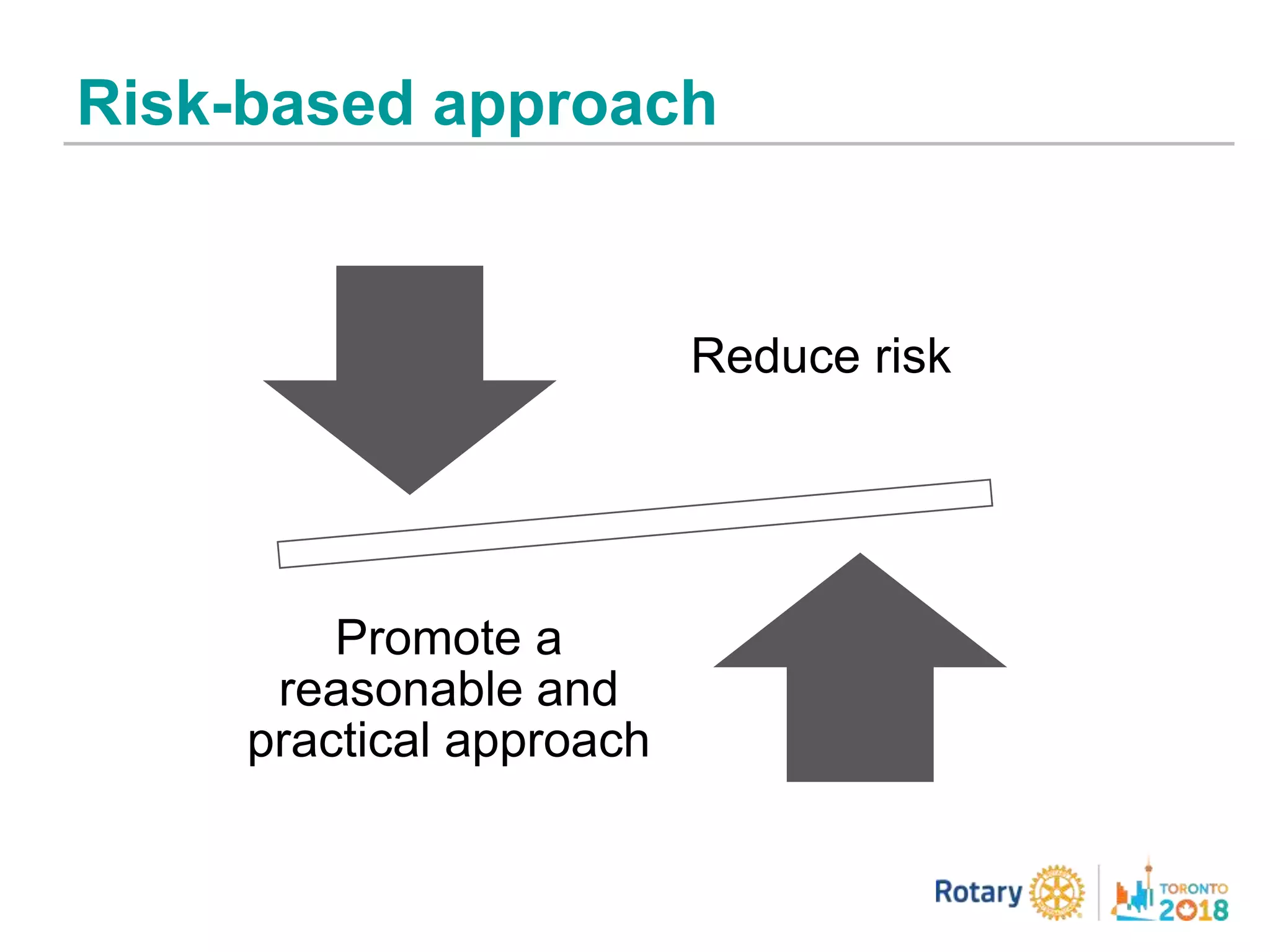
Risk-based approach
Reduce risk
Promote a
reasonable and
practical approach
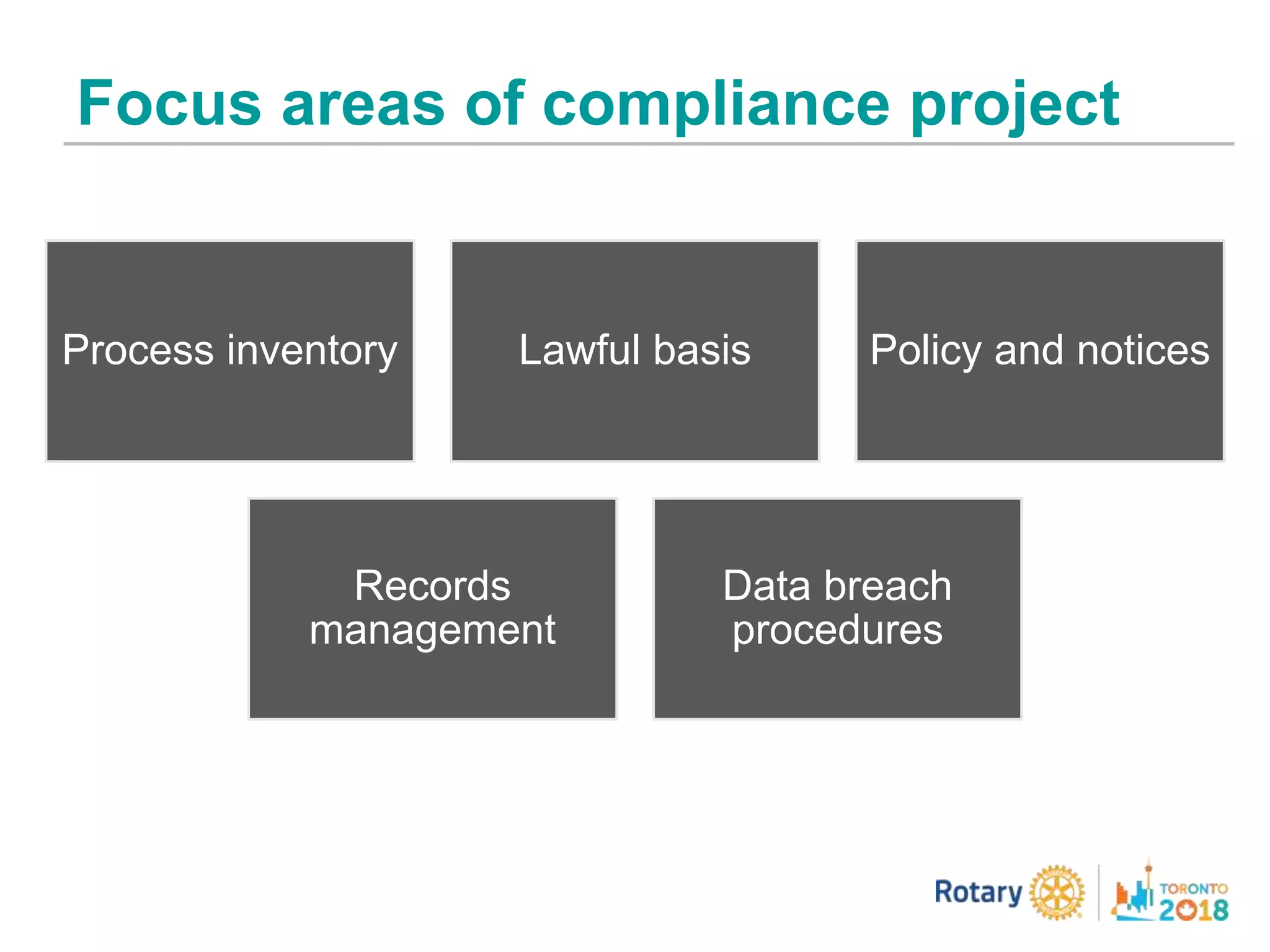
Focus areas of compliance project
Process inventory Lawful basis Policy and notices
Records
management
Data breach
procedures
Key decisions we made
Data processor/controller
Records of processing
Data Protection Officer
Legitimate interest
Policy updates
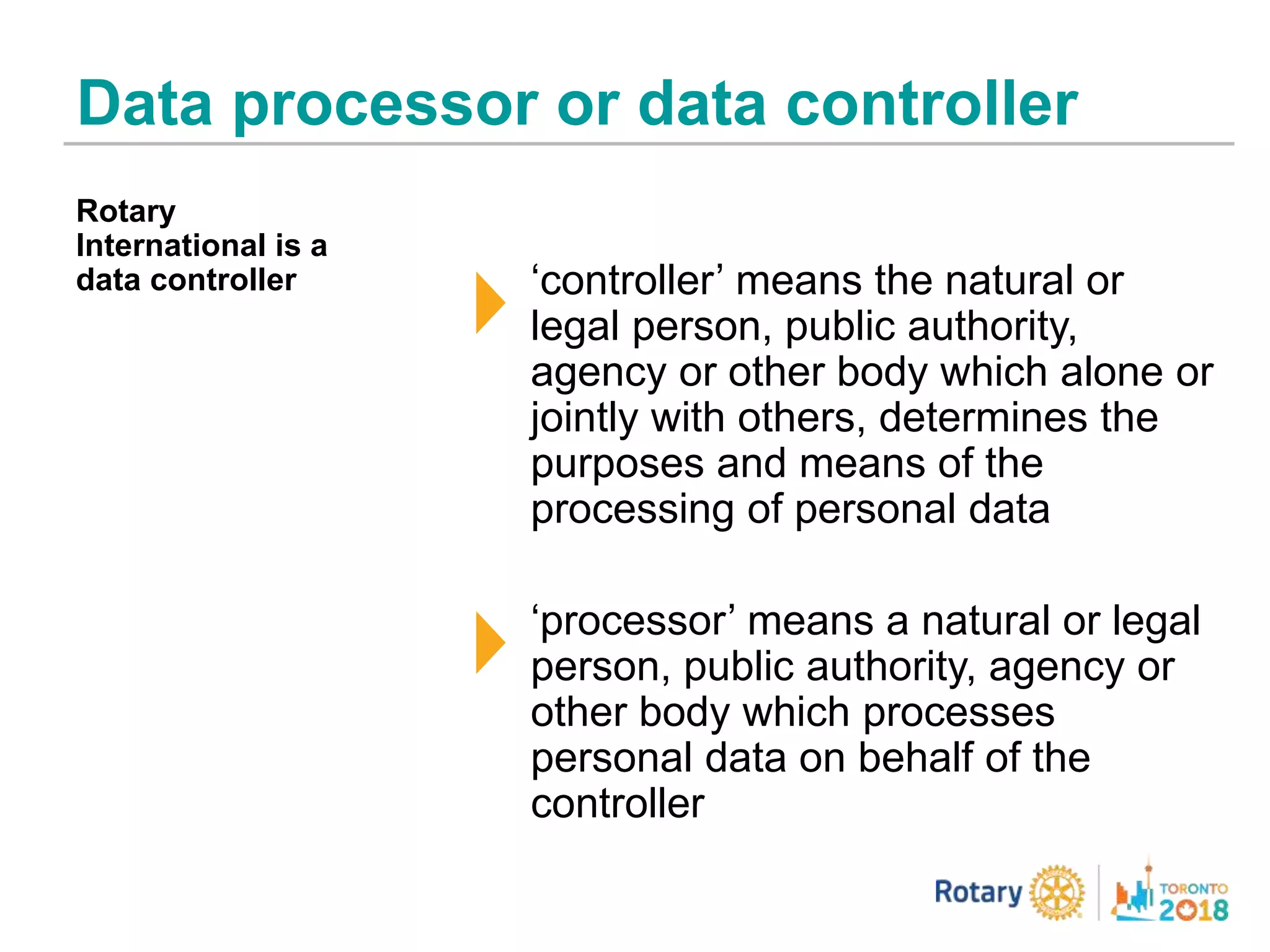
Data processor or data controller
Rotary
International is a
data controller ‘controller’ means the natural or
legal person, public authority,
agency or other body which alone or
jointly with others, determines the
purposes and means of the
processing of personal data
‘processor’ means a natural or legal
person, public authority, agency or
other body which processes
personal data on behalf of the
controller
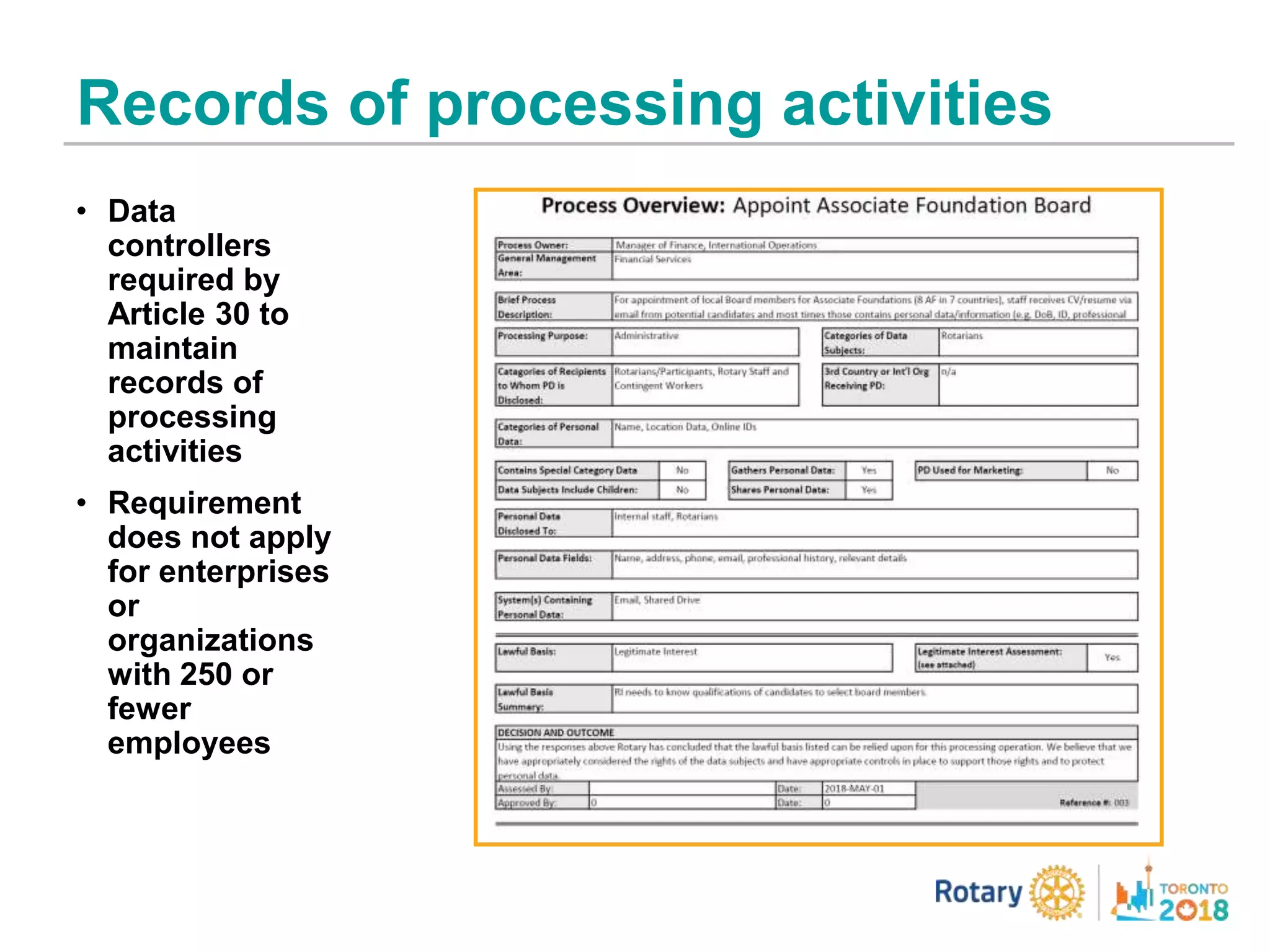
Records of processing activities
• Data
controllers
required by
Article 30 to
maintain
records of
processing
activities
• Requirement
does not apply
for enterprises
or
organizations
with 250 or
fewer
employees
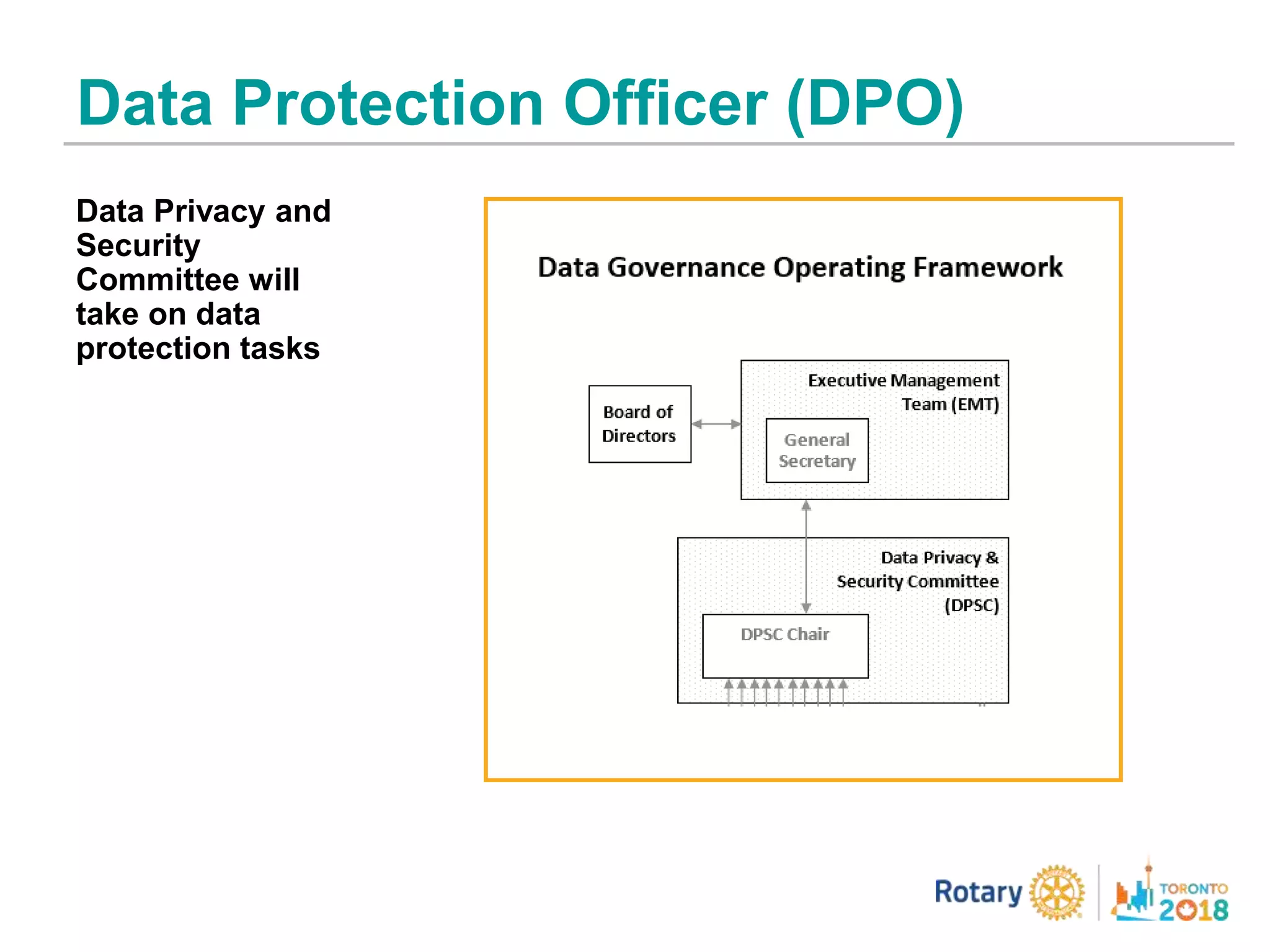
Data Protection Officer (DPO)
Data Privacy and
Security
Committee will
take on data
protection tasks
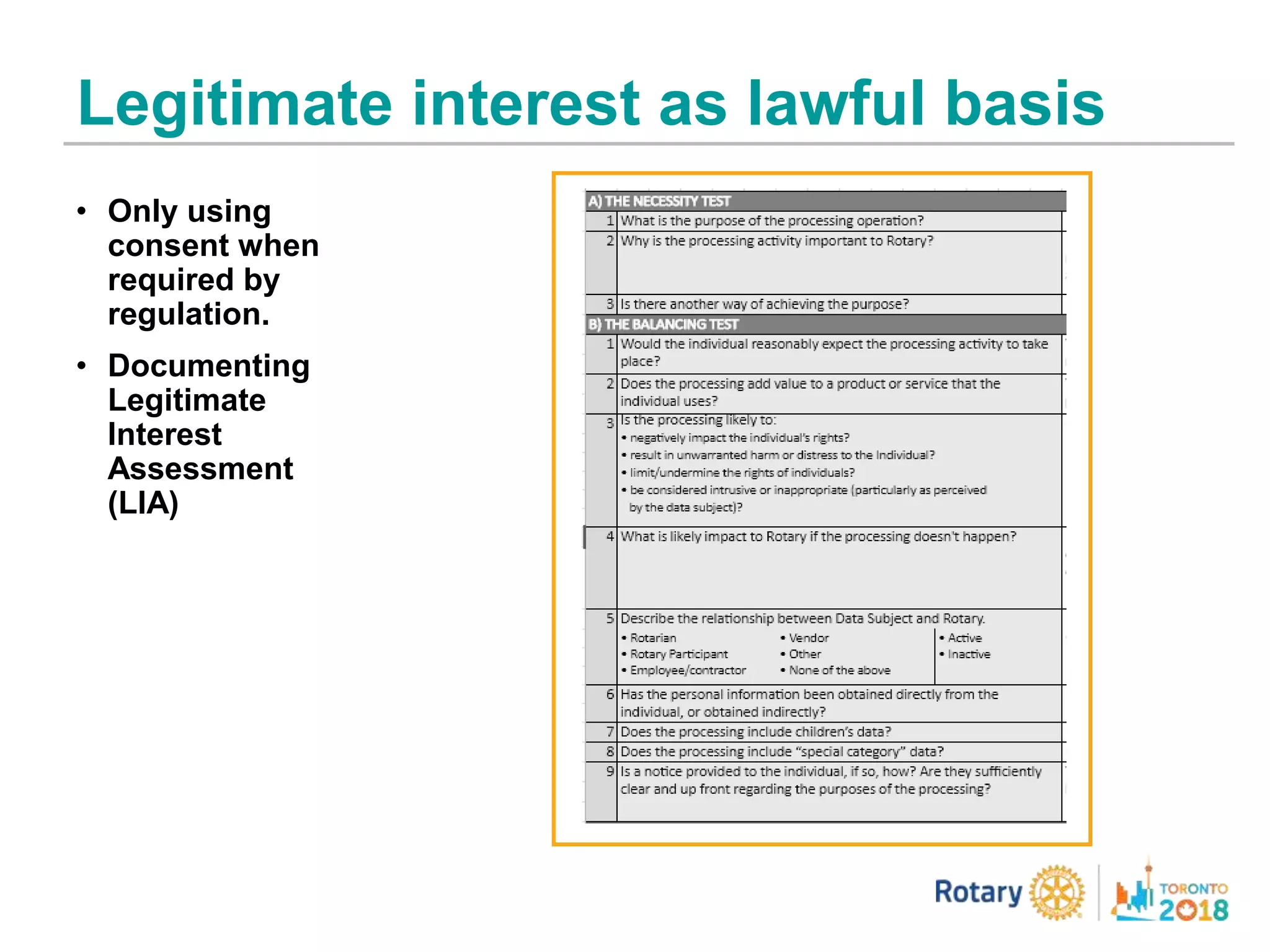
Legitimate interest as lawful basis
• Only using
consent when
required by
regulation.
• Documenting
Legitimate
Interest
Assessment
(LIA)
Updates to policy
• No longer
allowing
children under
16 to create
website
accounts
• Adding Data
Processing
Addendum to
third-party
agreements
• Updating
record
retention
schedules
WHAT DO
ROTARIANS
NEED TO
KNOW?
Maureen Ninneman
Deputy General Counsel
•Provide notice
•Minimize and secure data
•Get consent when appropriate
•Consult local privacy experts
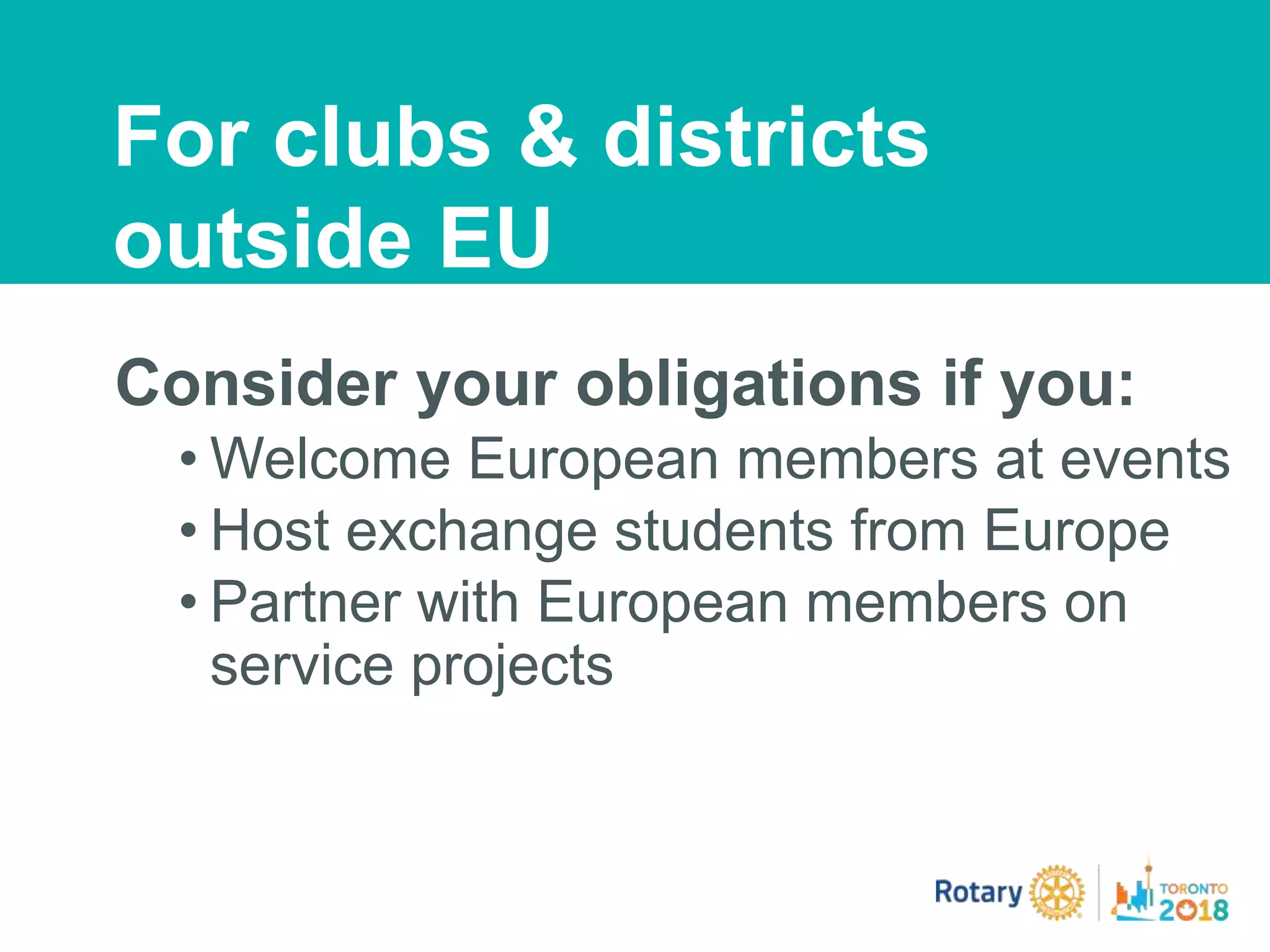
For clubs & districts
in EU
Consider your obligations if you:
• Welcome European members at events
• Host exchange students from Europe
• Partner with European members on
service projects
For clubs & districts
outside EU
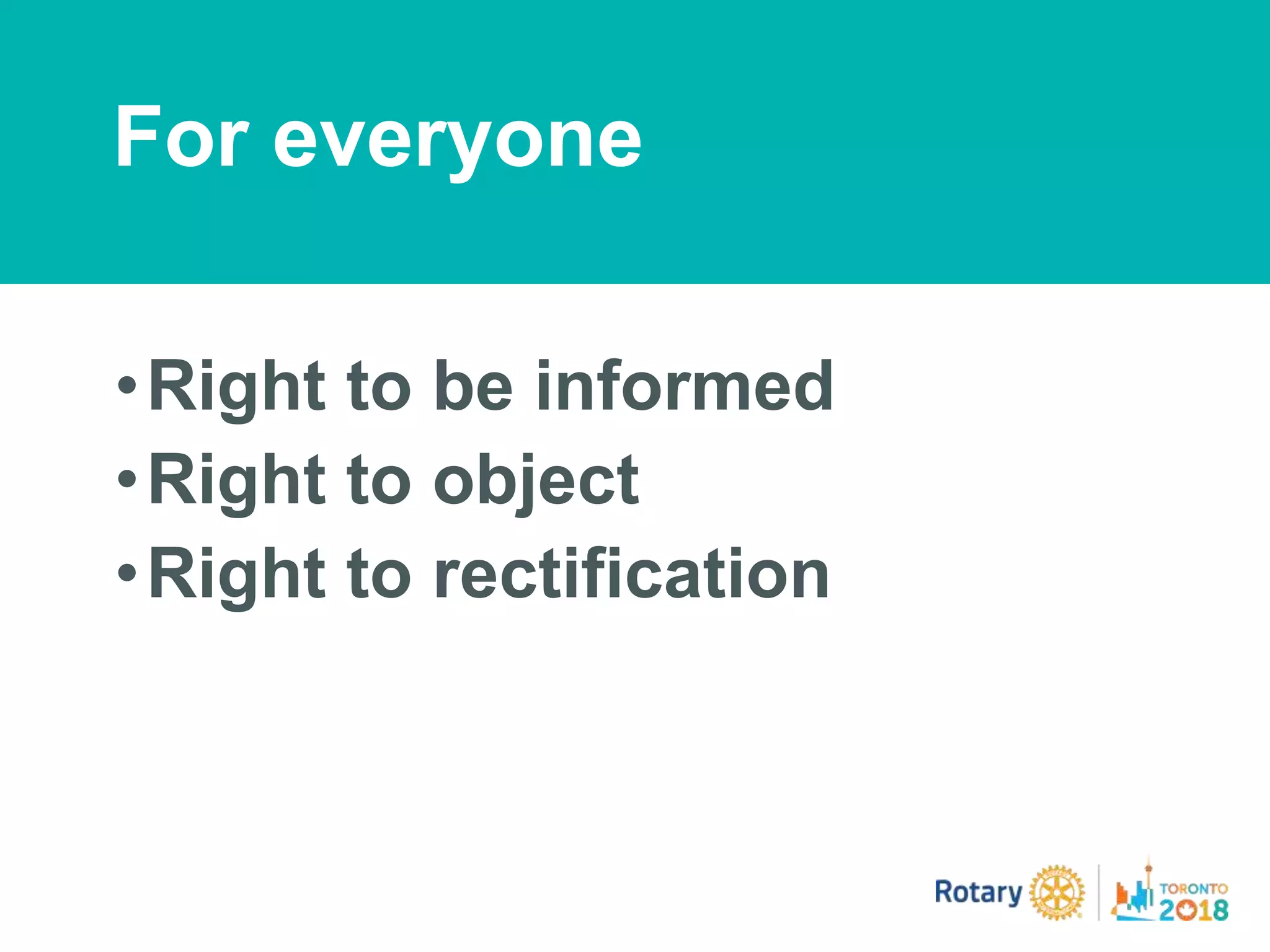
•Right to be informed
•Right to object
•Right to rectification
For everyone
We know you trust Rotary to
respect your privacy and
protect your information,
and we take this
responsibility seriously.
Questions?
privacy@rotary.org
This presentation and others
from throughout the convention
are available through the
convention mobile app and on
SlideShare at
www.SlideShare.net/Rotary_International.
Rate this session in the Rotary
Events app, available in your
Apple or Android app store.

Data Privacy and Data Protection: Rotary’s Compliance with GDPR

  • 1.
    ROTARY’S COMPLIANCE WITHGDPR 27 June 2018
  • 2.
  • 3.
    • WHAT ISGDPR? • WHAT HAS ROTARY DONE TO COMPLY? • WHAT DO ROTARIANS NEED TO KNOW? • Q&A PROGRAM
  • 4.
    WHAT IS GDPR? MaureenNinneman Deputy General Counsel
  • 5.
    What is GDPR? GDPRis the most significant global privacy regulation passed in the last 20 years For more than four years, EU authorities have been working on a complete overhaul of EU data protection rules. The GDPR replaces EU Directive 95/46/EC, which was passed in 1995 when the internet was still in its infancy. “GDPR” = General Data Protection Regulation Who does GDPR apply to? All companies that handle personal data of EU data subjects When did it go into effect? It was signed into law in mid-May 2016, but companies had two years to comply. Full enforcement began 25 May 2018. What changed? A LOT! Next pages provide more information
  • 6.
    Whose personal datais protected? These protections apply to: anyone who is in the EU, any processing of personal data in the EU, and in cases where personal data is collected from EU data subjects.
  • 7.
    What organizations areimpacted? Applies to organizations outside of the EU who process “personal data” of people in the EU if the activities are related to: Offering goods or services to EU data subjects Monitoring EU data subjects’ behavior All companies that handle personal data of EU data subjects are expected to comply with the new GDPR requirements.
  • 8.
    What is personaldata? Personal data "Personal data" means any information relating to an identified or identifiable natural person ("data subject"); • An identifiable person is one who can be identified, directly or indirectly, in particular by reference to an identifier such as a name, an identification number, location data, online identifier or to one or more factors specific to the physical, physiological, genetic, mental, economic, cultural or social identity of that person. Special categories “Special categories” of personal data are personal data revealing: • racial or ethnic origin • political opinions • religious or philosophical beliefs • trade-union membership • data concerning health or sex life and sexual orientation • genetic data or biometric data
  • 9.
    What is notice? Personaldata shall be processed lawfully, fairly, and in a transparent manner in relation to the data subject (‘lawfulness, fairness and transparency’ principles). Providing notice discloses processing to data subjects Using clear and plain language keeps data subjects informed and builds trust
  • 10.
    Lawfulness of processing ConsentContract Legal obligation Vital interest Public interest Legitimate interest
  • 11.
    Relying on consentas a lawful basis Consent is not always the most appropriate lawful way to process personal data. But it is one of a few bases available for certain cases, including: Processing special categories of personal data Processing personal data for children under 16
  • 12.
    Definition of consent •Consent must be freely given, specific, informed, unambiguous • Ensures consent is not implied, or hidden within contracts or agreements • Requires explicit definition of processing activities • Requires data subjects know their rights under GDPR
  • 13.
    Data subject rights Rightto data portability Right to erasure Right to object Right of access Right to rectification Right to restriction Right not to be subject to decisions based on automated processing
  • 14.
    Additional operational requirements Appointmentof a Data Protection Officer (DPO) Breach Notification Privacy Impact Assessments (PIAs) Records of processing activities International data transfers
  • 15.
    WHAT HAS ROTARY DONE TOCOMPLY? Kate Pichon Manager IT Business Operations
  • 16.
  • 17.
    Risk-based approach Reduce risk Promotea reasonable and practical approach
  • 18.
    Focus areas ofcompliance project Process inventory Lawful basis Policy and notices Records management Data breach procedures
  • 19.
    Key decisions wemade Data processor/controller Records of processing Data Protection Officer Legitimate interest Policy updates
  • 20.
    Data processor ordata controller Rotary International is a data controller ‘controller’ means the natural or legal person, public authority, agency or other body which alone or jointly with others, determines the purposes and means of the processing of personal data ‘processor’ means a natural or legal person, public authority, agency or other body which processes personal data on behalf of the controller
  • 21.
    Records of processingactivities • Data controllers required by Article 30 to maintain records of processing activities • Requirement does not apply for enterprises or organizations with 250 or fewer employees
  • 22.
    Data Protection Officer(DPO) Data Privacy and Security Committee will take on data protection tasks
  • 23.
    Legitimate interest aslawful basis • Only using consent when required by regulation. • Documenting Legitimate Interest Assessment (LIA)
  • 24.
    Updates to policy •No longer allowing children under 16 to create website accounts • Adding Data Processing Addendum to third-party agreements • Updating record retention schedules
  • 25.
    WHAT DO ROTARIANS NEED TO KNOW? MaureenNinneman Deputy General Counsel
  • 26.
    •Provide notice •Minimize andsecure data •Get consent when appropriate •Consult local privacy experts For clubs & districts in EU
  • 27.
    Consider your obligationsif you: • Welcome European members at events • Host exchange students from Europe • Partner with European members on service projects For clubs & districts outside EU
  • 28.
    •Right to beinformed •Right to object •Right to rectification For everyone
  • 29.
    We know youtrust Rotary to respect your privacy and protect your information, and we take this responsibility seriously.
  • 30.
  • 31.
    This presentation andothers from throughout the convention are available through the convention mobile app and on SlideShare at www.SlideShare.net/Rotary_International.
  • 32.
    Rate this sessionin the Rotary Events app, available in your Apple or Android app store.

Editor's Notes

  • #32 [Keep this slide at the end]
  • #33 [Keep this slide at the end, and read this suggested text] Your feedback is valuable so remember to complete the brief session evaluation in the convention mobile app. To download the app, search for “Rotary Events” in your Apple or Android app store.