Climate Data Training Session for Municipal and Conservation
Authority Engineers, Planners and Decision Makers
Toronto - 26 April 2017
Culverts
Presented by:
Hani Farghaly, PhD., P. Eng.
Ontario Ministry of Transportation
Storm Sewers
Bridges
 General introduction
 Overview of Findings of MTO’s
climate change Investigations
 New MTO Tools Supporting
Design in a Changing Climate
 MTO Design Policies
Addressing Climate Change
 Next Steps
2
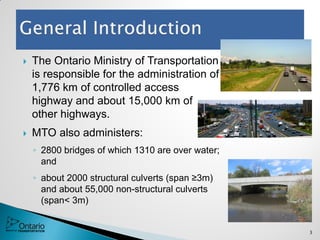
 The Ontario Ministry of Transportation
is responsible for the administration of
1,776 km of controlled access
highway and about 15,000 km of
other highways.
 MTO also administers:
◦ 2800 bridges of which 1310 are over water;
and
◦ about 2000 structural culverts (span ≥3m)
and about 55,000 non-structural culverts
(span< 3m)
3
 MTO undertakes the design of drainage highway
infrastructure based on design standards, procedures
and methods published in a number of documents
such as:
◦ MTO Drainage Design Standards
◦ MTO Drainage Management Manual
◦ Guidelines (e.g. Gravity Pipe Design Guidelines)
◦ Study reports (e.g. Hydrologic Design Methods, Resilience to
Climate Change, Salt Impact Mitigation)
◦ Provincial Engineering Memos (implementing new findings in
design)
4
 These documents are updated on a regular basis
to transfer research finding into practical
application in design
 MTO depends on academic and field research to
provide the fundamentals of new design methods
and procedures
 Work undertaken by other jurisdictions/agencies is
reviewed and the results are used to improve the
design methods and procedures.
5
 MTO began the research into climate change
impacts on drainage infrastructure in 2005
 Over the subsequent years research funding was
secured to continue to support new innovation in
design, especially, in light of climate change
 The research was undertaken in cooperation with
a number of universities
6
The following studies have been undertaken to begin to understand the
issue and take advantage of available data and information
1. Identification of the Effect of Climate Change on Future Design Standards of
Drainage Infrastructure in Ontario. MTO Report HIIFP-022, 2006. Coulibaly,
Paul and Shi, Xiaogang, McMaster University
2. Review of Climate Change Data Portal using 5-member PRECIS ensemble (UK
Met Office) U of Regina, 2014 - Part 1, of the Report on Investigation of
Resilience, MTO 2015.
3. Investigation of the Resilience of Ontario Highway Drainage Infrastructure
to Climate Change. MTO Report DCSO-01, 2015
4. Development of a new empirical method for flow calculation in Ontario
using the latest available rainfall and stream flow data. Unified Ontario
Flood Method (UOFM) Regional Flood Frequency Analysis of Ontario
Streams Using Multiple Regression, U of Toronto, April 2016
5. Trend Analysis of Ontario Rainfall Record, Part 3 of the Intensity-
Duration-Frequency Curves Study, Ric Soulis, U of Waterloo, 2016
7
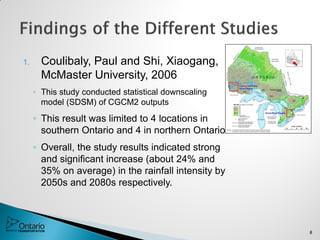
1. Coulibaly, Paul and Shi, Xiaogang,
McMaster University, 2006
◦ This study conducted statistical downscaling
model (SDSM) of CGCM2 outputs
◦ This result was limited to 4 locations in
southern Ontario and 4 in northern Ontario
◦ Overall, the study results indicated strong
and significant increase (about 24% and
35% on average) in the rainfall intensity by
2050s and 2080s respectively.
8
2. Review of Climate Change Data Portal using 5-
member PRECIS ensemble:
◦ Findings from this review identifies the order of
magnitude of climate change based on IDF values for the
entire province.
◦ It also provided a better understanding of how to interpret
IDF predictions
9
Comparison to IDF
curve for 1960-
1990 base year
Bias corrected
Comparison to IDF
curve for 2007
base year
Bias corrected
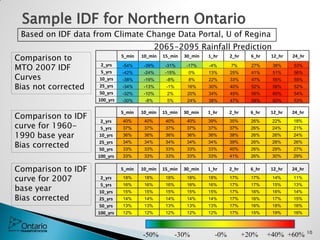
Sample IDF for Northern Ontario
2065-2095 Rainfall Prediction
Comparison to
MTO 2007 IDF
Curves
Bias not corrected
5_min 10_min 15_min 30_min 1_hr 2_hr 6_hr 12_hr 24_hr
2_yrs -54% -39% -31% -17% -4% 7% 27% 38% 53%
5_yrs -42% -24% -15% 0% 13% 25% 41% 51% 56%
10_yrs -38% -19% -8% 8% 22% 33% 47% 55% 55%
25_yrs -34% -13% -1% 16% 30% 40% 52% 58% 52%
50_yrs -32% -10% 2% 20% 34% 45% 56% 60% 54%
100_yrs -30% -8% 5% 24% 38% 47% 58% 60% 53%
5_min 10_min 15_min 30_min 1_hr 2_hr 6_hr 12_hr 24_hr
2_yrs 40% 40% 40% 40% 39% 35% 26% 22% 18%
5_yrs 37% 37% 37% 37% 37% 37% 26% 24% 21%
10_yrs 36% 36% 36% 36% 36% 38% 26% 26% 24%
25_yrs 34% 34% 34% 34% 34% 39% 26% 28% 26%
50_yrs 33% 33% 33% 33% 33% 40% 26% 29% 27%
100_yrs 33% 33% 33% 33% 33% 41% 26% 30% 29%
5_min 10_min 15_min 30_min 1_hr 2_hr 6_hr 12_hr 24_hr
2_yrs 18% 18% 18% 18% 18% 17% 17% 14% 11%
5_yrs 16% 16% 16% 16% 16% 17% 17% 15% 13%
10_yrs 15% 15% 15% 15% 15% 17% 16% 16% 14%
25_yrs 14% 14% 14% 14% 14% 17% 16% 17% 15%
50_yrs 13% 13% 13% 13% 13% 17% 16% 18% 16%
100_yrs 12% 12% 12% 12% 12% 17% 15% 19% 16%
-50% -30% -0% +20% +40% +60% 10
Based on IDF data from Climate Change Data Portal, U of Regina
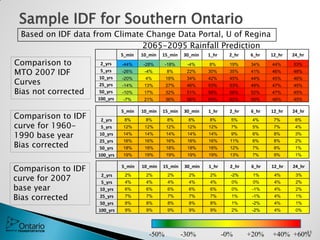
Sample IDF for Southern Ontario
2065-2095 Rainfall Prediction
Comparison to IDF
curve for 1960-
1990 base year
Bias corrected
Comparison to IDF
curve for 2007
base year
Bias corrected
Comparison to
MTO 2007 IDF
Curves
Bias not corrected
5_min 10_min 15_min 30_min 1_hr 2_hr 6_hr 12_hr 24_hr
2_yrs -44% -28% -18% -4% 8% 19% 34% 44% 53%
5_yrs -26% -4% 8% 22% 30% 35% 41% 46% 48%
10_yrs -20% 4% 18% 34% 42% 45% 44% 45% 46%
25_yrs -14% 13% 27% 46% 53% 53% 49% 47% 45%
50_yrs -10% 17% 32% 51% 58% 58% 52% 47% 45%
100_yrs -7% 21% 36% 56% 63% 62% 55% 48% 45%
5_min 10_min 15_min 30_min 1_hr 2_hr 6_hr 12_hr 24_hr
2_yrs 8% 8% 8% 8% 8% 5% 4% 7% 6%
5_yrs 12% 12% 12% 12% 12% 7% 5% 7% 4%
10_yrs 14% 14% 14% 14% 14% 9% 6% 8% 3%
25_yrs 16% 16% 16% 16% 16% 11% 6% 8% 2%
50_yrs 18% 18% 18% 18% 18% 12% 7% 8% 1%
100_yrs 19% 19% 19% 19% 19% 13% 7% 9% 1%
5_min 10_min 15_min 30_min 1_hr 2_hr 6_hr 12_hr 24_hr
2_yrs 2% 2% 2% 2% 2% -2% 1% 4% 3%
5_yrs 4% 4% 4% 4% 4% 0% 0% 4% 2%
10_yrs 6% 6% 6% 6% 6% 0% -1% 4% 2%
25_yrs 7% 7% 7% 7% 7% 1% -1% 4% 1%
50_yrs 8% 8% 8% 8% 8% 1% -2% 4% 1%
100_yrs 9% 9% 9% 9% 9% 2% -2% 4% 0%
-50% -30% -0% +20% +40% +60%11
Based on IDF data from Climate Change Data Portal, U of Regina
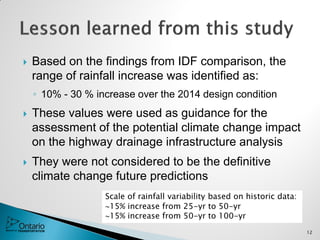
 Based on the findings from IDF comparison, the
range of rainfall increase was identified as:
◦ 10% - 30 % increase over the 2014 design condition
 These values were used as guidance for the
assessment of the potential climate change impact
on the highway drainage infrastructure analysis
 They were not considered to be the definitive
climate change future predictions
12
Scale of rainfall variability based on historic data:
15% increase from 25-yr to 50-yr
15% increase from 50-yr to 100-yr
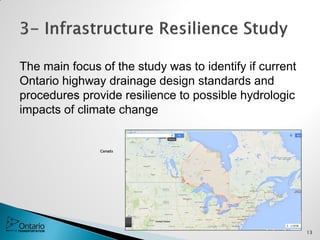
The main focus of the study was to identify if current
Ontario highway drainage design standards and
procedures provide resilience to possible hydrologic
impacts of climate change
Canada
13
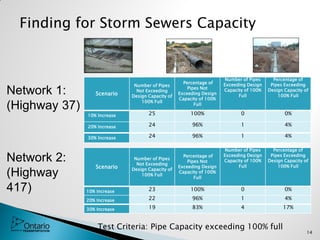
Network 1:
(Highway 37)
Scenario
Number of Pipes
Not Exceeding
Design Capacity of
100% Full
Percentage of
Pipes Not
Exceeding Design
Capacity of 100%
Full
Number of Pipes
Exceeding Design
Capacity of 100%
Full
Percentage of
Pipes Exceeding
Design Capacity of
100% Full
10% Increase 25 100% 0 0%
20% Increase 24 96% 1 4%
30% Increase 24 96% 1 4%
Finding for Storm Sewers Capacity
14
Scenario
Number of Pipes
Not Exceeding
Design Capacity of
100% Full
Percentage of
Pipes Not
Exceeding Design
Capacity of 100%
Full
Number of Pipes
Exceeding Design
Capacity of 100%
Full
Percentage of
Pipes Exceeding
Design Capacity of
100% Full
10% Increase 23 100% 0 0%
20% Increase 22 96% 1 4%
30% Increase 19 83% 4 17%
Test Criteria: Pipe Capacity exceeding 100% full
Network 2:
(Highway
417)
Base Case
m
10% Increase
m
20% Increase
m
30% Increase
m
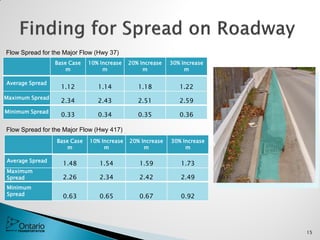
Average Spread
1.12 1.14 1.18 1.22
Maximum Spread
2.34 2.43 2.51 2.59
Minimum Spread
0.33 0.34 0.35 0.36
Base Case
m
10% Increase
m
20% Increase
m
30% Increase
m
Average Spread
1.48 1.54 1.59 1.73
Maximum
Spread 2.26 2.34 2.42 2.49
Minimum
Spread 0.63 0.65 0.67 0.92
Flow Spread for the Major Flow (Hwy 417)
Flow Spread for the Major Flow (Hwy 37)
15
Flow
Base
Flow
10%
Increase
in Flow
20%
Increase
in Flow
30%
Increase
in Flow
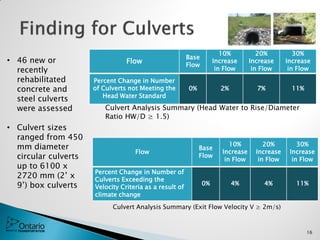
Percent Change in Number
of Culverts not Meeting the
Head Water Standard
0% 2% 7% 11%
Culvert Analysis Summary (Head Water to Rise/Diameter
Ratio HW/D ≥ 1.5)
• 46 new or
recently
rehabilitated
concrete and
steel culverts
were assessed
• Culvert sizes
ranged from 450
mm diameter
circular culverts
up to 6100 x
2720 mm (2’ x
9’) box culverts
16
Flow
Base
Flow
10%
Increase
in Flow
20%
Increase
in Flow
30%
Increase
in Flow
Percent Change in Number of
Culverts Exceeding the
Velocity Criteria as a result of
climate change
0% 4% 4% 11%
Culvert Analysis Summary (Exit Flow Velocity V ≥ 2m/s)
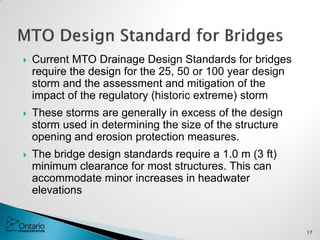
 Current MTO Drainage Design Standards for bridges
require the design for the 25, 50 or 100 year design
storm and the assessment and mitigation of the
impact of the regulatory (historic extreme) storm
 These storms are generally in excess of the design
storm used in determining the size of the structure
opening and erosion protection measures.
 The bridge design standards require a 1.0 m (3 ft)
minimum clearance for most structures. This can
accommodate minor increases in headwater
elevations
17
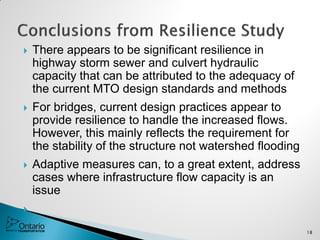
 There appears to be significant resilience in
highway storm sewer and culvert hydraulic
capacity that can be attributed to the adequacy of
the current MTO design standards and methods
 For bridges, current design practices appear to
provide resilience to handle the increased flows.
However, this mainly reflects the requirement for
the stability of the structure not watershed flooding
 Adaptive measures can, to a great extent, address
cases where infrastructure flow capacity is an
issue

18
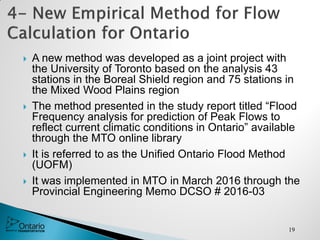
 A new method was developed as a joint project with
the University of Toronto based on the analysis 43
stations in the Boreal Shield region and 75 stations in
the Mixed Wood Plains region
 The method presented in the study report titled “Flood
Frequency analysis for prediction of Peak Flows to
reflect current climatic conditions in Ontario” available
through the MTO online library
 It is referred to as the Unified Ontario Flood Method
(UOFM)
 It was implemented in MTO in March 2016 through the
Provincial Engineering Memo DCSO # 2016-03
19
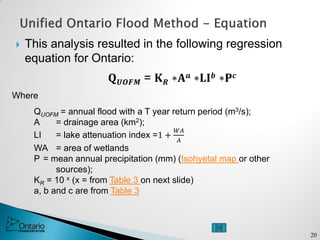
 This analysis resulted in the following regression
equation for Ontario:
𝐐 𝑼𝑶𝑭𝑴 = 𝐊 𝑹 ∗𝐀 𝒂 ∗𝐋𝐈 𝒃 ∗𝐏 𝒄
Where
QUOFM = annual flood with a T year return period (m3/s);
A = drainage area (km2);
LI = lake attenuation index =1 +
𝑊𝐴
𝐴
WA = area of wetlands
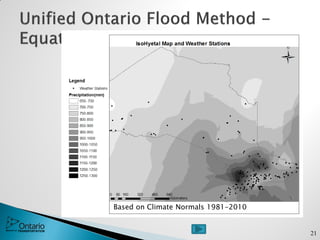
P = mean annual precipitation (mm) (Isohyetal map or other
sources);
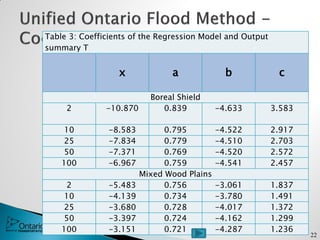
KR = 10 x (x = from Table 3 on next slide)
a, b and c are from Table 3
20
21
Based on Climate Normals 1981-2010
22
Table 3: Coefficients of the Regression Model and Output
summary T
x a b c
Boreal Shield
2 -10.870 0.839 -4.633 3.583
10 -8.583 0.795 -4.522 2.917
25 -7.834 0.779 -4.510 2.703
50 -7.371 0.769 -4.520 2.572
100 -6.967 0.759 -4.541 2.457
Mixed Wood Plains
2 -5.483 0.756 -3.061 1.837
10 -4.139 0.734 -3.780 1.491
25 -3.680 0.728 -4.017 1.372
50 -3.397 0.724 -4.162 1.299
100 -3.151 0.721 -4.287 1.236
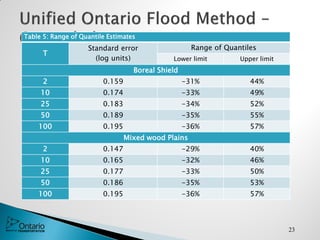
Table 5: Range of Quantile Estimates
T
Standard error
(log units)
Range of Quantiles
Lower limit Upper limit
Boreal Shield
2 0.159 -31% 44%
10 0.174 -33% 49%
25 0.183 -34% 52%
50 0.189 -35% 55%
100 0.195 -36% 57%
Mixed wood Plains
2 0.147 -29% 40%
10 0.165 -32% 46%
25 0.177 -33% 50%
50 0.186 -35% 53%
100 0.195 -36% 57%
23
 The Ministry has undertaken a study with the University
of Waterloo to investigate trends in the historical rainfall
records across Ontario
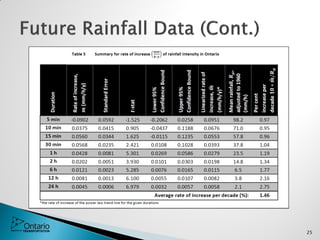
 A regional scale trend in extreme precipitation upwards
was identified that ranges from 0.95% per decade for
the 10-minute storm to 2.75% per decade for the 24-
hour storm
 Implicit in this methodology is that the historical trend
extends linearly into the future
 Future GHG scenarios is a subject of another study
currently underway lead by the Ontario Ministry of the
Environment and Climate Change and U of Waterloo
25
One of the first steps to begin to address climate
change in design was to regularly update the IDF
curves as soon as data became available
◦ MTO updated its IDF curves in 2012, 2014 and 2016 to
reflect changes in climate, based on the latest available
Environment Canada data
◦ Further updates will continue once new rainfall data
becomes available from Environment Canada
◦ A new update is planned for 2018
◦ The updates also included improvements in the statistical
methods used in the assessment of the IDF values
26
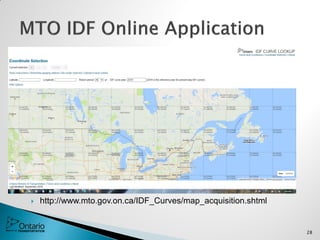
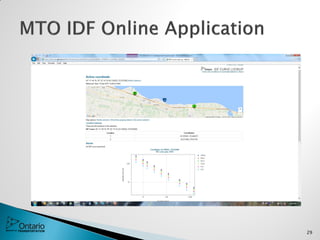
 To facilitate the determination of IDF curves at any
location in the province, MTO in cooperation with
the University of Waterloo developed the IDF look-
up application
 This application provides a representative IDF
curve at any location in the province for:
◦ A point location
◦ Highway segment length (highway improvement project)
◦ A water crossing catchment area (bridge or culvert
design)
27
 http://www.mto.gov.on.ca/IDF_Curves/map_acquisition.shtml
28
29
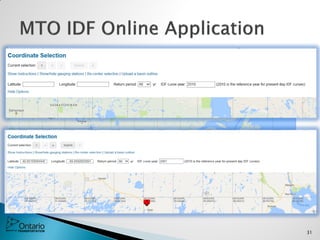
 The findings of the trend analysis study with the U
of Waterloo were incorporated into the 2016
version of the IDF application
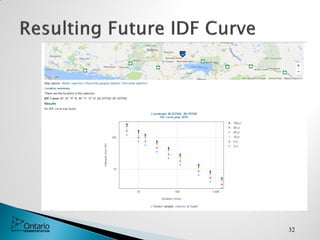
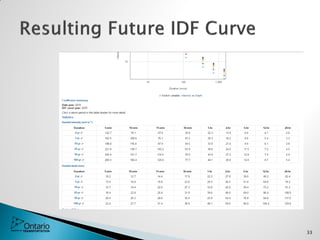
 It is now possible to determine the IDF curves for

the base year (2010) and any future year
30
 http://www.mto.gov.on.ca/IDF_Curves/map_acquisition.shtml
31
32
33
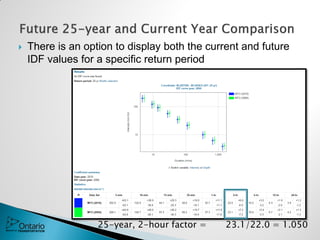
 There is an option to display both the current and future
IDF values for a specific return period
25-year, 2-hour factor = 23.1/22.0 = 1.050
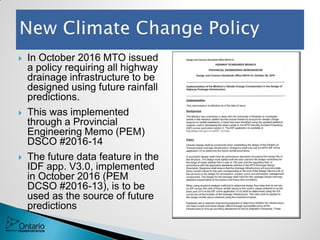
 In October 2016 MTO issued
a policy requiring all highway
drainage infrastructure to be
designed using future rainfall
predictions.
 This was implemented
through a Provincial
Engineering Memo (PEM)
DSCO #2016-14
 The future data feature in the
IDF app. V3.0, implemented
in October 2016 (PEM
DCSO #2016-13), is to be
used as the source of future
predictions
 A successful design shall meet all performance standards
throughout the design life of the structure
 The design must satisfy both the start and end life design
constraints
 Design continues to be in accordance with the MTO
Drainage Design Standards using engineering judgement
 Designers shall apply future rainfall values for the year
corresponding to the end of the Design Service Life of the
structure in the design for conveyance, erosion, scour and
stormwater management components
 The design for fish passage shall meet the low flow
requirements at the present and future flow conditions
 Continue to update the MTO IDF curve online
application as new rainfall data and better climate
change predictions become available
 Keep up-to-date with climate change modeling
research to take advantage of advancements in
the science and engineering
 Integrate new design methods in other systems
such as MNRF OFAT system
37
38
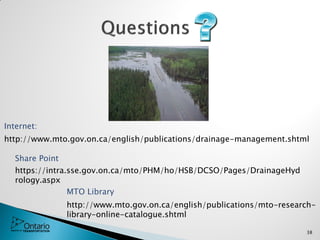
http://www.mto.gov.on.ca/english/publications/drainage-management.shtml
Internet:
https://intra.sse.gov.on.ca/mto/PHM/ho/HSB/DCSO/Pages/DrainageHyd
rology.aspx
Share Point
http://www.mto.gov.on.ca/english/publications/mto-research-
library-online-catalogue.shtml
MTO Library
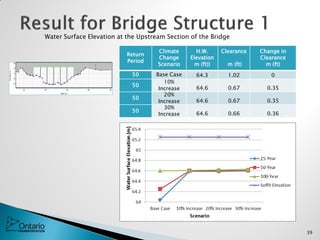
Return
Period
Climate
Change
Scenario
H.W.
Elevation
m (ft))
Clearance
m (ft)
Change in
Clearance
m (ft)
50 Base Case 64.3 1.02 0
50
10%
Increase 64.6 0.67 0.35
50
20%
Increase 64.6 0.67 0.35
50
30%
Increase 64.6 0.66 0.36
Water Surface Elevation at the Upstream Section of the Bridge
39
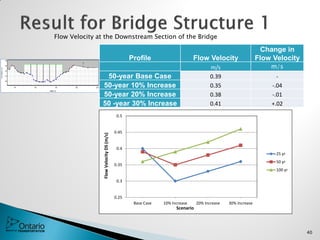
Profile Flow Velocity
Change in
Flow Velocity
m/s m/s
50-year Base Case 0.39 -
50-year 10% Increase 0.35 -.04
50-year 20% Increase 0.38 -.01
50 -year 30% Increase 0.41 +.02
Flow Velocity at the Downstream Section of the Bridge
0.25
0.3
0.35
0.4
0.45
0.5
Base Case 10% Increase 20% Increase 30% Increase
25 yr
50 yr
100 yr
Scenario
FlowVelocityDS(m/s)
40
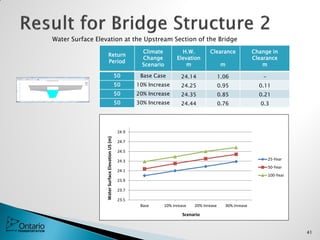
Return
Period
Climate
Change
Scenario
H.W.
Elevation
m
Clearance
m
Change in
Clearance
m
50 Base Case 24.14 1.06 -
50 10% Increase 24.25 0.95 0.11
50 20% Increase 24.35 0.85 0.21
50 30% Increase 24.44 0.76 0.3
Water Surface Elevation at the Upstream Section of the Bridge
23.5
23.7
23.9
24.1
24.3
24.5
24.7
24.9
Base 10% Inrease 20% Inrease 30% Inrease
25-Year
50-Year
100-Year
WaterSurfaceElevationUS(m)
Scenario
41
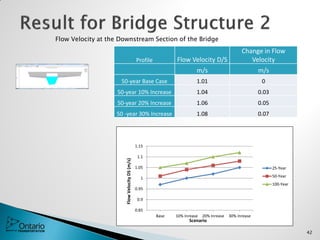
Profile Flow Velocity D/S
Change in Flow
Velocity
m/s m/s
50-year Base Case 1.01 0
50-year 10% Increase 1.04 0.03
50-year 20% Increase 1.06 0.05
50 -year 30% Increase 1.08 0.07
Flow Velocity at the Downstream Section of the Bridge
0.85
0.9
0.95
1
1.05
1.1
1.15
Base 10% Inrease 20% Inrease 30% Inrease
25-Year
50-Year
100-Year
FlowVelocityDS(m/s)
Scenario
42
 The term adaptation, in the context of the current
investigation, refers to measures that can allow
existing infrastructure to serve their function to the
end of their service life
 Adaptive measures can, to a great extent, address
cases where infrastructure flow capacity is an
issue
43
 Two types of adaptive measures were identified:
1. Hard measures
These measures involve physical actions that are
suitable for the different types of drainage
infrastructure
2. Soft measures
These measures involve factors related to
expanding our knowledge and modifying human
behaviours and expectations
44
Some of the adaptive measures that can be considered for culverts
are as follows:
◦ Inlet improvements to reduce head loss at the entrance and
reduce head water elevation (the addition of head walls, wing
walls or aprons)
◦ Provision of additional erosion protection where flow velocities
become too high
◦ Creation of upstream ponding area to allow excess flows to be
stored and reduce the flow through culverts at high flow events
◦ If site conditions permit, the construction of a relief culvert may be
considrered
45
Some of the soft measures include:
1. Ensure ongoing and effective maintenance to maintain design
level of service
2. Maintain climate data monitoring at existing locations and
filling in the gaps where data is lacking
3. Develop a dialogue between hydraulic engineers,
climatologists, infrastructure owners and regulators to improve
on climate change modelling
4. Undertake pilot infrastructure vulnerability assessments for
select infrastructure and locations to guide the process of
overall risk assessment
5. Give consideration to changing levels of public expectation
related to the occurrence of minor service degradation or
impacts for short periods of time.
46

Addressing Climate Change through Engineering Practice

  • 1.
    Climate Data TrainingSession for Municipal and Conservation Authority Engineers, Planners and Decision Makers Toronto - 26 April 2017 Culverts Presented by: Hani Farghaly, PhD., P. Eng. Ontario Ministry of Transportation Storm Sewers Bridges
  • 2.
     General introduction Overview of Findings of MTO’s climate change Investigations  New MTO Tools Supporting Design in a Changing Climate  MTO Design Policies Addressing Climate Change  Next Steps 2
  • 3.
     The OntarioMinistry of Transportation is responsible for the administration of 1,776 km of controlled access highway and about 15,000 km of other highways.  MTO also administers: ◦ 2800 bridges of which 1310 are over water; and ◦ about 2000 structural culverts (span ≥3m) and about 55,000 non-structural culverts (span< 3m) 3
  • 4.
     MTO undertakesthe design of drainage highway infrastructure based on design standards, procedures and methods published in a number of documents such as: ◦ MTO Drainage Design Standards ◦ MTO Drainage Management Manual ◦ Guidelines (e.g. Gravity Pipe Design Guidelines) ◦ Study reports (e.g. Hydrologic Design Methods, Resilience to Climate Change, Salt Impact Mitigation) ◦ Provincial Engineering Memos (implementing new findings in design) 4
  • 5.
     These documentsare updated on a regular basis to transfer research finding into practical application in design  MTO depends on academic and field research to provide the fundamentals of new design methods and procedures  Work undertaken by other jurisdictions/agencies is reviewed and the results are used to improve the design methods and procedures. 5
  • 6.
     MTO beganthe research into climate change impacts on drainage infrastructure in 2005  Over the subsequent years research funding was secured to continue to support new innovation in design, especially, in light of climate change  The research was undertaken in cooperation with a number of universities 6
  • 7.
    The following studieshave been undertaken to begin to understand the issue and take advantage of available data and information 1. Identification of the Effect of Climate Change on Future Design Standards of Drainage Infrastructure in Ontario. MTO Report HIIFP-022, 2006. Coulibaly, Paul and Shi, Xiaogang, McMaster University 2. Review of Climate Change Data Portal using 5-member PRECIS ensemble (UK Met Office) U of Regina, 2014 - Part 1, of the Report on Investigation of Resilience, MTO 2015. 3. Investigation of the Resilience of Ontario Highway Drainage Infrastructure to Climate Change. MTO Report DCSO-01, 2015 4. Development of a new empirical method for flow calculation in Ontario using the latest available rainfall and stream flow data. Unified Ontario Flood Method (UOFM) Regional Flood Frequency Analysis of Ontario Streams Using Multiple Regression, U of Toronto, April 2016 5. Trend Analysis of Ontario Rainfall Record, Part 3 of the Intensity- Duration-Frequency Curves Study, Ric Soulis, U of Waterloo, 2016 7
  • 8.
    1. Coulibaly, Pauland Shi, Xiaogang, McMaster University, 2006 ◦ This study conducted statistical downscaling model (SDSM) of CGCM2 outputs ◦ This result was limited to 4 locations in southern Ontario and 4 in northern Ontario ◦ Overall, the study results indicated strong and significant increase (about 24% and 35% on average) in the rainfall intensity by 2050s and 2080s respectively. 8
  • 9.
    2. Review ofClimate Change Data Portal using 5- member PRECIS ensemble: ◦ Findings from this review identifies the order of magnitude of climate change based on IDF values for the entire province. ◦ It also provided a better understanding of how to interpret IDF predictions 9
  • 10.
    Comparison to IDF curvefor 1960- 1990 base year Bias corrected Comparison to IDF curve for 2007 base year Bias corrected Sample IDF for Northern Ontario 2065-2095 Rainfall Prediction Comparison to MTO 2007 IDF Curves Bias not corrected 5_min 10_min 15_min 30_min 1_hr 2_hr 6_hr 12_hr 24_hr 2_yrs -54% -39% -31% -17% -4% 7% 27% 38% 53% 5_yrs -42% -24% -15% 0% 13% 25% 41% 51% 56% 10_yrs -38% -19% -8% 8% 22% 33% 47% 55% 55% 25_yrs -34% -13% -1% 16% 30% 40% 52% 58% 52% 50_yrs -32% -10% 2% 20% 34% 45% 56% 60% 54% 100_yrs -30% -8% 5% 24% 38% 47% 58% 60% 53% 5_min 10_min 15_min 30_min 1_hr 2_hr 6_hr 12_hr 24_hr 2_yrs 40% 40% 40% 40% 39% 35% 26% 22% 18% 5_yrs 37% 37% 37% 37% 37% 37% 26% 24% 21% 10_yrs 36% 36% 36% 36% 36% 38% 26% 26% 24% 25_yrs 34% 34% 34% 34% 34% 39% 26% 28% 26% 50_yrs 33% 33% 33% 33% 33% 40% 26% 29% 27% 100_yrs 33% 33% 33% 33% 33% 41% 26% 30% 29% 5_min 10_min 15_min 30_min 1_hr 2_hr 6_hr 12_hr 24_hr 2_yrs 18% 18% 18% 18% 18% 17% 17% 14% 11% 5_yrs 16% 16% 16% 16% 16% 17% 17% 15% 13% 10_yrs 15% 15% 15% 15% 15% 17% 16% 16% 14% 25_yrs 14% 14% 14% 14% 14% 17% 16% 17% 15% 50_yrs 13% 13% 13% 13% 13% 17% 16% 18% 16% 100_yrs 12% 12% 12% 12% 12% 17% 15% 19% 16% -50% -30% -0% +20% +40% +60% 10 Based on IDF data from Climate Change Data Portal, U of Regina
  • 11.
    Sample IDF forSouthern Ontario 2065-2095 Rainfall Prediction Comparison to IDF curve for 1960- 1990 base year Bias corrected Comparison to IDF curve for 2007 base year Bias corrected Comparison to MTO 2007 IDF Curves Bias not corrected 5_min 10_min 15_min 30_min 1_hr 2_hr 6_hr 12_hr 24_hr 2_yrs -44% -28% -18% -4% 8% 19% 34% 44% 53% 5_yrs -26% -4% 8% 22% 30% 35% 41% 46% 48% 10_yrs -20% 4% 18% 34% 42% 45% 44% 45% 46% 25_yrs -14% 13% 27% 46% 53% 53% 49% 47% 45% 50_yrs -10% 17% 32% 51% 58% 58% 52% 47% 45% 100_yrs -7% 21% 36% 56% 63% 62% 55% 48% 45% 5_min 10_min 15_min 30_min 1_hr 2_hr 6_hr 12_hr 24_hr 2_yrs 8% 8% 8% 8% 8% 5% 4% 7% 6% 5_yrs 12% 12% 12% 12% 12% 7% 5% 7% 4% 10_yrs 14% 14% 14% 14% 14% 9% 6% 8% 3% 25_yrs 16% 16% 16% 16% 16% 11% 6% 8% 2% 50_yrs 18% 18% 18% 18% 18% 12% 7% 8% 1% 100_yrs 19% 19% 19% 19% 19% 13% 7% 9% 1% 5_min 10_min 15_min 30_min 1_hr 2_hr 6_hr 12_hr 24_hr 2_yrs 2% 2% 2% 2% 2% -2% 1% 4% 3% 5_yrs 4% 4% 4% 4% 4% 0% 0% 4% 2% 10_yrs 6% 6% 6% 6% 6% 0% -1% 4% 2% 25_yrs 7% 7% 7% 7% 7% 1% -1% 4% 1% 50_yrs 8% 8% 8% 8% 8% 1% -2% 4% 1% 100_yrs 9% 9% 9% 9% 9% 2% -2% 4% 0% -50% -30% -0% +20% +40% +60%11 Based on IDF data from Climate Change Data Portal, U of Regina
  • 12.
     Based onthe findings from IDF comparison, the range of rainfall increase was identified as: ◦ 10% - 30 % increase over the 2014 design condition  These values were used as guidance for the assessment of the potential climate change impact on the highway drainage infrastructure analysis  They were not considered to be the definitive climate change future predictions 12 Scale of rainfall variability based on historic data: 15% increase from 25-yr to 50-yr 15% increase from 50-yr to 100-yr
  • 13.
    The main focusof the study was to identify if current Ontario highway drainage design standards and procedures provide resilience to possible hydrologic impacts of climate change Canada 13
  • 14.
    Network 1: (Highway 37) Scenario Numberof Pipes Not Exceeding Design Capacity of 100% Full Percentage of Pipes Not Exceeding Design Capacity of 100% Full Number of Pipes Exceeding Design Capacity of 100% Full Percentage of Pipes Exceeding Design Capacity of 100% Full 10% Increase 25 100% 0 0% 20% Increase 24 96% 1 4% 30% Increase 24 96% 1 4% Finding for Storm Sewers Capacity 14 Scenario Number of Pipes Not Exceeding Design Capacity of 100% Full Percentage of Pipes Not Exceeding Design Capacity of 100% Full Number of Pipes Exceeding Design Capacity of 100% Full Percentage of Pipes Exceeding Design Capacity of 100% Full 10% Increase 23 100% 0 0% 20% Increase 22 96% 1 4% 30% Increase 19 83% 4 17% Test Criteria: Pipe Capacity exceeding 100% full Network 2: (Highway 417)
  • 15.
    Base Case m 10% Increase m 20%Increase m 30% Increase m Average Spread 1.12 1.14 1.18 1.22 Maximum Spread 2.34 2.43 2.51 2.59 Minimum Spread 0.33 0.34 0.35 0.36 Base Case m 10% Increase m 20% Increase m 30% Increase m Average Spread 1.48 1.54 1.59 1.73 Maximum Spread 2.26 2.34 2.42 2.49 Minimum Spread 0.63 0.65 0.67 0.92 Flow Spread for the Major Flow (Hwy 417) Flow Spread for the Major Flow (Hwy 37) 15
  • 16.
    Flow Base Flow 10% Increase in Flow 20% Increase in Flow 30% Increase inFlow Percent Change in Number of Culverts not Meeting the Head Water Standard 0% 2% 7% 11% Culvert Analysis Summary (Head Water to Rise/Diameter Ratio HW/D ≥ 1.5) • 46 new or recently rehabilitated concrete and steel culverts were assessed • Culvert sizes ranged from 450 mm diameter circular culverts up to 6100 x 2720 mm (2’ x 9’) box culverts 16 Flow Base Flow 10% Increase in Flow 20% Increase in Flow 30% Increase in Flow Percent Change in Number of Culverts Exceeding the Velocity Criteria as a result of climate change 0% 4% 4% 11% Culvert Analysis Summary (Exit Flow Velocity V ≥ 2m/s)
  • 17.
     Current MTODrainage Design Standards for bridges require the design for the 25, 50 or 100 year design storm and the assessment and mitigation of the impact of the regulatory (historic extreme) storm  These storms are generally in excess of the design storm used in determining the size of the structure opening and erosion protection measures.  The bridge design standards require a 1.0 m (3 ft) minimum clearance for most structures. This can accommodate minor increases in headwater elevations 17
  • 18.
     There appearsto be significant resilience in highway storm sewer and culvert hydraulic capacity that can be attributed to the adequacy of the current MTO design standards and methods  For bridges, current design practices appear to provide resilience to handle the increased flows. However, this mainly reflects the requirement for the stability of the structure not watershed flooding  Adaptive measures can, to a great extent, address cases where infrastructure flow capacity is an issue  18
  • 19.
     A newmethod was developed as a joint project with the University of Toronto based on the analysis 43 stations in the Boreal Shield region and 75 stations in the Mixed Wood Plains region  The method presented in the study report titled “Flood Frequency analysis for prediction of Peak Flows to reflect current climatic conditions in Ontario” available through the MTO online library  It is referred to as the Unified Ontario Flood Method (UOFM)  It was implemented in MTO in March 2016 through the Provincial Engineering Memo DCSO # 2016-03 19
  • 20.
     This analysisresulted in the following regression equation for Ontario: 𝐐 𝑼𝑶𝑭𝑴 = 𝐊 𝑹 ∗𝐀 𝒂 ∗𝐋𝐈 𝒃 ∗𝐏 𝒄 Where QUOFM = annual flood with a T year return period (m3/s); A = drainage area (km2); LI = lake attenuation index =1 + 𝑊𝐴 𝐴 WA = area of wetlands P = mean annual precipitation (mm) (Isohyetal map or other sources); KR = 10 x (x = from Table 3 on next slide) a, b and c are from Table 3 20
  • 21.
    21 Based on ClimateNormals 1981-2010
  • 22.
    22 Table 3: Coefficientsof the Regression Model and Output summary T x a b c Boreal Shield 2 -10.870 0.839 -4.633 3.583 10 -8.583 0.795 -4.522 2.917 25 -7.834 0.779 -4.510 2.703 50 -7.371 0.769 -4.520 2.572 100 -6.967 0.759 -4.541 2.457 Mixed Wood Plains 2 -5.483 0.756 -3.061 1.837 10 -4.139 0.734 -3.780 1.491 25 -3.680 0.728 -4.017 1.372 50 -3.397 0.724 -4.162 1.299 100 -3.151 0.721 -4.287 1.236
  • 23.
    Table 5: Rangeof Quantile Estimates T Standard error (log units) Range of Quantiles Lower limit Upper limit Boreal Shield 2 0.159 -31% 44% 10 0.174 -33% 49% 25 0.183 -34% 52% 50 0.189 -35% 55% 100 0.195 -36% 57% Mixed wood Plains 2 0.147 -29% 40% 10 0.165 -32% 46% 25 0.177 -33% 50% 50 0.186 -35% 53% 100 0.195 -36% 57% 23
  • 24.
     The Ministryhas undertaken a study with the University of Waterloo to investigate trends in the historical rainfall records across Ontario  A regional scale trend in extreme precipitation upwards was identified that ranges from 0.95% per decade for the 10-minute storm to 2.75% per decade for the 24- hour storm  Implicit in this methodology is that the historical trend extends linearly into the future  Future GHG scenarios is a subject of another study currently underway lead by the Ontario Ministry of the Environment and Climate Change and U of Waterloo
  • 25.
  • 26.
    One of thefirst steps to begin to address climate change in design was to regularly update the IDF curves as soon as data became available ◦ MTO updated its IDF curves in 2012, 2014 and 2016 to reflect changes in climate, based on the latest available Environment Canada data ◦ Further updates will continue once new rainfall data becomes available from Environment Canada ◦ A new update is planned for 2018 ◦ The updates also included improvements in the statistical methods used in the assessment of the IDF values 26
  • 27.
     To facilitatethe determination of IDF curves at any location in the province, MTO in cooperation with the University of Waterloo developed the IDF look- up application  This application provides a representative IDF curve at any location in the province for: ◦ A point location ◦ Highway segment length (highway improvement project) ◦ A water crossing catchment area (bridge or culvert design) 27
  • 28.
  • 29.
  • 30.
     The findingsof the trend analysis study with the U of Waterloo were incorporated into the 2016 version of the IDF application  It is now possible to determine the IDF curves for the base year (2010) and any future year 30
  • 31.
  • 32.
  • 33.
  • 34.
     There isan option to display both the current and future IDF values for a specific return period 25-year, 2-hour factor = 23.1/22.0 = 1.050
  • 35.
     In October2016 MTO issued a policy requiring all highway drainage infrastructure to be designed using future rainfall predictions.  This was implemented through a Provincial Engineering Memo (PEM) DSCO #2016-14  The future data feature in the IDF app. V3.0, implemented in October 2016 (PEM DCSO #2016-13), is to be used as the source of future predictions
  • 36.
     A successfuldesign shall meet all performance standards throughout the design life of the structure  The design must satisfy both the start and end life design constraints  Design continues to be in accordance with the MTO Drainage Design Standards using engineering judgement  Designers shall apply future rainfall values for the year corresponding to the end of the Design Service Life of the structure in the design for conveyance, erosion, scour and stormwater management components  The design for fish passage shall meet the low flow requirements at the present and future flow conditions
  • 37.
     Continue toupdate the MTO IDF curve online application as new rainfall data and better climate change predictions become available  Keep up-to-date with climate change modeling research to take advantage of advancements in the science and engineering  Integrate new design methods in other systems such as MNRF OFAT system 37
  • 38.
  • 39.
    Return Period Climate Change Scenario H.W. Elevation m (ft)) Clearance m (ft) Changein Clearance m (ft) 50 Base Case 64.3 1.02 0 50 10% Increase 64.6 0.67 0.35 50 20% Increase 64.6 0.67 0.35 50 30% Increase 64.6 0.66 0.36 Water Surface Elevation at the Upstream Section of the Bridge 39
  • 40.
    Profile Flow Velocity Changein Flow Velocity m/s m/s 50-year Base Case 0.39 - 50-year 10% Increase 0.35 -.04 50-year 20% Increase 0.38 -.01 50 -year 30% Increase 0.41 +.02 Flow Velocity at the Downstream Section of the Bridge 0.25 0.3 0.35 0.4 0.45 0.5 Base Case 10% Increase 20% Increase 30% Increase 25 yr 50 yr 100 yr Scenario FlowVelocityDS(m/s) 40
  • 41.
    Return Period Climate Change Scenario H.W. Elevation m Clearance m Change in Clearance m 50 BaseCase 24.14 1.06 - 50 10% Increase 24.25 0.95 0.11 50 20% Increase 24.35 0.85 0.21 50 30% Increase 24.44 0.76 0.3 Water Surface Elevation at the Upstream Section of the Bridge 23.5 23.7 23.9 24.1 24.3 24.5 24.7 24.9 Base 10% Inrease 20% Inrease 30% Inrease 25-Year 50-Year 100-Year WaterSurfaceElevationUS(m) Scenario 41
  • 42.
    Profile Flow VelocityD/S Change in Flow Velocity m/s m/s 50-year Base Case 1.01 0 50-year 10% Increase 1.04 0.03 50-year 20% Increase 1.06 0.05 50 -year 30% Increase 1.08 0.07 Flow Velocity at the Downstream Section of the Bridge 0.85 0.9 0.95 1 1.05 1.1 1.15 Base 10% Inrease 20% Inrease 30% Inrease 25-Year 50-Year 100-Year FlowVelocityDS(m/s) Scenario 42
  • 43.
     The termadaptation, in the context of the current investigation, refers to measures that can allow existing infrastructure to serve their function to the end of their service life  Adaptive measures can, to a great extent, address cases where infrastructure flow capacity is an issue 43
  • 44.
     Two typesof adaptive measures were identified: 1. Hard measures These measures involve physical actions that are suitable for the different types of drainage infrastructure 2. Soft measures These measures involve factors related to expanding our knowledge and modifying human behaviours and expectations 44
  • 45.
    Some of theadaptive measures that can be considered for culverts are as follows: ◦ Inlet improvements to reduce head loss at the entrance and reduce head water elevation (the addition of head walls, wing walls or aprons) ◦ Provision of additional erosion protection where flow velocities become too high ◦ Creation of upstream ponding area to allow excess flows to be stored and reduce the flow through culverts at high flow events ◦ If site conditions permit, the construction of a relief culvert may be considrered 45
  • 46.
    Some of thesoft measures include: 1. Ensure ongoing and effective maintenance to maintain design level of service 2. Maintain climate data monitoring at existing locations and filling in the gaps where data is lacking 3. Develop a dialogue between hydraulic engineers, climatologists, infrastructure owners and regulators to improve on climate change modelling 4. Undertake pilot infrastructure vulnerability assessments for select infrastructure and locations to guide the process of overall risk assessment 5. Give consideration to changing levels of public expectation related to the occurrence of minor service degradation or impacts for short periods of time. 46