DIGESTIVE SYSTEM
………………………………………………………………………………………………………………………………………………………………………………………………………………………………………………………………………………
REPTILES, BIRDS AND MAMMALS
SUBMITTED BY RITTIK GARG | BSc
rd
IN THIS
PRESENTATION, WE
WILL DISCUSS ABOUT
THE DIGESTIVE
SYSTEM OF
BIRDS
Eg:Pegion (Columba)
MAMMALS
Eg:Rabbit
(Oryctolagus)
REPTILES
Eg: Lizard (Calotes)
REPTILES
Reptiles are tetrapod (four-limbed vertebrate) animals in the class Reptilia, comprising today's
turtles, crocodilians, snakes, amphisbaenians, lizards, tuatara, and their extinct relatives. The
study of these traditional reptile orders, historically combined with that of modern amphibians,
is called herpetology.
Mouth & oral cavity- tetrapods such as reptiles, typically have longer oral cavities.
Teeth- reptiles still have teeth on the vomer, palatine, & pterygoid bones.
Tongue- primary tongue + glandular field (or tuberculum impar) + lateral lingual swellings
(more hypobranchial muscle).
Tongue mobility- sometimes long and may move in and out of the oral cavity.
Oral glands- some reptiles secrete poison. (E.g. Snake)
Pharynx- is the part of the foregut preceeding the esophagus & includes:
- glottis (slit leading into the larynx)
-openings of auditory (eustachian) tubes
- opening into esophagus
Stomach- increasing specialization (more differentiated from the esophagus)
Intestine- coiled small intestines & a relatively short large intestine (that empties into the
cloaca)
Cloaca- chamber at end of digestive tract that receives the intestine, & urinary & genital ducts,
ducts, & opens to the exterior via the vent
A.Digestive system of Calotes
B.A tooth
C.Showing structural relationship of liver and
pancreas with duodenum.
Digestive system of Snake
BIRDS
DIGESTIVE
SYSTEM OF
BIRDS
Birds has faster and more efficient digestive system than those of other
vertebrate groups.
Their beaks or bills replace the lips and mouth of mammals and vary in
shape.
Their tongue do helps manipulate food for swallowing.
Food passes through esophagus on its way to stomach.
Birds have a two part stomach,
granular portion known as Proventriculus and the muscular portions
known as Gizzard.
MAMMALS
The mammalian digestive system consists of the alimentary canal
(complete digestive tract) and various accessory glands that secret
digestive juices into the canal through the ducts. The food is moved
along the tract by the contraction of smooth muscles in the walls of the
canal. These rhythmic contraction waves are called peristalsis. The
regulation of passage of material from one chamber to another within
the canal is controlled by ring-like valves called sphincters.
The accessory glands of the mammalian digestive tract are three pairs of
salivary glands, the pancreas, the liver, and its storage organ the gall
bladder.
Mouth: Foodstuffs are broken down mechanically by chewing and saliva is
added as a lubricant.
Pharynx - Out throat is the pharynx which leads to both the esophagus
and the windpipe ( trachea). When a human swallows the top of the
windpipe moves up so that its opening, the glottis, is blocked by a flap of
cartilage called the epiglottis. This helps to ensure that the bolus enters
the esophagus.
Esophagus: A simple conduit between the mouth and stomach -
important but only marginally interesting.
Stomach: Where the real action begins - chemical digestion of proteins
initiated and foodstuffs reduced to liquid form.
Liver: The center of metabolic activity in the body - its major role in the
digestive process is to provide bile salts to the small intestine, which are
critical for digestion and absorption of fats.
Pancreas: Important roles as both an endocrine and exocrine organ -
provides a potent mixture of digestive enzymes to the small intestine
which are critical for digestion of fats, carbohydrates and protein.
Small Intestine: The most exciting place to be in the entire digestive
system - this is where the final stages of chemical digestion occur and
where almost all nutrients are absorbed.
Large Intestine: Major differences among species in extent and
importance - in all animals water is absorbed, bacterial fermentation
takes place and feces are formed. In carnivores, that's about the extent
of it, but in herbivores like the horse, the large intestine is huge and of
critical importance for utilization of cellulose.
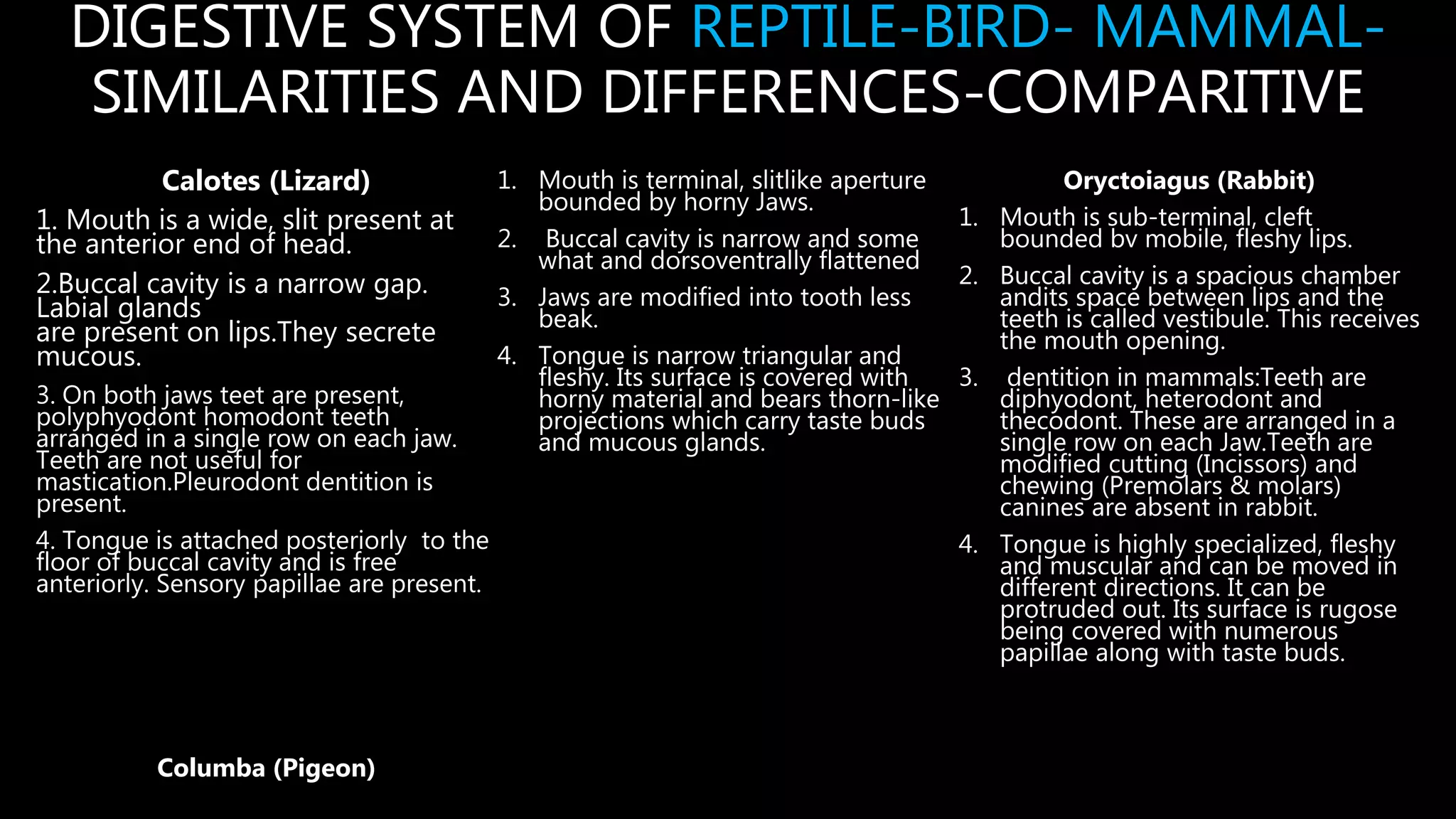
DIGESTIVE SYSTEM OF REPTILE-BIRD- MAMMAL-
SIMILARITIES AND DIFFERENCES-COMPARITIVE
Calotes (Lizard)
1. Mouth is a wide, slit present at
the anterior end of head.
2.Buccal cavity is a narrow gap.
Labial glands
are present on lips.They secrete
mucous.
3. On both jaws teet are present,
polyphyodont homodont teeth
arranged in a single row on each jaw.
Teeth are not useful for
mastication.Pleurodont dentition is
present.
4. Tongue is attached posteriorly to the
floor of buccal cavity and is free
anteriorly. Sensory papillae are present.
Columba (Pigeon)
1. Mouth is terminal, slitlike aperture
bounded by horny Jaws.
2. Buccal cavity is narrow and some
what and dorsoventrally flattened
3. Jaws are modified into tooth less
beak.
4. Tongue is narrow triangular and
fleshy. Its surface is covered with
horny material and bears thorn-like
projections which carry taste buds
and mucous glands.
Oryctoiagus (Rabbit)
1. Mouth is sub-terminal, cleft
bounded bv mobile, fleshy lips.
2. Buccal cavity is a spacious chamber
andits space between lips and the
teeth is called vestibule. This receives
the mouth opening.
3. dentition in mammals:Teeth are
diphyodont, heterodont and
thecodont. These are arranged in a
single row on each Jaw.Teeth are
modified cutting (Incissors) and
chewing (Premolars & molars)
canines are absent in rabbit.
4. Tongue is highly specialized, fleshy
and muscular and can be moved in
different directions. It can be
protruded out. Its surface is rugose
being covered with numerous
papillae along with taste buds.
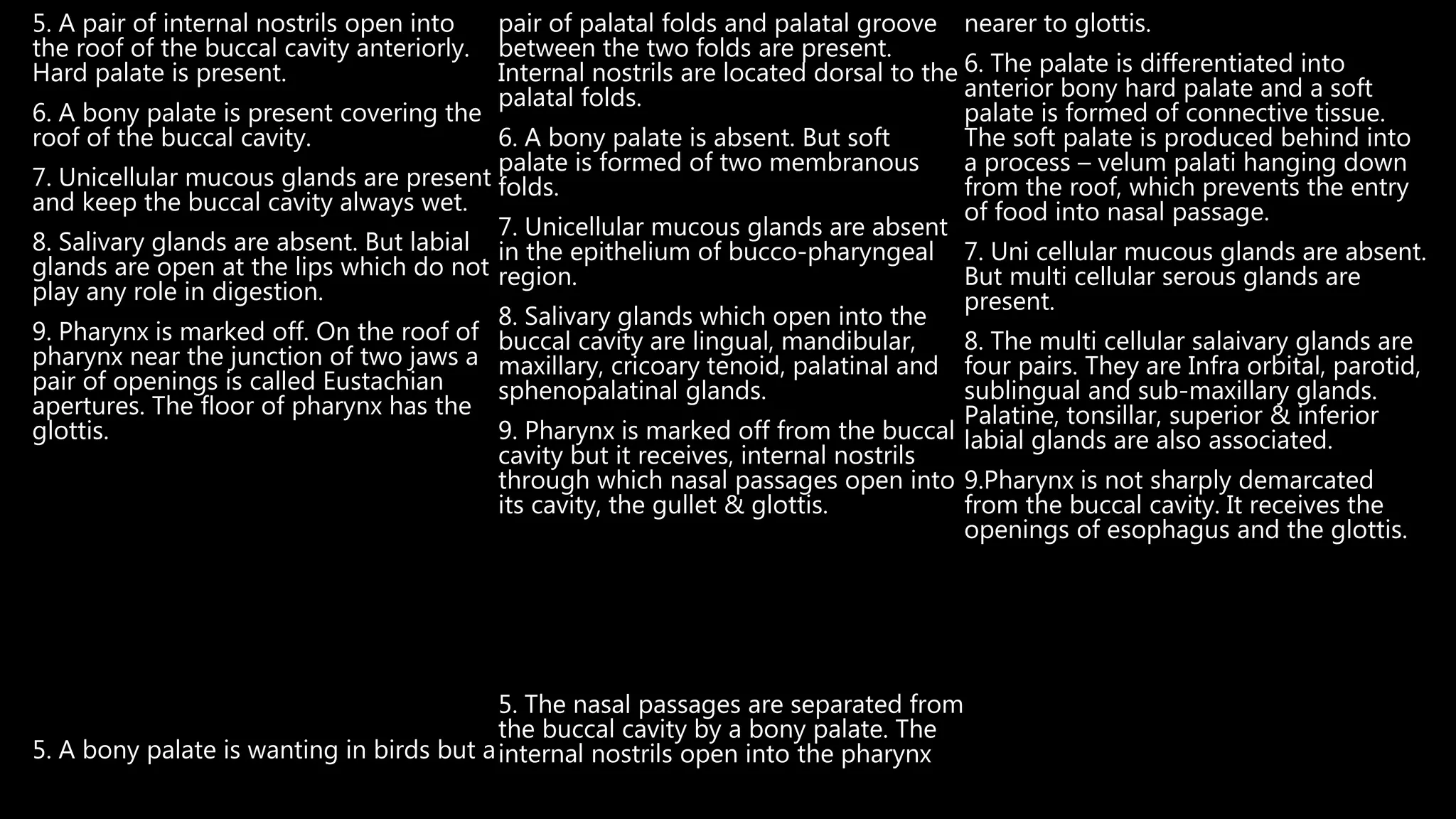
5. A pair of internal nostrils open into
the roof of the buccal cavity anteriorly.
Hard palate is present.
6. A bony palate is present covering the
roof of the buccal cavity.
7. Unicellular mucous glands are present
and keep the buccal cavity always wet.
8. Salivary glands are absent. But labial
glands are open at the lips which do not
play any role in digestion.
9. Pharynx is marked off. On the roof of
pharynx near the junction of two jaws a
pair of openings is called Eustachian
apertures. The floor of pharynx has the
glottis.
5. A bony palate is wanting in birds but a
pair of palatal folds and palatal groove
between the two folds are present.
Internal nostrils are located dorsal to the
palatal folds.
6. A bony palate is absent. But soft
palate is formed of two membranous
folds.
7. Unicellular mucous glands are absent
in the epithelium of bucco-pharyngeal
region.
8. Salivary glands which open into the
buccal cavity are lingual, mandibular,
maxillary, cricoary tenoid, palatinal and
sphenopalatinal glands.
9. Pharynx is marked off from the buccal
cavity but it receives, internal nostrils
through which nasal passages open into
its cavity, the gullet & glottis.
5. The nasal passages are separated from
the buccal cavity by a bony palate. The
internal nostrils open into the pharynx
nearer to glottis.
6. The palate is differentiated into
anterior bony hard palate and a soft
palate is formed of connective tissue.
The soft palate is produced behind into
a process – velum palati hanging down
from the roof, which prevents the entry
of food into nasal passage.
7. Uni cellular mucous glands are absent.
But multi cellular serous glands are
present.
8. The multi cellular salaivary glands are
four pairs. They are Infra orbital, parotid,
sublingual and sub-maxillary glands.
Palatine, tonsillar, superior & inferior
labial glands are also associated.
9.Pharynx is not sharply demarcated
from the buccal cavity. It receives the
openings of esophagus and the glottis.

Digestive system of reptiles, birds and mammals

  • 1.
  • 2.
    IN THIS PRESENTATION, WE WILLDISCUSS ABOUT THE DIGESTIVE SYSTEM OF BIRDS Eg:Pegion (Columba) MAMMALS Eg:Rabbit (Oryctolagus) REPTILES Eg: Lizard (Calotes)
  • 3.
  • 4.
    Reptiles are tetrapod(four-limbed vertebrate) animals in the class Reptilia, comprising today's turtles, crocodilians, snakes, amphisbaenians, lizards, tuatara, and their extinct relatives. The study of these traditional reptile orders, historically combined with that of modern amphibians, is called herpetology. Mouth & oral cavity- tetrapods such as reptiles, typically have longer oral cavities. Teeth- reptiles still have teeth on the vomer, palatine, & pterygoid bones. Tongue- primary tongue + glandular field (or tuberculum impar) + lateral lingual swellings (more hypobranchial muscle). Tongue mobility- sometimes long and may move in and out of the oral cavity. Oral glands- some reptiles secrete poison. (E.g. Snake) Pharynx- is the part of the foregut preceeding the esophagus & includes: - glottis (slit leading into the larynx) -openings of auditory (eustachian) tubes - opening into esophagus Stomach- increasing specialization (more differentiated from the esophagus) Intestine- coiled small intestines & a relatively short large intestine (that empties into the cloaca) Cloaca- chamber at end of digestive tract that receives the intestine, & urinary & genital ducts, ducts, & opens to the exterior via the vent
  • 5.
    A.Digestive system ofCalotes B.A tooth C.Showing structural relationship of liver and pancreas with duodenum. Digestive system of Snake
  • 6.
  • 7.
  • 8.
    Birds has fasterand more efficient digestive system than those of other vertebrate groups. Their beaks or bills replace the lips and mouth of mammals and vary in shape. Their tongue do helps manipulate food for swallowing. Food passes through esophagus on its way to stomach. Birds have a two part stomach, granular portion known as Proventriculus and the muscular portions known as Gizzard.
  • 9.
  • 10.
    The mammalian digestivesystem consists of the alimentary canal (complete digestive tract) and various accessory glands that secret digestive juices into the canal through the ducts. The food is moved along the tract by the contraction of smooth muscles in the walls of the canal. These rhythmic contraction waves are called peristalsis. The regulation of passage of material from one chamber to another within the canal is controlled by ring-like valves called sphincters. The accessory glands of the mammalian digestive tract are three pairs of salivary glands, the pancreas, the liver, and its storage organ the gall bladder.
  • 11.
    Mouth: Foodstuffs arebroken down mechanically by chewing and saliva is added as a lubricant. Pharynx - Out throat is the pharynx which leads to both the esophagus and the windpipe ( trachea). When a human swallows the top of the windpipe moves up so that its opening, the glottis, is blocked by a flap of cartilage called the epiglottis. This helps to ensure that the bolus enters the esophagus. Esophagus: A simple conduit between the mouth and stomach - important but only marginally interesting. Stomach: Where the real action begins - chemical digestion of proteins initiated and foodstuffs reduced to liquid form.
  • 12.
    Liver: The centerof metabolic activity in the body - its major role in the digestive process is to provide bile salts to the small intestine, which are critical for digestion and absorption of fats. Pancreas: Important roles as both an endocrine and exocrine organ - provides a potent mixture of digestive enzymes to the small intestine which are critical for digestion of fats, carbohydrates and protein. Small Intestine: The most exciting place to be in the entire digestive system - this is where the final stages of chemical digestion occur and where almost all nutrients are absorbed. Large Intestine: Major differences among species in extent and importance - in all animals water is absorbed, bacterial fermentation takes place and feces are formed. In carnivores, that's about the extent of it, but in herbivores like the horse, the large intestine is huge and of critical importance for utilization of cellulose.
  • 13.
    DIGESTIVE SYSTEM OFREPTILE-BIRD- MAMMAL- SIMILARITIES AND DIFFERENCES-COMPARITIVE Calotes (Lizard) 1. Mouth is a wide, slit present at the anterior end of head. 2.Buccal cavity is a narrow gap. Labial glands are present on lips.They secrete mucous. 3. On both jaws teet are present, polyphyodont homodont teeth arranged in a single row on each jaw. Teeth are not useful for mastication.Pleurodont dentition is present. 4. Tongue is attached posteriorly to the floor of buccal cavity and is free anteriorly. Sensory papillae are present. Columba (Pigeon) 1. Mouth is terminal, slitlike aperture bounded by horny Jaws. 2. Buccal cavity is narrow and some what and dorsoventrally flattened 3. Jaws are modified into tooth less beak. 4. Tongue is narrow triangular and fleshy. Its surface is covered with horny material and bears thorn-like projections which carry taste buds and mucous glands. Oryctoiagus (Rabbit) 1. Mouth is sub-terminal, cleft bounded bv mobile, fleshy lips. 2. Buccal cavity is a spacious chamber andits space between lips and the teeth is called vestibule. This receives the mouth opening. 3. dentition in mammals:Teeth are diphyodont, heterodont and thecodont. These are arranged in a single row on each Jaw.Teeth are modified cutting (Incissors) and chewing (Premolars & molars) canines are absent in rabbit. 4. Tongue is highly specialized, fleshy and muscular and can be moved in different directions. It can be protruded out. Its surface is rugose being covered with numerous papillae along with taste buds.
  • 14.
    5. A pairof internal nostrils open into the roof of the buccal cavity anteriorly. Hard palate is present. 6. A bony palate is present covering the roof of the buccal cavity. 7. Unicellular mucous glands are present and keep the buccal cavity always wet. 8. Salivary glands are absent. But labial glands are open at the lips which do not play any role in digestion. 9. Pharynx is marked off. On the roof of pharynx near the junction of two jaws a pair of openings is called Eustachian apertures. The floor of pharynx has the glottis. 5. A bony palate is wanting in birds but a pair of palatal folds and palatal groove between the two folds are present. Internal nostrils are located dorsal to the palatal folds. 6. A bony palate is absent. But soft palate is formed of two membranous folds. 7. Unicellular mucous glands are absent in the epithelium of bucco-pharyngeal region. 8. Salivary glands which open into the buccal cavity are lingual, mandibular, maxillary, cricoary tenoid, palatinal and sphenopalatinal glands. 9. Pharynx is marked off from the buccal cavity but it receives, internal nostrils through which nasal passages open into its cavity, the gullet & glottis. 5. The nasal passages are separated from the buccal cavity by a bony palate. The internal nostrils open into the pharynx nearer to glottis. 6. The palate is differentiated into anterior bony hard palate and a soft palate is formed of connective tissue. The soft palate is produced behind into a process – velum palati hanging down from the roof, which prevents the entry of food into nasal passage. 7. Uni cellular mucous glands are absent. But multi cellular serous glands are present. 8. The multi cellular salaivary glands are four pairs. They are Infra orbital, parotid, sublingual and sub-maxillary glands. Palatine, tonsillar, superior & inferior labial glands are also associated. 9.Pharynx is not sharply demarcated from the buccal cavity. It receives the openings of esophagus and the glottis.