PROTEIN BIOSYNTHESIS
AND INHIBITION
Dr Rina Das Mehta
Professor
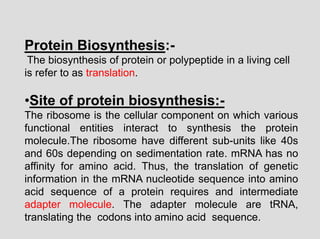
Protein Biosynthesis:-
The biosynthesis of protein or polypeptide in a living cell
is refer to as translation.
•Site of protein biosynthesis:-
The ribosome is the cellular component on which various
functional entities interact to synthesis the protein
molecule.The ribosome have different sub-units like 40s
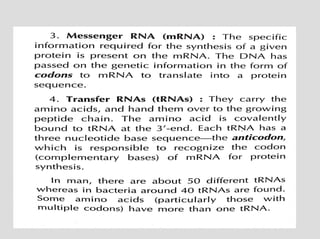
and 60s depending on sedimentation rate. mRNA has no
affinity for amino acid. Thus, the translation of genetic
information in the mRNA nucleotide sequence into amino
acid sequence of a protein requires and intermediate
adapter molecule. The adapter molecule are tRNA,
translating the codons into amino acid sequence.
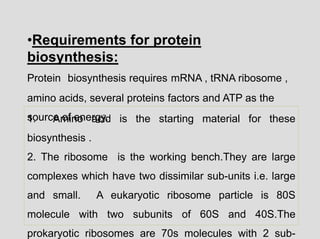
1. Amino acid is the starting material for these
biosynthesis .
2. The ribosome is the working bench.They are large
complexes which have two dissimilar sub-units i.e. large
and small. A eukaryotic ribosome particle is 80S
molecule with two subunits of 60S and 40S.The
prokaryotic ribosomes are 70s molecules with 2 sub-
•Requirements for protein
biosynthesis:
Protein biosynthesis requires mRNA , tRNA ribosome ,
amino acids, several proteins factors and ATP as the
source of energy.
THE STEPS INVOLVED IN PROTEIN
SYNTHESIS ARE :-
1. Activation of amino acid
2. Protein synthesis proper
ACTIVATION OF AMINO ACID
 Amino acid activation (also known as
aminoacylation or tRNA charging) refers to the
attachment of an amino acid to its Transfer RNA
(tRNA).
 Aminoacyl transferase binds Adenosine
triphosphate (ATP) to amino acid, PP is released.
 Aminoacyl tRNA synthetase binds AMP-amino acid
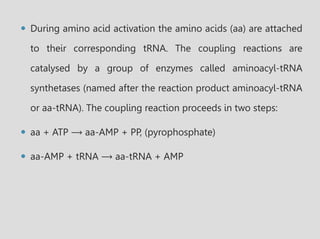
 During amino acid activation the amino acids (aa) are attached
to their corresponding tRNA. The coupling reactions are
catalysed by a group of enzymes called aminoacyl-tRNA
synthetases (named after the reaction product aminoacyl-tRNA
or aa-tRNA). The coupling reaction proceeds in two steps:
 aa + ATP ⟶ aa-AMP + PP, (pyrophosphate)
 aa-AMP + tRNA ⟶ aa-tRNA + AMP
PROTEIN SYNTHESIS PROPER
• The protein or polypeptide synthesis occurs on the
ribosomes (rather polyribosomes). The mRNA is read
in the direction and the polypeptide synthesis
proceeds from N-terminal end to C-terminal end.
Translation proper is divided into three stages:-
• Initiation
• Elongation
• Termination
INITIATION OF TRANSLATION
• The initiation of translation in eukaryotes is complex,
involving at least ten eukaryotic initiation factors
(elFs). Some of the elFs contain multiple (3-8)
subunits. The process of translation initiation can be
divided into four steps:
1. Ribosomal dissociation.
2. Formation of 43S pre-initiation complex.
3. Formation of 48S initiation complex.
4. Formation of 80S initiation complex.
Ribosomal dissociation:
The 80S ribosome dissociates to form 40S and 60S
subunits. Two initiating factors namely elF-3 and
elF-1A bind to the newly formed 40S subunit, and
thereby block its re-association with 60S subunit.
For this reason, some workers name elF-3 as anti-
association factor.
Formation of 43S pre-initiation complex:
A ternary complex containing met-tRNA’ and elF-2
bound to GTP attaches to 40S ribosomal subunit
to form 43S pre-initiation complex. The presence
of elF-3 and elF-1 A stabilizes this complex (Note;
Met-tRNA is specifically involved in binding to the
initiation condon AUGs; hence the superscrip’ is
used in met-tRNA’).
Formation of 48S initiation complex:
The binding of mRNA to 43S pre-initiation
complex results in the formation of 48S initiation
complex through the intermediate 43S initiation
complex. This, however, involves certain
interactions between some of the elFs and
activation of mRNA.
Formation of 80S initiation complex:
48S initiation complex binds to 60S ribosomal subunit to
form 80S initiation complex. The binding involves the
hydrolysis of GTP (bound to elF-2). This step is
facilitated by the involvement of elF-5. As the 80S
complex is formed, the initiation factors bound to 48S
initiation complex are released, and recycled. The
activation of elF-2 requires elF-2B (also called as
guanine nucleotide exchange factor) and GTP. The
activated elF-2 (i.e. bound to GTP) requires elF-2C to
form the ternary complex.
ELONGATION OF TRANSLATION
Ribosomes elongate the polypeptide chain by a
sequential addition of amino acids. The amino acid
sequence is determined by the order of the codons in
the specific mRNA. Elongation, a cyclic process involving
certain elongation factors (EFs), may be divided into
three steps:-
1. Binding of aminoacyl t-RNA to A-site.
2. Peptide bond formation.
3. Translocation.
Binding of aminoacyl—tRNA to A-site:
The 80S initiation complex contains met-tRNA1 in the P-site,
and the A-site is free. Another aminoacyl-tRNA is placed in
the A-site. This requires proper codon recognition on the
mRNA and the involvement of elongation factor 1a (EF-la)
and supply of energy by GTP. As the aminoacyl-tRNA is
placed in the A-site, EF-1a and GDP are recycled to bring
another aminoacyl- tRNA.
Peptide bond formation:
The enzyme peptidyltransferase catalyses the formation of
peptide bond (Fig). The activity of this enzyme lies on 28S
RNA of 60S ribosomal subunit. It is therefore the rRNA (and
not protein) referred to as ribozyme that catalyses the
peptide bond formation. As the amino acid in the aminoacyl-
tRNA is already activated, no additional energy is required
for peptide bond formation.
Translocation:
As the peptide bond formation occurs, the ribosome moves
to the next codon of the mRNA (towards 3′-end). This
process called translocation, basically involves the
movement of growing peptide chain from A-site to P-site.
Translocation requires EF-2 and GTP. GTP gets hydrolysed
and supplies energy to move mRNA. EF-2 and GTP complex
recycles for translocation.
TERMINATION OF TRANSLATION:
• Termination is a simple process when compared to
initiation and elongation. After several cycles of
elongation, incorporating amino acids and the
formation of the specific protein/polypeptide
molecule, one of the stop or termination signals
(UAA, UAG and UCA) terminates the growing
polypeptide.
INHIBITORS OF PROTEIN
SYNTHESIS:
 Translation is a complex process and it has become a
favorite target for inhibition by antibiotics. Antibiotics are
the substances produced by bacteria or fungi which inhibit
the growth of other organisms. Majority of the antibiotics
interfere with the bacterial protein synthesis and are
harmless to higher organisms. This is due to the fact that the
process of translation sufficiently differs between
prokaryotes and eukaryotes. The action of a few important
antibiotics on translation is described here.
Streptomycin:
Initiation of protein synthesis is inhibited by streptomycin. It causes
misreading of mRNA and interferes with the normal pairing between
codons and anticodons.
Tetracycline:
It inhibits the binding of aminoacyl tRNA to the ribosomal complex. In
fact, tetracycline can also block eukaryotic protein synthesis. This,
however, does not happen since eukaryotic cell membrane is not
permeable to this drug.
Puromycin:
This has a structural resemblance to aminoacyl tRNA. Puromycin
enters the A site and gets incorporated into the growing peptide chain
and causes its release. This antibiotic prevents protein synthesis in
both prokaryotes and eukaryotes.
Chloramphenicol:
It acts as a competitive inhibitor of the enzyme peptidyltransferase
and thus interferes with elongation of peptide chain.
Erythromycin:
It inhibits translocation by binding with 50S subunit of
bacterial ribosome.
Diphtheria toxin:
It prevents translocation in eukaryotic protein synthesis by
inactivating elongation factor eEF2.

protein synthesis biochem.ppt

  • 1.
  • 2.
    Protein Biosynthesis:- The biosynthesisof protein or polypeptide in a living cell is refer to as translation. •Site of protein biosynthesis:- The ribosome is the cellular component on which various functional entities interact to synthesis the protein molecule.The ribosome have different sub-units like 40s and 60s depending on sedimentation rate. mRNA has no affinity for amino acid. Thus, the translation of genetic information in the mRNA nucleotide sequence into amino acid sequence of a protein requires and intermediate adapter molecule. The adapter molecule are tRNA, translating the codons into amino acid sequence.
  • 3.
    1. Amino acidis the starting material for these biosynthesis . 2. The ribosome is the working bench.They are large complexes which have two dissimilar sub-units i.e. large and small. A eukaryotic ribosome particle is 80S molecule with two subunits of 60S and 40S.The prokaryotic ribosomes are 70s molecules with 2 sub- •Requirements for protein biosynthesis: Protein biosynthesis requires mRNA , tRNA ribosome , amino acids, several proteins factors and ATP as the source of energy.
  • 6.
    THE STEPS INVOLVEDIN PROTEIN SYNTHESIS ARE :- 1. Activation of amino acid 2. Protein synthesis proper
  • 7.
    ACTIVATION OF AMINOACID  Amino acid activation (also known as aminoacylation or tRNA charging) refers to the attachment of an amino acid to its Transfer RNA (tRNA).  Aminoacyl transferase binds Adenosine triphosphate (ATP) to amino acid, PP is released.  Aminoacyl tRNA synthetase binds AMP-amino acid
  • 8.
     During aminoacid activation the amino acids (aa) are attached to their corresponding tRNA. The coupling reactions are catalysed by a group of enzymes called aminoacyl-tRNA synthetases (named after the reaction product aminoacyl-tRNA or aa-tRNA). The coupling reaction proceeds in two steps:  aa + ATP ⟶ aa-AMP + PP, (pyrophosphate)  aa-AMP + tRNA ⟶ aa-tRNA + AMP
  • 9.
    PROTEIN SYNTHESIS PROPER •The protein or polypeptide synthesis occurs on the ribosomes (rather polyribosomes). The mRNA is read in the direction and the polypeptide synthesis proceeds from N-terminal end to C-terminal end. Translation proper is divided into three stages:- • Initiation • Elongation • Termination
  • 10.
    INITIATION OF TRANSLATION •The initiation of translation in eukaryotes is complex, involving at least ten eukaryotic initiation factors (elFs). Some of the elFs contain multiple (3-8) subunits. The process of translation initiation can be divided into four steps: 1. Ribosomal dissociation. 2. Formation of 43S pre-initiation complex. 3. Formation of 48S initiation complex. 4. Formation of 80S initiation complex.
  • 11.
    Ribosomal dissociation: The 80Sribosome dissociates to form 40S and 60S subunits. Two initiating factors namely elF-3 and elF-1A bind to the newly formed 40S subunit, and thereby block its re-association with 60S subunit. For this reason, some workers name elF-3 as anti- association factor.
  • 12.
    Formation of 43Spre-initiation complex: A ternary complex containing met-tRNA’ and elF-2 bound to GTP attaches to 40S ribosomal subunit to form 43S pre-initiation complex. The presence of elF-3 and elF-1 A stabilizes this complex (Note; Met-tRNA is specifically involved in binding to the initiation condon AUGs; hence the superscrip’ is used in met-tRNA’).
  • 13.
    Formation of 48Sinitiation complex: The binding of mRNA to 43S pre-initiation complex results in the formation of 48S initiation complex through the intermediate 43S initiation complex. This, however, involves certain interactions between some of the elFs and activation of mRNA.
  • 14.
    Formation of 80Sinitiation complex: 48S initiation complex binds to 60S ribosomal subunit to form 80S initiation complex. The binding involves the hydrolysis of GTP (bound to elF-2). This step is facilitated by the involvement of elF-5. As the 80S complex is formed, the initiation factors bound to 48S initiation complex are released, and recycled. The activation of elF-2 requires elF-2B (also called as guanine nucleotide exchange factor) and GTP. The activated elF-2 (i.e. bound to GTP) requires elF-2C to form the ternary complex.
  • 15.
    ELONGATION OF TRANSLATION Ribosomeselongate the polypeptide chain by a sequential addition of amino acids. The amino acid sequence is determined by the order of the codons in the specific mRNA. Elongation, a cyclic process involving certain elongation factors (EFs), may be divided into three steps:- 1. Binding of aminoacyl t-RNA to A-site. 2. Peptide bond formation. 3. Translocation.
  • 16.
    Binding of aminoacyl—tRNAto A-site: The 80S initiation complex contains met-tRNA1 in the P-site, and the A-site is free. Another aminoacyl-tRNA is placed in the A-site. This requires proper codon recognition on the mRNA and the involvement of elongation factor 1a (EF-la) and supply of energy by GTP. As the aminoacyl-tRNA is placed in the A-site, EF-1a and GDP are recycled to bring another aminoacyl- tRNA. Peptide bond formation: The enzyme peptidyltransferase catalyses the formation of peptide bond (Fig). The activity of this enzyme lies on 28S RNA of 60S ribosomal subunit. It is therefore the rRNA (and not protein) referred to as ribozyme that catalyses the peptide bond formation. As the amino acid in the aminoacyl- tRNA is already activated, no additional energy is required for peptide bond formation.
  • 17.
    Translocation: As the peptidebond formation occurs, the ribosome moves to the next codon of the mRNA (towards 3′-end). This process called translocation, basically involves the movement of growing peptide chain from A-site to P-site. Translocation requires EF-2 and GTP. GTP gets hydrolysed and supplies energy to move mRNA. EF-2 and GTP complex recycles for translocation.
  • 18.
    TERMINATION OF TRANSLATION: •Termination is a simple process when compared to initiation and elongation. After several cycles of elongation, incorporating amino acids and the formation of the specific protein/polypeptide molecule, one of the stop or termination signals (UAA, UAG and UCA) terminates the growing polypeptide.
  • 19.
    INHIBITORS OF PROTEIN SYNTHESIS: Translation is a complex process and it has become a favorite target for inhibition by antibiotics. Antibiotics are the substances produced by bacteria or fungi which inhibit the growth of other organisms. Majority of the antibiotics interfere with the bacterial protein synthesis and are harmless to higher organisms. This is due to the fact that the process of translation sufficiently differs between prokaryotes and eukaryotes. The action of a few important antibiotics on translation is described here.
  • 20.
    Streptomycin: Initiation of proteinsynthesis is inhibited by streptomycin. It causes misreading of mRNA and interferes with the normal pairing between codons and anticodons. Tetracycline: It inhibits the binding of aminoacyl tRNA to the ribosomal complex. In fact, tetracycline can also block eukaryotic protein synthesis. This, however, does not happen since eukaryotic cell membrane is not permeable to this drug. Puromycin: This has a structural resemblance to aminoacyl tRNA. Puromycin enters the A site and gets incorporated into the growing peptide chain and causes its release. This antibiotic prevents protein synthesis in both prokaryotes and eukaryotes. Chloramphenicol: It acts as a competitive inhibitor of the enzyme peptidyltransferase and thus interferes with elongation of peptide chain.
  • 21.
    Erythromycin: It inhibits translocationby binding with 50S subunit of bacterial ribosome. Diphtheria toxin: It prevents translocation in eukaryotic protein synthesis by inactivating elongation factor eEF2.