ENERGY CONSERVATION


PRESENTED BY:
RICHA CHAUDHARY
AGENDA

 WHAT IS ENERGY?
 TYPES OF ENERGY
 WHY TO CONSERVE?
 WHAT CAN WE DO?
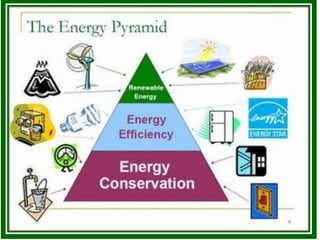
 ENERGY CONSERVATION
IN INDIA
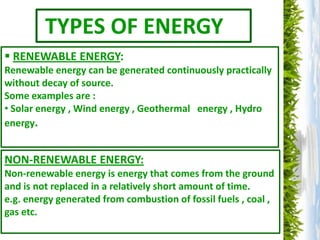
TYPES OF ENERGY
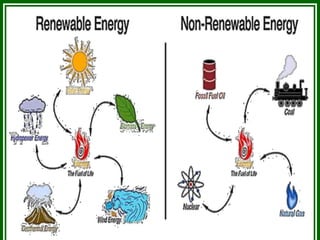
 RENEWABLE ENERGY:
Renewable energy can be generated continuously practically
without decay of source.
Some examples are :
• Solar energy , Wind energy , Geothermal energy , Hydro
energy.


NON-RENEWABLE ENERGY:
Non-renewable energy is energy that comes from the ground
and is not replaced in a relatively short amount of time.
e.g. energy generated from combustion of fossil fuels , coal ,
gas etc.
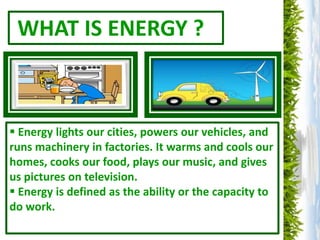
WHAT IS ENERGY ?


 Energy lights our cities, powers our vehicles, and
runs machinery in factories. It warms and cools our
homes, cooks our food, plays our music, and gives
us pictures on television.
 Energy is defined as the ability or the capacity to
do work.
WHY TO CONSERVE IT ?


We have limited resources available on earth.
 Our demands are continuously increasing day
by day.
 It is possible that someday most of the non-
renewable resources will be exhausted and we
will have to switch over to alternate energy
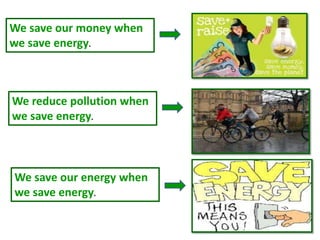
We save our money when
we save energy.


We reduce pollution when
we save energy.


We save our energy when
we save energy.
WHAT WE CAN DO ?

 RECYCLE - compositing waste materials into new
products to prevent waste of potentially useful
materials.
 Turn off all electronic devices that are not in use. Not
only turn them off but try to remember to unplug
them. You will be surprised how much you will save
with this simple step!
 Replace old light bulbs with energy saving fluorescent
bulbs. They may cost more, but will save you much
more in the long run.
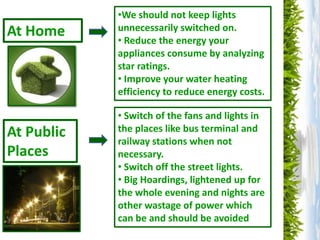
•We should not keep lights
At Home     unnecessarily switched on.
            • Reduce the energy your
            appliances consume by analyzing
            star ratings.
            • Improve your water heating
            efficiency to reduce energy costs.

            • Switch of the fans and lights in
At Public   the places like bus terminal and
            railway stations when not
Places      necessary.
            • Switch off the street lights.
            • Big Hoardings, lightened up for
            the whole evening and nights are
            other wastage of power which
            can be and should be avoided
HOW WILL IT HELP ?


 Let’s Take an simple example :
• let us assume electricity is available for Rs.4.00 per unit , a
100 watt bulb is used for 8 hrs a day then:
•If we replace a 100 watt bulb with 22 watt CFL ,
• The annual saving would be…
• Power saved : 100W– W = 78W
ENERGY CONSERVATION
         IN INDIA
 About 70% of India's energy generation capacity is from fossil
fuels, with coal accounting for 40% of India's total energy
consumption followed by crude oil and natural gas at 24% and
6% respectively. India is largely dependent on fossil fuel
imports to meet its energy demands.
 By 2030, India's dependence on energy imports is expected
to exceed 53% of the country's total energy consumption. In
2009-10, the country imported 159.26 million tonnes of crude
oil which amount to 80% of its domestic crude oil consumption
and 31% of the country's total imports are oil imports. The
growth of electricity generation in India has been hindered by
domestic coal shortages[ and as a consequence, India's coal
imports for electricity generation increased by 18% in 2010
THANK YOU!

Energy conservation ppt

  • 1.
  • 2.
    AGENDA  WHAT ISENERGY?  TYPES OF ENERGY  WHY TO CONSERVE?  WHAT CAN WE DO?  ENERGY CONSERVATION IN INDIA
  • 3.
    TYPES OF ENERGY RENEWABLE ENERGY: Renewable energy can be generated continuously practically without decay of source. Some examples are : • Solar energy , Wind energy , Geothermal energy , Hydro energy. NON-RENEWABLE ENERGY: Non-renewable energy is energy that comes from the ground and is not replaced in a relatively short amount of time. e.g. energy generated from combustion of fossil fuels , coal , gas etc.
  • 4.
    WHAT IS ENERGY?  Energy lights our cities, powers our vehicles, and runs machinery in factories. It warms and cools our homes, cooks our food, plays our music, and gives us pictures on television.  Energy is defined as the ability or the capacity to do work.
  • 6.
    WHY TO CONSERVEIT ? We have limited resources available on earth.  Our demands are continuously increasing day by day.  It is possible that someday most of the non- renewable resources will be exhausted and we will have to switch over to alternate energy
  • 7.
    We save ourmoney when we save energy. We reduce pollution when we save energy. We save our energy when we save energy.
  • 8.
    WHAT WE CANDO ?  RECYCLE - compositing waste materials into new products to prevent waste of potentially useful materials.  Turn off all electronic devices that are not in use. Not only turn them off but try to remember to unplug them. You will be surprised how much you will save with this simple step!  Replace old light bulbs with energy saving fluorescent bulbs. They may cost more, but will save you much more in the long run.
  • 10.
    •We should notkeep lights At Home unnecessarily switched on. • Reduce the energy your appliances consume by analyzing star ratings. • Improve your water heating efficiency to reduce energy costs. • Switch of the fans and lights in At Public the places like bus terminal and railway stations when not Places necessary. • Switch off the street lights. • Big Hoardings, lightened up for the whole evening and nights are other wastage of power which can be and should be avoided
  • 11.
    HOW WILL ITHELP ?  Let’s Take an simple example : • let us assume electricity is available for Rs.4.00 per unit , a 100 watt bulb is used for 8 hrs a day then: •If we replace a 100 watt bulb with 22 watt CFL , • The annual saving would be… • Power saved : 100W– W = 78W
  • 12.
    ENERGY CONSERVATION IN INDIA  About 70% of India's energy generation capacity is from fossil fuels, with coal accounting for 40% of India's total energy consumption followed by crude oil and natural gas at 24% and 6% respectively. India is largely dependent on fossil fuel imports to meet its energy demands.  By 2030, India's dependence on energy imports is expected to exceed 53% of the country's total energy consumption. In 2009-10, the country imported 159.26 million tonnes of crude oil which amount to 80% of its domestic crude oil consumption and 31% of the country's total imports are oil imports. The growth of electricity generation in India has been hindered by domestic coal shortages[ and as a consequence, India's coal imports for electricity generation increased by 18% in 2010
  • 13.