PERSPECTIVE ANALYTICS AND
FORECASTING TECHNIQUES FOR
MANPOWER PLANNING IN A
CONSTRUCTION COMPANY
Presentation by:
HUSAIN BADSHAH M060
VIBHOR BANSAL M061
REVATI BARGALE M062
KARAN BATAVIA M063
PIYUSH BHATIA M064
•
PRESCRIPTIVE ANALYTICS
I. What is it?
II. Why is it important?
III. How is it done?
What is it?
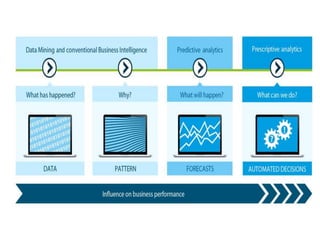
• Optimizes decision-making
• Different types of analytics, however, provide
different types of insights.
Analytics include:
1. Business intelligence
2. Predictive analytics
3. Prescriptive analytics
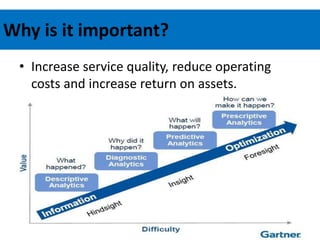
Why is it important?
• Increase service quality, reduce operating
costs and increase return on assets.
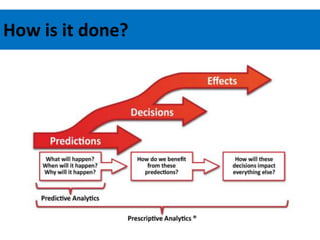
How is it done?
CASE STUDY
• The Kheri Construction Company uses
prescriptive analysis to solve the issue of high
staff turnover.
MANPOWER PLANNING
• Manpower planning is a very important part
of the overall planning of a business
organization. It is obvious that a business
cannot prosper unless the right number of
employees, having required skills, talents &
qualifications is available at right time.
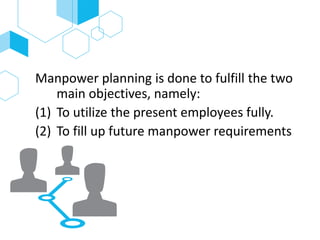
Manpower planning is done to fulfill the two
main objectives, namely:
(1) To utilize the present employees fully.
(2) To fill up future manpower requirements
TYPES OF MANPOWER PLANNING
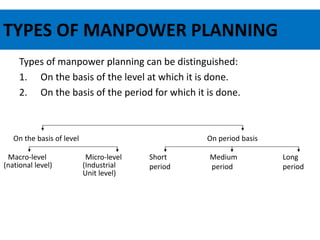
Types of manpower planning can be distinguished:
1. On the basis of the level at which it is done.
2. On the basis of the period for which it is done.
On the basis of level On period basis
Macro-level
(national level)
Micro-level
(Industrial
Unit level)
Short
period
Medium
period
Long
period
AIMS OF MANPOWER PLANNING
AND FORECASTING
• Walker (1968) points out that the aim of
manpower planning is ‘…forecasting and
planning for the right numbers and the right
kinds of people at the right places and the
right times to perform activities that will
benefit both the organisation and the
individual in it’.
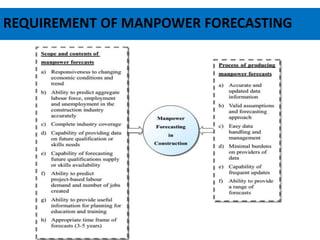
REQUIREMENT OF MANPOWER FORECASTING
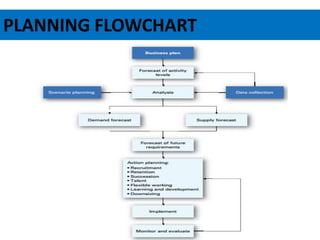
PLANNING FLOWCHART
Forecasting
• Step 1: Determine forecasting period.
• Step 2:Determine critical factors to be
forecasted.
• Step 3: Select Forecasting methods.
• Step 4: Gather information about the predicted
environment.
• Step 5: Complete Performance analysis.
• Step 6: Validate or develop a new mission.
FORECASTING TECHNIQUES
1. Managerial judgement
2. Scatter plot
3. HR budget and planning analysis
4. Scenario forecasting
5. Regression analysis
6. Nominal group technique
7. Job analysis

Manpower planning for a construction company

  • 1.
    PERSPECTIVE ANALYTICS AND FORECASTINGTECHNIQUES FOR MANPOWER PLANNING IN A CONSTRUCTION COMPANY Presentation by: HUSAIN BADSHAH M060 VIBHOR BANSAL M061 REVATI BARGALE M062 KARAN BATAVIA M063 PIYUSH BHATIA M064 •
  • 2.
    PRESCRIPTIVE ANALYTICS I. Whatis it? II. Why is it important? III. How is it done?
  • 3.
    What is it? •Optimizes decision-making • Different types of analytics, however, provide different types of insights. Analytics include: 1. Business intelligence 2. Predictive analytics 3. Prescriptive analytics
  • 5.
    Why is itimportant? • Increase service quality, reduce operating costs and increase return on assets.
  • 6.
    How is itdone?
  • 7.
    CASE STUDY • TheKheri Construction Company uses prescriptive analysis to solve the issue of high staff turnover.
  • 8.
    MANPOWER PLANNING • Manpowerplanning is a very important part of the overall planning of a business organization. It is obvious that a business cannot prosper unless the right number of employees, having required skills, talents & qualifications is available at right time.
  • 9.
    Manpower planning isdone to fulfill the two main objectives, namely: (1) To utilize the present employees fully. (2) To fill up future manpower requirements
  • 10.
    TYPES OF MANPOWERPLANNING Types of manpower planning can be distinguished: 1. On the basis of the level at which it is done. 2. On the basis of the period for which it is done. On the basis of level On period basis Macro-level (national level) Micro-level (Industrial Unit level) Short period Medium period Long period
  • 11.
    AIMS OF MANPOWERPLANNING AND FORECASTING • Walker (1968) points out that the aim of manpower planning is ‘…forecasting and planning for the right numbers and the right kinds of people at the right places and the right times to perform activities that will benefit both the organisation and the individual in it’.
  • 12.
  • 13.
  • 14.
    Forecasting • Step 1:Determine forecasting period. • Step 2:Determine critical factors to be forecasted. • Step 3: Select Forecasting methods. • Step 4: Gather information about the predicted environment. • Step 5: Complete Performance analysis. • Step 6: Validate or develop a new mission.
  • 15.
    FORECASTING TECHNIQUES 1. Managerialjudgement 2. Scatter plot 3. HR budget and planning analysis 4. Scenario forecasting 5. Regression analysis 6. Nominal group technique 7. Job analysis