 Introduction
 What is expression ?
 Infix Expression
 Postfix Expression
 Priority table
 Algorithm for conversion
 Reference
• In this presentation we are going to read
about how to convert infix expression to
postfix expression with the help of STACK.
• A Stack is a linear data structure in which
item may be inserted and deleted at one
end called TOP.
• The operational meaning of stack is LIFO
i.e. Last In Fast Out.
• This means the last element is inserted to
the stack is the first element to be
deleted.
An expression is any legal combination of
operators and operands that represents a
value.
Operands are values and Operators are
symbols that represent particular actions.
Ex:-a+b,p*q etc.
• This expression is common expression for
writing arithmetic expression.
• In infix expression the binary operator
symbol is placed between its two operands.
Ex:-A+B,P*Q,(X+Y)/Z
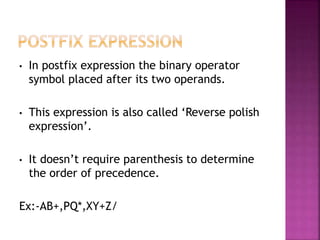
• In postfix expression the binary operator
symbol placed after its two operands.
• This expression is also called ‘Reverse polish
expression’.
• It doesn’t require parenthesis to determine
the order of precedence.
Ex:-AB+,PQ*,XY+Z/
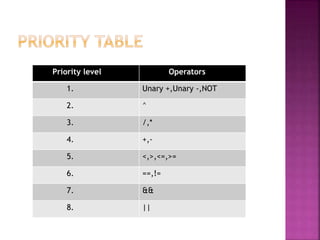
Priority level Operators
1. Unary +,Unary -,NOT
2. ^
3. /,*
4. +,-
5. <,>,<=,>=
6. ==,!=
7. &&
8. ||
POSTFIX(Q,P):Here Q is an infix expression.This
algorithm finds the equivalent postfix expression P.
Step 1:Take an empty stack ‘S’.
Step 2:Push ‘(’ to stack ‘S’ and add ‘)’ to given infix
expression.
Step 3:Scan infix expression for left to right & repeat
step 4-7 for each element of infix expression until
stack is empty
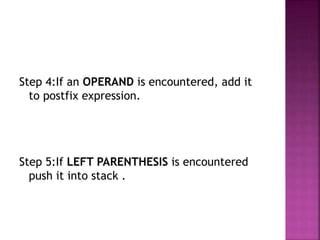
Step 4:If an OPERAND is encountered, add it
to postfix expression.
Step 5:If LEFT PARENTHESIS is encountered
push it into stack .
Step 6:If an OPERATOR is encountered, then
a. Repeatedly POP from stack and add
to postfix expression, each operator which
has same or as higher precedence then the
scanned operator.
b.Push the scanned operator to stack
[End of step 6 if structure]
Step 7:If a RIGHT PARENTHESIS is encountered
then:
a.Repeatedly POP from stack and add to
postfix expression,until a left parethesis is
encountered.
b.Remove the left parethesis from stack.
[End of step 7 if structure]
[End of step 3 loop]
Step 8:Exit
Q:-a+c*(d-e)^(b+c)-f)
Scanned item Stack Postfix expression
(
a ( a
+ (,+ a
c (,+ ac
* (,+,* ac
( (,+,*,( ac
d (,+,*,( acd
- (,+,*,(,- acd
e (,+,*,(,- acde
) (,+,* acde-
^ (,+,*,^ acde-
( (,+,*,^,( acde-
b (,+,*,^,( acde-b
+ (,+,*,^,(,+ acde-b
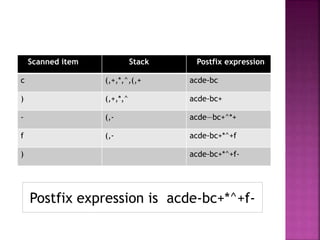
Scanned item Stack Postfix expression
c (,+,*,^,(,+ acde-bc
) (,+,*,^ acde-bc+
- (,- acde—bc+^*+
f (,- acde-bc+*^+f
) acde-bc+*^+f-
Postfix expression is acde-bc+*^+f-
Infix-Postfix expression conversion

Infix-Postfix expression conversion

  • 2.
     Introduction  Whatis expression ?  Infix Expression  Postfix Expression  Priority table  Algorithm for conversion  Reference
  • 3.
    • In thispresentation we are going to read about how to convert infix expression to postfix expression with the help of STACK. • A Stack is a linear data structure in which item may be inserted and deleted at one end called TOP. • The operational meaning of stack is LIFO i.e. Last In Fast Out. • This means the last element is inserted to the stack is the first element to be deleted.
  • 4.
    An expression isany legal combination of operators and operands that represents a value. Operands are values and Operators are symbols that represent particular actions. Ex:-a+b,p*q etc.
  • 5.
    • This expressionis common expression for writing arithmetic expression. • In infix expression the binary operator symbol is placed between its two operands. Ex:-A+B,P*Q,(X+Y)/Z
  • 6.
    • In postfixexpression the binary operator symbol placed after its two operands. • This expression is also called ‘Reverse polish expression’. • It doesn’t require parenthesis to determine the order of precedence. Ex:-AB+,PQ*,XY+Z/
  • 7.
    Priority level Operators 1.Unary +,Unary -,NOT 2. ^ 3. /,* 4. +,- 5. <,>,<=,>= 6. ==,!= 7. && 8. ||
  • 8.
    POSTFIX(Q,P):Here Q isan infix expression.This algorithm finds the equivalent postfix expression P. Step 1:Take an empty stack ‘S’. Step 2:Push ‘(’ to stack ‘S’ and add ‘)’ to given infix expression. Step 3:Scan infix expression for left to right & repeat step 4-7 for each element of infix expression until stack is empty
  • 9.
    Step 4:If anOPERAND is encountered, add it to postfix expression. Step 5:If LEFT PARENTHESIS is encountered push it into stack .
  • 10.
    Step 6:If anOPERATOR is encountered, then a. Repeatedly POP from stack and add to postfix expression, each operator which has same or as higher precedence then the scanned operator. b.Push the scanned operator to stack [End of step 6 if structure]
  • 11.
    Step 7:If aRIGHT PARENTHESIS is encountered then: a.Repeatedly POP from stack and add to postfix expression,until a left parethesis is encountered. b.Remove the left parethesis from stack. [End of step 7 if structure] [End of step 3 loop] Step 8:Exit
  • 12.
    Q:-a+c*(d-e)^(b+c)-f) Scanned item StackPostfix expression ( a ( a + (,+ a c (,+ ac * (,+,* ac ( (,+,*,( ac d (,+,*,( acd - (,+,*,(,- acd e (,+,*,(,- acde ) (,+,* acde- ^ (,+,*,^ acde- ( (,+,*,^,( acde- b (,+,*,^,( acde-b + (,+,*,^,(,+ acde-b
  • 13.
    Scanned item StackPostfix expression c (,+,*,^,(,+ acde-bc ) (,+,*,^ acde-bc+ - (,- acde—bc+^*+ f (,- acde-bc+*^+f ) acde-bc+*^+f- Postfix expression is acde-bc+*^+f-