CASE PRESENTATION
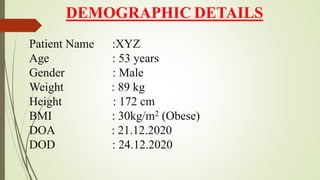
DEMOGRAPHIC DETAILS
Patient Name :XYZ
Age : 53 years
Gender : Male
Weight : 89 kg
Height : 172 cm
BMI : 30kg/m2 (Obese)
DOA : 21.12.2020
DOD : 24.12.2020
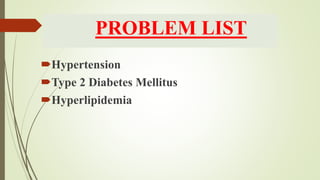
PROBLEM LIST
Hypertension
Type 2 Diabetes Mellitus
Hyperlipidemia
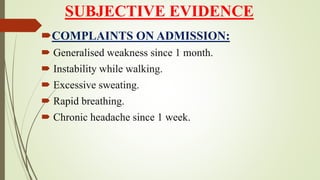
SUBJECTIVE EVIDENCE
COMPLAINTS ON ADMISSION:
 Generalised weakness since 1 month.
 Instability while walking.
 Excessive sweating.
 Rapid breathing.
 Chronic headache since 1 week.
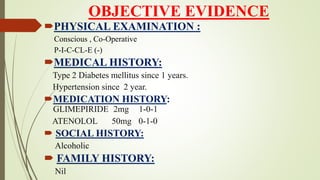
OBJECTIVE EVIDENCE
PHYSICAL EXAMINATION :
Conscious , Co-Operative
P-I-C-CL-E (-)
MEDICAL HISTORY:
Type 2 Diabetes mellitus since 1 years.
Hypertension since 2 year.
MEDICATION HISTORY:
GLIMEPIRIDE 2mg 1-0-1
ATENOLOL 50mg 0-1-0
 SOCIAL HISTORY:
Alcoholic
 FAMILY HISTORY:
Nil
GENERAL EXAMINATION
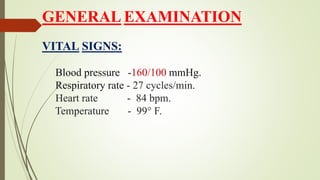
VITAL SIGNS:
Blood pressure -160/100 mmHg.
Respiratory rate - 27 cycles/min.
Heart rate - 84 bpm.
Temperature - 99° F.
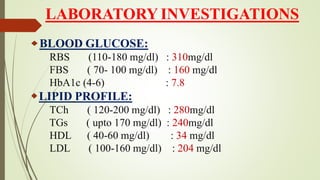
LABORATORY INVESTIGATIONS
BLOOD GLUCOSE:
RBS (110-180 mg/dl) : 310mg/dl
FBS ( 70- 100 mg/dl) : 160 mg/dl
HbA1c (4-6) : 7.8
LIPID PROFILE:
TCh ( 120-200 mg/dl) : 280mg/dl
TGs ( upto 170 mg/dl) : 240mg/dl
HDL ( 40-60 mg/dl) : 34 mg/dl
LDL ( 100-160 mg/dl) : 204 mg/dl
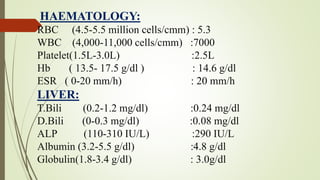
HAEMATOLOGY:
RBC (4.5-5.5 million cells/cmm) : 5.3
WBC (4,000-11,000 cells/cmm) :7000
Platelet(1.5L-3.0L) :2.5L
Hb ( 13.5- 17.5 g/dl ) : 14.6 g/dl
ESR ( 0-20 mm/h) : 20 mm/h
LIVER:
T.Bili (0.2-1.2 mg/dl) :0.24 mg/dl
D.Bili (0-0.3 mg/dl) :0.08 mg/dl
ALP (110-310 IU/L) :290 IU/L
Albumin (3.2-5.5 g/dl) :4.8 g/dl
Globulin(1.8-3.4 g/dl) : 3.0g/dl
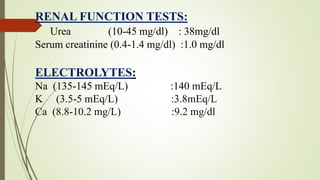
RENAL FUNCTION TESTS:
Urea (10-45 mg/dl) : 38mg/dl
Serum creatinine (0.4-1.4 mg/dl) :1.0 mg/dl
ELECTROLYTES:
Na (135-145 mEq/L) :140 mEq/L
K (3.5-5 mEq/L) :3.8mEq/L
Ca (8.8-10.2 mg/L) :9.2 mg/dl
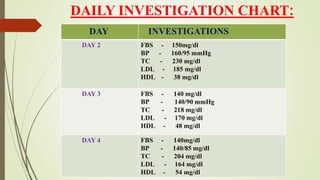
DAILY INVESTIGATION CHART:
DAY INVESTIGATIONS
DAY 2 FBS - 150mg/dl
BP - 160/95 mmHg
TC - 230 mg/dl
LDL - 185 mg/dl
HDL - 38 mg/dl
DAY 3 FBS - 140 mg/dl
BP - 140/90 mmHg
TC - 218 mg/dl
LDL - 170 mg/dl
HDL - 48 mg/dl
DAY 4 FBS - 140mg/dl
BP - 140/85 mg/dl
TC - 204 mg/dl
LDL - 164 mg/dl
HDL - 54 mg/dl
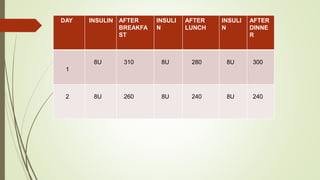
DAY INSULIN AFTER
BREAKFA
ST
INSULI
N
AFTER
LUNCH
INSULI
N
AFTER
DINNE
R
1
8U 310 8U 280 8U 300
2 8U 260 8U 240 8U 240
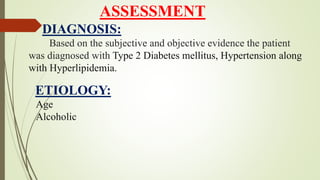
ASSESSMENT
DIAGNOSIS:
Based on the subjective and objective evidence the patient
was diagnosed with Type 2 Diabetes mellitus, Hypertension along
with Hyperlipidemia.
ETIOLOGY:
Age
Alcoholic
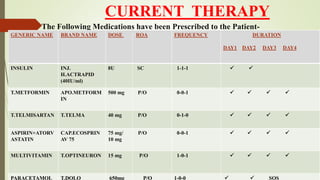
CURRENT THERAPY
The Following Medications have been Prescribed to the Patient-
GENERIC NAME BRAND NAME DOSE ROA FREQUENCY DURATION
DAY1 DAY2 DAY3 DAY4
INSULIN INJ.
H.ACTRAPID
(40IU/ml)
8U SC 1-1-1  
T.METFORMIN APO.METFORM
IN
500 mg P/O 0-0-1    
T.TELMISARTAN T.TELMA 40 mg P/O 0-1-0    
ASPIRIN+ATORV
ASTATIN
CAP.ECOSPRIN
AV 75
75 mg/ P/O
10 mg
0-0-1    
MULTIVITAMIN T.OPTINEURON 15 mg P/O 1-0-1    
PARACETAMOL T.DOLO 650mg P/O 1-0-0   SOS
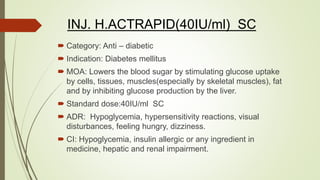
INJ. H.ACTRAPID(40IU/ml) SC
 Category: Anti – diabetic
 Indication: Diabetes mellitus
 MOA: Lowers the blood sugar by stimulating glucose uptake
by cells, tissues, muscles(especially by skeletal muscles), fat
and by inhibiting glucose production by the liver.
 Standard dose:40IU/ml SC
 ADR: Hypoglycemia, hypersensitivity reactions, visual
disturbances, feeling hungry, dizziness.
 CI: Hypoglycemia, insulin allergic or any ingredient in
medicine, hepatic and renal impairment.
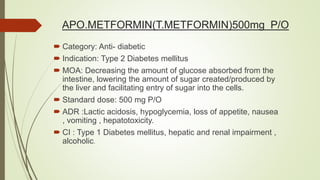
APO.METFORMIN(T.METFORMIN)500mg P/O
 Category: Anti- diabetic
 Indication: Type 2 Diabetes mellitus
 MOA: Decreasing the amount of glucose absorbed from the
intestine, lowering the amount of sugar created/produced by
the liver and facilitating entry of sugar into the cells.
 Standard dose: 500 mg P/O
 ADR :Lactic acidosis, hypoglycemia, loss of appetite, nausea
, vomiting , hepatotoxicity.
 CI : Type 1 Diabetes mellitus, hepatic and renal impairment ,
alcoholic.
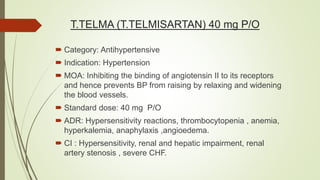
T.TELMA (T.TELMISARTAN) 40 mg P/O
 Category: Antihypertensive
 Indication: Hypertension
 MOA: Inhibiting the binding of angiotensin II to its receptors
and hence prevents BP from raising by relaxing and widening
the blood vessels.
 Standard dose: 40 mg P/O
 ADR: Hypersensitivity reactions, thrombocytopenia , anemia,
hyperkalemia, anaphylaxis ,angioedema.
 CI : Hypersensitivity, renal and hepatic impairment, renal
artery stenosis , severe CHF.
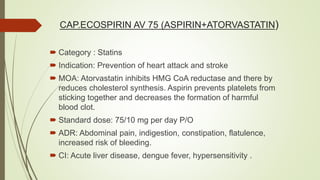
CAP.ECOSPIRIN AV 75 (ASPIRIN+ATORVASTATIN)
 Category : Statins
 Indication: Prevention of heart attack and stroke
 MOA: Atorvastatin inhibits HMG CoA reductase and there by
reduces cholesterol synthesis. Aspirin prevents platelets from
sticking together and decreases the formation of harmful
blood clot.
 Standard dose: 75/10 mg per day P/O
 ADR: Abdominal pain, indigestion, constipation, flatulence,
increased risk of bleeding.
 CI: Acute liver disease, dengue fever, hypersensitivity .
T.OPTINEURON (MULTIVITAMIN) 15mg
P/O
 Category: Multivitamin
 Indication: Vit.B12 deficiency
 MOA :Improve blood circulation and oxygen saturation . It has
good influence on CNS.
 Standard dose : 10-25 mg/day P/O
 ADR:
 CI: Hypersensitivity
T.DOLO (PARACETAMOL)650mg P/O
 Category: Analgesic and antipyretic
 Indication : Head ache ,body pain , common cold
 MOA: Blocking the release of certain chemical messenger
that cause pain and fever.
 Standard dose: 500-1000mg every 4-6hrs P/O
 ADR : Bleeding, breathing problems, itching mouth ulcer, skin
rash.
 CI: Liver damage , allergy to it or its ingredients.
PLAN
SHORT TERM GOALS:
To reduce high blood glucose level, blood pressure and cholesterol level.
To relief symptoms associated like pain, weakness, headache etc.
LONG TERM GOALS:
To control long term Micro and Macro vascular complications of DM
To Prevent the development of cardiovascular diseases.
To improve quality of life.
To reduce the morbidity and mortality.
MONITORING PARAMETERS
 THERAPEUTIC MONITORING :
BP
FBS
RBS
HbA1c
Lipid Profile
Urine Microalbumin to rule out Diabetic Retinopathy
ECG
TOXICITY MONITORING:
Renal function test
Liver Function test
POINTS TO PATIENT
DISEASE:
You have been diagnosed with hyperlipidemia that is increased
level of cholesterol, type 2 diabetes mellitus that is increased blood glucose
level and hypertension that is increased blood pressure. These conditions can
be maintained by following proper medications along with proper dietary
management and lifestyle modification.
DRUGS:
 The prescribed medications should be taken regularly to control the
complications.
 Do not skip any medications.
 In case of missed dose don’t take two drugs at a time as it may lead
to further complications.
 Always keep sugar candy with you, If you feel any Hypoglycemic
symptoms like confusion, dizziness, sweating, Tired then
immediately take those candies
 T. Telma can make you feel dizzy for the first few days, Rise slowly
if you have been sitting and lying for a long time
 Even if you feel relieved don’t stop the medications your own,
consult your physician.
LIFESTYLE MODIFICATIONS
 Follow American Diabetic Association Diet to control DM.
 Avoid intake of sugar.
 Reduce intake of carbohydrate rich food like rice instead you can prefer fibres rich food
like wheat.
 Follow DASH Therapy that is Dietary approach to stop Hypertension.
 Reduce the intake of Salt in your diet to less than 1 tablespoon daily.
 Manage stress.
 Reduce the amount of saturated and total fat such as oil, dairy products in the diet.
 Getting regular aerobic exercise for 30 minutes.
 Restrict daily intake of alcohol.
 Since diabetic feet problems are more likely to occur, never go on bare foot or avoid
trauma to feet by cutting toe nails and wearing shoes that fit properly. Also keep the foot
clean and dry before going to bed, as there are chances of getting diabetic foot ulcer.
 DISCHARGE MEDICATIONS:
The following drugs are to be continued-
 T. METFORMIN 500mg 1-0-1
Given for high blood sugar.
To be taken twice morning & night 15 minutes before food.
 T. TELMISARTAN 40mg 0-1-0
Given for high bp.
To be taken once in the afternoon after 30 minutes of lunch.
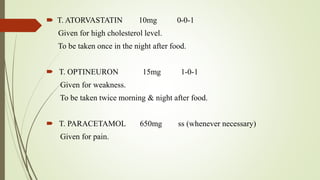
 T. ATORVASTATIN 10mg 0-0-1
Given for high cholesterol level.
To be taken once in the night after food.
 T. OPTINEURON 15mg 1-0-1
Given for weakness.
To be taken twice morning & night after food.
 T. PARACETAMOL 650mg ss (whenever necessary)
Given for pain.
FOLLOW-UP
Review in medical OPD after one month.

THANK YOU

EXAM CASE PRESENTATION.pptx

  • 1.
  • 2.
    DEMOGRAPHIC DETAILS Patient Name:XYZ Age : 53 years Gender : Male Weight : 89 kg Height : 172 cm BMI : 30kg/m2 (Obese) DOA : 21.12.2020 DOD : 24.12.2020
  • 3.
    PROBLEM LIST Hypertension Type 2Diabetes Mellitus Hyperlipidemia
  • 4.
    SUBJECTIVE EVIDENCE COMPLAINTS ONADMISSION:  Generalised weakness since 1 month.  Instability while walking.  Excessive sweating.  Rapid breathing.  Chronic headache since 1 week.
  • 5.
    OBJECTIVE EVIDENCE PHYSICAL EXAMINATION: Conscious , Co-Operative P-I-C-CL-E (-) MEDICAL HISTORY: Type 2 Diabetes mellitus since 1 years. Hypertension since 2 year. MEDICATION HISTORY: GLIMEPIRIDE 2mg 1-0-1 ATENOLOL 50mg 0-1-0  SOCIAL HISTORY: Alcoholic  FAMILY HISTORY: Nil
  • 6.
    GENERAL EXAMINATION VITAL SIGNS: Bloodpressure -160/100 mmHg. Respiratory rate - 27 cycles/min. Heart rate - 84 bpm. Temperature - 99° F.
  • 7.
    LABORATORY INVESTIGATIONS BLOOD GLUCOSE: RBS(110-180 mg/dl) : 310mg/dl FBS ( 70- 100 mg/dl) : 160 mg/dl HbA1c (4-6) : 7.8 LIPID PROFILE: TCh ( 120-200 mg/dl) : 280mg/dl TGs ( upto 170 mg/dl) : 240mg/dl HDL ( 40-60 mg/dl) : 34 mg/dl LDL ( 100-160 mg/dl) : 204 mg/dl
  • 8.
    HAEMATOLOGY: RBC (4.5-5.5 millioncells/cmm) : 5.3 WBC (4,000-11,000 cells/cmm) :7000 Platelet(1.5L-3.0L) :2.5L Hb ( 13.5- 17.5 g/dl ) : 14.6 g/dl ESR ( 0-20 mm/h) : 20 mm/h LIVER: T.Bili (0.2-1.2 mg/dl) :0.24 mg/dl D.Bili (0-0.3 mg/dl) :0.08 mg/dl ALP (110-310 IU/L) :290 IU/L Albumin (3.2-5.5 g/dl) :4.8 g/dl Globulin(1.8-3.4 g/dl) : 3.0g/dl
  • 9.
    RENAL FUNCTION TESTS: Urea(10-45 mg/dl) : 38mg/dl Serum creatinine (0.4-1.4 mg/dl) :1.0 mg/dl ELECTROLYTES: Na (135-145 mEq/L) :140 mEq/L K (3.5-5 mEq/L) :3.8mEq/L Ca (8.8-10.2 mg/L) :9.2 mg/dl
  • 10.
    DAILY INVESTIGATION CHART: DAYINVESTIGATIONS DAY 2 FBS - 150mg/dl BP - 160/95 mmHg TC - 230 mg/dl LDL - 185 mg/dl HDL - 38 mg/dl DAY 3 FBS - 140 mg/dl BP - 140/90 mmHg TC - 218 mg/dl LDL - 170 mg/dl HDL - 48 mg/dl DAY 4 FBS - 140mg/dl BP - 140/85 mg/dl TC - 204 mg/dl LDL - 164 mg/dl HDL - 54 mg/dl
  • 11.
  • 12.
    ASSESSMENT DIAGNOSIS: Based on thesubjective and objective evidence the patient was diagnosed with Type 2 Diabetes mellitus, Hypertension along with Hyperlipidemia. ETIOLOGY: Age Alcoholic
  • 13.
    CURRENT THERAPY The FollowingMedications have been Prescribed to the Patient- GENERIC NAME BRAND NAME DOSE ROA FREQUENCY DURATION DAY1 DAY2 DAY3 DAY4 INSULIN INJ. H.ACTRAPID (40IU/ml) 8U SC 1-1-1   T.METFORMIN APO.METFORM IN 500 mg P/O 0-0-1     T.TELMISARTAN T.TELMA 40 mg P/O 0-1-0     ASPIRIN+ATORV ASTATIN CAP.ECOSPRIN AV 75 75 mg/ P/O 10 mg 0-0-1     MULTIVITAMIN T.OPTINEURON 15 mg P/O 1-0-1     PARACETAMOL T.DOLO 650mg P/O 1-0-0   SOS
  • 14.
    INJ. H.ACTRAPID(40IU/ml) SC Category: Anti – diabetic  Indication: Diabetes mellitus  MOA: Lowers the blood sugar by stimulating glucose uptake by cells, tissues, muscles(especially by skeletal muscles), fat and by inhibiting glucose production by the liver.  Standard dose:40IU/ml SC  ADR: Hypoglycemia, hypersensitivity reactions, visual disturbances, feeling hungry, dizziness.  CI: Hypoglycemia, insulin allergic or any ingredient in medicine, hepatic and renal impairment.
  • 15.
    APO.METFORMIN(T.METFORMIN)500mg P/O  Category:Anti- diabetic  Indication: Type 2 Diabetes mellitus  MOA: Decreasing the amount of glucose absorbed from the intestine, lowering the amount of sugar created/produced by the liver and facilitating entry of sugar into the cells.  Standard dose: 500 mg P/O  ADR :Lactic acidosis, hypoglycemia, loss of appetite, nausea , vomiting , hepatotoxicity.  CI : Type 1 Diabetes mellitus, hepatic and renal impairment , alcoholic.
  • 16.
    T.TELMA (T.TELMISARTAN) 40mg P/O  Category: Antihypertensive  Indication: Hypertension  MOA: Inhibiting the binding of angiotensin II to its receptors and hence prevents BP from raising by relaxing and widening the blood vessels.  Standard dose: 40 mg P/O  ADR: Hypersensitivity reactions, thrombocytopenia , anemia, hyperkalemia, anaphylaxis ,angioedema.  CI : Hypersensitivity, renal and hepatic impairment, renal artery stenosis , severe CHF.
  • 17.
    CAP.ECOSPIRIN AV 75(ASPIRIN+ATORVASTATIN)  Category : Statins  Indication: Prevention of heart attack and stroke  MOA: Atorvastatin inhibits HMG CoA reductase and there by reduces cholesterol synthesis. Aspirin prevents platelets from sticking together and decreases the formation of harmful blood clot.  Standard dose: 75/10 mg per day P/O  ADR: Abdominal pain, indigestion, constipation, flatulence, increased risk of bleeding.  CI: Acute liver disease, dengue fever, hypersensitivity .
  • 18.
    T.OPTINEURON (MULTIVITAMIN) 15mg P/O Category: Multivitamin  Indication: Vit.B12 deficiency  MOA :Improve blood circulation and oxygen saturation . It has good influence on CNS.  Standard dose : 10-25 mg/day P/O  ADR:  CI: Hypersensitivity
  • 19.
    T.DOLO (PARACETAMOL)650mg P/O Category: Analgesic and antipyretic  Indication : Head ache ,body pain , common cold  MOA: Blocking the release of certain chemical messenger that cause pain and fever.  Standard dose: 500-1000mg every 4-6hrs P/O  ADR : Bleeding, breathing problems, itching mouth ulcer, skin rash.  CI: Liver damage , allergy to it or its ingredients.
  • 20.
    PLAN SHORT TERM GOALS: Toreduce high blood glucose level, blood pressure and cholesterol level. To relief symptoms associated like pain, weakness, headache etc. LONG TERM GOALS: To control long term Micro and Macro vascular complications of DM To Prevent the development of cardiovascular diseases. To improve quality of life. To reduce the morbidity and mortality.
  • 21.
    MONITORING PARAMETERS  THERAPEUTICMONITORING : BP FBS RBS HbA1c Lipid Profile Urine Microalbumin to rule out Diabetic Retinopathy ECG TOXICITY MONITORING: Renal function test Liver Function test
  • 22.
    POINTS TO PATIENT DISEASE: Youhave been diagnosed with hyperlipidemia that is increased level of cholesterol, type 2 diabetes mellitus that is increased blood glucose level and hypertension that is increased blood pressure. These conditions can be maintained by following proper medications along with proper dietary management and lifestyle modification.
  • 23.
    DRUGS:  The prescribedmedications should be taken regularly to control the complications.  Do not skip any medications.  In case of missed dose don’t take two drugs at a time as it may lead to further complications.  Always keep sugar candy with you, If you feel any Hypoglycemic symptoms like confusion, dizziness, sweating, Tired then immediately take those candies  T. Telma can make you feel dizzy for the first few days, Rise slowly if you have been sitting and lying for a long time  Even if you feel relieved don’t stop the medications your own, consult your physician.
  • 24.
    LIFESTYLE MODIFICATIONS  FollowAmerican Diabetic Association Diet to control DM.  Avoid intake of sugar.  Reduce intake of carbohydrate rich food like rice instead you can prefer fibres rich food like wheat.  Follow DASH Therapy that is Dietary approach to stop Hypertension.  Reduce the intake of Salt in your diet to less than 1 tablespoon daily.  Manage stress.  Reduce the amount of saturated and total fat such as oil, dairy products in the diet.  Getting regular aerobic exercise for 30 minutes.  Restrict daily intake of alcohol.  Since diabetic feet problems are more likely to occur, never go on bare foot or avoid trauma to feet by cutting toe nails and wearing shoes that fit properly. Also keep the foot clean and dry before going to bed, as there are chances of getting diabetic foot ulcer.
  • 25.
     DISCHARGE MEDICATIONS: Thefollowing drugs are to be continued-  T. METFORMIN 500mg 1-0-1 Given for high blood sugar. To be taken twice morning & night 15 minutes before food.  T. TELMISARTAN 40mg 0-1-0 Given for high bp. To be taken once in the afternoon after 30 minutes of lunch.
  • 26.
     T. ATORVASTATIN10mg 0-0-1 Given for high cholesterol level. To be taken once in the night after food.  T. OPTINEURON 15mg 1-0-1 Given for weakness. To be taken twice morning & night after food.  T. PARACETAMOL 650mg ss (whenever necessary) Given for pain.
  • 27.
    FOLLOW-UP Review in medicalOPD after one month.
  • 28.