

CONTENT
•Introduction
•Historical perspective
•Printing process
•Counterfeiting currency
INTRODUCTION
• Questioned document can be defined as any document whose trustworthiness is doubtful
• Questioned document can be in the form of printed document, handwritten, typewritten, or any
material that contain a hidden message in form of signs/symbols/images.
• Counterfeiting currency notes are one of the most common type of questioned documents in
today’s times.
• Various printing process, security feature and sections are associated with the issue of
counterfeiting currency, which will be discussed further.
HISTORICAL PERSPECTIVE
• Paper money was introduced in India, by Bank of Hindustan in 1770.
• Government security press, Nasik, established in 1928, started printing of currency notes in
India.
• In 1935, Reserve Bank of India gets established and take over the printing of currency notes.
• Earlier, paper money was mainly issued by Bank of Bengal, Bank of Madras, Bank of Bombay
and Bank of Hindustan.
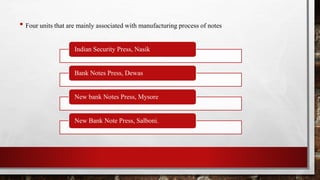
• Four units that are mainly associated with manufacturing process of notes
Indian Security Press, Nasik
Bank Notes Press, Dewas
New bank Notes Press, Mysore
New Bank Note Press, Salboni.
• Note press, Nasik use wet offset process for printing of currency notes.
• Intaglio printing was used by Bank Notes Press, Dewas, for the same purpose.
• The Wet Offset Process does not leave any indentation or mark but intaglio printing have in
respite inked area, can be observed under microscope or felt by hand.
• The security paper used in the manufacturing of notes is produced by security Paper Mill,
Hoshangabad (Madhya Pradesh).
PRINTING PROCESS
• Offset printing
• It is a planographic process.
• Mostly used for commercial purposes
• Image is created in single surface.
• Chemically coplanar image and no image area are distinguished.
• Transfer of ink takes place from treated plate to offset medium to target.
• Dry offset process uses a raised image plate in combination with an intermediate transfer
blanket.
Figure showing printing by offset printing process.
• Intaglio printing
• Mainly used for engrave work or special announcement.
• Image is engraved in form of lines into metal plate.
• Intaglio ink is applied into engravings and is wiped from the surface of plate.
• Than it is transferred to the target/substrate.
• Gives image both visual and tactual effect.
Figure showing printing by intaglio printing process.
• Typographic or letter press printing
• On a raised surface ink is applied.
• Transferred to the substrate by direct impression.
• This method of ink transfer create an effect known as squeeze out effect.
• Examples – typewriters, date stamps.
Figure showing printing by letter press printing process.
INK
• Selection of ink is based on its wear and tear characteristics.
• Ink must be durable and be subjected to durability tests.
• Security inks can be used for security features.
• Color shifting ink prove to be aid in prevention of counterfeiting .
• Inks used in printing of bank notes are specifically designed and are not available outside legal
printing industries.
Figure showing color sifting of ink in denomination.
COUNTERFEITING CURRENCY
• The word counterfeit refers to the imitation of something with a malicious intent to deceive or
to prepare a forged copy of something.
• Currency that is produced by illegal measures and is not sanctioned by the government is known
as counterfeiting currency.
• Counterfeiting of currency is a serious crime, as it involves illegal means in manufacturing
process
MCQ
• Which of the following printing process is used for printing invitation card for a special occasion?
• A ) Offset printing
• B) Letter press printing
• C) Intaglio printing
• D) All of the mentioned.
Counterfeiting Currency Notes

Counterfeiting Currency Notes

  • 3.
  • 4.
    INTRODUCTION • Questioned documentcan be defined as any document whose trustworthiness is doubtful • Questioned document can be in the form of printed document, handwritten, typewritten, or any material that contain a hidden message in form of signs/symbols/images. • Counterfeiting currency notes are one of the most common type of questioned documents in today’s times. • Various printing process, security feature and sections are associated with the issue of counterfeiting currency, which will be discussed further.
  • 5.
    HISTORICAL PERSPECTIVE • Papermoney was introduced in India, by Bank of Hindustan in 1770. • Government security press, Nasik, established in 1928, started printing of currency notes in India. • In 1935, Reserve Bank of India gets established and take over the printing of currency notes. • Earlier, paper money was mainly issued by Bank of Bengal, Bank of Madras, Bank of Bombay and Bank of Hindustan.
  • 6.
    • Four unitsthat are mainly associated with manufacturing process of notes Indian Security Press, Nasik Bank Notes Press, Dewas New bank Notes Press, Mysore New Bank Note Press, Salboni.
  • 7.
    • Note press,Nasik use wet offset process for printing of currency notes. • Intaglio printing was used by Bank Notes Press, Dewas, for the same purpose. • The Wet Offset Process does not leave any indentation or mark but intaglio printing have in respite inked area, can be observed under microscope or felt by hand. • The security paper used in the manufacturing of notes is produced by security Paper Mill, Hoshangabad (Madhya Pradesh).
  • 8.
    PRINTING PROCESS • Offsetprinting • It is a planographic process. • Mostly used for commercial purposes • Image is created in single surface. • Chemically coplanar image and no image area are distinguished. • Transfer of ink takes place from treated plate to offset medium to target. • Dry offset process uses a raised image plate in combination with an intermediate transfer blanket.
  • 9.
    Figure showing printingby offset printing process.
  • 10.
    • Intaglio printing •Mainly used for engrave work or special announcement. • Image is engraved in form of lines into metal plate. • Intaglio ink is applied into engravings and is wiped from the surface of plate. • Than it is transferred to the target/substrate. • Gives image both visual and tactual effect.
  • 11.
    Figure showing printingby intaglio printing process.
  • 12.
    • Typographic orletter press printing • On a raised surface ink is applied. • Transferred to the substrate by direct impression. • This method of ink transfer create an effect known as squeeze out effect. • Examples – typewriters, date stamps.
  • 13.
    Figure showing printingby letter press printing process.
  • 14.
    INK • Selection ofink is based on its wear and tear characteristics. • Ink must be durable and be subjected to durability tests. • Security inks can be used for security features. • Color shifting ink prove to be aid in prevention of counterfeiting . • Inks used in printing of bank notes are specifically designed and are not available outside legal printing industries.
  • 15.
    Figure showing colorsifting of ink in denomination.
  • 16.
    COUNTERFEITING CURRENCY • Theword counterfeit refers to the imitation of something with a malicious intent to deceive or to prepare a forged copy of something. • Currency that is produced by illegal measures and is not sanctioned by the government is known as counterfeiting currency. • Counterfeiting of currency is a serious crime, as it involves illegal means in manufacturing process
  • 17.
    MCQ • Which ofthe following printing process is used for printing invitation card for a special occasion? • A ) Offset printing • B) Letter press printing • C) Intaglio printing • D) All of the mentioned.