A
SEMINAR
ON
“Advance Magnetic Levitation Train Technology ”
Submitted in Partial Fulfillment for the Award of
Bachelor of Technology Degree
Of
Rajasthan Technical University, Kota
05/03/15 1
Contents
Introduction
Objective
How train works ?
Levitation System power
Propulsion System
Pantograph
Pantograph
Application Information
Transrapid Project
Advantage and Limitations
Conclusion
References
05/03/15 205/03/15 2
INTRODUCTION
• A pantograph always remains in contact with the overhead train
line is used to send electricity to the main transformer of the
electric train, thus providing power.
• Due to many external Disturbances the train line may lose
contact with pantograph, causes arcing phenomena to occur.
• The arcing produced creates harmonics in the electric over head
line and degrades the Power Quality
• Physical properties of magnetic components is used improve the
contact between the pantograph and the overhead train line
05/03/15 3
OBJECTIVES
• To reduce the arcing caused by contact loss of overhead train
line and the pantograph using magnetic components.
• To improve the Power Quality in the Over head train line by
reducing the current fluctuations.
• To optimize the magnetic force based arc prevention methods
using Artificial Neural Network.
05/03/15 4
How Train Works
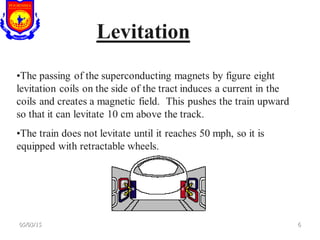
• The electromagnets on the underside of the train pull it up to
the ferromagnetic stators on the track and levitate the train.
• The magnets on the side keep the train from moving from side
to side.
• A computer changes the amount of current to keep the train 1
cm from the track.
This means there is no friction between the train and the track!
05/03/1505/03/15 55
05/03/1505/03/15 66
Levitation System’s Power Supply
• Batteries on the train power the system, and therefore
it still functions without propulsion.
• The batteries can levitate the train for 30 minutes
without any additional energy.
• Linear generators in the magnets on board the train
use the motion of the train to recharge the batteries.
• Levitation system uses less power than the trains air
conditioning.
05/03/1505/03/15 77
Propulsion
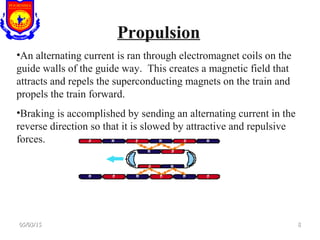
•An alternating current is ran through electromagnet coils on the
guide walls of the guide way. This creates a magnetic field that
attracts and repels the superconducting magnets on the train and
propels the train forward.
•Braking is accomplished by sending an alternating current in the
reverse direction so that it is slowed by attractive and repulsive
forces.
05/03/1505/03/15 88
Propulsion System
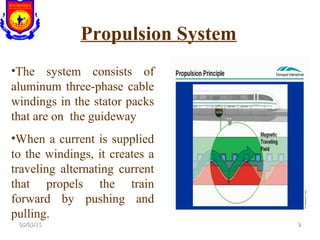
•The system consists of
aluminum three-phase cable
windings in the stator packs
that are on the guideway
•When a current is supplied
to the windings, it creates a
traveling alternating current
that propels the train
forward by pushing and
pulling.
05/03/1505/03/15 99
•When the alternating current is reversed, the train brakes.
•Different speeds are achieved by varying the intensity of the
current.
•Only the section of track where the train is traveling is
electrified.
.
Propulsion System
05/03/1505/03/15 1010
Pantograph
• Pantograph is always placed at the top of the train Engine.
• Pantograph send electricity to the main transformer of the
electric train by making contact with the overhead train line.
• A graphite plate is their in pantograph that slides on over head
line.
• Various Disturbances can cause pantograph rapidly contact and
separate with train line results as arcing produced.
05/03/15 11
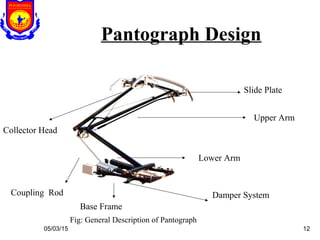
Lower Arm
Upper Arm
Coupling Rod Damper System
Collector Head
Slide Plate
Base Frame
Fig: General Description of Pantograph
Pantograph Design
05/03/15 12
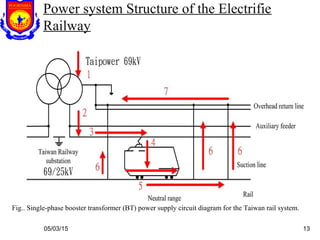
Power system Structure of the Electrifie
Railway
Fig.. Single-phase booster transformer (BT) power supply circuit diagram for the Taiwan rail system.
05/03/15 13
Application Information
Safety
•The trains are virtually impossible to derail because the train is
wrapped around the track.
•Collisions between trains are unlikely because computers are
controlling the trains movements.
Maintenance
• There is very little maintenance because there is no contact
between the parts.
05/03/1505/03/15 1414
Comfort
•The ride is smooth while not accelerating..
Economic Efficency
•The initial investment is similar to other high speed rail roads.
(Maglift is $20-$40 million per mile and I-279 in Pittsburg cost
$37 million per mile 17 years ago.)
•Operating expenses are half of that of other railroads.
•A train is composed of sections that each contain 100 seats, and
a train can have between 2 and 10 sections.
•The linear generators produce electricity for the cabin of the
train.
05/03/1505/03/15 1515
Speed
•The train can travel at about 300 mph. (Acela can only go 150
mph)
•For trips of distances up to 500 miles its total travel time is
equal to a planes (including check in time and travel to airport.)
•It can accelerate to 200 mph in 3 miles, so it is ideal for short
jumps. (ICE needs 20 miles to reach 200 mph.)
05/03/1505/03/15 1616
Environment
•It uses less energy than existing transportation systems. For
every seat on a 300 km trip with 3 stops, the gasoline used per
100 miles varies with the speed. At 200 km/h it is 1 liter, at 300
km/h it is 1.5 liters and at 400 km/h it is 2 liters. This is 1/3 the
energy used by cars and 1/5 the energy used by jets per mile.
•The tracks have less impact on the environment because the
elevated models (50ft in the air) allows all animals to pass, low
models ( 5-10 ft) allow small animals to pass, they use less land
than conventional trains, and they can follow the landscape better
than regular trains since it can climb 10% gradients (while other
trains can only climb 4 gradients) and can handle tighter turns.
05/03/1505/03/15 1717
Noise Pollution
•The train makes little noise because it does not touch the track
and it has no motor. Therefore, all noise comes from moving air.
This sound is equivalent to the noise produced by city traffic.
05/03/1505/03/15 1818
Magnetic Field:
•The magnetic field created is low, therefore there are no
adverse effects.
05/03/1505/03/15 1919
Transrapid Projects
 Germany was going to build a
magnetic lift system between
Berlin and Hamburg (200 miles)
in 1996, but never did because a
new political party came in and
decided that the improvements
over ICE was not worth $7
billion dollars.
 China is building a 20 mile system between Shanghai Pudong
and Pudong International Airport. It will open in January of
2004, and it will reach speeds of over 250 mph. If the project is
successful, then China will build a system from Beijing to
Shanghai, a journey of over 800 miles.
05/03/1505/03/15 2020
How Magnets Uses
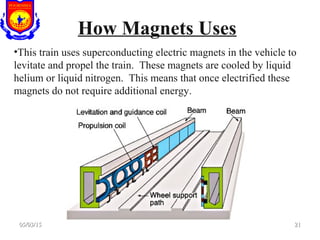
•This train uses superconducting electric magnets in the vehicle to
levitate and propel the train. These magnets are cooled by liquid
helium or liquid nitrogen. This means that once electrified these
magnets do not require additional energy.
05/03/1505/03/15 2121
Lateral Guidance
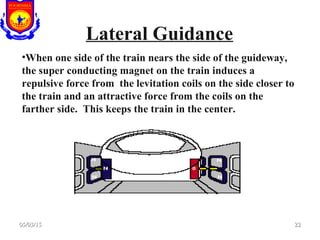
•When one side of the train nears the side of the guideway,
the super conducting magnet on the train induces a
repulsive force from the levitation coils on the side closer to
the train and an attractive force from the coils on the
farther side. This keeps the train in the center.
05/03/1505/03/15 2222
Advantage and Limitations
 This system is not ready for use now, but it should be ready in a few
years.
 It’s top speed with people aboard is 350 mph.
 The super conducting magnets create a strong magnetic field that
could be a problem for some passengers.
 The train is earthquake proof because the greater space (10 cm)
between the track and the train leaves more room for track
deformation
 Linear generators will produce all the electricity needed in the
train’s interior.
 Only the part of the track that is used will be electrified so no energy
is wasted.
05/03/1505/03/15 2323
Conclusion
•Since there is no friction these trains can reach
high speeds.
•It is a safe and efficient way to travel.
•Governments have mixed feelings about the
technology. Some countries, like China, have
embraced it and others like Germany have
balked at the expense.
05/03/1505/03/15 2424
References
1. W. Wang et al., “Experimental study of electrical
characteristics on pantograph arcing,” in Proc. 1st ICEPE-ST,
2011, pp. 602–607.
2. T. Li et al., “Pantograph arcing’s impact on locomotive
equipment's,” in Proc. IEEE 57th Holm Conf. Elect. Contacts,
2011, pp. 1–5.
3. T. Ding, G. X. Chen, and J. Bu, “Effect of temperature and
arc discharge on friction and wear behaviors of carbon
strip/copper contact wire in pantograph–catenary systems,”
Wear, vol. 271, no. 9/10, pp. 1629–1636, Jul. 2011.
4. G. Bucca, A. Collina, and R. Manigrasso, “Analysis of
electrical interferences related to the current collection quality
in pantograph–catenary interaction,” Proc. Inst. Mech. Eng., J.
Rail Rapid Transit, vol. 225, no. F5, pp. 483–499, 2011.
05/03/1505/03/15 2525
05/03/1505/03/15 2626
05/03/1505/03/15 2727

maglev train

  • 1.
    A SEMINAR ON “Advance Magnetic LevitationTrain Technology ” Submitted in Partial Fulfillment for the Award of Bachelor of Technology Degree Of Rajasthan Technical University, Kota 05/03/15 1
  • 2.
    Contents Introduction Objective How train works? Levitation System power Propulsion System Pantograph Pantograph Application Information Transrapid Project Advantage and Limitations Conclusion References 05/03/15 205/03/15 2
  • 3.
    INTRODUCTION • A pantographalways remains in contact with the overhead train line is used to send electricity to the main transformer of the electric train, thus providing power. • Due to many external Disturbances the train line may lose contact with pantograph, causes arcing phenomena to occur. • The arcing produced creates harmonics in the electric over head line and degrades the Power Quality • Physical properties of magnetic components is used improve the contact between the pantograph and the overhead train line 05/03/15 3
  • 4.
    OBJECTIVES • To reducethe arcing caused by contact loss of overhead train line and the pantograph using magnetic components. • To improve the Power Quality in the Over head train line by reducing the current fluctuations. • To optimize the magnetic force based arc prevention methods using Artificial Neural Network. 05/03/15 4
  • 5.
    How Train Works •The electromagnets on the underside of the train pull it up to the ferromagnetic stators on the track and levitate the train. • The magnets on the side keep the train from moving from side to side. • A computer changes the amount of current to keep the train 1 cm from the track. This means there is no friction between the train and the track! 05/03/1505/03/15 55
  • 6.
  • 7.
    Levitation System’s PowerSupply • Batteries on the train power the system, and therefore it still functions without propulsion. • The batteries can levitate the train for 30 minutes without any additional energy. • Linear generators in the magnets on board the train use the motion of the train to recharge the batteries. • Levitation system uses less power than the trains air conditioning. 05/03/1505/03/15 77
  • 8.
    Propulsion •An alternating currentis ran through electromagnet coils on the guide walls of the guide way. This creates a magnetic field that attracts and repels the superconducting magnets on the train and propels the train forward. •Braking is accomplished by sending an alternating current in the reverse direction so that it is slowed by attractive and repulsive forces. 05/03/1505/03/15 88
  • 9.
    Propulsion System •The systemconsists of aluminum three-phase cable windings in the stator packs that are on the guideway •When a current is supplied to the windings, it creates a traveling alternating current that propels the train forward by pushing and pulling. 05/03/1505/03/15 99
  • 10.
    •When the alternatingcurrent is reversed, the train brakes. •Different speeds are achieved by varying the intensity of the current. •Only the section of track where the train is traveling is electrified. . Propulsion System 05/03/1505/03/15 1010
  • 11.
    Pantograph • Pantograph isalways placed at the top of the train Engine. • Pantograph send electricity to the main transformer of the electric train by making contact with the overhead train line. • A graphite plate is their in pantograph that slides on over head line. • Various Disturbances can cause pantograph rapidly contact and separate with train line results as arcing produced. 05/03/15 11
  • 12.
    Lower Arm Upper Arm CouplingRod Damper System Collector Head Slide Plate Base Frame Fig: General Description of Pantograph Pantograph Design 05/03/15 12
  • 13.
    Power system Structureof the Electrifie Railway Fig.. Single-phase booster transformer (BT) power supply circuit diagram for the Taiwan rail system. 05/03/15 13
  • 14.
    Application Information Safety •The trainsare virtually impossible to derail because the train is wrapped around the track. •Collisions between trains are unlikely because computers are controlling the trains movements. Maintenance • There is very little maintenance because there is no contact between the parts. 05/03/1505/03/15 1414
  • 15.
    Comfort •The ride issmooth while not accelerating.. Economic Efficency •The initial investment is similar to other high speed rail roads. (Maglift is $20-$40 million per mile and I-279 in Pittsburg cost $37 million per mile 17 years ago.) •Operating expenses are half of that of other railroads. •A train is composed of sections that each contain 100 seats, and a train can have between 2 and 10 sections. •The linear generators produce electricity for the cabin of the train. 05/03/1505/03/15 1515
  • 16.
    Speed •The train cantravel at about 300 mph. (Acela can only go 150 mph) •For trips of distances up to 500 miles its total travel time is equal to a planes (including check in time and travel to airport.) •It can accelerate to 200 mph in 3 miles, so it is ideal for short jumps. (ICE needs 20 miles to reach 200 mph.) 05/03/1505/03/15 1616
  • 17.
    Environment •It uses lessenergy than existing transportation systems. For every seat on a 300 km trip with 3 stops, the gasoline used per 100 miles varies with the speed. At 200 km/h it is 1 liter, at 300 km/h it is 1.5 liters and at 400 km/h it is 2 liters. This is 1/3 the energy used by cars and 1/5 the energy used by jets per mile. •The tracks have less impact on the environment because the elevated models (50ft in the air) allows all animals to pass, low models ( 5-10 ft) allow small animals to pass, they use less land than conventional trains, and they can follow the landscape better than regular trains since it can climb 10% gradients (while other trains can only climb 4 gradients) and can handle tighter turns. 05/03/1505/03/15 1717
  • 18.
    Noise Pollution •The trainmakes little noise because it does not touch the track and it has no motor. Therefore, all noise comes from moving air. This sound is equivalent to the noise produced by city traffic. 05/03/1505/03/15 1818
  • 19.
    Magnetic Field: •The magneticfield created is low, therefore there are no adverse effects. 05/03/1505/03/15 1919
  • 20.
    Transrapid Projects  Germanywas going to build a magnetic lift system between Berlin and Hamburg (200 miles) in 1996, but never did because a new political party came in and decided that the improvements over ICE was not worth $7 billion dollars.  China is building a 20 mile system between Shanghai Pudong and Pudong International Airport. It will open in January of 2004, and it will reach speeds of over 250 mph. If the project is successful, then China will build a system from Beijing to Shanghai, a journey of over 800 miles. 05/03/1505/03/15 2020
  • 21.
    How Magnets Uses •Thistrain uses superconducting electric magnets in the vehicle to levitate and propel the train. These magnets are cooled by liquid helium or liquid nitrogen. This means that once electrified these magnets do not require additional energy. 05/03/1505/03/15 2121
  • 22.
    Lateral Guidance •When oneside of the train nears the side of the guideway, the super conducting magnet on the train induces a repulsive force from the levitation coils on the side closer to the train and an attractive force from the coils on the farther side. This keeps the train in the center. 05/03/1505/03/15 2222
  • 23.
    Advantage and Limitations This system is not ready for use now, but it should be ready in a few years.  It’s top speed with people aboard is 350 mph.  The super conducting magnets create a strong magnetic field that could be a problem for some passengers.  The train is earthquake proof because the greater space (10 cm) between the track and the train leaves more room for track deformation  Linear generators will produce all the electricity needed in the train’s interior.  Only the part of the track that is used will be electrified so no energy is wasted. 05/03/1505/03/15 2323
  • 24.
    Conclusion •Since there isno friction these trains can reach high speeds. •It is a safe and efficient way to travel. •Governments have mixed feelings about the technology. Some countries, like China, have embraced it and others like Germany have balked at the expense. 05/03/1505/03/15 2424
  • 25.
    References 1. W. Wanget al., “Experimental study of electrical characteristics on pantograph arcing,” in Proc. 1st ICEPE-ST, 2011, pp. 602–607. 2. T. Li et al., “Pantograph arcing’s impact on locomotive equipment's,” in Proc. IEEE 57th Holm Conf. Elect. Contacts, 2011, pp. 1–5. 3. T. Ding, G. X. Chen, and J. Bu, “Effect of temperature and arc discharge on friction and wear behaviors of carbon strip/copper contact wire in pantograph–catenary systems,” Wear, vol. 271, no. 9/10, pp. 1629–1636, Jul. 2011. 4. G. Bucca, A. Collina, and R. Manigrasso, “Analysis of electrical interferences related to the current collection quality in pantograph–catenary interaction,” Proc. Inst. Mech. Eng., J. Rail Rapid Transit, vol. 225, no. F5, pp. 483–499, 2011. 05/03/1505/03/15 2525
  • 26.
  • 27.