Release the Dogma!
Evidence based resistance training for performance
and hypertrophy
RWL Coaching Team
The evidence
• Evidence-based resistance training
recommendations (2011)
• James Fisher, James Steele, Stewart Bruce-Low
and Dave Smith
• Southampton Solent , Manchester
Metropolitan University
First a consideration
Strength
Hypertrophy
Posture
Body composition
Flexibility
Agility
Skill
Health
First a consideration
Strength
Hypertrophy
Posture
Body composition
Flexibility
Agility
Skill
Health
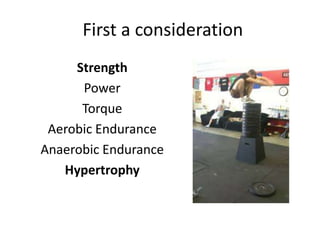
First a consideration
Strength
Power
Torque
Aerobic Endurance
Anaerobic Endurance
Hypertrophy
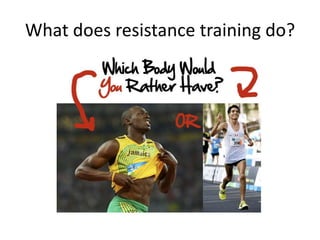
What does resistance training do?
How many reps?
ACSM
• Low reps (1-5)
strength and power
• Moderate reps (5-
15) hypertrophy
• High reps (15+) for
endurance
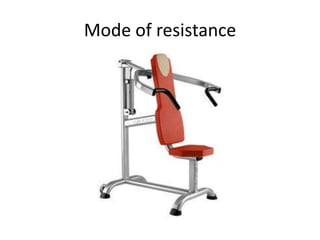
Mode of resistance
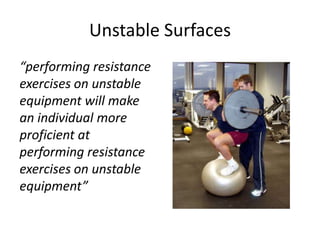
Unstable Surfaces
“performing resistance
exercises on unstable
equipment will make
an individual more
proficient at
performing resistance
exercises on unstable
equipment”
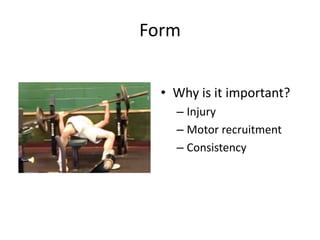
Form
• Why is it important?
– Injury
– Motor recruitment
– Consistency
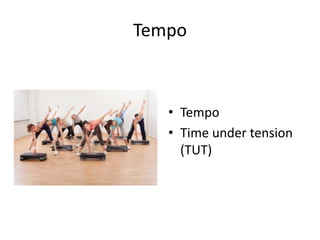
Tempo
• Tempo
• Time under tension
(TUT)
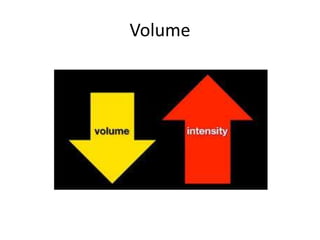
Volume
Frequency of training
• What are you training
for?
• Recovery
– Food intake
– Sleep
– Stress
– 80/20
It’s all about intensity
What is the ultimate aim before you start your
workout?
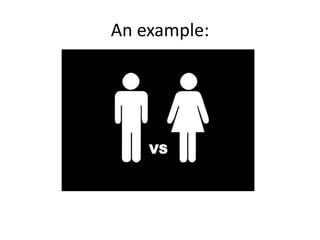
An example:
VS
Momentary muscular failure
The holy grail of
resistance training
But…
• Progress in individuals
will vary
• Somatotype
• Body Composition
• Age
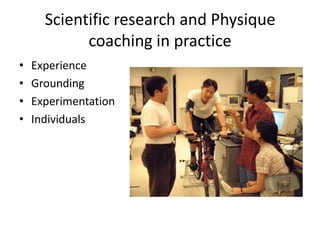
Scientific research and Physique
coaching in practice
• Experience
• Grounding
• Experimentation
• Individuals
Why we do what we do
• Interest
• Body composition
• Performance - Periodisation
• Posture – Flexibility, mobility and stability
• Injury prevention
• Agility and speed

Evidence based resistance training recommendations

Editor's Notes

  • #3 Resistance training produces an array of health benefits, as well as the potential to promote muscular adaptations of strength, size, power and endurance. The American College of Sports Medicine (ACSM) regularly publish a position stand making recommendations for optimal achievement of the desired training goals. However, the most recent position stand (as well as previous ones) has come under heavy criticism for misrepresentation of research, lack of evidence and author bias. Therefore this paper proposes a set of scientifically rigorous resistance training guidelines, reviewing and summarising the relevant research for the purpose of proposing more logical, evidence-based training advice.
  • #6 The word strength is an ambiguous term, it can mean a lot of things. For example:Two people can pick up the same weight, one person takes 1 second and the other takes 2. Are they stronger? Two people can clean the same weight, but one can deadlift more. Are they stronger?Someone can keep pushing the same weight for longer than another person are they stronger?
  • #7 Improves GI transitIncreased BMRImproved glucose metabolismImproved blood lipid profileReduced blood pressureImproved BMDReduction in pain from arthritisDecreased lower back painEnhanced flexibilityImproved maximal aerobic capacityPrehab
  • #8 Research does not unequivocally support the superiority of a particular repetition range for enhancing any aspect of muscle function.The rationale for low weights is that it recruits more motor units and teaches them to work together simultaneously. The muscle is more efficient but nor bigger. Also encourages myofibular hypertrophy.Moderate weights allow sarcoplasmic hypertrophy. The TUT increases blood flow, causes lactate release and damages muscle fibres. High reps totals the aerobic system, but is not heavy enough to induce the changes above.However it is easier to achieve failure on moderate number of reps
  • #9 Free weights, resistance machines, hydraulics and pneumaticsIt doesn’t matter, just failure matters
  • #10 There is no evidence for an increased benefit in strength or transferrable performance when performing unilateral exercises, or exercises on unstable equipment. There is no transferrable benefit to performing specific movements under resistance to improve performance, i.e. using a heavy bat.
  • #12 When muscular tension is maintained, there is little difference between different tempos. Explosive lifts do not recruit as many muscle fibres because they rely a lot on momentum. Slow lifting technique should reduce the incidence of injury
  • #13 Volume is the amount of reps performed during a workout, an example of a high volume session would be going for a runTypically those looking for hypertrophy, bodybuilders, perform low intensity high volume workouts. Focussing on maintaining muscular tension and working the muscle as much as possible. It seems from research that there is no benefit in strength or muscle growth from performing high volume workouts when intensity is controlled for effectively.
  • #15 Intensity is commonly defined as a percentage of your 1RM.
  • #16 Men and women have different fibre types. Generally speaking men have more powerful muscles by weight, and women have more fatigue resistant muscles.A man and a woman performing an exercise at 80% 1RM will not be perform the same number of reps. The man will be able to do far fewer reps than the woman. It should be defined as effort, and the only way you can have a cast iron guarantee of the level of effort is at 100%, when you can’t do another rep.
  • #17 It was previously thought that the stimulation of strength and muscle growth was to use heavy weights as these were the only weights that would recruit the powerful muscle fibres. However when the muscle is at failure, the entire motor pool is recruited maximally.
  • #18 You have to be prepared to progress within your genetic limit. A good indication of this is your somatotype. If you have wide shoulders and a narrow waist then you are likely a mesomorph, you have high levels of the right hormones and life is easy. If you have wide hips and shoulders then you are an endomorph. Your carb tolerance will be lower and assuming that your diet is on point you will gain muscle slowly.If you are scrawny then you can gain muscle fast.