AMPLIFIED FRAGMENT LENGTHPOLYMORPHISM
How would you distinguish organisms based on their genomes? One of the tools scientists use is
amplified fragment length polymorphism polymerase chain reaction (AFLP-PCR).
What if you were given two samples of genomic DNA collected from two seemingly similar
organisms whose genome sequences were not known, and you were then asked to determine
whether the two organisms were members of the same species? When faced with this situation, a
geneticist might opt to use the powerful and highly accurate technique called amplified fragment
length polymorphism polymerase chain reaction (AFLP-PCR) genotyping (Mueller &
Wolfenbarger, 1999). With this technique, even small amounts of genomic DNA can be used to
produce DNA "fingerprints" that are highly specific to particular species. Although this approach
requires a DNA sample, it does not require any prior knowledge of the genome sequence itself.
DNA Fingerprinting Defined
In order to understand how AFLP-PCR works, it's first important to understand what researchers
mean when they use the term "DNA fingerprinting." In short, DNA fingerprinting involves the
generation of a set of distinct DNA fragments from a single DNA sample; these fragments are
then used as a source of genotypic information. A wide range of techniques can be used to
generate DNA fingerprinting data. Researchers choose among these techniques based on
the organism being studied and on the question being addressed.
All DNA fingerprinting methods study patterns associated with genetic markers; however,
individual techniques differ in terms of the number and type of genetic markers examined. For
example, some approaches allow the examination of a marker at a single locus (called single-
locus markers), whereas others allow the simultaneous investigation of multiple loci (called
multilocus markers). Some approaches focus on codominant markers, which provide information
about both alleles present at a given locus. In contrast, other techniques are concerned with
dominant markers, which only report the presence or absence of a given allele and cannot
provide information about whether an individual is homozygous for that allele.
The oldest method used in DNA fingerprinting studies is restriction fragment length
polymorphism (RFLP) analysis. RFLP analysis has been widely employed by researchers to
identify genes linked to several Mendelian (single-gene) diseases, such as Huntington's disease.
This approach detects differences in DNA fragment lengths due to the presence or absence of a
restriction enzyme site, or due to an insertion or deletion that occurs between two restriction
enzyme sites. Although RFLP analysis does not require knowledge of the genome sequence,
RFLP studies can be extremely time-consuming and challenging in the absence of such data.
When sequence data is not available, the experimenter must physically clone a region of the
genome under study that is large enough to be cut up by enzymes, and this process requires a
great deal of time and resources.
As opposed to RFLP analysis, a second DNA fingerprinting technique focuses
on microsatellite regions of the genome that contain simple sequence repeats (SSRs), which are
short stretches of two to six nucleotides that are repeated multiple times. Most often, SSRs
consist of two or three nucleotides (e.g., CACACACA...). The number of SSRs within a given
microsatellite region of the genome often varies among individuals. Because of these differences,
researchers can use PCR-based approaches with primers that flank the microsatellite region to
2.
determine the lengthof the SSR. The size of the resulting PCR products is determined using
high-resolution gel electrophoresis. This approach requires knowledge of the genome sequence
to design the primers, but it can be used to detect multiple alleles for a given microsatellite
region.
Yet another approach to DNA fingerprinting, called random amplified polymorphic DNA
(RAPD) analysis, uses PCR primer sets designed to randomly amplify DNA fragments scattered
throughout the genome. RAPD is a multilocus approach that uses low-stringency PCR conditions
to permit promiscuous amplification of genomic regions. It can be carried out in the absence of
genome sequence data, but the low-stringency conditions sometimes provide challenges when
trying to reproduce or interpret results.
Today, researchers are increasingly turning to AFLP-PCR in their DNA fingerprinting efforts.
AFLP-PCR uses many of the same steps as RFLP, SSR, and RAPD, including restriction
enzyme digestion of genomic DNA, PCR, and electrophoretic separation of DNA fragments.
However, this method includes additional steps that permit high-resolution interrogation of the
entire genome, and it yields highly specific, reproducible genotypic data. Although AFLP can
only be used to study dominant genetic markers, it does not rely on any previous knowledge of
the genome sequence.
A Closer Look at AFLP-PCR
AFLP-PCR was first described by researcher Pieter Vos and his colleagues in 1995 (Vos et al.,
1995). This technique involves five major steps, as described in the following sections.
Step 1: Preparing the AFLP Template
3.
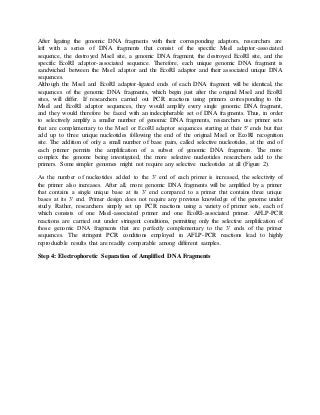
Figure 1
Figure Detail
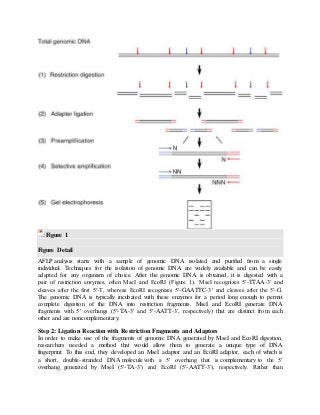
AFLPanalysis starts with a sample of genomic DNA isolated and purified from a single
individual. Techniques for the isolation of genomic DNA are widely available and can be easily
adapted for any organism of choice. After the genomic DNA is obtained, it is digested with a
pair of restriction enzymes, often MseI and EcoRI (Figure 1). MseI recognizes 5′-TTAA-3′ and
cleaves after the first 5′-T, whereas EcoRI recognizes 5′-GAATTC-3′ and cleaves after the 5′-G.
The genomic DNA is typically incubated with these enzymes for a period long enough to permit
complete digestion of the DNA into restriction fragments. MseI and EcoRI generate DNA
fragments with 5′ overhangs (5′-TA-3′ and 5′-AATT-3′, respectively) that are distinct from each
other and are noncomplementary.
Step 2: Ligation Reaction with Restriction Fragments and Adaptors
In order to make use of the fragments of genomic DNA generated by MseI and EcoRI digestion,
researchers needed a method that would allow them to generate a unique type of DNA
fingerprint. To this end, they developed an MseI adaptor and an EcoRI adaptor, each of which is
a short, double-stranded DNA molecule with a 5′ overhang that is complementary to the 5′
overhang generated by MseI (5′-TA-3′) and EcoRI (5′-AATT-3′), respectively. Rather than
4.
containing a 3′-Aafter the 5′-TA-3′ overhang, the MseI adaptor contains a 3′-C, which destroys
the MseI recognition site once ligated. Similarly, rather than containing a 3′-C after the 5′-
AATT-3′ overhang, the EcoRI adaptor contains a 3′-G, which destroys the EcoRI recognition
site once ligated. The MseI and EcoRI adaptors each contain their own specific DNA sequence,
typically between 19 and 22 base pairs in length, that is located upstreamof their respective 5′
overhangs.
The aforementioned ligation reaction involves incubation of the MseI/EcoRI digested genomic
DNA together with the two adaptors and with DNA ligase, which is an enzyme that covalently
links the adaptors with their respective complementary 5′ ends. MseI and EcoRI restriction
enzymes can also be added to this ligation reaction, as they will prevent re-ligation between
EcoRI-EcoRI and MseI-MseI genomic fragments and will not recognize the ligated adaptor-
genomic DNA fragments.
Step 3: Selective PCR Amplification
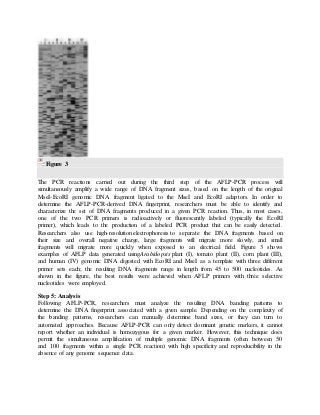
Figure 2
Figure Detail
5.
After ligating thegenomic DNA fragments with their corresponding adaptors, researchers are
left with a series of DNA fragments that consist of the specific MseI adaptor-associated
sequence, the destroyed MseI site, a genomic DNA fragment, the destroyed EcoRI site, and the
specific EcoRI adaptor-associated sequence. Therefore, each unique genomic DNA fragment is
sandwiched between the MseI adaptor and the EcoRI adaptor and their associated unique DNA
sequences.
Although the MseI and EcoRI adaptor-ligated ends of each DNA fragment will be identical, the
sequences of the genomic DNA fragments, which begin just after the original MseI and EcoRI
sites, will differ. If researchers carried out PCR reactions using primers corresponding to the
MseI and EcoRI adaptor sequences, they would amplify every single genomic DNA fragment,
and they would therefore be faced with an indecipherable set of DNA fragments. Thus, in order
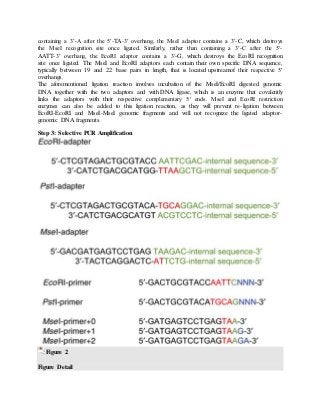
to selectively amplify a smaller number of genomic DNA fragments, researchers use primer sets
that are complementary to the MseI or EcoRI adaptor sequences starting at their 5′ ends but that
add up to three unique nucleotides following the end of the original MseI or EcoRI recognition
site. The addition of only a small number of base pairs, called selective nucleotides, at the end of
each primer permits the amplification of a subset of genomic DNA fragments. The more
complex the genome being investigated, the more selective nucleotides researchers add to the
primers. Some simpler genomes might not require any selective nucleotides at all (Figure 2).
As the number of nucleotides added to the 3′ end of each primer is increased, the selectivity of
the primer also increases. After all, more genomic DNA fragments will be amplified by a primer
that contains a single unique base at its 3′ end compared to a primer that contains three unique
bases at its 3′ end. Primer design does not require any previous knowledge of the genome under
study. Rather, researchers simply set up PCR reactions using a variety of primer sets, each of
which consists of one MseI-associated primer and one EcoRI-associated primer. AFLP-PCR
reactions are carried out under stringent conditions, permitting only the selective amplification of
those genomic DNA fragments that are perfectly complementary to the 3′ ends of the primer
sequences. The stringent PCR conditions employed in AFLP-PCR reactions lead to highly
reproducible results that are readily comparable among different samples.
Step 4: Electrophoretic Separation of Amplified DNA Fragments
6.
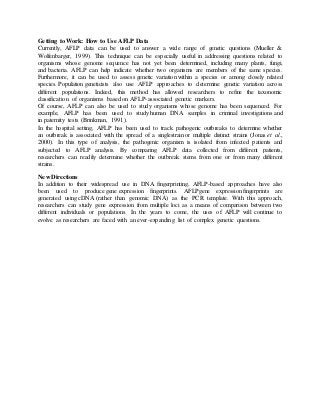
Figure 3
The PCRreactions carried out during the third step of the AFLP-PCR process will
simultaneously amplify a wide range of DNA fragment sizes, based on the length of the original
MseI-EcoRI genomic DNA fragment ligated to the MseI and EcoRI adaptors. In order to
determine the AFLP-PCR-derived DNA fingerprint, researchers must be able to identify and
characterize the set of DNA fragments produced in a given PCR reaction. Thus, in most cases,
one of the two PCR primers is radioactively or fluorescently labeled (typically the EcoRI
primer), which leads to the production of a labeled PCR product that can be easily detected.
Researchers also use high-resolution electrophoresis to separate the DNA fragments based on
their size and overall negative charge, large fragments will migrate more slowly, and small
fragments will migrate more quickly when exposed to an electrical field. Figure 3 shows
examples of AFLP data generated usingArabidopsis plant (I), tomato plant (II), corn plant (III),
and human (IV) genomic DNA digested with EcoRI and MseI as a template with three different
primer sets each; the resulting DNA fragments range in length from 45 to 500 nucleotides. As
shown in the figure, the best results were achieved when AFLP primers with three selective
nucleotides were employed.
Step 5: Analysis
Following AFLP-PCR, researchers must analyze the resulting DNA banding patterns to
determine the DNA fingerprint associated with a given sample. Depending on the complexity of
the banding patterns, researchers can manually determine band sizes, or they can turn to
automated approaches. Because AFLP-PCR can only detect dominant genetic markers, it cannot
report whether an individual is homozygous for a given marker. However, this technique does
permit the simultaneous amplification of multiple genomic DNA fragments (often between 50
and 100 fragments within a single PCR reaction) with high specificity and reproducibility in the
absence of any genome sequence data.
7.
Getting to Work:How to Use AFLP Data
Currently, AFLP data can be used to answer a wide range of genetic questions (Mueller &
Wolfenbarger, 1999). This technique can be especially useful in addressing questions related to
organisms whose genome sequence has not yet been determined, including many plants, fungi,
and bacteria. AFLP can help indicate whether two organisms are members of the same species.
Furthermore, it can be used to assess genetic variation within a species or among closely related
species. Population geneticists also use AFLP approaches to determine genetic variation across
different populations. Indeed, this method has allowed researchers to refine the taxonomic
classification of organisms based on AFLP-associated genetic markers.
Of course, AFLP can also be used to study organisms whose genome has been sequenced. For
example, AFLP has been used to study human DNA samples in criminal investigations and
in paternity tests (Brinkman, 1991).
In the hospital setting, AFLP has been used to track pathogenic outbreaks to determine whether
an outbreak is associated with the spread of a singlestrain or multiple distinct strains (Jonas et al.,
2000). In this type of analysis, the pathogenic organism is isolated from infected patients and
subjected to AFLP analysis. By comparing AFLP data collected from different patients,
researchers can readily determine whether the outbreak stems from one or from many different
strains.
New Directions
In addition to their widespread use in DNA fingerprinting, AFLP-based approaches have also
been used to produce gene expression fingerprints. AFLPgene expression fingerprints are
generated using cDNA (rather than genomic DNA) as the PCR template. With this approach,
researchers can study gene expression from multiple loci as a means of comparison between two
different individuals or populations. In the years to come, the uses of AFLP will continue to
evolve as researchers are faced with an ever-expanding list of complex genetic questions.