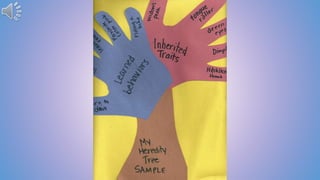
What is the difference 
between inherited traits 
and learned behavior? 
Tammy Herrin 
Cathy Hudson 
Claudia Sanchez
NSES 
Life Science 
• The characteristics of organisms: 
• 4CLS2.2 Plants and animals closely resemble their parents. 
• 4CLS2.3 Many characteristics of an organism are inherited from the parents of 
the organism, but other characteristics result from an individual’s interactions 
with the environment. Inherited characteristics include the color of flowers 
and the number of limbs of an animal. Other features, such as the ability to 
ride a bicycle, are learned through interactions with the environment and 
cannot be passed on to the next generation.
TEKS 
Science: 
(10) Organisms and environments. The student knows that organisms undergo similar life processes and have structures that 
help them survive within their environments. The student is expected to: 
(b) explore that some characteristics of organisms are inherited such as the number of limbs on an animal or flower 
color and recognize that some behaviors are learned in response to living in a certain environment such as animals using tools to 
get food; and 
(2) Scientific investigation and reasoning. The student uses scientific inquiry methods during laboratory and outdoor 
investigations. The student is expected to: 
(a) Plan and implement descriptive investigations, including asking and answering questions, making inferences, and 
selecting and using equipment or technology needed, to solve a specific problem in the natural world; 
Technology: 
(1) Creativity and innovation. The student uses creative thinking and innovative processes to construct knowledge and develop 
digital products. The student is expected to: 
(c) use virtual environments to explore systems and issues. 
Math: 
(1) Mathematical process standards. The student uses mathematical processes to acquire and demonstrate mathematical 
understanding. The student is expected to: 
(c) select tools, including real objects, manipulatives, paper and pencil, and technology as appropriate, and techniques, 
including mental math, estimation, and number sense as appropriate, to solve problems
OBJECTIVES 
1.The students will be able to differentiate between inherited 
traits and learned traits. 
2.Students will be able to make inferences about the relation 
between inherited traits and learned behaviors. 
3.Students will compare and contrast inherited traits and 
learned behaviors in their country to other countries. 
4.Students will determine what objects to use when 
measuring their pointer finger and their height.
MATERIALS 
• pictures of examples 
• online video 
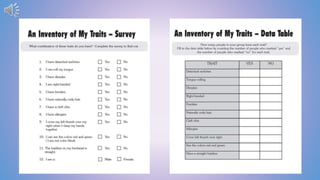
• inherited traits survey 
• data table worksheet 
• pencils 
• construction paper 
• glue 
• scissors 
• mirrors 
• trait/behavior cards 
• tape 
• ruler 
• yardstick 
• science journal worksheets
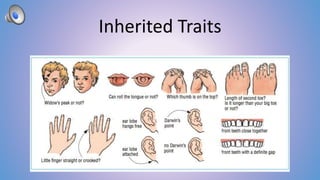
Inherited Traits
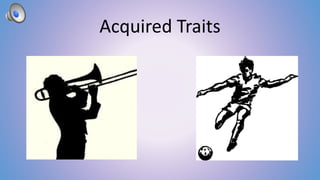
Acquired Traits
ENGAGE 
1. “Do you and your parents have the same hair/eye 
color?”(Knowledge) 
2. “Describe the differences between you and your siblings.” 
(Comprehension) 
3. “ Name some of the things you have in common with your 
friends” (Knowledge) 
4. “Why do you think you look like your parents?” (Analysis)
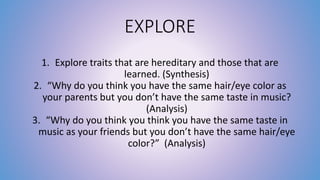
EXPLORE 
1. Explore traits that are hereditary and those that are 
learned. (Synthesis) 
2. “Why do you think you have the same hair/eye color as 
your parents but you don’t have the same taste in music? 
(Analysis) 
3. “Why do you think you think you have the same taste in 
music as your friends but you don’t have the same hair/eye 
color?” (Analysis)
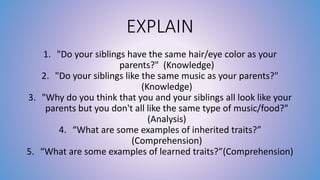
EXPLAIN 
1. "Do your siblings have the same hair/eye color as your 
parents?" (Knowledge) 
2. "Do your siblings like the same music as your parents?" 
(Knowledge) 
3. "Why do you think that you and your siblings all look like your 
parents but you don't all like the same type of music/food?" 
(Analysis) 
4. “What are some examples of inherited traits?” 
(Comprehension) 
5. “What are some examples of learned traits?”(Comprehension)
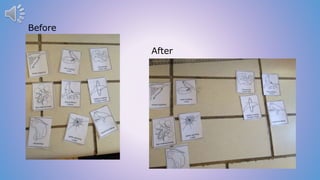
Before 
After
ELABORATE 
1. “How would you explain why you have blue eyes if both your 
parents have brown?” (Applications) 
2. “Where do you think your parents got their hair color from?” 
(Synthesis)
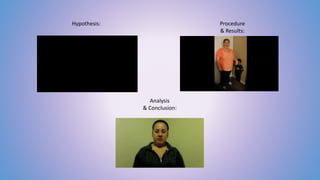
Hypothesis: 
Analysis 
& Conclusion: 
Procedure 
& Results:
EVALUATE 
1. “What evidence do you have to support why you have blue 
eyes/tall/short/curly hair/straight hair?” (Applications) 
2. “How would you explain the difference in an inherited trait 
and a learned trait?” (Applications)
Inherited Traits

Inherited Traits

  • 1.
    What is thedifference between inherited traits and learned behavior? Tammy Herrin Cathy Hudson Claudia Sanchez
  • 2.
    NSES Life Science • The characteristics of organisms: • 4CLS2.2 Plants and animals closely resemble their parents. • 4CLS2.3 Many characteristics of an organism are inherited from the parents of the organism, but other characteristics result from an individual’s interactions with the environment. Inherited characteristics include the color of flowers and the number of limbs of an animal. Other features, such as the ability to ride a bicycle, are learned through interactions with the environment and cannot be passed on to the next generation.
  • 3.
    TEKS Science: (10)Organisms and environments. The student knows that organisms undergo similar life processes and have structures that help them survive within their environments. The student is expected to: (b) explore that some characteristics of organisms are inherited such as the number of limbs on an animal or flower color and recognize that some behaviors are learned in response to living in a certain environment such as animals using tools to get food; and (2) Scientific investigation and reasoning. The student uses scientific inquiry methods during laboratory and outdoor investigations. The student is expected to: (a) Plan and implement descriptive investigations, including asking and answering questions, making inferences, and selecting and using equipment or technology needed, to solve a specific problem in the natural world; Technology: (1) Creativity and innovation. The student uses creative thinking and innovative processes to construct knowledge and develop digital products. The student is expected to: (c) use virtual environments to explore systems and issues. Math: (1) Mathematical process standards. The student uses mathematical processes to acquire and demonstrate mathematical understanding. The student is expected to: (c) select tools, including real objects, manipulatives, paper and pencil, and technology as appropriate, and techniques, including mental math, estimation, and number sense as appropriate, to solve problems
  • 4.
    OBJECTIVES 1.The studentswill be able to differentiate between inherited traits and learned traits. 2.Students will be able to make inferences about the relation between inherited traits and learned behaviors. 3.Students will compare and contrast inherited traits and learned behaviors in their country to other countries. 4.Students will determine what objects to use when measuring their pointer finger and their height.
  • 5.
    MATERIALS • picturesof examples • online video • inherited traits survey • data table worksheet • pencils • construction paper • glue • scissors • mirrors • trait/behavior cards • tape • ruler • yardstick • science journal worksheets
  • 6.
  • 7.
  • 8.
    ENGAGE 1. “Doyou and your parents have the same hair/eye color?”(Knowledge) 2. “Describe the differences between you and your siblings.” (Comprehension) 3. “ Name some of the things you have in common with your friends” (Knowledge) 4. “Why do you think you look like your parents?” (Analysis)
  • 10.
    EXPLORE 1. Exploretraits that are hereditary and those that are learned. (Synthesis) 2. “Why do you think you have the same hair/eye color as your parents but you don’t have the same taste in music? (Analysis) 3. “Why do you think you think you have the same taste in music as your friends but you don’t have the same hair/eye color?” (Analysis)
  • 12.
    EXPLAIN 1. "Doyour siblings have the same hair/eye color as your parents?" (Knowledge) 2. "Do your siblings like the same music as your parents?" (Knowledge) 3. "Why do you think that you and your siblings all look like your parents but you don't all like the same type of music/food?" (Analysis) 4. “What are some examples of inherited traits?” (Comprehension) 5. “What are some examples of learned traits?”(Comprehension)
  • 13.
  • 14.
    ELABORATE 1. “Howwould you explain why you have blue eyes if both your parents have brown?” (Applications) 2. “Where do you think your parents got their hair color from?” (Synthesis)
  • 15.
    Hypothesis: Analysis &Conclusion: Procedure & Results:
  • 16.
    EVALUATE 1. “Whatevidence do you have to support why you have blue eyes/tall/short/curly hair/straight hair?” (Applications) 2. “How would you explain the difference in an inherited trait and a learned trait?” (Applications)